In Reality Bites, Winona Ryder and Ben Stiller are on their first date and she tells him that hte Big Gulp is “the most profound, important invention of my lifetime.” They hook up after that and the plot follows its trajectory of a twentysomething coming-of-age romantic comedy, but the line stands out as one of the many witty pop culture observations that are simultaneously the film’s greatest strength and biggest weakness. Okay, maybe I’m just using the word weakness just so show contrast, but I will say that there are moments in the movie where the catchphrases and allusions work and other timeswhere they wind up feeling ham-handed and forced. The Big Gulp line could have been the latter if in the hands of someone other than Winona Ryder, but she’s being silly and flirting in that moment, which makes Ben Stiller melt (and I admit, me too). Besides, we all know that there is no way, with all of the technological innovation we have achieved since the end of the Second World War, that the Big Gulp of all things could possibly be that important.
Or could it?
7-Eleven has kind of always innovated when it comes to the convenience store, and especially when it comes to drinks. For instance, they invented the coffee to go cup in 1964 (although the iconic Greek Diner coffee cup debuted around the same time, so I guess you can make a case for either being first). What became the Big Gulp debuted in 1976, as according to Smithsonian magazine, 7-Eleven came out with a 32-ounce drink that was circular on the bottom and had a square top “like a milk carton” (the magazine’s authors and editors could not find an image of it and sadly neither could I). The cup was created at the requrest of Coca-Cola, who was looking for a way to shift more product, since back in the 1970s, they were still selling their drink in glass bottles that went for 50 cents and included a “deposit,” meaning you’d get money back upon returning the bottle. 7-Eleven sold the 32 ounce up at the price of 39 cents and advertised no deposit, and it was an immediate hit. When the cup’s manufacturer could not continue to produce it for a little while because they were moving their manufacturing to Canada and had to take a hiatus in operation, Dennis Potts–who was in charge o fthe product at 7-Eleven–commissioned a new design and the Big Gulp as we know it came to be.

It seems like product development 101, but the popularity of the Big Gulp did have kind of a snowball effect in the company and later on in convenience stores altogether. It led to bigger sizes–the Super Big Gulp and the Double Gulp–and became so popular that in 1984, 7-Eleven made their sodas self-serve, something we take for granted today but came about to increase speed and efficiency for the customers since prior to that, employees were the ones operating the soda fountains.
That, to me, is kind of weird, because I cannot imagine a 7-Eleven or any convenience store without a self-serve beverage station. There’s one around the corner from my house and without even walking in, I can see the row of coffee urns, Slurpees churning in various colors (i’ve always loved making a Cherry Coke Slurpee), and the soda fountain with its massive cups. And as isolated as my hometown is from the rest of the world (for example, the nearest McDonald’s and Burger King required trips up to the high way, Taco Bell was at least a 15-minute drive, and while Dairy Queen was advertised, the closest one was half an hour away), we had a 7-Eleven. I wish I could tell you that I frequented the place, especially since it wasn’t too far away from the video store and therefore accessible by bike, but I didn’t go in there very often. And my parents never took me there to get a Slurpee, either. I imagine that they preferred to take me to Poppa Mia’s–the Italian Ice stand on the West Sayville/Oakdale border–or that indulging my requrest was just too much of a pain in the ass.
As a result, most of my memories of my local 7-Eleven are hearing about how the cool kids in my high school would hang out in front of the store on a Friday night to try and get someone to buy them beer. That, and I also remember the number of insensitive jokes made about the Indian guys who ran it. Tariq and Amal were incredibly nice to every single customer–and since this was at the tail end of the era when the “old man behind the counter” was still kind of an asshole to kid customers, that was a plus–but The Simpsons had debuted when I was in junior high. You can debate me all you want about whether or not people are “too sensitive” by seeing Apu as problematic, but you’re wrong becasue he is. So many little shits–myself included–made the jokes and did the accent, and to this day I feel like an asshole whenever I think about it.
I guess things changed a little when I finally got a car, because the 7-Eleven was across from the Sunoco station and Big Gulps were cheap, so I had no problem grabbing one and drinking it on a summer night. Yes, you’d think I’d crack open a can of Bud Light or beast or whatever shit beer someone got a hold of, because I was a teenager at that point, but I was a responsible driver and was also never cool enough to drink in high school (or drink and get away with it). The only problem was that the car I drove in my late teens was a 1991 Hyundai Excel, which had features such as … nothing. Okay, it had a tape deck (that ate more than one tape over the years) but no air conditioning, no back speakers, and no cup holder. A can of soda would fit between the seat and the emergency break level, but if I wanted to drink a Big Gulp in the car, I had to hold it while driving.
As cliche as this is going to sound, driving had more of an impact on my life than anything else in my late teens and early twenties. It obviously helped me get to my job and was more convenient than my 10-speed when it came to going out on dates, but there was also an impact on my diet. I grew up in a house without dosa and candy, so having my own car meant that I could consume as much of that crap as I watned. Even though 7-Eleven did eventually distribute a Big Gulp cup shaped for a car cupholder, my lack of one meant that I wound up downing more cans than cups, especially since cans of soda were just about anywhere, and even more iconic than a Big Gulp cup. After all, Cindy Crawford didn’t saunter up to the self-serve station at 7-Eleven.
By the time I was a kid, the pop top can had already become the industry standard, but I’m actually only a bit younger than its debut. Ermal (Ernie) Fraze patened what we know as the “pop top” in 1976 with an improvement made in April 1977, literally two months before I was born. The idea of opening a can of beer or soda had been around for a while, but the “zip top” cans were reportedly the cause of increasing problems–the removable tabs were the source of litter and injury as people stepped on them and even accidentally ingested them. What Fraze did was create the mechanism we know now, which is the “level” of the tab that you push into the can and use to open it. AAnd this all came about because back in the late 1950s, he didn’t have a church key to open a beer and had to use the fin of his car.

And of course I know that soda machines predate the pop top can, but I can’t hlep but think about how this moment of necessity had such an impact. I have seen soda machines in the most random places–laundromats, ferry terminals, teachers lounges–and in various forms. Of course, most of them advertise Coke or Pepsi, but who hadn’t come across one for 7-Up, Dr. Pepper or something complete random? My high school had a Canada Dry machine in our cafeteria, which sold non-caffeinated beverages and where I would buy cans fo Country Time Lemonade. No, that was not nutritious and actually didn’t taste too great, but the freedom that came from having a couple of quarters in my pocket and buying a drink wound up being worth it. to this day, seeing a soda machine, especially one with a vintage Pepsi logo, gives me a nostalgic rush and makes me want to buy a drink. And I don’t even like Pepsi. But that can of Schweppes five buttons down? A Cheerwine? A Ramblin’ Root Beer? Take my quarters.
The aluminum can has more or less stayed the same since I was a kid, with the possible exception of the “wide mouth” that was added in the 1990s (I want to say by Budweiser, but don’t quote me on that), and the fridge pack has added a level of convenience we never knew we needed. But if I am going to go back to the start of this post, I am going to say that if there is one invention/innovation that couple possibly be more important than the Big Gulp or anything else I’ve mentioned, it’s the 20 ounce bottle.
Years ago, I wrote a blog post about going to the pizza place and picking up a two-liter bottle of soda to go along with the pie I’d ordered. But two-liter bottles (or the big three-liter ones that you could buy at the supermarket) were for the family and not the type of thing you’d buy as a single serving. If I were to get a sing-serve container of Coke as a kid, it would be in an aluminum can or a 16-ounce glass bottle that had a styrofoam label and looked like a stubbier version of the two-liter. I don’t think I drank may of those because you couldn’t get them from soda machines. But in 1993, everything changed beacuse that’s when Coca-Cola debuted the 20-ounce bottle. It was shaped to look like the classic glass Coke bottles from several decades prior, a shape that worked very well with the way you’d hold the drink. Plus, it was a great piece of marketing, dovetailing nicely with the “Always Coca-Cola” ad campaign that used the iconic glass bottle inside a red button (a bottle cap if you will) as its logo.
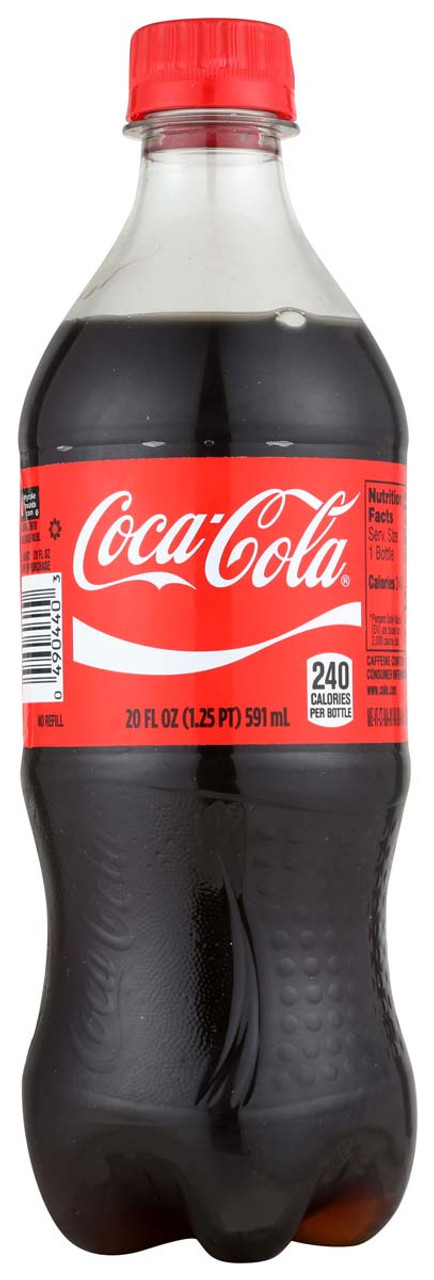
Not only did that campaign help re-cement Coke into its premier status in sode and conclude the company’s recovery from New Coke, I’d venture to say that more than anything, the company changed the way that we drink soda because that 20-ounce bottle literally changed the size of a single serving. Think about it: prior to that bottle, we weren’t drinking that much in a single sitting. Sure, the bottles would tell you that they actually contained more than one serving of cola, but who the hell shares one of those bottles?
I could go on some long-winded rant about how this has led to the obesity epidemic and eventually the downfall of Western civilization, but I don’t have any proof. Besides, while I gained 30 pounds during my freshman year of college, I’m pretty sure it was all the meatball subs and bags of Combos and not just the 20-ounce Cokes. But really, now when I or so many of us are in a store, we are clearly reaching for a 20-ounce plastic bottle, even though it’s more expensive and less environmentally friendly than the aluminum can.
Although I will say that it kind of took a minute for the car cup holder to catch up to Coke’s design. Cup holdres had been around since the 1950s and 1960s in various forms, but what we now see in every vehicle came about with teh rise of the minivan in the 1980s and the SUV in the 1990s and according to Wikipedia, really took hold after the famous McDonald’s hot coffee lawsuit. My 1998 Honda Civic had one, although that car’s cup holder had two major design flaws: it was placed directly in front of the CD player, and was too shallow for the 20 ounce bottle. So, if I wanted to change CDs, I had to move the drink, and when I put a full bottle in the cup holder, it would go flying out when I turned. Okay, maybe I was taking my turns too hard ro something, but I did lose count of the number of times a 20-ounce bottle fo Coke would go flying onto the floormats or roll under the seat. I wouldn’t get a car with a proper cupholder until 2021. Then again, up until 2021, I was driving my wife’s old 1997 Toyota RAV-4, so maybe I was the one behind the times.
I realize that none of the things I just wrote about are a smart phone, but I also know that not everything that has a major impact on our lives comes with a huge announcement from a man working for a startup. Soemtimes, themost profound, important invention of your lifetime comes from random necessity and takes hold before you even realize it.
 Pop Culture Affidavit