It’s 1968 and the beginning of the Tet Offensive in “The Beginning of the End,” a story by Doug Murray, Wayne Vansant, and Geof Isherwood that sees the 23rd encountering events that have historical significance when it comes to the media’s coverage of the war. That’s in The ‘Nam #24. As always, in addition to the summary and review of the issue I’ll be talking about the story’s historical context as well as taking a look at the letters, ‘Nam Notes, and ads.
Fifteen years ago this summer, moviegoers were treated to one of the best and most consistent moviegoing experiences in history. Walk with me through ten movies from the summer of 1999, from The Phantom Menace and its ultimate disappointment to The Blair Witch Project and its being the scariest surprise of the season!
Had the events of the evening of June 17, 1994 not proceeded the way they did, i am sure that I would have remembered the day anyway. It wouldn’t have had the national significance that it does; still, it’s not every year that the Rangers get a ticker tape parade because they won the Stanley Cup. In fact, that day wound up marking the end of two significant periods of my life hours before O.J. and A.C. managed to take the Los Angeles Police Department and every television station in the country up the 405 for 50 miles and a few hours.
At 8:30 that morning in the Sayville High School gymnasium, I sat down to take my English Regents. This was both the culmination of three years of novels, plays, literary essays, and compositions at the hands of my English teachers as well as the very last Regents I would have to take. That may not seem like much, especially to people who did not grow up and attend public school in New York State, but those who did know exactly what I mean when I say that I considered the end of my Regents-taking career to be a cause for celebration, if however minor.
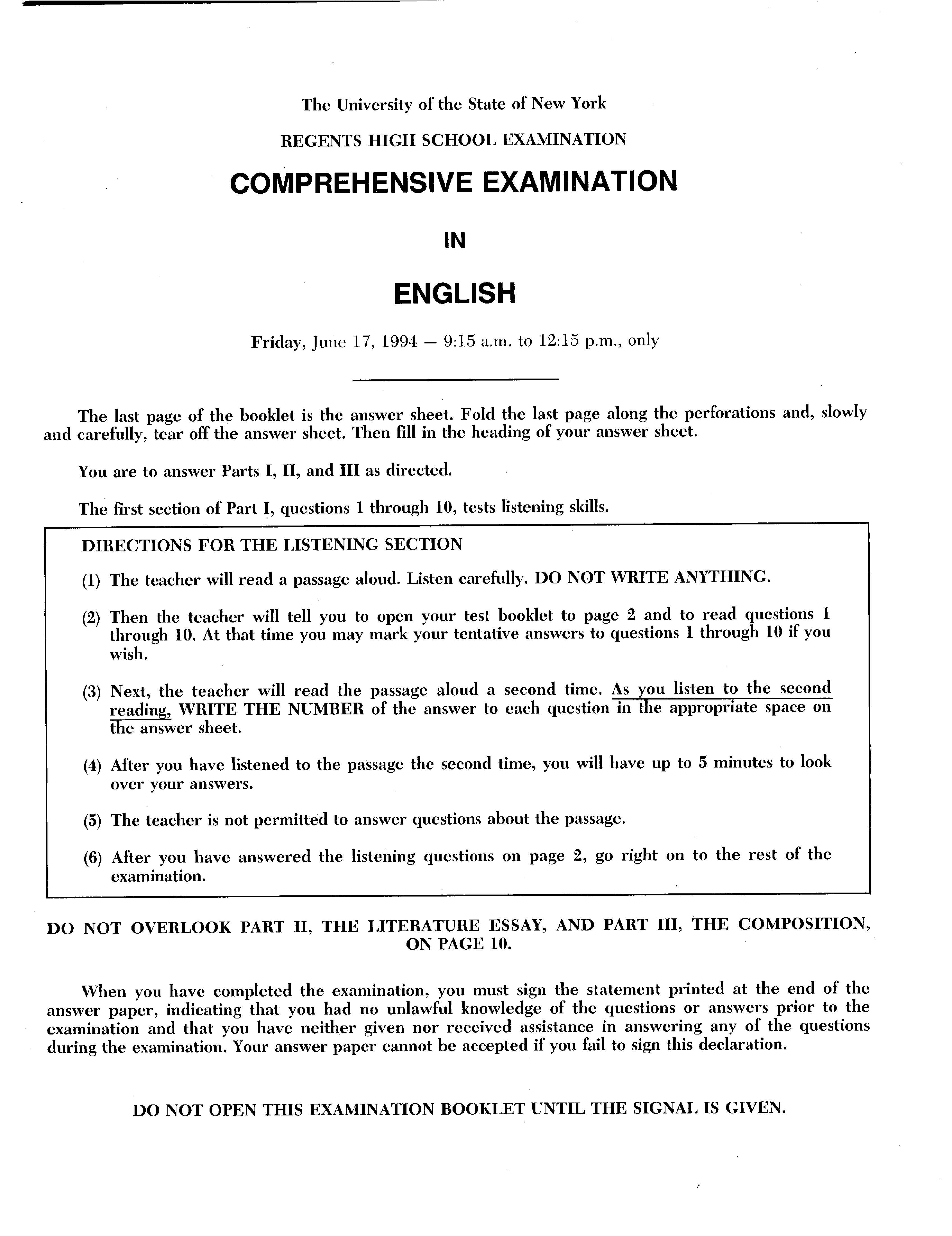
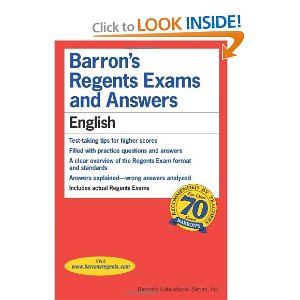
Regents were what kept us in school until late in June (well, that an starting after Labor Day and having a week off in February) and were a ritual for high school students since the New York State Department of Education started them way back in the 1930s (a quick look at the archives, shows tests on homemaking in the 1950s and 1960s). Coming sealed in plastic and bearing titles like “The University of the State of New York Regents High School Examination Comprehensive Examination in English,” the tests were more than a rite of passage–they were one of the most important rituals of our academic careers. Starting after Easter, our book bags were further weighed down with Red Barron’s books full of old tests, which we’d take and then pore over to see what we were doing right and what needed improvement.
A Barron’s Regents review book, courtesy of Amazon.com
And English wasn’t particularly hard, although I’m sure my students would blanch at the sight of it. Whereas current students in Virginia take SOL exams in reading and writing that are passage-based and have one simple five-paragraph prompt-based persuasive essay, my generation had to endure spelling, definitions, two essays (a literary analysis piece and a composition), and a listening section. That’s right–a portion of our test required us to sit and listen while our teachers read a passage and we had to answer multiple-choice questions based on what we heard. I’m sure that such a concept would send today’s average anti-testing advocate/expert into a blood-vomiting rage. Personally, I never thought twice about it, but then again I was one of those students they’d accuse of having Stockholm Syndrome or something because I dutifully took my Regents exams and did well in school.
Anyway, I remember chugging through the multiple choice, choosing one of the two literary essay prompts (which have both made their way onto my 10th grade advanced English final in recent years) and writing a composition that I think I titled “Notes From a Rest Stop on the Information Highway.” It was my attempt at wit, I guess, and it seemed to work because I did well enough to continue on my path to graduating with honors a year later.
A page from the spelling section of the 1994 Regents English exam.
I wasn’t thinking of any of that while taking the test, of course, because the Rangers parade was going to be on television and the Regents exam was the only reason I hadn’t asked my parents if I could take the train to the city that morning (same could be said for my friends as well because we all had to take the Regents). So like everyone else, I watched it on television. To this day, the Rangers hoisting the Cup as they drove through the Canyon of Heroes followed by the presentations at City Hall seem surreal. I wasn’t wearing my jersey–I had finally thrown that in the laundry after superstitiously refusing to wash it throughout the playoffs–but I was glued to my television set the way I was eight years earlier when my dad taped the 1986 Mets parade for me.
The Rangers hoist the cup on Broadway.
Of course, the television would be more important later that night. But I didn’t know that; did anyone?
Stone Temple Pilots were supposed to appear on Letterman. I don’t think that’s why I stayed home, but at some point in the afternoon, I made a mental note to stay up late and turn on The Late Show after I was done with whatever Friday night plans I had made–which, knowing my life in 1994 was probably renting videos and watching them in the basement–so I could see one of my favorite bands. But of course, that didn’t happen. Well, the STP performance actually did because Letterman taped his show in the afternoon, but it never aired.
At some point–I don’t remember when–I turned on the television and saw live footage of a white Ford Bronco speeding down a Los Angeles freeway followed by police. The news reporters said that driving the Bronco was Al Cowlings and his passenger was O.J. Simpson. (more…)
It’s Christmas time in the ‘Nam and we see the boys of the 23rd treated to some genuine USO entertainment, even if it is a “Blue Christmas” for some of them. It’sThe ‘Nam #23, presented to you by Doug Murray, Wayne Vansant, and Frank Springer. As always, in addition to the summary and review of the issue Ill be talking about the storys historical context as well as taking a look at the letters, ‘Nam Notes, and ads.
Twenty years ago, the New York Rangers won their first Stanley Cup since 1940. Join me as I reminisce about that amazing run and talk about my life as a Rangers fan as well as share the memories of some of my friends.
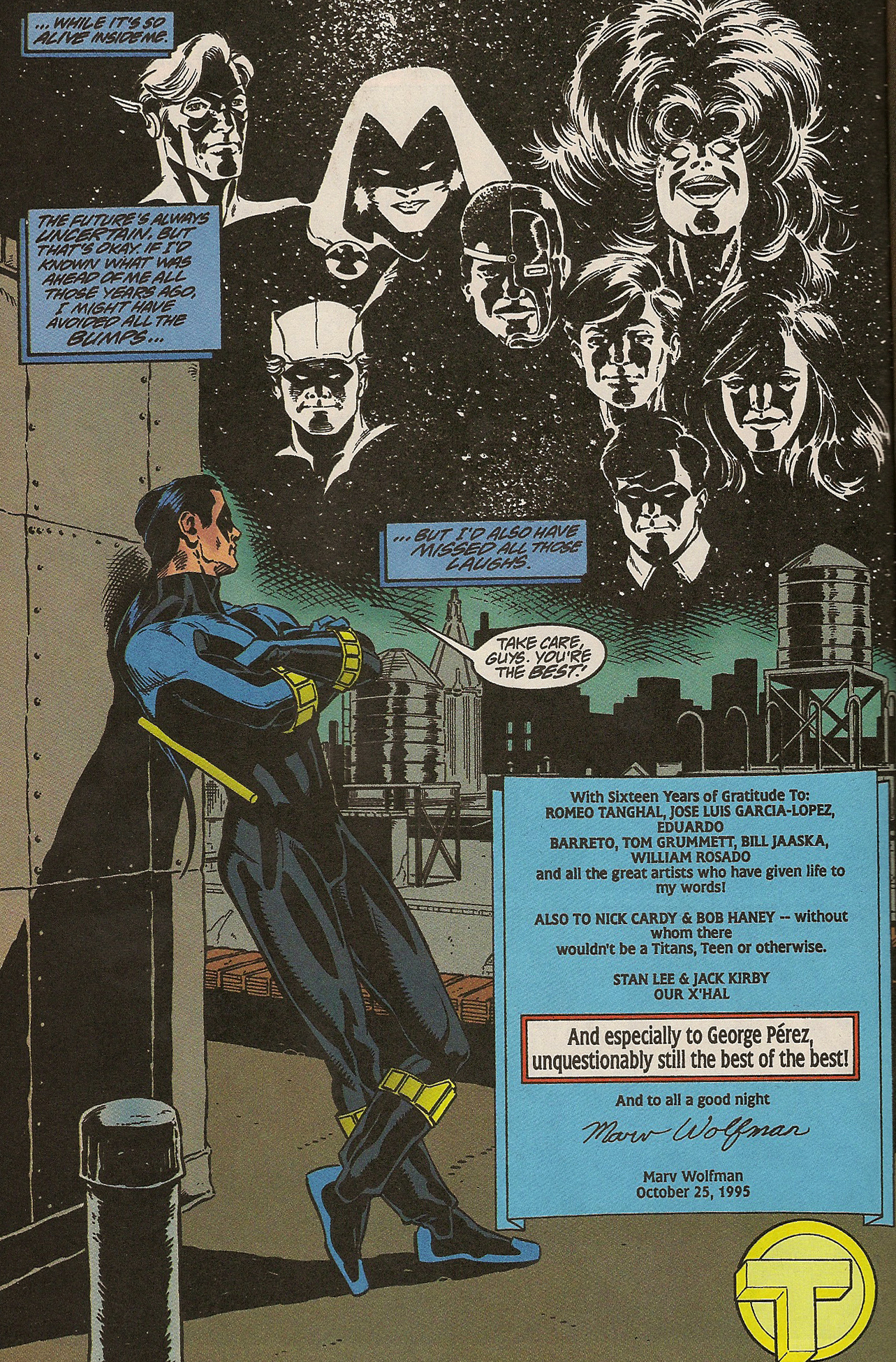
The last page of New Titans #130, which has a cameo by Nightwing.
I stopped reading Titans in 2011. DC announced the New 52 and the new series looked so horrible (as did Red Hood and the Outlaws) that I finally declared that I’d had enough. My life as a Teen Titan, however, really does end with New Titans #130.
I mentioned in the last entry that I saw the Previews solicit for the comic during parents weekend of my freshman year of college and was surprised that the series was coming to an end. I wasn’t upset, though, because comics at the time were taking a back seat to everything else–movies, music, girls, beer–and while I still collected and read them, they became something to read on breaks and during the summer when I was on my own and wasn’t sifting through assigned reading. The Titans during that time took an even further back seat, as I became more interested in other books as well as big events like Kingdom Come.
The Titans themselves would, of course, go on. Arsenal had a special shortly following the end of the title, an international espionage story that did wrap up one loose end from the series–we find out that the Titans had disbanded at some point following the events of “Meltdown”–and even got a lettercolumn about New Titans #130. About a year later, Dan Jurgens would write and pencil Teen Titans, a series that is a bit of an oddity but that I enjoyed and find to be underrated. Then again, I haven’t read it in at least 10-15 years, so I’ll have to see if my opinion changes when I get around to it. The Devin Grayson/Jay Faeber Titans series deserves much of the criticism it gets, and I have mixed feelings about the series that started in 2003, especially Geoff Johns’s run. I intend to reread all of those comics all the way through, although I won’t be writing about them because they all feel like they are part of different times in my fandom and comic collecting life.
I started reading New Titans when I was thirteen and the final issue came out when I was eighteen. By then, the comic store was no longer around the block and I was no longer a lonely, worried junior high school student. Moreover, I had moved beyond the point where I was reading about the Titans because I was looking for characters with whom I could identify. The 1980s books had been like watching a John Hughes movie or hanging out with my older cousins–these were people I might wind up being–and the 1990s comics had characters I wanted to get to know. By the time that title left the world behind, I had stopped needing to have a personal investment in the people I was reading about.
And really, the timing of the end of the series was perfect because the subsequent relaunches did feel like going back to my old town or old high school and seeing that things weren’t ever going to be the same: the Dan Jurgens title was the new class you didn’t know very well, The Titans was Wooderson period, and the 2003 Teen Titans was almost like coming back to teach (your dreams were your ticket out).
Closing out what wound up being an enormous blogging endeavour isn’t easy to do. After all, this spawned a podcast that is still going and some of the posts I wrote have gotten quite a number of hits these last few years. But I found a source of inspiration in the last pages of that very last issue. Though he hasn’t been in the book since issue #0 (and even that was a cameo), “Where Nightmares End” concludes with the person with whom it started–Dick Grayson. Standing on a rooftop, he thinks:
There have been so many moments to think about. Moments good and bad. Moments I’d love to live all over again … and others I’d pay anything to forget. But I don’t think if I could I’d change any of them. I move on, but I don’t leave my childhood behind as if it’s gone. It can never be gone … while it’s so alive inside me.
The future’s always uncertain, but that’s okay. If I’d know what was ahead of me all those years ago, I might have avoided all the bumps … but I’d also have missed all those laughs.
He then says,
Take care, guys. You’re the best!
Marv Wolfman then gives a farewell to the audience and thanks everyone he’s worked with in the fifteen or sixteen years he’s been on the title and I’m glad that on some level, that he ended the series on his terms. I’m also glad that even though it took a while, I had a chance to look back on comics that have been so important to my life as a comic collector.
It’s Thanksgiving and that means … well, humpin’ in in the boonies, unfortunately. But the focus on this issue is not necessary the misery of our boys in the 23rd; rather it’s a look at the VC. The ‘Nam issue #22, “Thanks for Thanksgiving,” is brought to you by Doug Murray, Wayne Vansant, and Geof Isherwood. As always, in addition to the summary and review of the issue I’ll be talking about the story’s historical context as well as taking a look at the letters, ‘Nam Notes, and ads.
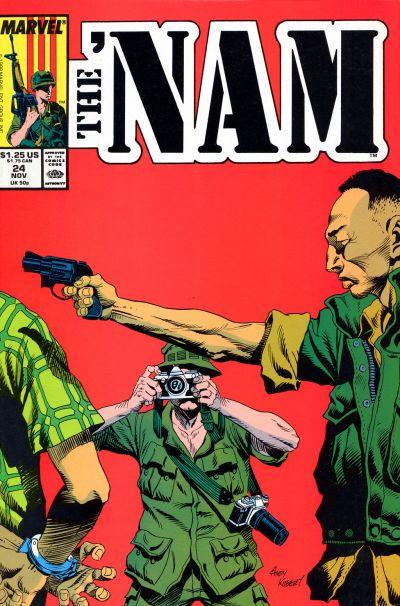 It’s 1968 and the beginning of the Tet Offensive in “The Beginning of the End,” a story by Doug Murray, Wayne Vansant, and Geof Isherwood that sees the 23rd encountering events that have historical significance when it comes to the media’s coverage of the war. That’s in The ‘Nam #24. As always, in addition to the summary and review of the issue I’ll be talking about the story’s historical context as well as taking a look at the letters, ‘Nam Notes, and ads.


 It’s Christmas time in the ‘Nam and we see the boys of the 23rd treated to some genuine USO entertainment, even if it is a “Blue Christmas” for some of them. It’sThe ‘Nam #23, presented to you by Doug Murray, Wayne Vansant, and Frank Springer. As always, in addition to the summary and review of the issue Ill be talking about the storys historical context as well as taking a look at the letters, ‘Nam Notes, and ads.

 Pop Culture Affidavit