I have had so many discussions with Stella about the literature we read in our formative yearrs. While I realize that pointing out the difference in ages (she’s nine years younger than I am) is a running joke, it applies here because what was “Young Adult” literature was different for eachof us. I am sure that there was some overlap of titles we’d find on the Scholastic Book Club flyer, but I also can say that YA lit was at the beginning of its boom years when she was in middle and high school and barely existed when I was a tween (in fact, the word “tween” didn’t exist when I was a tween).
I realize that’s a bit of an exaggeration. There certainly were books aimed at a middle or junior high school audience, but the great ones were few and far between and I found my refuge in Star Trek, Star Wars, and Robotech novels as well as more adult works by Stephen King. But I didn’t get there right away because while I am sure that my fandom for a franchise like Star Wars would definitely motivate me to read at least one novel, something before all of that made me want to read.
Looking back, I always had books in my home. My parents had a good stack of novels and when I was little, I owned a ton of Golden Books and Curious George books. I can’t remember when I graduated from those to works that were more complicated, but I want to say that it probably started sometime in the first grade. I have done an entry about the McGraw-Hill readers and also have a memory of grabbing these Reader’s Digest collections in the back of Mrs. Hickman’s room and reading through them one by one. I cannot tell you what any of them were about, of course, but I did understand them, and by the time I was in the second grade, I (and a number of my friends) had children’s novels and textbooks to read or read to us.
But that, of course, is probably the case for so many of us, and there has to be some specific books that I can set apart from the rest as truly formative. And of course, I have a list.
Nonfiction/Reference
When it comes to learning, I’ve always been very curious. I was the kid who loved to look through the World Book Encyclopedia in the library and would often flip through the back sections of my parents’ copy of Funk & Wagnalls’ Standard Encyclopedic Dictionary because it had facts about history, geography, and the world, as well as full-color photographs about the space program (up until about 1971 or so, which is when it was published). But when it comes to nonfiction and learning, I can point to three specific things.
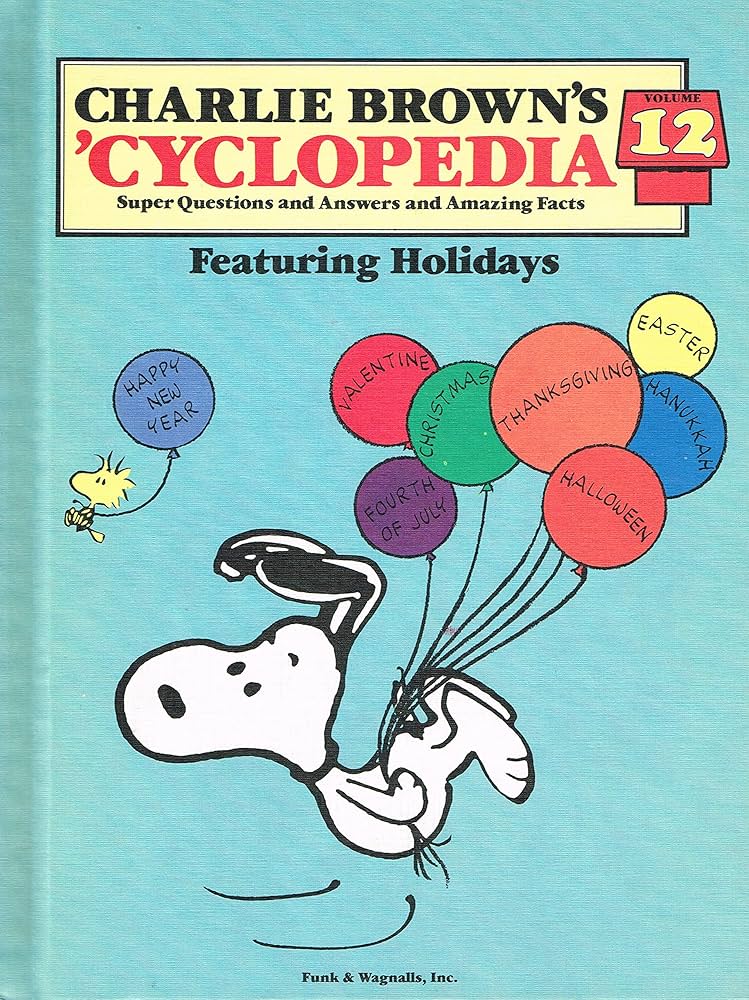
Charlie Brown’s ‘Cyclopedia. This was a set of books that to this day is probably the most fun encyclopdia I ever owned. How could it not be? It was facts and information with a bunch of Peanuts cartoons, and instead of simply being alphabetical entries, the books were grouped by topic–animals, your body, electricity and magnetism–and were 15 volumes in total. I cannot remember who gave them to me, or if I got them all at once. But I read book 12 the most, which was about holidays. I pored over this and it’s how I learned the etymology of Halloween and Christmas as well as the esxistence of Boxing Day (via a reworked cartoon where Charlie Brown was telling Snoopy that a box he was tearing into said “Do not open until December 26th” and Snoopy was thinking, “Dogs can’t read! Hee hee hee!”). I learned what cells were from reading these. And since they were on my bookshelf at home sitting next to my Star Wars and Empire Strikes Back storybooks, I would grab these whenever I was bored and would simply flip through them. And I’m such a trivia nerd these days that this set of books probably has something to do with it.
Creative Paperbacks Baseball Books. I don’t exactly know what hte name of the line of these books was and forty years later, I am amazed that I could confirm they existed at all. It took a lot of Googling to finally find an eBay listing, and that’s where I got this from.
I started following baseball during the 1985 season. This included watching as many games as I could, collecting baseball cards, and also picking up one of those Panini sticker books and spending change on the stickers to collect all the players on all the teams. 1985 was also around the same time that I was allowed to ride to the library on my bike by myself. It was about a block away and a block over from my parents’ house, tucked into the corner of a neighborhood. And man, I could go on and on about how much I loved that mid-century modern building and the amount of time I spent there from elementary school to high school. But this is about the books and these books about all of the baseball teams in the country were some of the first things I looked for whenever I was in the non-fiction stacks of the kids’ section. And how could I not want to read them? The covers looked like the 1982 Topps baseball card set (and were published around 1982).
From what I remember, they weren’t anything remarkable as far as books are concerned. Each book told the story of the team it covered and was written on a fourth-grade level, but you also have to rememeber that this was an age without instant access to highlight sor information. If you wanted to know how a team was doing, you had maybe three or four sources: the local news/newspaper, Sports Illustrated, and This Week in Baseball. But if you wanted to know, say, the history of the Montreal Expos? Well, that’s why you had books like this. And they were amazing because in the 1980s, baseball was amazing (then again, I was seven and the baseball you follow at that age is always going to be the most amazing baseball). I have distinct memories of checking all of them out and at least waiting like crazy for the Mets book to make its way back to the shelf. I even read five in one day. Of course, that’s because I was grounded.
No, really. I had been caught lying about doing my homework and forged my mother’s signature on my weekly class progress report. My parents went ballistic and grounded me for two weeks (they think this is an amusing story these days; for me, the jury’s out on it). But I had gotten caught at the very end of October of 1986 (in fact, the Mets had just won the World Series) and that meant that I was going to be grounded for trick or treating. So, as a compromise, they let me choose to do something in lieu of being punished for trick or treating and I said I would spend an entire day in my room. So I went to the library and checked out a pile of the books. Spending all of your time in your room when you like to do stuff like read or draw or write isn’t the worst, to be honest.

Draw 50 __ by Lee J. Ames. While not reference or full-length non-fiction books, the drawing instruction books by Lee J. Ames are important to me because my classmates at Lincoln Avenue Elementary School were always competing for them whenever they got put on the library displays. Lee J. Ames was a prolific illustrator and cartoonist, who worked for disney and a number of other places but was most known for these “Draw 50” books that covered everything from buildings to airplanes to movie characters. In fact, the one that we all tried to check out every time we had library day was Draw 50 Monsters, Creeps, Superheroes, Demons, Dragons, nerds, Dirts, Ghouls, Giants, Vampires, Zombies, and Other Curiosa. That’s a mouthful, and the book was popular because you could daw both Yoda and Darth Vader.
You’re probably familiar with the book’s methodology. You start by drawing basic shapes, add more, and eventually put in details to finish a pretty nice-looking represntation of wshat was on the page. Of course, I never was that great and I am sure a lot of people weren’t, which is probably why Frank Cho used it as inspiration for one of my faovrite Liberty Meadows strips:

Decades after my Lincoln Avenue days, I took Brett to the public library and found a copy of the book. It was an updated edition, but it still had Vader and Yoda. So feast your eyes on my adult attempt at the Dark Lord of the Sith.

Now you know why I decided to write.
Poetry

A Light in the Attic and Where the Sidewalk Ends. I realize it’s very English Teacher of me to talk about how poetry was a formative thing in my life, but Shel Silverstein left an imprint on my generation that I think we all can still feel. So many of my peers had one or both of these books and for so many of us, it was where we first read poetry that went beyond nursery rhymes or Dr. Seuss. Silverstein’s poetry is silly but not juvenile and can be deep. I use both “Homework Machine” and “Where the Sidewalk Ends” in my freshman English class (the phrase “to cool in the peppermint wind” is so gorgeous). And the students i have who are familiar with his work are those who are great writers and really build an appreciation of poetry. I got A Light in the Attic from my friend after I had surgery; I swiped my sister’s copy of Where the Sidewalk Ends (she got it for a good report card), and every year that I use the poems, I bring in the books and wind up flipping through them. They are still wonderful.
Fiction
As much as I liked to learn, stories were always important. I definitely hit the Hardy Boys shelves at the library, and those blue-spined books were a mainstay in my elementary school reading, even if they were usually about smugglers.
But there are other books or book series that I feel had more of a connection to.

The Great Brain. While it didn’t really do it for me, I seem to remember that this was one of the earliest books series I ever knew about. I supposed that anyone raised on Anne of Green Gables and Little House on the Prairie might have avoided Johhn D. Fitzgerald’s The Great Brain books. They are storeis bsaed on his childhood, and care abotu t a kid nmaed J.D. Fitzgerald (yes, the author) and his brother Tom, and whatever happens to them druing the end of the later part of the 19h/early 20th Centuries. And they took place in Utah, which makes them kind of a Mormon Tom and Huck.
Okay, not really. The characers were Catholic, ubu there is a depiction of erligion of hte novel along with a number of aspects of 19th Century life. My fifth grade teacher, Mr. Schaeffer, was the person who introduced me to them as part of my independing reading an dI remember reeading more than a few of the ones he offered up. But if I’m being honest, I didn’t remember them an dI had to Google around to remember the titles. Sho why is thisso formative? Well, it wound up being a kind of genre chooser for me. I just was not a fan–and stil am not a fan–of frontier or western stories. Yeah, kids living in Olden Times? Hard pass.
Fifth Grade Magic. Written by Beatrice Gormley, this is a book taht our teacher was reading to us in the fourth grade when I came down with the chicken pox, so I missed the ending. When I got the chance, I checked it out of the library and finished it on my own.
It was, if you wanted to be gendered about things, a “girl” book. And really, so many of the interesting books were “girl” books back then. Maybe it’s because “boy” books were about adventure and mysteries an ddidn’t have the drama or emotion of the “girl” books. Not to say that Fifth Grade Magic was a heavy novel or anything. I mean, it’s about a girl who wants a part in a play and finds a fairy godmother to grant wishes. If I receall correctly, the results were all sorts of wacky hijinks and they affect everyone around her but it takes a while for her to get what she wanted. Or it might be one of those “you did this on your own without magic” types of stories. It’s been forty years since I read it, so don’t go by me. Plus, it makes me think of Teen Witch and you can’t really top that.

Tales of a Fourth Grade Nothing. If you listened to Stella and I talk about Are You There God, It’s Me Margeret, you heard me talk about how prior to that book, I’d only ever read two Judy Blume novels: Tales of a Fourth Grade Nothing and Superfudge. The latter didn’t leave much of an impression on me. This book, though, is one I read at least two or three times when I was in elementary school, first encountering it in the second or third grade when our teacher read it to us and then checking it out for myself a while later. These days, it would be like all of the kids I know who have read the Diary of a Wimpy Kid series. The book had a character that I could, at least on some level, identify with. Like I said about Fifth Grade Magic, there were a lot of books that were “boy books” that were more focused on action/adventure than friendship and emotion (and I wouldn’t read The Outsiders until I was in junior high). Peter’s travails dealing with being unrecognized in fourth grade and having to deal with his younger brother, Fudge, were very real. The setting of New York City was very cool and almost exotic because I was growing up in its shadow, had many friends’ parents who “worked in the city”, but it was larger than life. But the kid and what he went through didn’t seem impossible and had actual depth.
I’d discover, as I went on, that was important to me, and I didn’t get a lot of novels showing me that. If anything, I didn’t get real emotional depth in a boy-centered story until Stand By Me, which I watched when I was around the age of the characters in the movie. And that’s the coming-of-age gold standard story for boys, no matter what the generation, because it’s not afraid to shy away from deep emotions (something that many boys are raised to suppress). I haven’t read a lot of books that come close to it over the years, though I will shout out Michael Thomas Perone and his novels, which I talked about with him several podcast episodes back. And I have to wonder if we had more books like that, there wouldn’t be so many douchebag guys in my generation.

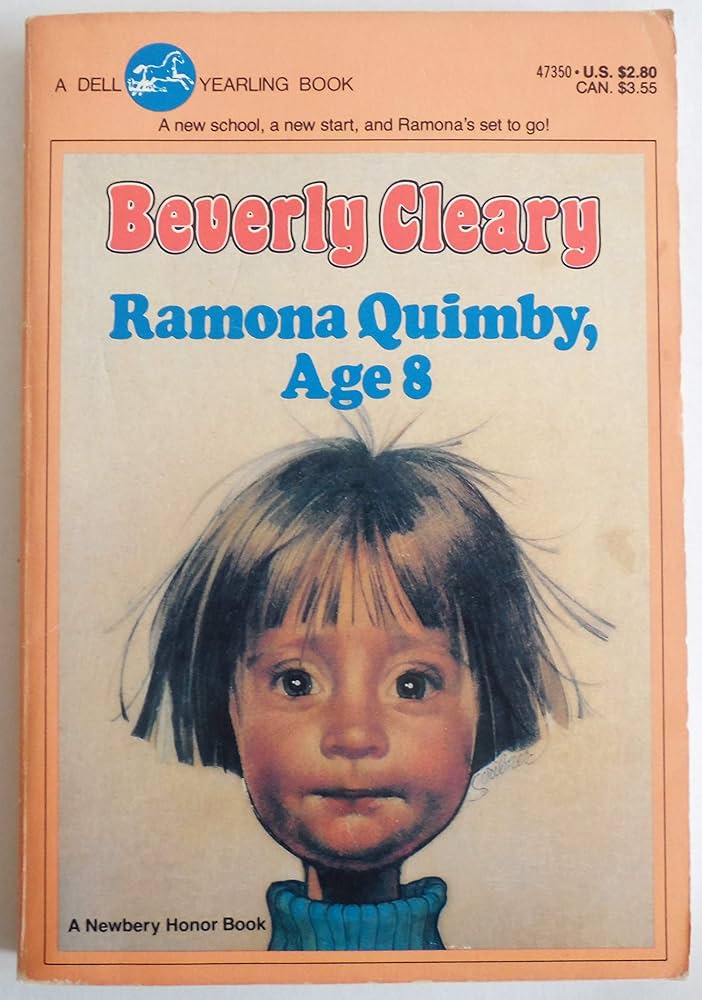
The novels of Beverly Cleary. In second grade, my teacher read the book Henry Huggins to the class. It was the first of many beverly cleary books I would read in my elementary school years, which also included Otis Spofford, Ralph S. Mouse, and the Ramona books. I don’t know why I liked the character of Ramona Quimby so much. I was not an eight-year-old girl. But like I said, when everything I read starring boys was more or less about adventure, I had to get the slice of life stories I wanted starring girls. Cleary wrote novels that explored family dynamics and wrote so many for so long that she adjusted for the times and therefore made her books timeless (Judy Blume has done the same). Ramona and Her Father and Ramona and Her Mother were both written in the Seventies with Ramona Quimby Age 8 and Ramona Forever coming out during the early 1980s. They always felt like the world i was living in (as opposed to the 1950s of some other novels I’d read), and even though they took place in Oregon, the places and situations stil felt familiar.
More importantly, Cleary’s books interconnected and were a shared universe, which was something I realized early on even if i didn’t have any idea or concept of a shared universe. The kids all knew one another and in some cases were friends and would appear in each others’ stories. It was fascinating to me when I was young and it really made her one of the most influential authors of my childhood.
With the exception of the Shel Silverstein books, I haven’t revisited any of these since elementary school. But the chance to pick these books up from a library or through the Scholastic Book Club orders is something I’ll always be grateful for.
 Pop Culture Affidavit
Homer with his “Go School” DIY flag always makes me laugh :)Shel Silverstein and Dr. Seuss were formative to me, too – especially for my appreciation of poetry. Encyclopedias were EVERYTHING! A love lost to the future generations/our kids generations.Nancy Drew was a favorite. I even tried to write my own mystery novel with a Nancy knock off, when I was around 10 years old.I love this post!