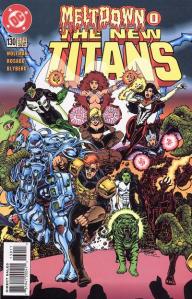
 For all of my devotion to The New Titans, it’s ironic that I almost missed the ending. Okay, I wouldn’t have actually missed it because I had the book on my pull list, but the final issue came out during my freshman year of college, a time when I was incredibly disengaged as a comics fan. In fact, I remember the day I discovered that the book had been canceled: it was parents weekend and I was flipping through Previews while waiting for my mom and dad to show up. The solicit for The New Titans #130 read FINAL ISSUE and featured a cover by George Perez that showed the current version of the team in the same exact pose as the original team did in the very first issue of The New Teen Titans back in 1980. After sixteen years, Marv Wolfman’s nearly uninterrupted run on the title was about to come to a close.
The story behind this as told in The Titans Companion is basically that Wolfman had been fed up with editor Pat Garrahy’s mandates and manipulations for quite some time, and at a DC Christmas Party, asked to be taken off the book. Being that the book was on the chopping block anyway, DC told Wolfman he could “have the book back” and he was given a few months to wrap things up. He then set out to write a story that put every one of the original Titans who were still around back to some approximation of who they were. The only restriction was that Wolfman could not use Nightwing, who was then well on his way to being entrenched in the Batman family.
What we got was “Meltdown,” a five-part story that is actually a four-parter with a first chapter that doesn’t really seem to make too much sense. Then again, that issue is done as a fill-in by Dale Hrebik (whose only other credits are Deathstroke #50 and Annual #4) with art by Rik Mays with the other issues pencilled by then-regular artist William Rosado. As far as storylines from this era go, it’s one of the stronger ones, although I suppose that’s not saying much.
Basically what happens is that while a fair amount of infighting happens among the team members, the Titans are summoned to Tamaran by Starfire and Cyberion–formerly Cyborg–because Raven has returned and is leading an entire legion of hostile aliens against Kory’s home planet. After being attacked by a now-conscious Changeling, the group subdues their former teammate and Kory reveals that she has Raven’s soul self. She is unable to heal Gar, but he is eventually cured when Raven draws all of the Trigon seeds into herself, basically revealing that Trigon himself is trying to use her as a vessel for his resurrection.
Her war reaches a critical point when she destroys Tamaran–and in one last act of bravery, Kory’s parents stay on the planet–and Starfire and Blackfire (two sisters who have had a reconciliation) lead their rebellion of sorts, finding their adversary and destroying Raven’s body as well as the evil contained within. At the end, on a planet that will become known as New Tamaran (that is, until the Sun Eater destroys it in Final Night), Raven is good again and an ethereal/astral form; Gar and Cyberion go off to travel through space; Kory is pregnant with her new husband, Ph’yzzon’s child; and Donna Troy is still a Darkstar (and will remain a Darkstar until John Byrne gets a hold of her). So status quo is sort of reestablished.
Upon my reread, I realized that much like the rest of the post-Zero Hour Titans, this story is a bit of a mess. I am not sure when Wolfman’s meeting took place in the creative process, but the first part feels like the start of an entirely different story than the one we got. That could have been due to a different writer being on that issue, of course, but in New Titans #126, we have an Arsenal character piece that shows how the team has its problems. For instance, at one point, the “kids” on the team play a bit of a “let’s catch you off guard with an ambush” prank and when Donna sees that Rose Wilson was involved, she goes off on them. Rose responds with “You’re not my mother!” It suggests that perhaps they were setting up some teen angst sort of storyline or something that would bond the kids on the team while fracturing the adults.
That never happens. Instead, it provides a springboard for Wolfman, only taking the Titans he wants to take to Tamaran. Mirage and Terra remain on Earth because it’s revealed that Mirage faked her miscarriage and is actually now in labor. Supergirl is elsewhere. Damage gets pissed off and quits, and Impulse literally misses the ride to space. So we get the core group (with a couple of additions, like Green Lantern) and the final forced resolution of the Raven storyline.
Funny enough, I’d actually come to like some of the characters in this run. Roy Harper’s crisis of confidence as a leader made him more interesting than he had been in the past. I cared about Mirage and her very complex problems. Even the mystery of Terra’s true identity was intriguing, as were character changes in people like Kory, who was becoming more of a warrior and less naive. But in hindsight, it was time, and the bloom from the renaissance of five years earlier had faded long before. It’s just sad that such a once-great book went out with a whimper.
Next Up: The end of my life as a Teen Titan.
 1994: The Most Important Year of the Nineties continues with a look at The Crow. Over the course of this episode, I take a look at the comic book by James O’Barr as well as the 1994 film starring Brandon Lee. Does this film hold up after twenty years? Tune in and find out!
 This time around, we have “Do Not Forsake Me” from The ‘Nam #21, a story that develops the potential romance between Clark and his nurse friend, Jane. Unfortunately, things don’t always go the way we hope they will. Brought to you by Doug Murray, Wayne Vansant, and Geof Isherwood. As always, in addition to the summary and review of the issue Ill be talking about the storys historical context as well as taking a look at the letters, ‘Nam Notes, and ads.
 This time around, it’s “Dominoes,” The ‘Nam #20, where we see the boys of the 23rd team up with Thai soldiers and get some resolution in the fragging of Alarnick storyine. Brought to you by Doug Murray, Wayne Vansant, and Geof Isherwood. As always, in addition to the summary and review of the issue Ill be talking about the storys historical context as well as taking a look at the letters, ‘Nam Notes, and ads.
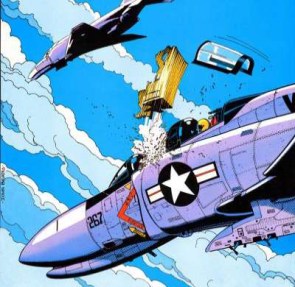 We’re back in The ‘Nam with a look at issue #19, “Milk Run.” This time, the guys of the 23rd help out a Marine who’s been shot down. Brought to you by Doug Murray, Wayne Vansant, and Geof Isherwood. As always, in addition to the summary and review of the issue Ill be talking about the storys historical context as well as taking a look at the letters, ‘Nam Notes, and ads.



 Pop Culture Affidavit