books

The Books That Made Me

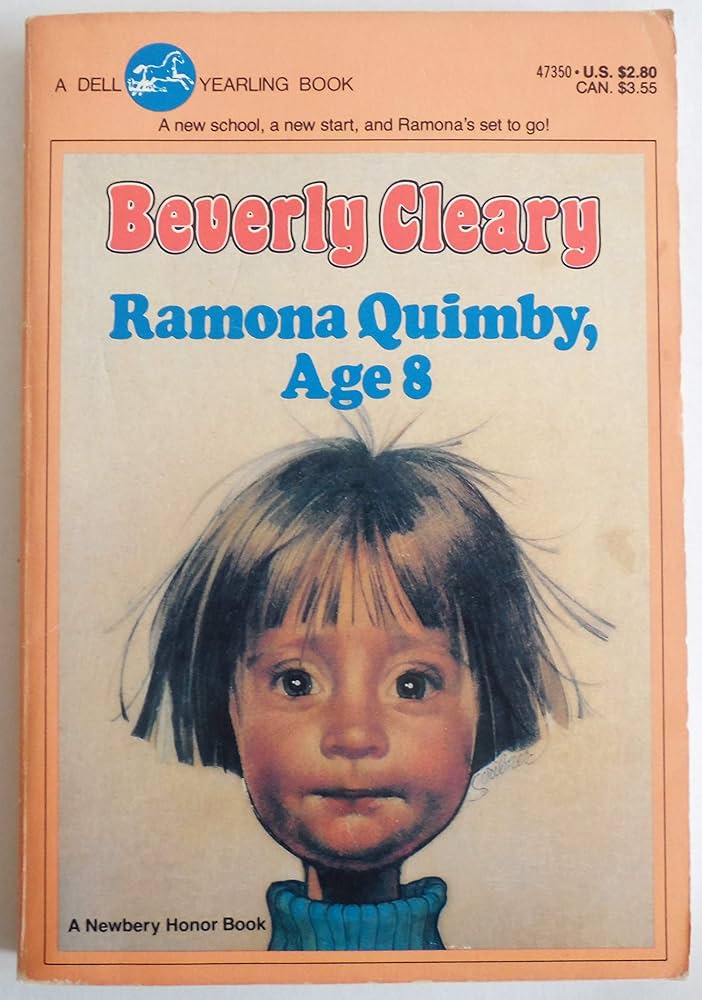
Ramona Quimby, Age 8. The paperback edition from the 1980s. That Dell Books border was a mainstay for kids’ paperbacks. Image from Amazon.

I have had so many discussions with Stella about the literature we read in our formative yearrs. While I realize that pointing out the difference in ages (she’s nine years younger than I am) is a running joke, it applies here because what was “Young Adult” literature was different for eachof us. I am sure that there was some overlap of titles we’d find on the Scholastic Book Club flyer, but I also can say that YA lit was at the beginning of its boom years when she was in middle and high school and barely existed when I was a tween (in fact, the word “tween” didn’t exist when I was a tween).

I realize that’s a bit of an exaggeration. There certainly were books aimed at a middle or junior high school audience, but the great ones were few and far between and I found my refuge in Star Trek, Star Wars, and Robotech novels as well as more adult works by Stephen King. But I didn’t get there right away because while I am sure that my fandom for a franchise like Star Wars would definitely motivate me to read at least one novel, something before all of that made me want to read.

Looking back, I always had books in my home. My parents had a good stack of novels and when I was little, I owned a ton of Golden Books and Curious George books. I can’t remember when I graduated from those to works that were more complicated, but I want to say that it probably started sometime in the first grade. I have done an entry about the McGraw-Hill readers and also have a memory of grabbing these Reader’s Digest collections in the back of Mrs. Hickman’s room and reading through them one by one. I cannot tell you what any of them were about, of course, but I did understand them, and by the time I was in the second grade, I (and a number of my friends) had children’s novels and textbooks to read or read to us.

But that, of course, is probably the case for so many of us, and there has to be some specific books that I can set apart from the rest as truly formative. And of course, I have a list.

(more…)
A Last Point in Elementary School

I wish I could have some profound way of starting this essay or even something or someone to tie it together, but the truth is that last week, I fell down one of hte more random Internet rabbit holes. Although I don’t know if this was a rabbit hole beacuse I was actually finding the answer to something and had some serendipity come along with it. Either way I think I am probably the only person in the world who does a fist pump the moment he discovers his sixth grade reading textbook on the Internet Archive.

The timing of my search for it does make sense, though. It was my last week of summer break and I didn’t have much to do on the day when it was pouring out, so I decided to look into some of the topics on the very large list of topics for possible blog posts and then remembered that years ago, I’d purchased a copy of The Mine of Lost Days by Marc Brandel. It’s a children’s/young adult novel published in 1975 that’s about a kid visiting relatives in Ireland and finding a group of children in a mine who are actually from more than 100 years ago. I remembered liking the book when I was a kid and had bought it because I had been looking for an answer to my very specific question: “What was that novel that was in Point?”

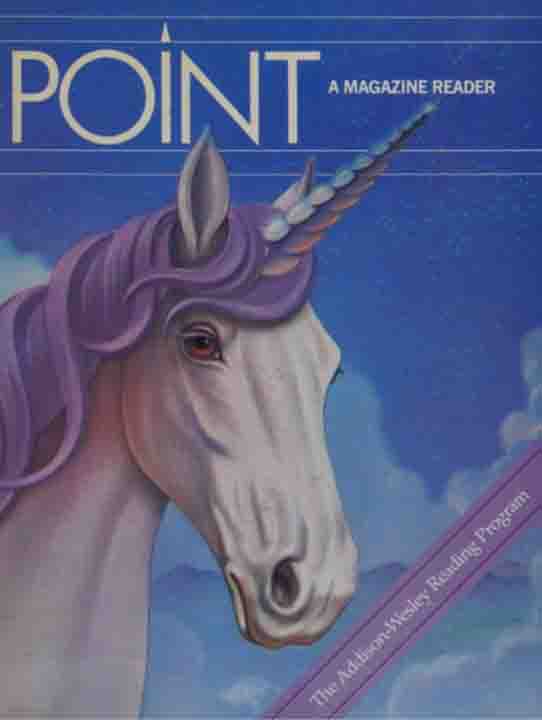
Point was a book published in 1982 as part of the Addison-Wesley Reading Program and at Lincoln Avenue Elementary was considered the highest level of reading book that you could hit. I was a high-achieving reader through all of elementary school, so I was pretty sure that as I was working my way through Green Salad Seasons in the fifth grade, I would wind up being one of those cool kids in sixth grade carrying around the elite reading book–and nothing says elite like a textbook with a unicorn on the cover. I probably had to cover it with a brown paper bag anyway.

Point‘s elite status lost a little bit of its luster when my sixth grade teacher, Ms. Frei, told us that everyone in the class was reading from it. Modern pedagogy says that this is probalby not a good idea (although to be fair, modern pedagogy gives you conflicting information on everything from instructional approach to whether or not you should put a poster on the wall), although now that I have been teaching for about 20 years, I see the case of having everyone read the same thing at the same time. Besides, she had us do a lot beyond simply trudge our way through a reading book story by story–there were book reports, research projects, and the occasional short story from a 1970 reading book called To Turn a Stone, which sounds like the most 1970 title for a reading book ever. I remember one story from that collection called “The Cave” where this kid who is in a gang befriends a homeless guy who lives in a cave and then his gang runs the guy off so they can use the cave for their new hideout. He winds up fighting the gang leader and getting kicked out, then makes a vow to join the other gang and get revenge. Between this and The Outsiders in the eighth grade, no wonder my generation was largely feral.

(more…)

A Night Without Armor

I Say to You Idols

I say to you idols
of carefully studied
disillusionment

And you worshipers
who find beauty
in only fallen things

That the greatest
Grace
we can aspire to
is the strength
to see the wounded
walk with the forgotten
and pull ourselves
from the screaming
blood of our losses
to fight on
undaunted
all the more

Kilcher, Jewel, “I Say to You Idols.” A Night Without Armor, HarperCollins, 1998, p. 52.

Though it’s more of an artifact of 1990s pop culture these days, Jewel’s poetry collection A Night Without Armor was a New York Times bestseller when it came out, with more than a million copies sold. While big sales of a book connected to a popular singer aren’t out of the ordinary, sales of poetry books rarely ever hit this level and if they do, they’re from well-known poets, poets who are currently making or have made a big impact on our culture, or classical bards like Homer and Virgil. Even Jewel said she had a hard time getting a publisher to print it despite being huge at the time.

If you remember A Night Without Armor, you probably remember a few things: first, its success; second, its mixed reviews, which range from praise to balanced criticism to insults*; and third, that moment with Kurt Loder.

(more…)

Pop Culture Affidavit Episode 150: Continuing the Search

It’s episode 150 of the show, and for this episode, I revisit my series of episodes about America: its history, its people, and its culture. After talking about my interest in books about American “stories” (and the many books I’ve read over the years), I return to Peter Jenkins’ A Walk Across America by looking at its newly published “sequels”: Barbara Jenkins’ book So Long As It’s Wild and Jedediah Jenkins’ book Mother, Nature.

Apple Podcasts:  Pop Culture Affidavit

Direct Download 

Pop Culture Affidavit podcast page

Pop Culture Affidavit Episode 148: Déjà View

Set at the end of the 1980s, Déjà View is a coming of age novel with a supernatural elements, and joining me for this episode is its author, Michael Thomas Perone. We sit down to talk about his novels Déjà View and Danger Peak and the inspirations behind them.

Apple Podcasts:  Pop Culture Affidavit

Direct Download 

Pop Culture Affidavit podcast page

If you’re interested in learning more about the author or buying his books, there are links below.

(more…)

Pop Culture Affidavit Episode 139: The Uncollecting II: The Clutter Strikes Back

New Year, New You! At least that’s what they tell ourselves. Back in episode 96, I talked about my efforts to “uncollect” the piles of stuff I own. Well, it’s been a few years, so how is it going?

That’s what this episode is about. I talk about two books I read about hoarding and clutter, the Marie Kondo series Sparking Joy with Marie Kondo, and the “Curiosity Inc.” YouTube series before getting into my own experience with The Uncollecting. So come along and clear the clutter with me!

By the way, if you’re interested in the blog I have set up for The Uncollecting, check out theuncollecting.com.

Apple Podcasts:  Pop Culture Affidavit

Direct Download 

Pop Culture Affidavit podcast page

And here are some extras for you.

Eve O. Schaub’s page for The Year of No Clutter.

The GoodReads page for Stuff: Compulsive Hoarding and the Meaning of Things.

The YouTube channel for Curiosity Inc.

The trailer for Sparking Joy With Marie Kondo:

Pop Culture Affidavit Episode 137: And Walked Off to Look

It’s third and final episode in a series of three episodes about America: its history, its people, and its culture. This time around, I am looking at walking across America through the lens of the seminal travel memoirs A Walk Across America and The Walk West: A Walk Across America 2 by Peter Jenkins and Barbara Jenkins. In addition, I take a look at the book their son, Jedediah Jenkins, wrote, To Shake the Sleeping Self. It’s the portrait of a journey, a country, and a family.

Content Warning: This episode includes me sharing my political views. Listener discretion is advised.

You can listen here:

Apple Podcasts:  Pop Culture Affidavit

Direct Download 

Pop Culture Affidavit podcast page

After the jump, there are a few extras …

(more…)

A Day in the Life of the Soviet Union

While I am in no way an anthropologist nor an anthropology student (even if I did take a couple of intro classes in grad school), I am fascinated by the concept of culture. I don’t know where it comes from and this is not the moment I am going to explore it, but I enjoy looking through the windows of others’ societies to see how they live their lives in ways that are both unique to them and common to so many of us. As I have been reading about America and exploring our history and culture on my podcast, I have come to appreciate our differences and similarities even more. Due to to our vastness, the nuance that you can find in our people is amazing.

Vladivostok, 7:30 a.m.: Sunrise over Golden Horn Bay. Photo by Lev Sherstennikov.

Why, then, I often wonder, do we assign a monoculture to a group that’s not like us?

I know the answers to this question involve one’s ignorance, prejudices, or hate. It’s even to think of, say, Black Americans as acting or living a certain way when you’re a racist; it’s simple to assign characteristics or behaviors to Latinx people when you’re xenophobic; and when you don’t know much about another country, it’s easy to make assumptions based on what you see in the media. Thankfully, there is travel as a way to erase that ignorance, and if you don’t have the privilege or luxury to travel to France or Morocco or India or Japan or anywhere else, there are plenty of travelogues to read or shows to watch.

Sometimes, though, the monoculture is the result of politics, a way of seeing a supposed “enemy” in only one way so the government or a particular political party can gain or maintain power. That can be easily wrapped together with racism and xenophobia, as we have seen throughout our history when it comes to countries with predominantly non-white populations. In fact, we wrap entire continents into said views–I have lost count of the number people who act like Africa is a country or anyone who comes from a country south of the United States is a “Mexican.” But then there’s the Soviet Union.

I spent the better part of two years taking a look at how Americans viewed the Soviet Union during my Fallen Walls Open Curtains miniseries, and came across so much media that basically described the average Soviet citizen as a bloodthirsty commie zombie ready to destroy America on command. At least, that is, until Rocky Balboa defeated Ivan Drago … I mean, until the mid-1980s when Gorbachev came to power and enacted Perestroika and Glasnost. Then, the media turned toward building a bridge with the USSR. The Russians (never mind that there were multiple Soviet republics, they were all Russians) liked blue jeans and Coca-Cola and rock and roll just like us!

Of course, looking at the people of the Soviet Union through that lens is just as ignorant because you’re grafting your own cultural identity onto them and therefore dressing them up in your own monoculture. To truly remedy the ignorance we all had about the people of the Soviet Union, we would have had to actually go there and meet people from all over the place. But that wasn’t possible for the average American in the 1980s (and is still well out of reach these days). Thankfully, we got A Day in the Life of the Soviet Union, a project conducted by 100 photojournalists on May 15, 1987.

(more…)

Pop Culture Affidavit Episode 134: A Day in the Life

It’s second of a series of three episodes about America: its history, its people, and its culture. This time around, I am looking at A Day in the Life of America. My coverage includes a 1968 Department of Defense film called “A Day in America”, the 1986 photo book A Day in the Life of America, the 2003 photo book America 24/7, and the 2019 documentary A Day in the Life of America. What do they capture and tell us about ourselves? Listen and find out.

Content Warning: This episode includes me sharing my political views. Listener discretion is advised.

You can listen here:

Apple Podcasts:  Pop Culture Affidavit

Direct Download 

Pop Culture Affidavit podcast page

After the jump, there are a few extras …

(more…)

9/11 and Popular Culture Part Three

It’s the third episode of a six-part miniseries that examines the books, movies, music, comics, and other popular culture that directly addresses or is about the attacks of September 11, 2001. In this episode, I look at literature. Selections include poems by Toni Morrison, Abigail Deutsch, Deborah Garrison, and others; short stories by Stephen King and Joyce Carol Oates; and Gae Polisner’s novel The Memory of Things.

This episode also crosses over with the most recent episode of Required Reading with Tom and Stella, where we talk about Extremely Loud and Incredibly Close by Jonathan Safran Foer.

A quick content warning: Though these events are now 20 years in the past, they are still traumatizing to many, and I also discuss some of my personal feelings and views, so listener discretion is advised.

Finally, I will be including a feedback section in the sixth episode of the series, and would love to hear what you think, so leave comments on the Pop Culture Affidavit Facebook pagefollow me on Twitter, or email me at popcultureaffidavit@gmail.com.

Here’s where to listen:

Apple Podcasts:  Pop Culture Affidavit

Direct Download 

Pop Culture Affidavit podcast page

Some extras for you …

(more…)