Mike Scott, the bane of the Mets' existence in the 1986 NLCS
I always hated the Astrodome.
Granted, in my entire life, I have spent an hour in Houston and that was for a layover between Austin and Washington, D.C., so I don’t have any personal experience with the Astrodome, but ever since I sat down and watched the 1986 All-Star Game, which was broadcast from the Eighth Wonder of the World, I hated the stadium, and I still kind of do. Part of the reason for that is my aversion to outdoor sports being played in domed stadiums, but part of it is that it seemed whenever I watched a Mets game in the Astrodome back when I was nine years old, they were bound to lose.
That certainly seemed the case when I turned on the sixth game of that year’s National League Championship Series in the seventh inning and saw that the Mets were down 3-0 and it looked like they weren’t going to be able to go to the World Series like I had hoped because Bob Knepper had been mowing them down left and right and the starting pitcher for game seven was scheduled to be Mike Scott, a name that I had become as familiar with and angry at as I had with Cardinals ace John Tudor the year before. Prior to my turning on the game in the late innings, I had been at school, so I had missed the Astros’ three runs off of Bob Ojeda in the first, but I have to say I wasn’t surprised by the lackluster performance in the Astrodome because I’d watched the first few innings of game one, when Glenn Davis had hit a home run off of Dwight Gooden for the game’s only run and an Astros win.
In fact, I don’t think I can talk about that sixth game of the ’86 NLCS without going all the way back to that All-Star Game and my first experience with the Astrodome. It was the first time I had ever seen a game inside a domed stadium and even though the Tigers’ Lou Whitaker homered pretty early in that game, I remember wondering how anyone ever hit a home run there. It didn’t seem that visitors fared well offensively because during the next four days, I watched a sporadic amount of Mets-Astros games from Houston and the Mets dropped three out of four, plus three of the Mets were arrested in an infamous nightclub brawl. Of course, I didn’t know that this particular Mets team was known for its debauchery (and many of the stories of said debauchery would go unknown until I read Jeff Perlman’s The Bad Guys Won! nearly twenty years later); all I knew was that I hated Houston, I hated the Astrodome, and I hated the Astros.
Mike Scott didn’t make things better. A rather mediocre pitcher that the Mets had off-loaded a few years earlier (a fact I only knew from a baseball card as it was before I had started following them in 1985), Scott had emerged as a dominant pitching force in 1986 due to his split-fingered fastball, a pitch that destroyed hitters and led to accusations that he was scuffing the ball, something that the Mets seemed a little too obsessed with as he beat them twice in the series–in the aforementioned game one and then game four, which was the only night game in three games played at Shea. So looking at a 3-0 Astros through seven, and then eight innings and Scott scheduled to pitch the next day, it was safe to say that it was over. All over.
Or was it? I certainly couldn’t believe that, even at the age of nine, not after I had watched two insane endings earlier that week. (more…)
Wheels finds out his parents have died in “Can’t Live With ‘Em, Part 1,” the third season premier of Degrassi Junior High (pic courtesy Degrassi Online)
There were very few moments during my two years of junior high when I felt cool. I spent most of both the seventh and eighth grade on the lower rung of the social ladder and I think that I did what I could to avoid the harassment and other crap that came with being in junior high school. But like I said, there were times when I felt like I was kind of cool, in a way.
One of those moments was when I was standing at the bus stop one morning during the seventh grade. I was one of five or six different kids at that bus stop, which was in the driveway of my neighbors’ house, and while I had grown up around most of them, by the time we were in junior high school together most of them were ninth graders who were bright, popular guys, the type that even though they were still the guys from across the street or next door were guys I looked up to. I overheard one of them say, “Yeah, so Spike had the baby” and my ears went up as if I was a cat that had just heard a can opener.
Someone else watched Degrassi Junior High? I thought I was the only person in the world who knew that the show existed (well, maybe me and Nancy), and not only that, but a couple of the cool kids liked it. And not only that, they were talking about it in public!
What they were referring to was the two-part season 3 premier that I had just watched that week, which was called “Can’t Live With ‘Em.” It was the first of a few seasons worth of ground-shaking premiers, all of which involved something monumental happening to a major character. In later seasons, these premiers would deal with abortion and AIDS, but this first one’s issue was drunk driving and would be the one with the biggest repercussions down the road, as Derek “Wheels” Wheeler’s parents were killed by a drunk driver.
Of course, the two-parter does not start off that way, and even the title itself is misleading. When we open, the members of the Zit Remedy are practicing in Joey’s basement and when he comes home a little later than he said he’d be home, Wheels winds up being forbidden to see Joey and Snake.
After the credits roll, we get the first day of school at Degrassi Junior High, where the returning characters catch one another up as to what happened over the summer. The two most significant changes are that Arthur’s mom won the lottery and Spike had Emma and is now a single mom. Both of these storylines would become central to most of season three, as Arthur’s having money would cause a fair amount of tension between him and Yick, and Spike would have to deal with raising her daughter and with Shane trying to make an effort to be a father.
But the immediate concern of the episode is how Wheels is ticked off at his parents and is lobbying them to allow him to hang out with Joey … well, until he decides to simply sulk around and waits until they go to the movies one night and sneaks out of the house to go there. The band records a “demo” (I guess it’s kind of an inside joke that this band only ever had one song … in what amounted to five years of Degrassi Junior High and Degrassi High, the guys played a gig, recorded a demo, and even shot a music video of ONE SONG.) and Wheels comes home to see a cop car parked in front of the house. At first, he thinks his parents called the police on him, but then he sees his grandmother and she tells him the awful truth.
Joey and Wheels reconcile at the end of part 2. (pic courtesy Degrassi Online)
The credits roll and it’s not until the next episode that we get the aftermath, which deals with Wheels’ grief. He seems to be in shock for a few days and won’t talk to Joey at all (meanwhile, Snake doesn’t know what to say), then loses it in the hallway and punches the crap out of him. But after talking to his grandmother about how much he blames himself, Wheels is able to deal a little more with this tragedy and reconciles with his friend.
It’s an episode that has a few cheesy moments, even in a story that’s very honest and realistic. I’ve never been unfortunate to lose either of my parents, but it does seem that the grief is portrayed in a pretty accurate way. Neil Hope overdoes it a little in the fight scene (the way he punches Joey is a little silly, like he wasn’t very good at it), but you do feel like he’s a step closer to healing when he and Joey hug at the end of part two. However, in the middle of all of this, Wheels has a dream wherein he sees his parents coming home from a movie and when he tells them he thought they were dead, they say, “We are” in a bad horror movie sort of way.
But like I said, the shock of the deaths (not even hinted at until the cop car is outside his house) and his anger as well as how his friends handle it (Snake, the awkward guy, especially) is done almost quietly and even with subtlety at some moments, which is something that many other television shows featuring teenagers often fail to accomplish.
And then there are the subplots and other storylines that are getting off the ground. We have Spike, who was the focus of the end of season two and whose baby everyone obviously wanted to know about, but instead of showing the baby (we do see some pics of Emma in the NICU) and having a full baby-oriented episode, we have some moments where Shane tries to talk to her and seems to start making an effort as a father. Lucy meets a guy and it becomes evident that there will be tensions between the two of them over a guy.
Speaking of friendships, Arthur and Yick are telegraphed as having a break in their friendship this season, even though they seem pretty close. They misdirect Bartholomew Bond, a seventh grader, into an eighth grade classroom in a moment that is supposed to be funny but just shows how kind of dumb they are; and Arthur reads the business pages while in the cafeteria line so he can check out his stocks, which is a little silly. Granted, this is actually pretty true to Arthur’s character but off the bat it is pretty irritating especially since we find out that Stephanie’s mom shipped her off to boarding school and that Arthur is going to give his little cousin Dorothy the same treatment Stephanie used to give him. Finally, Kathleen begins a run for class president, which calls back to that first season premier where Stephanie does her “All the way …” campaign and is eventually ousted by the kids in the grade below her (Kathleen among them). You can really see that her perfectionism is going to get in the way this season.
What is great about introducing all of these storylines in the first couple of episodes of the season is that it’s done more organically than so many other television shows. Yes, there are moments where every character gets a little screen time, but most of the conversations that start off these various tensions take place in hallways or in classrooms before the bell rings, which is where most of the important conversations in a school take place. It’s a great way to get you interested in more of the show while keeping you focused on the plot at hand.
I, of course, am realizing this now but didn’t have this in-depth analysis of the show when I was twelve years old. I simply knew that I didn’t have cable to TV to watch at the end of the day; I simply could turn on PBS around 5:00 or 5:30 and watch a pretty cool show about teenagers. Oh, and as I was finding out at the bus stop that day, I wasn’t alone. As those ninth grade guys continued talking about Degrassi, I considered jumping into the conversation, but I didn’t want to be accused of eavesdropping and the bus was about to pull up, so I never did get to say anything, so my moment was lost.
Mystery Sneaker, which was the "Holy Grail" of vocabulary development in Mrs. Hickman's first grade class.
She was telling us the class rules, and every single one of us was at attention. After all, she had attention as being the “strict” teacher and her tall stature, tightly wound red hair, and impeccable wardrobe reinforced that. Every once in a while, though, I’d sneak a glance at the back of the room at the giant target, which took up the entire bulletin board with its eight multi-colored rings and brown bull’s-eye that read “Mystery Sneaker.” I had no idea what “Mystery Sneaker” meant, but I knew that it was probably important to Mrs. Hickman, who was still talking but now looking straight at me. I sat up, looked right at her and allowed her to continue.
It was my first day of first grade and I was scared out of my mind.
Now, when I was five years old, I really didn’t know what “strict” meant, let alone that a “strict” teacher could be a good teacher. I just knew that “strict” equaled “mean” and that meant bad. Such information concerning Mrs. Hickman was gleaned from conversations with older kids who had been through first grade at Lincoln Avenue Elementary and spoke from experience—but also spoke knowing that we had no b.s. filter and it was fun to scare younger kids, even though some of the stories were true. We found out right away that if your desk was too messy, for instance, she would put a sign that said “Lincoln Avenue Garbage Dump” above it. And on the bulletin board behind her desk was the paddle.
Brown and stamped with “RAH,” the paddle looked like something she had gotten from a sorority and was single-handedly the source of every rumor about Mrs. Hickman. Students who never had her and never would know about the paddle and the more you heard about it, the worse it became. It didn’t merely hang on the wall. Oh no. The word on the Lincoln Avenue playground and the homes of Sayville elementary school students was that if you got out of line in any way, you got hit.
Now, I know there are people who did receive beatings at the hands of teachers, administrators, or nuns at some time or another. But by the time I got to school in 1983, I am sure that if Mrs. Hickman had hauled off and beaten the crap out of me because I didn’t clean my desk, tenure or no tenure, she would have gotten into serious trouble. In fact, there was one time you did get a paddling and that was on your birthday, and even then it was a light tap or two (though I’m sure that you couldn’t get away with that today). But when you sat in the classroom and looked at her desk, there it was, hanging, taunting you, telling you that she meant business.
And she did, although she didn’t need a paddle on the wall to show us. She marked up our work with a red pen and expected nothing less than what she knew were our best efforts. I remember one night sitting at the top of the stairs crying because I had colored in the exercise in my phonics book using a green Whitman crayon and had colored it so thickly that it prompted her to write, “Messy! You can do better!” Maybe I was being hard on myself or had a need for approval from authority figures, but this feeling that I had let her down was a sign that she was effective.
But as we discovered, she was effective because despite the pressure of high expectations and perceived fear of the paddle, she wanted us to love being in her class. I’m sure that’s why she turned learning to read into a game. Because when you’re six you may have a natural curiosity but you don’t have the natural love of learning that makes you purposely want to delve into existential philosophy or debate the merits of socialism in regards to public policy. No, you are still getting the shakes from naptime withdrawal and you’re still struggling with making a lowercase n not look like a lowercase h. So, with our education at such a base level, she knew that she not only had the challenge of teaching us how to read but the opportunity to make us want to read and love words and love reading and that is why the very first thing you noticed when you walked into the classroom wasn’t her paddle, but the giant target. (more…)
When I picked up New Titans #71, which at this point was more than two decades ago, I remember reading it from cover to cover several times over, especially after I read the next few issues of the Titans Hunt and was instantly drawn into the world of the Titans. One of the more helpful parts of that book was a very long editorial in the lettercolumn by new editor Jon Peterson, who introduced himself and answered some fan comments, then teased the readers with what was coming in the future, which included an original Titans graphic novel.
Yesterday, almost exactly 21 years after I picked up that issue, that graphic novel came out.
Entitled Games, it is a full-length story by the classic New Teen Titans creative team of Marv Wolfman and George Perez, who began working on it back when Perez returned to the title in the late 1980s (New Titans #50 and the “Who is Wonder Girl?” storyline) for what wound up being a rather short stint, and takes place during that particular time period for the team. It revolves around a new villain named The Gamesmaster, who has been making things tough for the C.B.I. (Central Bureau of Investigation, a fictional shadowy government agency) and its most prominent agent, King Faraday. The Gamesmaster has been committing acts of terrorism that are part of an elaborate–and very deadly–war game that he now intends to draw the Titans into.
Faraday visits the Titans and makes them aware of the situation while we see several different people getting into place for what will be an eventual takedown of each of the heroes. But first, after the Titans refuse to help Faraday clean up his mess, he begins to mess with their lives and the lives of their loved ones–Steve Dayton is audited, Starfire is investigated by the INS, and Joe Wilson’s mother’s company is under investigation. So, they agree to meet again and he shows them, through the use of cards that look like they’re out of a role-playing game, that the Gamesmaster knows just about everything about them. The team mobilizes to get their loved ones to safety and while they’re doing that, Sarah Simms doesn’t make it. (more…)
My memories of my freshman year of college may be a little cloudy at times, but I do remember talking to my roommate Drew about baseball and at one point during our conversation, he mentioned that one of his favorite players from his childhood was Phillies first baseman Von Hayes. Now, I wasn’t surprised, considering that Drew was from the Pennsylvania and had grown up in the shadow of Philadelphia just as my Long Island childhood was spent in the shadow of New York.
Still, I bristled at the mention of the name. I shouldn’t have–after all, Hayes retired from baseball in 1992 and we started college in the fall of 1995–because he’s not a name that most baseball fans really know. It’s easy to not like a Derek Jeter because he commands a huge salary and gets an incredible amount of attention and while I do think he is overrated, I will say that he is a clutch performer, the type of player you’d hate to have at bat against your team in a tight game.
But Von Hayes? Who, as far as an everyday baseball fan, was going to look at the Phillies and not see Mike Schmidt as the big gun of the 1980s? Well, it’s not so much that he was a “big gun” for the team, but he was definitely a “Met Killer.”
You probably know what I mean when I say “Met Killer”: the batter who will destroy your hopes and dreams, at least for a win that evening. Met Killers have come in the forms of players of all positions and have all contributed to my fan angst over the years, and for a while there during my childhood it seemed that there was at least one player that just killed the Mets for that year. In 1985, it was John Tudor; in 1987, it was Terry Pendelton (oh, Terry Fucking Pendelton, how I hated thee …); in 1988, it was Mike Scioscia; and in 1986 it was Von Hayes. (more…)
A 1970s-era Shasta advertisement, although my grandparents had a different model.
I suppose it’s only appropriate that on Labor Day weekend, I keep thinking of sunsets. I have seen some gorgeous ones in my lifetime in all sorts of settings, but if I had to choose my all-time favorite sunset it would have to be the one I watched when I was seven years old and spent a couple of nights at the beach with my grandparents.
Now, if you’re my age and come from the south shore of Long Island, a summer at the beach means taking the ferry over to Fire Island for the day, and an overnight probably means that you are staying at someone’s house, either out in the Hamptons or as part of whatever share you have on Fire Island or somewhere else. But Grandma and Grandpa Chopping were part of a different sort of beachgoing culture, one that doesn’t get as much attention as it used to back through the middle of the Twentieth Century. Instead of a beach house or time share, they owned a camper; specifically, a 1978 Shasta Camper, which they used to take every summer to the RV camp site at Smith Point County Park, which makes up the easternmost part of Fire Island.
Shasta, along with, say, Winnebago, is often associated with the RV and camping subculture that still exists and I’m sure that people who still hitch a trailer to their cars or drive their camper to a park would say is still going strong. After all, most national and state parks still have campsites and in my travels both up and down interstate highways on the eastern seaboard, I have seen my fair share of signs for campgrounds. Although, to be honest, I associate Shasta campers and trailers more with ephemera from the 1950s than with the 1980s of my childhood. I hear “trailer” or “camper” and I think of spage-age-looking silver trailers with check-pattern tablecloths on the fold-away table and a family of four very happy people using a campsite grill for that evening’s dinner. No, really, like something out of an old Dick & Jane book or an ad for the suburbs.
The bathroom of a 1970s-era Shasta, which had a very 1970s-era color scheme.
And for a while I think that it was. The Shasta brand is pretty well-recognized and if you do a search for the campers and trailers you see those classic models (which sometimes come in the red and aqua you might associate with that era. However, what my grandparents owned was manufactured after Shasta had been bought by a competitor, Coachman, in 1976 and it had less of the charm of the 1950s and more of the stifling interior design that you’d expect from the 1970s. The floor on the inside was a deep brown carpet and every single surface was some other shade of brown, right down to the wood-looking laminate that covered the particle board composite counter. Even the dashboard of the camper’s cab was a light mocha, as were the padded steps of the ladder that led up to the “Grandma’s Attic” where we could sleep. This, of course, was in addition to the harvest gold and rust orange stripes that ran across the side and the front of the camper, which itself had the same sort of utilitarian design that so many cars of the late 1970s and 1980s did. But it did take leaded gas (or “regular”), which I don’t think that many people born after 1990 are that familiar with because it’s been at least that many years since I saw a “regular” pump next to an “unleaded” pump at a gas station. But back then, when they pulled out of the side yard of their house near the foot of Foster Avenue, my grandfather would lumber the camper down to what was then an Amoco station on the corner of Foster and Montauk Highway and pull up to the yellow regular pump to make sure he had enough to make it all the way out to Smith Point. (more…)
It’s been a few months since I’ve written about the 1986 Mets. Put simply, it’s been hard to find many memories of the regular season that really are worth the space I usually devote to an entry around here. My most vivid memories–as I think is the case with most people–center around the postseason, although when I think hard I do remember a few great regular season moments. For instance, there was a four-game series against the Braves in mid-July where I watched Darryl Strawberry charge the mound after Dave Palmer plunked him after Gary Carter launched one into the seats en route to an 11-0 win. It was the first time I had ever seen a brawl in a baseball game live on TV, and I didn’t really understand why Straw charged the mound but it was cool to see a fight.
The Sunday game of that series featured a tribute to Rusty Staub, where the team came out during the pre-game ceremony wearing red wigs and a 2-0 victory which featured Gary Carter tagging out Ken Griffey, Sr. at home plate, a tag that was so awesome it wound up in promos for at least another year or so (it shows up in the music video at the 3:30 mark). But aside from those and the whole mess in Houston where Tim Teufel, Ron Darling, Bob Ojeda, and Rick Aguilera were arrested for a bar fight, I spent the summer watching games and checking the paper whenever I could to see how far ahead the Mets were. Then, as August started to drag on, I started checking their magic number and then learning what a magic number and “clinching” meant (I was nine and new to following baseball, so sue me).
There was no magic number in the daily news yet when we went to a game against the Expos on August 2, and I honestly don’t remember much about the game, except that Uncle Lou and Aunt Geri took us, it was the first time I had ever been to a night game at Shea Stadium, and it rained. My aunt and uncle will at least be able to confirm that–it seemed like it rained every single time we bought a bunch of tickets to go as a family. But still, sitting in the upper deck, watching the Mets win 4-2 under the lights was pretty cool. Plus, my dad and I had tickets for another game a few weeks later, against the Cardinals, a team I had hated since last season when they downed the Mets en route to a World Series appearance.
However, by this time, the Cards were toast and the Mets’ magic number sat at 33. We had tickets to the first game of an impromptu doubleheader (meaning that one of the games was a makeup of a rainout) and my dad took me and my “cousin” Vic (“cousin” meaning that our families were such good friends we might as well be related). It was a 2-1 loss and made me concoct a theory that perhaps I’d go to one losing game and one winning game every season. Anyway, it was a “down” time for the team–Gary Carter had just been placed on the DL the day before with a torn thumb and Ed Hearn hadn’t completely started to rise to the challenge of being the everyday catcher like he would. Rick Aguilera started the game but wound up leaving with an inflammed right knee (I always thought Aguilera was a decent pitcher with the Mets but not as steadfast as Doc, Darling, and Ojeda … Aguilera would wind up hitting his stride with Minnesota years later), and it was one of those games that just sort of sputtered out.
We intended to leave between the games of the doubleheader (after all, we needed to beat the traffic), but we stuck around because between the games, a guy took the field and made the crowd do all sorts of shouting and cheering and even The Wave. Yes, we did The Wave. Why was the guy there? Well, he was doing crowd shots for “Let’s Go Mets,” the official 1986 Mets music video, which premiered later in the season as the team was gearing up for its playoff run. Unofficially titled, “Let’s Go Mets Go” (because of the “Let’s go Mets go!” shout throughout the song), the video features the team, its fans, as well as some highlights and is set to a tune written by Shelton Leigh (“Shelly”) Palmer, who lately more notable as a technology columnist for sites like CNN.com and The Huffington Post, but composed several theme songs for television productions back in the 1980s.
It is, more or less, a huge PR piece with better production value than the local television promos. We begin in one of the parking ramps of Shea where three kids are playing some game where you flip baseball cards and the winner keeps all the baseball cards, which is something I never knew how to do when I was a kid. I’m pretty sure that a relative once tried to teach me but I never picked up on it. The rules of the game didn’t matter in the video anyway, because after the two kids lose all of their cards to a bully-type who looks like a cross between Scut Farkus from A Christmas Story and Jason Hervey’s character in Pee-Wee’s Big Adventure, Doc Gooden, Gary Carter, and Kevin Mitchell (because they couldn’t sober up Straw and who is rocking 1980s eyeglasses and a track suit that I can only describe as “Sharpton-esque”) show up.
Joey Jeremiah, resident Degrassi clown and keyboardist for The Zit Remedy. Photo courtesy of Degrassi Online.
I have to admit, in my half-assed effort to recap old Degrassi episodes, I was going to cherry pick stuff I remembered from Degrassi Jr. High and then go on to cover probably all of Degrassi High because I have all of that series on DVD and have watched it enough times in the last few years that I can probably pick off an episode at random. Besides, YouTube only had the first 26 or so episodes of DJH available and that was it. However, Hulu has the rest of them, and as I browsed through the titles I was reminded of how much of the show’s final season (before high school) I actually did watch.
Arguably the most famous storyline on Degrassi Junior High‘s second season is Spike’s pregnancy, which wound up providing the impetus for Degrassi: The Next Generation nearly fifteen years later (but enough about that for now). The thing is, while I knew that Spike was the pregnant teenager on Degrassi Junior High whenever I managed to catch an episode, I never actually saw the episode where she got pregnant, nor did I see the ones where her pregnancy became a huge scandal and she had to fight to stay in school. During those first two seasons, I saw a smattering of episodes and all I knew was that the show was about Arthur, Yick, Stephanie Kaye, the twins (whom I couldn’t tell apart), and the guys in the band The Zit Remedy.
Which is why I am probably sure that while I saw some of those second season episodes, I didn’t really remember any until the next season rolled around. There were few exceptions, and one of them was the second season finale, “Pass Tense.”
When the episode opens, it’s finals and Wheels is freaking out about his upcoming tests. He’s been having a pretty tough year academically and doesn’t want to risk being left behind. Meanwhile, everyone else is getting ready for the big eighth grade dance, as it’s their time to graduate to the local high school. Except, well, they won’t. City-wide overcrowding has resulted in the administration making the decision to keep the ninth grade at Degrassi Junior High next year, which puts a huge damper on the eighth graders’ celebration, especially when the seventh graders (led for the most part by Caitlin Ryan) decide that they are not going to be decoration monkeys anymore. But the show must go on (and the seventh graders get to attend as “payment” for doing the decorations) , especially when that show includes the first-ever performance by The Zit Remedy.
I think that anyone with a passing knowledge of Degrassi knows The Zit Remedy, which was the band comprised of Joey Jeremiah on keyboards, Derek “Wheels” Wheeler on bass, and Archie “Snake” Simpson on guitar. They had one song and only one song, the immortal, “Everybody Wants Something” (which in itself would be the title of an episode of Degrassi High, so when I get around to that one, I’ll talk more about it). This dance, according to Joey, was going to be their big break and throughout the episode he seemed to have a “Today Degrassi, tomorrow the world!” attitude. Until, that is, Mr. Raditch pulls him aside and tells him that he has failed eighth grade and will repeat.
It was a very pivotal episode for Joey for two reasons: first, you could tell that he was being hit pretty hard with reality here, and the fact that he was … well, slower than everyone else would define his character for most of the rest of the series. He also starts to take an interest in Caitlin, and that would … well, that’s “the relationship.” It’s a very quick moment at the dance at the end, but enough to suggest that something would go on between the two at some point in the coming year. And I have to admit that this was around the time that I started noticing Caitlin. I’m pretty sure that Stacie Mistysyn, the actress who played her, was my first real actress crush, which probably explains A LOT. (more…)
The cover to New Teen Titans (Baxter) 15 sums up this entire era perfectly.
So the Titans were popular when I was a teenager, but not that popular. Sure, Jon Peterson’s editorial run put the book back in the spotlight with enough cache to warrant two spin-off titles with an “event” crossover between them, but they weren’t so popular that comics shops were charging ridiculous amounts of money for their back issues. The Wolfman-Perez run on the book, which started in 1980 and ran until 1984 (or 1985-1986 if you factor in, by extension, Crisis on Infinitie Earths) is now one of those “classic” runs, something that comics fans put up as one of the best of that particular period (I don’t know if I’d say the best of all time because then you wind up in Lee/Kirby territory and I think that’s still considered blasphemy. Anyway …) but Marv Wolfman and George Perez are not Todd MacFarlane, Jim Lee, or Rob Liefeld whose backstock on the X-Men and Spider-Man were selling for prices in the double-digits. I should know … I’m the jackass who once paid $25 for a copy of Uncanny X-Men #248. So like I said, I got most of the original New Teen Titans series for about $2-$3 an issue, with the occasional issue, usually a very early one or a Deathstroke appearance, costing more.
The back issues of the Baxter series, which began in 1984, were a little more expensive and a little harder to come by, at least at Amazing Comics. Part of that was because the original price of each of those issues was more. Back in 1984, instead of paying 75 cents or $1.00 for an issue of New Teen Titans/Tales of the Teen Titans, you paid $1.25 for the Baxter series (by the time I started collecting, the price was $1.75). If you were buying off a newsstand, you could stil get the same stories for 75 cents or $1.00 because DC was reprinting the Baxter series in Tales of the Teen Titans, which continued the numbering of the original series. This meant that anyone buying Titans off the newsstand got those stories about a year after they had originally been printed.
Why a year, if DC was publishing the books simultaneously? Well, that’s because for the first year or so of the Baxter series, the original, newsstand series (which had been retitled Tales of the Teen Titans, if you didn’t guess that by now) was still running original stories. I think it might have confused readers a little because the stories in the Baxter book featured events that hadn’t happened yet in the other book. When Tales started reprints with #60 (well, technically #59, but that issue reprinted DC Comics Presents #26 and a DC Digest tale), it became apparent that if you were going to read the New Teen Titans from beginning to end, you’d start with DCCP #26 and work your way to Tales of the Teen Titans #58. Then you’d pick up the second series starting with issue #1 and the Raven/Trigon storyline.
Now that we’ve gotten that exhausting bit of explanation out of the way, I have to say that I think I agree with those fans who think that one of the contributions to the decline in the Titans through the late 1980s was the fact that the book was part of this direct market push. This was at a time when the idea of a comics shop was really starting to gain steam and both DC and Marvel (but honestly, I think DC more than Marvel because I don’t recall that many “direct market only” titles from Marvel) were creating products specifically to be sold in comics shops. For DC this meant books like The New Teen Titans, The Legion of Super-Heroes, The Outsiders, Vigilante, and The Omega Men being printed on Baxter paper and sold at a higher price as if they were meant to be in a bookstore instead of a spinner rack at the 7-Eleven (I think we kinda see this today with the trade paperbacks market … more books are coming out in hardcover and then softcover because DC and Marvel are clearly following a traditional publishing model that caters to Barnes & Noble rather than the LCSes of the world). Sure, of the three super-hero titles (Titans, Legion, Outsiders) there were newsstand-available reprint books, but I think that this move still took the Titans off the market and damaged sales potential.
But that’s not what really hurt the book so much as the actual stories did. Wolfman and Perez were a great team, but they tend to have the same faults as a Lennon/McCartney pairing. Both are great writers on their own but their weaknesses definitely get the better of them at times. I haven’t read too much of George Perez’s Wonder Woman, which is the title he took over after Crisis (I intend to, eventually), but I can say that Wolfman’s work suffered a bit … and he admits it, having said that during the post-Crisis period he went through a serious case of writer’s block, which caused the quality of the book to suffer and storylines to drag on way longer than they had to. I mean, Chris Claremont was writing the X-books at the time and his run is notorious for long-assed storylines, but the x-books in the 1980s had really hit their stride and Marvel was doing the right events and hiring the right artistic talent to put that book on top and keep it on top. I mean, I enjoyed Eduardo Barretto’s run as an artist on New Teen Titans, but the guy wasn’t Jim Lee.
Why, then, did it always seem that the books published between New Teen Titans #6 and New Titans #50 were such a pain in the ass to find? I have no idea. If I could speculate, perhaps the first year or so the book was selling so well that there weren’t that many back issues, and once the book started to fall off, the number of books ordered probably declined. Bob just didn’t have that many of the second series, so it meant going elsewhere, like to Sun Vet and any other shop I could find. Thankfully, the trip was always worth it because here and there I wound up with a couple of books at the low price of $3-5 each and eventually collected the entirety of an enormous storyline that starts with a spaceship crashing in Tales of the Teen Titans #52 and ends with Raven getting naked in New Teen Titans #39.
Uh … what? Trust me, I’ll get to it. It’ll take a long time, but I’ll get there. (more…)
A couple of weeks ago, the final space shuttle mission launched, and by the end of this week, it will have landed, ending a 30-year era of space exploration for the United States. It goes without saying that this is the end of an era. The first space shuttle launched when I was 3-1/2 years old, and I (unfortunately) rank the Challenger Disaster as one of the most important moments of my childhood.
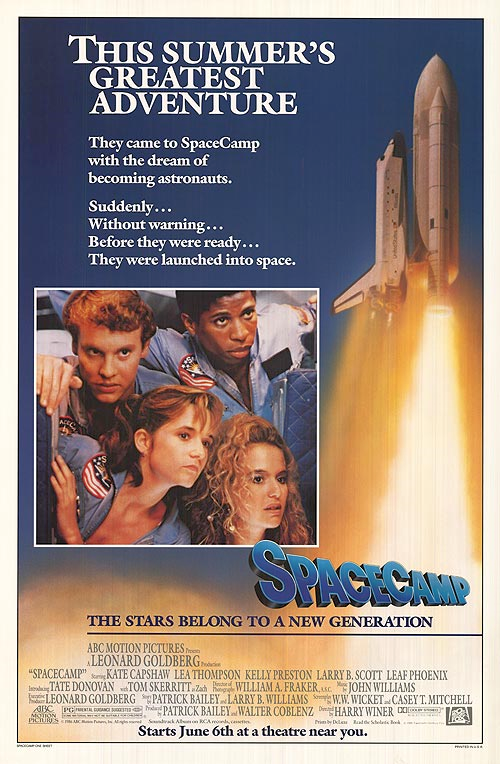
I wanted to post something about what I thought about the space shuttle saying farewell; however, I don’t know if I would have anything to say that hasn’t been said already, and I wasn’t sure how I was going to keep whatever I wrote within the confines of my “pop culture” subject matter. I thought of the Young Astronauts Challenger Commemorative Packet that I got when I was in the fourth grade and I also thought of writing about the time I put together one of those Revell space shuttle kits and got glue all over my hands, paint all over the place, and never got the decals to go on correctly (seriously, did anyone?). But then I thought of what nobody is probably talking about as far as the space shuttle is concerned, which is the biggest (and well … kind of only) space shuttle movie there is: SpaceCamp.
Starring Kate Capshaw, Lea Thompson, Kelly Preston, Joaquin Phoenix (back when he was known as “Leaf”), Tate Donovan, and Larry B. Scott (a.k.a. Lamar from Revenge of the Nerds), SpaceCamp is one of the few science-fiction (although in a way, this is more “science” based) movies from the late 1970s and 1980s where aliens do not attack and lay waste to the Earth, nor do they mate with, possess, or disembowel anyone. In fact, SpaceCamp doesn’t have any aliens. Unfortunately, its tension is tepid enough for a teacher to show an elementary school class.
Capshaw (about a year or two removed from Indiana Jones and the Temple of Doom) plays Andie Bergstrom, an astronaut who, when she sits on her family’s farm in 1961, sees John Glenn’s capsule fly through space and says proudly to her dog, “I’m goin’ up!” (a line delivered in the cheesiest manner possible, btw). More than two decades later, she has received the umpteenth notification that she will not fly on a shuttle mission–Atlantis, which is scheduled to launch within a couple of weeks. Her husband, Zach (Tom Skerritt, who would be Viper in Top Gun the same summer), then coaxes her into being an instructor at Space Camp, which for plot reasons is held at Cape Canaveral and not in Huntsville, Alabama (a Space Camp was opened in Florida in 1989, but this came out in 1986). She reluctantly takes on the “blue team” of Space Camp students, who are …
… a group of stock characters. Kevin (Donovan) is the arrogant screw-up guy and we know that because when we meet him, he’s wearing a Hawaiian shirt and rocking out in his new Jeep; Kathryn (Thompson) is an overachiever who is already a pilot, and we know this because she flies a WWI-era bi-plane to the parking lot; Tish (Preston) is a mall ditz who possesses the ability to memorize just about anything she reads, and we know this because she cinches her flight suit with a stylish red belt; Max (Phoenix) is the annoying kid genius who everyone will pick on, and we know this because everyone picks on him; and Rudy (Scott) is … well, the only one without any issues. (more…)






 Pop Culture Affidavit