1980s

The Sure Thing

Being that I grew up without cable television and didn’t always get the chance to get to a video store, there were times in my formative years where I lived for a good movie on broadcast television.  The local stations always seemed to comply with my wishes, too, because WPIX seemed to have one of the deepest film libraries imaginable, and even our local Fox affiliate would bust out something random when the network wasn’t running their primetime programming.   And of course you had the ABC Sunday Night Movie, which is where I got most of my exposure to the Roger Moore-era Bond films as well as various versions of the first two Superman movies.  The 1980s and early 1990s were a glorious period of movies on television, and are definitely directly responsible for my ongoing obsession of teen films, especially those of the two Johns:  Hughes and Cusack.

Now, I think one day I will probably do an entire post on the edited-for-television version of The Breakfast Club because it has its own place in the “Children of the Eighties” museum, and how WPIX seemed to have all of the rights to all of John Cusack’s mid-1980s teen comedies, even Hot Pursuit, which is one of those “Someone greenlighted this?” films that only the most hardcore of teen movie buffs will sit through.  I’ll even go into Better Off Dead, which was the start of my Cusack fandom (up until then, I’d recognized him as the older brother in Stand By Me and The Journey of Natty Gann, the latter of which made me bawl my eyes out when I first saw it), because I would rather focus on one of the films that is in my All-Time Desert Island Top Five Cusack films, and that is The Sure Thing (the others, in chronological order, are Better Off Dead, Say Anything …, Grosse Pointe Blank, and High Fidelity).

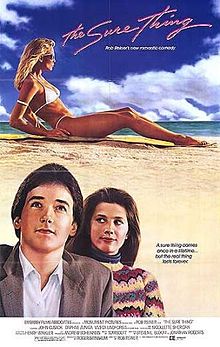
Directed by Rob Reiner in 1985, The Sure Thing was his follow-up to the seminal This is Spinal Tap and has the most Eightiesness about his films from that decade, even though it does not look dated at all (except for maybe Nicolette Sheridan’s hair and the fact that her breasts are real, but we’ll get to that).  I first saw the film in 1991 when  it had its network broadcast premiere on Fox one summer evening.  I was about to enter high school at the time and therefore the strict 8:00 bedtime my parents had maintained up until that point was starting to be eased, especially since it was the summer and I didn’t have school and rarely went out at night because I was either without rebellious friends or spending the summer recovering from some kind of facial surgery.

Anyway, I had heard of the film’s title because I had the easy-level sheet music to Rod Stewart’s “infatuation” in a movie themes book for the piano.  Never played it, though because I didn’t like Rod Stewart very much and the only thing I remembered about that song was the black-and-white video where he’s being really pervy.  The way the song is used in the film, by the way, is where I am sure that David Hasselhoff got his inspiration for about a hundred Baywatch montages, because it’s simply Nicolette Sheridan in a white bikini on a beach putting a blanket down, putting lotion on, and laying out while a very 1980s-looking title font rolls credits.  And even though I don’t like the song, I give props to Reiner because it’s a damn near perfect introduction.

I stuck with the movie not because of Sheridan (although being that I was fourteen years old, I was definitely, shall we say, intrigued), but because I noticed Cusack’s name in the credits and I had just spent most of the summer watching my taped copies of Better Off Dead and One Crazy Summer to the point where I had every line memorized and they were already wearing out.  Rob Reiner was a director I was slightly familiar with too, having watched Stand By Me and The Princess Bride quite a bit.  And the plot was simple enough to keep me going through Fox’s various commercial breaks that advertised the only thing it had going for it in the summer, which was the beach club episodes of Beverly Hills, 90210 (I can never remember the name of the beach club, btw.  I want to say Malibu Sands, but that was Saved By The Bell … ah, Stacy Carosi …):  guy travels 3,000 miles to get laid.

Okay, that’s not the entire plot of the movie because the 3,000 miles to get laid part starts after the movie’s first act is over and that first act sets up the two major characters: Walter “Gib” Gibson (Cusack) and Allison Bradbury (Daphne Zuniga, who I definitely knew from Spaceballs).  They’re attending college together at some ivy league-type school in the northeast (Gib tells his friend that he’s “never seen so much corduroy in one place”) and much like any good romantic comedy where opposites attract, they don’t really like each other after they first meet and by the time they wind up stuck together on the road trip to UCLA, where his friend Lance (a pre-Goose but nicely fratbro Anthony Edwards) has arranged a night with The Sure Thing; and her boyfriend Jason (Boyd Gaines) attends, they absolutely despise one another.

At this point, the film actually becomes a road movie and very much in the classic sense, which is what I think gives The Sure Thing its timelessness.  It’s one of those movies that I’m sure hasn’t been attempted in the remake/reboot sense, and I have a feeling that if a remake was attempted it would fall completely flat because it would be more like Road Trip, which has its moments but also has diminishing returns on subsequent viewings.  I’ve been watching The Sure Thing for twenty years—first on a pirated VHS copy and then on DVD—and to this day I laugh my ass off the entire way through.   I think it has to do with how realistic the situations and characters actually are.  A movie like Road Trip might be zany and crazy, but what happens to Allison and Gib while they’re on the road in The Sure Thing could very well still happen.  Reiner and the screenwriters seemed to take a lot of care to make sure that the film felt organic and that comedic bits, such as Allison’s flashing a truck full of guys after Gib calls her repressed, aren’t forced.

The credit also goes to the entire cast, too.  Cusack’s obviously the star (and it’s hard to believe that he was only 17 and actually had to be emancipated from his parents in order to shoot on location), and he nails every line and rant (his “if I fail English my life is ruined” bit is a classic).  But it’s not a John Cusack showcase; Zuniga’s job is to elevate the comedy above that of stuff like Porky’s, and she plays Allison like a Mallory Keaton with a brain.  Then, you have her on-screen boyfriend, Jason, who is the epitome of the “square” and should be a one note character, but Boyd Gaines delivers his lines so well that he almost steals certain scenes, especially when it becomes obvious that Allison is kind of over him.  The line, “How about a good hot mug of China Black?” which should be a random line, is quite possibly one of the funniest lines in Eighties teen movies.

But I digress.  I could very well sit down and talk for at least a couple of hours (or in our case, 1500 more words) about all of the little things that make this such a favorite of mine.  I’m just honestly pleased that a film genre that is very so often disposable has produced a gem like this.

Merry Metsmas

So back in October, when I was wrapping up my look at the 1986 Mets with all of the memorabilia that I had collected over the years, I left one particular item out of my list.  At first, I thought that I had forgotten to include it, but then I realized that it actually commanded its own entry, in a way.  That’s because I can’t write about the 1986 World Champions commemorative ornament without writing about Christmas itself.

I received the ornament as a Christmas gift in 1986 and while I am not 100% sure who gave it to me, I’m going to say it was my Uncle Lou because around the same time he also gave my sister and I copies of the 1986 World Series program.  And since we always went to my grandmother’s house on Christmas Eve, we more than likely hung it on the tree that night before we went to bed.  Soon after, however, I became insistent that every single year it go on the center of the Christmas tree, to the point where I would make sure it was the first ornament on the tree.

But I’m getting ahead of myself.

This weekend, my wife and I will be putting up our Christmas decorations and our pre-lit artificial tree is in a bag in the basement all ready for us to take it out and put it together.  This is a radical departure from what my sister and I had to go through when we were kids and it was time to put up the tree.  You see, my family was never one to rush a holiday, so we actually waited until after Thanksgiving to think about decorating for Christmas (as opposed to people who start putting inflatables up in September), but once Black Friday hit, we were shopping and were also commencing what was a 42-step process of putting Christmas together:

  1. Go to St. Ann’s church on Middle Road in Sayville.  Find a tree.
  2. Set that tree aside and wander around the lot in search of a better tree.
  3. Re-locate that first three and purchase it.
  4. Put tree in a bucket of water and lean against fence in backyard.
  5. Wait two weeks, during which children ask, “When are we going to put the tree up?  When are we going to put the tree up?  When are we going to put the tree up?”
  6. Decide on a day to decorate.  Wait until late afternoon to get started.
  7. Open attic stairs, do impression of Chevy Chase taking stairs to the face in National Lampoon’s Christmas Vacation.
  8. Go up to attic, realize how dark it is.
  9. Go to basement and get droplight.
  10. Hang droplight in attic and plug into bathroom outlight using extension cord that is longer than most “Turkey Trots” run on Thanksgiving weekend.
  11. Locate giant cardboard box that once held case of Luvs diapers but now holds every Christmas ornament that family has owned since the Carter Administration.
  12. Drag box across attic floor, almost fall to death when attic stairs are misjudged.
  13. Carry box down stairs, to den.
  14. Take Tylenol for back pain.
  15. Bring the tree in bucket from the back fence to the deck.
  16. Attempt to pry bucket off with hands.
  17. Give up on hands, start kicking the bucket.
  18. Give up kicking the bucket, use a hammer.
  19. Realize that water poured into bucket has frozen and chisel is required
  20. Chisel ice.
  21. Find tree stand bought during Eisenhower Administration in decorations box.
  22. Spend twenty minutes sawing tree trunk and fitting tree to stand.
  23. Bring tree into the house.
  24. Spend twenty more minutes making sure that tree is straight.
  25. Listen to kids bitch impatiently.
  26. Spend twenty more minutes making sure that fullest part of tree is in front.
  27. Continue to listen to kids bitch.
  28. Put on Christmas music to shut kids up or drown them out.
  29. Listen to kids bitch that Celine Dion’s Christmas album is an affront to the season.
  30. Begin stringing lights.
  31. Discover one strand of lights is not working properly.
  32. Spend twenty minutes finding malfunctioning light.
  33. Replace bulb.
  34. Realize you put in bulb that makes lights flash.
  35. Replace bulb again.
  36. Continue stringing lights.
  37. Continue stringing lights.
  38. Insist that tree is neither straight nor full, which leads to further tree adjustment.
  39. Wash sap off hands from tree adjustment.
  40. Continue stringing lights.
  41. Allow first ornament to be put on tree.
  42. Watch sun rise.

Okay, maybe I’m exaggerating on that last one but when you’re nine or ten years old and your life during the latter part of the year centers around celebrating Christmas, you have to admit that the process of putting a tree together seems to take an eternity, and every year I would spend that eternity fondling the blue ball that had the classic Mets logo on the front at 1986 World Champions, waiting to place it front and center, usually next to an orange light so that anyone that came by could bask in the awesomeness of the 1986 Mets.

Mets Madness

When I sat down to write about the afterglow of the 1986 World Series, I started to consider what it was like to be a fan of a championship-winning team and how that carried over into the 1987 season when I was sure that the Mets would “do it again” as the promos kept saying. But the 1987 Mets were a bit of a letdown (Thanks a LOT, Terry FUCKING Pendelton!) and the afterglow of the 1986 World Series is something that I don’t remember as well as my repeated viewings of 1986 Mets: A Year to Remember had made it seem.

Then, I began to sift through the massive amount of 1986 Mets crap that I own or have owned at one point during the past 25 years, and thought I would simply “catalogue” it.  Partially because I’m lazy and don’t feel like writing anything with an actual point, and partially because even I am amazed at how much stuff there is.

1986 Mets: A Year to Remember.  This is the official team highlight video, which my friends and I rented repeatedly from Video Empire, so much so that it was impossible for anyone to find it because one of us always seemed to have it out.  I do happen to have my own copy because sometime in the late 1990s I rented it one more time and hooked two VCRs together in order to dub the video.

The video itself starts with a highlight of Game Six and then goes month to month through the regular season, with a few montages thrown in, the most famous of which definitely has to be the Len Dykstra and Wally Backman “Wild Boys” video set to the Duran Duran song of the same name, as well as a great clip of Howard Johnson and Roger McDowell telling the audience how to pull the “hot foot” prank on a player.   The playoffs and series are covered as well, with most of the play calling coming from Bob Murphy, the radio voice of the Mets, which I have to say is awesome because as much as I like hearing Vin Scully, Bob Murphy’s voice calling the Mets is one of the best things you’ll ever hear. (more…)

1986

[A quick note:  I originally published this on my old website, Inane Crap, five years ago.  Since I have been writing about the 1986 Mets, I thought it would be appropriate to repost.  There will be another post tomorrow.]

I think that one of the biggest problems you face when you grow up normal is that you grow up being a good kid. Technically there is nothing wrong with parents instilling their children with a sense of morality, a work ethic, and awareness of the world around them. The problem is that normal kids do not make good criminals.

I mean, I am a terrible liar. I can embellish and exaggerate, but when it comes to fabrication, I flat-out suck. Luckily, I discovered this in the fourth grade when I tried to con my way out of getting in trouble for not doing my homework.

When I was nine years old, I began the fourth grade at Lincoln Avenue Elementary School in the fall of 1986. My teacher was a very nice woman named Mrs. Balcewicz, whom everyone called “Mrs. B.” Fourth grade was a huge year from anyone at Lincoln because it meant that you moved into the “big kid” hallway and got actual grades on your report cards instead of weird letters like “S,” “N,” and “U.” And not only was being in the 4-5-6 hallway exciting, I was poised to do very well because my third grade year had been stellar.

Unfortunately, this year of school was where I began my very slow descent into the social awkwardness that defined my adolescence. Like other years, I spent most of my days playing G.I. Joe and Top Gun and beating up on girls (not in the “future domestic violence case” way, though; more like in the “pulling pigtails” way). But most importantly, my brain was trying to tell me that it was time to start maturing, and that was by getting in trouble.

For the most part, this was not through any violent behavior, because I was a good kid. Nor was it through refusing to be clean, because I’d had a messy desk since I was in the first grade. The way I rebelled when I was nine years old was by not doing my homework. Mrs. B didn’t assign a lot of homework, but during one week in October 1986, thought a little homework was too much and refused to do it. What’s worse is that when she came to collect my homework and I didn’t have it, I used the excuse of going to see my ailing grandfather in the hospital. It was underhanded and mean, and my come-uppance was quick because on the Friday of that week, she handed out progress reports that had to be signed by our parents. Mine said that I was missing a couple of assignments, and had this comment: “Tommy has been telling me about going to see his grandfather in the hospital.”

Now when you’re in the fourth grade and you have never really done anything wrong in your life, you don’t’ have the smarts to know that the jig is up and you should come clean to your teacher about not doing your homework. I was a likable student, who would eventually be named “Teacher’s Pet” in my high school yearbook, so I probably would have gotten off with a warning. Instead, I hastily signed my mom’s name on the progress report and hid it in my desk at school until the day she collected it. Mrs. B was not stupid, and a few days later on October 28, 1986, she called my parents. (more…)

Titans After Dark (My Life as a Teen Titan, Part Nineteen)

New Titans #100 is probably one of the better examples of a “sucker punch” big issue that came out in the midst of the much-maligned “Dark Age” of comics.  Oh sure, there were big events in other comics that people actually cared more about; Superman had just come back from the dead, Batman #500 came out and Azbats gave Bane a serious beatdown, and we were getting pretty close to the time when Magneto ripped Wolverine apart (which is also close to the time I stopped buying the X-books).  But aside from the moment that would basically become the genesis of Onslaught (look it up, kids), many of the “events” were pretty well-known at the time.  And I guess you could say that Evil Raven interrupting the wedding of Dick Grayson and Kory Anders was telegraphed as well, but I think that most Titans fans didn’t expect the mood of the book to change so drastically with its new art team.

To say the least, Bill Jaaska’s contributions to the title weren’t very welcomed by fans (though the editors did have a tendency to run positive letters stating otherwise), and looking at it now it looks clunky in some parts and hasn’t really aged well, but I can see where they were going for a newer, darker mood for the book.  And in order to take the book down this path, Marv Wolfman had a four-pronged approached, at least for the next year’s worth of issues.  He had the Nightwing/Starfire relationship reach its ultimate conclusion, Changeling started to lose his mind due to the manipulations of the Mento helmet, Arsenal would gain control of the team, and after nearly four years of wondering what was going to happen to Vic Stone, we finally would get the conclusion to the Cyborg story.

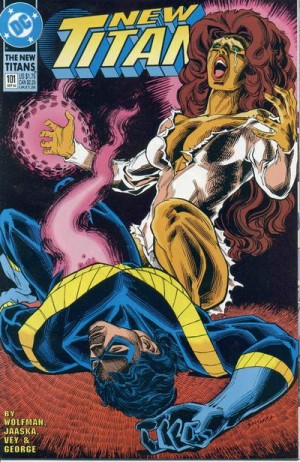
But since the biggest event of the previous issue was Raven kissing Starfire, it’s best to bring us back to our exploration of the Titans books of this era by looking at how Nightwing and Starfire recovered from the kiss.  Issue #101 was appropriately titled “Aftermath” and begins in S.T.A.R. Labs, where Kory is flipping out because she thinks that Raven is attacking her.  It’s a little bit different from many of the other Raven attacks we’ve seen because Kory seems to be fighting Raven’s influence and Phantasm–who at this point only seems to show up when the plot finds it necessary–uses his powers to help her fight.  It seems that they chase away the demon and Kory is back to the land of the living.

Meanwhile, Arsenal is wresting control away from a distraught Nightwing and it looks like he is about to strike a deal where the Titans may be a government-sponsored organization, something that pisses Nightwing off to no end and he and Roy come to blows.  Dick leaves the Titans to be at Kory’s bedside and Roy takes the team over, and in order to follow the story of the fan favorite Titans couple, we have to head to Flash #80-83, a four-part storyline where they help Wally West face off against a group called the Combine and an ex-girlfriend of his, Frances Kane. (more…)

Nails, Gary, and the Greatest Game Ever Played

Mike Scott, the bane of the Mets' existence in the 1986 NLCS

I always hated the Astrodome.

Granted, in my entire life, I have spent an hour in Houston and that was for a layover between Austin and Washington, D.C., so I don’t have any personal experience with the Astrodome, but ever since I sat down and watched the 1986 All-Star Game, which was broadcast from the Eighth Wonder of the World, I hated the stadium, and I still kind of do.  Part of the reason for that is my aversion to outdoor sports being played in domed stadiums, but part of it is that it seemed whenever I watched a Mets game in the Astrodome back when I was nine years old, they were bound to lose.

That certainly seemed the case when I turned on the sixth game of that year’s National League Championship Series in the seventh inning and saw that the Mets were down 3-0 and it looked like they weren’t going to be able to go to the World Series like I had hoped because Bob Knepper had been mowing them down left and right and the starting pitcher for game seven was scheduled to be Mike Scott, a name that I had become as familiar with and angry at as I had with Cardinals ace John Tudor the year before.  Prior to my turning on the game in the late innings, I had been at school, so I had missed the Astros’ three runs off of Bob Ojeda in the first, but I have to say I wasn’t surprised by the lackluster performance in the Astrodome because I’d watched the first few innings of game one, when Glenn Davis had hit a home run off of Dwight Gooden for the game’s only run and an Astros win.

In fact, I don’t think I can talk about that sixth game of the ’86 NLCS without going all the way back to that All-Star Game and my first experience with the Astrodome.  It was the first time I had ever seen a game inside a domed stadium and even though the Tigers’ Lou Whitaker homered pretty early in that game, I remember wondering how anyone ever hit a home run there.   It didn’t seem that visitors fared well offensively because during the next four days, I watched a sporadic amount of Mets-Astros games from Houston and the Mets dropped three out of four, plus three of the Mets were arrested in an infamous nightclub brawl.  Of course, I didn’t know that this particular Mets team was known for its debauchery (and many of the stories of said debauchery would go unknown until I read Jeff Perlman’s The Bad Guys Won! nearly twenty years later); all I knew was that I hated Houston, I hated the Astrodome, and I hated the Astros.

Mike Scott didn’t make things better.  A rather mediocre pitcher that the Mets had off-loaded a few years earlier (a fact I only knew from a baseball card as it was before I had started following them in 1985), Scott had emerged as a dominant pitching force in 1986 due to his split-fingered fastball, a pitch that destroyed hitters and led to accusations that he was scuffing the ball, something that the Mets seemed a little too obsessed with as he beat them twice in the series–in the aforementioned game one and then game four, which was the only night game in three games played at Shea.  So looking at a 3-0 Astros through seven, and then eight innings and Scott scheduled to pitch the next day, it was safe to say that it was over.  All over.

Or was it?  I certainly couldn’t believe that, even at the age of nine, not after I had watched two insane endings earlier that week. (more…)

Can’t Live With ‘Em

Wheels finds out his parents have died in “Can’t Live With ‘Em, Part 1,” the third season premier of Degrassi Junior High (pic courtesy Degrassi Online)

There were very few moments during my two years of junior high when I felt cool.  I spent most of both the seventh and eighth grade on the lower rung of the social ladder and I think that I did what I could to avoid the harassment and other crap that came with being in junior high school.  But like I said, there were times when I felt like I was kind of cool, in a way.

One of those moments was when I was standing at the bus stop one morning during the seventh grade.  I was one of five or six different kids at that bus stop, which was in the driveway of my neighbors’ house, and while I had grown up around most of them, by the time we were in junior high school together most of them were ninth graders who were bright, popular guys, the type that even though they were still the guys from across the street or next door were guys I looked up to.  I overheard one of them say, “Yeah, so Spike had the baby” and my ears went up as if I was a cat that had just heard a can opener.

Someone else watched Degrassi Junior High?  I thought I was the only person in the world who knew that the show existed (well, maybe me and Nancy), and not only that, but a couple of the cool kids liked it.  And not only that, they were talking about it in public!

What they were referring to was the two-part season 3 premier that I had just watched that week, which was called  “Can’t Live With ‘Em.”  It was the first of a few seasons worth of ground-shaking premiers, all of which involved something monumental happening to a major character.  In later seasons, these premiers would deal with abortion and AIDS, but this first one’s issue was drunk driving and would be the one with the biggest repercussions down the road, as Derek “Wheels” Wheeler’s parents were killed by a drunk driver.

Of course, the two-parter does not start off that way, and even the title itself is misleading.  When we open, the members of the Zit Remedy are practicing in Joey’s basement and when he comes home a little later than he said he’d be home, Wheels winds up being forbidden to see Joey and Snake.

After the credits roll, we get the first day of school at Degrassi Junior High, where the returning characters catch one another up as to what happened over the summer.  The two most significant changes are that Arthur’s mom won the lottery and Spike had Emma and is now a single mom.  Both of these storylines would become central to most of season three, as Arthur’s having money would cause a fair amount of tension between him and Yick, and Spike would have to deal with raising her daughter and with Shane trying to make an effort to be a father.

But the immediate concern of the episode is how Wheels is ticked off at his parents and is lobbying them to allow him to hang out with Joey … well, until he decides to simply sulk around and waits until they go to the movies one night and sneaks out of the house to go there.  The band records a “demo” (I guess it’s kind of an inside joke that this band only ever had one song … in what amounted to five years of Degrassi Junior High and Degrassi High, the guys played a gig, recorded a demo, and even shot a music video of ONE SONG.) and Wheels comes home to see a cop car parked in front of the house.  At first, he thinks his parents called the police on him, but then he sees his grandmother and she tells him the awful truth.

Joey and Wheels reconcile at the end of part 2. (pic courtesy Degrassi Online)

The credits roll and it’s not until the next episode that we get the aftermath, which deals with Wheels’ grief.  He seems to be in shock for a few days and won’t talk to Joey at all (meanwhile, Snake doesn’t know what to say), then loses it in the hallway and punches the crap out of him.  But after talking to his grandmother about how much he blames himself, Wheels is able to deal a little more with this tragedy and reconciles with his friend.

It’s an episode that has a few cheesy moments, even in a story that’s very honest and realistic.  I’ve never been unfortunate to lose either of my parents, but it does seem that the grief is portrayed in a pretty accurate way.  Neil Hope overdoes it a little in the fight scene (the way he punches Joey is a little silly, like he wasn’t very good at it), but you do feel like he’s a step closer to healing when he and Joey hug at the end of part two.  However, in the middle of all of this, Wheels has a dream wherein he sees his parents coming home from a movie and when he tells them he thought they were dead, they say, “We are” in a bad horror movie sort of way.

But like I said, the shock of the deaths (not even hinted at until the cop car is outside his house) and his anger as well as how his friends handle it (Snake, the awkward guy, especially) is done almost quietly and even with subtlety at some moments, which is something that many other television shows featuring teenagers often fail to accomplish.

And then there are the subplots and other storylines that are getting off the ground.  We have Spike, who was the focus of the end of season two and whose baby everyone obviously wanted to know about, but instead of showing the baby (we do see some pics of Emma in the NICU) and having a full baby-oriented episode, we have some moments where Shane tries to talk to her and seems to start making an effort as a father.  Lucy meets a guy and it becomes evident that there will be tensions between the two of them over a guy.

Speaking of friendships, Arthur and Yick are telegraphed as having a break in their friendship this season, even though they seem pretty close. They misdirect Bartholomew Bond, a seventh grader, into an eighth grade classroom in a moment that is supposed to be funny but just shows how kind of dumb they are; and Arthur reads the business pages while in the cafeteria line so he can check out his stocks, which is a little silly.  Granted, this is actually pretty true to Arthur’s character but off the bat it is pretty irritating especially since we find out that Stephanie’s mom shipped her off to boarding school and that Arthur is going to give his little cousin Dorothy the same treatment Stephanie used to give him.  Finally, Kathleen begins a run for class president, which calls back to that first season premier where Stephanie does her “All the way …” campaign and is eventually ousted by the kids in the grade below her (Kathleen among them).  You can really see that her perfectionism is going to get in the way this season.

What is great about introducing all of these storylines in the first couple of episodes of the season is that it’s done more organically than so many other television shows.  Yes, there are moments where every character gets a little screen time, but most of the conversations that start off these various tensions take place in hallways or in classrooms before the bell rings, which is where most of the important conversations in a school take place.  It’s a great way to get you interested in more of the show while keeping you focused on the plot at hand.

I, of course, am realizing this now but didn’t have this in-depth analysis of the show when I was twelve years old.  I simply knew that I didn’t have cable to TV to watch at the end of the day; I simply could turn on PBS around 5:00 or 5:30 and watch a pretty cool show about teenagers.  Oh, and as I was finding out at the bus stop that day, I wasn’t alone.  As those ninth grade guys continued talking about Degrassi, I considered jumping into the conversation, but I didn’t want to be accused of eavesdropping and the bus was about to pull up, so I never did get to say anything, so my moment was lost.

But oh well, I could still watch.

Part 1


Part 2

Put on your Mystery Sneaker and Give Me a Clue Because it’s Time to Ride the Sunrise

Mystery Sneaker, which was the "Holy Grail" of vocabulary development in Mrs. Hickman's first grade class.

She was telling us the class rules, and every single one of us was at attention.  After all, she had attention as being the “strict” teacher and her tall stature, tightly wound red hair, and impeccable wardrobe reinforced that.  Every once in a while, though, I’d sneak a glance at the back of the room at the giant target, which took up the entire bulletin board with its eight multi-colored rings and brown bull’s-eye that read “Mystery Sneaker.”  I had no idea what “Mystery Sneaker” meant, but I knew that it was probably important to Mrs. Hickman, who was still talking but now looking straight at me.  I sat up, looked right at her and allowed her to continue.

It was my first day of first grade and I was scared out of my mind.

Now, when I was five years old, I really didn’t know what “strict” meant, let alone that a “strict” teacher could be a good teacher.  I just knew that “strict” equaled “mean” and that meant bad.  Such information concerning Mrs. Hickman was gleaned from conversations with older kids who had been through first grade at Lincoln Avenue Elementary and spoke from experience—but also spoke knowing that we had no b.s. filter and it was fun to scare younger kids, even though some of the stories were true.  We found out right away that if your desk was too messy, for instance, she would put a sign that said “Lincoln Avenue Garbage Dump” above it.  And on the bulletin board behind her desk was the paddle.

Brown and stamped with “RAH,” the paddle looked like something she had gotten from a sorority and was single-handedly the source of every rumor about Mrs. Hickman.  Students who never had her and never would know about the paddle and the more you heard about it, the worse it became.  It didn’t merely hang on the wall.  Oh no.  The word on the Lincoln Avenue playground and the homes of Sayville elementary school students was that if you got out of line in any way, you got hit.

Now, I know there are people who did receive beatings at the hands of teachers, administrators, or nuns at some time or another. But by the time I got to school in 1983, I am sure that if Mrs. Hickman had hauled off and beaten the crap out of me because I didn’t clean my desk, tenure or no tenure, she would have gotten into serious trouble.  In fact, there was one time you did get a paddling and that was on your birthday, and even then it was a light tap or two (though I’m sure that you couldn’t get away with that today).  But when you sat in the classroom and looked at her desk, there it was, hanging, taunting you, telling you that she meant business.
And she did, although she didn’t need a paddle on the wall to show us.  She marked up our work with a red pen and expected nothing less than what she knew were our best efforts.  I remember one night sitting at the top of the stairs crying because I had colored in the exercise in my phonics book using a green Whitman crayon and had colored it so thickly that it prompted her to write, “Messy!  You can do better!”  Maybe I was being hard on myself or had a need for approval from authority figures, but this feeling that I had let her down was a sign that she was effective.

But as we discovered, she was effective because despite the pressure of high expectations and perceived fear of the paddle, she wanted us to love being in her class.  I’m sure that’s why she turned learning to read into a game.  Because when you’re six you may have a natural curiosity but you don’t have the natural love of learning that makes you purposely want to delve into existential philosophy or debate the merits of socialism in regards to public policy.  No, you are still getting the shakes from naptime withdrawal and you’re still struggling with making a lowercase n not look like a lowercase h.  So, with our education at such a base level, she knew that she not only had the challenge of teaching us how to read but the opportunity to make us want to read and love words and love reading and that is why the very first thing you noticed when you walked into the classroom wasn’t her paddle, but the giant target. (more…)

Games (My Life as a Teen Titan, Part 18)

When I picked up New Titans #71, which at this point was more than two decades ago, I remember reading it from cover to cover several times over, especially after I read the next few issues of the Titans Hunt and was instantly drawn into the world of the Titans.  One of the more helpful parts of that book was a very long editorial in the lettercolumn by new editor Jon Peterson, who introduced himself and answered some fan comments, then teased the readers with what was coming in the future, which included an original Titans graphic novel.

Yesterday, almost exactly 21 years after I picked up that issue, that graphic novel came out.

Entitled Games, it is a full-length story by the classic New Teen Titans creative team of Marv Wolfman and George Perez, who began working on it back when Perez returned to the title in the late 1980s (New Titans #50 and the “Who is Wonder Girl?” storyline) for what wound up being a rather short stint, and takes place during that particular time period for the team.  It revolves around a new villain named The Gamesmaster, who has been making things tough for the C.B.I. (Central Bureau of Investigation, a fictional shadowy government agency) and its most prominent agent, King Faraday.  The Gamesmaster has been committing acts of terrorism that are part of an elaborate–and very deadly–war game that he now intends to draw the Titans into.

Faraday visits the Titans and makes them aware of the situation while we see several different people getting into place for what will be an eventual takedown of each of the heroes.   But first, after the Titans refuse to help Faraday clean up his mess, he begins to mess with their lives and the lives of their loved ones–Steve Dayton is audited, Starfire is investigated by the INS, and Joe Wilson’s mother’s company is under investigation.  So, they agree to meet again and he shows them, through the use of cards that look like they’re out of a role-playing game, that the Gamesmaster knows just about everything about them.  The team mobilizes to get their loved ones to safety and while they’re doing that, Sarah Simms doesn’t make it. (more…)

Prelude to a Clinch (or Von Hayes, how I hated thee)

Von Hayes's 1986 Topps baseball card.

My memories of my freshman year of college may be a little cloudy at times, but I do remember talking to my roommate Drew about baseball and at one point during our conversation, he mentioned that one of his favorite players from his childhood was Phillies first baseman Von Hayes.  Now, I wasn’t surprised, considering that Drew was from the Pennsylvania and had grown up in the shadow of Philadelphia just as my Long Island childhood was spent in the shadow of New York.

Still, I bristled at the mention of the name.  I shouldn’t have–after all, Hayes retired from baseball in 1992 and we started college in the fall of 1995–because he’s not a name that most baseball fans really know.  It’s easy to not like a Derek Jeter because he commands a huge salary and gets an incredible amount of attention and while I do think he is overrated, I will say that he is a clutch performer, the type of player you’d hate to have at bat against your team in a tight game.

But Von Hayes?  Who, as far as an everyday baseball fan, was going to look at the Phillies and not see Mike Schmidt as the big gun of the 1980s?  Well, it’s not so much that he was a “big gun” for the team, but he was definitely a “Met Killer.”

You probably know what I mean when I say “Met Killer”: the batter who will destroy your hopes and dreams, at least for a win that evening.  Met Killers have come in the forms of players of all positions and have all contributed to my fan angst over the years, and for a while there during my childhood it seemed that there was at least one player that just killed the Mets for that year.  In 1985, it was John Tudor; in 1987, it was Terry Pendelton (oh, Terry Fucking Pendelton, how I hated thee …); in 1988, it was Mike Scioscia; and in 1986 it was Von Hayes. (more…)