
A while back, I wrote about the games series that Nintendo created as part of their initial years of the NES and the first wave of available games. Of course, I ownd a few of them and played a number of others, but I have to onfess that so many of them passed me by because I didn’t get my NES until 1988. That was the “Action Set”–with the still-gray Zapper and Super Mario Bros./Duck Hunt cartridge–and it was a huge birthday present, completely changing how I spent my free time.
Along with that set was a chance to join what was then called “The Nintendo Fun Club,” which had a thin magazine that came out every so often and featured stories about upcoming games and tips for taking on certain levels or bosses. My one and only issue of tha tmagazine was its very last and it featured Ice Hockey on the cover (a game I played endlessly and wrote about a while back). But I wasn’t cheated out fo whtever money my parents psnt on a Fun Club memership because in the fall of 1988, Nintendo put out the first issue of Nintendo Power.
I don’t need to explain Nintendo Power to most people my age because it’s the single most important magazine published for my generation. In fact, I am sure that I am not the only person who can close his eyes and see that first cover with Mario jumping, telling us taht inside the issue was an exclusive look at Super Mario Bros. 2. That first issue, with its coverage of the Mario sequel, also profiled three baseball games we could choose from (including Bases Loaded) and previewed upcoming games, including one announced or in development (something that magazines like Wizard would do for comics and movies about comics for years afterward).

Most importantly, the first issue of Nintendo Power featured a pull-out centerfold that on one side was a baseball video game-themed poster and on the other was a map. And it wasn’t just any map; no sir, it was the map for the second quest of The Legend of Zelda.
I cannot express how important this was. Zelda was the premier game for the NES and beating that gold cartridge was a badge of honor. Okay, maybe I considered it a badge of honor because I suck at video games and to this day have never actually completed The Legend of Zelda by myself–both times I had quests that had gotten deep into the game, one of my friends proceeded to “help” me and did a speed run of the remaining boards. At least I got the second quest–as did my sister, who took advantage of naming a game “Zelda” so she would automatically get the second quest. That map, therefore, proved invaluable and was used so many times. I still have it and it’s held together with Scotch tape and a prayer.
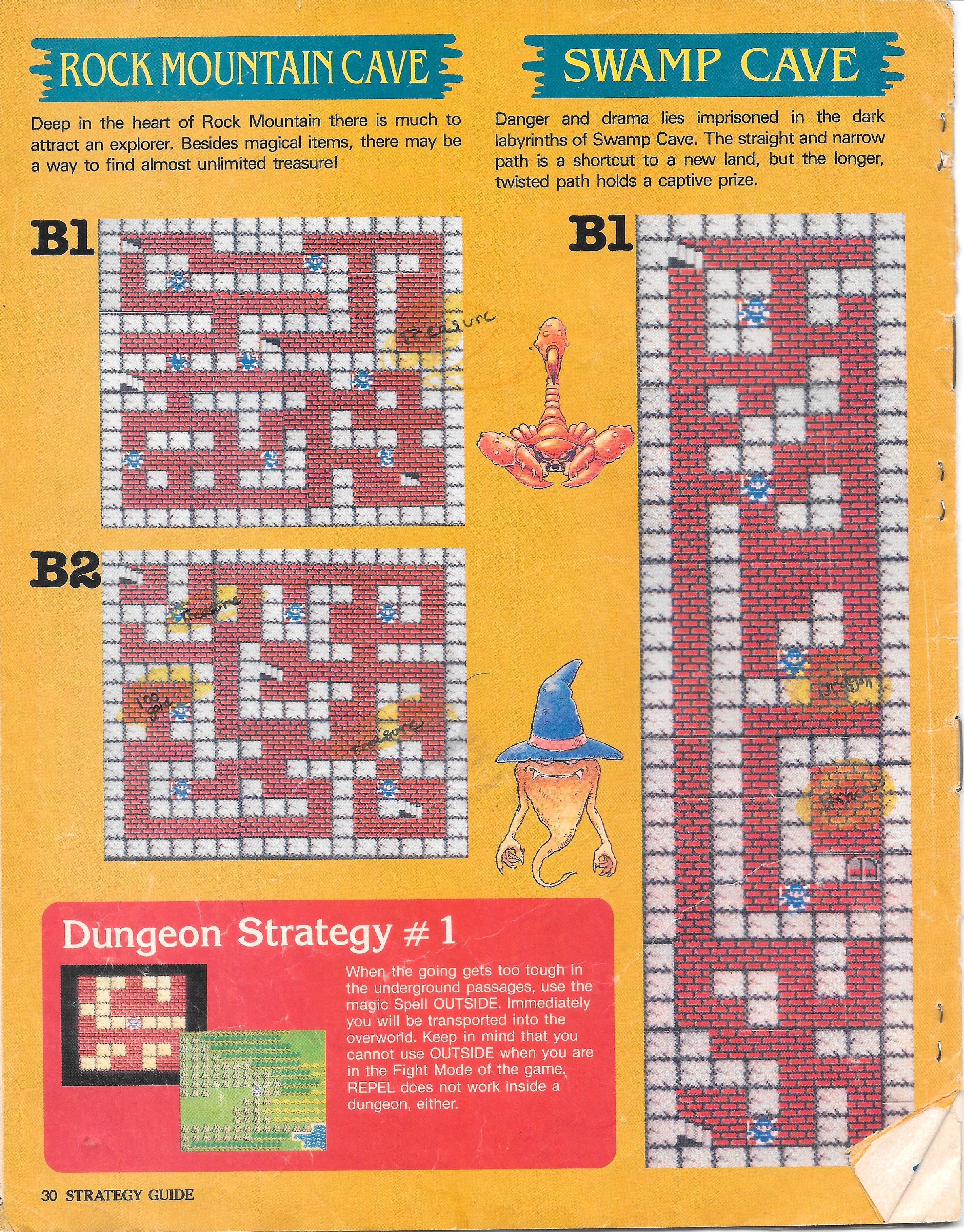
The same can be said for a couple of other things Nintendo Power published, such as their mini magazine insert about Dragon Warrior, the role-playing game that I know some of my friends found boring as hell, but I was obsessed with (along with its first sequel, and would have kept going in that series if I ever found III and IV but they were hard to come by). I marked that up with notes about where to find certain things or what direction to go in at certain points; I also saved one of the advice columns where someone wrote in to ask about the network of caves that would get you to the island where the final boss–The Dragon Lord–lived. And to their credit, Nintendo knew exactly what they had because eventually, they got into publishing player’s guides like The NES Game Atlas.
A book composed entirely of screenshots of each level from various games, the Game Atlas was a special book that you bought separately or came with a subscription renewal–which I’m pretty sure is how I got mine. It was printed to stand out as well, with a stiffer cover and size akin to what we’d eventually see in comic book trade paperbacks. The graphics on the page, while real, were microscopic and it took some real effort to actually see the images. I’m pretty sure I didn’t care, though, because this was a treasure trove, especailly for games like Zelda and Metroid.
Not that helped me win anything or get any further in a game, mind you.
I guess, though, that was the other appeal, because I was able to see later stages of Teenage Mutant Ninja Turtles that I never, ever saw due to dying in that damned underwater stage every time I played the game. Seriously, it was rage-inducing.
Anyway, the Game Atlas was the frist of a series of Players Guides of which Nintendo would publish three more before choosing a different format. The other three were Game Boy, Mario Mania, and Super NES. That last one is on our house and I’m pretty sure it’s because my wife owns a Super Nintendo. It is similar to the Game Atlas in that it does contain some maps, but it’s more like a set of fairly in-depth profiles of just about every SNES game available at the time. Nintendo was competing with Sega Genesis at the time.
Most of my Nintendo Power issues were thrown away years ago. I still have the one with Teenage Mutant Ninja Turtles on the cover as well as issue #41, which was Super Castlevania IV. I’m pretty sure the latter issue was toward the end of my subscription because they were covering NES games less and less. And that made sense considering that they would phase out the system by 1994. I never did own a Super Nintendo or a Game Boy, so I decided to drop my subscription and read Sports Illustrated.
But I get such a rush of nostalgia whenever I flip through one of these books or magazines. They are such an encapsulation of my early teen years.
 Pop Culture Affidavit