Thirty years ago, I begn collecting comics for the first time. Now, Im taking you back to those days with “Origin Story,” a comics podcasting miniseries where I will look at all of the comics I bought in 1986-1987 in “real time.”
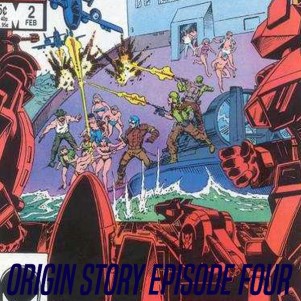
With this episode, I return to the series I started with, G.I. Joe and the Transformers. I take a look at issue #2 and see how the Decepticons make an alliance with Cobra and possibly plan to double cross them. Are we working toward a big conclusion or are things just dragging along? Listen to find out! Plus, I reminisce about October/November 1986.
Thirty years ago, I began collecting comics for the first time. Now, I’m taking you back to those days with “Origin Story,” a comics podcasting miniseries where I will look at all of the comics I bought in 1986-1987 in “real time.”
For episode two, it’s time to dive into one of my favorite series of that era, which is G.I. Joe: A Real American Hero #55, “Unmaskings.” I give a summary and review of the issue as well as take a look back at some mid-1980s television in my second segment.
Thirty years ago, I began collecting comics for the first time. Now, I’m taking you back to those days with “Origin Story,” a comics podcasting miniseries where I will look at all of the comics I bought in 1986-1987 in “real time.”
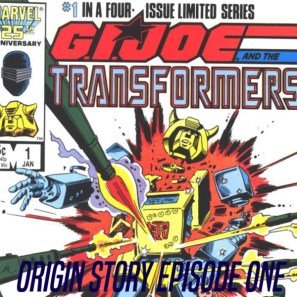
In this first episode, I take a look at the book that started all of this, which is a crossover that every kid would have loved to see play out because they had already been playing the crossover in their basements and bedrooms with their toys. I’m talking about Marvel Comics’ miniseries G.I. Joe and The Transformers. This time around, I will summarize and review issue #1 of the series.
Chuck Dixon and Kevin Kobasic bring us “Creep,” the story of an American sniper that is more legend than man, in The ‘Nam #66. As always, I’ll have a synopsis and review of the comic and this time around, my historical context section will be focusing on the second half of 1970 and January 1971.
While I don’t think that I can ascribe great personal significance to any of the comics I’ve covered in this series, I’d have to say that G.I. Joe: A Real American Hero #48 is probably one of the most important because this was the series that would become the most read and collected of my brief foray into comics in 1987. This was also a book that when I would read through the back and current issues that I had collected (and by the time my collecting fell off, there were quite a few) would have a cracked cover and rolled spine, showing the beating it had taken since I first got my hand on it at my friend Chris’s birthday party.
I’ll admit that when I got the book as a party favor, I wasn’t as excited as some of the other kids at the party because some of them got issue #47 (I assume that this issue was part of a Marvel Comics three-pack), and that comic book had an incredible Mike Zeck color of Wet Suit, Beachhead, and Hawk on the Devilfish (full disclosure: I had to look that up) firing weapons and yelling. Plus, issue #47 conclues with The Baroness shooting and killing Storm Shadown on a beach. Issue #48, on the other hand, features another Mike Zeck cover–one that is no less great–of Zartan holding Gung Ho in a choke hold with a sign behind them saying “G.I. Joe Headquarters: Level 3.”
That’s basically the main plot of the book, as it’s very much a “bottle episode” of a television show because it takes place mostly at The Pit, which was the nickname for the Joes’ HQ. Back in issue #46, Ripcord had infiltrated Cobra Island in search of his girlfriend Candy and was knocked out cold. Zartan decided that this was a great opportunity for him to infiltrate the Joe headquarters, so he disguised Ripcord as himself and then took Ripcord’s form using his morphing powers. While Ripcord wakes up in a hospital Springfield (a town in the United States that Cobra completely controls) and then proceeds to continue to search for Candy while fighting his way through Cobra operatives, Zartan is “treated” in The Pit’s infirmary, but his cover is quickly blown.
Ripcord’s story continues in the following issue (whose main focus is Destro aiding Dr. Mindbender in the creation of Serpentor), which means that the main focus here is Zartan, who is chased around The Pit and tries to elude capture by changing form several times and nearly gets away with it but is ultimately brought down by a brand new Joe, Sgt. Slaughter, who was a character I always had mixed feelings about because I knew him from the WWF (although in an interesting bit of trivia, Slaughter’s role in G.I. Joe is what led to him leaving the WWF in the mid-1980s, as Vince McMahon did not want to allow him to license himself to Hasbro; Slaughter would return in the early 1990s as an Iraqi-sympathizing heel), and therefore he was more like an “imported” character than one of the more “home grown” characters. And yes, I felt like this when I was nine years old. Plus, his solving the problem, while it definitely was meant to be slightly comedic (two Gung Hos come at Sarge and he punches one. When asked how he knew which one was Zartan, Sarge basically says, “I didn’t.”), also seems a little forced in that “look at how awesome this new character is” sort of way that didn’t always work on television shows, cartoons, or comic books. I haven’t read much beyond this issue recently, so I can’t really say how much of a role Sgt. Slaughter plays in future storylines, and I know that Larry Hama focused more on the ninja-type characters anyway (as we’ll see when I get into the actual “Origin Story” podcast).
The end of the issue is a meeting between Hawk and several of the U.S. military’s top brass, which carries on one of the running subplots of the time–Cobra has its own island and has managed to get “sovereign nation” status from the United Nations and the U.S. is hamstrung as to what to do. Cobra is a terrorist organization, so attacking Cobra Island would be considered an actual act of war, so the brass tell Hawk that the island is off-limits. This sets up what will be a huge story in issue #50, which is where the Joes invade Springfield and ultimately find nothing, something that leads to the team’s downfall (which includes Cobra invading The Pit around issue #53).
It’s a testament to Larry Hama’s writing that he could create such a continuity for an audience whose primary desire in picking up the comic was to see their action figures have adventures, although that’s not something I realized at the time, even though it would be soon enough.
And that’s it for my “Comics Prehistory.” Tune in on September 30, 2016 for the first episode of “Origin Story,” where I will cover G.I. Joe and The Transformers #1.
It’s the conclusion of a three-part story featuring Iceman and Speed in “Duty Elsewhere” from The ‘Nam #64 by Chuck Dixon, Wayne Vansant, and Art Nichols. Plus, I take a look at the history of the Vietnam War in April and May 1971.
After a brief hiatus, “In Country” is back and back in The ‘Nam with issue #63. We continue our three-parter featuring Iceman and Speed with a story by Chuck Dixon that features art by Wayne Vansant and Kim DeMulder. Plus, I look at events from March 1971 and read listener feedback!
You know, the phrase “It was all a big blur” is one that most people probably associate with a drunken night (or several, perhaps) in college, not to reading a comic book when you are eight years old. Then again, I may not be the only person who will say this about Secret Wars II.
Published in 1985 and 1986, Secret Wars II as the direct sequel to the blockbuster Marvel Super Heroes Secret Wars event that had come out in 1984. In that original series, an omnipotent being named The Beyonder swipes all of Earth’s heroes and villains and transports them to Battleworld, where they do an enormous amount of fighting (and Spider-Man gets the infamous alien costume). In the sequel, The Beyonder comes to Earth in human form and learns about being human.
I think?
I have to be honest–I only ever owned issue #6 and even then didn’t buy it voluntarily because it was another birthday party favor. And I don’t know if I read it thirty years ago when I first got it. Even if I did, I probably didn’t understand what was going on. I remember looking at the cover and thinking that the issue was probably important because it said that it was “#6 in a nine-issue limited series” (that and DC’s “miniseries,” “maxi-series,” or “Anniversary” banners were catnip to me back in the day … and still kind of are) and the cover showed this guy busting past a group of Earth’s mightiest heroes, saying, “Move over heroes, The Beyonder’s here!”
But really, up until I read this comic for this very blog post, I didn’t know what the comic was about. And quite frankly, I still have no idea what is going on. It seems that The Beyonder has come to Earth, closed on some property, built a huge house/headquarters, filled it with a ton of stuff like cars and planes, and then decides to help out Power Pack (which I assume plays out in greater detail in Power Pack #18, which is an official crossover issue). Meanwhile, Dave, a reporter from a local newspaper interviews him and The Beyonder tells the reporter all about who he is and how he came to be. But then he basically hires the guy as his PR man, they set up and organization, and The Beyonder decides he will “fight for life.” he doesn’t know what his role is or should be, and The Watcher along with superheroes think he might be dangerous. He then decides to eliminate Death and despite the objections every celestial being, succeeds. Then Molecule Man and Dave plead for him to bring Death back because it has completely upset the balance of the universe and then he makes Dave into Death and disassembles his new house.
And that’s the most succinct summary I could come up with.
Because honestly, the issue is almost what it would be like if a kid were given super powers and had free right. Think of Tom Hanks in Big. Plus, The Beyonder does kind of look like and eight-year-old dressed him. I don’tknow if that many grown men wore a curly mullet and that appears to be a vinyl jumpsuit (seriously, it’s like the guy saw a windbreaker and said, “No. I want the whole outfit to be that”), but then again, I have seen grown me in cropped muscle tees and acid-wash jeans. God, the Eighties were blindingly awful.
Anyway, if I am going to pick something positive out of the story that Jim Shooter wrote, it’s that it is kind of like a kid trying to “act bigger” than he is–like it’s his first day of high school or something–and the art by Al Milgrom is workmak-like. Otherwise, I can see why Secret Wars II was something I forgot as soon as I acquired it and why it’s more of a punchline than a fondly remembered story.
Next Up: We finish “Comics Prehistory” with G.I. Joe: A Real American Hero #48
“Dirty Deeds” brings us the return of two characters from previous ‘Nam missions: Speed and Iceman. Here, they are sent to retrieve an LRRP soldier who has gone rogue while back in Da Nang, the girlfriend of one of their special forces’ team gets into some serious trouble. It’s all in The ‘Nam #62 by Chuck Dixon, Wayne Vansant and Kim DeMulder.
I’ll also take a look at historical context from March 1971 and will be looking at letters and ads.
Okay, so I cheated a bit with my last post and simply reblogged a very old post about Superman: The Secret Years, but in rereading that old post, I saw the very roots of this series as well as “Origin Story” itself–three of those four issues came from Amazing Comics, and that started me on the road to eventually becoming a collector because I knew exactly where I could get any comic at any time. Not only that, but I had followed an entire series from beginning to end, which was a big deal when I was seven.
On the day in March 1985 when I bought Superman: The Secret Years #4, which was a few weeks after the issue had hit the stands, I also bought Transformers #5. My friend Christ had come over to my house and for some reason, my dad decided to take us to the comic book store. I grabbed the Superman book while he grad a comic that he said had “Superman’s dad” in it that I think was Crisis on Infinite Earths #3; we both, however, saw Shockwave on the cover of Transformers #5 standing in front of the phrase “Are All Dead,” which he had carved into a wall and almost immediately grabbed a copy. In fact, I think I remember being slightly scared of that cover and even to this day I think there is something ominous about it.
Plus, Shockwave was one of the toys that had recently been introduced along with the autobot Jetfire, which was and still is my favorite-looking Transformers toy (mainly because it was modeled after the Valkyrie fighter from Robotech). They had shared a commercial and in our minds, that made them big.
Unknown to us at the time, in terms of The Transformers comic book, Shockwave was big–at the end of issue #4 (the last issue of what was then a four-issue miniseries), with the Autobots on the verge of a major victory, Shockwave shows up on Earth and just blasts everyone who is left standing completely to hell. When issue #5 opens, he is watching The Honeymooners (and the opening of Ed asking “What’sa matter, Ralphie Boy?” and Ralph saying “Homina homina homina” cracked the two of us up) among other shows, including a news broadcast about an offshore oil rig, and he decides that Earth will be easy to conquer. And by the way, the opening splash page, which is drawn by Alan Kupperberg, is incredible.
Then, we get an image scarier than the cover–a two-page splash of Shockwave walking under the seemingly dead bodies of the Autobots. Moreover, we see him reviving and repairing his fellow Decepticons and telling Megatron–who is also under repair–that he is going to lead the group now, especially since Megatron’s rather incompetent excuse for leadership is what got them all there to begin with.
It’s a dynamic that I was unfamiliar with, to be honest. I had been watching the cartoon every day after school and if you had asked me to name the Decepticon most likely to pose a threat to Megatron, I would say that probably would have been Starscream and not Shockwave. But the comic and the cartoon had a lot of difference in continuities, which is something I would discover years later when I collected the comics.
There isn’t much else to this issue. Spike and Buster find the one surviving Autobot, Ratchet, and begin to work toward helping the good guys get back to life, and the next issue’s main event, which is a fight between Megatron and Shockwave in one of those classic, “AND ONLY ONE SHALL LEAD!” Marvel cover moments. But I think it is probably one of the most important issues of the series. This was the first issue of the ongoing comic book (and if this were today, it would have been a new issue #1), so this storyline was going to be the big test of whether or not The Transformers could sustain a following. Bob Budianscky provides a transition piece that is full of tension and leaves you wanting action, but also complicates the world even further. It was only because of my sporadic comics buying habits, however, that I wouldn’t get issue #6, or any other Transformers comic book until 1987.
 Thirty years ago, I begn collecting comics for the first time. Now, Im taking you back to those days with “Origin Story,” a comics podcasting miniseries where I will look at all of the comics I bought in 1986-1987 in “real time.”


 Chuck Dixon and Kevin Kobasic bring us “Creep,” the story of an American sniper that is more legend than man, in The ‘Nam #66. As always, I’ll have a synopsis and review of the comic and this time around, my historical context section will be focusing on the second half of 1970 and January 1971.
 While I don’t think that I can ascribe great personal significance to any of the comics I’ve covered in this series, I’d have to say that G.I. Joe: A Real American Hero #48 is probably one of the most important because this was the series that would become the most read and collected of my brief foray into comics in 1987. This was also a book that when I would read through the back and current issues that I had collected (and by the time my collecting fell off, there were quite a few) would have a cracked cover and rolled spine, showing the beating it had taken since I first got my hand on it at my friend Chris’s birthday party.
 It’s the conclusion of a three-part story featuring Iceman and Speed in “Duty Elsewhere” from The ‘Nam #64 by Chuck Dixon, Wayne Vansant, and Art Nichols. Plus, I take a look at the history of the Vietnam War in April and May 1971.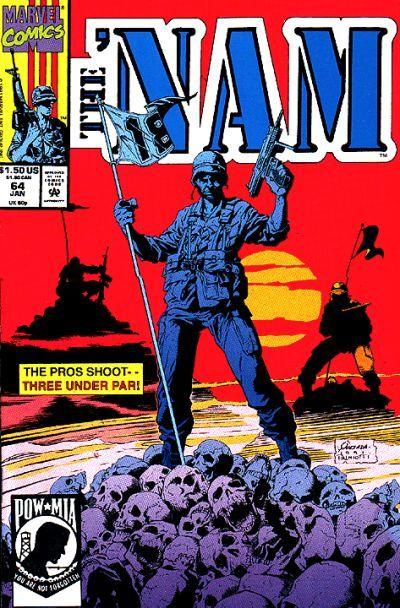
 After a brief hiatus, “In Country” is back and back in The ‘Nam with issue #63. We continue our three-parter featuring Iceman and Speed with a story by Chuck Dixon that features art by Wayne Vansant and Kim DeMulder. Plus, I look at events from March 1971 and read listener feedback!
 You know, the phrase “It was all a big blur” is one that most people probably associate with a drunken night (or several, perhaps) in college, not to reading a comic book when you are eight years old. Then again, I may not be the only person who will say this about Secret Wars II.
 “Dirty Deeds” brings us the return of two characters from previous ‘Nam missions: Speed and Iceman. Here, they are sent to retrieve an LRRP soldier who has gone rogue while back in Da Nang, the girlfriend of one of their special forces’ team gets into some serious trouble. It’s all in The ‘Nam #62 by Chuck Dixon, Wayne Vansant and Kim DeMulder.
 Okay, so I cheated a bit with my last post and simply reblogged a very old post about Superman: The Secret Years, but in rereading that old post, I saw the very roots of this series as well as “Origin Story” itself–three of those four issues came from Amazing Comics, and that started me on the road to eventually becoming a collector because I knew exactly where I could get any comic at any time. Not only that, but I had followed an entire series from beginning to end, which was a big deal when I was seven.
 Pop Culture Affidavit