 In writing this series of blog posts about the comics I picked up before the period I’ll be covering in the “Origin Story” podcast miniseries later this year, I’ve been deliberately writing about them in publication order because with the exception of a few books, I barely, if ever, remember the exact circumstances of their purchase. So that means while I’m covering things in order chronologically, I’m out of order autobiographically. I have very little reason as to why I’m clarifying that except to be anal retentive or something. Oh, and to say that while Star Wars #81 is to be read after Return of the Jedi, I’m fairly certain I got my copy before the Return of the Jedi adaptation miniseries I covered in the last entry.
While I’m not sure of the date, I vividly remember standing in Unique stationery, which would later become Sayville Card and Gift and looking through the magazine and comic book rack, probably on a night where we had ordered Chinese food and were killing time while the cooks at the Wai Wah Kitchen a few doors down cooked it. Unique had the kids magazines and comics on the bottom racks where we could all reach them and the more adult (and truly adult) magazines were on shelves for much taller people. Anyway, I flipped through all of the comics on the rack and when I saw the cover for Star Wars #81, immediately stopped and grabbed it, then asked for it. The comic was 60 cents, so as was usually the case it didn’t take much convincing.
Besides, looking at the cover, how could you not want to buy it? I’d seen Star Wars comics before, but for the most part was never interested in them, probably because at six years old, I was still too young to start being a full-fledged comics reader. Plus, while I saw Return of the Jedi in the theater that summer and Star Wars #81 came out in December, I hadn’t seen The Empire Strikes Back yet, so the pre-Jedi adventures didn’t necessarily pique my interest. But seeing this cover by Tom Palmer, where Han Solo and Princess Leia look exactly like they did on the screen, I thought to myself, “Wow, it’s really Star Wars!“ and once we had purchased it, I tore into it.

Chewbacca snuggles with some Ewoks.
Like other comics of the time, this one would be lost among all of the other ephemera of my youth–coloring books, comic books, and magazines that would be thrown in my desk and then thrown away as part of a spring cleaning purge. Also, like other comics of the time, I wouldn’t remember much about the story and would focus on the art–I could read very well at six years old, but there’s being able to understand the words and reading comprehension and my reading comprehension skills were not as fully developed as they would be down the line–and I remember moments like Chewbacca snuggling with some Ewoks and Han finding the dice he used to win the Falcon from Lando in a long-ago, still-untold story. And it wasn’t until 30 years later, when I bought a copy of the “A Long Time Ago …” Volume 4 omnibus from Dark Horse that I was able to reread and fully appreciate “Jawas of Doom.”
Written by Jo Duffy, who would write the series all the way to its end (save for a few fill-in issues) and illustrated by Ron Frenz, Tom Palmer, and Tom Mandrake, the story is the first in the Star Wars series that takes place after the Battle of Endor. The rebels are still on the planet, although it’s implied that this takes place just after Return of the Jedi, perhaps even the day after the big “Yub Nub” party. Han needs money and he tries to borrow some from a rebel pilot, who not only refuses him but insults him in the process. Leia suggests that she can loan him some money because she does come from a wealthy family, and that angers him even more, causing Han to stomp off with his pride hurt. The rest of the main characters are wondering what’s wrong and Leia explains that everything has happened so quickly since they freed him from the carbonite that Han really hasn’t had the chance to process everything and probably needs time to adjust.

Chewie gives Han a comforting hug aboard the Millennium Falcon.
Aboard the Millennium Falcon, which is shown having the radar dish that Lando knocked off while racing through the Death Star (something that I found awesome because my Millennium Falcon toy had lost its radar dish at one point, so I could just pretend it was post-Return of the Jedi), Han thinks about what his life is now life, especially since he spent so many years being a loner. He finds the dice that he used to win the ship from Lando and then Chewie comes in to give him a comforting hug.
Han then takes off with Leia and Chewie to Tattooine where he had stashed money years before, and on Tattooine, we see Boba Fett escape the sarlaac pit and get picked up by Jawas who mistake him for a droid. Han lands at Mos Eisley, Han has problems landing and then can’t get his money out of the bank because according to the bank the assets are frozen due to the customer being frozen. We also hear that the death of Jabba the Hutt has thrown the planet into a bit of chaos with various factions vying for the power left behind by the former gangster. Leia remembers that Artoo can probably talk with the bank computers to change the glitch in the system. They return to the Falcon to find Artoo gone and figure out that he’s been snatched by some jawas. Han and Leia borrow a couple of landspeeders and head after the sandcrawler, which has both Boba Fett and Artoo on board.
 The Jawas begin attacking the landspeeders and we have a fight where our heroes attempt to get into the sandcrawler while Artoo tries to escape. At one point, Han comes face to face with Boba Fett and Fett has no idea who Han Solo is. Fett helps Han out of the sandcrawler with Artoo and Han decides that he is going to help the bounty hunter as well. It’s only when Leia yells for Han that Fett gets his memory back and starts to shoot at Han, only to be foiled when Han and Artoo jump off of the sandcrawler just as it crashes into the sarlaac.
Now, my judgment and memory here may be off, but I think this is one of the more well-known, and perhaps one of the more well-regarded issues of Star Wars from the Return of the Jedi era. I’d say that its proximity to the film as well as its cover definitely have something to do with that; however, this isn’t a case where it’s just that because this is a great single-issue story. Han Solo was woefully underused in Return of the Jedi and while there is an end to the story overall at the end of that film, something that could be a sort of question regarding Han would be what he is going to do with his old life. Yes, the debt to Jabba has been “paid” (in that Jabba is dead so there’s probably no debt), but does that mean he settles down and doesn’t have adventures anymore or stays in the military? Or does he return to his old life as a smuggler?
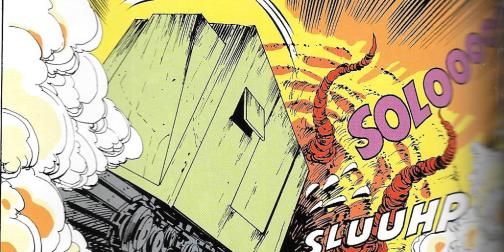
After a big fight, Boba Fett and the sandcrawler head into the mouth of the sarlaac.
The Force Awakens has shown that both actually happen and examines how they are wrapped up in particular consequences of the post-Jedi galaxy. “Jawas of Doom” is more of a hangover story–what happens when the party is over and you have to go back to work on Monday morning, in a manner of speaking. And it’s a good character piece that manages to be both fun and serious while furthering those involved without needing to shout THIS HAS IMPORTANT RAMIFICATIONS FOR THE FUTURE. And I know that one of the other notable features of the issue is the “return” of Boba Fett, or at least having Boba Fett “come back” and then be put right back where we found him, but to me that’s secondary to having Han go back to the exact place where he left off, which is Tattooine–the world he was on when he decided to take Ben Kenobi and Luke Skywalker to Alderaan.
There are a number of Star Wars stories that I go back to whenever I want to flip through the old Marvel series and this is one of them. Not, mind you, because of the personal nostalgia of remembering how I picked this one out, but because it’s actually a great read.
Coming Next Month: The Transformers #1.
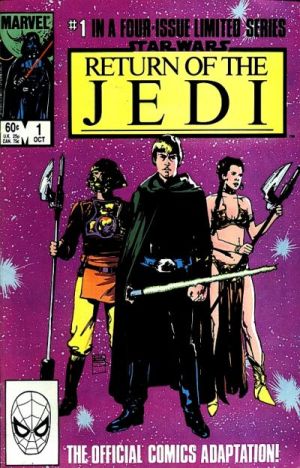 In my previous post, I wrote about the first comic I technically owned, although I only remember finding it years after I actually had “bought” it as a kid and it wound up feeling way more important later on, especially when I became an avid Batman collector and a fan of DC continuity, especially the continuity that centered around or was associated with Crisis on Infinite Earths. Here, looking at the second set of comics, is something that was purchased because it was associated with the most important thing in my life when I was six years old and that was Star Wars.
 You could not escape Return of the Jedi in 1983 and 1984. You may have not gone and seen the film (although I don’t know that many people my age who hadn’t seen it), but that didn’t matter because no matter what store you walked into, it seemed that there was something with a return of the Jedi logo on it. Lucasfilm licensed Jedi to the hilt and when I was a the height of my kid fandom, I had a ton of merchandise that went beyond the toys: sheets; cookies; Dixie cups; a calendar; and my most prized non-toy possessions, which were the records, tapes and books that told the story of the film. For myself and a number of other kids my age, owning these pieces of merchandise allowed me to relive the movie for at least a few years before I saw it again or owned my own copy on VHS (a copy I still actually have).
 If you’re unfamiliar with comic book multipacks, these were polybagged packs of three or four comic books that were stocked on the shelves of K-Mart, Toys R Us, and similar stores (for those local to Long Island, you’ll recognize the name TSS). Sometimes they were entire collections of limited series, such as this, but other times they were three comics featuring the same character or characters. I remember a number of times where I would pick one of the multipacks off the shelf and try to see what the middle book was because you only could see the full covers of two of them. Most of the comics multipacks were from Marvel, although DC produced them as well, and at some point in late 1983 or early 1984, the company bagged the entire four-issue series and put it on the shelves for the low, low price of $2.29, which was an 11-cent discount.
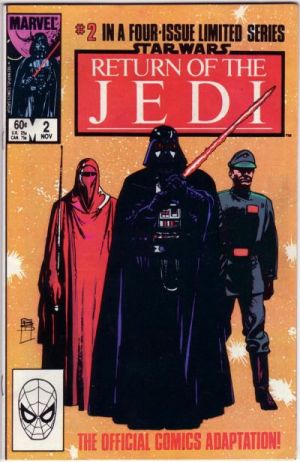 In trying to remember how I got these comics, I seem to recall getting them from Toys R Us in Bay Shore, and it was one of those rare times when my parents took Nancy and I to the store and allowed us to pick something out because we didn’t get toys or anything like that at random very often–they were usually saved for Christmas or our birthdays. Why we were at Toys R Us to begin with is beyond me, but I’m going to assume that either one of us was there to spend Christmas or birthday money or we were there to buy a gift for someone else, perhaps someone whose birthday party we were attending. The comics and coloring books were all located on a newsstand rack that was at the end of the board games aisle at the back of the store (and honestly, the old-school Toys R Us layout is probably worth its own blog post, especially if I can find pictures), and what probably happened is that I saw the comics multipack, asked my parents to buy it for me, and since it was roughly the same price as an action figure (my usual go-to “can you buy me this” item because it was cheap and they knew it wouldn’t go to waste), they said yes.
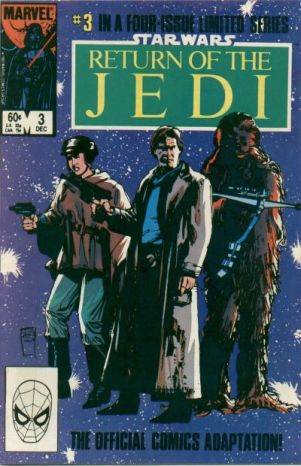 Still, I have to say that it is quite a disappointment. Having to condense the entire movie into four issues means that Goodwin and Williamson are almost doing a retread of the photographic storybook, as it’s heavy on narration boxes and the panels look more like stills than dynamic depictions of action. Granted, I know the story and knew the story when I first read it, so I didn’t and don’t need that feeling of “What’s going to happen next,” but this during an era of the Marvel Star Wars comics where David Micheline and Jo Duffy were writing some excellent stories and the work by artists such as Walt Simonson, Ron Frenz, and Tom Palmer was top-notch. That’s not saying that Goodwin and Williamson were bad at their jobs, but reading Jedi as part of that omnibus package had me wondering what the series would have been like if those creators had taken on the task of adapting the film.
 Pop Culture Affidavit