suburbs

Surely Brenda and Eddie Still Survive

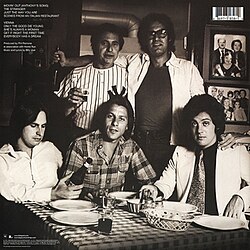
The back cover of The Stranger.

I was running errands this morning and listening to The Stranger (as one does) and as I wound through Charlottesville, I realized that the main characters inmy favorite song on the album, “Scenes from an Italian Restaurant” were married fifty years ago this month.

If you’re unfamiliar with the song, it’s seven minutes long and is a suite of sorts with a ballad at its center about two characters named Brenda and Eddie, who were the couple in high school, married at the end of July 1975, but the marriage crashed and burned quickly and they went their separate ways, though they remained friends. The premise of the song’s framing device is that Brenda and Eddie are meeting one another for dinner at an Italian restaurant, perhaps for the first time in years. While the “Ballad of Brenda and Eddie” section of the song is narrated in the third person, Eddie narrates the rest of the song, giving us one side of his conversation with Brenda (“Got a new wife, got a new life, and the family is fine”). As bittersweet as the song can be, it ends on a comfortable, warm tone with a return to a wine list from the opening (“bottle of red, bottle of white …”) and the sense that though the marriage never worked out, the friendship endures.

The sheet music as found in The Complete Billy Joel Volume 1. Note that I was playing it in September 1993.

I first encountered this song via sheet music, because I owned the book for Greatest Hits Vol 1 and II. Later, I’d buy The Complete Billy Joel books, which at the time covered everything from Piano Man to Storm Front in album order (and included songs from Cold Spring Harbor in the section devoted to Songs in the Attic). “Scenes from an Italian Restaurant” is in volume one of the two-book collection. My piano teacher, Mrs. Stein, would always let me pick a song to play every week or two in addition to whatever selection from the “course book” I was working through along with my scales and fingering exercises. For years, it was one-off sheet music for popular songs like “November Rain”, but I’d often go back to the Billy Joel books. At the time I got it, I had only heard three albums: An Innocent Man, Greatest Hits Vol. I & II, and Turnstiles. So my selections were mostly songs that were well known alongside tracks from Turnstiles like “Summer Highland Falls” (a song I never really mastered). But I’d often flip through the book to see what other songs were out there, which is how “Scenes from an Italian Restaurant” caught my eye.

How could it not? The title alone suggested something special. What it was and how it sounded, I had no idea, but I’d read through the lyrics look over the music whenever I was flipping through the book. I don’t know why I never decided to just try and play it; I either was worried I wasn’t going to play it right because I’d never heard of it, or that I would get in trouble for playing a song that hadn’t been assigned to me. Yes, that sounds ridiculous, but I have always been ridiculous.

Anyway, I didn’t have to wait too long after buying the sheet music book because I got a stereo for my fifteenth birthday and between my parents and my relatives, received six CDs, one of which was The Stranger (the others were Queen Live and Wembley ’86, Pocket Full of Kryptonite, … And Justice for All, Born to Run, and For Unlawful Carnal Knowlege). I already knew half of the album because those songs were on the Greatest Hits album, and while I can’t say if I went right for “Scenes from an Italian Restaurant” upon my first listen, I know I played it early and often. I think I may have made an attempt at it on the piano before Mrs. Stein assigned it to me, but I didn’t actually start playing it for real until September of 1993 (at least that’s what’s written in the book).
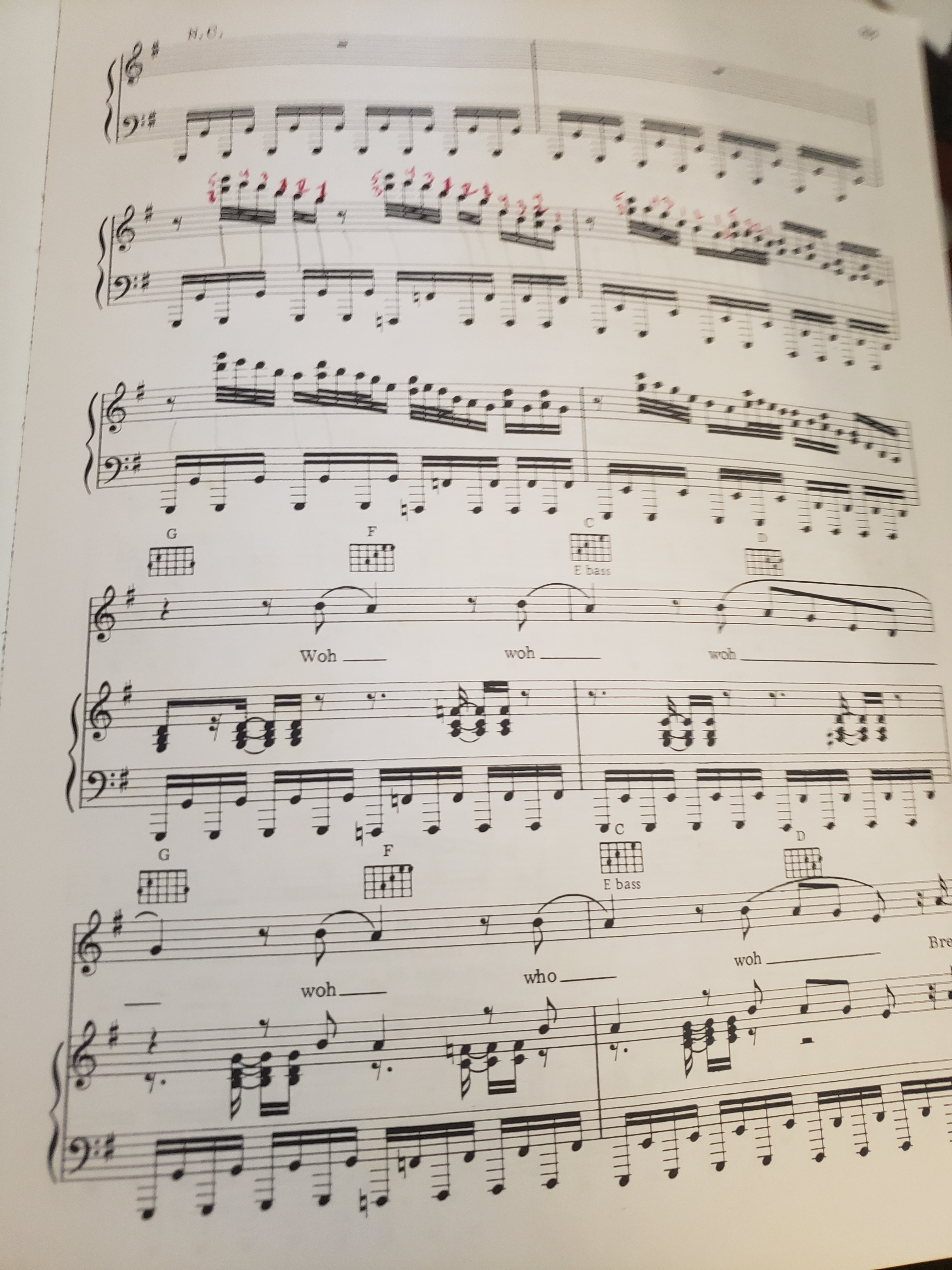
The intro to the “Ballad of Brenda and Eddie” section of the song. Note the continuous octaves in the bass and the fast movement in the treble.

I’ve mentioned this a couple of times on podcasts where I’ve discussed the song or The Stranger as a whole (Fire and Water Records, Long Play), but while the beginning and ending of the song are pretty easy to play, once you get to the beginning of the “Ballad of Brenda and Eddie” section, it becomes a bitch to play. The bass portion of the song, which you play with your left hand is a series of sixteenth notes, all of which are octaves. Now, that’s not hard to do in theory; it’s just that those sixteenth-note octaves go on for at least half the song, finally ending right before the final “bottle of red, bottle of white” lines. I’m neither left-handed nor did I ever master relaxing my wrists enough to have the endurance for those octaves, and that meant that at some point during the Brenda and Eddie verses, my left wrist would not only tense up, it would feel like it was burning. Add to that the way those verses open, where the right hand is playing four measures of what are mostly thirty-second notes before getting to the lyrics. I enjoyed playing the piano and got fairly good at it but despite my efforts, never mastered the song.

That didn’t stop it from becoming one of my favorite Billy Joel songs. I love it for its structure and how that changes throughout to fit the mood (see also: “Bohemian Rhapsody”), but moreover I love what it’s about. In my most recent podcast episode, I talked about his1980s output and I mentioned that while Springsteen wrote for the working class and Mellencamp wrote for the farmers, Billy Joel wrote for the middle-class suburbs. There are a number of songs that show this (the most on the nose being “The Great Suburban Showdown” off Streetlife Serenade), but this is one of the best because it encapsulates a certain feeling of suburban teenhood and is timeless in the way that movies like American Graffiti and Dazed and Confused are despite their very specific settings.

In fact, Brenda and Eddie come from American Graffiti, as they’re described as the “popular steadies and the king of the queen of the prom / ridin’ around with the car top down and the radio on.” I never ran with the Brenda and Eddie crowd, but in a town as small as Sayville, it wasn’t hard to spot the Brenda and Eddies of my high school. I knew the way people looked at the and referred to them, and definitely knew The Diner and how central that was (and to a degree still is) to Long Island culture, to the point where I’ve written stories that have diner scenes.

When Brenda and Eddie decide to get married toward the end of July 1975, Billy notes that “everyone said they were crazy / Brenda, you know that you’re much too lazy / and Eddie could never afford to live that kind of life.” But they go ahead with it anyway and while they find a place to live and buy a waterbed and paintings from Sears, they fight so much that they divorce quickly. It’s a pretty realistic picture and maybe even a caution tale about moving too fast when in love as a teenager (and thankfully, there’s no double suicide like some other stories about movie too fast when in love as a teenager). It’s also, as I realized many, many years after first hearing it, the flip side of a song that came out a decade earlier.

In 1964, Chuck Berry released “You Never Can Tell,” which most of my generation knows from the John Travolta/Uma Thurman dance scene in Pulp Fiction. The song is about two teenagers–Pierre and his girl, who is only referred to as “the Mademoiselle”–who get married as teenagers. In this song, Berry notes that “The old folks wished them well” and come to realize that it’s probably going to work, saying, “‘C’est la vie’ say the old folks / It goes to show you never can tell.”

The second verse is the most important to the context of “Scenes from an Italian Restaurant”:

They furnished off an apartment with a two room roebuck sale
The coolerator was crammed with TV dinners and ginger ale
But when Pierre found work, the little money comin’ worked out well
“C’est la vie” say the old folks
It goes to show you never can tell

Pierre and The Mademoiselle get an apartment and furnish it with things from Sears. Pierre gets a job and the money works out. And the old folks stand corrected because, you know, you never can tell.

As we know, Brenda and Eddie weren’t so lucky.

Maybe it was the optimism of the 1960s versus the harsh realities of the 1970s that are contrasted here; maybe it’s that Chuck Berry wrote upbeat rock and roll and Billy Joel wasn’t afraid to inject melancholy into a happy melody, but he’s telling us that the doubting old folks are probably right and it’s not going to work. But whereas Bruce Springsteen along with Jim Steinman and Meat Loaf would make their teen lovers feel trapped in “The River” and “Paradise by the Dashboard Light”, at least Brenda and Eddie are able to escape and get a second chance, even though they realize that their time as “The King and the Queen” has passed (“but you can never go back there again”).

That’s the most bittersweet moment of the whole song and a moment that I think most of us have had on some level as we’ve grown up and gotten older. I can’t tell you what my particular moment was, although it probably involved me going somewhere I used to go all the time and realizing that I wasn’t the center of anyone’s attention and I was just another customer or face in the crowd. Yes, I know how that sounds, but don’t forget that when you’re a teenager, you are often a walking ego and you often assume that everyone knows what’s going in your life and your world, as if they’ve been watching your movie this entire time. “Nobody cares who you were in high school” is truth because we all reach a point of emotional maturity where we understand that we are, yes, just going through life like everyone else. Some of us do it more quickly than others, and some don’t (read: influencer culture).

The sweetness with which Brenda and Eddie reunite years later is one of my favorite parts of “Scenes from an Italian Restaurant”, and one of the more optimistic parts of the song. Breakups don’t always go smoothly and relationships with exes are often fraught. By the time we’re in the Italian restaurant, they’re no longer “exes” in the sense that you or I would complain about our ex-girlfriends or ex-boyfriends. She’s an “old girlfriend” in the sense that the pain is behind him, and hopefully behind her as well. “Brenda and Eddie” survive in the sense that they can still be close and have something special between one another even though it’s much different than when they were eighteen.

As I get closer to fifty myself, I’ve come to realize how friendships that are fleeting or transient is just another part of life. There are people I was pretty close to in high school and college whom I only see via Instagram or Facebook posts; there are others whom I don’t talk to at all. And then there are the ones who are still there; maybe we take too long to get back to one another and aren’t embedded in one another’s lives like we were in our teens and twenties, but we’re still there and as cheesy as this concluding sentence is going to sound, will always save a seat at a bar, diner, or an Italian restaurant.
The Suburban Squall

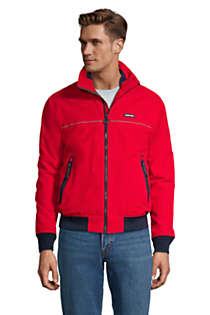
Image from Lands’ End

Though the individualistic teenagers I teach might be loathe to admit it, they all wear the same clothes. Oh sure, they all find ways to express themselves, but self-expression via nonconformity in clothing has been de rigueur for adolescents since they first gained a sense of purchasing power in the 1950s or 1960s. They may all say they aren’t one of the sheep-like masses, but look in their closets and you’ll find a hooded sweatshirt, a pair of stretch leggings, and a beat-up pair of jeans in the same way my generation had an array of flannel shirts, alternative band T-shirts, a beat-up pair of jeans, and the Lands’ End Squall Jacket.

First introduced by the Dodgeville, Wisconsin-based clothier in 1983, the Squall is a medium-weight nylon jacket with a fleeced lining that is suitable for the majority of autumn, winter, and early spring when the weather is cold but not the Ice Station Zebra conditions that make you bust out your Lands’ End parka. The company says that it “best exemplifies all of our know how. Popular for its classic style and versatility, it’s reliably warm, and made from durable windproof waterproof fabric.” That definitely appeals to the parent in me who wants to make any $50-100 jacket last as long as possible, and Lands’ End definitely knows I want dependability when it comes to my purchase at least according to their explanation of why the jacket is called “Squall”:

Reminiscent of our nautical past, the word ‘squall’ usually defines a sudden gust of wind bringing on storms of rain, snow, or sleet. Not the most comforting of images, is it? But at Lands’ End, Squall has come to define dependable warmth for generations … you might not be a captain sailing a ship through the choppy ocean but you certainly weather your fair share of storms throughout the day. Unlike a typical squall, our winter jacket may not be the cause of the storm will certainly be there to keep you cozy, dry, and protected from whatever is brewing on the horizon.

(source: Landsend.com)

I know that’s a lot to say about a jacket, or any article of clothing for that matter but the Squall jacket earned that pretense. My parents bought me my first Squall jacket sometime in the fourth or fifth grade; it was blue and I’m pretty sure that my sister got a red or pink colored one, and they were pretty much permanent fixtures during the transitional seasons all the way through high school, not just in my house but in my school and town as a whole. It was, in a sense, part of the suburban uniform of the 1980s and early 1990s. Those of a certain vintage and upbringing may remember going outside in the late winter and early spring, riding around on your bike in search of a friend to play with, and once you found them trying to figure out what to do because both of your moms kicked you off the Nintendo and out of the house. Sometimes, you got a bunch of other people together and played a rough game of touch football; other times, you just kept riding around while carrying on a conversation about whatever kid or teen topics came up. The specifics really didn’t matter, to be honest; you just remember that you were wearing the jacket.

(more…)

Fat Bats and Invisible Runners

Picture from Fixtures Close Up.

They were a sign of spring, popping up like tulips or daffodils out of their white pots, inviting every kid to grab one. The setting might have been different for each of us–a supermarket, a stationary store, a 7-Eleven–but we all saw the same skinny yellow stem with a red, white, and blue cardboard flower that read “Wiffle.”

I have no idea how many sets I owned as a kid but Wiffle ball had a constant presence my childhood, and was something that everyone wound up playing at some point or another. Very often, I’d be bored on a Saturday afternoon, get chased out of the house by my mom, and at some point, would rummage through my garage for the bat and ball with whichever friend happened to be around. Eventually, we’d get a game going with friends, neighbors, or even people we barely knew in whatever yard or empty street was available. Every game started the same way: we would plot out where the bases were using fence posts and bushes as bases and trees as foul poles, divide into teams, and play.

I never gave much thought to where Wiffle ball came from, and figured that it evolved from the games of stickball on the streets of Brooklyn that my parents’ generation played until they moved out to the suburbs in the 1950s, trading shadow of Ebbets Field to the shadow of a maple tree on the street of the same name. But it is a decidedly suburban game, created in the summer of 1953 in a Fairfield, Connecticut backyard. Two kids really wanted to play baseball, but the constraints—not enough people, not enough space, too much property damage—and made it impossible to get a good game going, so out of that, a new game was created. According to an account by David J. and Stephen A. Mullany on Wiffle ball’s official website, their father and his friend approached their grandfather—who himself played semi-pro ball—and:

He picked up some ball-shaped plastic parts from a nearby factory, cut various designs into them and sent Dad out to test them. They both agreed that the ball with eight oblong perforations worked best. That’s how the WIFFLE perforated plastic ball was invented. To this day, we don’t know exactly why it works… it just does!!

The ball they designed was easy to make curve and harder to hit, with lots of strikeouts. In our Dad’s neighborhood, a strike-out was called a “wiff”, which led to our brand name and federally registered trademark “WIFFLE”.

They also came up with a formal set of rules that designated distances for singles, doubles, triples and home runs, something I didn’t know about until recently because I don’t remember seeing any instructions with that sparsely packaged ball and bat. Plus, since there was no Internet, we just followed the rules of baseball when we played, putting as many people on the field as we could, and creating invisible runners when necessary.

Ah, the invisible runner, the universal placeholder for a small-sized team of kids, and the source of 99.9% of Wiffle ball arguments. I can’t count the number of times I hit the ball, rounded first, stepped safely on second and declared that another run had scored because I had invisible runners on second and third, only to have that disputed. Thankfully, most of those arguments were over quickly, but every so often I had to hear a sniveling “It’s not!” from That One Kid.

I don’t know how he always ended up in our group, but no matter the backyard or pickup game, That One Kid went 110%, pitching like he was Roger Clemens and swinging like he was Babe Ruth, although his only discernable skill was trash talking like the bear-drenched Yankees fan he was fated to become. I grew up hating this kid because it always seemed like he was out to make me feel terrible. Every remark he made had a snide tone of superiority, especially because of his athletic prowess or knowledge of the game. Plus, he didn’t seem to realize that we were playing for the fun of it. Wiffle ball allowed us to practice curve balls, sliders, and knuckleballs. Plus, if I really thought that we were playing the seventh game of the World Series, would I thrown so many eephus pitches (which we called “folly floaters”)?*

And by the way, since the ball was designed for better pitching, that made the game freaking hard. A good curve ball and an incredibly thin bat meant that we spent more time swinging and missing (with the occasional foul tip) instead of smacking the ball across the lawn. So when we got tired of sucking at the plate we would switch to “home run derby” mode, busting out the “illegal weapon”, which was a giant red fat bat left over from a preschool-aged baseball/softball set that had been in my garage next to the big wheels that were nearly destroyed and collecting dust. We’d ditch the rules and strand the invisible runners, designate a home run marker, and say “First to twenty wins.”

Well, that or whomever was winning when the ball got eaten by the huge tree in my parents’ yard. In those moments, I could step up to the plate and greet the underhanded pitch the way I wish I had been able to face the hardballs on the actual baseball diamond, hitting moon shot after moon shot and celebrating while my friends retrieved the ball from our neighbors’ lawn, not wanting it to end, even when it was getting dark and my parents were calling me in for dinner.

*Deep down, I knew that he wasn’t worth my aggravation, but the Little League years were hard for me and largely contributed to my insecurities in sports. In fact, years later, I would spend a lot of time in intramural and rec league softball hearing the voice of that one kid in my head as I tried desperately not to embarrass myself.

Candee Avenue Goes to War

Entertech water hawk

The Entertech water hawk, which is the pistol that my friends and I called “The Scorpion UZI.” Whether or not that was an accurate description is debatable. Photo by Marquis de Zod. Used under cc license.

It’s the summer of 1987.  Times are hard.  In the hot weather, the kids of Suburbia are desperate for cold snacks and air conditioning, both of which are kept in short supply by parents who are insistent that they go outside.  But outside has become a land of boredom–there are only so many places to ride, the playground is overrun by little kids, and the huge tree in the backyard at the latest wiffle ball.  The situation seems desperate and there is nothing left to do but fight.

All right, so the summer boredom sometimes suffered by suburban children is not a good premise for a 1980s action movie, but there was a time about 30 years ago where my friends and I took our interest in GI Joe and extended it to our yards and the streets surrounding them.  Granted, we had been playing pretend for years, reenacting superheroes, Voltron, and Star Wars on playgrounds, but that was fantasy, before we had seen Red Dawn and realized that we had to be ready to fight real-life villains like Mummar Gaddafi.  And so, for our birthdays, we got Entertech water guns.

https://www.youtube.com/watch?v=sU1b_F5ztX0

Now, we’d had water pistols before, usually the plastic-colored kind that came in multi-packs or that you fished out of a bin at Ben Franklin for $1.00.  But Entertech was a whole new dimension of water warfare.  These were battery-operated automatic guns which meant that all you had to do was fill the clip with water, slap it into the gun, and press the trigger.  Once you did, you heard the noise of a small motor and saw the water come out in steady bursts until you ran out and either threw in another clip (you could buy extra clips) or went and got a refill.  It was leaps and bounds beyond anything else we had seen until then and more importantly, they looked cooler than anything else we had seen.

Entertech guns looked like real guns.  LJN, who manufactured the guns, from 1985 until 1990, gave them fully automatic rounds of 60 RPMs and a range of 30 feet and “realistic” looks.  To an extent, anyway.  I mean, nobody was going to mistake a kid with an Entertech RPG for a terrorist.  But the realistic look and the fact that we were seeing moveist hat had guns just like it, such as Rambo (which Entertech would license at one point), made them incredibly appealing.  My friends and I had the Water Hawk, which I believe was a reproduction of a TEC-22 semiautomatic Intratec or “Scorpion,” which is why my friends and I referred to them as “Scorpion UZIs.”  And the advertising wasn’t false–they shot far and fired fast.

Unfortunately, without carrying around several clips of water, playing with all the functionality of the gun proved tedious, so what we often did was kept firing and pretending we were shooting bad guys or one another.  The motor still worked as long as the batteries weren’t dead, so we could get sound effects going.  And long after the batteries had died, rusted, and corroded because I’d stored the gun in the garage, it was still a prop for whatever adventures we devised.

My friend Tom’s backyard, which was huge, was usually the setting for those adventures.  We would put on the military camo pants that we’d gotten from Thunder Ride–our local army surplus store–and would run around dodging enemy fire, or army crawling through the grass to find and ambush someone, or climb into the huge tree in his backyard to get into sniper positions or to jump out of the tree like we were Rangers, the best of the best.  When we weren’t playing, we were at the local library looking up the various ranks and insignia in the World Book Encyclopedia or were photocopying pages out of books like Weapons of World War II by C.B. Colby.  Like I said, we weren’t just pretending; we were training.

Unfortunately, this commitment to realism resulted in its fair share of controversy in 1987 and 1988.  There is a line in Die Hard where Reginald Vel Johnson’s character talks a bout how he’s riding a desk because he shot a kid who was carrying a toy pistol.  While this served to give some background to his character, it was also a rather timely reference.  While this didn’t become a widespread phenomenon in the mid-1980s, toy guns being the cause of shootings or being used in crimes came to national attention.

In 1987, it literally spilled onto the airwaves when Gary Stollman managed to make his way into the studio of KNBC in Los Angeles and put a toy gun to the back of consumer reporter David Horowitz while forcing him to read what the Los Angeles Times called ” a rambling statement on the air about the CIA and space aliens.”  Stollman was the son of a former KNBC pharmaceutical reporter and had managed to find a legitimate way into the building–according to 4:00 p.m. newscast co-anchor Kristie Wilde, he had obtained a security badge and had made himself inconspicuous on the set prior to walking up to Horowitz.  The news director, Tom Capra, cut the feed, but not before viewers saw Stollman, Horowitz, and the gun:

The incident, which you can read about in the archives of the Los Angeles Times (“Intruder With Toy Gun Puts KNBC Off Air” and “Risk at NBC: Integrity of Newscast vs. a Man’s Life”), was probably the most high-profile incident and by 1988, legislation was being introduced in various states as well as at the federal level to better regulate the manufacture and sale of toy guns.  According to a June 16, 1988 article in the New York Times (“After 3 Deaths, Realistic Toy Guns are Under Fire”), after a few deaths and crimes, several major cities–San Francisco, Memphis, Chicago, and Detroit–as well as states such as Connecticut, Michigan, California, Florida, and Massachusetts had begun banning the sale and manufacture of realistic toy guns (they also point out that black, blue, and silver guns had been banned in New York City since 1955).  At the time the article was published, the Senate had passed a bill that was sponsored by Bob Dole that required toy guns to have bright orange markings and barrel plugs.

While the article quotes Gerald Upholt, who was the director of Gun Owners of California, as saying,  ”Anti-gun types are trying to play on the emotional appeal of a few incidents. The real problem is that police officers may need a little more training,” the incidents and legislation were enough to spell the end of realistic toy guns on the shelves. Toys R Us said they wouldn’t be selling the guns and companies, including Entertech, changed their designs to be more colorful and fake-looking.

So the Entertech era didn’t last very long, and in the 1990s, Acclaim bought LJN and discontinued all of its toys, choosing to focus on the video game side of the company (probably because Nintendo would only license so many games per company per year and having two separate companies under one umbrella meant more games/more revenue).  Autofire guns weren’t as in vogue by that time anyway because in 1990, Larami released a game-changing water gun, the Super Soaker (which is now manufactured by Nerf), a gun that had a huge water tank and used pressure to shoot incredibly far and with a more powerful stream than other water pistols.

My friends and I had stopped fighting the war by then, anyway.  Our interest in G.I. Joe had faded, and while we were still watching our fair share of action movies, we were more in tune to what was happening in the world of the WWF.  Today, kids still can buy Super Soakers but can also arm themselves to the teeth with Nerf darts, which are really good for shooting cups off of a picnic table but maybe not so much for a real-life Red Dawn.