 While I don’t think that I can ascribe great personal significance to any of the comics I’ve covered in this series, I’d have to say that G.I. Joe: A Real American Hero #48 is probably one of the most important because this was the series that would become the most read and collected of my brief foray into comics in 1987. This was also a book that when I would read through the back and current issues that I had collected (and by the time my collecting fell off, there were quite a few) would have a cracked cover and rolled spine, showing the beating it had taken since I first got my hand on it at my friend Chris’s birthday party.
I’ll admit that when I got the book as a party favor, I wasn’t as excited as some of the other kids at the party because some of them got issue #47 (I assume that this issue was part of a Marvel Comics three-pack), and that comic book had an incredible Mike Zeck color of Wet Suit, Beachhead, and Hawk on the Devilfish (full disclosure: I had to look that up) firing weapons and yelling. Plus, issue #47 conclues with The Baroness shooting and killing Storm Shadown on a beach. Issue #48, on the other hand, features another Mike Zeck cover–one that is no less great–of Zartan holding Gung Ho in a choke hold with a sign behind them saying “G.I. Joe Headquarters: Level 3.”
That’s basically the main plot of the book, as it’s very much a “bottle episode” of a television show because it takes place mostly at The Pit, which was the nickname for the Joes’ HQ. Back in issue #46, Ripcord had infiltrated Cobra Island in search of his girlfriend Candy and was knocked out cold. Zartan decided that this was a great opportunity for him to infiltrate the Joe headquarters, so he disguised Ripcord as himself and then took Ripcord’s form using his morphing powers. While Ripcord wakes up in a hospital Springfield (a town in the United States that Cobra completely controls) and then proceeds to continue to search for Candy while fighting his way through Cobra operatives, Zartan is “treated” in The Pit’s infirmary, but his cover is quickly blown.
Ripcord’s story continues in the following issue (whose main focus is Destro aiding Dr. Mindbender in the creation of Serpentor), which means that the main focus here is Zartan, who is chased around The Pit and tries to elude capture by changing form several times and nearly gets away with it but is ultimately brought down by a brand new Joe, Sgt. Slaughter, who was a character I always had mixed feelings about because I knew him from the WWF (although in an interesting bit of trivia, Slaughter’s role in G.I. Joe is what led to him leaving the WWF in the mid-1980s, as Vince McMahon did not want to allow him to license himself to Hasbro; Slaughter would return in the early 1990s as an Iraqi-sympathizing heel), and therefore he was more like an “imported” character than one of the more “home grown” characters. And yes, I felt like this when I was nine years old. Plus, his solving the problem, while it definitely was meant to be slightly comedic (two Gung Hos come at Sarge and he punches one. When asked how he knew which one was Zartan, Sarge basically says, “I didn’t.”), also seems a little forced in that “look at how awesome this new character is” sort of way that didn’t always work on television shows, cartoons, or comic books. I haven’t read much beyond this issue recently, so I can’t really say how much of a role Sgt. Slaughter plays in future storylines, and I know that Larry Hama focused more on the ninja-type characters anyway (as we’ll see when I get into the actual “Origin Story” podcast).
The end of the issue is a meeting between Hawk and several of the U.S. military’s top brass, which carries on one of the running subplots of the time–Cobra has its own island and has managed to get “sovereign nation” status from the United Nations and the U.S. is hamstrung as to what to do. Cobra is a terrorist organization, so attacking Cobra Island would be considered an actual act of war, so the brass tell Hawk that the island is off-limits. This sets up what will be a huge story in issue #50, which is where the Joes invade Springfield and ultimately find nothing, something that leads to the team’s downfall (which includes Cobra invading The Pit around issue #53).
It’s a testament to Larry Hama’s writing that he could create such a continuity for an audience whose primary desire in picking up the comic was to see their action figures have adventures, although that’s not something I realized at the time, even though it would be soon enough.
And that’s it for my “Comics Prehistory.” Tune in on September 30, 2016 for the first episode of “Origin Story,” where I will cover G.I. Joe and The Transformers #1.
 You know, the phrase “It was all a big blur” is one that most people probably associate with a drunken night (or several, perhaps) in college, not to reading a comic book when you are eight years old. Then again, I may not be the only person who will say this about Secret Wars II.
 In writing this series of blog posts about the comics I picked up before the period I’ll be covering in the “Origin Story” podcast miniseries later this year, I’ve been deliberately writing about them in publication order because with the exception of a few books, I barely, if ever, remember the exact circumstances of their purchase. So that means while I’m covering things in order chronologically, I’m out of order autobiographically. I have very little reason as to why I’m clarifying that except to be anal retentive or something. Oh, and to say that while Star Wars #81 is to be read after Return of the Jedi, I’m fairly certain I got my copy before the Return of the Jedi adaptation miniseries I covered in the last entry.

 The Jawas begin attacking the landspeeders and we have a fight where our heroes attempt to get into the sandcrawler while Artoo tries to escape. At one point, Han comes face to face with Boba Fett and Fett has no idea who Han Solo is. Fett helps Han out of the sandcrawler with Artoo and Han decides that he is going to help the bounty hunter as well. It’s only when Leia yells for Han that Fett gets his memory back and starts to shoot at Han, only to be foiled when Han and Artoo jump off of the sandcrawler just as it crashes into the sarlaac.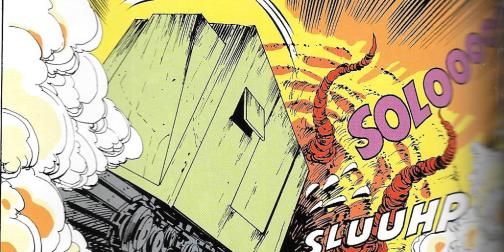
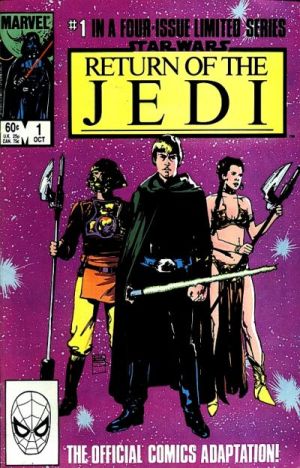 In my previous post, I wrote about the first comic I technically owned, although I only remember finding it years after I actually had “bought” it as a kid and it wound up feeling way more important later on, especially when I became an avid Batman collector and a fan of DC continuity, especially the continuity that centered around or was associated with Crisis on Infinite Earths. Here, looking at the second set of comics, is something that was purchased because it was associated with the most important thing in my life when I was six years old and that was Star Wars.
 You could not escape Return of the Jedi in 1983 and 1984. You may have not gone and seen the film (although I don’t know that many people my age who hadn’t seen it), but that didn’t matter because no matter what store you walked into, it seemed that there was something with a return of the Jedi logo on it. Lucasfilm licensed Jedi to the hilt and when I was a the height of my kid fandom, I had a ton of merchandise that went beyond the toys: sheets; cookies; Dixie cups; a calendar; and my most prized non-toy possessions, which were the records, tapes and books that told the story of the film. For myself and a number of other kids my age, owning these pieces of merchandise allowed me to relive the movie for at least a few years before I saw it again or owned my own copy on VHS (a copy I still actually have).
 If you’re unfamiliar with comic book multipacks, these were polybagged packs of three or four comic books that were stocked on the shelves of K-Mart, Toys R Us, and similar stores (for those local to Long Island, you’ll recognize the name TSS). Sometimes they were entire collections of limited series, such as this, but other times they were three comics featuring the same character or characters. I remember a number of times where I would pick one of the multipacks off the shelf and try to see what the middle book was because you only could see the full covers of two of them. Most of the comics multipacks were from Marvel, although DC produced them as well, and at some point in late 1983 or early 1984, the company bagged the entire four-issue series and put it on the shelves for the low, low price of $2.29, which was an 11-cent discount.
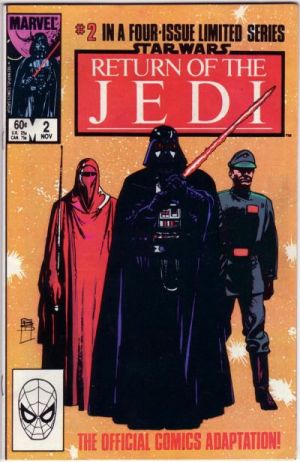 In trying to remember how I got these comics, I seem to recall getting them from Toys R Us in Bay Shore, and it was one of those rare times when my parents took Nancy and I to the store and allowed us to pick something out because we didn’t get toys or anything like that at random very often–they were usually saved for Christmas or our birthdays. Why we were at Toys R Us to begin with is beyond me, but I’m going to assume that either one of us was there to spend Christmas or birthday money or we were there to buy a gift for someone else, perhaps someone whose birthday party we were attending. The comics and coloring books were all located on a newsstand rack that was at the end of the board games aisle at the back of the store (and honestly, the old-school Toys R Us layout is probably worth its own blog post, especially if I can find pictures), and what probably happened is that I saw the comics multipack, asked my parents to buy it for me, and since it was roughly the same price as an action figure (my usual go-to “can you buy me this” item because it was cheap and they knew it wouldn’t go to waste), they said yes.
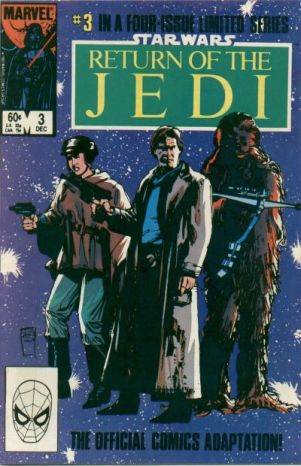 Still, I have to say that it is quite a disappointment. Having to condense the entire movie into four issues means that Goodwin and Williamson are almost doing a retread of the photographic storybook, as it’s heavy on narration boxes and the panels look more like stills than dynamic depictions of action. Granted, I know the story and knew the story when I first read it, so I didn’t and don’t need that feeling of “What’s going to happen next,” but this during an era of the Marvel Star Wars comics where David Micheline and Jo Duffy were writing some excellent stories and the work by artists such as Walt Simonson, Ron Frenz, and Tom Palmer was top-notch. That’s not saying that Goodwin and Williamson were bad at their jobs, but reading Jedi as part of that omnibus package had me wondering what the series would have been like if those creators had taken on the task of adapting the film.
 I suppose it’s kind of funny to say that comic #1 in your collection (read: the first comic you purchased and still have) is only #1 on a technicality. I own a copy of The Brave and the Bold #182 and have owned this comic since 1981; however, I honestly do not remember buying it.


 Pop Culture Affidavit