For so many good movies, there are the unfortunate sequels. Oh sure, there are good sequels out there, but there’s also Predator 2, American Pie 2, or Eddie and The Cruisers II: Eddie Lives. And I’ve seen all three of those, so I know.
Anyway, in the grand scheme of things, most of those sequels are pretty much forgotten, relegated to late night runs on random cable channels that cannot afford quality movies, and I don’t think I would have known there was a sequel to American Graffiti if it hadn’t been pointed out to me via Charles Champlain’s book, George Lucas: The Creative Impulse when it came out in 1992. While it doesn’t get the attention of Star Wars, Empire, Jedi, or the original American Graffiti, More American Graffiti is covered halfway decently. In reading about the movie online and watching it last week, however, I get the feeling that this one is ranked in the Lucas filmography as “At least it’s not Howard the Duck.”
Okay, that’s a little harsh, but it wasn’t a movie that I intended seeking out and had I not been showing American Graffiti in my advanced English class, I would have been fine with watching bits and pieces of it here and there throughout the years whenever I happened to come across a random showing on WPIX or on cable. Plus, when I looked it up on Netflix, it was available for instant viewing.
American Graffiti, Lucas’s 1973 classic, follows a group of friends on the last night of the summer. What Lucas and director Bill Norton do is set More American Graffiti on four consecutive New Year’s Eves, from 1964-1967. After an initial scene in 1964 where several characters from the original meet at a racetrack, the storylines go their separate ways: John Milner is drag racing cars in 1964; Terry “The Toad” is in Vietnam; Debbie is a hippie in 1966 San Francisco; and Steve and Laurie are a married couple in Modesto in 1967. (more…)
My movie viewing history as a child and adolescent seems to have two phases. Starting from when I was very young, I have always loved science fiction and action movies. That shouldn’t be a surprise, considering I was born the year Star Wars came out and spent the better part of my youth watching cartoons that were used to sell action and sci-fi based toys. My father, his friend (my “uncle”) Chuck, my Uncle Lou, and quite a number of other family members happily fostered my love for those things through buying me toys and making me copies of those movies, or not balking at the fact that in the fourth and fifth grade I was watching R-rated movies.
But as I went through high school, I began to become more interested in another genre, which was the teen movie. I’d known about the types of movies for a while and had owned a copy of Ferris Bueller’s Day Off since it first came out on video, but before I graduated, I had probably seen every movie starring John Cusack or directed by John Hughes. The person or people who deserve the credit for this are not the same who got me into a galaxy far, far away, because none of them absolutely loved Say Anything … the way I did (though nobody seemed to think it was weird that a 15-year-old boy wanted to rent Porky’s). I lay the blame for my love of the teen movie genre at someone I didn’t even know: the programming director of WPIX.
Now, here is where I probably should talk about how I first watched Three O’Clock High on a random Saturday afternoon on WPIX and that prompted me to rent the uncensored version of the movie and from there I was completely hooked on this little gem of a film, but that would be a lie. That’s because I actually saw Three O’Clock High in the theater, which should have been a sign that I would become fully ensconced in teen angst flicks within a few years, but in all honesty I went to see it with my friend Tom on Columbus Day weekend of 1987 because we had nothing better to do that day and the commercial had been running on television for the better part of a couple of weeks, so we asked my dad for some money and rode our bikes up to Sayville Theater to take in a very cheap matinee.
My dad was on the phone when I asked him for the money, although I wasn’t deliberately timing it that way because the cost of a matinee for two people at Sayville Theater in those days came in under ten bucks, so it wasn’t like I wasn’t going to get the money. He reached for his wallet and began describing what he thought was the movie we were going to see: a guy has to protect a daughter and she’s in danger, which was the plot of the Scott Glenn version of Man on Fire. I corrected him and he stopped telling my neighbor what the movie was about and looked at us incredulously.
“You’re going to see the one about the fight?” he asked.
“Uh … yeah,” I said.
My father looked at both of us and let out a groan, as if we had just committed the most disappointing act a couple of ten-year-old boys ever could have done. I mean, I might as well have told him that we were going to the salon to learn how to braid the hair of my sister’s My Little Pony collection.
And yes, Three O’Clock High is about a fight. Casey Siemaszko plays Jerry Mitchell, an overachieving geek who raises the ire of Buddy Revell (played by Richard Tyson, who is probably best known for being the villain in Kindergarten Cop) because … well, Jerry touches him and Buddy hates being touched. (more…)
Being that I grew up without cable television and didn’t always get the chance to get to a video store, there were times in my formative years where I lived for a good movie on broadcast television. The local stations always seemed to comply with my wishes, too, because WPIX seemed to have one of the deepest film libraries imaginable, and even our local Fox affiliate would bust out something random when the network wasn’t running their primetime programming. And of course you had the ABC Sunday Night Movie, which is where I got most of my exposure to the Roger Moore-era Bond films as well as various versions of the first two Superman movies. The 1980s and early 1990s were a glorious period of movies on television, and are definitely directly responsible for my ongoing obsession of teen films, especially those of the two Johns: Hughes and Cusack.
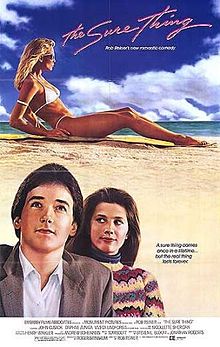
Now, I think one day I will probably do an entire post on the edited-for-television version of The Breakfast Club because it has its own place in the “Children of the Eighties” museum, and how WPIX seemed to have all of the rights to all of John Cusack’s mid-1980s teen comedies, even Hot Pursuit, which is one of those “Someone greenlighted this?” films that only the most hardcore of teen movie buffs will sit through. I’ll even go into Better Off Dead, which was the start of my Cusack fandom (up until then, I’d recognized him as the older brother in Stand By Me and The Journey of Natty Gann, the latter of which made me bawl my eyes out when I first saw it), because I would rather focus on one of the films that is in my All-Time Desert Island Top Five Cusack films, and that is The Sure Thing (the others, in chronological order, are Better Off Dead, Say Anything …, Grosse Pointe Blank, and High Fidelity).
Directed by Rob Reiner in 1985, The Sure Thing was his follow-up to the seminal This is Spinal Tap and has the most Eightiesness about his films from that decade, even though it does not look dated at all (except for maybe Nicolette Sheridan’s hair and the fact that her breasts are real, but we’ll get to that). I first saw the film in 1991 when it had its network broadcast premiere on Fox one summer evening. I was about to enter high school at the time and therefore the strict 8:00 bedtime my parents had maintained up until that point was starting to be eased, especially since it was the summer and I didn’t have school and rarely went out at night because I was either without rebellious friends or spending the summer recovering from some kind of facial surgery.
Anyway, I had heard of the film’s title because I had the easy-level sheet music to Rod Stewart’s “infatuation” in a movie themes book for the piano. Never played it, though because I didn’t like Rod Stewart very much and the only thing I remembered about that song was the black-and-white video where he’s being really pervy. The way the song is used in the film, by the way, is where I am sure that David Hasselhoff got his inspiration for about a hundred Baywatch montages, because it’s simply Nicolette Sheridan in a white bikini on a beach putting a blanket down, putting lotion on, and laying out while a very 1980s-looking title font rolls credits. And even though I don’t like the song, I give props to Reiner because it’s a damn near perfect introduction.
I stuck with the movie not because of Sheridan (although being that I was fourteen years old, I was definitely, shall we say, intrigued), but because I noticed Cusack’s name in the credits and I had just spent most of the summer watching my taped copies of Better Off Dead and One Crazy Summer to the point where I had every line memorized and they were already wearing out. Rob Reiner was a director I was slightly familiar with too, having watched Stand By Me and The Princess Bride quite a bit. And the plot was simple enough to keep me going through Fox’s various commercial breaks that advertised the only thing it had going for it in the summer, which was the beach club episodes of Beverly Hills, 90210 (I can never remember the name of the beach club, btw. I want to say Malibu Sands, but that was Saved By The Bell … ah, Stacy Carosi …): guy travels 3,000 miles to get laid.
Okay, that’s not the entire plot of the movie because the 3,000 miles to get laid part starts after the movie’s first act is over and that first act sets up the two major characters: Walter “Gib” Gibson (Cusack) and Allison Bradbury (Daphne Zuniga, who I definitely knew from Spaceballs). They’re attending college together at some ivy league-type school in the northeast (Gib tells his friend that he’s “never seen so much corduroy in one place”) and much like any good romantic comedy where opposites attract, they don’t really like each other after they first meet and by the time they wind up stuck together on the road trip to UCLA, where his friend Lance (a pre-Goose but nicely fratbro Anthony Edwards) has arranged a night with The Sure Thing; and her boyfriend Jason (Boyd Gaines) attends, they absolutely despise one another.
At this point, the film actually becomes a road movie and very much in the classic sense, which is what I think gives The Sure Thing its timelessness. It’s one of those movies that I’m sure hasn’t been attempted in the remake/reboot sense, and I have a feeling that if a remake was attempted it would fall completely flat because it would be more like Road Trip, which has its moments but also has diminishing returns on subsequent viewings. I’ve been watching The Sure Thing for twenty years—first on a pirated VHS copy and then on DVD—and to this day I laugh my ass off the entire way through. I think it has to do with how realistic the situations and characters actually are. A movie like Road Trip might be zany and crazy, but what happens to Allison and Gib while they’re on the road in The Sure Thing could very well still happen. Reiner and the screenwriters seemed to take a lot of care to make sure that the film felt organic and that comedic bits, such as Allison’s flashing a truck full of guys after Gib calls her repressed, aren’t forced.
The credit also goes to the entire cast, too. Cusack’s obviously the star (and it’s hard to believe that he was only 17 and actually had to be emancipated from his parents in order to shoot on location), and he nails every line and rant (his “if I fail English my life is ruined” bit is a classic). But it’s not a John Cusack showcase; Zuniga’s job is to elevate the comedy above that of stuff like Porky’s, and she plays Allison like a Mallory Keaton with a brain. Then, you have her on-screen boyfriend, Jason, who is the epitome of the “square” and should be a one note character, but Boyd Gaines delivers his lines so well that he almost steals certain scenes, especially when it becomes obvious that Allison is kind of over him. The line, “How about a good hot mug of China Black?” which should be a random line, is quite possibly one of the funniest lines in Eighties teen movies.
But I digress. I could very well sit down and talk for at least a couple of hours (or in our case, 1500 more words) about all of the little things that make this such a favorite of mine. I’m just honestly pleased that a film genre that is very so often disposable has produced a gem like this.
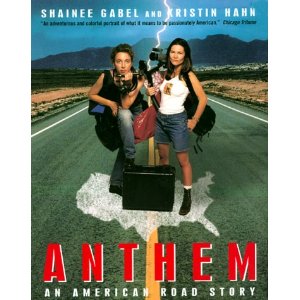
What is American is one of those things that is so hard to determine that at this point, it’s almost like a philosophical dilemma rather than a physical entity. Many have tried to define or capture it; in fact, it seems that the right wing has sought to trademark it for the last couple of decades. But pinning the answer to that question to one definition is never successful, and it seems that the journey to find that answer is just as if not more important. Such is the case with Shainee Gabel and Kristin Hahn’s Anthem: An American Road Story.
In the summer of 1995, the two women, fed up with their jobs, decided to interview as many people as they possibly could under the auspices of looking for the definition of our country, of American heroes, and of the American Dream. The result was a chronicle of that trip told through both a book and a film.
I am not sure if either the film or book were very popular upon their release, as I came in after the fact, getting the book as swag in the summer of 1998 when I interned for its publisher, Avon Books. I was quite possibly the worst intern in the history of publishing because aside from free books and the ability to fix a five-way copier jam in under a minute, I took nothing away from my experience except for the desire to not work in publishing and to not spend my life commuting into Manhattan via the Long Island Rail Road.
But my ultimately unrewarding experience aside (which, by the way, is compounded by the fact that I turned down an interview for an unpaid internship with a major comics publisher because this internship was paid and I didn’t want my parents to be upset that I was working for no money), I got some very good reads out of it and Anthem was one of them. During my time in editorial, the book’s editor, Jennifer Hershey, had a large poster of the cover to the paperback edition (Gabel and Hahn standing in a road holding their recording equipment) on the wall of her office and a huge stack of the hardcover edition by her door. I either asked for a copy or swiped one (probably the former) because the concept of two people taking a road trip to interview people intrigued me, as it was a huge risk for someone to take with her life and I was one of the most risk-averse people in the world (still am to an extent).
I read Anthem on the train, taking it in kind of passively. I don’t think that’s the type of reaction that the authors were looking for from a reader, but it’s not their fault; at that time I had the perspective of an overprivileged white college student who really knew nothing about the world beyond beers on Saturday. Oh sure, I had service learning in classes that had me volunteering in sketchy areas of Baltimore and there was a professor or two that required a subscription to The New York Times, but the atmosphere at Loyola was very insulating; I went to college for four years and really didn’t take the time to look very much beyond myself or my own shit. So really, it’s not their fault. (more…)
A couple of weeks ago, the final space shuttle mission launched, and by the end of this week, it will have landed, ending a 30-year era of space exploration for the United States. It goes without saying that this is the end of an era. The first space shuttle launched when I was 3-1/2 years old, and I (unfortunately) rank the Challenger Disaster as one of the most important moments of my childhood.
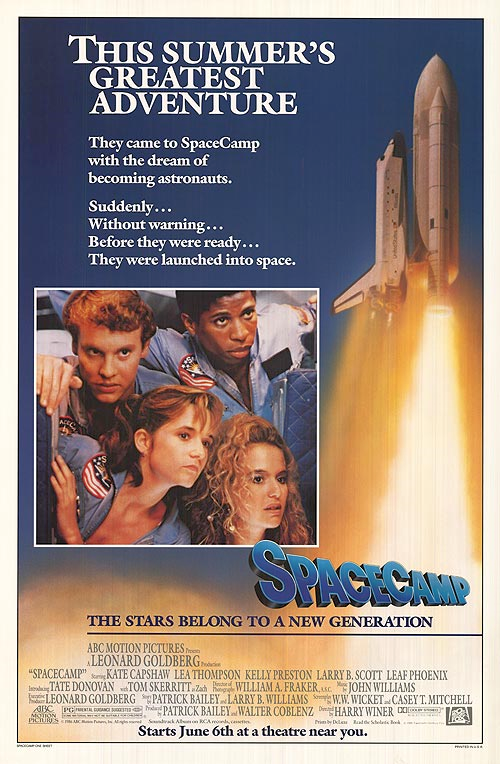
I wanted to post something about what I thought about the space shuttle saying farewell; however, I don’t know if I would have anything to say that hasn’t been said already, and I wasn’t sure how I was going to keep whatever I wrote within the confines of my “pop culture” subject matter. I thought of the Young Astronauts Challenger Commemorative Packet that I got when I was in the fourth grade and I also thought of writing about the time I put together one of those Revell space shuttle kits and got glue all over my hands, paint all over the place, and never got the decals to go on correctly (seriously, did anyone?). But then I thought of what nobody is probably talking about as far as the space shuttle is concerned, which is the biggest (and well … kind of only) space shuttle movie there is: SpaceCamp.
Starring Kate Capshaw, Lea Thompson, Kelly Preston, Joaquin Phoenix (back when he was known as “Leaf”), Tate Donovan, and Larry B. Scott (a.k.a. Lamar from Revenge of the Nerds), SpaceCamp is one of the few science-fiction (although in a way, this is more “science” based) movies from the late 1970s and 1980s where aliens do not attack and lay waste to the Earth, nor do they mate with, possess, or disembowel anyone. In fact, SpaceCamp doesn’t have any aliens. Unfortunately, its tension is tepid enough for a teacher to show an elementary school class.
Capshaw (about a year or two removed from Indiana Jones and the Temple of Doom) plays Andie Bergstrom, an astronaut who, when she sits on her family’s farm in 1961, sees John Glenn’s capsule fly through space and says proudly to her dog, “I’m goin’ up!” (a line delivered in the cheesiest manner possible, btw). More than two decades later, she has received the umpteenth notification that she will not fly on a shuttle mission–Atlantis, which is scheduled to launch within a couple of weeks. Her husband, Zach (Tom Skerritt, who would be Viper in Top Gun the same summer), then coaxes her into being an instructor at Space Camp, which for plot reasons is held at Cape Canaveral and not in Huntsville, Alabama (a Space Camp was opened in Florida in 1989, but this came out in 1986). She reluctantly takes on the “blue team” of Space Camp students, who are …
… a group of stock characters. Kevin (Donovan) is the arrogant screw-up guy and we know that because when we meet him, he’s wearing a Hawaiian shirt and rocking out in his new Jeep; Kathryn (Thompson) is an overachiever who is already a pilot, and we know this because she flies a WWI-era bi-plane to the parking lot; Tish (Preston) is a mall ditz who possesses the ability to memorize just about anything she reads, and we know this because she cinches her flight suit with a stylish red belt; Max (Phoenix) is the annoying kid genius who everyone will pick on, and we know this because everyone picks on him; and Rudy (Scott) is … well, the only one without any issues. (more…)
Instead, I felt like taking a look at a movie that I know that she doesn’t necessarily love but has probably seen as many times as some people have seen Star Wars, which is the 1993 rollerblading movie, Airborne.
Yes, in 1993 someone decided to make a teen/sports movie whose focus was rollerblading.
Now, in my wife’s defense I am sure she’s only sat through this entire movie a couple of times and it’s not her Star Wars by any means. However, I think that we both have lost count of the number of times that we’ve been flipping channels only to come across this movie, usually on one of the high-numbered random-assed movie channels that we get as part of our basic cable plan (like “FLIX”) or one of the assorted Disney-owned channels like ABC Family. You’d think that an 18-year-old movie about a niche sport that never really caught on would spend time wallowing in obscurity only to be occasionally retrieved from the bowels of Netflix instant streaming or one of the few remaining video stores throughout the land.
However, as we all know, there really aren’t any video stores left in the land (and certainly not many that have a VHS inventory or would have bought Airborne on DVD). Plus, this is not available on Netflix at all. And I’d like to say “Thankfully, it’s on cable all the time so I got the chance to tape and watch it,” but I can’t even do that because when I sat down to prep for this entry I couldn’t find it anywhere in my television listings. So I had to watch this movie “illegally” in a sense: in ten-minute increments on YouTube. No, really. I mean, I could have rented it from YouTube for $2.99 but it’s not worth that price (plus, isn’t that why I have a Netflix subscription) but someone took the time and the effort to break the movie into segments and post them in “parts” up on YouTube. It’s a little tedious and a couple of the parts are missing a few minutes but overall worth not having to pay for it.
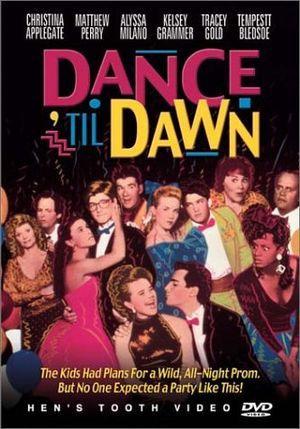
When I was a teenager, I spent a little too much time thinking about what my senior prom would be like. I wouldn’t call it an obsession, but I thought about the big end-of-high-school dance enough to keep my thoughts to myself as if they were some sort of dirty little secret. If I wasn’t writing about it, that is. Track down a copy of Collage, the Sayville High School literary magazine from 1995 and you’ll see a story called “Scenes from a High School Prom,” which is some sort of boy-finally-gets-the-girl story that only a lovesick teenager would write, or maybe even dream about (literally, in fact, because it’s based on a dream I once had). I even incorporated prom (specifically, that story) into a novel I wrote nearly a decade ago; although by then the message wasn’t so much about the fairytale of the perfect prom night but what happens the morning after and the baggage that comes with it.
In real life, I never had baggage concerning my senior prom experience. In fact, I had a great time mostly due to the fact that I went with someone very cool and avoided most of the bullshit drama that my particular group of friends was involved with at the time (at least for one night — certain friends of mine, if they’re reading this, know that there was drama that I definitely got sucked into during and after our senior year of high school). So I was never disappointed in my prom night, mainly because I was surprisingly well-adjusted coming out of high school (though I am the first to admit that I was both high-strung and immature … but enough about my issues). Still, I would be lying if I didn’t say that the prom fantasy definitely factored into my perception of what my prom would be like.
That fantasy, btw? The one featured in that short story I wrote in senior year creative writing? Well, boy takes friend on whom he has a crush to prom and at the last chance to finally do it, he tells her he loves her and she says she loves him and they kiss and everyone lives happily ever after. And where did I get the idea that this is what was going to happen at my prom because this is what happened at every prom? Usually I would have some long explanation regarding my unpopularity in high school coupled with my testimony of junior high dances being special, magical places; however, all I have to do is say three words:
There are some kids who aren’t scared of anything and there are some kids who are scared of everything. I spent most of my childhood in the latter camp, doing my best to avoid any situation that was a little scary, whether it be climbing aboard a roller coaster or climbing the ropes in gym class. Scary movies definitely fell into this category. I think that by the time I was ten years old, the scariest movie I had watched might have been a WPIX airing of Carrie (which really wasn’t scary) or an old Hammer Studios flick like Dracula: Prince of Darkness. In other words, despite my fascination with the video boxes for horror movies, I really wasn’t up for renting one.
I can’t tell if spending my early years being relatively sheltered from the sights and sounds of scary movies had a positive or negative effect on my life. I mean, the negative is that I was a complete pussy when it came to watching even Alien for the first time, and one scary scene could give me a really bad nightmare to the point where I insisted that my closet door be closed each night before I went to bed. Then again, the fact that I remembered that one scary scene so well has made me really appreciate what goes into a quality horror movie. In other words, I’m not one to sit back and simply let The Exorcist or The Blair Witch Project simply happen. If I’m watching one of those films, I’m involved.
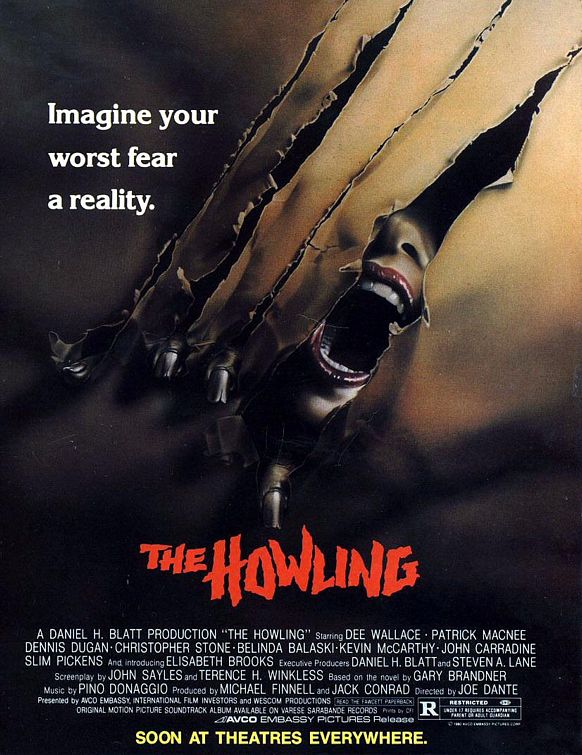
The poster for 1981’s “The Howling,” which was one video box I could never stop staring at when I was a kid.
I am not a horror movie guy. Sure, I’ll sit down and watch stuff like Halloween or Night of the Living Dead on occasion, but I am not the type to line up outside of a movie theater on the opening night of the latest Saw movie because I am promised that there are going to be 50% more genital mutilations. However, I’ve always been fascinated by horror films, especially those which are outside of the mainstream.
This fascination began at an early age, when Sayville’s Video Empire opened in 1984. This wasn’t the first video store that my parents frequented–that distinction belongs to Video Village, which was located in a very small house-like building next to what was Chicken Delight but is now Hot Bagels on Montauk Highway in Sayville; and Video Zone, which was across from the Oakdale train station–and those video stores were pretty cramped establishements with very little to offer me except for repeated rentals of Superman: The Movie and video collections of Mickey Mouse cartoons which, if you waited long enough after the cartoons were over, featured a long and terrible trailer for Disney’s long and terrible sci-fi movie, The Black Hole.
Video Empire, as I’ve mentioned before, quickly became my home video store after it opened because it was on the same side of Main Street/Montauk Highway as my parents’ house was, so that meant I didn’t have to worry about crossing it to get there on my bike; and it was pretty huge for a video store. Now, it was nowhere near the size of a Blockbuster Video but for a mom and pop operation, it was pretty large. The children’s section of the store was right as you came in, to the right, and if you kept walking toward the counter you found that the kiddie videos transitioned into the sci-fi/horror videos. By this time in my life I had seen Star Wars a ton of times, so I would peruse the shelves hoping to find The Empire Strikes Back or Return of the Jedi, both of which had just come out on video back in the mid-1980s and were highly sought after by Video Empire’s customers.
While perusing, my eyes would eventually land on the box for one of the many horror movies available. These included your obvious classics, such as the Friday the 13th series (which at that point was up to Part IV, or The Final Chapter), the Halloween series (at the awful Season of the Witch), or something random like Psycho or Alien. But they also included movies that probably didn’t make a lot of money at the box office and whose studios had decided to recoup whatever losses they had by making them readily available for the bourgeoning video rental market. If there’s nothing else out, they have to rent something, right? I mean, it’s a decent rationale. Eventually, while my dad tried to figure out what new release action flick to rent and my sister looked for The Last Unicorn or some shit, I would pick up one of those boxes and turn them over, reading the description.
I am sure that everyone has a movie that he’s meant to see but never gotten around to. Moreover, I’m sure that there are plenty of people out there who are weirdly obsessed with the possibility that they may watch a certain movie, yet never seem to get around to watching. Or, as my father often says, they’ve seen “bits and pieces” of certain films.
For years, whenever I would walk into Sayville’s Video Empire with my dad, the first place I would check out would be the science fiction/horror section. The reason for this was twofold: Star Wars movies fell under this classification and they were located along the right-hand wall next to the new releases. On the shelves were always random movies that to this day I’m sure nobody ever rented (ah, the early days of video stores where inventory meant whatever was actually available at the time) as well as the popular flicks. One of those was the 1984 movie Night of the Comet.
A film about teenagers having to make it in a post-apocalyptic Los Angeles, Night of the Comet didn’t do much at the box office and I would never had heard of it if I hadn’t been watching At the Movies with Siskel & Ebert on a regular basis and saw their review, which was pretty good for a movie that was nearly a B movie and didn’t do that well at the box office.
But the concept intrigued me: everyone in the world has been wiped out, a few teenagers seem to have survived, and all is not as it seems. Plus, the poster (and the subsequent video box) was really cool looking. How could you go wrong with this?
 For so many good movies, there are the unfortunate sequels. Oh sure, there are good sequels out there, but there’s also Predator 2, American Pie 2, or Eddie and The Cruisers II: Eddie Lives. And I’ve seen all three of those, so I know.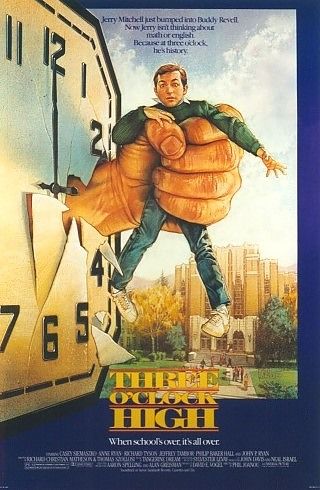


 Pop Culture Affidavit