movies

Pop Culture Affidavit, Episode 38: We’re Not Gonna Protest!

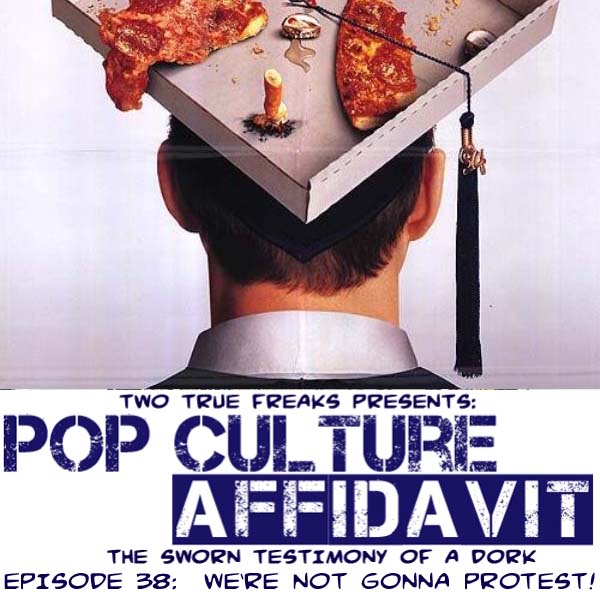
Episode 38 CoverSave your seat on the couch, throw on some P-Funk, try to figure out the Caine-Hackman theory, work on your thesis, and get really offended because it’s time to take a look at the 1994 college flick PCU! Yeah, while it’s not the most important film of 1994: The Most Important Year of the Nineties, it’s still one that we all remember, probably because of the number of times it aired on Comedy Central. Anyway, I take a look at the movie’s plot and talk about five of my favorite things about the Jeremy Piven classic.

You can listen here:

iTunes:  Pop Culture Affidavit

Direct Download 

Pop Culture Affidavit podcast page

Memories That Overshadow Movies

Just because we're both hideous doesn't mean we'll be compatible.

Just because we’re both hideous doesn’t mean we’ll be compatible.

About five years ago, I was showing Mary Shelley’s Frankenstein to a room full of high school seniors. We got to the scene where the monster (Robert DeNiro), who is now at the point where he has Victor Frankenstein (Kenneth Branagh) by the throat and is forcing the good doctor to make him a bride from the tattered remains of Helena Bonham Carter. The Bride of Frankenstein, so to speak, emerges from the 19th-Century life-giving apparatus and Victor and the monster begin calling to her, telling her to come to each of them as if she’s a puppy trying to choose between two owners.

I went on to ask my students about how Hollywood is forever getting Frankenstein completely wrong as I thought about how I missed how bad this movie was back when I saw it in the theater in 1994. After all, by putting the name of the author above the title–a trend that eventually died out after William Shakespeare’s Romeo & Juliet because … Shakespeare Wrote Romeo & Juliet? Thanks for telling me, Baz–Kenneth Branagh’s film purported to be the definitive adaptation of Mary Shelley’s classic horror novel. And to a point, it actually works out pretty well–bride-dog moments aside, the basic structure of the plot is there–but in many areas it falls flat and that’s why I was wondering why I liked it when I was seventeen. Then I realized that like a few of my entertainment choices in the mid-1990s, this story begins with the phrase: “You see, there was this girl …”

While I know it shouldn’t, being on a date drastically changes your perspective on the film you’re watching. The night I went to see Mary Shelley’s Frankenstein, I was on my first official date with a girl I had been friends with for a couple of years, but we’d been hanging out a lot and that prompted me to do the math: our hanging out together + she knowing that I liked her = she might actually want to go out with me. This wouldn’t mean very much to your average seventeen-year-old boy, but I wasn’t exactly your average seventeen-year-old boy. I had spent the majority of my adolesence being painfully awkward around girls, acting immature and not knowing what to say. The more attracted I was to a girl, the worse that awkwardness was, and that is probably the reason I didn’t go on a single date until that night in November to see Mary Shelley’s Frankenstein. So I spent most of the movie not concentrating on the film but trying to figure out how to properly behave so that the date went well and by the end of the night I could … well, I guess the experession “get to first base” would apply. In the blur of Branagh, Bonham Carter, DeNiro and Aidan Quinn (I remember his part because she squeed when she saw him), I worked on trying to find the right moment to put my arm around her, followed by trying to figure out a tactful way of taking my arm away when it started to go numb. It was ten times tougher than the calculus class I had every first period.

Not to brag, but I was successful. Okay, it’s not much of a brag because we walked from the movie theater to the corner near both of our houses and I spent what might have only been two minutes but felt like ten awkwardly and nervously chuckling and making small talk until I finally made a move and kissed her good night. It wasn’t my first kiss–that had come the previous summer when I was away in Europe–but it was my first “date” kiss, the first kiss that had the potential to lead to something more than a goodbye and a half-assed attempt at writing letters to one another for the first month after I got home. Never in my life had so much depended on one very chaste kiss at the end of the night; never in my life had a moment been so charmingly small town that they don’t even write those types of moments anymore.

I haven’t watched Mary Shelley’s Frankenstein in its entirety since that moment in my classroom five years ago; I’ve been more or less permanently teaching sophomores since then and high-concept, high-budget horror from the 1990s isn’t as interesting to me as low-budget schlock from the 1980s. And I guess I’ll keep it that way because for once I don’t mind having a memory overshadow a movie.

Pop Culture Affidavit, Episode 37: I’m Not Even Supposed to Be Here Today!

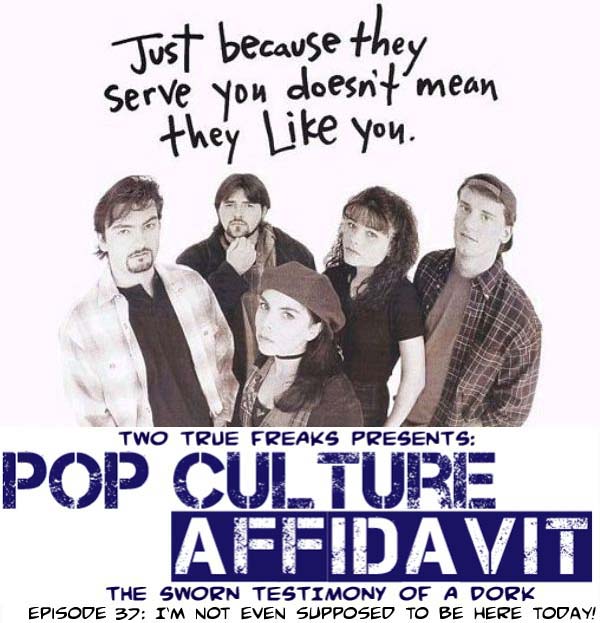
Episode 37 Cover-2With episode 37, I return to 1994: The Most Important Year of the Nineties with the only thing that I could possibly cover for episode 37: CLERKS! And to join me for this discussion of Kevin Smith’s classic debut is Trentus Magnus, the award-winning host of Trentus Magnus Punches Reality. We guarantee that it is so awesome, it will break you.

You can listen here:

iTunes:  Pop Culture Affidavit

Direct Download 

Pop Culture Affidavit podcast page

What an Institution!


This post is part of Forgotten Films’ 1984-a-Thon, a series of posts that celebrates the films of 1984. Check out more 1984-ness at The Forgotten Films Blog.

Whenever I sit down to review a movie, I inevitably find myself doing a mental, one-sentence review.  “It’s cute,” “Wow, this is really gory,” or “This could have been half an hour shorter” are common ones that come to mind.  When I finished watching Police Academy for the first time since the late 1980s, I thought, “This got six sequels?”

This got six sequels.

A comedy starring Steve Guttenberg, Eighties comedy hottie Kim Cattrall, and a cast of silly misfits, Police Academy actually made $81 million and was the sixth highest grossing film of 1984, which is amazing considering the top five were (in order): Beverly Hills Cop, Ghostbusters, Indiana Jones and the Temple of Doom, Gremlins, and The Karate Kid.  But unlike those other films, which all have a timelessness to them (even Beverly Hills Cop, which is clearly an Eighties movie), Police Academy has not aged well.  Or maybe that’s an inaccurate assessment and it simply hasn’t grown up with me.

For a movie that is rated R, Police Academy‘s humor seems to be more directed to the late elementary/middle school set, which makes sense because I loved this movie when I was about eleven or twelve years old (confession: I loved Police Academy 3: Back in Training because of the jetski chase at the end) and that was around the time when I discovered dirty jokes and sex humor but before the days where I really understood it.  The movie’s premise is simple:  the mayor of a large city (presumably Toronto Los Angeles) has opened up enrollment in the police academy to the average citizen, which means that every last klutz and moron now has the chance to become a cop.  Cary Mahoney (Guttenberg) is more or less sentenced to the academy after getting in trouble for the umpteenth time (a customer at the parking lot where he works insists on having his car parked despite the lot being full, so Mahoney turns it on its side and parks it that way) instead of going to jail because police captain Reed was friends with Mahoney’s father, who was also a cop.

We also meet our other potential defenders of the law:

  • Karen Thompson (Kim Cattrall):  Mahoney’s love interest and serious female police candidate.
  • Moses Hightower (Bubba Smith):  Exceptionally tall florist.
  • Leslie Barbara (Donovan Scott): Constantly bullied proprietor of a Fotomat-type store.
  • Doug Fackler (Bruce Mahler):  Complete klutz.
  • George Martín (Andrew Rubin): Resident lothario.
  • Laverne Hooks (Marion Ramsey):  Woman with soft, high, squeaky voice.
  • Larvell Jones (Michael Winslow):  Guy who can imitate any sound effect.
  • Eugene Tackleberry (David Graf):  Security guard and psychotic gun nut.
The theatrical release poster for Police Academy, which was drawn by famed poster artist Drew Struzman

The theatrical release poster for Police Academy, which was drawn by famed poster artist Drew Struzman

Oh, it’s a motley crew that’s destined to get into hijinks and that’s basically what happens, mainly because the police academy is run by Commandant Eric Lassard (George Gaynes), who is just about as absent minded as his recruits.  The conflict comes when the chief of police, who hates the mayor’s idea of open enrollment, asks Lieutenant Harris (F.W. Bailey) to ensure that none of the misfits actually graduate.  In order to do this, Harris recruits Copeland and Blankes (Scott Thomson and Brant van Hoffman) to sabotage Mahoney and his friends’ chances.

The rest of the film is more or less a series of gags until a final action/comedy sequence when the recruits are sent downtown to handle a riot and wind up saving the day.  Mahoney repeatedly tries to get himself kicked out of the academy until he falls for Karen and decides to stay.  Jones uses his sound effects mouth to fake everyone out.  George beds just about every woman until he finds his one true equal, the enormous-breasted Sgt. Callahan (Leslie Easterbrook).  Tackleberry wants to mow down everything in his path.  And we get the first appearance of one of the more famous gags from the Police Academy series:  Copeland and Blankes are given a fake address to the party that Mahoney is throwing and that address winds up being a gay bar named the Blue Oyster.  I didn’t find myself laughing very often, to be honest.  But I am not going to spend the next few paragraphs crapping all over the film because … well, that would be way too easy.  After all, Police Academy and its six sequels–Their First Assignment, which introduced series mainstay Bobcat Goldthwait; Back in Training; Citizens on Patrol, which was Guttenberg’s last film in the series and also starred Sharon Stone; Assignment Miami Beach, City Under Siege, and the direct-to-video Mission to Moscow–are kind of the standard-bearers of the badness found in Eighties comedies.  Instead, I’m going to give you five great things about Police Academy, even thirty years after its release …

1. The legacy of Steve Guttenberg.  This may be a stretch, but I have a feeling that without Carey Mahoney, we may not have gotten Zack Morris.  Okay, that’s just me projecting my Saved By the Bell fixation on a movie that came out a good four or five years earlier than the show and it’s clear that Ferris Bueller was more of a directly influence on the Zackster than Mahoney.  But Guttenberg’s portrayal of the smart-assed trickster is important because it proved the bankability of a relatable main character who was more attractive than some famous comedians out there but was not a matinee idol.  We’ve been getting those guys for years since.

2. F.W. Bailey as Captain Harris.  There’s so much about Police Academy that is derivative, with elements of National Lampoon’s Animal House and Private Benjamin, and Bailey’s Captain Harris character is definitely no exception.  I see a little bit of Dean Wormer in him and definitely bits of Ted Knight’s Judge Smails.  In fact, Bailey has the same sort of slow burn as Ted Knight, but brings a little bit more to it, with more of a pursed-lipped face than a descent into mania.  He plays the character as less of a villain and more of a comedic foil for someone like Mahoney and despite the film’s silliness and cheap jokes, they actually have some good chemistry.

3. Michael Winslow.  Now, the “Loud Mouth” Jones character gets real tired real quick but just like Bobcat Goldthwait in the sequels, I have to give Michael Winslow credit here because his character really is an icon of Eighties comedy.  He more or less is one of the main things anyone remembers about any of the Police Academy movies in the same way that most people will point to Curtis Armstrong’s Booger when they think of the Revenge of the Nerds films.  So even if you find his shtick annoying, props to him for making a career out of the character and his sound effects gags.

4. Eugene Tackleberry.  When I was a kid, Tackleberry was my favorite character.  Thirty years later, Tackleberry is still my favorite character.  The late David Graf plays the over-the-top gun nut with such sincerity that it’s one of the few things that still holds up (in fact, according to the film’s IMDb trivia page, “Tackleberry” is a term that private security firms often use to describe a person who is a little too enthusiastic about large firearms).  He’s perfectly intense and the other characters’ reactions to him (especially Harris, when Tackleberry produces what is quite possibly the largest handgun in the world on the firing range) are absolutely golden.  Dare I say, he makes this movie.

5. The Nostalgia Factor.  To this day, whenever I’m watching an old VHS tape and the Warner Home Video logo comes on the screen, I expect to hear the first few bars of the Police Academy theme song immediately afterwards.  This movie and its sequels hold a special place for me because they remind me of riding my bike to the video store on a regular basis and renting and re-renting all of my favorite flicks.  It was one of the first tastes of independence I had as a kid and really my first taste of comedy.  I’d eventually move on to Caddyshack, Airplane, and The Naked Gun movies, but this is where I started and I have to at least give it credit for that.

Police Academy is available on DVD and Blu-ray and can also be streamed on Amazon.
Boldy Went

Star_Trek_GenerationsEarlier this year, I sat down with Michael Bailey and talked about the comic books of 1994.  He talked about how this was a landmark year for him as a comic collector because it was the year that the greater DC Universe opened up to him.  I actually remember it as being a bit of the opposite.  I didn’t stop collecting comics or anything, but I did find myself becoming more discerning as a comic book reader and collector.  As I’ve thought about 1994 and its importance in the decade, I’ve come to realize that this also applies to Star Trek.

I was a pretty big Star Trek fan from the time I was about nine years old and saw Star Trek IV: The Voyage Home for the first time in the movie theater and through most of junior high and the first year or two of high school.  Being a fan of Trek wasn’t exactly popular at the time and I definitely took a fair amount of shit, but I seemed to take a fair amount of shit for simply breathing when I was in the eighth grade, so whatever.

Anyway, 1994 is a landmark year in Trek because it marked the end of Star Trek: The Next Generation, the show that really cemented the concept of Star Trek as a show with a legacy beyond a 1960s television show and a series of popular movies starring the same group of people.  I had been kind of cold to the show when it premiered in 1987 because I was huge fan of original series reruns and original series movies, but it grew on me.  I never found myself watching it on a regular basis, but I do remember streaks of several weeks in a row because one episode hooked me in (my all-time favorite is the two-part cliffhanger “The Best of Both Worlds”).

“All Good Things,” which was the final episode of ST:TNG, aired on May 23, 1994 and being in the New York area, that was on WPIX at either 7:00 or 8:00 on a Saturday night.  I missed the original airing because I had to go to some family party, so I programmed the ancient top-loading Panasonic VCR in our basement to tape it when I got home.  For whatever reason–probably user error–it didn’t tape.  I was bummed but apparently not bummed enough to try and find a rerun because I didn’t actually see “All Good Things” until about 2009 or 2010 when I found it randomly on cable one night.

But the Trek faithful didn’t have too much to be upset about that year when it came to losing their favorite show.  Star Trek: Deep Space Nine was still on the air (although I admittedly didn’t watch it) and that November, Star Trek: Generations hit theaters.  This was a movie that was set up to be a pretty big deal–Kirk and Picard were going to be on screen together.  There was time travel involved, of course, but it was going to be huge.

I missed this in the theater and when I eventually saw it on video, I was kind of glad I did.  Star Trek: Generations is not that great of a movie.  It’s not Star Trek V horrible by any means, but it definitely follows the pattern of odd-numbered Trek movies being “meh.”  Granted, I haven’t watched it in two decades so I may be wrong, and that’s why I’m not going in-depth with a review of it or offering up a podcast episode.

What strikes me, though, when thinking about this, was how it was one of the first times where I hit a point that I definitely could say that I was at the end of my fandom of something.  It’s not that I stopped liking Star Trek by any means–in fact, I went and saw First Contact in the theater (and thought it was pretty good)–it’s that I was no longer so attached to it.  And really, I wasn’t used to that.  Since then, it’s happened with several things from bands like Metallica to comics like Batman, but Trek was the first “living” thing that I could turn to and feel a specific nostalgia for (as opposed to long-dead cartoons like Voltron, for instance), as if it reminded me of a place, time, and attitude that was no longer there.

Oh, and I still think Kirk’s death was cheap.

Pop Culture Affidavit, Episode 32 — Royale With Cheese

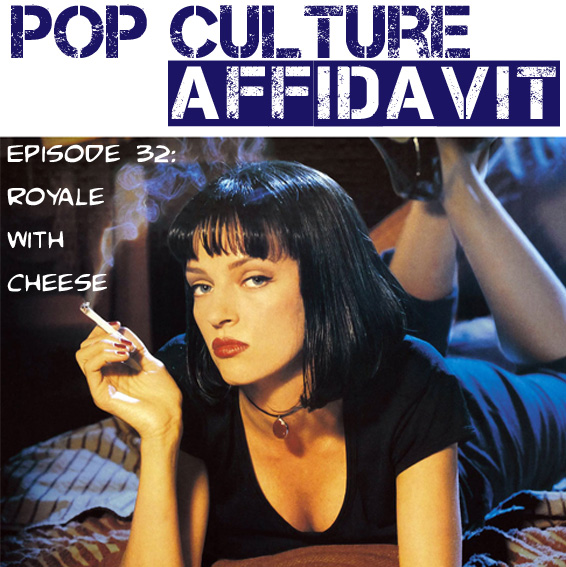
Episode 32 CoverSit back, relax, drink some of Jimmy’s coffee, give your girl a foot massage and make sure the gimp has a $5 milkshake, it’s time to take a look at the movie of 1994: Pulp Fiction.  I take a look at each section of the movie, talk a little bit about the film’s soundtrack and discuss its lasting influence as well as why it should have been Best Picture.

You can listen here:

iTunes:  Pop Culture Affidavit

Direct Download 

Pop Culture Affidavit podcast page

In Country: Marvel Comics’ “The ‘Nam” — Episode 29

IC 29 CoverOne hundred years ago, the world went to war.  After living through the war, a German soldier and writer named Erich Maria Remarque took his experiences and wrote them into a novel, All Quiet on the Western Front.  In this episode, I take a break from the Vietnam War and look back at Remarque’s World War I novel, giving it a full synopsis and review, then taking a look at two movie versions, and spending time on the poetry and songs of the First World War Era.

You can download the episode via iTunes or listen directly at the Two True Freaks website

In Country iTunes feed

In Country Episode 29 direct link


Here’s some of the media (videos, songs, poetry, etc.) that I use or mention in the episode. (more…)

5 Things to Love and 5 Things to Hate About Forrest Gump

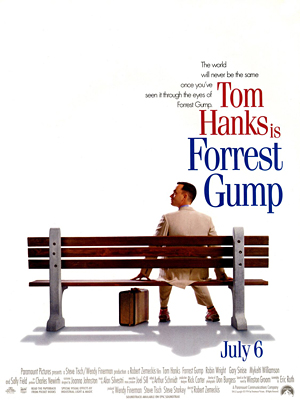
Forrest Gump PosterI could not spend a whole year talking about 1994 and calling it “the most important year of the Nineties” if I didn’t take the time to talk about the film from 1994 that would go on to win best picture: Forrest Gump.  Directed by Robert Zemeckis, it is the story of a simple-minded man (the un-PC term would be “mentally retarded”) who winds up living an extraordinary life.  Told through mostly flashbacks, the story concerns Forrest Gump (Tom Hanks), who is sitting on a bus stop bench in 1982 on his way to see Jenny, who as we learn over the course of the movie, is the love of his life.  He tells his life story to anyone who happens to be sitting next to him (as well as the audience):  born in Alabama, Forrest has a low I.Q. and had to wear braces on his legs as a kid until one day he learned how to run.  This served him well more than once, as he played for the University of Alabama football team, served in Vietnam, played diplomatic ping pong, opened a shrimping company, and started a running craze.  Along the way, we also see the life of his girl, Jenny (Robin Wright), who had a life that directly contrasts Hanks’s characcter: she was abused as a child, became a hippie, and spent much of her formative years in a drug- and alcohol-induced haze until finally coming home to Alabama and living with Forrest before leaving (which prompts Forrest to start running and the creation of his running craze).  When Forrest and Jenny meet up after he’s done telling his story, she tells him that she is dying and that she has a son named Forrest, who is the result of the one night that the two of them slept together.  By the end of the film Jenny has passed away and Forrest is now raising his son in his childhood home in Alabama.

That’s a gross simplification of the movie’s plot (after all, I didn’t mention Bubba or Lt. Dan), but most of the people reading this post are probably at least familiar enough with the film to follow along (and if you’re not, the film is available for streaming via Netflix).    Or you can check out the trailer:

So, with the plot out of the way, I thought I’d get to what I wanted to say about this movie, which has not been one of my favorites; in fact, I’ve long contended that with both The Shawshank Redemption and Pulp Fiction nominated for best picture that year, I can’t understand how this won best picture.  Okay, I can see why it was a popular choice for best picture, what with its sentimentality and emotional impact; I can’t understand how the Academy thought that this was more worthy of that particular honor than those two films, the latter of which had a major influence on filmmaking for at least the better part of the rest of the decade (and possibly beyond).

You know, never mind that I saw this three times in the theater, bought the soundtrack, and own a copy on VHS (although for the life of me I have no idea where that copy is).  In fact, I liked the movie when it came out.  It was beautifully shot, was pretty funny, and the music was great.  But it did not age well, especially after I saw Pulp Fiction and read Winston Groom’s novel upon which the film is based.  The novel turned me against the film in a big way, as Groom’s Forrest is a lot less likable than the buffoon with a heart of gold that Hanks plays on screen (and for which he won Best Actor).  Prior to writing this post, I hadn’t watched the film since 1996 and decided to give it a fair shake.  I didn’t hate it as much as I thought I would, although I still think it wasn’t worth the Best Picture honor (and I still maintain that it’s right up there with the oft-derided Ordinary People’s victory as Oscar larceny).  So what I did was do what any lazy good blogger does, and that’s made a list.  So here are the top five things I liked and the top five things I hated about Forrest Gump. (more…)

Pop Culture Affidavit, Episode 31 — The 1994 Grab Bag!

man reaching into grab bagWhat do Beverly Hills, 90210, the 1994 Baseball Strike, and Zima all have in common?  They’re all covered in the latest episode of Pop Culture Affidavit!  As part of my series of posts and episodes called 1994: The Most Important Year of the Nineties, I take a look at ten completely random things from 1994.  It’s movies, television, music, and current events all in one convenient episode!

You can listen here:

iTunes:  Pop Culture Affidavit

Direct Download 

Pop Culture Affidavit podcast page

(more…)

Pop Culture Affidavit Episode 30: “Summer 1999”

Episode 30 coverFifteen years ago this summer, moviegoers were treated to one of the best and most consistent moviegoing experiences in history.  Walk with me through ten movies from the summer of 1999, from The Phantom Menace and its ultimate disappointment to The Blair Witch Project and its being the scariest surprise of the season!

You can listen here:

iTunes:  Pop Culture Affidavit

Direct Download 

Pop Culture Affidavit podcast page

Below are the ten movies I talk about and their trailers, which you’ll hear in the episode … (more…)