Sixty years ago today, rock and roll lost three of its earliest stars when Buddy Holly, Ritchie Valens, and The Big Bopper died in a plane crash. In this episode, I take a look back at that event by focusing on how I learned about it as a kid in the 1980s and teenager in the 1990s. I begin by talking about my history with each of the artists and that era of music and then spend time going through the event via the 1999 episode of VH-1’s Behind the Music. Finally, I look at the song that gave “The Day the Music Died” its name: Don McLean’s “American Pie”.
[This post addresses current-day politics and expresses some of my political views. If you care not to read that, please skip this.]
I saw the decade end
when it seemed the world could change
in the blink of an eye.
Those are the first lines of the second verse of “Right Here, Right Now”, a song by Jesus Jones that hit number two on the Billboard Hot 100 (and topped the alternative chart) in late July 1991. Written about a year earlier, it is an optimistic song that celebrates what lead singer Mike Edwards describes as “watching the world wake up from history.” Even though the song is approaching its thirtieth anniversary, it still gets some airplay, especially on alternative radio stations that cater to the aging teenagers of the Nineties.
The song’s melody has aged well, especially compared to the pop that accompanied it at the time–an era in which pre-“grunge” alternative was seeing some mainstream success (EMF’s “Unbelievable” was also in the top ten) and D.J. Jazzy Jeff and the Fresh Prince released “Summertime,” but that was dominated by Paula Abdul’s “Rush Rush,” Bryan Adams’ “(Everything I Do) I Do It For You”, and the constant chart presence of Color Me Badd and Amy Grant–but its lyrics are very much of its time. The line about the world waking up from history is a reference to the end of the Cold War, which had begun in 1989 with the fall of the Berlin Wall and would continue until the Soviet Union finally disbanded in December 1991. And while I’m sure that anyone who actually takes music seriously would look at it and scoff at the sentiment, I thought then and still think that it encapsulates the feeling of the time (with apologies, of course, to “Winds of Change” by The Scorpions).
Granted, when I was seeing the world change in the blink of an eye, I was in junior high school and to me, it did seem that everything was happening at once. When you’re a ‘tween (I guess that’s the official term now–it really didn’t exist in the early 1990s), you don’t have a deep understanding of how the news that you catch glimpses of between your favorite shows is the result of years of policy decisions and other tactics taken by leaders, some of whom long ago left the world stage. Sure, maybe I’d get the Weekly Reader condensed version in class every once in a while, but for the most part, my context for the Cold War was mostly the action movies I was renting from the video store. The Soviet Union (or “Russia”, which is what we tended to say) was a big bad that our action heroes and action figures fought against. When we were on the playground, we weren’t having long discussions on the ramifications of Glasnost; we were pretending that the swings were F-14 Tomcats or we were hunting Gaddafi through the deserts of Libya. At the same time, though, we were being taught that not everyone over there was like what we saw on TV.
I am from the last Cold War generation and occupy a unique part of it because while my early childhood came during the first part of the Reagan era–that of the “Evil Empire” speech, The Day After, and the “Star Wars” plans to blow nuclear missiles out of the sky–my formative years truly began as it was all ending. I saw the threat of nuclear war but started to come of age when the teens in the U.S.S.R. were not zombified commie youth, but blue jeans-wearing, Coca-Cola drinking, heavy metal-loving kids. So, this song, with its catchy hook and bright lyrics, matched my perspective that everything was going to be great because we had gotten through a tough time in our history, but the Wall came down, all those countries were free, and we didn’t have to worry about a Third World War.
Flash forward to when I recently heard “Right Here, Right Now” on my local alternative station and thought about how much of a contrast the world politics of 1991 are to the situation in which we currently find ourselves. I know that not everyone thinks we have been living a waking nightmare since 2016, but I find it hard to think otherwise as I have tried to navigate the news, social media, work, and everyday life without having a complete breakdown. And I realize that compared to many other people out there, I am saying this from a place of extreme privilege, but I still feel that people who cheered with me when the Berlin Wall fell slammed me with a folding chair because heel turning on their tag team partner was more lucrative.
Yes, I realize that I just made a pretty clunky professional wrestling comparison and also realize that I’m the Marty Jannetty of said metaphor, but watching people go after one another online because “owning” them and declaring themselves some sort of “winner” is more important than actual conversation or a relationship makes said comparison apt. When I finally studied how the Cold War ended, I saw way more nuance and complexity than I was seeing in junior high and became more appreciative of it. At 41, I struggle with being someone who wants to see the same nuance and complexity in our world, knowing that’s a losing battle. I’ve watched people throw away their core values (though they don’t see it or won’t admit it) and let the doublethink take over and this makes me just want to toss my hands up and walk away because we’re completely fucked and quite frankly, I’m exhausted.
For decades, we’ve let pop music be the soundtrack to the times, but right here, right now, it’s tough to figure out what that soundtrack should be. At our most positive, maybe we could find comfort in the bittersweetness of “Let It Be”; at our most negative, we’re a teenager slamming the door to our room and blasting The Downward Spiral. Jesus Jones’ sentiment is quaint and maybe even trite, especially considering the cynical, toxic world in which we live. Maybe, though, listening to it now can provide us with some hope that there can be another time when we can say “I was alive and I waited for this.”
When you trade in nostalgia, the idea of a milestone anniversary for something you cherished in your formative years is constantly on your mind. Since starting this blog, I have watched the 20th, 25th, 30th, and even 40th anniversaries of pieces of popular culture that were personal milestones come and go. Some, I have celebrated; others, I have acknowledged but decided not to cover because the idea of constantly chasing such anniversaries sounds exhausting.
That being said, today marks 30 years since New Year’s Eve 1988. Nothing significant happened exactly on this day, but when I was thinking about what to write for my annual New Year’s Eve post, the thought of the 1988-1989 school year kept popping into my head and the more and more I thought about it, I discovered that in hindsight, this was a year that was more important than I once thought, both personally and culturally.
Why? Well, for a number of reasons (and not just mathematically), 1988 was the beginning of the end of what we commonly celebrate as the 1980s and as we moved into 1989, we would see our culture shift into that odd post-1980s hangover that was the pre-Nevermind early 1990s. It was, as the title of this post suggests, a time when we were on the brink. The Cold War was ending, we were heading toward a new decade, I was hitting puberty, and there were other societal shifts that we as a culture were both seeing and wouldn’t realize were there until they were over (or in my case, 30 years later).
So, to take us out of 2018, here is my list of … Eight Significant Things about 1988-1989. (more…)
In the Eighties, nobody was more awesome or rocked harder. Join me as I take a look back on this band and its legacy through a top 5 list of what I think are the most memorable songs.
Was she willing when she sat
and posed a pretty photograph
to save her flowering and fair
for days to come
for days to share
a big smile for the camera
how did she know
the moment could be lost forever
forever more
I found this photograph
in stacks between the old joist walls
in a place where time is lost
lost behind where all things fall
broken books and calendars,
Letters script in careful hand,
the music to a standard tune by
some forgotten big brass band
From the thresh hold what’s to see
of our brave new century
television’s just a dream
of radio and silver screen
a big smile for the camera
how did she know
the moment could be lost forever
forever more
Was her childhood filled with rhyme
or stolen books of passion crimes?
was she innocent or blind to the
cruelty of her time?
was she fearful in her day?
was she hopeful? did she pray?
were there skeletons inside
family secrets sworn to hide?
did she feel the heat that stirs
the fall from grace of wayward girls?
was she tempted to pretend
in love and laughter until the end?
The cover of the “Born to Choose” compilation, the CD released to benefit NARAL upon which “Photograph” appeared.
Over spring break, I was talking about R.E.M. with a friend of mine for a future episode of his podcast, and over the course of our conversation, this song that the band recorded with Natalie Merchant in 1993 (which is around the time the band was riding the success of Automatic for the People and Merchant was nearing the end of her tenure as the lead singer of 10,000 Maniacs) was mentioned and while we didn’t spend too much time analyzing it, we both agreed that the song is excellent
After the conversation, I wound up listening to “Photograph” again, and while there are a lot of times when R.E.M.’s lyrics border on the indecipherable, the lyrics here are actually more clear even if they are pretty complex. My first thought, upon first hearing it, was to compare it to the Jackson Browne song “Fountain of Sorrow,” but giving it another listen, I realized that the beauty in this particular song is that neither Merchant nor Michael Stipe know who the person in the photograph is.
It all reminds me of the early 2000s when I would waste time at work by looking at things posted to Found Magazine, which was devoted to trying to tell the story of objects that users had found. Many times, they related the circumstances that led to finding and keeping the object; other times, they were more about trying to tell that object’s story, in the same way that the lyrics are doing here.
The English teacher side of me loves this song, as does the writer side, because it lends itself to such a great multifaceted writing exercise. Of course, there’s the idea that I could take the time to tell the story of the photograph and answer the questions that they’re asking, similar to how I have often used Ted Kooser’s “Abandoned Farmhouse” as a springboard for a writing assignment. There’s also the possibility of describing the photograph based on the questions–as in, what about that photograph would lead someone to ask those questions?
And then there’s the objects that we own or don’t own that have stories behind them. Granted, you don’t need to study this song in order to create that assignment, but this would serve as a great model for any student looking to write the story of an object. If it’s something a student already owns, there is description and there is reflection; if it’s something the student doesn’t own (i.e., I gave them a photograph of people they didn’t know without any context), there is indulgence of curiosity and creativity, and also perhaps some self-reflection of the way that we judge people based on what we see.
I think poetry as a genre works really well, especially in this case, because it forces a person to stretch themselves. I could provide a prompt with a journal response, but that’s too simple and might result in some sort of bland description. This song, “Photograph,” and other poetry about the objects in our lives, goes deeper than that, asking questions that may not have answers and providing answers because it’s in our nature to want to do that.
In the liner notes to his live album Songs in the Attic, Billy Joel writes that the performance of “Miami 2017 (I’ve Seen the Lights Go Out on Broadway” “demands the gothic reverberation of a vast railroad terminus, such as Madison Square Garden.” Of course, that’s a reference to Penn Station, which is underneath the Garden, the concert venue in which the song was performed. I’ve always loved this song and I consider the studio album from which it came–1976’s Turnstiles, an album that also includes “Say Goodbye to Hollywood,” “New York State of Mind,” and “Prelude/Angry Young Man”–to be one of his best albums.
Then again, that probably comes from a place of nostalgia and not any judgment of quality because Turnstiles was the first non-Greatest Hits Billy Joel album that I ever owned. I got it on cassette for my 13th birthday after having asked for a Billy Joel album, and my dad picked it out because of the songs he recognized on the cover (and possibly because the “nice Price” sticker meant that it would cost less than the average cassette. We went to Fire Island for a week that summer and because it was overcast and unseasonably cold, I spent most of my time in our hotel room reading what few comics I had brought with me (including a copy of Batman #439 that I bought at a drug store) and listening to this one tape that I had brought with me. That tape would stay with me for at least another fifteen years when my last Walkman finally died and I put everything on my iPod (I still have a handful of cassettes left–that, however, is a different story for a different day).
Of all of the songs I listened to, I would say that “Summer, Highland Falls” and “Miami 2017” were the two I listened to the most. Since the latter is the closing song onf the album, I would constantly rewind side B so that I could hear it over and over again.
Why, at 13, in 1990, was I listening to a Billy Joel album from the year before I was born and not the latest heavy metal/hard rock/rap album? I can’t explain it aside from saying that I was a kid from Long island who liked to play the piano. I can, however, explain why this song in particular resonated with me. It has two things that I love in a song: a story and it starts off soft and then gets loud before ending soft (this is one of the reasons I like “Bohemian Rhapsody,” “American Pie,” and “Scenes from an Italian Restaurant”).
the first thing you hear, even on the live cut (which is superior to the studio cut because Songs in the Attic really captures the energy of an MSG audience) is an air-raid siren. Then, there is the piano, which starts with some fast finger work and then goes into a rhythm that almost feels processional. This stays this way through the first verse:
I’ve seen the lights go out on Broadway
i saw the Empire State lay low
and life went on beyond the Pallisades
They all bought Cadillacs and left there long ago.
They held a concert out in Brooklyn
To watch the island bridge blow
They turned our power down
And drove us underground
But we went right on with the show.
After that, the drums kick in and the music becomes defiantly more rock and roll. And what I appreciate about it is that even though there is a guitar part in there, Joel keeps letting the piano take the lead and uses the piano as the percussion instrument it is. Now, a person who has more academic prowess in music can probably argue against that, but what Joel is doing–and what Elton John often does–is really using the instrument to its potential and putting some muscle behind it.
And he deftly matches the music with the lyrics. The opening lines are written as if a man is reminiscing, and the line “And life went on beyond The Palisades” suggests how whatever happened in new York was isolated and everyone moved on, which if you think about it sounds like an apt description of the New York City of the 1970s and early 1980s. This is the time in which the city gained a reputation for being a hellhole and beyond its borders was derided as such if it wasn’t being ignored altogether. Joel makes this point in the Songs in the Attic liner notes, saying, “1975–New York Daily News Headline–‘Ford to New York–Drop Dead’! (Remember Madrid–No Pasaran!) More science fiction now than then. A legacy for my unborn grandchildren.”
Then we get to the plot of the story. Some sort of apocalyptic event happened and “they” literally blew up the bridges connecting Manhattan to Long island and in an act of rebellion, “we” held a concert in Brooklyn and kept playing even though the power was turned off. Of course, this could be a metaphor for an underground resistance because rock and roll has always been about rebellion on some level.
And there is carnage. Harlem burns, and things are overall destroyed. The lines about Brooklyn and the Yankees get huge applause from the New York crowd (of course) and while we never get the identity of who “they” are, we are told that whatever it was was an attack or a catastrophe. And I’d fault Joel for telling and not showing here, but if you think about it, this is the language that a person relating an event like this would use. There is always a “they” and we often employ euphemisms in place of very specific description. Despite that, we still have this sense of all of these things that happened and that at the end of it all when we look back a few decades later, there is nothing left.
more importantly, nobody remembers and we have to keep telling the story so that it doesn’t fade, which is what we see in the song’s finale:
You know those lights
Were bright on Broadway
That was so many years ago
Before we all lived here in Florida
Before the mafia
Took over Mexico.
There are not many who remember
They say a handful still survive
To tell the world about
The way the lights went out
And keep the memory alive.
What he is doing here is bearing witness–by telling the story, we keep the story alive, and while I guess you could say that there’s an odd prescience about the line about retiring to Florida (as so many of Joel’s generation have done) and the mafia taking over Mexico, I find that the most important part of this is the sentiment of continuing to tell the story and the idea of never forgetting.
Furthermore, the way this song is structured, it mirrors a flashback through a memory. When you have a memory like this triggered, it comes at you like a flash, and can crash down on you. So it’s not so much a story as it is a flood of moments that attack almost as literally as the event happened. As Joel himself says, “Miami 2017” is a piece of science fiction in verse–and it’s an underrated one at that. Because even though 1977 in New York City didn’t play out exactly like this, it wasn’t called “the hottest year in Hell” for nothing and there are still people who are around to reminisce and remind everyone of a time when walking through the crossroads of the world meant taking your life into your own hands.
A pop star in a red jacket slowly morphs into a werewolf. A young woman writhes on the floor against an all-white background. A striking-looking woman with orange hair sings about how “Sweet dreams are made of these.” Or was it “this”? These are indelible images from the 1980s that I am sure most people can identify for me, they comprise my music video origin story.
My history with cable television is spotty (and my relationship with Comcast’s customer service is contentious), and I’ve beaten the “I didn’t have cable as a kid” horse enough but here it actually applies because during the late 1980s and early to mid 1990s, I didn’t have cable. So when my friends were getting their musical education through 120 Minutes and Headbangers Ball, I was finding other sources, mostly radio stations, which explains my musical tastes were way more mainstream than a number of my friends and tended to skew towards older music at times (I mean, was anyone else listening to The Stranger and Born to Run as much as I was in 1994?). But that is not to say that I was completely in the dark and didn’t see a music video until 1996 when my parents finally got cable. I had friends, they had cable, and when we had nothing better to do, we would watch MTV for hours. But prior to even that, I saw some of the vanguard of early 1980s videos because of syndication.
Madonna was one of the few artists I remember from the time I watched Hot!. “Lucky Star” was played quite a bit (even though I don’t think this still is from that video).
MTV launched on August 1, 1981 but was not available nationwide; in fact, it was not carried in New York City where segments were taped, so the veejays had to watch their debut in a bar in New Jersey that had the channel. And up until about 1983-1984, the channel would remain relatively obscure, slowly building an audience before rocketing to the forefront of popular culture because of the stars it was making (or that made it) and its famous “I want my MTV!” marketing blitz. By the time my friend Tom got cable in 1986-1987, MTV was pretty much the only source for videos (with VH-1 running adult contemporary videos right next to it) at any time of the day.
But in 1984, when the New York Times published the article “Music Video is Here With a Vengeance,” that wasn’t the case. MTV wasn’t as ubiquitous but some TV stations were picking up on the fact that the music video was becoming important for teenaged consumers of pop music. The article is clearly written for an older audience but makes an apt comparison to The Ed Sullivan Show, saying that this is this generation’s version of that. It mentions MTV but also mentions a slew of locally syndicated or network-produced video shows: Hot! on WNEW 5 at 4:30 p.m.; Great Record Album Collections on WOR 9 at 5:30 p.m.; Solid Gold Hits on WPIX at 6:00 p.m.; Friday Night Videos on NBC; and ABC Rocks, which also aired on Friday night.
Friday Night Videos is probably the most famous of these and wast he longest lasting, as it technically ran until 2002, even though its format had completely changed by the mid 1990s to a more traditional variety show. I never actually watched it because it was on way past my bedtime–although I know people who were either allowed to watch it or had older siblings who did (and in hindsight, I probably could have taped the show). In the very early 1990s, NBC would air a spinoff show called Saturday Morning Videos that was on right after Saved By the Bell and lasted until 1992 when the network decided to focus on mining the teen audience and began airing shows like California Dreams, which had its own “music videos” within the shwo. I did watch this when I got the chance and specifically remember it’s where I first saw the video to George Michael’s “Freedom ’90,” which remains one of my all-time favorites to this day.
But in 1984, I was seven years old and would rush home to watch He-Man and the Masters of the Universe on WNEW Channel 5 (which would later become WNYW Fox 5) and at some point, the video show Hot! began airing at 4:30 and for whatever reason, I didn’t change the channel. Hot! (which sounds like a title thought up by someone who was marketing neon-colored trinkets to teenage girls) was a bare bones production counting down the … well, the hottest videos of the week.
While this clip only shows bits and pieces of videos, there is enough from the introductions from Claude Mann to let you know what the show was like. And he was enough of a “generic 1980s white guy” to be the type of host of this show–all he had to do was give a little bit of information and then play the videos because that’s what the kids watching after school were there to see. There were a few segments with interviews from artists, such as the one with Ray Parker Jr. about the “Ghostbusters” video (a song that even I was hip to in 1984) in this clip:
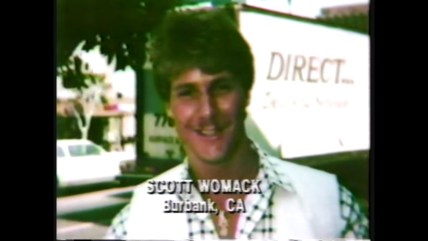
One other aspect of the show was its viewer contributions. People could write in with their favorite videos and send a picture of themselves and the producers might put that picture on the air–I can imagine that seeing your picture and name was kind of like waiting around for the end of Romper Room when the host would hold up the magic mirror and you were dying to hear your first name (I rarely did). That took some effort, too, when you think about it, because people like Scott Womack of Burbank, California, had to take the time to figure out what Van Halen video he thought should be at number one, then write a letter, get his picture taken, take it to Fotomat, wait a few days, get the pictures from Fotomat, put everything in an envelope, take it to the post office, and hope that by the time Hot! got his letter, that Van Halen song was still cool. Oh, who am I kidding? Scott knew that Van Halen song was still cool.
If you are attending an ’80s party anytime soon, Scott Womack of Burbank, California, has given you exactly what you need for your costume.
Anyway, MTV would perfect this viewer voting technique in 1986 with Dial MTV, their own daily countdown show, which had viewers call 1-800-DIAL-MTV to vote on their favorite videos. That number, of course, would be used to much bigger success in the late 1990s when Total Request Live took over the channel, and that particular show had its own huge impact on popular culture, which included the use of online voting in a huge way.
But in 1984, there was Hot! and whatever else kids could get their hands on, and with the exception of the “Thriller” video, which my parents taped off of Showtime before they cut the cord on that, this was the only place I saw music videos, at least for a few months. Hot! didn’t last very long on WNEW–another cartoon, probably Voltron or She-Ra, replaced the show and Channel 5 would air Diff’rent Strokes and The Facts of Life at 5:00 and 5:30 for most of the rest of the decade. So while I went back to my cartoons, toys, and other things that dominated the life of a second/third grader, the small amount of time I spent watching Hot! was enough of a glimpse into the culture of older kids, something I clearly wasn’t ready for at seven, but would be sooner than I realized.
In 1977, one of the biggest phenomenons of the decade was released, a movie that so encapsulated that moment in time that it’s been preserved for being culturally relevant. That movie? Saturday Night Fever. I take a ride to Bay Ridge, Brooklyn 40 years ago to hang out with Tony Manero and his friends as they escape their directionless lives for the dance floor of their favorite disco. I’ll talk about the movie, its place as one of the great post-adolescent films, and the multi-platinum-selling definitive disco soundtrack.
So I was listening to episode 73 of the podcast, where Amanda and I were talking about the albums that influenced us as teenagers, and at one point I mentioned something that I have mentioned before on both the podcast and this blog, which is that I listened to my fair share of Metallica when I was a teenager. Not only that, but as I got older and essentially grew out of Metallica, I came to realize that I didn’t really genuinely like most of the band’s music. Oh sure, there are songs that I think are still really good–“Whiplash,” “For Whom the Bell Tolls,” “Master of Puppets,” “One,” “Nothing Else Matters,” and “Hero of the Day” are still ones that I will put on rotation every once in awhile–but I hit a point in my adult life where I realized that I listened to Metallica and some other metal bands when I was a teenager mainly because I wanted to fit in with the guys I was hanging out with.
And yes, I reread that sentence and it sounds utterly ridiculous, but at the same time is so true, and I think that my fellow nerds will understand it. When you are hanging around a group of people with similar interests and you’re … well, you’re a bit of an introvert who is unsure of himself … you want to fit in. So when the guy who’s kind of the alpha of the group declares that a particular band or album is required listening, you either borrow his copy and tape it or you procure a copy of it yourself (I still remember the odd look on my aunt’s face when she gave me Kill ‘Em All for Christmas and asked if “this was the one you wanted”).
Anyway, I was listening to the episode and the Metallica point came up, and as I went through the rest of the episode and really reveled in the differences between Amanda’s and my musical tastes, I started thinking about what I either listened to in secret or completely missed out on while spending the better part of four years chasing my friends’ musical tastes. I mean, there were bands or albums that I didn’t discover until I was in college, and there were also things I used to kind of sneak-listen, keep in my Walkman, and lie about when asked “What are you listening to?” (hence the time I got caught with a Righteous Brothers tape). And maybe if I’d had the balls, I wouldn’t have had to not tell my friends that I was checking out Goodbye Yellow Brick Road from the public library or that I had taped most of 10,000 Maniacs’ Our Time in Eden and found that more enjoyable at times than, say, Ride the Lightning. I liked Paul Simon and Van Morrison and had a pop-rock sensibility that I just took way too long to fully embrace or at least admit to embracing.
But regrets are really not worth it at my age and instead of lamenting my bad choices made in my formative years, I’m going to list five musical acts, albums, or songs that I almost missed out on but eventually caught up to after high school.
Better Than Ezra. Credit for introducing this band goes to my friend Valerie, who was really into this band when we met in the fall of our freshman year of college. Deluxe had come out in February of 1995, so I was within about six months of its release when she introduced me to them, but during that February, I remember that I had just started going out with a girl whose favorite band was Live, so there was a lot of listening to songs that featured references to afterbirth (seriously … you couldn’t have thought of another lyric?). Better Than Ezra, and by extension bands like Gin Blossoms and Dishwalla (both of whom played Loyola at the end of our freshman year) were this lighter, radio-friendly rock-pop that washed up in the wake of the end of the earlier part of the decade and songs like “Good” and “In The Blood” found their way onto my car mix tapes. I personally prefer Friction, Baby, which was the 1996 follow-up to Deluxe, but I will say that these 3-4-minute pop/rock ditties were much more replayable than a seven minute-plus metal dirge.
The Clash. Yes, even though I said that Dookie was my gateway to other punk music, I didn’t buy my first Clash CD until the very end of high school. I had been watching some documentary about the history of rock and roll (in fact, it may have actually been called The History of Rock and Roll) on channel 9 and saw the episode about punk, which covered the 1970s punk scene and went specifically in depth with The Ramones, The Sex Pistols, The Clash, and X. The last of those groups was never one I would get too attached to, but I had heard of the Ramones by that point and shortly thereafter (this would have been May or June of 1995), I took my hard earned money to Borders and picked up the U.S. version of the Clash’s first album (it was the only one available at the time and the only copy I ever owned, so I can’t even say I was doing punk right). I really loved it, especially their cover of “I Fought the Law” (which, like a dork, I will pair with Mellencamp’s “Authority Song” on playlists from time to time).
Where this actually gets a little funny is that I brought this CD to the house of one of my friends who was that “alpha” of the group and seemed to want to dictate everyone’s musical tastes and the reception he gave the album was pretty indifferent. A few years later, he was listening to London Calling and I remember standing there like, “Huh. So … you’re full of shit.” I mean, it took a while but I finally came to my senses.
The Cure. Now, I can’t say that I’m a huge fan of The Cure. I don’t own a single album, and I think I may have only ever downloaded four of their songs: “Just Like Heaven,” “Love Song,” “In Between Days,” and “Lovecats.” But I did have a friend in high school who absolutely loved The Cure and had I not been lured in by the siren call of “I Alone,” I would have probably let her get me into the band. Because I have found since that I really do enjoy quite a bit of the 1980s new wave/alternative sound than I was willing to admit to in high school (except Morrissey … sorry … I can’t …).
And if I had listened to The Cure, I would have actually fit in at my high school. There was a huge contingent of Cure fans who were pretty popular and had the type of musical tastes that one could get a real education out of. I just never gave it a shot and while I want to say that I don’t know why, I have to say that I think a lot of it had to do with the way that a group like The Cure was seen, among some of the guys I was hanging around, as “chick music” or even “gay.” And I will be the first to admit that it took getting out of my hometown and even going beyond the confines of my college to really understand how homophobic I was as a teenager–not that that was the complete reason I rejected The Cure, but since my musical tastes (at least the public ones) were so dictated by how I was perceived and I tended to be the butt of my friends’ jokes anyway, it’s not shocking that I allowed it to shape my view of what is a really solid band.
Sarah McLachlan. So I’m in my freshman year of college and listening to, of all things, a CD put out by Loyola’s a cappella groups, The Chimes and The Belles. One of the tracks on the CD (and I own the CD … in fact, you can hear selections from it in the episode) is The Belles covering “Elsewhere,” a song I had never heard before and I think I might have had to ask someone where the song was from. At any rate, that was the first time I had heard anything off of Fumbling Towards Ecstasy and that was strange considering that the album had been out for easily a year and a half and was right in my 10,000 Maniacs/Cranberries/Lisa Loeb wheelhouse. But again, when you’re tracking down old Metallica albums or trying to find those rare Nine Inch Nails singles because that gets you cred with a group of guys who could barely get a girl to look at them, you tend to miss the siren call of Canadian singer-songwriters. In the years between that moment and the early 2000s, I’d buy most of the rest of her discography at the time, including Solace, which has two of my favorite songs of hers (“Path of Thorns (Terms)” and “I Will Not Forget You”) as well as a book of her sheet music. In fact, I remember downloading the guitar tab to “I Will Remember You,” printing it out, and figuring out how to play it on the piano (something I did for Green Day’s “Good Riddance (Time of Your Life)” as well). But the piano’s influence on my musical tastes is actually going to be the subject of another podcast episode, so I’ll move on.
The Entire Decade of the 1980s. By the time I moved in with Amanda in the fall of 2000, I had an enormous Eighties music collection. When I was a teenager, I would rock the hell out whenever the Totally ’80s commercial would come on:
But beyond my well-worn copy of Born in the U.S.A. and a few random songs I’d taped off the radio here and there, my Eighties game was weak and I went right on ignoring it while I chased the latest alternative and metal trends. And honestly, that’s the biggest shame, because even back then, I thought that “Centerfold” by J. Geils Band had one of the best hooks ever recorded and I still remembered all of the words to “Everybody Have Fun Tonight.” So when, in the late 1990s, the Eighties retro thing went huge with movies like Romy and Michelle’s High School Reunion, Grosse Pointe Blank, and The Wedding Singer, I was all up in that.
I guess if there’s a conclusion to this it’s that you really shouldn’t give a shit what people think when it comes to your favorite music and I wish I had been more sure of myself, or at least sure enough to say that it’s okay to like what I liked. At least I eventually learned that.
Not that I don’t have musical regrets. But that’s another story for another time.
It’s time to return to the music of the early 1990s … and I’m bringing Amanda along for the ride as well! This time around, we take a look at ten albums that influenced us as teenagers. You’ll hear us talk about Seattle icons such as Nirvana and Pearl Jam; legendary Nineties recording artists like Dr. Dre and Snoop Dogg, Green Day, Stone Temple Pilots, and Mary J. Blige; as well as everyone from Madonna and Queen to the Dixie Chicks and Denis Leary.
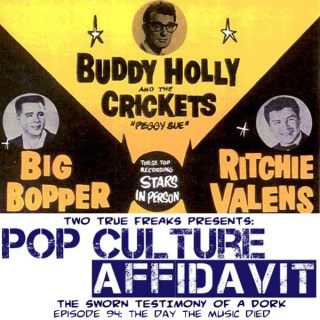 Sixty years ago today, rock and roll lost three of its earliest stars when Buddy Holly, Ritchie Valens, and The Big Bopper died in a plane crash. In this episode, I take a look back at that event by focusing on how I learned about it as a kid in the 1980s and teenager in the 1990s. I begin by talking about my history with each of the artists and that era of music and then spend time going through the event via the 1999 episode of VH-1’s Behind the Music. Finally, I look at the song that gave “The Day the Music Died” its name: Don McLean’s “American Pie”.
 Those are the first lines of the second verse of “Right Here, Right Now”, a song by Jesus Jones that hit number two on the Billboard Hot 100 (and topped the alternative chart) in late July 1991. Written about a year earlier, it is an optimistic song that celebrates what lead singer Mike Edwards describes as “watching the world wake up from history.” Even though the song is approaching its thirtieth anniversary, it still gets some airplay, especially on alternative radio stations that cater to the aging teenagers of the Nineties.
 In the Eighties, nobody was more awesome or rocked harder. Join me as I take a look back on this band and its legacy through a top 5 list of what I think are the most memorable songs.
 In the liner notes to his live album Songs in the Attic, Billy Joel writes that the performance of “Miami 2017 (I’ve Seen the Lights Go Out on Broadway” “demands the gothic reverberation of a vast railroad terminus, such as Madison Square Garden.” Of course, that’s a reference to Penn Station, which is underneath the Garden, the concert venue in which the song was performed. I’ve always loved this song and I consider the studio album from which it came–1976’s Turnstiles, an album that also includes “Say Goodbye to Hollywood,” “New York State of Mind,” and “Prelude/Angry Young Man”–to be one of his best albums.
 A pop star in a red jacket slowly morphs into a werewolf. A young woman writhes on the floor against an all-white background. A striking-looking woman with orange hair sings about how “Sweet dreams are made of these.” Or was it “this”? These are indelible images from the 1980s that I am sure most people can identify for me, they comprise my music video origin story.
 In 1977, one of the biggest phenomenons of the decade was released, a movie that so encapsulated that moment in time that it’s been preserved for being culturally relevant. That movie? Saturday Night Fever. I take a ride to Bay Ridge, Brooklyn 40 years ago to hang out with Tony Manero and his friends as they escape their directionless lives for the dance floor of their favorite disco. I’ll talk about the movie, its place as one of the great post-adolescent films, and the multi-platinum-selling definitive disco soundtrack.
 Better Than Ezra. Credit for introducing this band goes to my friend Valerie, who was really into this band when we met in the fall of our freshman year of college. Deluxe had come out in February of 1995, so I was within about six months of its release when she introduced me to them, but during that February, I remember that I had just started going out with a girl whose favorite band was Live, so there was a lot of listening to songs that featured references to afterbirth (seriously … you couldn’t have thought of another lyric?). Better Than Ezra, and by extension bands like Gin Blossoms and Dishwalla (both of whom played Loyola at the end of our freshman year) were this lighter, radio-friendly rock-pop that washed up in the wake of the end of the earlier part of the decade and songs like “Good” and “In The Blood” found their way onto my car mix tapes. I personally prefer Friction, Baby, which was the 1996 follow-up to Deluxe, but I will say that these 3-4-minute pop/rock ditties were much more replayable than a seven minute-plus metal dirge.
 The Clash. Yes, even though I said that Dookie was my gateway to other punk music, I didn’t buy my first Clash CD until the very end of high school. I had been watching some documentary about the history of rock and roll (in fact, it may have actually been called The History of Rock and Roll) on channel 9 and saw the episode about punk, which covered the 1970s punk scene and went specifically in depth with The Ramones, The Sex Pistols, The Clash, and X. The last of those groups was never one I would get too attached to, but I had heard of the Ramones by that point and shortly thereafter (this would have been May or June of 1995), I took my hard earned money to Borders and picked up the U.S. version of the Clash’s first album (it was the only one available at the time and the only copy I ever owned, so I can’t even say I was doing punk right). I really loved it, especially their cover of “I Fought the Law” (which, like a dork, I will pair with Mellencamp’s “Authority Song” on playlists from time to time).
 The Cure. Now, I can’t say that I’m a huge fan of The Cure. I don’t own a single album, and I think I may have only ever downloaded four of their songs: “Just Like Heaven,” “Love Song,” “In Between Days,” and “Lovecats.” But I did have a friend in high school who absolutely loved The Cure and had I not been lured in by the siren call of “I Alone,” I would have probably let her get me into the band. Because I have found since that I really do enjoy quite a bit of the 1980s new wave/alternative sound than I was willing to admit to in high school (except Morrissey … sorry … I can’t …).
 Sarah McLachlan. So I’m in my freshman year of college and listening to, of all things, a CD put out by Loyola’s a cappella groups, The Chimes and The Belles. One of the tracks on the CD (and I own the CD … in fact, you can hear selections from it in the episode) is The Belles covering “Elsewhere,” a song I had never heard before and I think I might have had to ask someone where the song was from. At any rate, that was the first time I had heard anything off of Fumbling Towards Ecstasy and that was strange considering that the album had been out for easily a year and a half and was right in my 10,000 Maniacs/Cranberries/Lisa Loeb wheelhouse. But again, when you’re tracking down old Metallica albums or trying to find those rare Nine Inch Nails singles because that gets you cred with a group of guys who could barely get a girl to look at them, you tend to miss the siren call of Canadian singer-songwriters. In the years between that moment and the early 2000s, I’d buy most of the rest of her discography at the time, including Solace, which has two of my favorite songs of hers (“Path of Thorns (Terms)” and “I Will Not Forget You”) as well as a book of her sheet music. In fact, I remember downloading the guitar tab to “I Will Remember You,” printing it out, and figuring out how to play it on the piano (something I did for Green Day’s “Good Riddance (Time of Your Life)” as well). But the piano’s influence on my musical tastes is actually going to be the subject of another podcast episode, so I’ll move on.
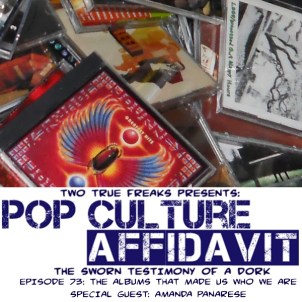 It’s time to return to the music of the early 1990s … and I’m bringing Amanda along for the ride as well! This time around, we take a look at ten albums that influenced us as teenagers. You’ll hear us talk about Seattle icons such as Nirvana and Pearl Jam; legendary Nineties recording artists like Dr. Dre and Snoop Dogg, Green Day, Stone Temple Pilots, and Mary J. Blige; as well as everyone from Madonna and Queen to the Dixie Chicks and Denis Leary.
 Pop Culture Affidavit