 Last week, a Facebook post as going around that recognized the 30th anniversary of the death of a naval aviator named Nick Bradshaw. As with many dead soldier post, its creator told us never to forget and dared us to re-post it, saying that he was sure that nobody would have the sense of patriotism or honor to do so.
In case you aren’t aware, Nick Bradshaw’s call sign was “Goose,” and his death actually didn’t happen because he was a fictional character–the witty sidekick to Tom Cruise’s Maverick in the 1986 movie Top Gun. His death comes about three quarters of the way through the film during a training exercise–while taking evasive action, Maverick is caught in another F-14’s jet wash (the technical term for which is “wake turbulence”) and both of his engines flame out, which results in his plane spinning out to sea. He and Goose manage to eject, but Goose launches into the roof of the cockpit and dies. His death winds up being a character moment for Maverick and becomes something he has to overcome, especially during the combat at the end (and the less said about how U.S. and Soviet diplomats magically managed to not have that incident result in a full scale war, the better).
Now, I think that if you polled people who were kids in 1986, the vast majority of them will tell you that they lost their pop culture innocence that year during Transformers: The Movie when Optimus Prime perished in battle. However, I contest that while Prime’s death was devastating, Goose’s death had a more long-term effect on my generation because whereas the former told us our favorite character could die, the latter told us that the average nice guy will not only never get his moment, but he might die, too.
This does not bode very well for people who look to identify with their favorite characters, and it does put truth to the cliche that “Nice guys finish last.” Maverick, after all, represents coolness to aspire to–he’s the best, dangerously the best pilot and he gets the girl–and Goose represents … well, he represents our reality. He is either who we are or who we will become. Let’s take a look at four reasons why.
1. He’s the class clown. When we’re introduced to Goose at the beginning of the film, it’s during the scene where Cougar and Merlin and Maverick and Goose enounter a couple of enemy MiG 28s and Cougar completely freezes up (this is the incident that eventually leads to both Maverick and Goose heading to Top Gun). While Merlin (played by a then-unknown and virtually unidentifiable Tim Robbins) is quite possibly one of the most neurotic characters in the film, Goose is making wisecracks and even takes a Polaroid of the MiG pilot when Maverick is “keeping up foreign relations … you know … giving him the bird?”
The wisecracks continue through most of the film and Goose is pretty much the guy who provides some levity through most of it and moreover has the confidence to do it. Take, for instance, the first day of instruction at Top Gun. Viper gives his introduction speech–and Tom Skerritt is incredibly intimidating in this movie–and Iceman says, “The plaque for the alternates is down in the ladies room.” Goose responds with an exaggerated laugh, one that says, “Yeah, you’re not very cool. Leave the jokes to me” but in a more subtle way than calling Iceman a loser (another great example of this in cinematic history is Charles DeMar’s reaction to Roy Stalin’s “You’d better shave her a little closer if you’re going to kiss her goodnight” at the New Year’s Eve dance in Better Off Dead). And that’s Goose’s role–to provide the humor and to be the nice guy that everyone likes (something Iceman awkwardly says in the locker room to Maverick following Goose’s death), whereas the rest of the co-pilots in the film seem to be variations on their pilots’ personalities (Slider’s just as arrogant as Iceman and Wolfman and Hollywood seem to have a thing going). He is, essentially, Robin to Maverick’s Batman and it shows.
2. He’s got his friend’s back. And in the same way that Batman needs Robin because he needs someone to help him out of a jam, Goose is always there to help his friend. Granted, Maverick doesn’t get into jams the way that Batman does, but when he needs help hitting on a woman in a bar because she’s lost that lovin’ feeling.
In fact, I’m pretty sure it’s this scene and this movie that gave rise to the term “Wingman” in dating parlance–the guy you’ve got with you to help you out.
And while I’m sure that there are a few people out there who are reading this post and thinking that they can fly solo and never need a wingman for “scoring with the ladies,” I say that … a) what are you, 17?; b) you’re also a complete liar; and c) the rest of us have all been the guy behind the guy.
[And a quick side note: this is the second movie in as many years where Anthony Edwards plays a guy who is trying to help get the main character laid and fails–the other is The Sure Thing starring John Cusack]
3. He’s a family man. Maverick is the ladies’ man. Goose, however, is married (to Meg Ryan) and has a kid, which is something that makes his death even more devastating, because this isn’t like Porkins dying during the Death Star attack because his Mountain Dew rolled under his seat and he had to reach down to get it. Here’s a guy who is trying to do right by his family and dies in a random accident, much like so many people. And I know that’s a completely macabre thought, but if you look at Top Gun as the story of Goose, it’s a sad and sometimes dark story that hopefully makes its audience really look at their own lives and feel grateful for what they have.
4. He plays volleyball with his shirt on. There are a lot of famous scenes in Top Gun, but I’m pretty sure that no other has been more inspiring or had a longer-lasting impact than the beach volleyball montage. It inspired an entire movie (Side Out, with C. Thomas Howell, Peter Horton, and Courtney Thorne-Smith) and probably had at least some influence on the montage-tastic syndicated television series Baywatch.
As you watch, you’ll probably notice three things: Tom Cruise, Val Kilmer, and Rick Rossovich are chisled; Cruise is playing beach volleyball in jeans; and Anthony Edwards is wearing a shirt.
This, in a sense, is my closing argument, because while I’m sure there are plenty of us out there who are in good shape as we approach 40 (I have to endure their goddamn Facebook posts about running on a constant basis, so there definitely are), there are many of us who are not and have come to accept our dad bod. Goose, therefore, is there for all of us. In fact, the way he gets upset when Maverick leaves to go on his date with Charlie (and we hear one of my faovrite lines in the movie: “MOTHER GOOSE YOU PUSSY!”) suggests that he’s that guy who really wants to win games like that and it means more to him than anyone else playing because it gives him more credibility among the cool kids.
I mean, I was totally like that in gym class in high school. I got competitive at times not because I was an insane jock, but because I had a long-standing reputation for being mediocre at most sports and I thought that gym class would be one of those places where I could prove that wrong, so when I lost or when other people weren’t taking it as seriously, I got more annoyed than I probably should have. While Goose gives as well as he takes, you can tell that he has to put up with a lot of bullshit “prove you’re a man” type of stuff from guys like Iceman and Slider, so any small victory is a victory.
There’s a goofy likeability to Goose that makes his character feel real and enduring and it’s why his death had such an impact. May we all fare better and get the chance to fly that cargo plane full of rubber dog shit out of Hong Kong.
 Okay, so I cheated a bit with my last post and simply reblogged a very old post about Superman: The Secret Years, but in rereading that old post, I saw the very roots of this series as well as “Origin Story” itself–three of those four issues came from Amazing Comics, and that started me on the road to eventually becoming a collector because I knew exactly where I could get any comic at any time. Not only that, but I had followed an entire series from beginning to end, which was a big deal when I was seven.
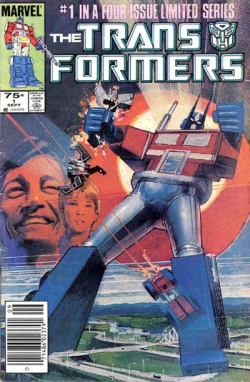 According to Mike’s Amazing World of Marvel Comics, Transformers #1 hit the stands on May 29, 1984. This would have been around the time that I was finishing up the first grade, and while I can’t exactly recall everything I got for my seventh birthday, I’m pretty sure that in the very least by the time I hit the beginning of second grade, I owned at least one Transformer–and it was probably
  This Friday, Batman and Superman will meet on the big screen for the first time in our lifetimes in the film Batman v Superman: Dawn of Justice. So, in order to “cash in” on this, I’m taking a look at the beginning and end of the World’s Finest team by looking at two pre-Crisis Batman and Superman team-ups.
 In writing this series of blog posts about the comics I picked up before the period I’ll be covering in the “Origin Story” podcast miniseries later this year, I’ve been deliberately writing about them in publication order because with the exception of a few books, I barely, if ever, remember the exact circumstances of their purchase. So that means while I’m covering things in order chronologically, I’m out of order autobiographically. I have very little reason as to why I’m clarifying that except to be anal retentive or something. Oh, and to say that while Star Wars #81 is to be read after Return of the Jedi, I’m fairly certain I got my copy before the Return of the Jedi adaptation miniseries I covered in the last entry.

 The Jawas begin attacking the landspeeders and we have a fight where our heroes attempt to get into the sandcrawler while Artoo tries to escape. At one point, Han comes face to face with Boba Fett and Fett has no idea who Han Solo is. Fett helps Han out of the sandcrawler with Artoo and Han decides that he is going to help the bounty hunter as well. It’s only when Leia yells for Han that Fett gets his memory back and starts to shoot at Han, only to be foiled when Han and Artoo jump off of the sandcrawler just as it crashes into the sarlaac.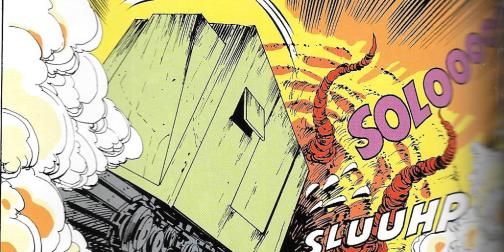
 It’s time for YET ANOTHER PLAYLIST EPISODE! Inspired by Andrew Leyland’s movie scores episode of “The Palace of Glittering Delights,” I’ve compiled a playlist of songs from movie soundtracks that are both classic and obscure but are in many ways spectacular. I’ve got Simon & Garfunkel, The Bee Gees, Queen, Irene Cara, and (of course) Kenny Loggins. So many movie memories! So many songs left off the list!
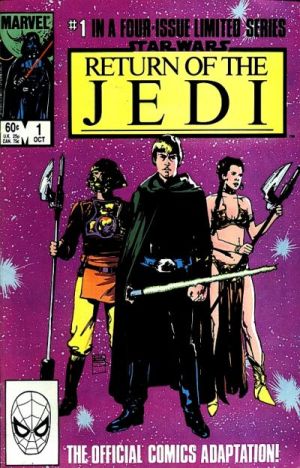 In my previous post, I wrote about the first comic I technically owned, although I only remember finding it years after I actually had “bought” it as a kid and it wound up feeling way more important later on, especially when I became an avid Batman collector and a fan of DC continuity, especially the continuity that centered around or was associated with Crisis on Infinite Earths. Here, looking at the second set of comics, is something that was purchased because it was associated with the most important thing in my life when I was six years old and that was Star Wars.
 You could not escape Return of the Jedi in 1983 and 1984. You may have not gone and seen the film (although I don’t know that many people my age who hadn’t seen it), but that didn’t matter because no matter what store you walked into, it seemed that there was something with a return of the Jedi logo on it. Lucasfilm licensed Jedi to the hilt and when I was a the height of my kid fandom, I had a ton of merchandise that went beyond the toys: sheets; cookies; Dixie cups; a calendar; and my most prized non-toy possessions, which were the records, tapes and books that told the story of the film. For myself and a number of other kids my age, owning these pieces of merchandise allowed me to relive the movie for at least a few years before I saw it again or owned my own copy on VHS (a copy I still actually have).
 If you’re unfamiliar with comic book multipacks, these were polybagged packs of three or four comic books that were stocked on the shelves of K-Mart, Toys R Us, and similar stores (for those local to Long Island, you’ll recognize the name TSS). Sometimes they were entire collections of limited series, such as this, but other times they were three comics featuring the same character or characters. I remember a number of times where I would pick one of the multipacks off the shelf and try to see what the middle book was because you only could see the full covers of two of them. Most of the comics multipacks were from Marvel, although DC produced them as well, and at some point in late 1983 or early 1984, the company bagged the entire four-issue series and put it on the shelves for the low, low price of $2.29, which was an 11-cent discount.
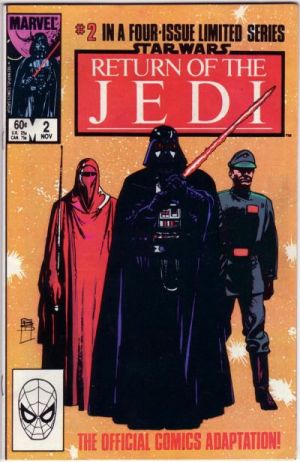 In trying to remember how I got these comics, I seem to recall getting them from Toys R Us in Bay Shore, and it was one of those rare times when my parents took Nancy and I to the store and allowed us to pick something out because we didn’t get toys or anything like that at random very often–they were usually saved for Christmas or our birthdays. Why we were at Toys R Us to begin with is beyond me, but I’m going to assume that either one of us was there to spend Christmas or birthday money or we were there to buy a gift for someone else, perhaps someone whose birthday party we were attending. The comics and coloring books were all located on a newsstand rack that was at the end of the board games aisle at the back of the store (and honestly, the old-school Toys R Us layout is probably worth its own blog post, especially if I can find pictures), and what probably happened is that I saw the comics multipack, asked my parents to buy it for me, and since it was roughly the same price as an action figure (my usual go-to “can you buy me this” item because it was cheap and they knew it wouldn’t go to waste), they said yes.
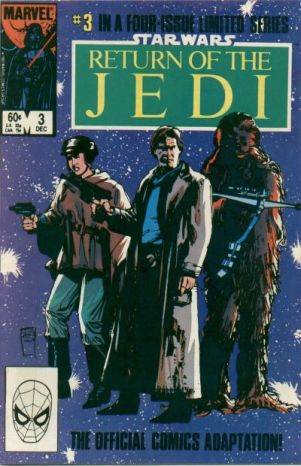 Still, I have to say that it is quite a disappointment. Having to condense the entire movie into four issues means that Goodwin and Williamson are almost doing a retread of the photographic storybook, as it’s heavy on narration boxes and the panels look more like stills than dynamic depictions of action. Granted, I know the story and knew the story when I first read it, so I didn’t and don’t need that feeling of “What’s going to happen next,” but this during an era of the Marvel Star Wars comics where David Micheline and Jo Duffy were writing some excellent stories and the work by artists such as Walt Simonson, Ron Frenz, and Tom Palmer was top-notch. That’s not saying that Goodwin and Williamson were bad at their jobs, but reading Jedi as part of that omnibus package had me wondering what the series would have been like if those creators had taken on the task of adapting the film.
 Well, it’s been a month since Christmas and you’ve all finally listened to all of the holiday-themed episodes that everyone else on the TTF network put out … so why not one more? That’s right, folks–we’ve kept the lights up and drinking egg nog way past its expiration date to bring you a look at FOUR Christmas-themed DC Comics. First up is a treasury-sized Rudolph the Red-Nosed Reindeer read by yours truly and Brett, complete with running commentary. I follow that up with Stella who discussed a Golden Age Batman story live at our local Starbucks. Then, it’s time to check in with the boy of steel and the Legion of Super-Heroes in a classic story that I reviewed with Michael Bailey. And finally, I fly solo for Team Titans #6. It’s festive! It’s jolly! It’s a month overdue!
 Be a good citizen! Don’t do drugs! Understand the dangers of unprotected sex and fight the stigma of AIDS. These are all part of various DC Comics public service announcements over the company’s 80-year history. In this episode, I tackle citizenship by looking at a classic one-page Superboy PSA; fight the war on drugs by looking at not one, but all three New Teen Titans Drug Awareness giveaways; and I contribute to AIDS awareness by looking at one-page PSAs featuring the DCU’s best and brightest as well as the mini-comic Death Talks About Life.
 It’s time to beam aboard and join me as I take a brief look at one of DC’s most successful licensed properties comics: Star Trek. In this episode, I take a quick look at Star Trek (1st series) #33, an issue billed as a “Twentieth Anniversary Special” that has the Excelsior as captained by James T. Kirk and his former Enterprise crew meet up with the crew from … the Enterprise?!
 Pop Culture Affidavit