1980s

Let’s Dance in Style, Let’s Dance for a While

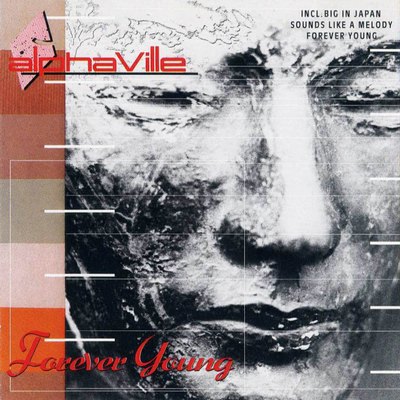
I guess that if you were going to comb through the annals of pop hits that have made their ways into senior proms and yearbooks, you wouldn’t expect to find lyrics about being resilient in the face of Armageddon.  No, your regular prom fare is about being the best of friends to the end or holding onto that girl or guy and never letting go.  Sometimes the song is written specifically to be used at a prom or graduation (I’m looking at you, Vitamin C) but “Are you gonna drop the bomb or not?” A lyric like that is unexpected.  Unless, that is, you went to high school on Long Island in the 1980s or 1990s, as my class—the Sayville High School Class of 1995—was one of many who dialed up Alphaville’s “Forever Young” for a slow dance at prom.

Running about 3:45 and coming from the 1984 album of the same name, the song was written by Marian Gold, Bernhard Lloyd and Frank Mertens, who comprised the German synth-pop band (whose original name was actually Forever Young).  Coming out at the height of Duran Duran’s MTV reign and around the same time as U2’s The Unforgettable Fire, “Forever Young” seems like it was an album that got lost in a sea of new wave songs that were ruling the playlists of stations like WLIR (later WDRE) in the early to mid-1980s.  However, though the title track only hit 65 on the Billboard Hot 100, stuck around, becoming a cult hit well into the later part of the decade, nearly three years after its release.  According an article in the June 11, 1988 issue of Billboard (whose text is included in the liner notes to the Singles Collection CD), the song was voted as #1 on a countdown by listeners of WDRE in 1988, and had a definite influence across the Island:

“Forever Young” is so slow and dreamy that Laura Branigan could cover it (and did).  While “Forever” was the top record of 1985 at WPST Trenton, NJ, where it is still played as an oldie, it hasn’t been passed from one hip, top 40 PD to another (Both “Blue Monday” and “I Melt With You” have).  It’s not even played everywhere in its own format.  It has shown up at various Long Island high schools as a class song in recent years.  The song’s popularity among teens may be due to its emphasis on mortality, a running theme in the bopper hits of the ‘70s.

WDRE, the name during the late 1980s and early 1990s of what was once WLIR, a leading modern-rock station based on Long Island.

(more…)

Once More to the Twine Ball

The Biggest Ball of Twine in Minnesota, which is the subject of an epic “Weird Al” Yankovic song.

For years, I have identified with E.B. White in “Once More to the Lake” as he takes his son to a lake in Maine where he and his father used to vacation when he was a boy.  He expects that in the thirty years or so since he first visited that lake–a time in which American had fallen fully in love with the automobile, among other more “modern” conveniences–much of it will have changed and the visit will be a disappointment.  To his surprise, though some of modern American life has crept in, the lake is mostly the same to the point where he sees himself in his son and his father in himself.  It’s an essay version of Harry Chapin’s “Cat’s Cradle” (though written thirty years prior) and the sort of tale that you probably would aspire to associate with your life.

Alas, I can’t lie anymore and say that when I think of Kezar Lake in New Hampshire, where my parents still spend two weeks every July, I think of E.B. White.  Because the truth is, I think of Weird Al.

(more…)

Fleet of DOOM!

Clearly, the Voltron cartoon series and the associated toys are a benchmark in my childhood, the first time that I ever felt I’d “discovered” something really cool, something that I hadn’t been told to like by commercials.  And as evidenced by the lengths I went to get the lion Voltron and the fact that I was one of a few people so fully vested in the cartoon that I also had the vehicle Voltron, I was one of those kids who watched the show religiously, even when both cartoons had cycled completely through and WPIX began re-airing the original lion stories.

But as Voltron fans, my second-grade friends and I were not fully satisfied by what we were seeing on television.  After a slew of lion stories , what seemed like an interminable amount of vehicle stories, and endless debates on which Voltron could win in a fight, we wanted a crossover.  I mean, He-Man and She-Ra could do it (and later on in the 1980s, G.I. Joe and The Transformers would do it) so why not the lion and vehicle Voltrons?

In 1986, we got our wish with an extra-long episode entitled Fleet of Doom, although I don’t know if most of my friends knew it.  I first learned about the crossover episode when my dad took me to Video Empire one day and my sister and I spent a few minutes combing through the children’s section looking for something other than the same five Disney cartoon tapes we’d rented since the day the store opened in 1984.  There, two shelves above my head, were two or three Voltron video boxes.  I jumped up and got them down, then studied the synopsis on the back of each (I have loved reading the back of videocassette/DVD boxes since I first stepped into a video store).  Two of them were shows I had already seen—the original five-parter and some of the episodes hat immediately followed—but the third was called “Fleet of Doom” and was about a team-up between both the lion and the vehicle Voltron.

I was sold.  I went home, watched it, and apparently remembered very little about it because when I watched it last week (thank you, Netflix) it really felt like I had never seen it before.  I mean, even with American Ninja, which I hadn’t seen in 25 years either, I at least had some flashbacks to when I originally watched it.  Fleet of Doom?  Nothing.  No memory of what it was about; honestly, I can see why.

(more…)

Cars and Trucks and Things That Go!

The vehicle Voltron, an also-ran in 1980s anime-based giant robots.

When the casual observer hears the word “Voltron,” he definitely thinks of the famous robot that was formed from five lions; however, those of us who watched the show religiously every afternoon know that “Voltron” can be either one of two robots: the famous lion robot and one made of many vehicles (and the truly hardcore know there was a third Voltron, but I’ll get to that later).

The vehicle Voltron snuck up on the country as quickly as the lion Voltron did.  One day, we were sitting down to watch the mighty Voltron fight King Zarkon and Prince Lotor and the next, there were a bunch of people we’d never seen and a completely different robot.  This one had fifteen characters to follow, all of whom made up a Voltron force that fought against the Drule empire.  It was kind of like a mash-up between Voltron and Robotech, and it would have made sense if it seemed like it had anything to do with the other series (like Robotech did — each series took place after the other), but there didn’t seem to be much of a connection except that both robots were named Voltron and the people who piloted the vehicles were cheap knock-offs of characters on the other show.

So the introduction of the vehicle Voltron after the lion Voltron never really actually ended seemed abrupt, like they were interrupting everything to push something else on me, or trying to Coy and Vance me.  I think that’s one of the reasons this one never caught on; the other was that with fifteen characters behind fifteen parts of Voltron, it was really hard to remember who was who.  Sure, there was a land, sea, and air team that altogether formed the mighty robot, but whereas I could recite the entire lion transformation scene and knew exactly who I wanted to be when we “played Voltron” on the playground, telling my friends that I wanted to be “Cliff” from the land team seemed really awkward.

(more…)

Go Lionbot Force! Wait … that doesn’t sound right.

The Matchbox-produced lion Voltron. According to the package, he's the "king of the space jungle."

In your childhood, I guess there are phenomena and there are milestones where toys are concerned.  And then there are flash in the pans, those toys that are insanely popular for most of a school year but get shoved to the back of a toy closet by the summer.  My first experience with a flash in the pan was Voltron.

 In a couple of weeks, I’ll talk about the cartoon series that spawned this particular toy, but it’s worth mentioning that I only know what voltron was because an early episode was on at my neighbor’s house one afternoon when I was in the second grade.  I didn’t know what the cartoon was, just that five robot lions that formed a much larger robot were pretty kickass.

 Soon after watching those first few episodes of the lion Voltron (the vehicle Voltron came later), my schoolmates and I were compoetely hooked.  We played Voltron just about every day and very often I was Keith or Lance and on at least a couple of occasions, my friend Lori wore her hair like Princess Allura.

Still, the tie-in toys alluded us, which was weird considering that every single cartoon we watched in those days was essentially a 30-minute toy commercial.  Even some of the movies—Star Wars, for instance—had a toy line.  But nobody, when those first few shows aired, owned a Voltron.  That’s probably because we never saw television commercials for Voltron toys.

In fact, I would not come across any toy related to Voltron for the better part of six months, when I would be at a local stationary store, Sayville Card and Gift (which may have been known as Unique Cards and Gifts at the time), browsing through the toys while my dad was two doors down buying Chinese food, and spotted something called “Lionbot.” 

But what was inside the “Lionbot” case was a die-cast metal Voltron lion.

(more…)

Silent, but deadly

Am I the only person who wanted this poster as a kid?

When you’re a kid, you like to make up movies, usually starring all of the action figures you’ve played with, and featuring all of the stuff you find cool.  It’s very rare, if ever, that such movies are made.  Sure, you get comic book movies that feature storylines you’ve loved since you were a kid, or movies based on a line of toys where the right actor is playing the right role, but nobody does a “kitchen sink” type of movie.

Except for American Ninja.

Produced by Golan-Globus for Cannon Films (the same company that gave us classics like Enter the Ninja, Revenge of the Ninja, and Ninja III: The Domination), American Ninja came out in 1985, right around the time that toys like G.I. Joe were getting very popular among boys.  I was about eight at the time and didn’t see it in the theater but wound up renting the film on video and watching it with friends.  It was rated R and may have been the very first R-rated movie I saw (or that was Commando).  But even though it was a pretty violent action movie, watching it again after 25 years, I can see that the movie was clearly geared towards those kids with permissive parents.

Take, for instance, the opening scene.  After some witty banter between a toady-looking Army douche named Charlie and some other G.I.s wherein the star, Michael Dudikoff, stands against a jeep playing with a switchblade and saying absolutely nothing, a convoy gets going.  Among the precious cargo that this convoy is hauling is Patricia (Judy Aronson), the daughter of a very influential colonel.  Sure enough, the convoy is hijacked by the go-to villians in the 1980s–Latin American guerillas.  They rough up the troops but Dudikoff decides he’s not going to take their shit and starts throwing some karate moves about, including throwing a screwdriver so it lands in someone’s carteroid artery, taking someone out with a tire iron, and karate kicking people left and right.

Patricia, who apparently is your typical “Army brat” then decides to commandeer the car that she’s in and promptly drives it into the jungle, where it crashes.  This is around the time that a shitload of ninjas show up, led by a super-ninja who has a black star on his face (and actually is known as “Black Star Ninja”, the most deadly ninja in the world).

Seriously, read that back again.  I can imagine the people who created this movie sitting around a table with this scene and someone saying, “I know what would make this awesome:  NINJAS!  And the leader should have a black star!”

(more…)

Up, Up, and Away!

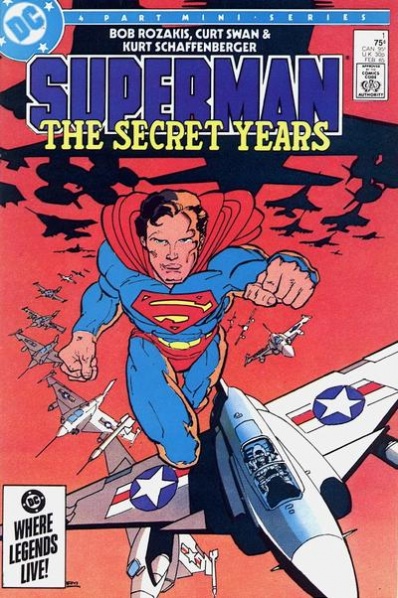
Superman: The Secet Years #1

I honestly don’t remember when I bought my first comic book or what that comic was.  I have vague memories of perusing the magazine rack at Greaves stationary in my hometown and coming home with an issue of The Amazing Spider-Man or Superman.  At some point, I know that I got an issue of the Batman team-up title The Brave and the Bold sometime in the very early 1980s, so that might have been it.  But Superman: The Secret Years #2 was the very first comic book that I remember buying at an actual comic book store.

Amazing Comics, which is on Gillette Avenue in Sayville, NY, opened in the fall of 1984 next to an iron-on T-shirt store named The Special-T, which is where my friends and I procured most of our wardrobe.  I am sure that I was at the Special-T buying a birthday present for someone when my dad noticed that there was a brand-new comic book store in the next building (it had previously been a junk/antique store, I believe).  It was and still is an extremely small store with barely any room to move; in fact, I think if you fit more than six people in there, you’re exceeding maximum occupancy.  But at seven years old, an entire room filled with comic books blew my mind.  Who knew that you could sell them on your own and not off a rack located between the cigarettes and the pens and pencils? (more…)

Mecha, Minmei, and a decade-long fight for the future

While I have extensive experience with superhero comic books, my experience with manga is relatively small.  I know that my local Barnes & Noble has a significant amount of shelf space devoted to manga, and that quite a number of my students are often seen walking around with Tokyopop trade paperbacks.  I once flirted with anime a little bit, but going so far as to dive head-first into that particular world of fandom was never something I even attempted.

That being said, I am sure that I’m not alone in my generation by mentioning that as a kid I had exposure to Japanese comics and cartoons through Voltron and Robotech.  I suppose I’ll get around to talking about Voltron some other time, but Robotech seemed to have far greater reach, at least in terms of manga/anime as a whole.  Of course, I think that “true” fans of the genre and the work refer to it (or at least part of it) as Macross, but considering I have spent my life being nothing but mainstream, I’ll just go with Robotech.

My first exposure to Robotech was when  the animated series ran on WPIX 11 every afternoon when I was in elementary school.  It was an enormous show that had more episodes and storylines than I could count, but to be quite honest I wasn’t interested in the plots or character development when I was eight years old.  I just thought it was awesome because the character flew around in planes that transformed into robots that looked exactly like the Autobot named Jetfire (or was it Skyfire?  There was an enormous debate between my friend Evan and myself about this when I was a kid.  Evan, at one point, even claimed that there were two separate toys and he had the other one … but never produced it).  There was a comic book series put out by Comico that retold the television series verbatim (it even had a little “As seen on TV!” box in the middle), which you can probably pick up in a dollar bin somewhere; and a toy line put out by Matchbox which was compatible with G.I. Joe (I had the motorcycle).

However, Robotech was for the most part forgotten after it went off TV and toys were relegated to that “aisle of random and forgotten toys” in Toys R Us.  None of my friends ever really got that into it and so I was kind of alone in my love of the mecha series and gave it up to concentrate on the Joes, movies like Aliens, and baseball. 

Then, when I was in the ninth or tenth grade, a new store called Bassett Book Club opened up next to K-Mart on Sunrise Highway.  The place was huge, several times bigger than the B.Dalton and Waldenbooks I used to frequent at the mall, and the first time my mom took me there, I went straight for the science fiction section to check out their selection of graphic novels and Star Trek books.  After marveling at the fact that the store had the novelization of just about every movie as well as books that I’d only seen listed in my Star Trek Fan Club magazine, the spine of several books with “Robotech” written on the side caught my eye.

(more…)

Where Legends Live

When I heard that Dick Giordano died the other day, my first reaction was, “Oh, that’s sad,” which is I guess what you’d say when anyone dies.  But then I got to thinking about who he was and the impact he had on my life as a reader of comics.

For those who don’t have more than a passing knowledge of comic books, Dick Giordano was an artist and editor at DC Comics  in the 1970s, 1980s, and 1990s.  His most important role during that time was as DC’s executive editor/editor-in-chief, which means that he was the second-in-command at the company, working just below its publisher, Jeanette, Khan.  So, he more or less shaped DC for the better part of two or three decades.  He was, in a way, DC’s Stan Lee, as just like Stan wrote a column in the “Bullpen Bulletins” that were found in each Marvel comic, Dick wrote “Meanwhile …” a regular feature in those of Marvel’s “Distinguished Competition.”

(more…)

Let off some steam, Bennett!

John Matrix -- the ultimate badass.

In one of my classes today, I was covering the end of Frankenstein.  If you’re unfamiliar with the novel, it doesn’t end as spectacularly as most film versions.  As Mary Shelley writes it, Victor Frankenstein dies from a prolonged sickness brought about by the anguish of dealing with the monster he created and what that monster has done to his life by murdering those around him.  Then, the monster shows up and tells Captain Walton (to whom Frankenstein was telling his story) that he has no reason to live either and will go commit suicide.  Surely enough, he ventures out into the Arctic ice presumably to die.

As I was recapping this for my students and we were discussing what parts of this scene represents, I went off on a little bit of a tangent as to what Frankenstein would be like if it were a 1980s-era Schwarzenegger movie (with Schwarzenegger as the monster).  Walton, probably played by a relative unknown although this would be a great part for a Cobra-era Stallone, sees the monster run off.  “NOOOOOOOOOOOOOOOOOOOOOOO!” he screams before telling his men to turn the ship around and follow the monster while he goes below to suit up.

A few moments later, Walton comes back armed to the teeth and says, “It’s payback time.  THIS IS FOR VICTOR!” and starts opening fire with a vast array of automatic weapons (which I realize were not invented in 1816, but this is a motherfucking action sequence so you can suspend disbelief).  The monster is gunned down in a hail of bullets — I think I compared it to the scene in Predator where Jesse Ventura gets his guts blown out and Bill Duke mows down half of the Amazon in rage — and there is a heroic song by Stan Bush or 707 to take us through the closing credits.

Of course, this never did happen and will never happen, but it is a testimony to how my mind has been warped over the years by viewing too many action movies.  That’s not an unusual thing, of course — every boy in my generation had at least one G.I. Joe figure in the 1980s and at some point before we left elementary school we graduated from Star Wars and cartoons to R-rated violence and gratuitous bloodshed with a high body count.

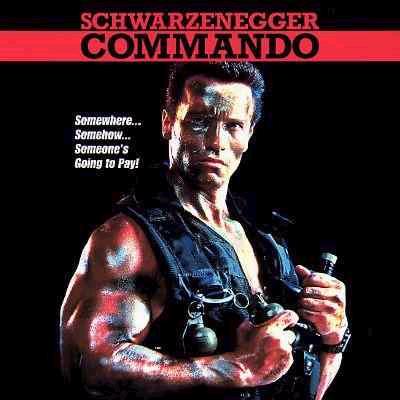
For me, it started when I was in the fourth grade with Commando.

(more…)