1990s

Pop Culture Affidavit, Episode 28 — Nothing is Trivial

Episode 28 Cover1994: The Most Important Year of the Nineties continues with a look at The Crow.  Over the course of this episode, I take a look at the comic book by James O’Barr as well as the 1994 film starring Brandon Lee.  Does this film hold up after twenty years?  Tune in and find out!

You can listen here:

iTunes:  Pop Culture Affidavit

Direct Download 

Pop Culture Affidavit podcast page

Meltdown (My Life as a Teen Titan, Part Forty)

New Titans 130For all of my devotion to The New Titans, it’s ironic that I almost missed the ending.  Okay, I wouldn’t have actually missed it because I had the book on my pull list, but the final issue came out during my freshman year of college, a time when I was incredibly disengaged as a comics fan.  In fact, I remember the day I discovered that the book had been canceled:  it was parents weekend and I was flipping through Previews while waiting for my mom and dad to show up.  The solicit for The New Titans #130 read FINAL ISSUE and featured a cover by George Perez that showed the current version of the team in the same exact pose as the original team did in the very first issue of The New Teen Titans back in 1980.  After sixteen years, Marv Wolfman’s nearly uninterrupted run on the title was about to come to a close.

The story behind this as told in The Titans Companion is basically that Wolfman had been fed up with editor Pat Garrahy’s mandates and manipulations for quite some time, and at a DC Christmas Party, asked to be taken off the book.  Being that the book was on the chopping block anyway, DC told Wolfman he could “have the book back” and he was given a few months to wrap things up.  He then set out to write a story that put every one of the original Titans who were still around back to some approximation of who they were.  The only restriction was that Wolfman could not use Nightwing, who was then well on his way to being entrenched in the Batman family.

What we got was “Meltdown,” a five-part story that is actually a four-parter with a first chapter that doesn’t really seem to make too much sense.  Then again, that issue is done as a fill-in by Dale Hrebik (whose only other credits are Deathstroke #50 and Annual #4) with art by Rik Mays with the other issues pencilled by then-regular artist William Rosado.  As far as storylines from this era go, it’s one of the stronger ones, although I suppose that’s not saying much.

Basically what happens is that while a fair amount of infighting happens among the team members, the Titans are summoned to Tamaran by Starfire and Cyberion–formerly Cyborg–because Raven has returned and is leading an entire legion of hostile aliens against Kory’s home planet.  After being attacked by a now-conscious Changeling, the group subdues their former teammate and Kory reveals that she has Raven’s soul self.  She is unable to heal Gar, but he is eventually cured when Raven draws all of the Trigon seeds into herself, basically revealing that Trigon himself is trying to use her as a vessel for his resurrection.

Her war reaches a critical point when she destroys Tamaran–and in one last act of bravery, Kory’s parents stay on the planet–and Starfire and Blackfire (two sisters who have had a reconciliation) lead their rebellion of sorts, finding their adversary and destroying Raven’s body as well as the evil contained within.  At the end, on a planet that will become known as New Tamaran (that is, until the Sun Eater destroys it in Final Night), Raven is good again and an ethereal/astral form; Gar and Cyberion go off to travel through space; Kory is pregnant with her new husband, Ph’yzzon’s child; and Donna Troy is still a Darkstar (and will remain a Darkstar until John Byrne gets a hold of her).  So status quo is sort of  reestablished.

Upon my reread, I realized that much like the rest of the post-Zero Hour Titans, this story is a bit of a mess.  I am not sure when Wolfman’s meeting took place in the creative process, but the first part feels like the start of an entirely different story than the one we got.  That could have been due to a different writer being on that issue, of course, but in New Titans #126, we have an Arsenal character piece that shows how the team has its problems.  For instance, at one point, the “kids” on the team play a bit of a “let’s catch you off guard with an ambush” prank and when Donna sees that Rose Wilson was involved, she goes off on them.  Rose responds with “You’re not my mother!”  It suggests that perhaps they were setting up some teen angst sort of storyline or something that would bond the kids on the team while fracturing the adults.

That never happens.  Instead, it provides a springboard for Wolfman, only taking the Titans he wants to take to Tamaran.  Mirage and Terra remain on Earth because it’s revealed that Mirage faked her miscarriage and is actually now in labor.  Supergirl is elsewhere.  Damage gets pissed off and quits, and Impulse literally misses the ride to space.  So we get the core group (with a couple of additions, like Green Lantern) and the final forced resolution of the Raven storyline.

Funny enough, I’d actually come to like some of the characters in this run.  Roy Harper’s crisis of confidence as a leader made him more interesting than he had been in the past.  I cared about Mirage and her very complex problems.  Even the mystery of Terra’s true identity was intriguing, as were character changes in people like Kory, who was becoming more of a warrior and less naive.  But in hindsight, it was time, and the bloom from the renaissance of five years earlier had faded long before.  It’s just sad that such a once-great book went out with a whimper.

Next Up:  The end of my life as a Teen Titan.

Binge and Purge

Live ShitI am pretty sure that if you asked him, the greatest moment of my friend Brendan’s adolescence was his first Metallica concert.  He and his friend were both members of the official fan club and were able to get front row center seats for the band’s concert at Jones Beach in May 1994.  I admit that’s pretty impressive.  The closest I ever got to any performance like that was second-row seats to Les Miserables that same spring; otherwise, my concert-going life has been relegated to what’s available or what I can afford–usually bleeders.

Anyway, this wound up being the culmination of a few years of Metallica fandom but also in a huge year for the band.  In 1991, they had released Metallica (otherwise known as “The Black Album”) and toured nearly non-stop up until they recorded and released Load in 1996, an album that is so divisive, it’s probably worth its own entry.  In the middle of all of this touring, the band released something that most bands do when they put out a successful record–a live album.

But it wasn’t just a live album; when you are the biggest band in the world, you release the biggest live boxed set the world has ever seen.  Released at the tail end of 1993 and called Live Shit: Binge and Purge, Metallica’s album came in a small trunk and included three CDs, three VHS tapes, a T-shirt, a booklet, stickers, and a fake backstage pass (there was another version released with cassettes instead of CDs and subsequent rereleases have replaced the VHS tapes with DVDs).  It retailed for $89.95, which was a lot of money then and actually still is a lot of money for a boxed set.  You’d have to be a crazy hardcore fan to want to spend that much money.

Which, to be honest, is the nature of boxed sets.  In fact, Barenaked Ladies even wrote a song called “Box Set” (on Gordon) wherein they satirize the product’s bloated nature:

Disc One
It’s where we’ve begun, it’s all of greatest hits,
and if you are a fan then you know that you’ve already got ’em.

Disc Two
It was all brand new, an album’s worth of songs,
but we had to leave the whole disc blank ’cause
some other label bought ’em.

Disc Three
This is really me in a grade school play;
I had about a hundred thousand lines but of course I forgot ’em. …

Disc Four
Never released before, and you can tell why.
it’s just some demos I recorded in my basement.

Disc Five
I was barely alive, I was coughing up a lung,
so they had to use a special computer as my replacement.

Disc Six
A dance remix, so I can catch the latest trend
and it’ll make you scratch your head and wonder
where my taste went.

And they can definitely be hit or miss.  The two Springsteen boxed sets that I have–Tracks and Live 1975-1985–are well worth their price tags.  But for the most part, the average boxed set is an overdone affair with a good $20 less than its price tag.  Live Shit: Binge & Purge didn’t suffer its price, eventually selling 15 million copies.

For my friends who were into the band (and to a lesser extent, myself) one of us obtaining this monster was a cause for celebration.  I’d heard live albums beofre, but a band we so favorited had never done anything like this, so putting an entire Metallica concert into the CD player and blasting it like we had tickets was awesome.  Plus, the band was playing music we hadn’t heard before or that we had heard of but had found hard to obtain.  I personally taped “Last Caress,” “Am I Evil,” and “Stone Cold Crazy,” and would go onto crib whatever I could from Brendan’s various bootlegs, imports, and singles (well, until Garage, Inc. came out in 1998 and replaced my need for the worn-out tapes in my car’s glove compartment).  And between that and “Breadfan,” I was good to go.  Brendan wasn’t and proceeded to collect any import or bootleg he could get his hands on.

If anything, like the nights they capture for posterity, live albums are time capsules and Live Shit: Binge and Purge is no exception.  It’s Metallica’s last gasp before they reinvented themselves as a Nineties band.  If I listened to it now, I’d probably be able to picture sitting in my friend’s room reading magazines and talking about hockey while James Hetfield grunted and roared away.

Pop Culture Affidavit, Episode 27: 1994 — The Year in Comics, Part Two

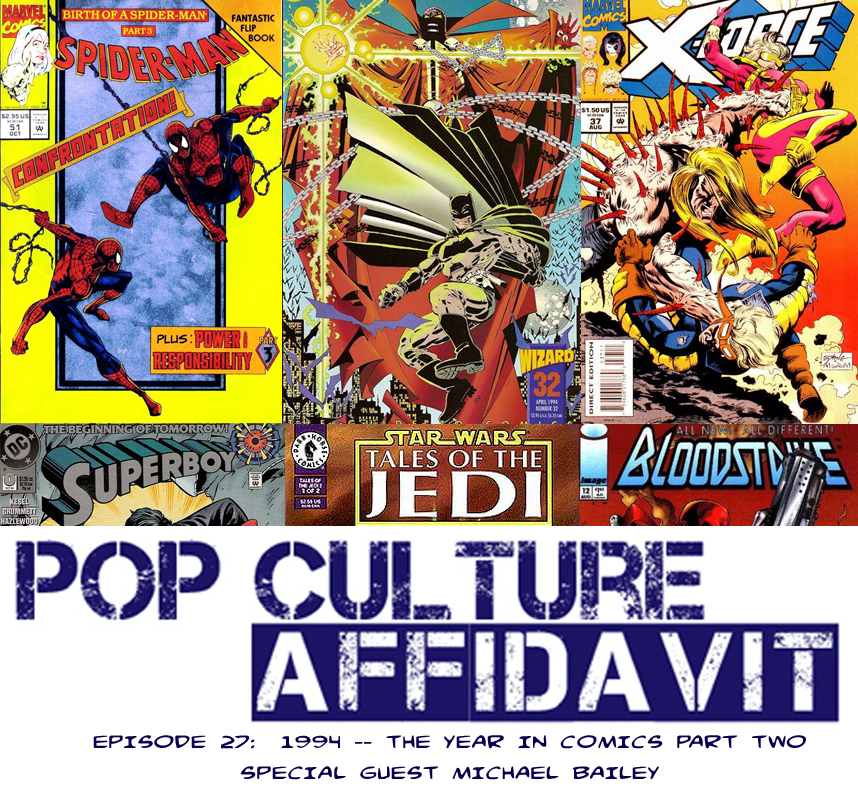
Episode 27 CoverIt’s It’s the big conclusion of my conversation with Michael Bailey about 1994 in comics.  Whereas we spent last episode talking about the comics industry, we spend most of this episode talking about what we thought were the most important comics of the year.the big conclusion of my conversation with Michael Bailey about 1994 in comics.  Whereas we spent last episode talking about the comics industry, we spend most of this episode talking about what we thought were the most important comics of the year.

You can listen here:

iTunes:  Pop Culture Affidavit

Direct Download 

Pop Culture Affidavit podcast page

And for your viewing pleasure, here is the Zero Hour/Zero Month promo video that Mike mentions in the episode:

A Banquet, a Song, a Date, a Mug

December_1963_oh_what_a_nightA few months ago, I was doing the dishes after breakfast, and after putting my coffee mug in the drying rack, I heard it crash to the floor.  I sighed and grabbed the broom and dustpan, and while sweeping it up, got annoyed.  I was annoyed at myself for not being careful, but also annoyed that a mug I had owned for twenty years was now gone.

The black coffee mug with a gold rim and “Sayville High School ’95” was the favor from my junior banquet, which took place on April 18, 1994. I honestly don’t know why it was called a banquet and not a prom–I suspect it had something to do with the seniors not wanting the juniors to call our dance a “prom” because my high school was all about that petty sort of crap–but it was the first formal school dance I ever attended.  In fact, if you want to get technical, it was my first date.

It is shocking to absolutely no one that I was an incredibly late bloomer.  Oh sure, I knew as early as elementary school that I liked girls, but at sixteen, I had not evolved socially beyond the awkwardness I had around girls when I was twelve.  I could control my behavior and wasn’t as obnoxious or immature in the presence of a pretty girl, but I still had ridiculous crushes on girls who were way out of my league, and even as late as college it took signals brighter than the average Times Square billboard for me to pick up on the fact that someone found me even marginally attractive.  In fact, at that point, my pursuit of the opposite sex amounted to asking out my crush in the ninth grade (and getting rejected) and getting friendzoned by someone prior to Christmas break, so the idea that I’d actually get a date for a dance was pretty ridiculous.

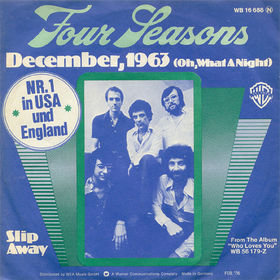
The junior banquet, though, was the social event of the year–at least for me, anyway–and because of that I felt that finding a date was necessary.  Okay, there was no stated obligation to find a date, but I definitely felt some sort of pressure to make sure I had a companion for the evening.  Maybe it was because my friends were getting dates or maybe because the dance was formal.  Personally, I blame our class’s choice of a theme song:  “Oh What a Night.” (more…)

Interstate Love Song

Interstate Love SongThere have only been a few times where I looked at the title of a song and said, “This is going to be a good one.”  Usually, song titles are pretty innocuous and if you were to give me a list of titles from a band’s latest album, I’d shrug.  The song’s called “Stay?”  Well, that could mean anything.  But like I said, every once in a while, I see “Raining in Baltimore” or “Elderly Woman Behind the Counter in a Small Town” and pay a little more attention to what it might be about.

Such was the case with “Interstate Love Song.”

When Purple was released in early June 1994, I had been waiting in anticipation for a couple of weeks.  “Big Empty” had been playing on the radio and in commercials for The Crow, and “Vasoline” had made its debut a week before.  Couple that with the fact that Core was still in regular rotation in my CD player and I didn’t need anything else to be sold.  I’m not sure if I bought the album the week it came out or if I picked it up a few weeks later.  All I know is that one afternoon, I came home from the mall (probably Sam Goody) with copies of Purple and 10,000 Maniacs’ MTV Unplugged.

One of my friends, who was the self-appointed authority when it came to all things music, wasn’t too hot on the album because it wasn’t as heavy as Core; however, I actually preferred Purple, and my co-purchase of the 10,000 Maniacs album should have been a sign that I had different tastes (the number of times that girls I knew borrowed said 10,000 Maniacs CD should have also been a sign that I was on the right track).  Purple wasn’t exactly a revelation in the way Dookie would become later that year, but in hindsight, it was a sign that the alternative music scene was lightening up a little.  “Big Empty” was the “this is the same as Core” track; “Vasoline” was a little different but still had guitars and speed the way I thought guitars and speed should be in a song.  But “Interstate Love Song?”  I looked at the title and wanted to listen to it because it sounded like a great title, even if a love song–which was more suited to people like Jon Secada–did not fit the criteria for a “good” song among my friends and I.  I mean, we listened to metal, not love songs.

Okay, my friends listened to metal and I was only listening to it so I could fit in.

Even so, that title drew me in.  I wanted to know more.  So after binging on “Big Empty” and “Vasoline,” I skipped ahead to track #4 and almost immediately, Purple’s status above Core as the better of the two albums, was established.  The tune hooked me in, which is perfect because I couldn’t understand what the hell Scott Weiland was actually singing about anyway.

By the way, it’s heroin.  He’s singing about heroin.

Okay, that’s not entirely true, although his heroin addiction–which was common among musicians of the early 1990s alternative scene–is something he’s cited in interviews as an inspiration.  The song’s also about honesty, and touches upon how relationships are inherently complicated.  Having not been in a relationship yet when I was sixteen, I didn’t know anything about this.  But I understood, on some level, the song’s sense of longing and of hoping for something (albeit pessimistically).

“Interestate Love Song” would eventually receive the highest of honors when it came to my musical tastes–I put it on a mix tape for a girl.  Granted, I had completely misinterpreted the song and had it mean something about long-distance relationships (I guess I took the title a bit too literally), but in that misinterpretation, the song wound up fulfilling the purpose of a mix tape anyway–it was repurposed by a listener.  And that’s usually why it’s one of those songs that reminds me of being a teenager, with the contradiction between its tune and its meaning recalling the conflict between youth and burgeoning adulthood and the struggle between longing and ultimate fulfillment.

Pop Culture Affidavit Episode 26: 1994 — The Year in Comics, Part One

Episode 26 CoverAs my look at 1994: The Most Important Year of the Nineties continues, it’s time to take a look at the comic books.  Joining me for this endeavor is Michael Bailey of Views from the Longbox (among other podcasts).  In this two-parter, we’re going to talk about the comics industry of the 1990s, what the big releases were in 1994 as well as what our favorite books were that year.

You can listen here:

iTunes:  Pop Culture Affidavit

Direct Download 

Pop Culture Affidavit podcast page

D.O.A. (My Life as a Teen Titan, Part Thirty-Nine)

Deathstroke 60On some level, I probably should be surprised that Deathstroke lasted as long as it did.

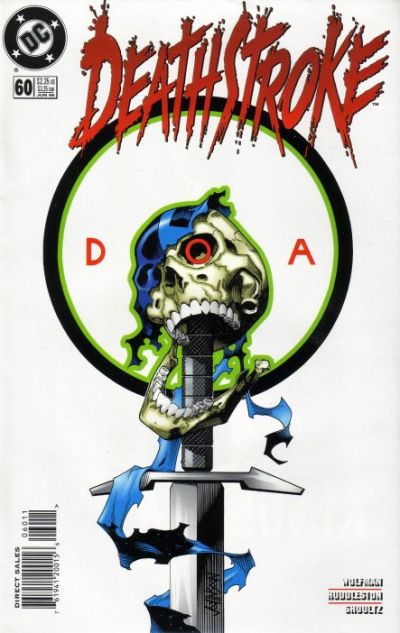
When I arrived home from college in the middle of May 1996, I picked up the books on hold at the comic store and in that stack sat Deathstroke #60, which was a white cover that had the main character’s mask and skull balanced on the hilt of a sword and the letters “D.O.A.”  It was the final issue of what I guess could be considered an experiment of sorts–giving a character who was essentially a villain his own title, something that wasn’t all that common back in 1991 when the first issue premiered (The Joker had his own series in the 1970s but beyond that, villain-led ongoings weren’t very common).

Of course, the fact that Slade Wilson was a mercenary and not inherently evil–in fact, his origin was more like a twisted version of Captain America’s–made him an easy “anti-hero” or adventure character.  As I’ve explored throughout this series of posts, much of his series was exactly like that.  Marv Wolfman took the character and the few supporting characters that had already been established–Adeline Kane and Wintergreen–developed them further and even added to them.  Then, they were almost all completely wiped out because of editorial mandates in the post-Zero Hour Hunted/Crimelord saga.

I’ll get into the editorial changes that allowed Wolfman to leave the Titans and Deathstroke behind with a slightly better taste in his mouth in the next entry, so what I’ll say here is that somewhere around issue #53, the book’s editor changed again, Tom Joyner (co-creator of Damage) came on to do a two-parter where Slade had to stop a terrorist cell from assassinating the president, vice-president, and every other high-ranking Washington official with chemical weapons (specifically, a plague) only to be blown up in an explosion that destroyed the dome of the Capitol Building.  It’s a serviceable story that sets up two things that would take the book through the last six issues of the series:  Slade will get a new costume and Slade will be de-aged and lose his memory. (more…)

Come as you are, as you were, as I want you to be

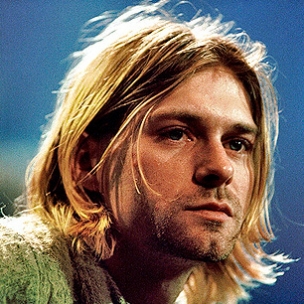
kurt-cobainSo it’s been twenty years since Kurt Cobain’s suicide.  I suppose that I’m not the only person writing a piece about it today (although I’m definitely one of the least important people writing about it).  Truth be told, if I wasn’t spending much of this year looking at 1994, I might not have even noted it beyond recognition upon seeing a Facebook post or something.

His death didn’t affect me very much–celebrity deaths rarely do.  However, when I was sixteen, I wasn’t that much of a fan of Nirvana.  Oh sure, I’d enjoyed the songs I’d heard off of albums like Nevermindbut I didn’t own any of them and was more into stuff like Pearl Jam, Stone Temple Pilots, and Metallica.  I suppose that might all have been different had I access to MTV on a daily basis but I can’t exactly write about something that wasn’t true.

What was true is that my friend Brendan called me up on April 8 and told me he saw something on MTV about Kurt Cobain having been found dead (Cobain’s autopsy would later reveal that he’d died on April 5).  We made some jokes about it adn then talked about something else.  It was probably hockey or school.  That night, I went to a meeting for the People to People Student Ambassador group for the trip to Europe I was scheduled to take that summer.  One girl, whose name I think was Tammy, was wearing a Nirvana T-shirt and I innocently asked if that was because of the news.  She replied that he wasn’t dead and that wasn’t completely true about the heroin overdose.  I apparently then became the person who first told her about Cobain’s suicide.

Beyond that, life went on.  I listened to other bands and explored other genres.  I did noticed that other people were more upset.  My sister’s friend, who had a flair for the dramatic, seemed pretty insistent on proclaiming that every lyric on every Nirvana album was a clue to his suicide.  There was at least one piece in the student newspaper about it.  And T-shirt stops at the mall seemed to be selling a lot more Nirvana T-shirts.

As the grunge of the early 1990s gave way to the fluorescent pop of the late 1990s, I began to see the significance in his death, culturally if not personally.  Cobain’s suicide is almost a dividing line between the two decades, establishing a Nirvana/Britney Spears divide between Generations X and Y (for lack of better terms, anyway).  It also winds up establishing Nirvana as a near-perfect band.  Okay, I’m not a fan of In Utero but the group has that Beatles-esque achievement of ending before they could really suck, whereas Pearl Jam was more like the Stones–slowly fading with diminishing returns and occasional flashes of brilliance.

Had Cobain not taken his own life, how would things have been deifferent?  Would we have gotten another Nevermind or would they have been put out Binural?  Would Kurt and Courtney have continued to be a trainwreck of a couple or would they look like Gavin Rossdale and Gwen Stefani (well, before they broke up)?  Would Nirvana’s continued presence prevent the rise of The Goo Goo Dolls, Marcy Playground, Third-Eye Blind, Smashmouth, Fastball, and a host of other “Where are they now?” bands from the late 1990s and early 2000s?

Such speculation is both fun and frustrating.  So are overwrought odes to dead artists and pretentious think pieces.  At least on a day like this, we can take the time to appreciate his contributions to music.

Bottom of the Inning: Taking Baseball Personally (Baseball, Part Two)

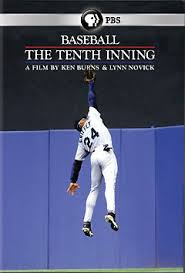
Baseball 10thIn my last post, I mentioned that watching all of Baseball made me feel like I was in an introductory, or “101” class on the game.  As well-researched and well-crafted as Ken Burns’s documentary was, there were times where I felt like I was getting the history textbook version of the baseball story:  hit the high points, go selectively in-depth, and completely skip over quite a bit.

While that’s a valid criticism, leaving it at that would be giving the work short shrift, especially since it’s a full day’s worth of a documentary.  Furthermore, I spent much of that first part of my look at Baseball on summary and critique and didn’t give much of my personal “story” as it is, or at least my personal reactions while I was watching it.  Which is kind of the whole purpose of this blog, right?

So that’s what I’m going to do.  Inning by inning.

First Inning (“Our Game” 1850s-1900):  This isn’t Baseball, this is seventh grade social studies with Mr. Kerkhof.  We’re talking about the Antebellum period and …  man, the 1800s are boring.  But this?  This isn’t so much because it’s an origin story, the kind I’m fixated on whenever we begin looking at an important event.  What were the first shots fired in the Revolutionary War and how did it progress from there?  Who actually founded the Roman Empire?  When did the  Middle Ages officially begin?  Who played that first game of baseball and what was it like in what seems like the Dark Ages to me–before Ruth, Gehrig, Mays, Mantle, and every other name I know?

Second Inning (“Something Like a War” 1900-1910):  I’m ten years old and my parents have given me a “Baseball’s All-Time Greats” baseball card set, the one I spotted in the Sears catalogue.  There’s Ty Cobb, and there’s Honus Wagner, who has the most expensive baseball card in existence, something I learned on a feature I saw on 20/20 the previous year.  I begin looking at the all-time stats for the old players and am amazed and even though many of their records have been broken, they still are in the top five for many of their most notable categories.  The card set is worth original retail price (and even today it’s not worth much), but what it lacks in monetary value it more than makes up for in facts.

Third Inning (“The Faith of Fifty Million People” 1910-1920):  To me, it’s not the Black Sox scandal; it’s Eight Men Out and Field of Dreams.  It’s “Say it ain’t so, Joe,” and the last scene of that softball episode of Married … With Children that parodies the last scene of Eight Men Out.  It’s also the idea that even something as pure as a game I play on Saturday mornings in Little League can be corrupted by outside influences (yunno, beyond the opposing team’s coach being friends with the umpire).

Fourth Inning (“A National Heirloom” 1920-1930):  I’m in the fifth grade and we’re asked to take a biography out of the library for our latest book report/conference with the teacher.  I grab one about Babe Ruth.  He competes with Gehrig.  He is supposedly “stranger than fiction,” which is what one of the chapter titles says.  Despite my being an excellent reader, I have trouble getting through the entire book.  I don’t know if it’s because the book’s badly written or because I don’t find the subject matter as interesting as I thought I would.  In fact, I can’t remember if I ever finished that book.  I do know that when I had my conference with Mr. Schafer about it, I did fine.

Fifth Inning (“Shadow Ball” 1930-1940):  I have no personal context for this.  In fact, if there is any episode that I found myself glued to, it’s this one.  Growing up, my knowledge of the struggle of African-Americans was limited to slavery, Plessy v. Ferguson, Brown v. Board of Education, and Martin Luther King Jr.  I was not exactly a scholar.  I knew the Negro Leagues existed but I don’t think that what little I read about them in books clued me in to what extent.  If anything, I’m grateful for what I gained from this episode.

Sixth Inning (“The National Pastime” 1940-1950):  It’s 2012 and I’m in a used bookstore on the Downtown Mall.  I’m looking for a copy of As You Like It but am also perusing the small graphic novel section.  On my way to the counter, I pass sports and Roger Kahn’s The Boys of Summer.  It sits on my shelf until the start of the 2013 season rolls around.  While Kahn’s biographical retelling of his time becoming a sportswriter is interesting, it’s his visits with former Dodger greats and the retelling of Jackie Robinson’s history that pulls me in.  For years, I knew three things about Robinson:  he played for the Dodgers, he broke the color barrier, and he stole home once in the World Series.  This tells me so much more.

Seventh Inning (“The Capital of Baseball” 1950-1960): I’m twelve years old and my family is throwing one of those big barbecues where everyone–from my mom’s side and dad’s side–is there.  My Uncle Brian, a die-hard Yankees fan, spends a good hour talking to Grandpa Panarese about baseball in the 1950’s.  They talk about the Yankees, the Giants, and the Dodgers.  I don’t interject; I just listen.  It’s one of the best memories I have of these two men and one of the most informative conversations upon which I ever eavesdrop.

Eighth Inning (“A Whole New Ballgame” 1960-1970):  To me, this is where baseball begins; specifically, in 1962, when the New York Mets go 40-120 and set an all-time single-season loss record that still stands.  I cut my baseball history teeth on An Amazin’ Era in 1986 and to me, “baseball history” has always involved Seaver, Koosman, Swoboda, Clendenon, Agee, Grote, Garrett, and McGraw.  Yes, there are more important figures in baseball history and more important events.  But it’s the lovable losers’ transformation into the Miracle Mets that I always remember.

Ninth Inning (“Home” 1970-1993):  It’s fascinating to see Bob Costas tell the story of being in the Red Sox locker room during the Buckner play and watching the champagne get wheeled out as quickly as possible.  It’s also fascinating to see testimony from Red Sox fans who were wounded by the play.  After all, I rooted for “the enemy” in 1986.  My nine-year-old dreams came true when Jesse Orosco threw the last pitch to Marty Barrett (I have a poster on the wall of my classroom), so it never occurred to me that someone might be upset by that night’s events.  Beyond that, there are so many recognizable faces here and I wish he was taking more time on them; I wish he was reminiscing with me the way he was reminiscing with my parents through the seventh inning.

When it ends with a talk about how baseball endures I realize that this isn’t a documentary; it’s a eulogy.  The season was cancelled due to a strike the month before the first episode aired and it doesn’t seem like we’ll get the game back.  Furthermore, it’s hard to pick a side because everyone seems greedy; everyone seems like a villain.  And here, at the funeral, we’re all trying to remember why we came.

Tenth Inning (1994-2010):  I was there.  I remember that.  I watched that.

I will never tire of watching Barry Bonds fail to throw out Sid Bream.  I always loved how much fun Ken Griffey Jr. seemed to be having–and always wished I had that swing.  I was cheering for McGwire the whole time and have to admit I was disappointed when the PED charges came to light.  I never cheered for Bonds unless he struck out looking.  I want to buy Steve Bartman a beer and talk baseball with the guy–not that game, just baseball.  No, the 2004 ALCS is not overrated and yes, I’ll watch the Yankees choke like that any time, day or night.  My heart was in my throat when Endy Chavez made that catch, only to have the Cardinals rip it out and crush it a few innings later.  You’re really using that Springsteen song, Ken?  Don’t you realize it’s about looking back and realizing how middle-aged you are?

“But then time slips away and leaves you with nothing mister but boring stories of glory days.”

You know what?  That’s exactly what this is, isn’t it?  Good job, sir.