We’re nearing the end of 1994: The Most Important Year of the Nineties and in the penultimate episode of the series, I’m showcasing what is one of the most important television series of the Nineties, The Real World. Specificlally, I take a look at season three: San Francisco, which starred Judd Winick, Pedro Zamora, and “Puck.” The episode includes a run-down of the history of The Real World up to that point, a look at the season and then a look at the season’s legacy as well as Winick’s 2000 graphic novel, Pedro and Me.
It’s Thanksgiving time and 1994: The Most Important Year of the Nineties continues with a look at the biggest night of network television that year–NBC’s Thursday night Must See TV lineup! Join me and my wife, Amanda, as we sit and watch the episodes of Mad About You, Friends, and Seinfeld that aired on November 17, 1994. It’s a kinda sorta commentary?
There’s a running joke that Michael Bailey (of Views From the Longbox fame) and I have going about us having “the same childhood”–being close in age and having grown up being able to watch a lot of the same TV channels, he and I have a lot of shared experiences when it comes to entertainment from the 1980s and 1990s. What makes this coincidence possibly more weird than funny, however, is that we both have the same mutant power. Both Mike and I have the ability to remember exactly where we were and what we were doing when we first saw a particular movie, heard a certain song, read a certain comic book, or encountered a number of other pieces of popular culture. I can take it one step further and tell you exactly where I was and what I was doing when my mutant power manifested itself. It was the day after Thanksgiving in 1994 and I was in my friend Vanessa’s kitchen. My girlfriend was breaking up with me over the phone and in the background of our conversation was Candlebox’s “Far Behind.”
Written as a tribute to Andrew Wood, the late singer of the seminal Seattle band Mother Love Bone, “Far Behind” is arguably the most well-known song off of Candlebox’s 1993 self-titled album. It was released on January 25, 1994 and peaked at #18 on the Billboard Hot 100, although it’s important to note that it was on the charts for most of the year and by the end of November 1994 was still in the top 40, having dropped to #35. But chart position for rock in 1994 wasn’t terribly important to those of us who were living on a steady diet of any band that we thought was quality in the wake of the coming of Nirvana and Pearl Jam during my freshman and sophomore years of high school, and since Candlebox sounded similar to Pearl Jam, Soundgarden, and Alice in Chains, I heard songs like “You” (their first single) and “Far Behind” and picked up the album.
I honestly had no idea that this was a tribute song. In fact, I had no idea who Andrew Wood was back in 1994 and my only experience with Mother Love Bone was the song “Chole Dancer/Crown of Thorns,” which was on the Singles soundtrack. I figured it was a typical-for-the-era breakup song/torch song, and to be honest, the events surrounding the day after Thanksgiving 1994 definitely contributed to that, especially since I took that moment very hard and it would take the better part of a year for she and I to get around to being friends without “We had once gone out and you broke up with me and I’m still pissed” being the elephant in the room. And that had more than anything to do with my immaturity–even though we only went out for a couple of weeks, she was the first girl I’d ever really dated and therefore this was my first real breakup. So “Far Behind” became its theme song and every time I heard it, I’d picture myself hanging out with Vanessa, who was home on break from college, calling up the girlfriend, and hearing her awkwardly ramble her way through a breakup that ended with “Well, I think we should just be friends.” It got to the point where it was like I was following some sort of masochistic ritual, and when I signed her yearbook that June I drove home the point by quoting the opening lines: “Well maybe I didn’t mean to treat you bad, but I did it anyway.” Because, you know, I was a senior in high school but when it came to girls I sometimes felt like I was still in junior high.
Despite all that, she and I are still friends and in a weird sort of way, this is a belated thank-you note to her because most importantly, that breakup was where memories of certain events or people in my life really began to be associated with something in popular culture and I began to think along the lines of “I remember when I first saw/heard this.” I hadn’t listened to “Far Behind” in nearly twenty years before watching the video on YouTube–a video I had, by the way, never seen before because I didn’t have cable in high school, and one that is so very Nineties (seriously, the empty pool, the color scheme, the guy walking around aimlessly, the outfits … this isn’t a music video, it’s an artifact in a Nineties museum)–and that’s not because of my memories but more because of my changing tastes in music (unlike Live’s Throwing Copper which I refused to listen to for years because of a girl and now refuse to listen to because Live simply sucks). Hearing it now, I can still see the wood paneling in Vanessa’s house and remember our conversations about David Letterman before picking up her phone and having that conversation and having my stomach drop, a moment that at the time was painful but eventually became almost bittersweet because of its normalcy and innocence.
I have to admit that I went in to re-watching With Honors with a feeling that I remember it being a lot better than it actually was. This tends to happen, I guess, when you don’t watch a movie for the better part of twenty years and you only wanted to see it because you had (and still kind of have) a thing for Moira Kelly. It’s honestly not that good. Okay, that makes it sounds worse than it is, but it’s not exactly The Big Chill or anything like that.
Released in April 1994, With Honors is the feature film directorial debut of Alex Kehishian, whose best-known work is one of the best rock documentaries of all time, the 1990 Madonna film Truth or Dare. It managed to gross a little bit more than $20 million at the box office and finished 69th overall for the year, which isn’t exactly flop material but isn’t a box-office success either. But quality of a movie is never really measured in receipts and my original attraction to the travails of Harvard student Montgomery “Monty” Kessler (Brendan Fraser) and his friends was similar to my attraction to the gang from St. Elmo’s Fire–a weird desire to watch people who were slightly older than me so I could possibly see if that’s what my life would be like.
Which sounds completely ridiculous, especially considering I saw this film in November 1994 when it had come out on video and I was seventeen years old at the time. Watching films about people older than in the hopes that you’ll get some sort of weird fantasy fulfillment out of it is something you do when you’re twelve or thirteen, not on the verge of graduating high school; then again, I was a late bloomer. But there is something about the setting of Harvard (even though quite a bit of the movie wasn’t filmed there) and the house that Monty shares with his friends that fills you with a wistful sort of feeling of either wanting to live in the place or wanting to go back to a time when you were a starving student.
But I’m getting ahead of myself and ahead of the plot, because With Honors isn’t St. Elmo’s Fire. Whereas that film is a look at how the relationships between a group of friends becomes incredibly complicated once they graduate from Georgetown and live on their own, With Honors is the story of how Monty meets a bum named Simon Wilder (Joe Pesci), who winds up touching all of them in some way or another and changing Monty’s life for the better. It starts with Monty’s hard drive getting completely fried (and if you’re up for getting really nostalgic, check out the MS-DOS command prompts and clickety-clack of an early 1990s IBM keyboard) and his insisting that he run out right that minute to get copies made even though it’s the middle of the night and it’s snowing. Naturally, he loses the thesis down a window grate and has to have Courtney (Moira Kelly) help him sneak into the library to get it from the boiler room. It’s not there when he arrives and instead has fallen into the hands of Simon, who begins making him all sorts of deals so that Monty can get the pages of his thesis back.
Simon winds up more or less invading Monty’s life and at first their relationship is contentious, but soon enough Simon is not only occupying much of Monty’s time and most of his thoughts but his philosophy as well, especially after his confrontation with Monty’s professor and mentor (who is played by Gore Vidal):
So what we get is one of those “he touched all of us” stories, especially after they discover that Simon is dying from a condition caused by having worked in a shipyard that constantly exposed him to asbestos. By the time that the gang takes a road trip so Simon can see the son he abandoned years before, he’s even won over Jeffrey, the mama’s boy roommate whose fastidiousness contributes to his initial hatred of Pesci’s lovable bum. But he, too, joins in the group hug.
If it sounds like the movie lays it on a little thick, it’s because it does. The characters are pretty much what you’d expect from a movie set at Harvard: the stressed-out students, the crazy artiste (Patrick Dempsey in Everett, who even has his own radio show and acts like Ronnie Miller amped up a few nothces), and the galpal. They live in an off-campus house that you would have killed to live in when you were in college (at least me, anyway, who spent four years in the dorm), and everything about the film says, “Stressed out smart college students finding something out about themselves.” Plus, the main plot isn’t at all subtle and if anything is subtle in With Honors, it’s the obvious romantic tension between Courtney and Monty, who on the surface appear to act like brother and sister but really have strong feelings for one another but are afraid to act on those feelings–that is, until Simon convinces Monty that it’s worth the risk and we get one of the better scenes in the film at a “pajama party”:
Okay, maybe it’s just my aforementioned crush on Moira Kelly that makes me think this is one of the better scenes in the film, but I do love that line, “I’m ending our friendship.” And looking at what I’ve written in the last few paragraphs, it seems like I didn’t like With Honors, but as uneven as it is, I did, although not as much as twenty years ago.
Then again, twenty years ago I was sitting on a couch with the girl I was dating and we ended out making out at the end of the night; when I watched this, I was streaming it on my Kindle and my wife was already asleep. In a way, it was indicative of how 1994 was ending for me personally–I’d gone from secretly renting movies at the video store and watching them alone on Friday night to picking out something that would be a good “Date Night” movie. And the movies themselves began to become more and more intertwined with where and when I was as well as who I was with.
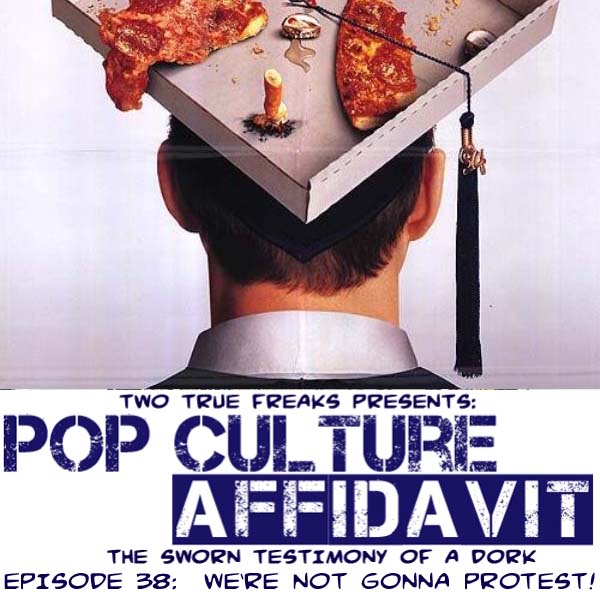
Save your seat on the couch, throw on some P-Funk, try to figure out the Caine-Hackman theory, work on your thesis, and get really offended because it’s time to take a look at the 1994 college flick PCU! Yeah, while it’s not the most important film of 1994: The Most Important Year of the Nineties, it’s still one that we all remember, probably because of the number of times it aired on Comedy Central. Anyway, I take a look at the movie’s plot and talk about five of my favorite things about the Jeremy Piven classic.
Just because we’re both hideous doesn’t mean we’ll be compatible.
About five years ago, I was showing Mary Shelley’s Frankenstein to a room full of high school seniors. We got to the scene where the monster (Robert DeNiro), who is now at the point where he has Victor Frankenstein (Kenneth Branagh) by the throat and is forcing the good doctor to make him a bride from the tattered remains of Helena Bonham Carter. The Bride of Frankenstein, so to speak, emerges from the 19th-Century life-giving apparatus and Victor and the monster begin calling to her, telling her to come to each of them as if she’s a puppy trying to choose between two owners.
I went on to ask my students about how Hollywood is forever getting Frankenstein completely wrong as I thought about how I missed how bad this movie was back when I saw it in the theater in 1994. After all, by putting the name of the author above the title–a trend that eventually died out after William Shakespeare’s Romeo & Juliet because … Shakespeare Wrote Romeo & Juliet? Thanks for telling me, Baz–Kenneth Branagh’s film purported to be the definitive adaptation of Mary Shelley’s classic horror novel. And to a point, it actually works out pretty well–bride-dog moments aside, the basic structure of the plot is there–but in many areas it falls flat and that’s why I was wondering why I liked it when I was seventeen. Then I realized that like a few of my entertainment choices in the mid-1990s, this story begins with the phrase: “You see, there was this girl …”
While I know it shouldn’t, being on a date drastically changes your perspective on the film you’re watching. The night I went to see Mary Shelley’s Frankenstein, I was on my first official date with a girl I had been friends with for a couple of years, but we’d been hanging out a lot and that prompted me to do the math: our hanging out together + she knowing that I liked her = she might actually want to go out with me. This wouldn’t mean very much to your average seventeen-year-old boy, but I wasn’t exactly your average seventeen-year-old boy. I had spent the majority of my adolesence being painfully awkward around girls, acting immature and not knowing what to say. The more attracted I was to a girl, the worse that awkwardness was, and that is probably the reason I didn’t go on a single date until that night in November to see Mary Shelley’s Frankenstein. So I spent most of the movie not concentrating on the film but trying to figure out how to properly behave so that the date went well and by the end of the night I could … well, I guess the experession “get to first base” would apply. In the blur of Branagh, Bonham Carter, DeNiro and Aidan Quinn (I remember his part because she squeed when she saw him), I worked on trying to find the right moment to put my arm around her, followed by trying to figure out a tactful way of taking my arm away when it started to go numb. It was ten times tougher than the calculus class I had every first period.
Not to brag, but I was successful. Okay, it’s not much of a brag because we walked from the movie theater to the corner near both of our houses and I spent what might have only been two minutes but felt like ten awkwardly and nervously chuckling and making small talk until I finally made a move and kissed her good night. It wasn’t my first kiss–that had come the previous summer when I was away in Europe–but it was my first “date” kiss, the first kiss that had the potential to lead to something more than a goodbye and a half-assed attempt at writing letters to one another for the first month after I got home. Never in my life had so much depended on one very chaste kiss at the end of the night; never in my life had a moment been so charmingly small town that they don’t even write those types of moments anymore.
I haven’t watched Mary Shelley’s Frankenstein in its entirety since that moment in my classroom five years ago; I’ve been more or less permanently teaching sophomores since then and high-concept, high-budget horror from the 1990s isn’t as interesting to me as low-budget schlock from the 1980s. And I guess I’ll keep it that way because for once I don’t mind having a memory overshadow a movie.
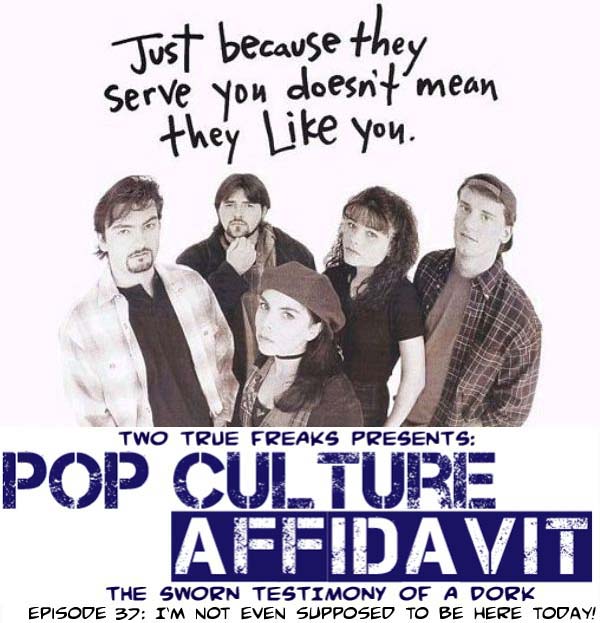
With episode 37, I return to 1994: The Most Important Year of the Nineties with the only thing that I could possibly cover for episode 37: CLERKS! And to join me for this discussion of Kevin Smith’s classic debut is Trentus Magnus, the award-winning host of Trentus Magnus Punches Reality. We guarantee that it is so awesome, it will break you.
The Ford Explorer after its update for the 1995 model year. Image courtesy of Wikipedia.
I will fully admit that I’m not a car guy. I know very little aboutt the interior workins of an automobile, and don’t really care about what I am driving as long as it has four wheels and runs properly. In fact, I didn’t even get my license until after I graduated high school, and even then it was because I wanted to get my road test out of the way before heading to college. Still, like any of the guys I know who are into cars, I can appreciate a well-designed vehicle and did notice through the mid- to late-1990s how the automobiles I was seeing on the road were starting to change. By the time we hit the turn of the century, the SUV came to dominate, something os noticable that even The Washington Post Magazine was doing its cover story on how people in compact cars were afraid for their lives on the Beltway due to the high volume of Ford Expeditions (and how many of those Expeditions were being driven by the incompetent and the aggressive).
But the Expedition wasn’t king of the road yet in 1994, as most of the suburbanite families I knew were hauling kids around and running errands either in a minivan or in a Ford Taurus wagon, which was the last great station wagon. It was the best-selling car in the country at the time and held that status until 1997 when it was replaced by the Toyota Camry. I’m sure that there were many reasons for this, but a significant factor had to be Ford’s lackluster redesign of the Taurus in 1996, which effectively killed the sedan. That didn’t mean, however, that Ford didn’t make its mark in the mid-1990s because it did so with an SUV and a car: the Explorer and the Mustang.
Both of these cars already existed prior to 1994, obviously, but it’s important to note that this year saw important changes for both. The Explorer was a relative newcomer to suburban driveways, hvaving been introduced in 1990. SUVs weren’t as ubiquitous then as they are now–some people had Jeep Grand Cherokees, some had GMC Suburbans (which was more like a truck), and there was this infamous Ford Bronco that made its way down a Los Angeles freeway that June–so to own an Explorer back in its first few years meant that you had enough money to not need a Taurus and were a bit more sophisiticated than the average minivan owner. And if you had the Eddie Bauer edition Explorer? Well.
The 1994 Ford Explorer Eddie Bauer edition. Image from Motortopia.
Really, very few things int he early 1990s say “Family plucked from the pages of a catalogue” than the Eddie Bauer edition of the Ford Explorer. Usuall hunter green, the SUV had an all-leather interior with the Eddie Bauer goose logo stitched into the seat backs and tan pinstriping with “Eddie Bauer” stenciled on side. There was one owned by a family a few blocks over from me, a car appropriate for its street–Handsome Avenue, which was a wide street lined with trees whose leaves cascaded beautifully to the ground each fall. I pictured that family wearing matching barn jackets while driving their Eddie Bauer edition Ford Explorer to some cabin on a lake where they would then spend their evenings drinking cocoa while sitting by a fire in their coordinating sweaters. Ford probably saw this and saw potential in it too, because even though the Eddie Bauer edition was out in 1993 or so, they redesigned the Explorer for the 1995 model year to be less boxy and more in line with the curvature of then-modern cars. Unlike the Taurus, this was a win and by the end of the decade, the Explorer, Expedition, and Excursion were just about everywhere.
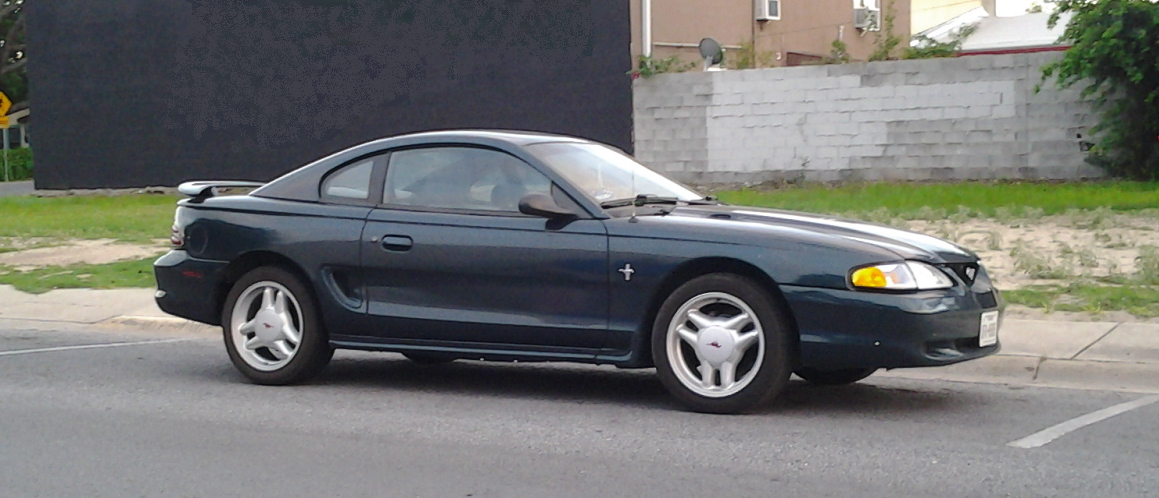
Another win was the redesign of the Mustang, a car that helped define “muscle” during its heyday. but like quite a number of cars in the 1980s and early 1990s, it had fallen upon hard times aesthetically and was a shadow of its former shefl. The 1994 Mustang was Ford’s shot at changing that, a redesign that was going to return its famous sports car to its former glory, as evidence by this ad campaign:
The redesigned 1994 Ford Mustang. Image courtesy of Wikipedia.
The redesign worked and the new Mustang definitely made enough of a splash to get it noticed by even non-car guys like me. But honestly, if it went from 0-60 in 5.3 seconds, it went from 0-guido in 2.5. I don’t know if it was Ford’s intention, but whenever I think of this car, I picture it being colored bright teal, reeking of Parliaments and blasting Gina G. with the driver spackling on another layer of base while driving 75 in a 35 on the way to a club whose name includes the word “Dublin” to meet a Mustang-driving boyfriend who infused the once-great car with all of the tricked out features, gold chains, tank tops, backwards Yankees caps, and Drakkar Noir they could get their hands on.
And I know I spent my time here focusing on Ford when there are scores of other cars out there, but these two cars are two that would help define the suburban landscape for the latter part of the decade. Furthermore, they would help re-create the sense of the cars you own as a middle class status symbol, an affordable luxury that was beyond the utilitarian K-cars of the prior decade and showed how well you were at keeping up with everyone else.
My MSCL two-parter concludes with an extra-sized celebration through conversations with longtime fans of the show. Join me, Sarah Bunting (of TWoP and Previously.tv fame), Cory, Mark, Andrea, and chelle as we talk about MSCL, its impact on our lives, our history as fans, and the show’s legacy twenty years later.
Twenty years ago, a television show premiered that, while it lasted only one season, had a clear impact on its devoted fans. The show was My So-Called Life. In honor of its twentieth anniversary and its place in 1994: The Most Important Year of the Nineties, here’s the first of two episodes. In this one, I give my so-called origin story and take a look at each episode.
 We’re nearing the end of 1994: The Most Important Year of the Nineties and in the penultimate episode of the series, I’m showcasing what is one of the most important television series of the Nineties, The Real World. Specificlally, I take a look at season three: San Francisco, which starred Judd Winick, Pedro Zamora, and “Puck.” The episode includes a run-down of the history of The Real World up to that point, a look at the season and then a look at the season’s legacy as well as Winick’s 2000 graphic novel, Pedro and Me.
 There’s a running joke that Michael Bailey (of
  I have to admit that I went in to re-watching With Honors with a feeling that I remember it being a lot better than it actually was. This tends to happen, I guess, when you don’t watch a movie for the better part of twenty years and you only wanted to see it because you had (and still kind of have) a thing for Moira Kelly. It’s honestly not that good. Okay, that makes it sounds worse than it is, but it’s not exactly The Big Chill or anything like that.