1990s

Pop Culture Affidavit Episode 45: Live From New York, it’s Saturday Night!

Episode 45 website coverIt’s a coattails-riding self-indulgent trip down comedy memory lane as I spend 30 minutes talking about Saturday Night Live, which just had a huge 40th anniversary special this past Sunday. Here, I look back on another anniversary special from the show, its 15th anniversary special, which aired in the fall of 1989, and I also talk about how the show has had an effect on me since I’ve been watching it for the last 25 years.
Here’s where to listen:

iTunes: Two True Freaks Presents Pop Culture Affidavit

Direct Download

Two True Freaks Presents: Pop Culture Affidavit podcast page

80 Years of DC Comics, Part One: A Comics Life in Moments

80 Years Episode 1 Website LogoPresenting the first episode in an all-new podcast miniseries from Pop Culture Affidavit, 80 Years of DC Comics. Throughout these twelve episodes, I am going to be taking a look at the various genres of comic books that DC Comics has produced in its 80-year history. For my first episode, I start off easy by talking about superheroes. More specifically, I go through 10 moments in DC Comics published during my lifetime that have I’ve enjoyed or that have had some sort of impact on me. So while it doesn’t necessarily cover all 80 years of the company, it’s a personal look at DC, company I’ve been very loyal to since I started seriously collecting comics more than two decades ago.

Of course, you can download the episode from the same iTunes feed used for every episode of Pop Culture Affidavit, or you can listen here:  Pop Culture Affidavit Presents 80 Years of DC Comics, Part One:  A Comics Life in Moments.

Below are scans of the ten moments I talk about, in brief, in the episode (btw, some of these are spoilers for the stories they are from).

1. Batman Confronts Silver St. Cloud (Detective Comics #475):

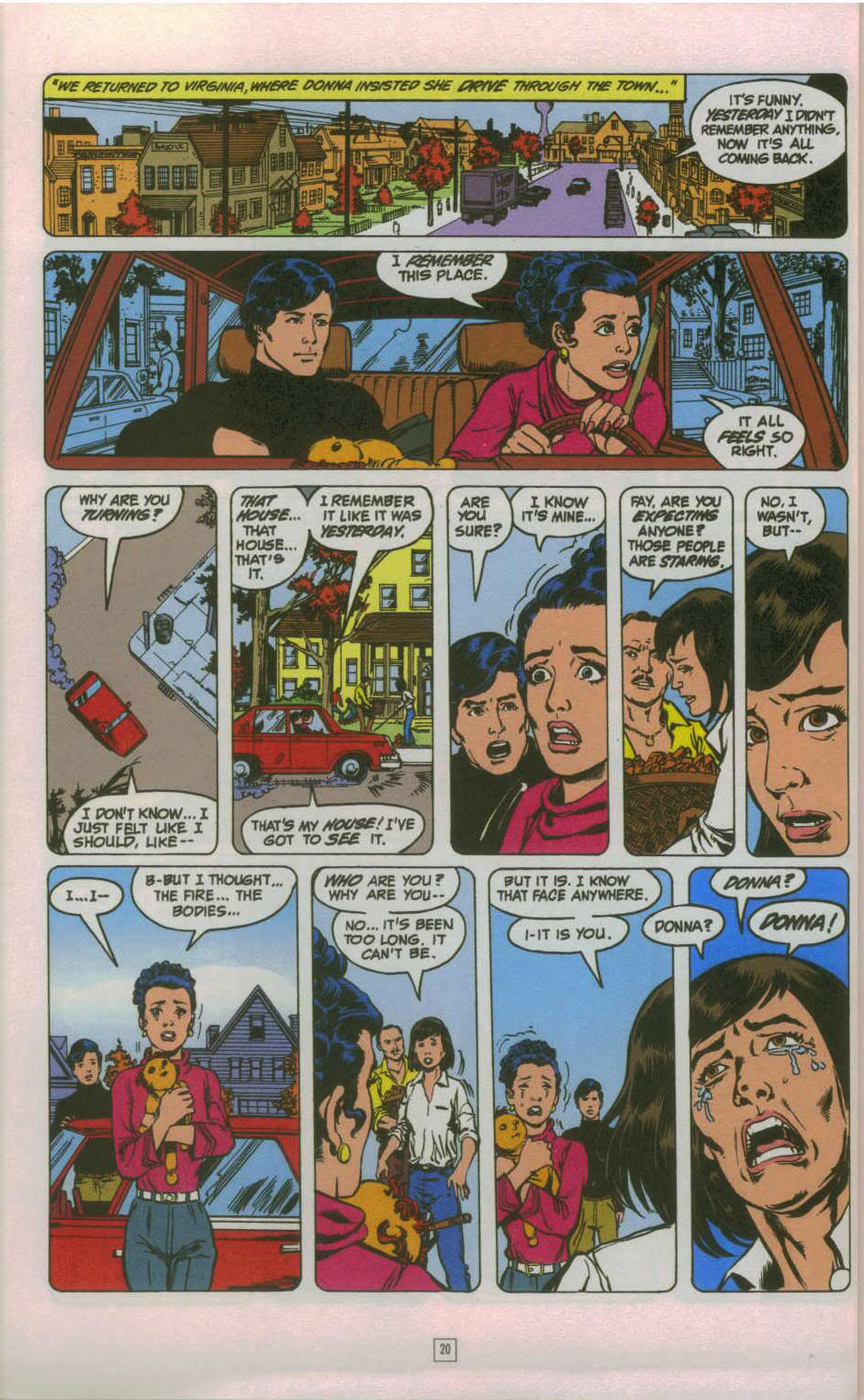
Silver St Cloud2. Donna Troy Reunites With Her Adopted Mother (The New Teen Titans [First Series] #38):

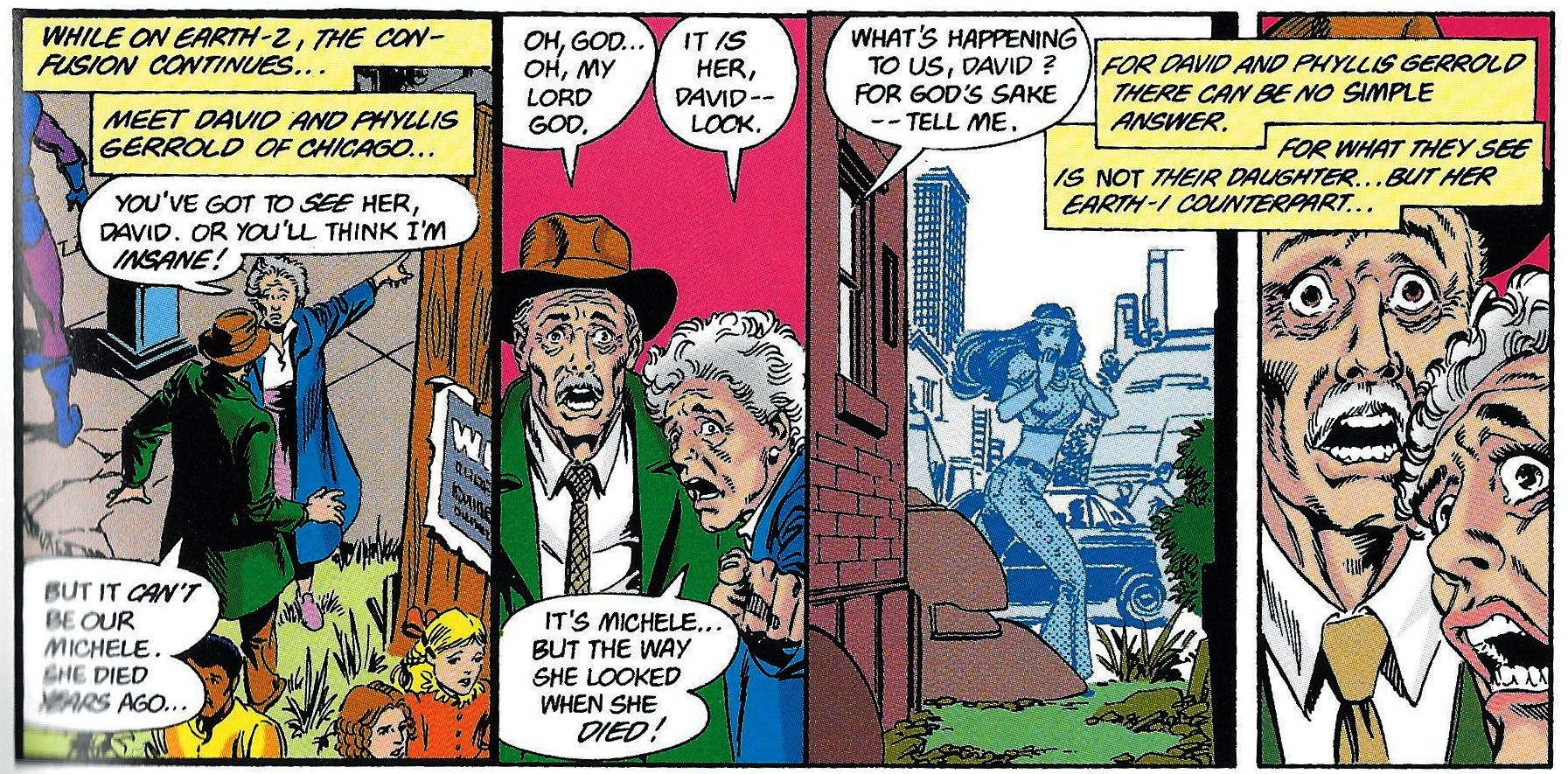
Donna Troy Reunion3. Ordinary Citizens Reacting to Merging Earths (Crisis on Infinite Earths #5):

Crisis 5 Old Couple4. Bruce Wayne Has Some Bad News (Detective Comics #620):

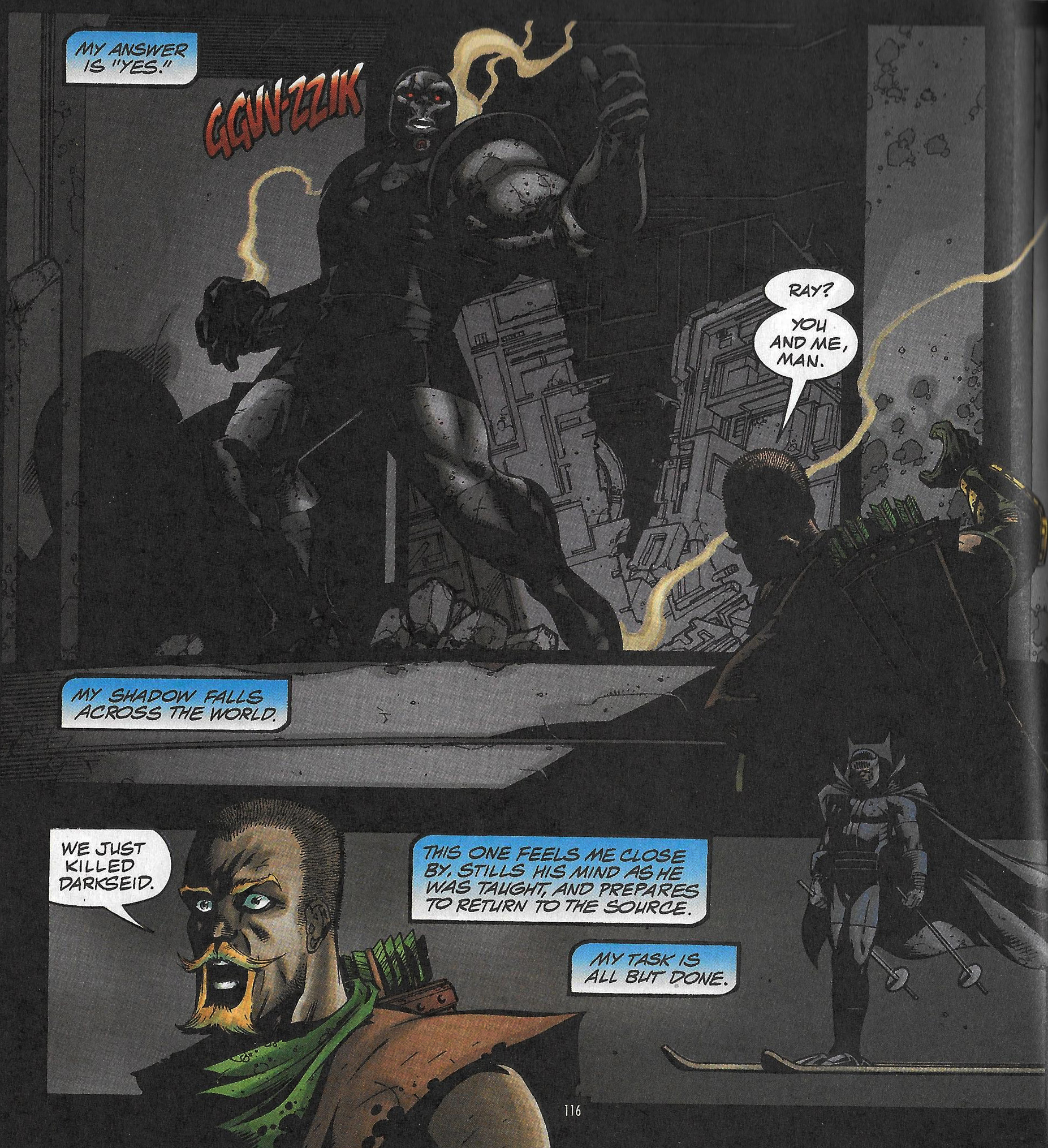
Detective 620 Last page5. The Atom and Green Arrow Kill Darkseid (JLA #14):

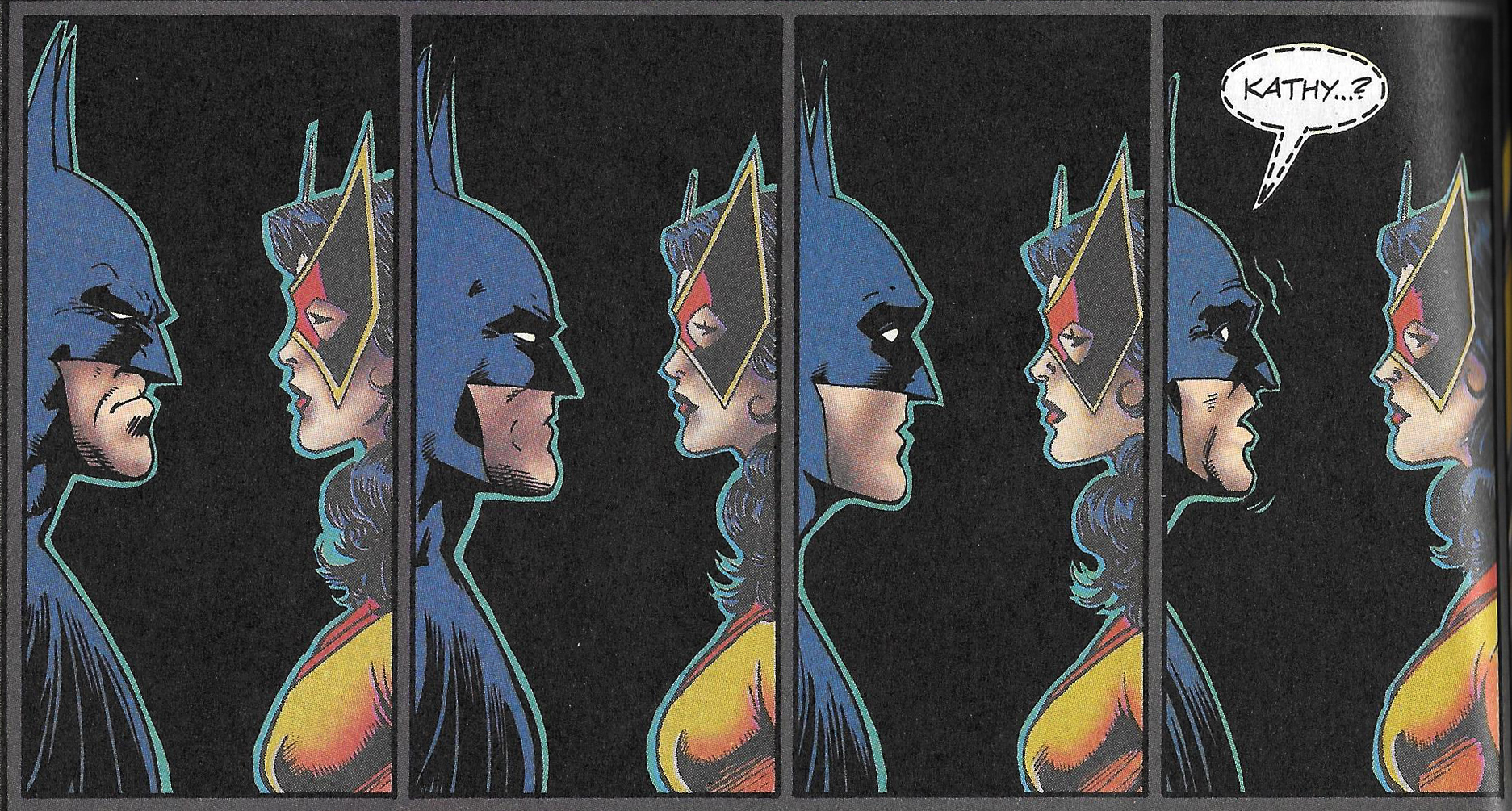
JLA Death of Darkseid6. Batman meets … Batwoman? (The Kingdom:  Planet Krypton):

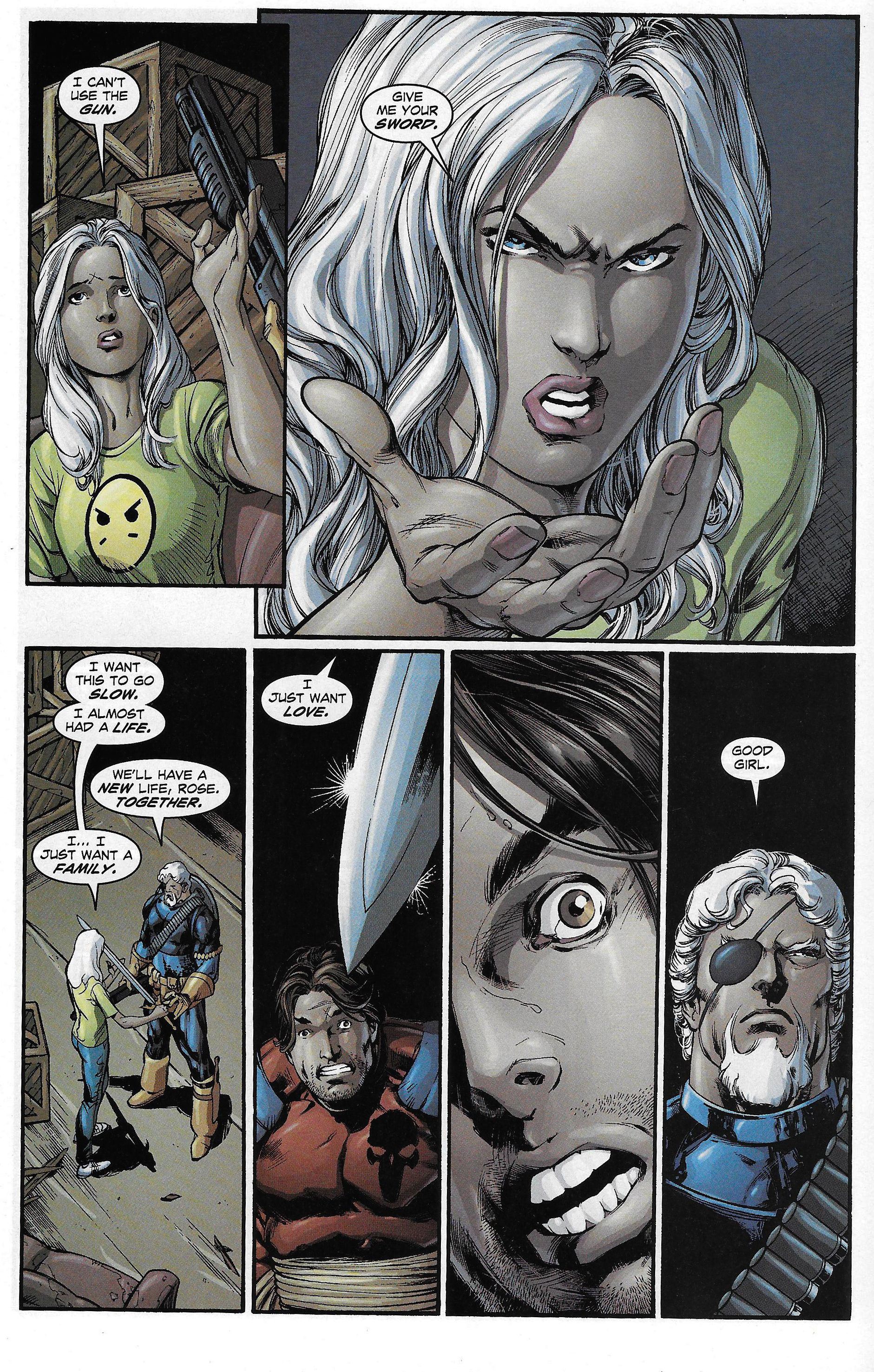
The Kingdom Batwoman7. Rose Wilson Chooses Her Family (Teen Titans #1/2):

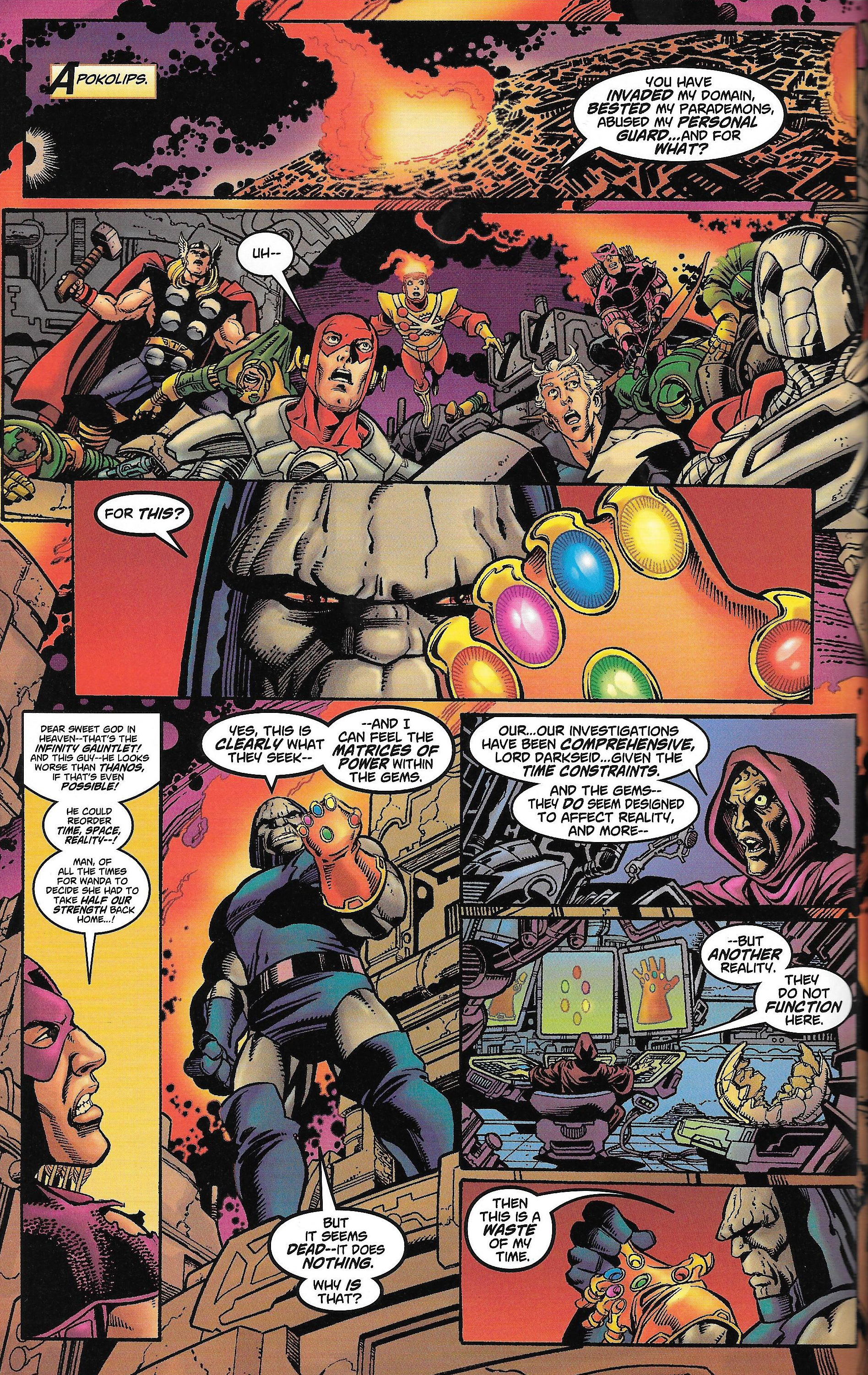
Rose Wilson Ravager8. Darkseid and The Infinity Gauntlet (JLA/Avengers #2):

Darkseid JLA Avengers9. “Superheroes.  Kill.”  (Final Crisis #3):

Final Crisis 3 final page10.  Danny Chase’s Sacrifice (The New Teen Titans: Games)

Teen Titans Games Danny Chase

We Wrote the Book on Savings

consumers catalog

The cover of the fall 1991-1992 Consumers catalog. The company stayed in business until the mid-1990s, although my local store was gone by then.

I think that I am at the point in my life where I don’t get upset if I go to the store and something is out of stock.  Oh sure, it’s a minor inconvenience and the solution usually leads to me getting in the car and driving to another, similar store down the road.  But when you are a kid, this is a hard lesson to learn.  You don’t have a car and you don’t know much about the stores in your area beyond what you have seen whenever your parents have taken you, so showing up to TSS only to find out that the action figure you wanted was completely sold out can be absolutely devastating, even if it provides you with much-needed lessons about how you’re not always able to get what you want instantly.  Now, I’m sure that if you ask a number of people in my generation how they learned this lesson, they’ll tell you a variation on the same story–they wanted a toy, they asked mom or dad to take them to the store to get it, it wasn’t there.  Or they may say one word:  “Consumers.”

Consumers was a catalog-based store that was founded in Canada as Consumers Distributing in 1957 and expanded over the course of a couple of decades, adding stores and then buying out other, similar retail outlets, something that helped them to pop up with more frequency during the 1980s.  The idea behind the store was similar to its main competitor, Service Merchandise:  the company published a catalog and then anyone who wanted to buy something from the catalog would head to the local retail outlet–usually at a mall–and pick it up.

That is, if they actually had anything.

The G.I. Joe page of a 1980s Consumers catalog. Photo courtesy of YoJoe.com

The arrival of the Consumers catalog twice a year was an event.  My friends and I would grab it out of the mail and skip right to the toys and games section.  Open before us was a display of everything we ever wanted, from G.I. Joe figures and vehicles to every Nintendo game that we’d ever seen advertised anywhere.  Plus, the prices were much better than what you would get at Toys R Us–not that Toys R Us was overpriced or anything, but any time you can say, “Hey Mom!  The Legend of Zelda is only $45 and not $60!  Can we get it?” you have a better shot at getting what you wanted.

That is, if your parents were completely gullible, which mine were not, but that didn’t stop me from trying.  Unfortunately for those who actually got this ploy to work, going to Consumers was usually a bust because they would head to the store, find the item on display, give the cashier a ticket and most of the time discover that said item was currently out of stock.  According to the Wikipedia page on the store, this led to the company creating what was then an innovative inventory checking system, where they were able to look up the item you wanted on the inventory of every store in the area, which is something that we take for granted in today’s retail world.

But the prevailing perception was that most of the merchandise at Consumers was non-existent and as much as the company tried to change that, I don’t think it really helped.  It also didn’t help that the Consumers store in the Sayville area was in the Sun Vet Mall, a mall that was closer than any of the malls in the area but was clearly third-tier, especially when compared to the South Shore Mall and Smith Haven Mall, which had big-name department stores.  Sure, Sun Vet had The Gap, which was convenient when I was in junior high and high school, but its anchors were a Rickel Home Center and a PathMark, so it didn’t exactly scream “Galleria” if you know what I mean.

The Consumers store was located in the corner of the mall near the Gap and McCrory, both of which have since left, and whereas the other malls always were bustling, Sun Vet always seemed half dead and while the mall’s pizzeria was excellent and Sun Vet Coin and Stamp always was good for a few back issues, you only went there if you absolutely had to or if you were like me and my friend Jeremy, who would ride there on our bikes when we were teenagers simply because we had very little else to do.  Whereas Service Merchandise would be a huge store that was part of a brand new shopping center down the road, Consumers was shoved into that corner and while the first few catalogs would get people there, the store was pretty dead within a year or two, especially as we’d taken to dragging our parents back to Toys R Us or anywhere else where we knew that would have what we wanted in stock.

So in a way, it was a learning experience about being more strategic in begging for toys and other stuff as well as being more patient, and perhaps that is why so many of us are more intelligent these days about where we shop.

Pop Culture Affidavit Episode 42: Closing the Door on 1994

Episode 42 Webpage CoverIt’s the end of the year and that means it’s the end of my year-long series, “1994: The Most Important Year of the Nineties!” I close things out with another grab bag that features music, movies, television, politics, and the Internet and then give a final, closing statement about why 1994 is the most important year of what’s proven to be an incredibly important decade.

You can listen here:

iTunes:  Pop Culture Affidavit

Direct Download 

Pop Culture Affidavit podcast page

And for your viewing/listening pleasure, here’s some things that were covered in the grab bag or at least mentioned at one point or another …

Dave Matthews Band: “Best of What’s Around”

Hammer: “Pumps and a Bump”

Weezer:  “Buddy Holly”

Beastie Boys: “Sabotage”

Scenes from The Ref

Opening credits to Party of Five

BoDeans: “Closer to Free”

Live: “Selling the Drama”

Live: “Lightning Crashes”

The trailer for True Lies

A call from The Jerky Boys

Dave Matthews Band: “Ants Marching”

Real McCoy: “Another Night”

Pop Culture Affidavit, Episode 40: What Happens When People Start Being Polite and Start Gettin’ Real

?????????????We’re nearing the end of 1994: The Most Important Year of the Nineties and in the penultimate episode of the series, I’m showcasing what is one of the most important television series of the Nineties, The Real World. Specificlally, I take a look at season three: San Francisco, which starred Judd Winick, Pedro Zamora, and “Puck.” The episode includes a run-down of the history of The Real World up to that point, a look at the season and then a look at the season’s legacy as well as Winick’s 2000 graphic novel, Pedro and Me.

You can listen here:

iTunes:  Pop Culture Affidavit

Direct Download 

Pop Culture Affidavit podcast page

Also, you can buy Judd Winick’s Pedro and Me, it is still available on Amazon:  Pedro & Me: Friendship, Loss, and What I Learned

Also, here’s some of the stuff featured in the episode …

A compilation of the intros to The Real World …

The “Why Doesn’t MTV Play Videos Anymore” sketch from Brian and Maria …

Pop Culture Affidavit Episode 39: Must See TV!

Episode 39 Webpage LogoIt’s Thanksgiving time and 1994: The Most Important Year of the Nineties continues with a look at the biggest night of network television that year–NBC’s Thursday night Must See TV lineup! Join me and my wife, Amanda, as we sit and watch the episodes of Mad About You, Friends, and Seinfeld that aired on November 17, 1994. It’s a kinda sorta commentary?

You can listen here:

iTunes:  Pop Culture Affidavit

Direct Download 

Pop Culture Affidavit podcast page

My mutant power activated the day I was left “Far Behind”

CandleboxThere’s a running joke that Michael Bailey (of Views From the Longbox fame) and I have going about us having “the same childhood”–being close in age and having grown up being able to watch a lot of the same TV channels, he and I have a lot of shared experiences when it comes to entertainment from the 1980s and 1990s.  What makes this coincidence possibly more weird than funny, however, is that we both have the same mutant power.  Both Mike and I have the ability to remember exactly where we were and what we were doing when we first saw a particular movie, heard a certain song, read a certain comic book, or encountered a number of other pieces of popular culture.  I can take it one step further and tell you exactly where I was and what I was doing when my mutant power manifested itself.  It was the day after Thanksgiving in 1994 and I was in my friend Vanessa’s kitchen.  My girlfriend was breaking up with me over the phone and in the background of our conversation was Candlebox’s “Far Behind.”

Written as a tribute to Andrew Wood, the late singer of the seminal Seattle band Mother Love Bone, “Far Behind” is arguably the most well-known song off of Candlebox’s 1993 self-titled album.  It was released on January 25, 1994 and peaked at #18 on the Billboard Hot 100, although it’s important to note that it was on the charts for most of the year and by the end of November 1994 was still in the top 40, having dropped to #35.  But chart position for rock in 1994 wasn’t terribly important to those of us who were living on a steady diet of any band that we thought was quality in the wake of the coming of Nirvana and Pearl Jam during my freshman and sophomore years of high school, and since Candlebox sounded similar to Pearl Jam, Soundgarden, and Alice in Chains, I heard songs like “You” (their first single) and “Far Behind” and picked up the album.

I honestly had no idea that this was a tribute song.  In fact, I had no idea who Andrew Wood was back in 1994 and my only experience with Mother Love Bone was the song “Chole Dancer/Crown of Thorns,” which was on the Singles soundtrack.  I figured it was a typical-for-the-era breakup song/torch song, and to be honest, the events surrounding the day after Thanksgiving 1994 definitely contributed to that, especially since I took that moment very hard and it would take the better part of a year for she and I to get around to being friends without “We had once gone out and you broke up with me and I’m still pissed” being the elephant in the room.  And that had more than anything to do with my immaturity–even though we only went out for a couple of weeks, she was the first girl I’d ever really dated and therefore this was my first real breakup.  So “Far Behind” became its theme song and every time I heard itI’d picture myself hanging out with Vanessa, who was home on break from college, calling up the girlfriend, and hearing her awkwardly ramble her way through a breakup that ended with “Well, I think we should just be friends.”  It got to the point where it was like I was following some sort of masochistic ritual, and when I signed her yearbook that June I drove home the point by quoting the opening lines: “Well maybe I didn’t mean to treat you bad, but I did it anyway.”  Because, you know, I was a senior in high school but when it came to girls I sometimes felt like I was still in junior high.

Despite all that, she and I are still friends and in a weird sort of way, this is a belated thank-you note to her because most importantly, that breakup was where memories of certain events or people in my life really began to be associated with something in popular culture and I began to think along the lines of “I remember when I first saw/heard this.”  I hadn’t listened to “Far Behind” in nearly twenty years before watching the video on YouTube–a video I had, by the way, never seen before because I didn’t have cable in high school, and one that is so very Nineties (seriously, the empty pool, the color scheme, the guy walking around aimlessly, the outfits … this isn’t a music video, it’s an artifact in a Nineties museum)–and that’s not because of my memories but more because of my changing tastes in music (unlike Live’s Throwing Copper which I refused to listen to for years because of a girl and now refuse to listen to because Live simply sucks).  Hearing it now, I can still see the wood paneling in Vanessa’s house and remember our conversations about David Letterman before picking up her phone and having that conversation and having my stomach drop, a moment that at the time was painful but eventually became almost bittersweet because of its normalcy and innocence.

But I’m a Harvard bum.

I have to admit that I went in to re-watching With Honors with a feeling that I remember it being a lot better than it actually was.  This tends to happen, I guess, when you don’t watch a movie for the better part of twenty years and you only wanted to see it because you had (and still kind of have) a thing for Moira Kelly.  It’s honestly not that good.  Okay, that makes it sounds worse than it is, but it’s not exactly The Big Chill or anything like that.

Released in April 1994, With Honors is the feature film directorial debut of Alex Kehishian, whose best-known work is one of the best rock documentaries of all time, the 1990 Madonna film Truth or Dare.  It managed to gross a little bit more than $20 million at the box office and finished 69th overall for the year, which isn’t exactly flop material but isn’t a box-office success either.  But quality of a movie is never really measured in receipts and my original attraction to the travails of Harvard student Montgomery “Monty” Kessler (Brendan Fraser) and his friends was similar to my attraction to the gang from St. Elmo’s Fire–a weird desire to watch people who were slightly older than me so I could possibly see if that’s what my life would be like.

Which sounds completely ridiculous, especially considering I saw this film in November 1994 when it had come out on video and I was seventeen years old at the time.  Watching films about people older than in the hopes that you’ll get some sort of weird fantasy fulfillment out of it is something you do when you’re twelve or thirteen, not on the verge of graduating high school; then again, I was a late bloomer.  But there is something about the setting of Harvard (even though quite a bit of the movie wasn’t filmed there) and the house that Monty shares with his friends that fills you with a wistful sort of feeling of either wanting to live in the place or wanting to go back to a time when you were  a starving student.

But I’m getting ahead of myself and ahead of the plot, because With Honors isn’t St. Elmo’s Fire.  Whereas that film is a look at how the relationships between a group of friends becomes incredibly complicated once they graduate from Georgetown and live on their own, With Honors is the story of how Monty meets a bum named Simon Wilder (Joe Pesci), who winds up touching all of them in some way or another and changing Monty’s life for the better.  It starts with Monty’s hard drive getting completely fried (and if you’re up for getting really nostalgic, check out the MS-DOS command prompts and clickety-clack of an early 1990s IBM keyboard) and his insisting that he run out right that minute to get copies made even though it’s the middle of the night and it’s snowing.  Naturally, he loses the thesis down a window grate and has to have Courtney (Moira Kelly) help him sneak into the library to get it from the boiler room.  It’s not there when he arrives and instead has fallen into the hands of Simon, who begins making him all sorts of deals so that Monty can get the pages of his thesis back.

Simon winds up more or less invading Monty’s life and at first their relationship is contentious, but soon enough Simon is not only occupying much of Monty’s time and most of his thoughts but his philosophy as well, especially after his confrontation with Monty’s professor and mentor (who is played by Gore Vidal):

So what we get is one of those “he touched all of us” stories, especially after they discover that Simon is dying from a condition caused by having worked in a shipyard that constantly exposed him to asbestos.  By the time that the gang takes a road trip so Simon can see the son he abandoned years before, he’s even won over Jeffrey, the mama’s boy roommate whose fastidiousness contributes to his initial hatred of Pesci’s lovable bum.  But he, too, joins in the group hug.

If it sounds like the movie lays it on a little thick, it’s because it does.  The characters are pretty much what you’d expect from a movie set at Harvard:  the stressed-out students, the crazy artiste (Patrick Dempsey in Everett, who even has his own radio show and acts like Ronnie Miller amped up a few nothces), and the galpal.  They live in an off-campus house that you would have killed to live in when you were in college (at least me, anyway, who spent four years in the dorm), and everything about the film says, “Stressed out smart college students finding something out about themselves.”  Plus, the main plot isn’t at all subtle and if anything is subtle in With Honors, it’s the obvious romantic tension between Courtney and Monty, who on the surface appear to act like brother and sister but really have strong feelings for one another but are afraid to act on those feelings–that is, until Simon convinces Monty that it’s worth the risk and we get one of the better scenes in the film at a “pajama party”:

Okay, maybe it’s just my aforementioned crush on Moira Kelly that makes me think this is one of the better scenes in the film, but I do love that line, “I’m ending our friendship.”  And looking at what I’ve written in the last few paragraphs, it seems like I didn’t like With Honors, but as uneven as it is, I did, although not as much  as twenty years ago.

Then again, twenty years ago I was sitting on a couch with the girl I was dating and we ended out making out at the end of the night; when I watched this, I was streaming it on my Kindle and my wife was already asleep.  In a way, it was indicative of how 1994 was ending for me personally–I’d gone from secretly renting movies at the video store and watching them alone on  Friday night to picking out something that would be a good “Date Night” movie.  And the movies themselves began to become more and more intertwined with where and when I was as well as who I was with.

Pop Culture Affidavit, Episode 38: We’re Not Gonna Protest!

Episode 38 CoverSave your seat on the couch, throw on some P-Funk, try to figure out the Caine-Hackman theory, work on your thesis, and get really offended because it’s time to take a look at the 1994 college flick PCU! Yeah, while it’s not the most important film of 1994: The Most Important Year of the Nineties, it’s still one that we all remember, probably because of the number of times it aired on Comedy Central. Anyway, I take a look at the movie’s plot and talk about five of my favorite things about the Jeremy Piven classic.

You can listen here:

iTunes:  Pop Culture Affidavit

Direct Download 

Pop Culture Affidavit podcast page

Memories That Overshadow Movies

Just because we're both hideous doesn't mean we'll be compatible.

Just because we’re both hideous doesn’t mean we’ll be compatible.

About five years ago, I was showing Mary Shelley’s Frankenstein to a room full of high school seniors. We got to the scene where the monster (Robert DeNiro), who is now at the point where he has Victor Frankenstein (Kenneth Branagh) by the throat and is forcing the good doctor to make him a bride from the tattered remains of Helena Bonham Carter. The Bride of Frankenstein, so to speak, emerges from the 19th-Century life-giving apparatus and Victor and the monster begin calling to her, telling her to come to each of them as if she’s a puppy trying to choose between two owners.

I went on to ask my students about how Hollywood is forever getting Frankenstein completely wrong as I thought about how I missed how bad this movie was back when I saw it in the theater in 1994. After all, by putting the name of the author above the title–a trend that eventually died out after William Shakespeare’s Romeo & Juliet because … Shakespeare Wrote Romeo & Juliet? Thanks for telling me, Baz–Kenneth Branagh’s film purported to be the definitive adaptation of Mary Shelley’s classic horror novel. And to a point, it actually works out pretty well–bride-dog moments aside, the basic structure of the plot is there–but in many areas it falls flat and that’s why I was wondering why I liked it when I was seventeen. Then I realized that like a few of my entertainment choices in the mid-1990s, this story begins with the phrase: “You see, there was this girl …”

While I know it shouldn’t, being on a date drastically changes your perspective on the film you’re watching. The night I went to see Mary Shelley’s Frankenstein, I was on my first official date with a girl I had been friends with for a couple of years, but we’d been hanging out a lot and that prompted me to do the math: our hanging out together + she knowing that I liked her = she might actually want to go out with me. This wouldn’t mean very much to your average seventeen-year-old boy, but I wasn’t exactly your average seventeen-year-old boy. I had spent the majority of my adolesence being painfully awkward around girls, acting immature and not knowing what to say. The more attracted I was to a girl, the worse that awkwardness was, and that is probably the reason I didn’t go on a single date until that night in November to see Mary Shelley’s Frankenstein. So I spent most of the movie not concentrating on the film but trying to figure out how to properly behave so that the date went well and by the end of the night I could … well, I guess the experession “get to first base” would apply. In the blur of Branagh, Bonham Carter, DeNiro and Aidan Quinn (I remember his part because she squeed when she saw him), I worked on trying to find the right moment to put my arm around her, followed by trying to figure out a tactful way of taking my arm away when it started to go numb. It was ten times tougher than the calculus class I had every first period.

Not to brag, but I was successful. Okay, it’s not much of a brag because we walked from the movie theater to the corner near both of our houses and I spent what might have only been two minutes but felt like ten awkwardly and nervously chuckling and making small talk until I finally made a move and kissed her good night. It wasn’t my first kiss–that had come the previous summer when I was away in Europe–but it was my first “date” kiss, the first kiss that had the potential to lead to something more than a goodbye and a half-assed attempt at writing letters to one another for the first month after I got home. Never in my life had so much depended on one very chaste kiss at the end of the night; never in my life had a moment been so charmingly small town that they don’t even write those types of moments anymore.

I haven’t watched Mary Shelley’s Frankenstein in its entirety since that moment in my classroom five years ago; I’ve been more or less permanently teaching sophomores since then and high-concept, high-budget horror from the 1990s isn’t as interesting to me as low-budget schlock from the 1980s. And I guess I’ll keep it that way because for once I don’t mind having a memory overshadow a movie.