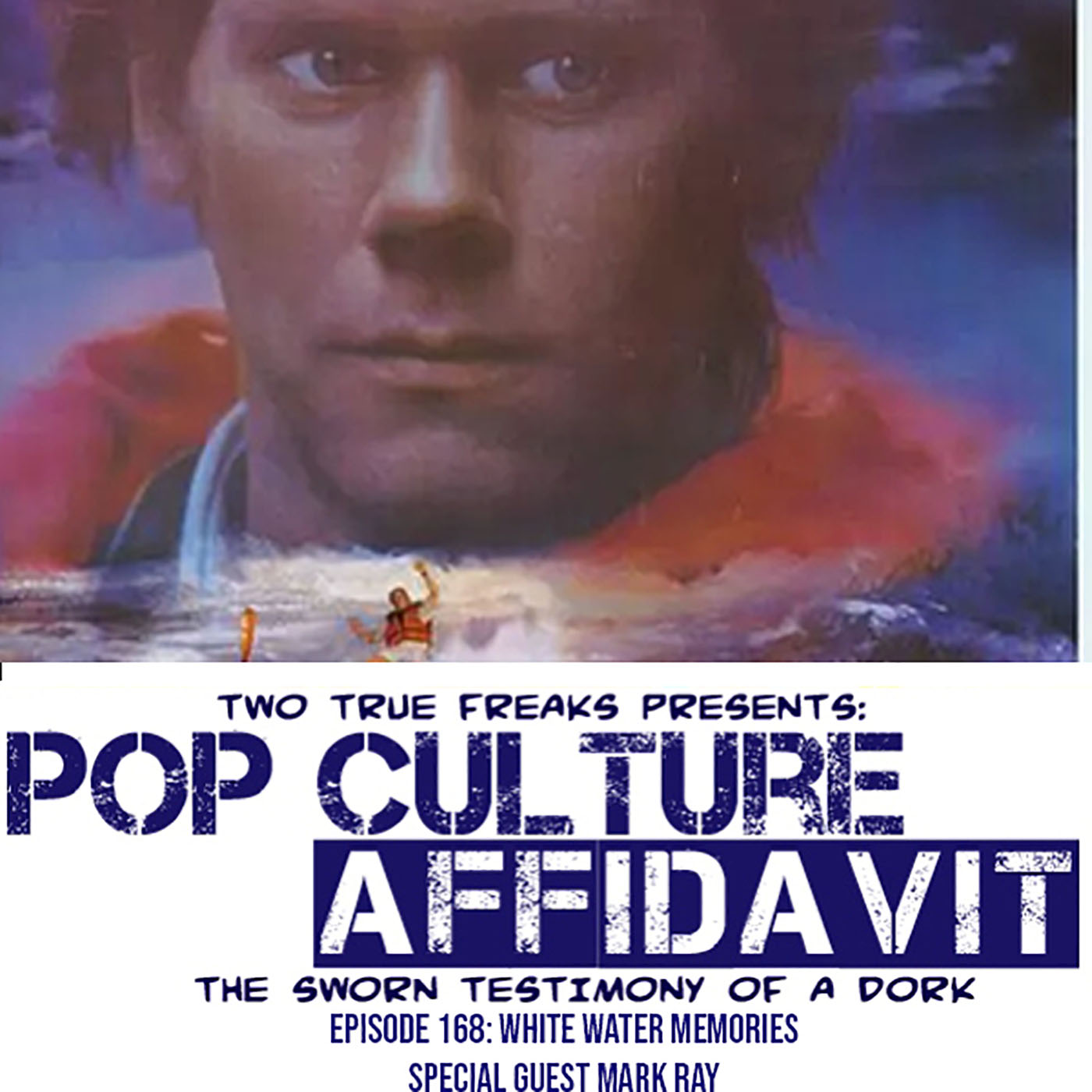
In 1987, White Water Summer, starring Kevin Bacon and Sean Astin, was released. The movie did poorly in theaters but gained a following on cable and video, becoming a coming-of-age cult classic. This episode, I’m joined by Mark Ray, one of the film’s stuntmen. He talks to me about the movie and his experience filming it.
For my 18th birthday, I got a $25 gift certificate to Tape World.
It was 1995 and I hadn’t bought a cassette in at least a few years. But in The Smith Haven Mall, there was still a store called Tape World. I’d never set foot inside of it and I don’t think anyone I knew had either. Sam Goody was right around the corner, sitting in prime position across from Aeropostale and The Gap, beckoning music lovers with its neon entrance and posters advertising the latest albums. Tape World was a blocky ‘80s-lettering sign above a thin store that was tucked between 5-7-9 and The Bombay Company. I actually had to check the mall directory to find it.
The Eighties didn’t so much end in 1990; rather, they slowly faded into obscurity, and that has me thinking about where they eventually went. Tape World, for instance, has its place in our cultural examination of the decade, as one of Michael Galinsky’s photos for The Decline of Mall Civilization shows a blonde girl with quintessential mall hair walking by the store and its wood paneling facade. A look through my memories of the malls near me (and yes, malls, plural–it was Long island) shows a number of places where time seemed to stand still well after the decade had changed over while simultaneously trying to keep up with the times. Gardiner Manor Mall had an ancient Sears, an Orange Julius, and a bridge to Stern’s. The South Shore Mall had Captree Corners, a late-1970s mini mart of small shops and a fountain I loved to throw pennies into when I was six. The Sun Vet Mall was where 1981 went to die.
Smith Haven, started out as a mid-century mall of the late 1960s with fountains, Alexander Calder sculptures, and the low-lit atmosphere that I associate with the era. It was a twenty-minute drive from Sayville and when I was little, I loved going to “the mall with the fountains.” However, it underwent a massive renovation in 1987 and emerged with a brighter neon-tinged and mauve-tiled palette that has come to typify the Eighties.
The renovation was hyped even as it was going on. When the mall was getting its makeover, there were radio commercials that sang “We’re building the place of your dreams … Smith Haven Mall!” Later, the commercials changed to “Your wildest dreams will come true … Smith Haven Mall!” I don’t know what “wildest dreams” can come true at Jean Country or Casual Corner, but I will take their word for it. The mall was also the home to a local news special on WLIG 55, “At the Mall With Drew Scott.” It remains one of the more amazing artifacts of 1980s Long Island as did the mall itself until it underwent another renovation in the mid-2000s.
That’s probably why it’s always stayed alive while so many shopping malls have died. A hot place in the Eighties, Smith Haven was also a destination for Nineties mall-ness because it had a Gap, Aeropostale, Structure, Express, Limited, Eddie Bauer, Bath and Body Works, Victoria’s Secret, Disney Store, and Warner Brothers Studio Store. But it was still Eighties building that held onto that part of its identity with stores like Tape World; Sssassy, which was a real-life version of Over Our Heads, the store from the last few seasons of The Facts of Life; and the cutlery store Hoffritz. Because honestly, nothing is more Eighties than a store devoted entirely to cutlery.
Sssassy in Smith Haven Mall, probably in the late 1980s or early 1990s. Photo was taken from siteride on Flickr.
The faded Eighties aesthetic in the era of grunge was simultaneously out of place and in line with those who have come to be known as “Xennials”. Stuck between our cool older Generation X and annoying little Millennial siblings, the Xennial microgeneration is the middle child–ignored because mom and dad had already done everything for those older siblings and the younger ones were showing much more promise. We were raised by people going through the motions, wearing hand-me-downs and finding ourselves too old for anything new. I don’t think it was spurred on by anything other than bad timing. We had our peak teenage mall years during the first Bush recession where the economy and the housing market both bottomed out, especially on Long Island, so that meant that development and progress were put on pause and we did our best to use our fading institutions of commerce.
Ironically–appropriate for the Nineties, I know–this made parts of Long Island feel like a museum exhibit. In recent years, there has been a ton of McMansioning and townhome development. But in the late 1990s, there was still a lot left over from decades past. My grandmother’s neighborhood in New Hyde Park had houses that had remained unchanged since the 1950s. Downtown spaces in Patchogue, Amityville, and Huntington still resembled their 1950s and 1960s selves. Sayville Pizza looked like it hadn’t been updated since 1975. Even as a kid, I wondered what ghosts were sending echoes through their halls and walls, and whatever patina or grime covered the Island led me to associate authentic with “worn.”
Of course, such things do not always last, especially when the economy improves and developers can give yet another facelift to a mall or neighborhood. The candy-colored late 90s and the housing boom of the 2000s meant knocking down the useless buildings to put up Target (as they did with the Gardiner Manor Mall) or turning a shopping center property into a housing development. In some cases, the limited space provided by an area in Queens or Nassau County meant a creative way to drop a Barnes & Noble into a strip mall. In other, like in Suffolk County, you could bulldoze acres of woods to create an outlet mall. I’m sure nobody really noticed when Rickel and Pergament gave way to Lowes and Home Depot unless someone prompted them. It’s such a suburban aesthetic to embrace whatever is new. “They’re putting in a Whole Foods.”
Yeah, they give us a lot.
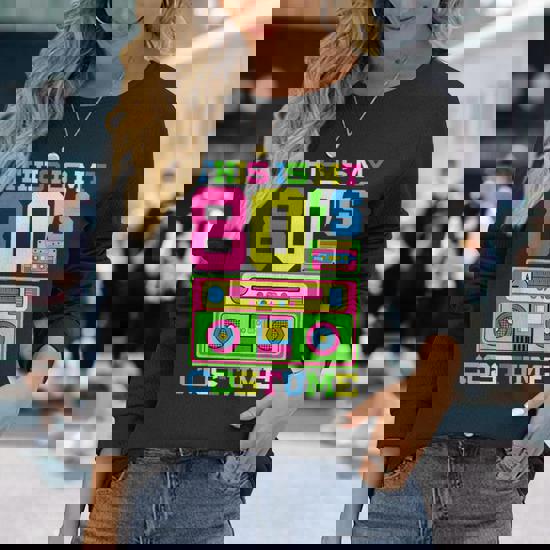
Image taken from one of those baitclick T-shirt ads that uses really bad photoshopping. You know the ones.
They’ve even given us the past, preserving the Eighties in places that are comfortable and happy–movies, marathon weekends on radio stations, your kids’ spirit week costumes. But it’s all cosplay and manufactured nostalgia put forward by those who stand to earn money or cache off of our memories: memes, influencers who pretend they “are Eighties”, bad TikToks of someone bobbing their head and pointing out that random items existed or making lists of cartoons “nobody heard of” yet every single commenter remembers. Yet, that’s the product of our culture, which is one that has been manufactured for generations.
Tons of ink has been spilled about suburbia, stripping down its vinyl siding to show the flaws underneath andI want to make some pretentious point about how because the Eighties were actually stripped of all substance and repackaged, we are stuck in a cultural Allegory of the Cave and the people who sold us the American Dream are making money off of that, but I’ll just look for where the past has receded and the decade truly remains. Because it’s not a place everyone goes. It’s in a paragraph of the last chapters of a U.S. history textbook. It’s documentaries buried underneath a pile of true crime exposés on second-tier streaming services. It’s in a bin in the attic, the back of a closet, or on the shelves and racks of thrift stores.
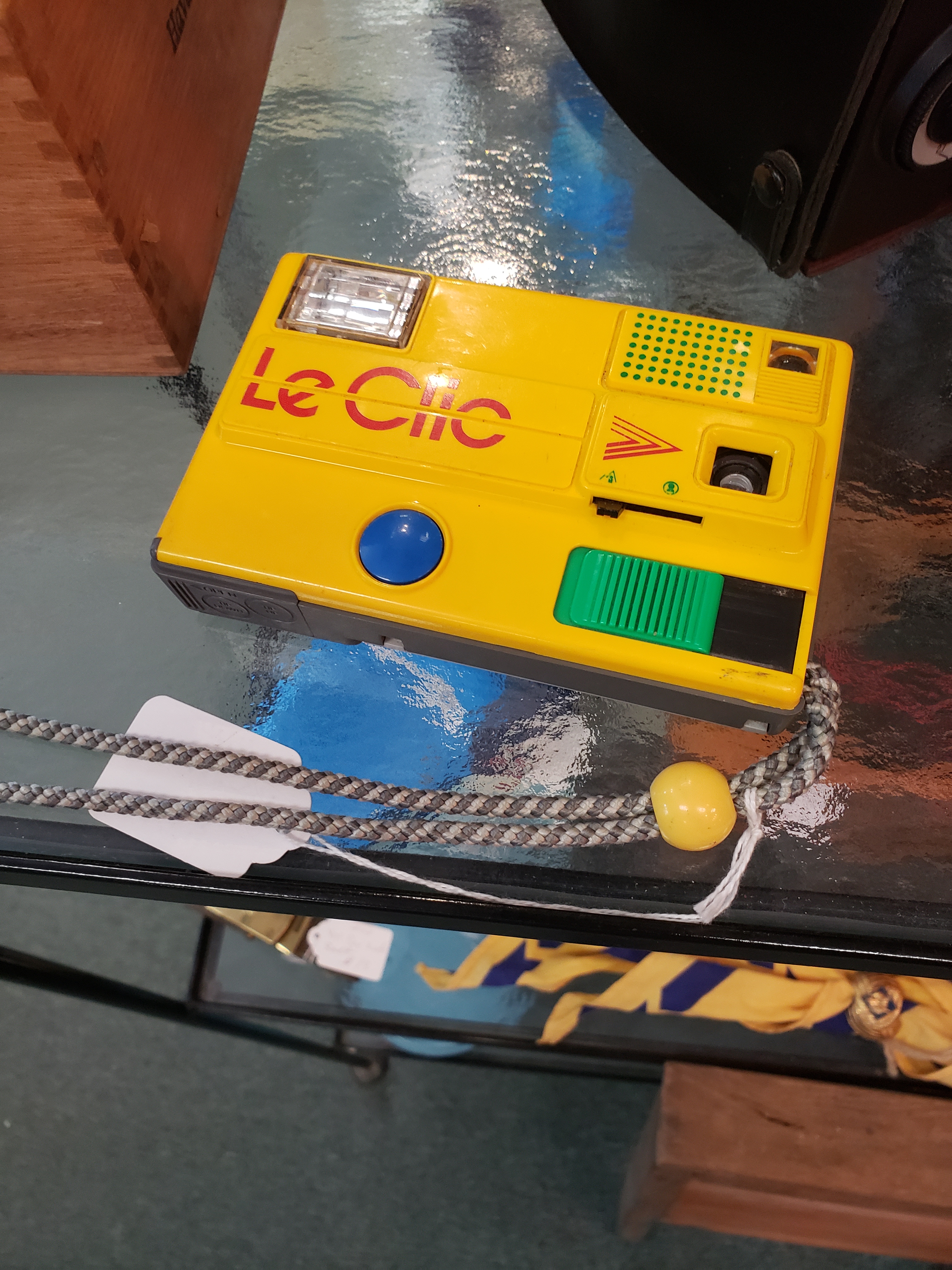
A few months ago, I was in one of those antique malls where people offload things that don’t qualify for an appearance on Antiques Roadshow but still think are worth more than a couple of bucks at a yard sale. Among stacks of old Corningware, old country albums, military ephemera, and old guitars were a number of video games, baseball cards, toys, and other things I recognized, like a Le Clic, a disk film camera that came in an assortment of colors, all of which screamed Eighties. These were more comforting than any meme or slapped-together neon wardrobe I’ve seen on a high schooler. They felt lived in and I could picture some kid with a questionable haircut wearing an Ocean Pacific T-shirt once collecting and playing with all of them.
picture taken from eBay.
In the ten or fifteen minutes I spent in Tape World thirty years ago, I stuck to Eighties music. I’d like to say that a store called Tape World demanded an Eighties music purchase, it was because CDs were expensive and I wanted to get the most out of my $25. The Fast Times at Ridgemont High soundtrack on CD was just enough to allow me to dive into a bargain bin and fish out The 80s Rock + On, a K-Tel produced 80s compilation cassette that would live in my Walkman or the tape deck of my Hyundai Excel until I offloaded my cassettes in the mid 2000s. So yes, I did buy a tape at Tape World.
I wish I could have some profound way of starting this essay or even something or someone to tie it together, but the truth is that last week, I fell down one of hte more random Internet rabbit holes. Although I don’t know if this was a rabbit hole beacuse I was actually finding the answer to something and had some serendipity come along with it. Either way I think I am probably the only person in the world who does a fist pump the moment he discovers his sixth grade reading textbook on the Internet Archive.
The timing of my search for it does make sense, though. It was my last week of summer break and I didn’t have much to do on the day when it was pouring out, so I decided to look into some of the topics on the very large list of topics for possible blog posts and then remembered that years ago, I’d purchased a copy of The Mine of Lost Days by Marc Brandel. It’s a children’s/young adult novel published in 1975 that’s about a kid visiting relatives in Ireland and finding a group of children in a mine who are actually from more than 100 years ago. I remembered liking the book when I was a kid and had bought it because I had been looking for an answer to my very specific question: “What was that novel that was in Point?”
Point was a book published in 1982 as part of the Addison-Wesley Reading Program and at Lincoln Avenue Elementary was considered the highest level of reading book that you could hit. I was a high-achieving reader through all of elementary school, so I was pretty sure that as I was working my way throughGreen Salad Seasons in the fifth grade, I would wind up being one of those cool kids in sixth grade carrying around the elite reading book–and nothing says elite like a textbook with a unicorn on the cover. I probably had to cover it with a brown paper bag anyway.
Point‘s elite status lost a little bit of its luster when my sixth grade teacher, Ms. Frei, told us that everyone in the class was reading from it. Modern pedagogy says that this is probalby not a good idea (although to be fair, modern pedagogy gives you conflicting information on everything from instructional approach to whether or not you should put a poster on the wall), although now that I have been teaching for about 20 years, I see the case of having everyone read the same thing at the same time. Besides, she had us do a lot beyond simply trudge our way through a reading book story by story–there were book reports, research projects, and the occasional short story from a 1970 reading book called To Turn a Stone, which sounds like the most 1970 title for a reading book ever. I remember one story from that collection called “The Cave” where this kid who is in a gang befriends a homeless guy who lives in a cave and then his gang runs the guy off so they can use the cave for their new hideout. He winds up fighting the gang leader and getting kicked out, then makes a vow to join the other gang and get revenge. Between this and The Outsiders in the eighth grade, no wonder my generation was largely feral.
My trilogy of nostalgia-fueled movies comes to an end with a look at The Big Chill, Lawrence Kasdan’s iconic 1983 film that was a touchstone for the Baby Boomer generation. Along for the ride with me is Michael Bailey, who talks about the film and its impact on us as children of those Boomers as well as the movie’s best-selling soundtrack.
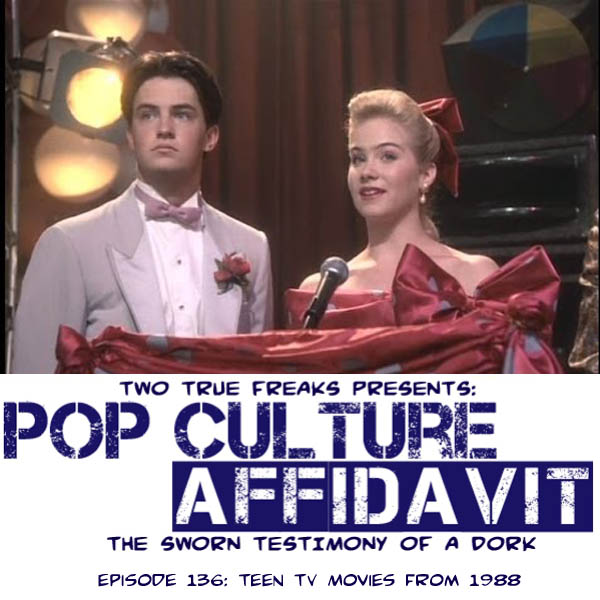
In 1988, NBC produced three television movies starring a gaggle of teenage stars from some of the most popular sitcoms of the day. And for this episode, I sit down and talk about them. So strap in for “Crash Course,” get on the floor for “Dance ’til Dawn” and set sail on a “Class Cruise!”
After four years and six films, John Hughes left the teen movie subgenre behind in 1987, but not before producing one last film, Some Kind of Wonderful. Join me as I take a look at the film, its novelization, the soundtrack, and evaluate its place in the teen movie canon and 1980s film history.
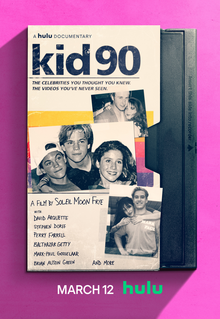
Toward the end of her documentary Kid 90, Soleil Moon Frye talks about how she watches video tapes that she made of her and her friends in the early and mid-1990s and considers how she never saw the warning signs regarding those friends who died by suicide or because of drug abuse. She also mentions that she is living a lot of those memories for the second time and (of course) with the perspective of a now middle-aged adult. It’s a moment that is predictable because of the way we naturally consider such things after a tragedy, but is sad nonetheless and tempers a very nostalgic documentary with a sadness, making it more than superficial fluff.
If you haven’t heard of Kid 90, it was born out of the fact that Frye spent much of her childhood and adolescence recording both audio and video of herself and her friends in their everyday live, intending it as a private keepsake*. A few years ago, she dug up the material and began going through it with the intention of making a documentary about being a child star and a teenager in Hollywood during the 1980s and early 1990s. She originally didn’t intend to put herself into the film (except for the aforementioned archival footage) but as she told Variety, she was editing one particular segment and realized that in order to give it full context, she needed to be interviewed. And that’s how we get the moment I just described.
I came to this film via Hulu’s recommendations and upon seeing the description, put it on my watch list. Plus, I’m a mark for any sort of late 1980s/early 19990s nostalgia, and am like every other person my age in that I immediately associate Fry with her iconic role as Punky Brewster. I also remember her showing up on a couple of random sitcom episodes–The Wonder Years and Friends, especially. What I didn’t know was that her circle of friends consisted of actors and actresses I was watching regularly during my early teen years and whom were also about my age (Frye is a year older than I am). So when people like Brian Austin Green, Mark Paul Gosselaar, and Jenny Lewis started showing up in both the footage and interviews, and also oddly connected to it beyond just recognizing those faces.
Over the past couple of years, I have spent time going trough my own personal teenage archive. Most of the stuff I have been looking at has been my teenage journal, along with various ephemera I’d thrown in a box or storage bin and held onto over the years. None of it is nearly as star-powered as Frye’s video and audio footage of hanging out with Danny Boy from House of Pain, but I could at least relate to it on the level of digging into what you had in the past. But as I watched Kid 90, I also had the passing thought:
This is what it must like like for the cool kids to reminisce.
Oh yeah, that is flat-out one of the most idiotic thoughts a middle-aged man could have about people from high school, but I couldn’t help it. As the movie rolled, my mind flashed to Facebook group threads filled with pictures of them at house parties, seventeen with 1990s haircuts, flannels over Gap jeans, with Budweiser cans everywhere. And really, that’s what Frye’s home movies look like–suburban keggers but with famous people. There’s a point she makes in the film that her mom tried her best to her and her brother (Meeno Replace, the star of the NBC show Voyagers!) as normal a life away from their jobs in Hollywood as possible and this is the proof. The rooms they’re in, the general silliness that they’re up to (especially when they’re 13 or 14) all looks s if it could be taking place in any number of my classmates’ houses, and a world that I never entered. I spent many Saturday nights playing video games with friends or renting whatever movie I could get my hands on and then watching Saturday Night Live.
And while I’d like to be nonchalant and say “Ah, who gives as shit about school popularity when you’re 44?”, I have to also admit that this lack of coolness dogged me for quite a long time. I wound up with more tan a few toxic “friendships” and a laundry list of embarrassing and awkward moments, which my anxiety loves to weaponize on occasion, just to remind me who I am … or at least who I was. The world of the cool kids in my immediate vicinity was as much a mystery to me as the world of these ultra-cool Hollywood kids in the film. Frye goes from hanging with the ‘tween and teen jet set of the early ’90s to heading across the country to attend college in New York and befriending cast members from Larry Clark’s Kids, showing that she always had a “crew” wherever she decided to live.
But in the midst of all of that, there’s a real darkness. At one point, we hear an audio recording of her talking to a friend and trying to figure out what happened the previous night because she woke up at home not knowing how she got there. At another point, she is discussing how a guy at a party clearly raped her when he kept going even though she told him she didn’t want to. You can’t dismiss those stories by saying that it’s some symptom of Hollywood excess or that it’s another sign of how former child stars often become cautionary tales. No, ask around and you are bound to meet a woman who has had one of both of those happen, maybe even more. And, to bring in Hollywood, add the way the film industry treated her because of her body (she had breast reduction surgery at 16, which was a People Magazine cover story) and you have a look at how monumentally screwed up our culture is.
Which brings me back to what I mentioned in the beginning of this piece–Frye’s perspective as a woman and parent in her forties. One of the reasons she began the project that would become Kid 90 is to see if how she remembered her teenage years was accurate, and I found myself relating to the honesty with which she approached everything as well as the bravery required to do it. You can always flip through an old yearbook and laugh at the silly or even heartfelt things people wrote to you, but there is a point where you have to decide if you want to cross the threshold into the uncomfortable and really meet the kid you were. As a parent, you want to see what you can learn from your younger self so that your kid doesn’t suffer the same fate. Sure, there are adolescent rites of passage that involve mistakes and regrettable moments and I know I can’t protect my kid from everything bad they might encounter, but I also know that part of my job as a father is to use the gift of hindsight to discern between true rites of passage and truly awful things that we are too scared to admit were wrong or even toxic.
Reopening old wounds, taking the blindfold off in the cave, digging into the past–whatever you want to call it–can suck, even when you know it’s going to be therapeutic and said therapy can last longer than intended. But it’s a testament to the fact that making it through any of it is a small miracle.
* A similar documentary from Val Kilmer is set to debut on Amazon Prime in August.
It’s the fifth chapter in a podcast miniseries that looks at the fall of the Iron Curtain and the popular culture of the Cold War. To start us off, I look at what happened in Eastern Europe from September to November 1990 with a special focus on the roles that corporate America and pop music played in the end of the Cold War. Then, the discussion turns to sports; specifically, the Olympics with a spotlight on the controversial 1972 men’s basketball final, The Miracle on Ice, and the 1984 Los Angeles Summer Olympics.
It’s Halloween and that means it’s time for me to actually get seasonal … for once. I’m here and talking about some oddities of entertainment from the late 1980s and early 1990s. First up is Time-Life Books’ best-selling series Mysteries of the Unknown, whose commercials were some of the creepies of the time. Then, I move into the area of true crime (among other subjects) by looking at a classic Robert Stack-era episode of Unsolved Mysteries. Plus: listener feedback!
Space. The final frontier. This episode is a conversation between me and special guest star Gene Hendricks. Our mission? To talk about the original crew Star Trek films and explore our own origins as fans of the classic science fiction franchise. But it’s not just movie talk. We have also read all six of the film novelizations and discuss how much they add to the experience. It’s a classic fan conversation with two guys who are boldly going where many have gone before!
And a quick note on the audio quality of the episode. At one point, early on in recording, my USB microphone died and I had to switch to my in-computer mic. I have done my best to remedy the poor quality through rerecording a few pieces of what I had, and using various noise cancellation and volume balancing tricks. So my apologies for the bad quality of sound on my end. I just didn’t want to let such a great conversation go unheard.







 Space. The final frontier. This episode is a conversation between me and special guest star Gene Hendricks. Our mission? To talk about the original crew Star Trek films and explore our own origins as fans of the classic science fiction franchise. But it’s not just movie talk. We have also read all six of the film novelizations and discuss how much they add to the experience. It’s a classic fan conversation with two guys who are boldly going where many have gone before!
 Pop Culture Affidavit