It’s an extra-sized 50th episode of In Country. We’ve hit the halfway point in our journey through The ‘Nam as well as our look at the Vietnam War as a whole, so it’s time to look at a novel and movie that share a name with this podcast: In Country. In this episode, I take a look at the novel In Country, which was written by Bobbie Ann Mason and was published in 1984. It’s the story of Sam Hughes, a teenage girl in Kentucky whose father died in the war and her efforts to discover more about who seh is so that she can better understand him as well as her uncle Emmett, who continues to cope with his Vietnam experience. The film version, from 1989, was directed by Norman Jewison and stars Bruce Willis and Emily Lloyd.
A quick note: This episode contains explicit language.
It’s the 50th episode of Pop Culture Affidavit! For this special episode, I take a look back twenty years to the year I graduated from high school. Along the way, I look at how senior year of high school is represented in movies. It includes stops at, among other things, American Pie, Fast Times at Ridgemont High, Can’t Buy Me Love, and Paper Towns as well as a host of personal memories about my own senior year of high school (which ended on June 25, 1995). Was high school the best time of my life? Was it a waking nightmare? Was it a little bit of both? You’ll have to listen to find out.
In the pilot episode of the late, lamented My So-Called Life, Angela Chase’s English teacher sits her down during lunch to talk about what’s been going on with her lately. Her appearance has changed and she quit yearbook (much to her teacher’s chagrin because she’s the yearbook adviser). Angela’s response in her typical half-engaged fashion, is:
It just seems like, you agree to have a certain personality or something. For no reason. Just to make things easier for everyone. But when you think about it, I mean, how do you know it’s even you? And, I mean, this whole thing with yearbook – it’s like, everybody’s in this big hurry to make this book, to supposedly remember what happened. Because if you made a book of what really happened, it’d be a really upsetting book. You know, in my humble opinion.
For the past ten years, I was a high school yearbook adviser and I had that quote on the wall of my classroom, partially because MSCL is one of my all-time favorite television shows and partially because I’ve always thought there was a certain amount of truth to it. While quite a number of high school yearbooks are afforded the chance to show the school, students and teachers for what they are, most are simply glorified PR pieces that students can have signed and eventually show off.
So I guess that begs the question: if you made a book of what really happened, would it be a really upsetting book?
Of course, I’m going to hedge here and say that it depends on what your reaction to such a book would be. Some people would find the reality of high school depressing while others might find it refreshing to get more than just the slickness and sheen of a yearbook. A number of people might find it boring. Still, what would it look like?
Well, while I’m sure there is more than one book out there (Queen Bees and Wannabees, the book that was the source for the film Mean Girls springs to mind), this has been answered more than once in television and film. Which shouldn’t sound weird to anyone who has seen any of the offerings from MTV in the last twenty years or so, from True Life, which premiered in 1998; to shows such as Made, 16 and Pregnant, and Teen Mom, which have all tried to present the lives of its subjects for what they were (although all but True Life stretched the concept of “reality” pretty far). But the idea of a film or television crew taking a group of teenagers and filming their lives, while having gained popularity since the turn of the century, is actually quite older.
While the concept of “reality television” has its genesis in the 1970s with shows such as An American Family but my first encounter with it was in the spring of 1991 when Fox aired a new show called Yearbook. Produced by Hank O’Karma, written by Louis H. Gorfain, and Directed by Charles Bagert and Hank O’Karma, a production team that worked on several similar productions throughout the Nineties, Yearbook followed the lives of several students at Glenbard West High School in the Chicago suburbs (a note of trivia: the show’s music was by Michael Bacon, brother of Kevin Bacon). The show only had nine episodes, all of which aired between March 7 and May 4, 1991, and fell into obscurity quickly thereafter while Fox discovered that it had a bona fide hit in another series about teenagers, Beverly Hills 90210, which by May 4, 1991 was pulling in about 10-15 million viewers per episode.
I was one of the few people who watched the show on a consistent basis, having been intrigued by both commercials I saw and by the description of the show provided by TV Guide. It was as it promised: a look at the lives of several students at the high school as they happened throughout the year.
This ten-minute clip is only one of two examples of what exists of Yearbook on the Internet (or at least as far as I could get while doing research). The other example is most of the episode “War and Peace,” or at least the parts of that episode that focus on Todd Myra, a student who was set to start with the Marines when he graduated in 1991.
If you’re watching Yearbook and it looks like something out of a John Hughes movie, it’s because it kind of is–after all, Hughes set most of his important teen movies in suburban Chicago–and this helped the students in the series look pretty familiar, especially if they had been watching those movies on video or if they had been watching another Fox show about teenagers, 21 Jump Street. Reality television’s evolution to the point where the audience is constantly questioning the veracity of what they see on the screen wouldn’t be fully realized for at least another decade. At the time this was something unique, as The Real World was at least a year away, and Yearbook was the closest thing we had to a documentary and I honestly wonder if the producers’ original intent was to make a documentary but Fox television provided the better deal.
Looking at these two quick glances for the first time in nearly 25 years, I was struck by how dated the series looked, but then reminded myself that it’s a slice of life piece from the early 1990s, so my amusement at the clothes and hair of the time as well as the title sequence at the narration (which is done by Ken Dashow, who was then a deejay at WNEW-FM in New York City, although he sounds like he’s narrating a video I would have watched in health class) got set aside for a look at the people and the situations for what they were as opposed to how ridiculous everyone looked. The show does become very after-school special at times, but with less of the melodrama from after-school specials, and that’s definitely one of its enduring strengths: we can see these people for who they are (or were at the time).
I was drawn to this because I was fourteen years old at the time and thought it was a great idea for a show–after all, I’d been ensconsed in Degrassi at that point–and while I don’t remember if I watched all nine episodes, some of the episodes I watched stuck with me as well as did some of their moments. Centering the first episode around hoemcoming seemed to be a pretty good idea since it’s a universal high school experience. Granted, not everyone gets all “rah rah” about homecoming, everyone in the audience could at least relate, and it also provides a nice bookend to the graduation that concludes the series. Of course, my biggest takeaway was the memory of watching the episode with my parents and when the Homecoming Queen is crowned, my father started bitching at the television that she’s going to have to get up in front of everyone with “all of that hat hair.” Because, you know, that’s the most important part.
But as you go past the first episode and get deeper and deeper into the lives of these people it becomes less like a show and more like the documentary that the creators will obviously go for, serving as a look at a particular sliver of our culture but also as a time capsule for both those involved and those watching. “war and Peace,” the episode about Todd Myra, is one of the best examples of that because Operation Desert Storm happens right in the middle of the episode and he worries about how his life will be affected by this moment in history (of course, being that this was Desert Storm in 1991, his life wasn’t really affected because the war was over incredibly quickly), a worry that is juxtaposed by the heartbreaking story of his foster brother having to possibly go live with his birth parents (seriously, even I was feeling sad when the kid started wailing in his mother’s arms about how he didn’t want to go away).
The gangs episode was also of its time. Not that gangs aren’t still a problem now, but back in 1991, there was this fear among people in America’s suburbs–especially those like mine that were overwhelmingly white–that gangs were this enormous threat to their children. It went along with the trepidation every parent had about rap music and “black” movies. If you paid attention to the news at any given time for a couple of years, the fact that Ice-T wrote a song called “Cop Killer,” there was a fight that broke out at a screening of New Jack City, and gangs existed, every white middle class teenager was walking into some sort of apocalyptic hell every time they went out on a Friday night. At the time, I never could truly figure out why adults seemed so up in arms about these things, although I eventually realized that it was part of an implicit racism that exists in many of those types of communities (and let’s face it, some of those communities have explicit racism) as well as worrying about “the big black rap and gang monster” provided a distraction from the drinking and sex kids were doing and adults could do something about.
But getting involved with gangs is a very serious thing, and though there isn’t very much in the clip, getting out of a gang is very dangerous, and the producers seemed to be doing there best to show it in a way that the audience could learn something from it, the same way that the episode “A Mother’s Story” focuses on the struggle that Mark Palicki deals with in his life because his mother has leukemia and is having a bone marrow transplant. This was one of the most memorable episodes when I first watched it, as my having been very sheltered up until that point hadn’t seen anyone as sick as his mom was in that episode. For what it was, this was intelligent and I find it ironic that Fox, of all networks, gave us not one, but two high-concept, very honest looks at teenagers, when they were responsible for some of the trashiest, lowbrow reality programming of the late 1990s and early 2000s: Temptation Island, Paradise Hotel, Who Wants to Marry A Millionaire?, and The Swan, to name a few.
The other high-concept reality program they released lasted even shorter than Yearbook’s nine episodes, and that was American High, which aired in August 2000 and lasted for only four episodes; however, PBS picked up the show and aired all thirteen of its episodes in 2000. Created by R.J. Cutler, who has also directed the acclaimed documentaries The War Room and The September Issue (which is a must-see), American High won an Emmy in 2001 for Outstanding Reality Program and uses the same concept as Yearbook, but with some modifications. Instead of claiming to follow the whole class of a high school, the intro tells us that the show is taking a look at fourteen students in Highland Park, Illinois, which is also a suburb of Chicago and not only were hours upon hours of documentary footage shot, but the students were given cameras themselves in order to keep video diaries. This makes sense, of course, as we were now nearly a decade into The Real World, which brought us the reality show confessional.
Much like Yearbook, not much of American High exists online. The website for the show that PBS set up in the early 2000s when it was running all thirteen episodes is still live, but the videos on the site use a Real Player plugin that I’m not sure actually exists. Thankfully, through the wonder of YouTube, I was able to watch one episode, “Boogie Nights,” which was the third episode overall.
The previouslies are important for the episode, as American High had overarching stories (as opposed to Yearbook whose stories were more self-contained) and in the previous episode, Brad, who is a major player in “Boogie Nights,” came out to his friends. Apparently, this went very well as Brad’s now being out at school is not the center of the episode, but rather his determination to put together an awesome dance routine for the school’s dance program. While I found myself impressed by–and admittedly jealous of–the school’s performing arts facilities as well as its openness to forms of dancing that the rather conservative community in which I teach would be utterly scandalized by, I also noticed that the producers had decided to focus on the type of problems that are definitely suburban high school problems yet can be easily understood by those outside of high school as well.
Brad, for instance, is dealing with the pressure he’s putting on himself for making the dancing perfect, which is very nicely juxtaposed to the pressure Suzy is putting on herself regarding her personal body image issues, and he has to deal with Morgan, who is the epitome of the late 1990s/early 2000s teenage boy that Frontline once called “the mook,” a perpetually immature boy whose behavior often gets in the way of his accomplishing anything. I found myself rolling my eyes when he talked about how he knew he could learn the moves for the routine was deliberately slacking off because there were hot girls and their having to constantly reteach him the moves meant that he got to dance with them longer. He’s so much like a number of students I’ve taught, but even though he annoyed me I didn’t see him as a villain in the episode, which is what tends to happen in current-day reality shows. Instead, I found myself mesmerized by the dance routine and whether or not they’d pull it off (or if there would be controversy as a result). The format was a little less clinical than Yearbook’s tended to be, as the students’ video diaries made the show feel more up to date.
Then again, by the time American High aired, the footage/confessional format was routine, so the students were obviously comfortable with all of it on the same level, and by then quite a number of studies, articles, and even television specials were being produced about how Generation Y (as it was known at the time) was one of the most marketed-to generations in history. Frontline’s piece on this, “The Merchants of Cool,” took a look at this through the various people who made a career out of trying to sell to teens and tweens and those people described all of the various “types” within that generation with astounding accuracy.
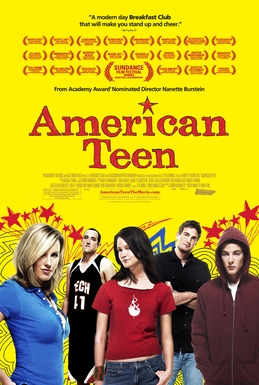
The follow up to “The Merchants of Cool,” “Generation Like,” did the same for the current generation of teenagers, a group of which (or at least the older end of that generation) comprises the cast of the 2008 documentary American Teen. Filmmaker Nanette Burstein takes a look at five teenagers at Warsaw High School in Warsaw, Indiana. Colin, a star basketball player, wants nothing more than to play college basketball. Megan is the queen bee, Jake is the dork who is shown constantly trying to find a girlfriend, Mitch is Colin’s friend and the attractive “heartthrob” guy, and Hannah is the artsy girl who wants nothing more than to get out of Warsaw and go to film school in San Francisco.
Out of the three depictions of teenage culture that I’m covering here, American Teen is the most accessible, as it’s been available on DVD since 2008 and while it purports to present a fairly accurate look at the senior year for these five students, there were some questions about its accuracy. I know that critics of the film as a documentary and not a docudrama were nitpicking Burstein’s ability to have both sides of a telephone conversation on screen, but I think that the criticisms come more from the fact that she edited the film to have a discernible plot for four of the five characters (honestly, Mitch is more of a supporting player, as he’s introduced later in the movie and his biggest story arc seems to be the fact that he starts to date Hannah and then winds up breaking up with her with a text message) and that there were good guys and bad guys in the film.
Megan, the queen bee, comes off as an obvious villain throughout much of the movie, especially when she gets a hold of topless pictures that her friend Erica sent to her friend Jake and then emails them to as many people in the school’s email directory that she can think of, and spray paints a penis and the word “FAG” on the junior class president’s window (while her friends teepee the house) because he changed the prom theme without her consent. The ensuing discipline meeting with the principal is very typical–since she hasn’t gotten into much trouble before (and let’s face it, is the queen bee), she gets off with a slap on the wrist of some community service hours and a revocation of some activities privileges.
Now, she could be a real-life Regina George or Heather Chandler if it wasn’t for the fact that Burstein allows us to see her as deeper than just the villain that she would have been portrayed as if this were a trashy reality show. At one point, Megan gets in a fight with her friend Ali and we later realize that it was not because of anything Ali particularly did, but because Megan is dealing with the stress of trying to get into Notre Dame as well as it being the anniversary of her older sister’s suicide.
On the flip side, Hannah, who is set up to be the free-spirited hero of the film, the girl who you want to see escape the trap of Warsaw that girls like Megan rule (after all, people hate the way Molly Ringwald made over Ally Sheedy in The Breakfast Club). But the free spirit hides a struggle with anxiety and depression that hits hard after her boyfriend Joel breaks up with her. Hannah crawls into herself and spends the next three weeks away from school, to the point where there are times that she has full-on panic attacks as she drives up to school and attempts to attend for the day. Her relationship with Mitch ends with that text, but we see growth, as she manages to finish out the school year and finds arguing with her parents over San Franscisco more important.
Colin’s story is that of the crushing reality that comes with being good at sports in a small pond like Warsaw but maybe not what the big pond wants. He struggles through his senior season to try and impress recruiters, so much that his performance suffers and the team’s record suffers. Of course, he turns it around by the end and he winds up going to Indiana Tech on a scholarship and gets the winning shot in the sectional championship.
Jake basically spends the entire movie being socially awkward and trying to get a girlfriend and it’s cute at times, uncomfortable at others, and the point is belabored quite a bit, if I’m being honest. But it fits right in with a lot of the other situations presented in the film in that while the kids may be mugging for the camera at times, there are other times where they’re being honest and you can tell that any statement they may have about how they didn’t notice the camera was there is probably true. The film, which I’ve now seen twice, doesn’t necessarily hold up to rewatches, but there are moments that sucked me in both times that I watched it. Hannah’s depression both times had me really hoping that she gets herself back together and I found myself siding with her at the end of the movie when she’s arguing with her parents about her wanting to go to San Francisco after high school because while her mom talked about how all of the rapes and murders that happen to girls like her in the scary city, I knew that moving to California was the only way that Hannah was ever going to get out and not wind up living a miserable life in Warsaw.
Conversely, I was hoping that Megan would get more consequences than she did, although I will say that by the end of the film, when she has gotten into Notre Dame and is showing signs of being sick of the town and the school herself (something I think we all do as seniors), I believe the note in the epilogue where she says that she’s matured a lot since starting college.
In a sense, when you take these three pieces as a whole, they represent a beginning, middle, and end of teen culture, with the first part being in 1991 with the tail end of Generation X and then the Generation Y in 1999 and then the Millennials in 2008. This is three generations of kids (mainly because at least two of these groups are on the cusp of the labels that were assigned to their respective generations. There is a sense of universality among all of these stories. It’s 2015 and when I look back on both shows and the film and see the same issues, the same problems, and even the same attitudes as students I currently teach, even as far back as 25 years ago before I even started high school, I see that while so much as changed yet so much has not.
The problem with American culture is that we have this weird collective ADD when it comes to popular culture and on some level I think that comes from the fact that pop culture is ephemeral and by its nature has a tendency to be ephemeral. So we don’t necessarily remember things as well or for as long as we should. Oh sure, there are things that have staying power, but there are those things that are gone in a blink and provide examples of why obscurity exists in the first place. For instance, Yearbook, American High, and American Teen. never made enough impact on our culture for us to not realize “this has been done before” when the latest iteration of the high school documentary came about.
Education can be the same way. The talking heads/thought leaders/pundits in education seem to constantly tout how the current generation of students is unlike no other, as if they are a new make or model of car that we’re going to have to learn how to drive. I’ve heard people wax on about how students learn differently these days and while that may be true, it’s also unnecessarily untrue because when you go back to shows such as Yearbook and see how people have looked at teenagers as an anthropological/sociological study (as opposed to the more common usage for in-depth looks at teenagers lately, which is marketing), it’s important to note the universality of that experience. Furthermore, if you can look at something for what it is as opposed to what’s in front of you, you’ll start to reach a more thorough understanding of what’s going on.
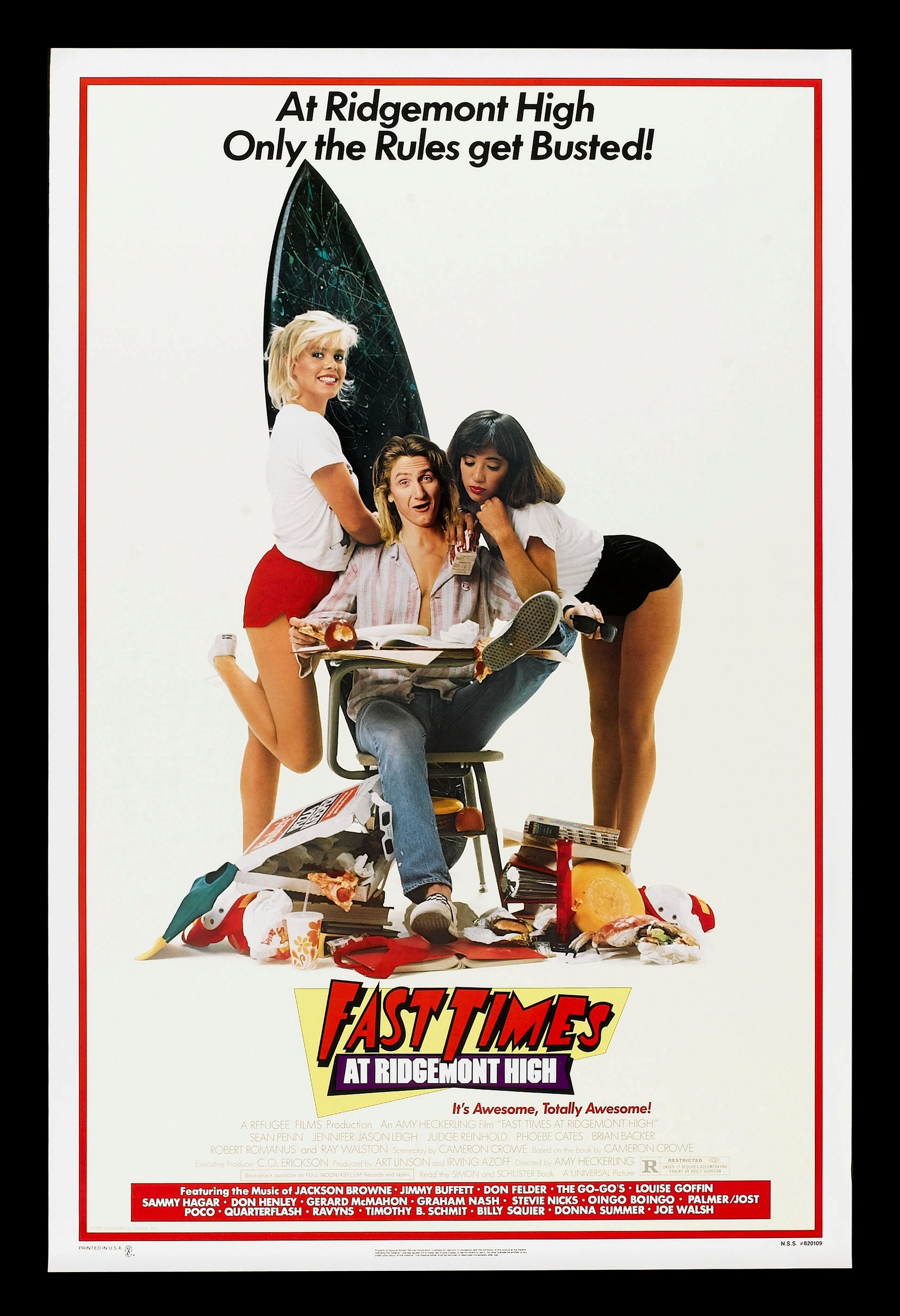
It’s time for another look back at a classic teen movie and this time I’ve pulled out all the stops for one of the quintessential 1980s teen flicks, Fast Times at Ridgemont High. I’m joined by Todd Liebenow of The Forgotten Filmcast to talk about the film, and its influence. We cover all the bases, including an iconic performance by Sean Penn and an iconic moment that comes courtesy of Phoebe Cates.
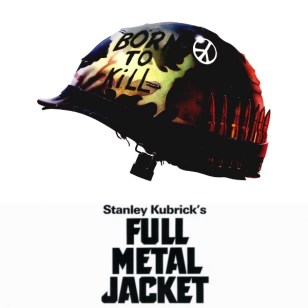
It’s time for another break from our regular coverage of The ‘Nam to talk about a classic Vietnam War movie. This time around, I take a look at Stanley Kubrick’s Full Metal Jacket, the 1987 film starring Matthew Modine, R. Lee Ermey, Adam Baldwin, and Vincent D’Onofrio. It’s a film known for its look at basic training as well as how war can harden a soldier. I give some backstory on the film, a summary, and review.
WARNING: THIS EPISODE CONTAINS GRAPHIC LANGUAGE. LISTENER DISCRETION IS ADVISED.
It’s literally a literary episode of Pop Culture Affidavit as Professor Alan from the Relatively Geekly Network (Shortbox Showcase, Quarter Bin Podcast) joins me to talk about books and movies; specifically, adaptation. We get into what makes a good adaptation, what makes a bad adaptation, talk about movies based on books that we love and hate, and even discuss what books we’d like to see and not see made into films (with a little tangent conversation about television).
It’s the end of the year and that means it’s the end of my year-long series, “1994: The Most Important Year of the Nineties!” I close things out with another grab bag that features music, movies, television, politics, and the Internet and then give a final, closing statement about why 1994 is the most important year of what’s proven to be an incredibly important decade.
I have to admit that I went in to re-watching With Honors with a feeling that I remember it being a lot better than it actually was. This tends to happen, I guess, when you don’t watch a movie for the better part of twenty years and you only wanted to see it because you had (and still kind of have) a thing for Moira Kelly. It’s honestly not that good. Okay, that makes it sounds worse than it is, but it’s not exactly The Big Chill or anything like that.
Released in April 1994, With Honors is the feature film directorial debut of Alex Kehishian, whose best-known work is one of the best rock documentaries of all time, the 1990 Madonna film Truth or Dare. It managed to gross a little bit more than $20 million at the box office and finished 69th overall for the year, which isn’t exactly flop material but isn’t a box-office success either. But quality of a movie is never really measured in receipts and my original attraction to the travails of Harvard student Montgomery “Monty” Kessler (Brendan Fraser) and his friends was similar to my attraction to the gang from St. Elmo’s Fire–a weird desire to watch people who were slightly older than me so I could possibly see if that’s what my life would be like.
Which sounds completely ridiculous, especially considering I saw this film in November 1994 when it had come out on video and I was seventeen years old at the time. Watching films about people older than in the hopes that you’ll get some sort of weird fantasy fulfillment out of it is something you do when you’re twelve or thirteen, not on the verge of graduating high school; then again, I was a late bloomer. But there is something about the setting of Harvard (even though quite a bit of the movie wasn’t filmed there) and the house that Monty shares with his friends that fills you with a wistful sort of feeling of either wanting to live in the place or wanting to go back to a time when you were a starving student.
But I’m getting ahead of myself and ahead of the plot, because With Honors isn’t St. Elmo’s Fire. Whereas that film is a look at how the relationships between a group of friends becomes incredibly complicated once they graduate from Georgetown and live on their own, With Honors is the story of how Monty meets a bum named Simon Wilder (Joe Pesci), who winds up touching all of them in some way or another and changing Monty’s life for the better. It starts with Monty’s hard drive getting completely fried (and if you’re up for getting really nostalgic, check out the MS-DOS command prompts and clickety-clack of an early 1990s IBM keyboard) and his insisting that he run out right that minute to get copies made even though it’s the middle of the night and it’s snowing. Naturally, he loses the thesis down a window grate and has to have Courtney (Moira Kelly) help him sneak into the library to get it from the boiler room. It’s not there when he arrives and instead has fallen into the hands of Simon, who begins making him all sorts of deals so that Monty can get the pages of his thesis back.
Simon winds up more or less invading Monty’s life and at first their relationship is contentious, but soon enough Simon is not only occupying much of Monty’s time and most of his thoughts but his philosophy as well, especially after his confrontation with Monty’s professor and mentor (who is played by Gore Vidal):
So what we get is one of those “he touched all of us” stories, especially after they discover that Simon is dying from a condition caused by having worked in a shipyard that constantly exposed him to asbestos. By the time that the gang takes a road trip so Simon can see the son he abandoned years before, he’s even won over Jeffrey, the mama’s boy roommate whose fastidiousness contributes to his initial hatred of Pesci’s lovable bum. But he, too, joins in the group hug.
If it sounds like the movie lays it on a little thick, it’s because it does. The characters are pretty much what you’d expect from a movie set at Harvard: the stressed-out students, the crazy artiste (Patrick Dempsey in Everett, who even has his own radio show and acts like Ronnie Miller amped up a few nothces), and the galpal. They live in an off-campus house that you would have killed to live in when you were in college (at least me, anyway, who spent four years in the dorm), and everything about the film says, “Stressed out smart college students finding something out about themselves.” Plus, the main plot isn’t at all subtle and if anything is subtle in With Honors, it’s the obvious romantic tension between Courtney and Monty, who on the surface appear to act like brother and sister but really have strong feelings for one another but are afraid to act on those feelings–that is, until Simon convinces Monty that it’s worth the risk and we get one of the better scenes in the film at a “pajama party”:
Okay, maybe it’s just my aforementioned crush on Moira Kelly that makes me think this is one of the better scenes in the film, but I do love that line, “I’m ending our friendship.” And looking at what I’ve written in the last few paragraphs, it seems like I didn’t like With Honors, but as uneven as it is, I did, although not as much as twenty years ago.
Then again, twenty years ago I was sitting on a couch with the girl I was dating and we ended out making out at the end of the night; when I watched this, I was streaming it on my Kindle and my wife was already asleep. In a way, it was indicative of how 1994 was ending for me personally–I’d gone from secretly renting movies at the video store and watching them alone on Friday night to picking out something that would be a good “Date Night” movie. And the movies themselves began to become more and more intertwined with where and when I was as well as who I was with.
Save your seat on the couch, throw on some P-Funk, try to figure out the Caine-Hackman theory, work on your thesis, and get really offended because it’s time to take a look at the 1994 college flick PCU! Yeah, while it’s not the most important film of 1994: The Most Important Year of the Nineties, it’s still one that we all remember, probably because of the number of times it aired on Comedy Central. Anyway, I take a look at the movie’s plot and talk about five of my favorite things about the Jeremy Piven classic.
Just because we’re both hideous doesn’t mean we’ll be compatible.
About five years ago, I was showing Mary Shelley’s Frankenstein to a room full of high school seniors. We got to the scene where the monster (Robert DeNiro), who is now at the point where he has Victor Frankenstein (Kenneth Branagh) by the throat and is forcing the good doctor to make him a bride from the tattered remains of Helena Bonham Carter. The Bride of Frankenstein, so to speak, emerges from the 19th-Century life-giving apparatus and Victor and the monster begin calling to her, telling her to come to each of them as if she’s a puppy trying to choose between two owners.
I went on to ask my students about how Hollywood is forever getting Frankenstein completely wrong as I thought about how I missed how bad this movie was back when I saw it in the theater in 1994. After all, by putting the name of the author above the title–a trend that eventually died out after William Shakespeare’s Romeo & Juliet because … Shakespeare Wrote Romeo & Juliet? Thanks for telling me, Baz–Kenneth Branagh’s film purported to be the definitive adaptation of Mary Shelley’s classic horror novel. And to a point, it actually works out pretty well–bride-dog moments aside, the basic structure of the plot is there–but in many areas it falls flat and that’s why I was wondering why I liked it when I was seventeen. Then I realized that like a few of my entertainment choices in the mid-1990s, this story begins with the phrase: “You see, there was this girl …”
While I know it shouldn’t, being on a date drastically changes your perspective on the film you’re watching. The night I went to see Mary Shelley’s Frankenstein, I was on my first official date with a girl I had been friends with for a couple of years, but we’d been hanging out a lot and that prompted me to do the math: our hanging out together + she knowing that I liked her = she might actually want to go out with me. This wouldn’t mean very much to your average seventeen-year-old boy, but I wasn’t exactly your average seventeen-year-old boy. I had spent the majority of my adolesence being painfully awkward around girls, acting immature and not knowing what to say. The more attracted I was to a girl, the worse that awkwardness was, and that is probably the reason I didn’t go on a single date until that night in November to see Mary Shelley’s Frankenstein. So I spent most of the movie not concentrating on the film but trying to figure out how to properly behave so that the date went well and by the end of the night I could … well, I guess the experession “get to first base” would apply. In the blur of Branagh, Bonham Carter, DeNiro and Aidan Quinn (I remember his part because she squeed when she saw him), I worked on trying to find the right moment to put my arm around her, followed by trying to figure out a tactful way of taking my arm away when it started to go numb. It was ten times tougher than the calculus class I had every first period.
Not to brag, but I was successful. Okay, it’s not much of a brag because we walked from the movie theater to the corner near both of our houses and I spent what might have only been two minutes but felt like ten awkwardly and nervously chuckling and making small talk until I finally made a move and kissed her good night. It wasn’t my first kiss–that had come the previous summer when I was away in Europe–but it was my first “date” kiss, the first kiss that had the potential to lead to something more than a goodbye and a half-assed attempt at writing letters to one another for the first month after I got home. Never in my life had so much depended on one very chaste kiss at the end of the night; never in my life had a moment been so charmingly small town that they don’t even write those types of moments anymore.
I haven’t watched Mary Shelley’s Frankenstein in its entirety since that moment in my classroom five years ago; I’ve been more or less permanently teaching sophomores since then and high-concept, high-budget horror from the 1990s isn’t as interesting to me as low-budget schlock from the 1980s. And I guess I’ll keep it that way because for once I don’t mind having a memory overshadow a movie.
 It’s an extra-sized 50th episode of In Country. We’ve hit the halfway point in our journey through The ‘Nam as well as our look at the Vietnam War as a whole, so it’s time to look at a novel and movie that share a name with this podcast: In Country. In this episode, I take a look at the novel In Country, which was written by Bobbie Ann Mason and was published in 1984. It’s the story of Sam Hughes, a teenage girl in Kentucky whose father died in the war and her efforts to discover more about who seh is so that she can better understand him as well as her uncle Emmett, who continues to cope with his Vietnam experience. The film version, from 1989, was directed by Norman Jewison and stars Bruce Willis and Emily Lloyd.
 It’s the 50th episode of Pop Culture Affidavit! For this special episode, I take a look back twenty years to the year I graduated from high school. Along the way, I look at how senior year of high school is represented in movies. It includes stops at, among other things, American Pie, Fast Times at Ridgemont High, Can’t Buy Me Love, and Paper Towns as well as a host of personal memories about my own senior year of high school (which ended on June 25, 1995). Was high school the best time of my life? Was it a waking nightmare? Was it a little bit of both? You’ll have to listen to find out.
 The other high-concept reality program they released lasted even shorter than Yearbook’s nine episodes, and that was American High, which aired in August 2000 and lasted for only four episodes; however, PBS picked up the show and aired all thirteen of its episodes in 2000. Created by R.J. Cutler, who has also directed the acclaimed documentaries The War Room and The September Issue (which is a must-see), American High won an Emmy in 2001 for Outstanding Reality Program and uses the same concept as Yearbook, but with some modifications. Instead of claiming to follow the whole class of a high school, the intro tells us that the show is taking a look at fourteen students in Highland Park, Illinois, which is also a suburb of Chicago and not only were hours upon hours of documentary footage shot, but the students were given cameras themselves in order to keep video diaries. This makes sense, of course, as we were now nearly a decade into The Real World, which brought us the reality show confessional.
 Megan, the queen bee, comes off as an obvious villain throughout much of the movie, especially when she gets a hold of topless pictures that her friend Erica sent to her friend Jake and then emails them to as many people in the school’s email directory that she can think of, and spray paints a penis and the word “FAG” on the junior class president’s window (while her friends teepee the house) because he changed the prom theme without her consent. The ensuing discipline meeting with the principal is very typical–since she hasn’t gotten into much trouble before (and let’s face it, is the queen bee), she gets off with a slap on the wrist of some community service hours and a revocation of some activities privileges.
 It’s time for another break from our regular coverage of The ‘Nam to talk about a classic Vietnam War movie. This time around, I take a look at Stanley Kubrick’s Full Metal Jacket, the 1987 film starring Matthew Modine, R. Lee Ermey, Adam Baldwin, and Vincent D’Onofrio. It’s a film known for its look at basic training as well as how war can harden a soldier. I give some backstory on the film, a summary, and review.
 It’s the end of the year and that means it’s the end of my year-long series, “1994: The Most Important Year of the Nineties!” I close things out with another grab bag that features music, movies, television, politics, and the Internet and then give a final, closing statement about why 1994 is the most important year of what’s proven to be an incredibly important decade.
 I have to admit that I went in to re-watching With Honors with a feeling that I remember it being a lot better than it actually was. This tends to happen, I guess, when you don’t watch a movie for the better part of twenty years and you only wanted to see it because you had (and still kind of have) a thing for Moira Kelly. It’s honestly not that good. Okay, that makes it sounds worse than it is, but it’s not exactly The Big Chill or anything like that.

 Pop Culture Affidavit