1994

Come as you are, as you were, as I want you to be

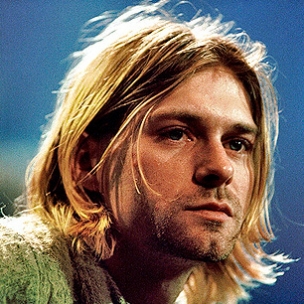
kurt-cobainSo it’s been twenty years since Kurt Cobain’s suicide.  I suppose that I’m not the only person writing a piece about it today (although I’m definitely one of the least important people writing about it).  Truth be told, if I wasn’t spending much of this year looking at 1994, I might not have even noted it beyond recognition upon seeing a Facebook post or something.

His death didn’t affect me very much–celebrity deaths rarely do.  However, when I was sixteen, I wasn’t that much of a fan of Nirvana.  Oh sure, I’d enjoyed the songs I’d heard off of albums like Nevermindbut I didn’t own any of them and was more into stuff like Pearl Jam, Stone Temple Pilots, and Metallica.  I suppose that might all have been different had I access to MTV on a daily basis but I can’t exactly write about something that wasn’t true.

What was true is that my friend Brendan called me up on April 8 and told me he saw something on MTV about Kurt Cobain having been found dead (Cobain’s autopsy would later reveal that he’d died on April 5).  We made some jokes about it adn then talked about something else.  It was probably hockey or school.  That night, I went to a meeting for the People to People Student Ambassador group for the trip to Europe I was scheduled to take that summer.  One girl, whose name I think was Tammy, was wearing a Nirvana T-shirt and I innocently asked if that was because of the news.  She replied that he wasn’t dead and that wasn’t completely true about the heroin overdose.  I apparently then became the person who first told her about Cobain’s suicide.

Beyond that, life went on.  I listened to other bands and explored other genres.  I did noticed that other people were more upset.  My sister’s friend, who had a flair for the dramatic, seemed pretty insistent on proclaiming that every lyric on every Nirvana album was a clue to his suicide.  There was at least one piece in the student newspaper about it.  And T-shirt stops at the mall seemed to be selling a lot more Nirvana T-shirts.

As the grunge of the early 1990s gave way to the fluorescent pop of the late 1990s, I began to see the significance in his death, culturally if not personally.  Cobain’s suicide is almost a dividing line between the two decades, establishing a Nirvana/Britney Spears divide between Generations X and Y (for lack of better terms, anyway).  It also winds up establishing Nirvana as a near-perfect band.  Okay, I’m not a fan of In Utero but the group has that Beatles-esque achievement of ending before they could really suck, whereas Pearl Jam was more like the Stones–slowly fading with diminishing returns and occasional flashes of brilliance.

Had Cobain not taken his own life, how would things have been deifferent?  Would we have gotten another Nevermind or would they have been put out Binural?  Would Kurt and Courtney have continued to be a trainwreck of a couple or would they look like Gavin Rossdale and Gwen Stefani (well, before they broke up)?  Would Nirvana’s continued presence prevent the rise of The Goo Goo Dolls, Marcy Playground, Third-Eye Blind, Smashmouth, Fastball, and a host of other “Where are they now?” bands from the late 1990s and early 2000s?

Such speculation is both fun and frustrating.  So are overwrought odes to dead artists and pretentious think pieces.  At least on a day like this, we can take the time to appreciate his contributions to music.

Bottom of the Inning: Taking Baseball Personally (Baseball, Part Two)

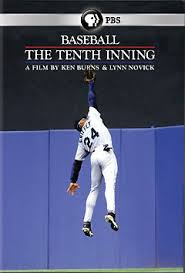
Baseball 10thIn my last post, I mentioned that watching all of Baseball made me feel like I was in an introductory, or “101” class on the game.  As well-researched and well-crafted as Ken Burns’s documentary was, there were times where I felt like I was getting the history textbook version of the baseball story:  hit the high points, go selectively in-depth, and completely skip over quite a bit.

While that’s a valid criticism, leaving it at that would be giving the work short shrift, especially since it’s a full day’s worth of a documentary.  Furthermore, I spent much of that first part of my look at Baseball on summary and critique and didn’t give much of my personal “story” as it is, or at least my personal reactions while I was watching it.  Which is kind of the whole purpose of this blog, right?

So that’s what I’m going to do.  Inning by inning.

First Inning (“Our Game” 1850s-1900):  This isn’t Baseball, this is seventh grade social studies with Mr. Kerkhof.  We’re talking about the Antebellum period and …  man, the 1800s are boring.  But this?  This isn’t so much because it’s an origin story, the kind I’m fixated on whenever we begin looking at an important event.  What were the first shots fired in the Revolutionary War and how did it progress from there?  Who actually founded the Roman Empire?  When did the  Middle Ages officially begin?  Who played that first game of baseball and what was it like in what seems like the Dark Ages to me–before Ruth, Gehrig, Mays, Mantle, and every other name I know?

Second Inning (“Something Like a War” 1900-1910):  I’m ten years old and my parents have given me a “Baseball’s All-Time Greats” baseball card set, the one I spotted in the Sears catalogue.  There’s Ty Cobb, and there’s Honus Wagner, who has the most expensive baseball card in existence, something I learned on a feature I saw on 20/20 the previous year.  I begin looking at the all-time stats for the old players and am amazed and even though many of their records have been broken, they still are in the top five for many of their most notable categories.  The card set is worth original retail price (and even today it’s not worth much), but what it lacks in monetary value it more than makes up for in facts.

Third Inning (“The Faith of Fifty Million People” 1910-1920):  To me, it’s not the Black Sox scandal; it’s Eight Men Out and Field of Dreams.  It’s “Say it ain’t so, Joe,” and the last scene of that softball episode of Married … With Children that parodies the last scene of Eight Men Out.  It’s also the idea that even something as pure as a game I play on Saturday mornings in Little League can be corrupted by outside influences (yunno, beyond the opposing team’s coach being friends with the umpire).

Fourth Inning (“A National Heirloom” 1920-1930):  I’m in the fifth grade and we’re asked to take a biography out of the library for our latest book report/conference with the teacher.  I grab one about Babe Ruth.  He competes with Gehrig.  He is supposedly “stranger than fiction,” which is what one of the chapter titles says.  Despite my being an excellent reader, I have trouble getting through the entire book.  I don’t know if it’s because the book’s badly written or because I don’t find the subject matter as interesting as I thought I would.  In fact, I can’t remember if I ever finished that book.  I do know that when I had my conference with Mr. Schafer about it, I did fine.

Fifth Inning (“Shadow Ball” 1930-1940):  I have no personal context for this.  In fact, if there is any episode that I found myself glued to, it’s this one.  Growing up, my knowledge of the struggle of African-Americans was limited to slavery, Plessy v. Ferguson, Brown v. Board of Education, and Martin Luther King Jr.  I was not exactly a scholar.  I knew the Negro Leagues existed but I don’t think that what little I read about them in books clued me in to what extent.  If anything, I’m grateful for what I gained from this episode.

Sixth Inning (“The National Pastime” 1940-1950):  It’s 2012 and I’m in a used bookstore on the Downtown Mall.  I’m looking for a copy of As You Like It but am also perusing the small graphic novel section.  On my way to the counter, I pass sports and Roger Kahn’s The Boys of Summer.  It sits on my shelf until the start of the 2013 season rolls around.  While Kahn’s biographical retelling of his time becoming a sportswriter is interesting, it’s his visits with former Dodger greats and the retelling of Jackie Robinson’s history that pulls me in.  For years, I knew three things about Robinson:  he played for the Dodgers, he broke the color barrier, and he stole home once in the World Series.  This tells me so much more.

Seventh Inning (“The Capital of Baseball” 1950-1960): I’m twelve years old and my family is throwing one of those big barbecues where everyone–from my mom’s side and dad’s side–is there.  My Uncle Brian, a die-hard Yankees fan, spends a good hour talking to Grandpa Panarese about baseball in the 1950’s.  They talk about the Yankees, the Giants, and the Dodgers.  I don’t interject; I just listen.  It’s one of the best memories I have of these two men and one of the most informative conversations upon which I ever eavesdrop.

Eighth Inning (“A Whole New Ballgame” 1960-1970):  To me, this is where baseball begins; specifically, in 1962, when the New York Mets go 40-120 and set an all-time single-season loss record that still stands.  I cut my baseball history teeth on An Amazin’ Era in 1986 and to me, “baseball history” has always involved Seaver, Koosman, Swoboda, Clendenon, Agee, Grote, Garrett, and McGraw.  Yes, there are more important figures in baseball history and more important events.  But it’s the lovable losers’ transformation into the Miracle Mets that I always remember.

Ninth Inning (“Home” 1970-1993):  It’s fascinating to see Bob Costas tell the story of being in the Red Sox locker room during the Buckner play and watching the champagne get wheeled out as quickly as possible.  It’s also fascinating to see testimony from Red Sox fans who were wounded by the play.  After all, I rooted for “the enemy” in 1986.  My nine-year-old dreams came true when Jesse Orosco threw the last pitch to Marty Barrett (I have a poster on the wall of my classroom), so it never occurred to me that someone might be upset by that night’s events.  Beyond that, there are so many recognizable faces here and I wish he was taking more time on them; I wish he was reminiscing with me the way he was reminiscing with my parents through the seventh inning.

When it ends with a talk about how baseball endures I realize that this isn’t a documentary; it’s a eulogy.  The season was cancelled due to a strike the month before the first episode aired and it doesn’t seem like we’ll get the game back.  Furthermore, it’s hard to pick a side because everyone seems greedy; everyone seems like a villain.  And here, at the funeral, we’re all trying to remember why we came.

Tenth Inning (1994-2010):  I was there.  I remember that.  I watched that.

I will never tire of watching Barry Bonds fail to throw out Sid Bream.  I always loved how much fun Ken Griffey Jr. seemed to be having–and always wished I had that swing.  I was cheering for McGwire the whole time and have to admit I was disappointed when the PED charges came to light.  I never cheered for Bonds unless he struck out looking.  I want to buy Steve Bartman a beer and talk baseball with the guy–not that game, just baseball.  No, the 2004 ALCS is not overrated and yes, I’ll watch the Yankees choke like that any time, day or night.  My heart was in my throat when Endy Chavez made that catch, only to have the Cardinals rip it out and crush it a few innings later.  You’re really using that Springsteen song, Ken?  Don’t you realize it’s about looking back and realizing how middle-aged you are?

“But then time slips away and leaves you with nothing mister but boring stories of glory days.”

You know what?  That’s exactly what this is, isn’t it?  Good job, sir.
Top of the Inning: The 101 Course (Baseball, Part One)

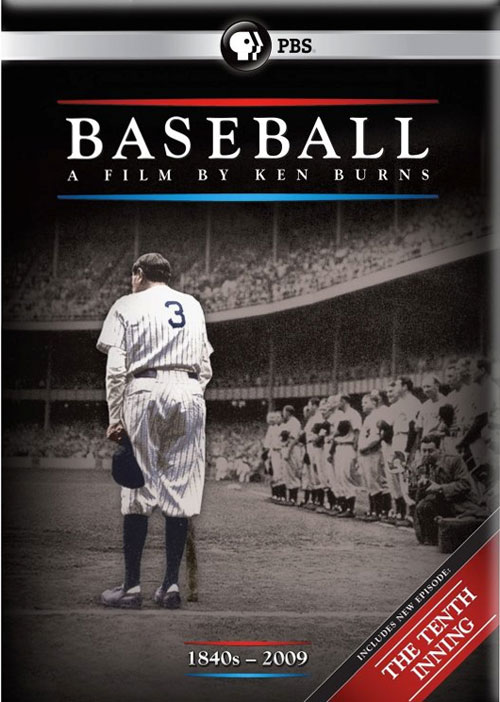
Baseball DVDThis post and the next post is part of the Big League Blog-a-thon, coordinated by Forgotten Films, home to one of the best film podcasts out there, The Forgotten Filmcast, which is about the movies that time forgot.

I discovered early on, after volunteering to sit down and watch Ken Burns’ documentary, Baseball, that one simply does not sit down and watch Ken Burns’ Baseball. No, it is something that taunts you from the screen of your Netflix queue, daring you to take it on like a pitcher who’s been throwing heat all night and has only just hit his stride.  And all you can do, really, is step up to the plate, bear down, and let him know that if he’s going to get you out, you’re going to have to work for it.

In other words, challenge accepted.

Bad metaphors and even worse Barney Stinson jokes aside, Baseball was something I had watched when it was originally on back in 1994 but didn’t remember much about except that Burns spent the segment about the 1986 Mets talking about the agony of the 1986 Red Sox and that he must have exhausted every available version of “Take Me Out to the Ballgame” over the course of the documentary.  That I remember the former should not be a surprise–my Mets fandom runs deep, even when they lose–and after re-watching all ten innings, the latter still rings true.

Baseball originally aired twenty years ago as a nine-part documentary, each part appropriately titled an “inning,” with a two-part “tenth inning” being added in 2010.  What this adds up to is a documentary that if one were to sit down and watch without a break, he would be on the couch for nearly a full twenty-four hours.  Burns begins with the  origins of baseball, both real and myth (an urban legend involving Abner Doubleday that has been disproven countless times yet still seems to have legs all these years later) and then moves chronologically through the beginnings of the game up until what at that point was the present.

Through the first five innings, Burns seems to have accomplished what he set out to do, which is given us a full history of the game.  Instead of blowing through the 19th Century, he spends all of the “First Inning” exploring baseball’s evolution and then only moves ten years ahead into the future with the second inning, bringing us only up to 1940 by the end of inning five.

This slow progression works to flesh out the characters of the first half of baseball’s history, men whose names are known and aren’t necessarily forgotten but are definitely overshadowed by the names revered in my parents’ youth.  Ty Cobb, Honus Wagner, Cy Young, Rogers Hornsby, and Grover Cleveland Alexander were long dead by the time I went to my first baseball game in 1985, existing only  in trivia books like Bill Mazer’s Amazin’ Baseball Book.  Here, there is footage and there are interviews by historians and some of the few people who were, at the time, left alive to talk about playing against or watching those old-timers.

Furthermore, throughout the first half of the documentary, Burns does not shy away from the racism that pervaded the game for decades, telling the story of the Negro League whose history to me when I was a kid growing up on Long Island was a footnote in the Cobbs, Ruths, DiMaggios, and Mantles of books about baseball.  With stories from Negro League players such as Buck O’Neil (who is a delight in every interview throughout the series), you learn more about the racial history of the early 20th Century than you do in most high school history classes, even when that history is overshadowed by a mammoth figure such as Babe Ruth, who gets almost an entire episode to himself.

As Burns moves through the 1940s and 1950s, into an era where baseball really exploded and where he should have his strongest stories–after all, many of the players of those eras were still alive at the time when he was filming–the cracks begin to show and while the documentary doesn’t exactly fall apart by the Ninth Inning, it definitely is a lot weaker than at its beginning.  He relies too much on the same seven or eight different interviewees and we don’t hear directly from very many players beyond Ted Williams and a few others.  I wasn’t expecting every single player or anything, but seeing at least one appearance by Nolan Ryan, Tom Seaver, or Johnny Bench.  Heck, 1994 was when Tim McCarver was still mildly tolerable.

Which, in a way, brings me to the second major problem with the documentary.  Burns, who is a Red Sox fan, is committing the cardinal sin of sports reporting and being a “homer,” reporting with an incredible Northeast bias.  Walk away from Baseball and you will think that the period between 1957 and 1994 was a complete wasteland (as if the Brooklyn Dodgers’ and New York Giants’ leaving for California stripped baseball of its virginity in a way that the Black Sox scandal or the systemic racism that preceded the Jackie Robinson era never could) and that the only baseball worth happening occurred in Boston and New York and mostly in 1975 and 1986.  And I’ll readily acknowledge that both of those World Series deserve their reputations, as does the career and legacy of George Steinbrenner.  But much like a high school history class where you cover the Vietnam War in a day because the teacher has run out of time, Burns gives short shrift to then-recent history, probably assuming that we were all there and we all remember.

He sort of remedies this in the added “Tenth Inning,” but even then there’s an ESPN-like whitewash, perpetuating the narrative of Mark McGwire and Sammy Sosa “saving” baseball in 1998, the Yankees “saving” New York City in the fall of 2001, the Red Sox “saving” the nation’s soul in 2004, and Barry Bonds’ role as some sort of supervillain in the whole thing.  All  of those storylines have legitimacy, but Burns’ coverage only serves to date the film a little–we’ve had so many highlight reels, specials, and shorter documentaries about those specific moments that one wonders if there was a need for him to come back and tell the stories at all.

That’s not to say that this behemoth isn’t worth watching.  Technically, Baseball is carefully made and serves as a perfect “101 Class,” an introduction to a topic that can’t possibly be contained to a single film, no matter how large it is.

In Part Two:  Taking Baseball Personally

Pop Culture Affidavit Episode 24 — A Comedy About Love in the ’90s

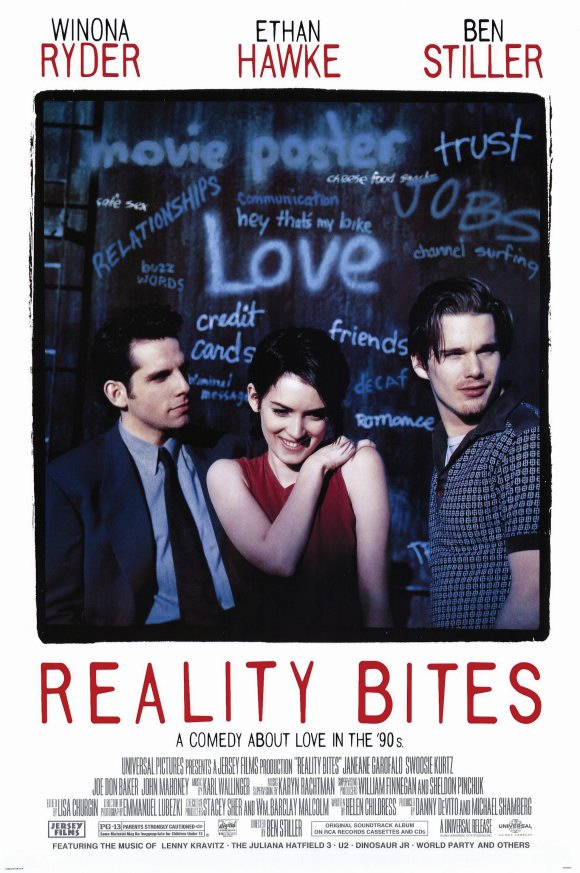
Episode 24 Cover1994: The Most Important Year of the Nineties continues with one of the most Nineties of Nineties movies, Reality Bites.  I take a look at the Winona Ryder/Ben Stiller/Ethan Hawke classic and also talk about its place in popular culture as well as talk about why it failed at the box office as did so many other attempts ot market to “Generation X.”

You can listen here:

iTunes:  Pop Culture Affidavit

Direct Download 

Pop Culture Affidavit podcast page

Here are some links to some recent pieces about the movie …

20 Years Later: An Oral History of Reality Bites

Hit Fix interviews the principal players from the movie’s cast and production and they talk about what it was like to make it in 1993-1994.

I Watched Reality Bites and it’s Bascially a Manual for Shitheads

A very funny Jezebel piece that waxes nostalgic about the film … with some perspective.

Reality Bites PosterHere’s also a link to two previous posts about the movie …

Generation X Is …

This post, actually my first column from my high school newspaper in the fall of 1994, is my seventeen-year-old self trying to make sense of my generation, especially after I watched Reality Bites on video.

Being Michael Grates

In this post, I take a look at Reality Bites nearly two decades later and discover how much I identify with Ben Stiller’s character, Michael Grates, the yuppie In Your Face TV executive who competes with Troy Dyer’s (Ethan Hawke) for Lelaina’s (Winona Ryder) affection.

Pop Culture Affidavit Episode 23 — The Album That Changed My Life

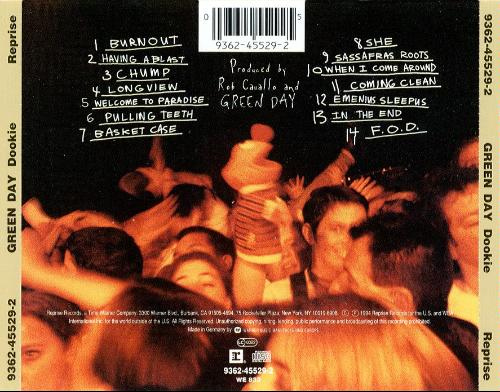
Episode 23 CoverDo you have the time to listen to me whine?  No?  Well, do you have the time to listen to me talk about Green Day’s Dookie, which was released twenty years ago and is one of the most important albums I ever purchased?  You do?  Great!  I’ll give some history on the album, go through it track by track and then explain exactly why, when I was 17 years old, this punk classic changed my life.

You can listen here:

iTunes:  Pop Culture Affidavit

Direct Download 

Pop Culture Affidavit podcast page

As a bonus, here is the CD cover …

Dookie CD CoverHere is the orignal version of the CD’s back cover …

Dookie Back Cover


And here are links to articles and books mentioned the episode …

“Young, Loud, and Snotty”  (1994 Spin article)

Our Band Could Be Your Life by Michael Azzerad (Amazon.com)


Whoomp, There It Was!

Bill Clinton plays the sax (we're Animaniacs) on The Arsenio Hall Show in 1992, probably the most iconic moment in the show's history.

Bill Clinton plays the sax (“we’re Animaniacs”) on The Arsenio Hall Show in 1992, probably the most iconic moment in the show’s history.

While this will date this entry years hence, I guess it should be noted that I’m writing it the same week that Jimmy Fallon starts hosting NBC’s long-running late-night talk show, The Tonight Show.  In the last few weeks there have been all sorts of farewells to both him on Late Night (which is being taken over by SNL alum Seth Meyers) and Jay Leno.  Leno, in 1993, received his first stint as permanent host of The Tonight Show after the retirement of Johnny Carson and the fights behind the camera as well as resulting late night ratings wars between Leno and Letterman (who would go on to do his own show after being passed over for Carson’s) would be one of the more well-known (and notorious) television stories of the 1990s.

One of the biggest casualties of the late night wars of 1993 was The Arsenio Hall Show.  Since its debut in 1989, the syndicated talk show had garnered respectable ratings and was very popular among younger audiences, but when three other late-night shows debuted during that year and many of the CBS affiliates that were carrying Hall’s show picked up Letterman’s instead, the ratings started to take a turn for the worst.  On May 27, 1994, the final episode of the show aired.

Now, when Arsenio was at his height of popularity, I wasn’t a regular viewer of his show.  Staying up that late on a school night was not an option for me in those years, and while I was allowed much later nights in the summer, those were usually spent watching a baseball game.  But if I happened to be up and not watching a random movie and had a desire to watch a late night talk show, I would tune in to Arsenio because like a lot of people who were watching his show, I found Carson to be … old.

And that sounds so pedantic, especially considering that Johnny Carson was such a huge legend in comedy and also considering that I would occasionally tape Late Night With David Letterman and Letterman was Carson’s heir apparent.  But Hall was cool–he must have been since he hosted the VMAs four times in a row (still a record to this date)–and he had guests that I was familiar with.  Granted, I knew who most of the guests on your average Carson episode were, but people I actually might have a chance of watching/listening to with more frequency were on Arsenio.

When Hall’s show went off the air on May 27, I wasn’t watching.  However, I had a good reason not to:  Game 7 of the Eastern Conference Finals between the New York Rangers and New Jersey Devils (“MATTEAU!  MATTEAU!” … oh, sorry … that’ll be another post).

I found the final episode of the show on YouTube and while I’m not sure if it’s the entire show (it’s in three parts and a couple of things do seem to be missing), it’s enough to get a feel for what Arsenio was about for its brief life.  In what I’ve seen, the episode’s format is what you’d expect from a talk show–a monologue and guests (Arsenio wasn’t really one for comedic bits).  The two guests mentioned are Whoopi Goldberg and James Brown.  You don’t see much of Brown–I have a feeling that whomever posted the video missed his performance or it was trimmed down in the original broadcast–and Whoopi’s conversation with Arsenio is about how his show was successful and the cultural impact he had.  Being a horribly naive 17-year-old white kid from the suburbs in 1994, I wouldn’t have been able to say word one about the cultural impact of a talk show hosted by an African-American but with twenty years of life experience and perspective now behind me, I completely understand what she’s talking about.  Hall was not only the first but he was also successful.  No, he didn’t have the long runs that Carson and Letterman had, but five years in syndication and holding on to an oft-fickle youth audience is something to be commended.

(more…)