comics

Zero Hour: Crisis in Time (My Life as a Teen Titan, Part Twenty-Seven)

About two years ago, when I started posting comics-related entries to this blog, I made a point to write about the first series that ever had a true impact on me, which was Crisis on Infinite Earths.  Marv Wolfman and George Perez’s 1985 epic was a story that I came late to, having read it for the first time in its entirety in 1991 after owning only issue 12 and then going back and collecting the rest.  Before the summer of ’91–when Armageddon 2001 and War of the Gods were both published–there had been three company-wide crossovers that don’t hold the same weight as Crisis did and some of which haven’t aged very well.  Legends, Millennium, and Invasion! were published in the late 1980s before DC decided to take a break from the company-wide crossover for a couple of years.  With maybe one or two exceptions, the issues for each of these stories were pretty easy to find and were cheap to procure in the early 1990s (seriously, except for Batman books, nobody was buying DC back issues at the time) so I quickly became an obsessive crossover fan.

The annuals crossovers that began with Armageddon 2001 (awesome then awesomely disappointing), Eclipso: The Darkness Within (uneven in parts but still a solid crossover), and Bloodlines (let’s not go there) were nice to have, but since the one company-wide-within-the-actual-books crossover that DC had in the early 1990s was the poorly executed War of the Gods, there wasn’t much to satisfy my craving for something epic.  Oh sure, there was the Superman books’ Panic in the Sky! and by the time 1994 rolled around I was knee-deep in both The Death and Return of Superman and Knightfall, but I still wanted more.  I mean, if Marvel could have Infinity Wars and Crusades, couldn’t DC have something?

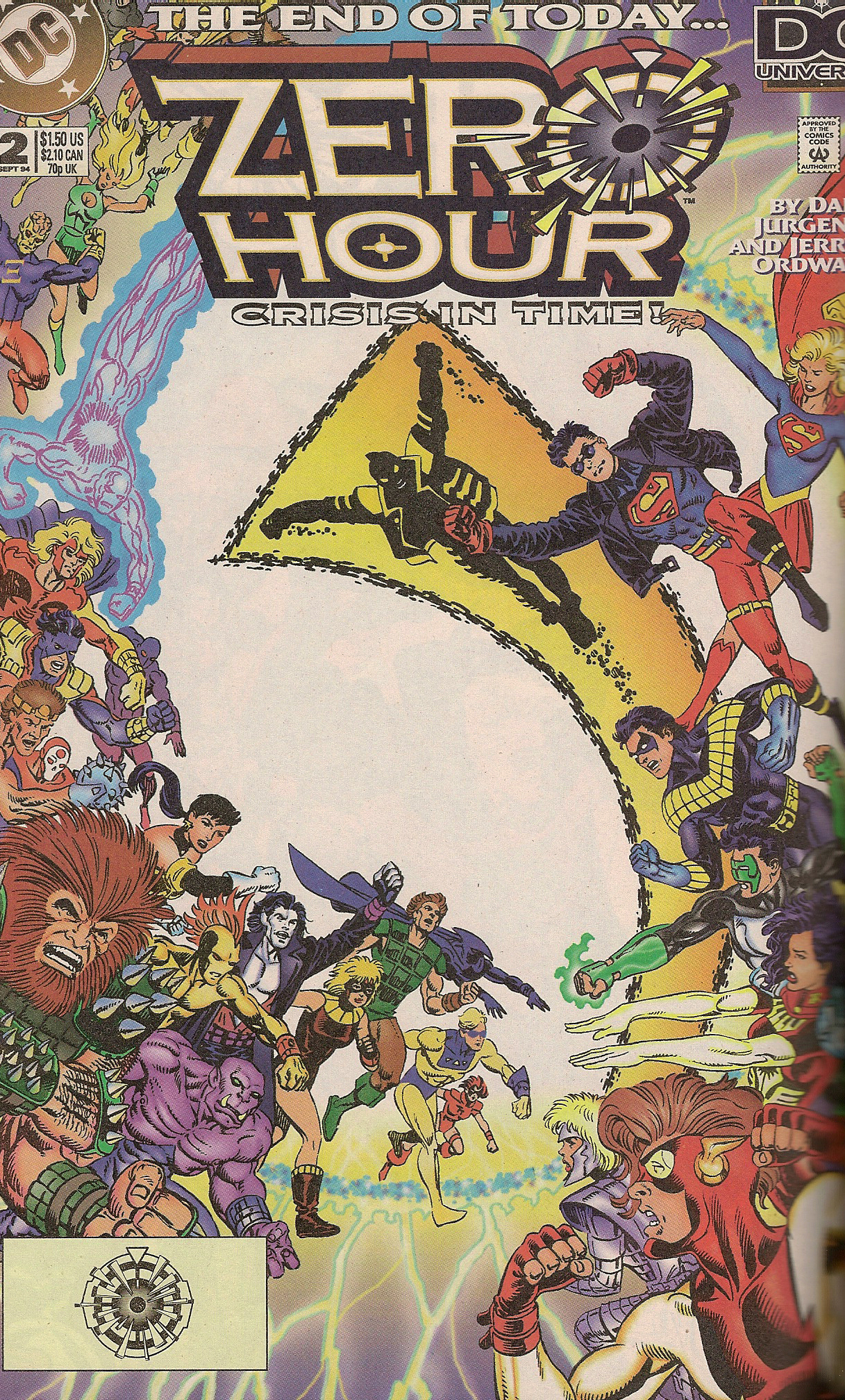
Then, in the fall of 1993 on the DC Universe promo page, there appeared a simple graphic of a ticking clock with the words “The Countdown Has Begun.  Zero Hour.  Be Prepared.”

I remember going almost practically apeshit over this.  I didn’t know what it was, I didn’t know what it was going to be … but I wanted it.  During the course of the next year or so, weird stuff would happen in the various books of the DC Universe that suggested that this Zero Hour event was going to be something very important, not just some random C-list villain making an effort to be someone important.  The biggest one that I noticed was that Valor–otherwise known as Lar Gand of the 30th Century–dies in his 20th Century-set book, a thousand years before he is part of the Legion of Super-Heroes.  Plus, there was this attempt to make some sense of Hawkman (I didn’t understand it either), and in Team Titans, the identity of The Leader was revealed to be none other than … Monarch.
This all led in to two issues of the anthology series Showcase ’94 where Waverider (he of Armageddon 2001 and Linear Men fame) and Rip Hunter observe Hank Hall as Monarch in some random hideout where he’s hooked up to a bunch of machines and … well, we’re supposed to accept the idea that Hall has been able to get his hands on a lot of different technology and also had the knowledge to use it.  They attempt to develop his character a little bit, or at least try to “erase” the mistake of the end of Armageddon 2001 by having him explain something about how when Dove died, her essence as a personification of order went into him (Hawk, the personification of chaos) and he became more powerful and aware than he ever had.  Then, Hall changes himself into Extant, a time-traveling villain who is supposed to serve a legitimate threat to the heroes of the DCU (instead of Monarch, who never really could seem to get his crap together).

It’s a halfway decent lead-in to Zero Hour, because we at least have a villain established and by the time Zero Hour #4 opens (the issues were numbered counting down to 0), it’s thought that Extant has somehow figured out how to screw with time itself to the point where pockets of entropy are opening up and swallowing time and space from both ends.  The heroes of the DCU are called upon to fight it and even though Wally West (aka The Flash) seemingly dies (he winds up in the speed force, a concept that Mark Waid would introduce at this point in his spectacular run on The Flash) and the Justice Society is forced into retirement (in quite possibly the worst way possible), they seem to stop the entropy from eating up the universe.  At least for a moment, when it’s revealed that the true villain of the story is Hal Jordan, aka Parallax, who has decided to try to recreate the universe so that everything that sucked never happened.    The heroes fight him, use a kid named Damage to start a new version of the Big Bang, and then the universe restarts as it should.

Make any sense? (more…)

Time’s Up (My Life as a Teen Titan, Part Twenty-Six)

When you have a comic book title that has a big mystery such as the identity of a major character and you finally reveal the answer to that mystery, you are then faced with an almost unbearable burden–following it up.  In some cases, it goes well and that reveal becomes another notch in the belt of a classic creative team.  Most of the time, however, it marks the beginning of the end.  Though it is not entirely the creative team’s fault, Team Titans definitely falls into the latter, as it only lasted four more issues after the revelation that Monarch was the mysterious team leader.

Now, from what I understand, Jeff Jensen and Phil Jiminez had taken on a flagging title and wound up being forced into a corner by DC editorial by way of Zero Hour: Crisis in Time, a “This Changes Everything” type of crossover that had a lead-up of a few months in some of DC’s titles, especially those that starred the Legion of Super-Heroes or had crazy continuity problems, such as Hawkman.  Team Titans joined that group of titles because since the book was on the chopping block, the teamers were going to be playing a part in Zero Hour and the story that runs from issue 21-23 winds up being a crossover lead-in with the series’ final issue being an actual Zero Hour crossover.

The story that was told, which set up the Teamers as unknowingly working for Monarch and that included character changes like increased aggression from characters like Kilowatt, a darker and more mysterious attitude from Prester Jon, and an actual physical transformation of Carrie Levine, a.k.a. Redwing as she morphed from a girl with wings into an actual man-bird beast renamed Warhawk.  But before we even were to get to that point, we had to sever the most important connection that the Team Titans had to its parent title, and that is Donna Troy. (more…)

Running Out of Time (My Life as a Teen Titan, Part Twenty-Five)

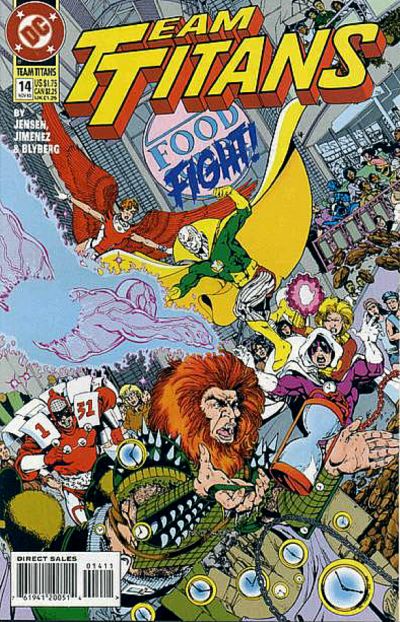
The cover to Team Titans #14 by Phil Jiminez

While I have no experience actually writing comic books, I think that taking over a failing title might have to be one of the hardest things that a creative team has to do, maybe even harder than following a very successful run because at least in the latter case, the book you’re coming into is selling well. In 1993, I was sixteen and didn’t know that Team Titans wasn’t selling well because out of the three Titans books that were being published at the time, it was the one I followed the most closely. As I said last time around, I was barely paying attention to Deathstroke; and New Titans, while definitely still an important comic book in my monthly reading pile, had artwork that was either so inconsistent or lackluster that I often found myself tuning out.

Team Titans, on the other hand, had two things going for it. First, there was an ongoing mystery as to the identity of the “leader,” the guy who sent the team back into the past to kill Donna Troy all the way back in New Titans Annual #7. Harris and I, who had been writing the New Titans editors since the first time we asked them to kill Donna Troy a couple of year earlier, were also writing to the letter column of this book, with our usual M.O., but also trying to figure out who this mysterious red-haired person was. It kept us on the lookout for clues all the way until issue #20 when it was revealed on the last page.

The other thing going for the book was the art. Phil Jiminez and then Terry Dodson are very well-known artists by now, but back then nobody had really heard of them. I had started to really enjoy Jiminez’s work when I first saw it in the Eclipso-related Titans annuals and the three-issue Red Star/Cyborg storyline written by Louise Simonson. It was reminiscient of George Perez, the famous New Teen Titans co-creator and artist who’d left the book for the second time a couple of years earlier; furthermore, it was so much the opposite of what New Titans was providing with Bill Jaaska that it was, by comparison, amazing.

Jiminez was also one of the writers on the title, co-writing with Jeff Jensen who is now a senior writer for Entertainment Weekly and recently wrote Green River Killer: A True Detective Story, a graphic novel about the search for the Green River Killer. Re-reading the last 13 issues of this title, it’s clear that they were cutting their teeth and while there are some missteps, I find this particular portion of Team Titans to be underrated, especially considering the problems they had as a creative team.

For starters, Marv Wolfman never really was happy writing the characters, or at least that’s how he has characterized his time on the Team Titans. in The Titans Companion, he says in an interview:

I always thought it was a stupid idea.  I didn’t like it; didn’t like working on the book.

Furthermore, the editors of the book, as Jiminez said in the Companion

…wanted was DC Comics’ X-Force.  They, DC management at the time, saw Team Titans as this answer to Rob Liefeld’s X-Force and what we wanted to do was something much more character-driven [and] self-aware, something more like Grant Morrison’s Doom Patrol.  So from literally the first issue, it was a struggle editorially to the point that the book just fell apart on us completely and a long-term story that we had planned got condensed into four issues.  Then Zero Hour came along and undermined everything anyway.

So you can see where they were kind of behind the eight ball when it came to writing the title, and in looking at their first storyline, you can see where it was obviously meant to be something bigger. (more…)

The man of action just keeps going (My Life as a Teen Titan, Part Twenty-Four)

One of the tougher things about covering the 1990s-era Titans books for this blog (if you can believe that is difficult at all) is not having to reread disappointing storylines like “Terminus” (especially considering if I extend my reading all the way through to the late 1990s The Titans title, I am going to be looking at some extremely poor stories), it’s that I find it tough to determine in what order to read these books.

With the Team Titans and New Titans titles, it was always easy to figure out where things were going, especially because they would cross over into one another here and there, at least through Team Titans‘ first year and as the DC Universe as a whole inched closer to Zero Hour, a crossover I found intriguing from the very first advertisement on the DC Universe coming attractions page.

But Deathstroke? It was a good action-adventure book but always kind of the odd man out in the Titansverse. Slade Wilson and his supporting cast kind of kept to their own until it was absolutely necessary for them to appear in the main Titans books, and since this was a book I was getting through the mail via DC’s subscription program, I really didn’t pay much attention to it. In fact, I’m pretty sure when I first got the issues between the “World Tour” and the post-Zero Hour “The Hunted” storyline, I skimmed the books, bagged and boarded them and really never gave them much thought.

Rereading issues #35-40, you can kind of see why. They’re not terrible stories, but whereas the small group of stories between the end of the Cheshire storyline and the World Tour were decent adventure tales, these are serviceable at best. Over the course of these issues, there are several art teams and while there is a three-parter about Wintergreen fighting for the right to restore his family’s honor because his father was a Nazi sympathizer, it seems that Wolfman was asked to kind of plug along before giant editorial changes took place.

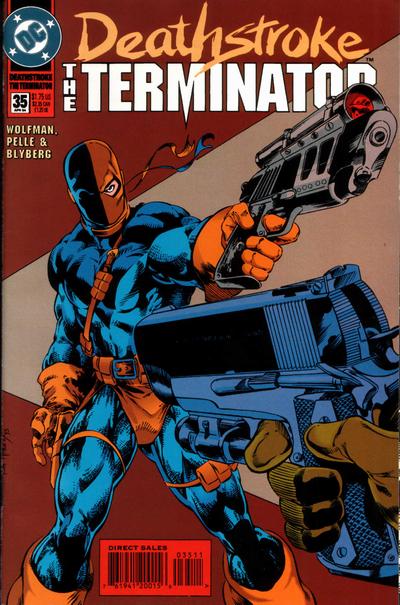
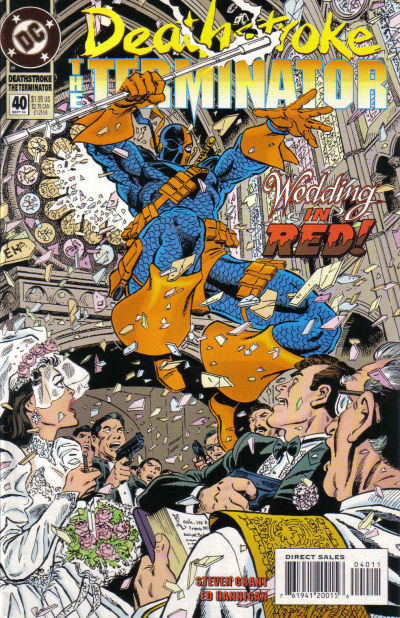
It is kind of odd, by the way, that Deathstroke did not have a Zero Hour crossover issue (and really neither did New Titans, although the issue that takes place around the same time as Zero Hour does at least put an ending to part of the Titans story). It would have been interesting to see a different version of Deathstroke pop up or maybe even one, if not both of his dead sons come back. Instead, there is the Wintergreen story, a team-up with Green Arrow, and Slade breaking up a mafia wedding. Wolfman does try to continue to build Slade’s character in some issues–in fact, issue #35 is basically a huge fight between slade and Wintergreen that winds up replaying the “No, go ahead! Kill yourself!” scene from Lethal Weapon. But even so, the “My family is dead because of me!” bit is starting to get tired.

I’m not trying to sound too negative here because it’s not like I didn’t enjoy Deathstroke’s title and it’s not like I didn’t like reading these stories, but I didn’t expect to have the same feelings I did nearly twenty years ago, which was these were the books I had to “get through” and that I was reading because they were associated with the Titans. In fact, it may have been a mistake to continually tie the title back to the Titans because Wolfman’s writing was pretty tight, and if this had been its own title that had its own continuity–something I think he was trying to do here but would be stopped with the next summer crossover–it would have worked a lot better.

Next Up: Back to the Team Titans and a look at that book’s change in creative team.

Terminus! (My Life as a Teen Titan, Part Twenty-Three)

The last panel that the late Eduard Barretto ever drew for the New Teen Titans was of Victor Stone kissing the woman who was now the love of his life, Sarah Charles, as they entered a new phase of their relationship at the end of New Teen Titans #49.  So I guess it’s wholly appropriate that by the time we finally got around to resolving the Cyborg storyline, it’s Sarah Charles who has been watching over him and trying to help restore his mind, even going so far as to head to Russia for him back in New Titans #94-96, which was one of the stronger post-Total Chaos stories that rightfully featured two of the Titans’ strongest members.

Unfortunately, the storyline that sends this particular strong member off is one of the weakest in the latter part of Marv Wolfman’s run, and one of the lowlights during the post-New Titans #100/pre-Zero Hour period (I’d call it the Bill Jaaska era, but most of the issues featured here actually aren’t drawn by Jaaska).  Entitled “Terminus: The Final Fate of Cyborg,” the story builds on what was established at the beginning of “The Darkening” with the apparent return of Rita Farr and villains that were not really villains but weird beings of light, and then goes bi-weekly for issues #104-107 in order to wrap everything up in a timely manner.

But the story really begins in New Titans #102, where Sarah Charles is trying to restore Vic and brings in the Team Titans’ ethereal computer guy, Prester Jon (my second-least-favorite Team Titan, something I’ll get more into next time) to try to interface with him, kind of in the same way that the Justice League used to use The Atom to go waaaayyyy down to somewhere small.  Meanwhile, Pantha digs deeper into whether or not Dayton Industries had something to do with her origin,  Dick and Kory are having their issues and Gar fights a monster called Sinn while he also fights against what seems to be indulging the fact that he can only seem to transform into monsters.  At the end of the issue, Sinn is revealed to be an agent of Raven, who is also manipulating Councilman Quirk, the replacement for Liz Alderman–which begs me to ask, if she was going to ruin the Titans’ public image all along, why remove Liz Alderman from the picture?

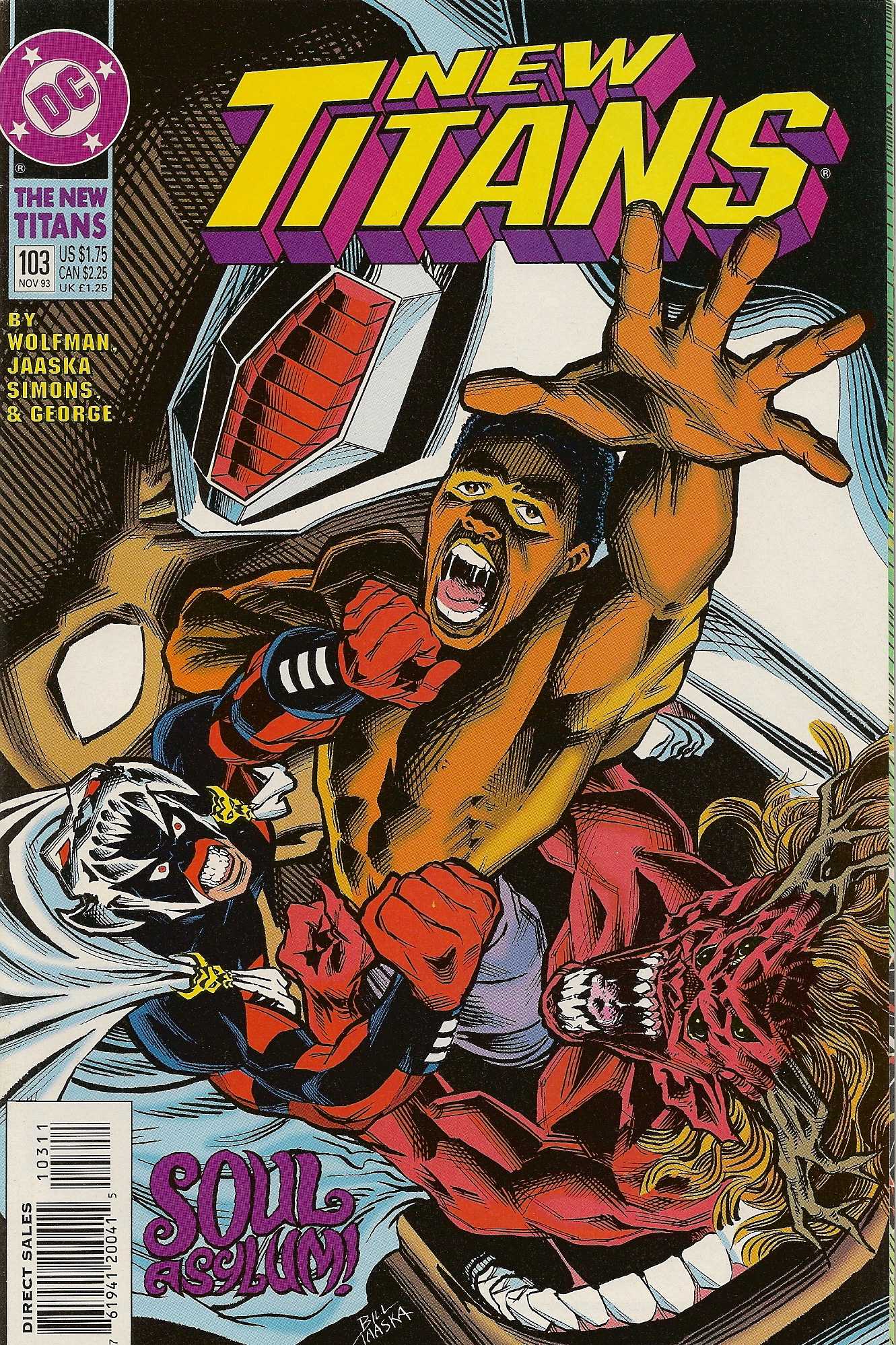
But we will leave Gar and Raven, as well as Dick and Kory for another month and turn our attention solely to Cyborg, as Prester Jon spends most of issue #103 inside Cyborg trying to find Vic Stone.  He runs into a fair bit of trouble, even getting attacked at one point while the fake Doom Patrol members from “The Darkening” show up and reveal themselves to be denizens of a planet called Technis and that they need Cyborg in order to survive.  The next issue box promises two issues per month and a “hot newcomer” named George Napolitano on pencils, which at the time was promising.  If you read the letters column from this time (when there was one), you’ll see that there were quite a number of readers who really loved Bill Jaaska’s pencils and DC was clearly making an effort to show all of us doubters out there that he was a good penciller.  The problem was that I couldn’t stand him and when I saw that someone else was taking on the art for a couple of months, I was actually excited and I think that Harris and I actually wrote a letter to the editor complimenting the art.

Re-reading it nearly two decades later, one of the biggest problems with Terminus is that the art completely takes away from what could have probably been a halfway decent story.  In fact, just as with many bad runs of art on any comic book, it becomes hard to “see” the story unless you take the time to read closely.  And the story itself is … well, it’ll seem familiar after a while. (more…)

Superman and the Image problem

Recently, screenwriter Max Landis (Chronicle) posted a video to YouTube where he took down the 1992-1993 Death and Return of Superman storyline (it was his commentary accompanied by several famous friends playing roles).  It’s snarky, mean-spirited, and wildly inaccurate, and the best rebuttals have been from Michael Bailey and Jeffery Taylor, the guys behind a great podcast called From Crisis to Crisis: A Superman Podcast (their mission is to cover every Superman comic published between 1986 and 2006 and right now, they are covering this very storyline).

Nothing more needs to be said about Landis’ video, but it did remind me of another time Superman’s death was used as a springboard for commentary on the state of the comics industry.  What’s funny is that like Landis’ commentary it comes off more as a poor reflection of the commentator rather than the story.  You see, in the world of comics, there are great stories, great artists, and then there are those who just think they’re great.  Sometimes, they intersect in a way that at the moment seems important but looking back borders on the ridiculous.

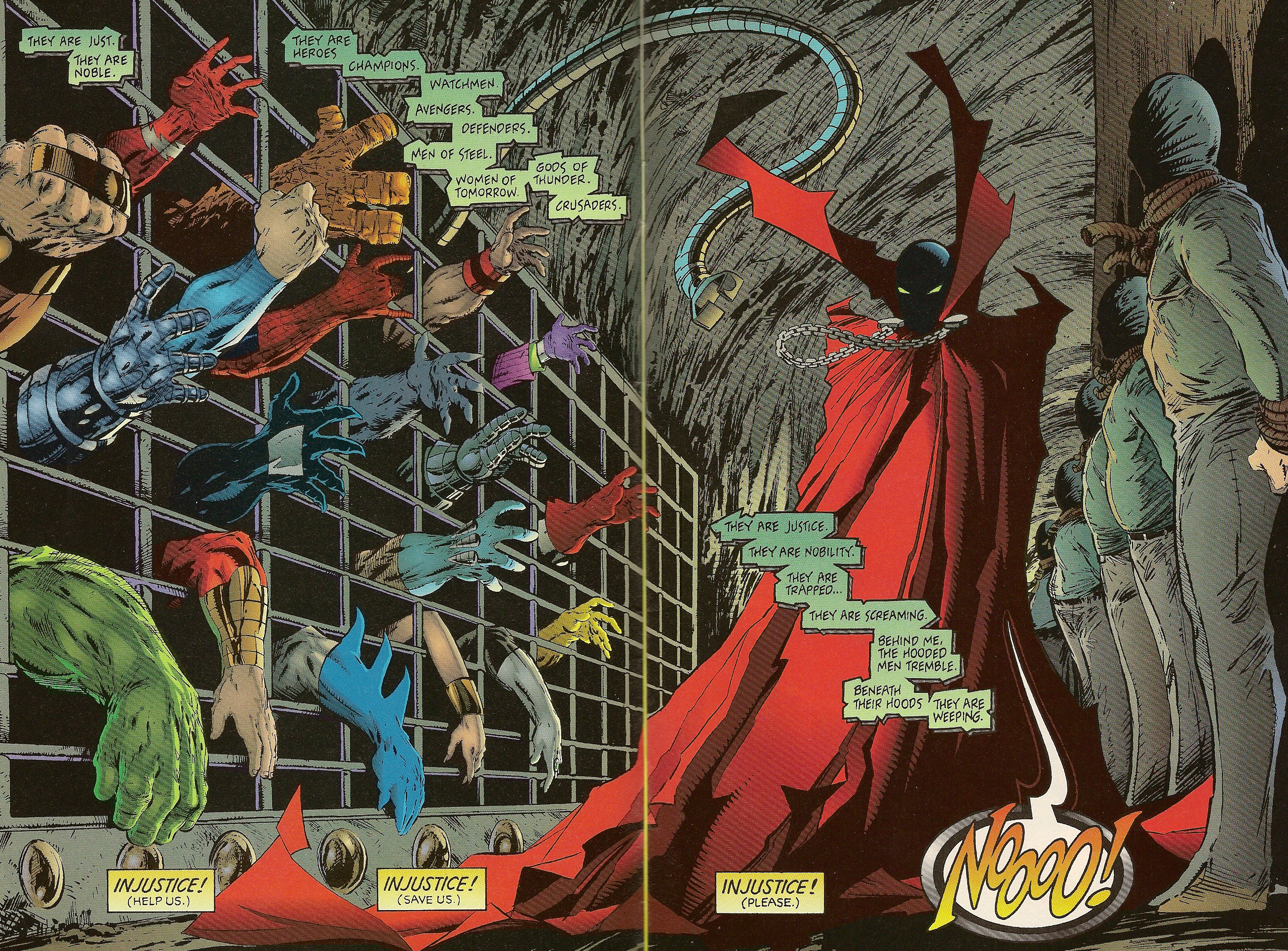
Spawn #10 was written by Dave Sim as part of a four month-long string of issues that were written by notable guest writers (Alan Moore, Neil Gaiman, Sim, and Frank Miller) and penciled by series creator Todd McFarlane.  Moore, Gaiman, and Miller’s issues served to introduce new characters nad help build the Spawn mythos; Sim’s spot in issue #10 seems to serve the Image Comics mythos.  It’s a piece of meta-fiction about the nature of creativity that is a reinforcement of the attitude that McFarlane and his Image co-founders had when they left Marvel twenty years ago.

In the story, after the conclusion of the previous issue where Spawn touched the mystical staff of that issue’s villain, Angela (a move that “removed” him from the continuity long enough to tell issue #10’s story), he meets up with Sim’s Aardvark, Cerebus, who teaches the hero a lesson about creator-owned characters and the happiness that comes with being able to have the rights to what you make.  It even ends with “Spawn is trademark and copyright Todd McFarlane/Cerebus is trademark and copyright Dave Sim FOREVER” written in the same way it would be airbrushed onto a license plate Gina made for Tommy’s IROC.

Pithy comments aside, the most important few pages in the story are in the beginning.  Spawn walks down a dungeon hall where men stand with hoods over their heads and their hands tied behind their backs while several costumed hands reach out for his help.  Many of the hands are identifiable (in fact, shortly after this issue came out, Wizard–never one to miss a chance to promote an Image comic–had a contest where they challenged you to name all of the characters displayed on that panel), and the hooded men with their hands behind their backs are obviously the creative teams of those various heroes’ books.  It is Sim and McFarlane’s comic book version of Plato’s Allegory of the Cave, although I think that the Greeks were a little more subtle.

The biggest point made in the whole sequence, however, comes not from the multitude of hero hands reaching out from inside their prison, but from a single hero who tells Spawn that he is the “original hero.”  In a two-page sequence, he offers Spawn his power because he claims that Spawn has the ability to free all of the prisoners.  Our protagonist takes it, and fires, but it is to no avail, as the villain (a version of Spawn’s archenemy The Violator wearing a dress made of money) claims he is too powerful and there will be no justice for those creators because even that “original hero” has succumbed to his will.  This is confirmed when the hero utters one word:  Doomsday. (more…)

Man vs. Machine (My Life as a Teen Titan, Part Twenty-Two)

When I finally return to the New Titans, I’ll be taking a look at a storyline called “Terminus: the Final Fate of Cyborg.”  At the time, it was a long-awaited story because Cyborg had been blown up in a rocket to Russia at the end of New Titans #75 and then rebuilt in New Titans #77.  We’re heading into issue #104 at this point, so that means that Vic Stone has been a vegetable for something like 2-1/2 years, which is a long time for a character whose story is so integral to the Titans as a team.

I have to admit, though, when I was a teenager first collecting the New Teen Titans and New Titans, I really wasn’t the biggest Cyborg fan.  Robin/Nightwing was obviously my favorite character and I also wanted all of the issues that involved Terra and Deathstroke, which are all issues I’ll get to in a few months.  I mean, I bought the issues that focused on Cyborg but that’s because I wanted as many issues as I could.

Or that I could find, anyway.

Up until I was about 15, I had rarely been to a comic book store outside of Amazing Comics or Sun Vet Coin and Stamp.  Sure, there was the occasional trip to that comic book store in Huntington, but it was true that for the most part, I had bought just about every Titans back issue that Bob had in the bins and with the exception of ordering back issues through Mile High Comics (which usually charged a pretty penny for them) didn’t have any other ways to get comics.  In the summer of 1992, however, I flew down to Fort Lauderdale to spend a week with my friend Chris, who was as much of an X-Men fan at the time as I was a Titans fan.

Armed with a stack of Uncanny X-Men back issues for him–mostly stuff from the mid-170s, which were all part of the “From the Ashes” trade–and a hefty amount of cash I had saved from the job I had working at a stationery story on weekend mornings, I hit Florida and went comics shopping at his LCS, which I don’t remember the name of except that he referred to it as “Phil’s.”  Phil had an enormous backstock, especially of Titans and I was able to complete most of my collection of the 1980 series (I think I had to track down #2, and #34, and if I wanted to, the reprints issues).  Among those were most of Cyborg’s story before the Trigon storyline in the first issues of the Baxter series.

That story begins all the way in the New Teen Titans’ very first appearance in DC Comics Presents #26 (a book I got for all of a buck at a comics show back in the early 1990s).  The premise of that story is that Raven is planting dreams in Robin’s head that involve him fighting alongside the New Teen Titans, a team that includes herself, Starfire, and Cyborg, none of whom he knows at that point.  While Starfire is simply a “golden girl” flying around and shooting bolts from her fingers and Raven is at the center of the mystery, We see that something has made Cyborg angry because when they defeat an interdimensional monster at STAR Labs, he starts yelling at one of the scientists, who happens to be his father.

That’s all we get for the most part, but it establishes his character as two things:  a very powerful Cyborg and an angry kid.  I’d venture to say that at a glance, the early Vic Stone stories are that of an angry black kid and he would have been a complete stereotype if Wolfman and Perez hadn’t slowly given hints to his origin throughout the first year or so of the book before revealing it completely in the first issue of the Titans mini-series, Tales of the New Teen Titans (not to be confused with Tales of the Teen Titans).  In New Teen Titans #7, we see Vic’s father, Silas Stone, again as he has designed Titans Tower and had it built and then reveals he is dying.  The two get a chance to reconcile before he does pass, which is supposed to show that he hasn’t lost all his humanity because we had just been treated to a brief summary of how Vic was mutilated in a lab accident and his father built the Cyborg body to save him. (more…)

Slade Wilson Fightin’ ‘Round the World (My Life as a Teen Titan, Part Twenty-One)

The opening splash page to Deathstroke #27. All of the "World Tour" issues began with similar splash pages.

There was a time in my life when I actually did want to be a comic book writer.  Okay, that’s a lie–if someone gave me the opportunity to write a comic book, I would jump at the chance, but that’s beside the point.  Comics are one of the coolest things in the world, I think, to write (especially if you can draw, then you don’t have to find an artist), but in following series that are as lengthy in numbers like the Titans, I can see one of the major drawbacks, which is having to constantly keep your audience excited.  The “Graphic Novelist” (in caps because it’s pretentious) doesn’t really have that problem because he or she can do his thing and leave satisfied.  But when DC or Marvel are looking for an ongoing series to stretch beyond issue 12 or 20 and possibly into the 100’s (although the way both companies constantly reset or relaunch stuff these days, I’m amazed anything makes it past 20), you have a harder road to travel.

That’s why I have a lot of admiration for people like Marv Wolfman.  Oh sure, he had some clunkers in his day–the post-Crisis on Infinite Earths Brother Blood saga and some of the stuff that is coming down the road in New Titans are good examples–but the man wrote the same set of characters mostly uninterrupted for sixteen years, and constantly came up with new ideas, even if all of them weren’t the best.  The Deathstroke: The Terminator series falls on the side of “good idea” because while it was obvious from the outset that while Slade Wilson was a popular anti-hero due to his “pilot” issue in New Titans #70 and role in the Titans Hunt it seems pretty clear that Wolfman wanted to write more of an adventure book than a Punisher knock-off.  As the title went into its third year, he finally got that chance with “World Tour ’93,” a eight-part globe-trotting adventure that begins with the kidnapping of his ex-wife Adeline at the end of issue #26 and ends in an Indiana Jones-type fashion in issue #34. (more…)

Angst, Abuse, and Rock n’ Roll: A Team Titans After-School Special (My Life as a Teen Titan, Part Twenty)

With about a year on Team Titans under his belt, Marv Wolfman left the title he started with Total Chaos to spend his energy on the goings-on in New Titans and Deathstroke: The Terminator.  In interviews about this particular era, he’s said that he really doesn’t even remember writing this book for an entire year and doesn’t seem to be a big fan of the characters; obviously, Woflman doesn’t think that his year with the Teamers was his best work.  It’s kind of a shame, too, because the main Titans title was suffering a little bit at this point and while Deathstroke’s “World Tour” storyline was about to get going, those were books on my pull list that I read after everything else, especially considering both Knightfall and Reign of the Supermen were going on, and Team Titans was the one book in that family that I was attached to.

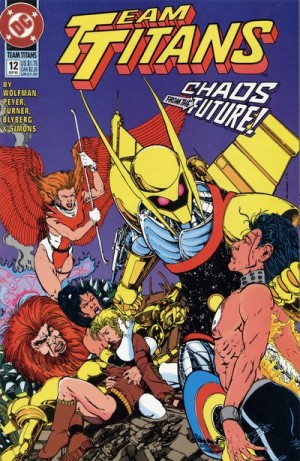
Looking at the last three parts of Wolfman’s run (two of which were merely plotted by Wolfman and scripted by Tom Peyer), I can see where his heart wasn’t in it and how a new creative team might be able to do a little more with the characters because some of the story elements seem a little forced.  Take, for instance, the two-parter in Team Titans #11 and 12, which came out around June 1993 and heavily featured Metallik, the Voltron-esque Titans team that we’d been introduced to in the immediate post-Total Chaos issues.  The premise of the two-parter was that a robot was sent back in time to eliminate the Team Titans, and immediately goes after a lone Teamer named Sunburst before Metallik gets in on the action and eventually our main team of Titans joins in the fight.

It’s kind of a throwaway story, to be honest.  The robot comes in all Terminator-style, winds up killing Sunburst (which pisses off the girls of Metallik because they think he’s cute) and eventually meets his end when Kole shows up again and augments Kilowatt’s power in order to destroy it.  There’s also some subplots that are continued, one being an attempt to give Batallion depth as he tracked down and pretty much stalked the woman who was his wife in the alternate reality from whence he came.  He scares the crap out of her (well, who wouldn’t be scared if they were being constantly followed by some guy with a huge mane who is armed to the teeth?) and then realizes that he can’t be with her and is going to be alone in this world. I think I’ve said before that I was never a big fan of Batallion because it was obvious that someone at DC wanted the Team Titans to have a “badass” character that could compete with Cable.

But Team Titans was never X-Force and was never going to be X-Force because even though Wolfman didn’t particularly like writing the book, he did his best to have the team in a realistic world, whereas X-Force always seemed to take place at scientific facility X or desert location Y.  The subplots that would continue past Wolfman’s tenure showed that.  Mirage dealing with the aftermath of Deathwing’s trying to kill her after he slept with her; the team’s overstaying their welcome at the Troy/Long farm; and the mystery of how many Titans teams survived the trip back from the alternate 2001 and how they fared were moved along here and would be be fleshed out more over the course of the next six months.  I especially liked, and still like the idea that not all of the teams did as well as the team we’re following.  Sunburst, when we’re introduced to him in issue #11, is the only one who survived the trip back (and wound up going back three years early) and was essentially homeless and waiting for the end.  Most time-travel stories with superheroes don’t have them get so banged up.

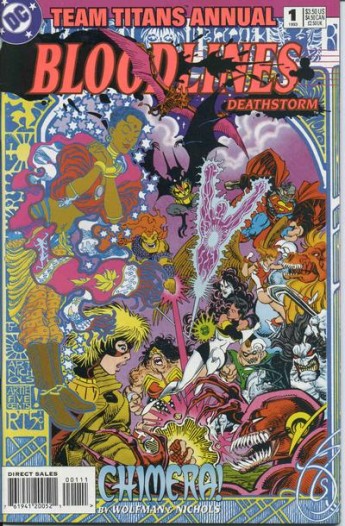
Wolfman ended his run with the first Team Titans annual, part of the much-reviled Bloodlines crossover, where aliens were feeding on people and turning some of them into superheroes.  In New Titans Annual #9, we discovered Anima in a rather forgettable story (though she did get her own title after that); in Team Titans Annual #1, we get Chimera in one of the better Bloodlines annuals, which was written by Woflman and features art by Art Nichols.   The team encounters the alien early with one of the few times that Dagon being a vampire that can transform into a man-bat really does look cool.  They take on the alien without Redwing, who is attending a high school dance as part of another attempt to fit in.  She feels like a freak and her one friend, Sanjeet, isn’t there to encourage her, so she flies off and is about to help the rest of the Teamers when she sees Sanjeet get into an argument with her father and take off in his car.

Carrie chases after Sanjeet and they run into another alien, who attacks her friend and puts her into a coma, during which it’s revealed that Sanjeet now has the power to make dreams become real and … well, deadly.  Part of this has to do with the attack and her powers, but it’s revealed that part of it has to do with the fact that Sanjeet was doing drugs in order to cope with her father’s abuse.  So what you get here is very much a psychological drama as it is a superhero story, but with the psychological part literally coming to life.  When it appears that Sanjeet and the Team Titans are adversaries, she forces them to face some of their greatest nightmares (Mirage, for instance, is forced to relive time as a whore for Lord Chaos and his troops).  Eventually, they talk her down and Sanjeet faces off against her father, who is eventually arrested.

Now, it’s a bit like one of those “very special” episodes where there’s an issue and we all learn a lesson after our heroes solve their problems, but Wolfman made the Chimera character one that is more personal than some of the very forced heroes we were getting out of the “new blood” that DC was trying to position as the next big thing (read: they really needed to compete with Marvel and Image), and to be honest, even though Anima did get her own series, the only character worth anything to come out of this particular crossover was Hitman.  And if this hadn’t been part of a crossover, it could have worked on its own because Sanjeet’s powers trapping her in her own world and manifesting her torment were very similar to what Wolfman and Perez had done in “The Possession of Frances Kane” back in the early 1980s.  Plus, the team may have been heroes by at least giving them a shot at a true teenage problem was worth it.

Next Up: Deathstroke goes on a World Tour.

Titans After Dark (My Life as a Teen Titan, Part Nineteen)

New Titans #100 is probably one of the better examples of a “sucker punch” big issue that came out in the midst of the much-maligned “Dark Age” of comics.  Oh sure, there were big events in other comics that people actually cared more about; Superman had just come back from the dead, Batman #500 came out and Azbats gave Bane a serious beatdown, and we were getting pretty close to the time when Magneto ripped Wolverine apart (which is also close to the time I stopped buying the X-books).  But aside from the moment that would basically become the genesis of Onslaught (look it up, kids), many of the “events” were pretty well-known at the time.  And I guess you could say that Evil Raven interrupting the wedding of Dick Grayson and Kory Anders was telegraphed as well, but I think that most Titans fans didn’t expect the mood of the book to change so drastically with its new art team.

To say the least, Bill Jaaska’s contributions to the title weren’t very welcomed by fans (though the editors did have a tendency to run positive letters stating otherwise), and looking at it now it looks clunky in some parts and hasn’t really aged well, but I can see where they were going for a newer, darker mood for the book.  And in order to take the book down this path, Marv Wolfman had a four-pronged approached, at least for the next year’s worth of issues.  He had the Nightwing/Starfire relationship reach its ultimate conclusion, Changeling started to lose his mind due to the manipulations of the Mento helmet, Arsenal would gain control of the team, and after nearly four years of wondering what was going to happen to Vic Stone, we finally would get the conclusion to the Cyborg story.

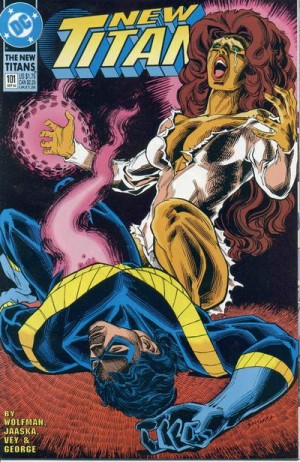
But since the biggest event of the previous issue was Raven kissing Starfire, it’s best to bring us back to our exploration of the Titans books of this era by looking at how Nightwing and Starfire recovered from the kiss.  Issue #101 was appropriately titled “Aftermath” and begins in S.T.A.R. Labs, where Kory is flipping out because she thinks that Raven is attacking her.  It’s a little bit different from many of the other Raven attacks we’ve seen because Kory seems to be fighting Raven’s influence and Phantasm–who at this point only seems to show up when the plot finds it necessary–uses his powers to help her fight.  It seems that they chase away the demon and Kory is back to the land of the living.

Meanwhile, Arsenal is wresting control away from a distraught Nightwing and it looks like he is about to strike a deal where the Titans may be a government-sponsored organization, something that pisses Nightwing off to no end and he and Roy come to blows.  Dick leaves the Titans to be at Kory’s bedside and Roy takes the team over, and in order to follow the story of the fan favorite Titans couple, we have to head to Flash #80-83, a four-part storyline where they help Wally West face off against a group called the Combine and an ex-girlfriend of his, Frances Kane. (more…)