random stuff

Amy + Joey 4eva

The_Amy_Fisher_Story_DVDSo I’m not the only person in my generation who is starting to feel a little older because quite a number of the things that I enjoyed when I was in high school are turning 20.  We’ve already passed the 20th anniversaries of Nirvana’s Nevermind and Pearl Jam’s Ten and are about a year or so away from the 20th anniversary of the release of Green Day’s Dookie, an album that I have always considered to be very significant in my personal music-listening history.

What we haven’t really noted is a moment that while it is really not much more than a blip in our culture’s history.  On December 28, 1992 and January 3, 1993, three movies about Amy Fisher aired on television.

Yeah, I know that sounded way more epic than it actually was, but you have to understand that I grew up on Long Island and for the last half of 1992 through at least the first half of 1993, and while there were plenty of other probably more important things going on in both the world and in the world of entertainment, this was the most important thing that was going on.  From the moment Amy did her perp walk to when she went to jail, you could not escape her story.

In case you’re unfamiliar with the story, in 1991, Amy Fisher began an affair with Joey Buttafuoco, the owner of the body shop where she had taken her car after wrecking it (and had supposedly enticed him into the affair so that her parents wouldn’t find out).  Fisher was sixteen years old at the time and would plead guilty to statutory rape in October 1992, eventually serving jail time.

But while the affair’s lurid details would capture Long Island’s (and eventually the nation’s) attention, nobody would have cared one bit about Amy Fisher if not for what had happened on May 19, 1992, when she knocked on the Buttafuocos’ door and confronted Joey’s wife, Mary Jo, about an affair her husband was having with one of Amy’s “friends.”  When Mary Jo blew her off, Fisher shot her in the head.  Fisher was arrested and charged three days later on May 22, and her perp walk was covered on the evening news:

Usually with stories like this, I don’t know much about what is going on until it makes such major headlines that it’s hard to ignore.  But believe it or not, I happened to be up late on May 22, 1992 (it was a Friday and being that I had no life I was probably home all night watching movies in my parents’ basement), and for whatever reason watched the 11:00 news and saw her being led away in handcuffs while the on-air reporter gave details about what she had been charged with. (more…)

The Last Time the World was Supposed to End

A Y2K bunker. Although it doesn’t look like this one was very well-supplied.

So we survived yet another supposed apocalypse.You know, I have never been able to take threats of the end of the world very seriously.  I suppose it’s due to the fact that in recent year, the talk of the end of days has come from the extreme type, those whose religious views are so out there that they may as well be something out of a bad movie about a cult.  I suppose our popular culture hasn’t helped either.  Turn on your average cable channel these days and while you surf through the low- class sideshow it has become (seriously, this is what I begged my parents for when I was a teenager?) you will more than likely come across a History Channel special where faux academics are interviewed about the vague statements made by someone before the flushable toilet was invented, or stuff like Doomsday Preppers.

I am not sure if the shows like these glorify these idiots or ridicule them.  It seems like the fringe is more in the spotlight than they ever were, but it is hard to consider them “legitimate” because there really aren’t any threats anymore.  It’s not like it’s 1962 anymore and we’re all building bombs shelters in our backyards because we are all scared of the bomb.  As advanced as I guess the Mayans seemed, it was an ancient prophecy that seemed as unlikely as the prediction made last year by some dipwad who claimed that The Rapture was upon us (although I always thought The Rapture was not really in the book of Revelation, and instead was manufactured by someone who wanted followers to give him money).  Besides, I had already become skeptical of apocalypse predictions years ago when Y2K didn’t happen.

Now, I’ m sure that most people who may read this remember what Y2K was, but its prominence as a threat to our society seems to have faded over time, becoming a footnote at least or the answer to a trivia question at best.  In fact, the sophomores I teach had no idea what I was talking about when we were talking about the Mayan Apocalypse during some down time on the last day of classes before Christmas break.  So, if you don’t know or don’t remember, Y2K was basically a widespread computer glitch that was going to destroy us all.  The problem, basically, was that most co.puters were programmed with internal clocks that only displayed years with two digits.  So, 1999 was simply 99.  And on January 1, 2000, these computers would all display “00,” and since they didn’t know the difference between centuries, the computers would think it was not 2000, but 1900, and would shut down or something.

I first learned about it in Time when I came  across the article “The End of the World As We Know It,” a title I suppose the magazine’s editors probably thought was hip but was really groan-worthy.  Anyway, I had come across the article when I was in the Honors Program study lounge at Loyola, intending to do what everyone who went to the lounge always did, which was nap on the couch.  Instead I got sucked into the story of the the Eckhart family of rural Ohio, who were among a population of very religious people who were convinced that it was the End of Days and had started to stockpile all sorts of supplies,including weapons, for the coming doom.  They had even gone as far as to make bunkers, just like it was the Cuban Missile Crisis all over again.  I was a typically self-absorbed college senior whose two major concerns were writing my weekly column in the student paper, and having the gas money to get to my girlfriend’s house on Friday night.  Besides, I was set to graduate in May and only pulling 12 credits that semester, so I really didn’t give a crap.

Okay, that’s not entirely true,because I did run a Y2K compliance check on my computer (because my PC was so decrepit at that point that I wouldn’t have been surprised if it had exploded that January 1), and I had seen enough science fiction to wonder if it could really happen.  But really, I just went about my business. (more…)

Memories of Concrete and Asphalt

8088965584_cef7870c35Back in October, my parents came down from Long island to take my son to Kings Dominion, an amusement park just outside of Richmond.  Being that he’s only five years old, he was interested in the animatronic dinosaurs and kiddie rides, one of which was the Peanuts tie-in called “Joe Cool’s Driving School.”  He sat in a little car and drove around a mock streetscape that came complete with traffic lights, road signs, and street lamps, one of which looks exactly like the crooked-style street lamp that I remember being attached to jersey barriers on the Wantagh Parkway.

In case you are unfamiliar with the Wantagh Parkway or any of the other parkways on Long Island, this is one of a network of roads that shuttles passengers around Long Island, especially to and from New York City.  I won’t name and describe all of them, but will say that the two most well-known are the Southern State and Northern State, which run on the south and north shores, respectively, with parkways like the Meadowbrook, Wantagh, and Sagtikos connecting them from north to south.  The parkways were designed in the earlier decades of the 20th Century by Robert Moses (who was parks commissioner at the time and has a state park and causeway named after him) and are passenger car-only roadways with stone-façade bridges, and even some hiking and walking trails.

A satellite view of the Wantagh Parkway, courtesy of Google Maps.

A satellite view of the Wantagh Parkway, courtesy of Google Maps.

But important to me and my childhood on Long Island, these parkways were the way my family traveled from our house in Sayville to my grandmother’s house in New Hyde Park.  She and my grandfather (who passed away when I was in high school) lived in a  typical post-war suburban home that they had moved into back in the late 1940s or early 1950s when my grandfather had returned from the Second World War, living in Brooklyn became tougher, and these homes were becoming more readily available.  My family drove this route more times than I can count, and it wasn’t until I attended Joe Cool’s Driving School that I realized that every trip to my grandmother’s was a history lesson.  I honestly don’t know what prompted it—probably because I have always associated Peanuts with the suburban 1960s of its television specials—and I honestly don’t know why I hadn’t noticed it before.  After all, I have always been interested in the modern history of my homeland (although I have only read Robert Caro’s infamous New Yorker article on Robert Moses and not The Power Broker, which I swear I will one day pick up and read) so you think I would have realized that Long Island has an element of “living history” to it.

Exit W3 in 2009 with the parkway's crooked lamp posts, courtesy of street view on Google Maps ...

Exit W3 in 2009 with the parkway’s crooked lamp posts, courtesy of street view on Google Maps …

Then again, you rarely notice these things when you live among them and the history of suburban Long Island is not designated with historical markers the way the Revolutionary and Civil War landmarks are near my current home in Virginia.  It’s more geologic, in a sense.  When you look at a rock formation or a canyon, you see striations in the rocks and any geologist can tell you how that determines the age as well as what can clue you into that area’s history (for example, the presence of certain elements can suggest that, say, an asteroid hit the Earth at some point).  When you look at the suburbs of Long island, you see that their history is layered.  Sure, Levitt bulldozed farmland and build houses at one point and Moses did the same for the parkways, but that was more than half a century ago and since then, one thing has been built on top of one another, or the old has been repurposed, perhaps several times over.

... and the same exit taken in 2011, accessed on Google Maps.

… and the same exit taken in 2011, accessed on Google Maps.

Starting my trip in my parents’ house in Sayville is perfect for this sort of examination.  My hometown is a good 200 years old and while it has had its fair share of changes over the years (read: something was knocked down in order to put up another bank), there are still vestiges of its former life as a seaside gateway for the turn-of-the-century upper class as well as century-old main street buildings that are more suited to its life a s pre-suburban small town, as are the towns of West Sayville and Oakdale, which we would snake through on our way to the three parkways that would eventually take us to New Hyde Park.

Each seems to have its own personality.  The Southern State, which when I was a little kid still had a few timber post street lamps lining its shoulders, has the feel of what I can imagine was truly considered a “parkway”—a sprawling, twisting, turning road with stone-façade bridges that reminds you that you are, in fact, driving along the south shore.  Even when it becomes the Belt Parkway (the bane of any New York-area traveler), you still feel like you are on a coastal highway.  Contrast that with the Northern State, witch seems to choke its way along the north shore before it becomes the Grand Central Parkway and heads straight for Fitzgerald’s Valley of Ashes, and you have a look at various shades of the past.  On approach to New Hyde Park via the Northern State, there are the North Shore Towers, which is a high rise luxury condo but always seemed like a reminder that we were near New York City.

But not the New York City of the time; a New York City of another era, or the type of city I remembered from years of educational films.  And the Wantagh provided the transition between the more open, even rural Suffolk County and the increasingly urban Nassau County.  Whereas the Southern and Northern States both saw their looks change from years past—lanes were expanded and timber post lights were modernized—for years, the Wantagh still had the same crooked lamp post that were installed in the 1970s and it skirted by towns that at a glance looked like they hadn’t changed in years.  It’s not an extraordinary stretch of road by any means and we were only on the parkway for a few miles, but between those towns and those lights, I always felt as if I were going back in time. (more…)

We’re #1 on This Demonstration

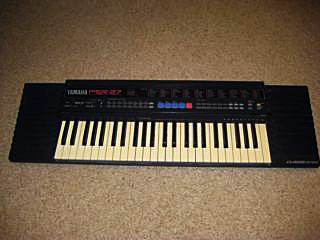
The Yamaha PSR-27 keyboard.

I have been playing the piano since I was about seven years old, and since I was in junior high, I have also owned an electronic keyboard. Keyboards were big-ticket items when I was a kid because they not only cost a decent amount of money, but also were pretty amazing. The better keyboards could synthesize a ton of instruments and had several present rhythms and one-touch chords.

My first keyboard was a small Casio PT-180, which I remember bringing into school to work on a project, but the first keyboard that I remember really being important to me was myu second one, a Yamaha PSR-27. In terms of keyboardness, it wasn’t much (compared to some of the more high end models), but it had way more instruments than that Casio, plus came with its own stand so instead of taking it out of the box, setting it up, and plugging it in whenever I wanted to use it, I simply set it up and plugged it in in the basement.

The coolest thing on the keyboard was a yellow button that said “demo.” This was pretty much exactly what you’d think it was–a demonstration of what the keyboard was capable of, done through a 90-second song that used several instruments, rhythms, and effects, including the orchestra hit, which was popular to almost an annoying degree in the late 1980s and early 1990s.

My sister and I played that keyboard endlessly, fooling around with the different instruments, playing our weekly piano pieces on the “distortion guitar” or “church organ” settings, and even adding the one-touch chords and disco beat to songs like the Star Wars theme. But the most fun we had was with the demonstration because it was a crazy tune that used just about everything the keyboard offered and even if we figured out how to play it, we would never be that good because we were not very quick at changing instruments.

But more importantly, this was around the time when the two fo us were really into playing with her stuffed animals. Yes, I know that it seems weird that a twelve year old would play with stuffed animals, but Nancy was still nine and there were many days when the two fo us were stuck in the house together. By this time, stuffed animal play had evolved to the action-adventure stage. Each animal that was among our “main players” had a distinct character and we were even working on a semblance of continuity when it came to our stories.

That is, of course, when we weren’t playing Battle of the Stuffed Animal Bands. This was a regular contest that featured four of the most hard-rocking groups of animals: two frogs named Felix and Fred, otherwise known as “Fe and Fred;” the guitar-laden novelty animal Rockasaurus; the beaver-rabbit-raccoon combo known as the Woodland Creatures; and two dogs that we called the Nas. (more…)

Get Down Tonight

All of the pictures from the night in questions aren’t ones that my friends and I want floating around the web, so here’s a picture of the Humanities building.

I was cleaning a couple of weeks ago, doing the semi-annual “purge” of random useless stuff from the house, and among the old clothes and toys that were going to Goodwill was a pair of commemorative glasses from my college freshman-sophomore semi-formal more than 15 years ago.  I’d like to say that I had held onto the glasses because I wanted to cherish the memories of that time in my life, but to be honest, I’m one of those people who is too lazy to buy new glassware so I simply hadn’t gotten rid of it earlier.

That’s not to say that retiring the glasses didn’t make me think of the night in question.  Unfortunately, my adoring fans (both of them) will be disappointed to find out that the freshman sophomore semi, held April 26, 1997 with the theme of “Get Down Tonight” was not epic, grand, illicit, or even out of the ordinary, but instead was just like any other Saturday night in college.

Okay, I was wearing a jacket and tie.

It seems weird that a college SGA would throw dances, or at least that when they threw the dances, people actually would attend.  College students are supposed to spend Saturday nights getting hammered on Natty Ice and throwing up into a trash receptacle outside of the library (which, of course, marks the only time in college they actually go to the library), not getting all dolled up and posing for pictures like it’s a high school homecoming dance, although everyone looks ten times worse than they did at homecoming due to college beer bloat and the fact that a dorm room doesn’t make for a very good area to primp.

On some level, attending a dance at my college kind of made sense because you really had nothing better to do, especially if you were one of those students who could not get into the bars and wanted some excuse to drink other than it was a weekend night.  They were held in Reitz Arena, which is the same gym where the D-I Greyhounds played basketball … and I use the word gym because it really is a glorified gym.  Sometimes the dances were held in the student center, but no matter where they were held, they always felt kind of like a high school dance, not something you’d expect in college. Oh sure, I went to a few sorority functions when I wa sdating my wife, but I can’t remember if she had a school-wide freshman-sophomore semi held in her university’s gym.  Considering that The University of Virginia has about four times the population of Loyola College in Maryland, I’m probably right about that.

The music didn’t help, either.  Our theme, “Get Down Tonight” came about probably because the late 1990s had a fair amount of nostalgia for both the late 1970s and 1980s going for it.  Disco kind of made a comeback at that point, especially (and strangely) groups like K.C. and the Sunshine Band, whose three or four hits had become staples at weddings by then.  They also weren’t hard songs to track down because they were featured heavily on the ever-popular ESPN Jock Jams albums that were released from 1995-1997, which my friends and I were all convinced were the only CDs the deejay that the SGA hired actually owned.  I mean, how do you explain that the dance remix of “What’s Up?” by 4 Non Blondes was popular in 1996, 1997, 1998, and 1999?

Maybe he was counting on the fact that we were too blitzed to pay attention to the music.  If you were going to a school dance, you showed up already drunk because you spent the afternoon pre-gaming in your dorm room (one night had my five of us–my roommates and I plus my girlfriend—drink an entire keg during said pregaming) and maybe danced with your friends for the better part of an hour before, much like a high school dance, things got boring, drama happened, ro someone required some hair holding.  I don’t think that anyone could really say that they were monumental romantic benchmarks.

Well, I should be more specific because for all I know someone first kissed his future wife at the freshman-sophomore semi.  So let’s just say that these dances were never really monumental for me.  I can’t decide if that’s because I put too much pressure on myself to have an amazing memorable time, or if I’m a complete romantic putz.  Or both.  Probably both.

But for what it’s worth, I went, danced, got my glass at the end of the night and went on with my life, developing a roll of film that probably won’t see the light of day and shrugging my shoulders at the thought of remembering and cherishing the night for the rest of my life.  Unless I’m supposed cherish it and I’m doing it wrong, because in all honesty, I had to stretch to think about what exactly went on that night.  I’m pretty sure there was drinking, sex, and definitely fighting among boyfriends and girlfriends, but ultimately it was fuzzy and fleeting, lost among the randomness of a time in my life that never made much sense and probably wasn’t supposed to anyway.

Cuckoo for CoCo Wheats

I’ve always been attracted to random stuff at stores. When I was a kid, for instance, I liked to walk down the “aisle of forgotten toys” at Toys R Us. In fact, I even had a few of the random-assed action figures found in that aisle or at places like Odd Lot. The obscurity of those things was kind of alluring – they were products that weren’t as cool or popular as the G.I. Joe figures that were selling out in droves, so they were more or less buried in the store (which, in a way, probably explains why I created this blog). As I got older, I saw the same thing with books, albums, and movies, which led to some purchases that were pretty awesome and others that wound up explaining why said item had been left for retail dead.

I never thought the same could be said for food, however. Food, in general, has an expiration date, so I would be less likely to find a three-year-old jar of peanut butter on a store shelf (although I am sure they probably have some at South of the Border) than, say, leftover Spider-Man 3 toys. Still, there are always some foods in a supermarket that never seem to exist anywhere else, as if they were brought here through an interdimensional portal or something.

Nowhere is this more apparent than with cereal. Stroll down your average cereal aisle and you’ll see a variety of products you never knew existed–bagged cereals, oddly named generic cereals, laxative cereals, King Vitaman–and while most of them won’t even garner a second glance, there is sure to be one that jumps out at you.

For my wife and I, this was the case with CoCo Wheats. A chocolate-flavored farina cereal, we first encountered it at a Kroger in Charlottesville back in 2004 or 2005. I can’t remember if we bought a box the first time we saw them or if our first time came later, but somewhere along the line in our search for a breakfast food that wasn’t the same boring box of Cheerios, we decidd that we had to have them. Thankfully, we were not disappointed upon trying them for the first time; in fact, they’ve been a welcome addition to our breakfast table ever since.

Okay, I read that last sentence and realize it sounds like every crappy commercial ever. Sorry.

Anyway, two things that I found particular about CoCo Wheats were that for a cereal that kind of seems obscure, it has a pretty rich history; and the actual process of cooking CoCo Wheats is nothing short of a chemistry experiment. (more…)

Fuzzy memories of summer camp

On Monday, my son started summer camp.  Beng that he is a four-year-old rising kindergartener, this was a pretty big deal because it is his first “summer break” after a year of school (whereas up until last August he was simply in daycare).  The camp is run out of his school, so there really is no difference in our morning and afternoon routines of dropping him off or picking him up, even though he is going to spend most of his days going to the pool or making crafts or playing games as opposed to sitting in class and learning letters and numbers.

Apparently, camp around here is kind of a big thing, to the point where every spring, there is not only a huge advertising supplement in the local newspapers about the various summer camp programs offered throughout the greater Charlottesville area, but there is a “summer camp expo” held at a local hotel where parents can stop by, pick up literature, sign up for camps, and meet local newscasters (I don’t know what the appeal is in meeting local newscasters, but there you go).  Where I grew up on Long Island, I don’t remember the ramp-up to summer break being a huge rush to get kids “signed up for something,” because quite a number of my summers were spent sitting around and doing very little.  I know that I sound like an old fart when I say that I was a kid in the days when kids could be left home alone and there was no danger in that, but it is actually true.  Most of the friends I had in later elementary school were kids whose parents weren’t always home and as long as I could ride my bike to their houses and as long as I was home before dinner time and wasn’t committing any criminal acts (and seriously, I grew up in freaking Sayville … the most “illegal” thing I ever did was cut through an abandoned lot and buy smoke bombs from the ice cream man), everything was fine.  Granted, there were days where my friend Tom and I spent time jumping out of trees and body slamming his little brother and I’m amazed that nobody got seriously injured, but we wound up fine.

But for those kids whose parents: a) were sick of their children doing nothing except watch TV all day; b) didn’t want their children unsupervised; or c) had the money, there was “camp.”  I didn’t know many kids who went to a “sleepaway” camp like the type portrayed in Meatballs or Wet Hot American Summer, probably because by the time I was old enough to do a sleepaway camp, those places had become synonymous with machete-wielding, hockey-mask-wearing killers.

Okay, that probably wasn’t the reason–it was probably more like sleepaway camp was a pain in the ass and parents preferred something more local, of which there were plenty of opportunities, some of which were almost like a sleepaway camp but were called “day camps.”  Every spring during my childhood, when I would be home in the afternoon watching G.I. Joe or He-Man and the Masters and the Universe, the local syndicated stations (like WPIX and WNEW/WNYW) would air a commercial for Young People’s Day Camp:

Now I am sure that this commercial ran well into the late 1980s and maybe even the early 1990s because I remember seeing it for years and I am sure that most of the kids in the commercial were in college by the time I was watching it.  I’d say that Young People’s Day Camp is the Mount Airy Lodge of children’s camps–the type of place that if you visited it now, it would be mired in bankruptcy and one skinned knee from being shut down by either the board of health or child protective services–but they are still up and running throughout the New York and New Jersey area, even if they’re not airing the same commercials. (more…)

Jewel-cased Memories

And this is only A-H of my CD collection.

One of the most practical gifts I received for Christmas was a CD book the size of a photo album.  It’s made out of faux leather and holds about 375 CDs, which is about half of my music collection.  I’m going to need another one at some point, but I was able to clean out half of the dresser that houses my CDs and I did something that I have never been able to do in nearly twenty years of owning compact discs: I threw away my jewel cases.

That sounds completely ridiculous because I am sure that there are plenty of people who were throwing jewel cases out the moment they bought their CDs a decade ago and didn’t feel the need to write about it.  Then again, I have that hoarder’s mentality where I hold on to some things because I feel like I am going to miss out on something, which is why I never threw out my jewel cases the first time I had one of these large CD books fourteen years ago, or during my twenties when I hauled box after box of CDs up and down flights of stairs during move after move.

So why pull the trigger now?  Well, as I was making my Christmas list, I realized that I had absolutely no CDs on it.  I certainly had been listening to a lot of music, but I couldn’t remember the last time I had purchased a new CD (which, after some thinking, I realized was The Gaslight Anthem’s American Slang), and the dresser where I keep the CDs was taking up so much space in my office that I wanted to get rid of it.  I began with the start of the alphabet, or ABBA Gold, and in a few hours found myself staring at a pile of empty jewel cases on the floor.

It didn’t seem right that they—along with the CD booklets—were so disposable.  If this were a record collection, I would have been carefully preserving the album sleeves and covers as much as the albums themselves.  But so many of the jewel cases were cracked and missing pieces that preservation wasn’t exactly going to be an issue.  And I don’t think that years from now, a guy on Antiques Roadshow will be telling me that my copy of Ride the Lightning would be worth more if the jewel case didn’t have a crack in it. (more…)

Put on your Mystery Sneaker and Give Me a Clue Because it’s Time to Ride the Sunrise

Mystery Sneaker, which was the "Holy Grail" of vocabulary development in Mrs. Hickman's first grade class.

She was telling us the class rules, and every single one of us was at attention.  After all, she had attention as being the “strict” teacher and her tall stature, tightly wound red hair, and impeccable wardrobe reinforced that.  Every once in a while, though, I’d sneak a glance at the back of the room at the giant target, which took up the entire bulletin board with its eight multi-colored rings and brown bull’s-eye that read “Mystery Sneaker.”  I had no idea what “Mystery Sneaker” meant, but I knew that it was probably important to Mrs. Hickman, who was still talking but now looking straight at me.  I sat up, looked right at her and allowed her to continue.

It was my first day of first grade and I was scared out of my mind.

Now, when I was five years old, I really didn’t know what “strict” meant, let alone that a “strict” teacher could be a good teacher.  I just knew that “strict” equaled “mean” and that meant bad.  Such information concerning Mrs. Hickman was gleaned from conversations with older kids who had been through first grade at Lincoln Avenue Elementary and spoke from experience—but also spoke knowing that we had no b.s. filter and it was fun to scare younger kids, even though some of the stories were true.  We found out right away that if your desk was too messy, for instance, she would put a sign that said “Lincoln Avenue Garbage Dump” above it.  And on the bulletin board behind her desk was the paddle.

Brown and stamped with “RAH,” the paddle looked like something she had gotten from a sorority and was single-handedly the source of every rumor about Mrs. Hickman.  Students who never had her and never would know about the paddle and the more you heard about it, the worse it became.  It didn’t merely hang on the wall.  Oh no.  The word on the Lincoln Avenue playground and the homes of Sayville elementary school students was that if you got out of line in any way, you got hit.

Now, I know there are people who did receive beatings at the hands of teachers, administrators, or nuns at some time or another. But by the time I got to school in 1983, I am sure that if Mrs. Hickman had hauled off and beaten the crap out of me because I didn’t clean my desk, tenure or no tenure, she would have gotten into serious trouble.  In fact, there was one time you did get a paddling and that was on your birthday, and even then it was a light tap or two (though I’m sure that you couldn’t get away with that today).  But when you sat in the classroom and looked at her desk, there it was, hanging, taunting you, telling you that she meant business.
And she did, although she didn’t need a paddle on the wall to show us.  She marked up our work with a red pen and expected nothing less than what she knew were our best efforts.  I remember one night sitting at the top of the stairs crying because I had colored in the exercise in my phonics book using a green Whitman crayon and had colored it so thickly that it prompted her to write, “Messy!  You can do better!”  Maybe I was being hard on myself or had a need for approval from authority figures, but this feeling that I had let her down was a sign that she was effective.

But as we discovered, she was effective because despite the pressure of high expectations and perceived fear of the paddle, she wanted us to love being in her class.  I’m sure that’s why she turned learning to read into a game.  Because when you’re six you may have a natural curiosity but you don’t have the natural love of learning that makes you purposely want to delve into existential philosophy or debate the merits of socialism in regards to public policy.  No, you are still getting the shakes from naptime withdrawal and you’re still struggling with making a lowercase n not look like a lowercase h.  So, with our education at such a base level, she knew that she not only had the challenge of teaching us how to read but the opportunity to make us want to read and love words and love reading and that is why the very first thing you noticed when you walked into the classroom wasn’t her paddle, but the giant target. (more…)

Summertime has come and gone and everybody’s home again …

A 1970s-era Shasta advertisement, although my grandparents had a different model.

I suppose it’s only appropriate that on Labor Day weekend, I keep thinking of sunsets.  I have seen some gorgeous ones in my lifetime in all sorts of settings, but if I had to choose my all-time favorite sunset it would have to be the one I watched when I was seven years old and spent a couple of nights at the beach with my grandparents.

Now, if you’re my age and come from the south shore of Long Island, a summer at the beach means taking the ferry over to Fire Island for the day, and an overnight probably means that you are staying at someone’s house, either out in the Hamptons or as part of whatever share you have on Fire Island or somewhere else.  But Grandma and Grandpa Chopping were part of a different sort of beachgoing culture, one that doesn’t get as much attention as it used to back through the middle of the Twentieth Century.  Instead of a beach house or time share, they owned a camper; specifically, a 1978 Shasta Camper, which they used to take every summer to the RV camp site at Smith Point County Park, which makes up the easternmost part of Fire Island.

Shasta, along with, say, Winnebago, is often associated with the RV and camping subculture that still exists and I’m sure that people who still hitch a trailer to their cars or drive their camper to a park would say is still going strong.  After all, most national and state parks still have campsites and in my travels both up and down interstate highways on the eastern seaboard, I have seen my fair share of signs for campgrounds.  Although, to be honest, I associate Shasta campers and trailers more with ephemera from the 1950s than with the 1980s of my childhood.  I hear “trailer” or “camper” and I think of spage-age-looking silver trailers with check-pattern tablecloths on the fold-away table and a family of four very happy people using a campsite grill for that evening’s dinner. No, really, like something out of an old Dick & Jane book or an ad for the suburbs.

The bathroom of a 1970s-era Shasta, which had a very 1970s-era color scheme.

And for a while I think that it was.  The Shasta brand is pretty well-recognized and if you do a search for the campers and trailers you see those classic models (which sometimes come in the red and aqua you might associate with that era.  However, what my grandparents owned was manufactured after Shasta had been bought by a competitor, Coachman, in 1976 and it had less of the charm of the 1950s and more of the stifling interior design that you’d expect from the 1970s.  The floor on the inside was a deep brown carpet and every single surface was some other shade of brown, right down to the wood-looking laminate that covered the particle board composite counter.  Even the dashboard of the camper’s cab was a light mocha, as were the padded steps of the ladder that led up to the “Grandma’s Attic” where we could sleep.  This, of course, was in addition to the harvest gold and rust orange stripes that ran across the side and the front of the camper, which itself had the same sort of utilitarian design that so many cars of the late 1970s and 1980s did.  But it did take leaded gas (or “regular”), which I don’t think that many people born after 1990 are that familiar with because it’s been at least that many years since I saw a “regular” pump next to an “unleaded” pump at a gas station.  But back then, when they pulled out of the side yard of their house near the foot of Foster Avenue, my grandfather would lumber the camper down to what was then an Amoco station on the corner of Foster and Montauk Highway and pull up to the yellow regular pump to make sure he had enough to make it all the way out to Smith Point.
(more…)