Teen Titans

Angst, Abuse, and Rock n’ Roll: A Team Titans After-School Special (My Life as a Teen Titan, Part Twenty)

With about a year on Team Titans under his belt, Marv Wolfman left the title he started with Total Chaos to spend his energy on the goings-on in New Titans and Deathstroke: The Terminator.  In interviews about this particular era, he’s said that he really doesn’t even remember writing this book for an entire year and doesn’t seem to be a big fan of the characters; obviously, Woflman doesn’t think that his year with the Teamers was his best work.  It’s kind of a shame, too, because the main Titans title was suffering a little bit at this point and while Deathstroke’s “World Tour” storyline was about to get going, those were books on my pull list that I read after everything else, especially considering both Knightfall and Reign of the Supermen were going on, and Team Titans was the one book in that family that I was attached to.

Looking at the last three parts of Wolfman’s run (two of which were merely plotted by Wolfman and scripted by Tom Peyer), I can see where his heart wasn’t in it and how a new creative team might be able to do a little more with the characters because some of the story elements seem a little forced.  Take, for instance, the two-parter in Team Titans #11 and 12, which came out around June 1993 and heavily featured Metallik, the Voltron-esque Titans team that we’d been introduced to in the immediate post-Total Chaos issues.  The premise of the two-parter was that a robot was sent back in time to eliminate the Team Titans, and immediately goes after a lone Teamer named Sunburst before Metallik gets in on the action and eventually our main team of Titans joins in the fight.
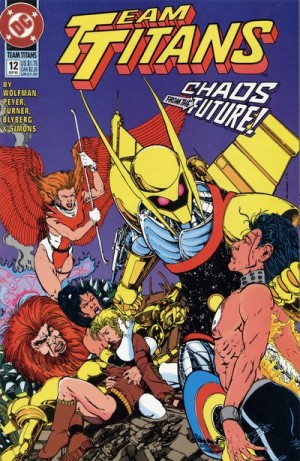
It’s kind of a throwaway story, to be honest.  The robot comes in all Terminator-style, winds up killing Sunburst (which pisses off the girls of Metallik because they think he’s cute) and eventually meets his end when Kole shows up again and augments Kilowatt’s power in order to destroy it.  There’s also some subplots that are continued, one being an attempt to give Batallion depth as he tracked down and pretty much stalked the woman who was his wife in the alternate reality from whence he came.  He scares the crap out of her (well, who wouldn’t be scared if they were being constantly followed by some guy with a huge mane who is armed to the teeth?) and then realizes that he can’t be with her and is going to be alone in this world. I think I’ve said before that I was never a big fan of Batallion because it was obvious that someone at DC wanted the Team Titans to have a “badass” character that could compete with Cable.

But Team Titans was never X-Force and was never going to be X-Force because even though Wolfman didn’t particularly like writing the book, he did his best to have the team in a realistic world, whereas X-Force always seemed to take place at scientific facility X or desert location Y.  The subplots that would continue past Wolfman’s tenure showed that.  Mirage dealing with the aftermath of Deathwing’s trying to kill her after he slept with her; the team’s overstaying their welcome at the Troy/Long farm; and the mystery of how many Titans teams survived the trip back from the alternate 2001 and how they fared were moved along here and would be be fleshed out more over the course of the next six months.  I especially liked, and still like the idea that not all of the teams did as well as the team we’re following.  Sunburst, when we’re introduced to him in issue #11, is the only one who survived the trip back (and wound up going back three years early) and was essentially homeless and waiting for the end.  Most time-travel stories with superheroes don’t have them get so banged up.

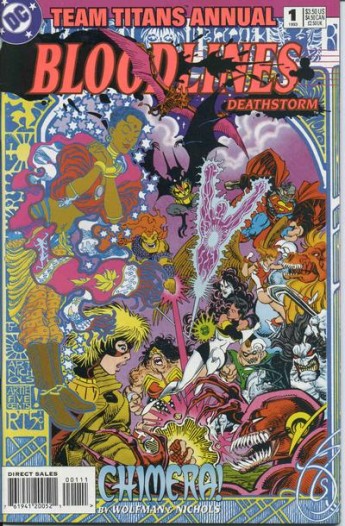
Wolfman ended his run with the first Team Titans annual, part of the much-reviled Bloodlines crossover, where aliens were feeding on people and turning some of them into superheroes.  In New Titans Annual #9, we discovered Anima in a rather forgettable story (though she did get her own title after that); in Team Titans Annual #1, we get Chimera in one of the better Bloodlines annuals, which was written by Woflman and features art by Art Nichols.   The team encounters the alien early with one of the few times that Dagon being a vampire that can transform into a man-bat really does look cool.  They take on the alien without Redwing, who is attending a high school dance as part of another attempt to fit in.  She feels like a freak and her one friend, Sanjeet, isn’t there to encourage her, so she flies off and is about to help the rest of the Teamers when she sees Sanjeet get into an argument with her father and take off in his car.

Carrie chases after Sanjeet and they run into another alien, who attacks her friend and puts her into a coma, during which it’s revealed that Sanjeet now has the power to make dreams become real and … well, deadly.  Part of this has to do with the attack and her powers, but it’s revealed that part of it has to do with the fact that Sanjeet was doing drugs in order to cope with her father’s abuse.  So what you get here is very much a psychological drama as it is a superhero story, but with the psychological part literally coming to life.  When it appears that Sanjeet and the Team Titans are adversaries, she forces them to face some of their greatest nightmares (Mirage, for instance, is forced to relive time as a whore for Lord Chaos and his troops).  Eventually, they talk her down and Sanjeet faces off against her father, who is eventually arrested.
Now, it’s a bit like one of those “very special” episodes where there’s an issue and we all learn a lesson after our heroes solve their problems, but Wolfman made the Chimera character one that is more personal than some of the very forced heroes we were getting out of the “new blood” that DC was trying to position as the next big thing (read: they really needed to compete with Marvel and Image), and to be honest, even though Anima did get her own series, the only character worth anything to come out of this particular crossover was Hitman.  And if this hadn’t been part of a crossover, it could have worked on its own because Sanjeet’s powers trapping her in her own world and manifesting her torment were very similar to what Wolfman and Perez had done in “The Possession of Frances Kane” back in the early 1980s.  Plus, the team may have been heroes by at least giving them a shot at a true teenage problem was worth it.

Next Up: Deathstroke goes on a World Tour.
Titans After Dark (My Life as a Teen Titan, Part Nineteen)

New Titans #100 is probably one of the better examples of a “sucker punch” big issue that came out in the midst of the much-maligned “Dark Age” of comics.  Oh sure, there were big events in other comics that people actually cared more about; Superman had just come back from the dead, Batman #500 came out and Azbats gave Bane a serious beatdown, and we were getting pretty close to the time when Magneto ripped Wolverine apart (which is also close to the time I stopped buying the X-books).  But aside from the moment that would basically become the genesis of Onslaught (look it up, kids), many of the “events” were pretty well-known at the time.  And I guess you could say that Evil Raven interrupting the wedding of Dick Grayson and Kory Anders was telegraphed as well, but I think that most Titans fans didn’t expect the mood of the book to change so drastically with its new art team.

To say the least, Bill Jaaska’s contributions to the title weren’t very welcomed by fans (though the editors did have a tendency to run positive letters stating otherwise), and looking at it now it looks clunky in some parts and hasn’t really aged well, but I can see where they were going for a newer, darker mood for the book.  And in order to take the book down this path, Marv Wolfman had a four-pronged approached, at least for the next year’s worth of issues.  He had the Nightwing/Starfire relationship reach its ultimate conclusion, Changeling started to lose his mind due to the manipulations of the Mento helmet, Arsenal would gain control of the team, and after nearly four years of wondering what was going to happen to Vic Stone, we finally would get the conclusion to the Cyborg story.

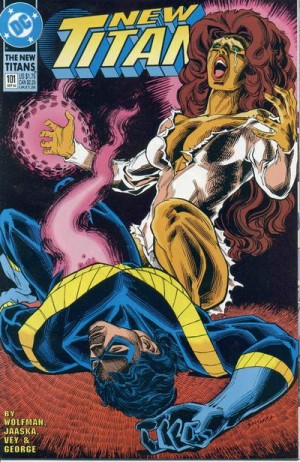
But since the biggest event of the previous issue was Raven kissing Starfire, it’s best to bring us back to our exploration of the Titans books of this era by looking at how Nightwing and Starfire recovered from the kiss.  Issue #101 was appropriately titled “Aftermath” and begins in S.T.A.R. Labs, where Kory is flipping out because she thinks that Raven is attacking her.  It’s a little bit different from many of the other Raven attacks we’ve seen because Kory seems to be fighting Raven’s influence and Phantasm–who at this point only seems to show up when the plot finds it necessary–uses his powers to help her fight.  It seems that they chase away the demon and Kory is back to the land of the living.

Meanwhile, Arsenal is wresting control away from a distraught Nightwing and it looks like he is about to strike a deal where the Titans may be a government-sponsored organization, something that pisses Nightwing off to no end and he and Roy come to blows.  Dick leaves the Titans to be at Kory’s bedside and Roy takes the team over, and in order to follow the story of the fan favorite Titans couple, we have to head to Flash #80-83, a four-part storyline where they help Wally West face off against a group called the Combine and an ex-girlfriend of his, Frances Kane. (more…)

Games (My Life as a Teen Titan, Part 18)

When I picked up New Titans #71, which at this point was more than two decades ago, I remember reading it from cover to cover several times over, especially after I read the next few issues of the Titans Hunt and was instantly drawn into the world of the Titans.  One of the more helpful parts of that book was a very long editorial in the lettercolumn by new editor Jon Peterson, who introduced himself and answered some fan comments, then teased the readers with what was coming in the future, which included an original Titans graphic novel.

Yesterday, almost exactly 21 years after I picked up that issue, that graphic novel came out.

Entitled Games, it is a full-length story by the classic New Teen Titans creative team of Marv Wolfman and George Perez, who began working on it back when Perez returned to the title in the late 1980s (New Titans #50 and the “Who is Wonder Girl?” storyline) for what wound up being a rather short stint, and takes place during that particular time period for the team.  It revolves around a new villain named The Gamesmaster, who has been making things tough for the C.B.I. (Central Bureau of Investigation, a fictional shadowy government agency) and its most prominent agent, King Faraday.  The Gamesmaster has been committing acts of terrorism that are part of an elaborate–and very deadly–war game that he now intends to draw the Titans into.

Faraday visits the Titans and makes them aware of the situation while we see several different people getting into place for what will be an eventual takedown of each of the heroes.   But first, after the Titans refuse to help Faraday clean up his mess, he begins to mess with their lives and the lives of their loved ones–Steve Dayton is audited, Starfire is investigated by the INS, and Joe Wilson’s mother’s company is under investigation.  So, they agree to meet again and he shows them, through the use of cards that look like they’re out of a role-playing game, that the Gamesmaster knows just about everything about them.  The team mobilizes to get their loved ones to safety and while they’re doing that, Sarah Simms doesn’t make it. (more…)

This Too, Shall Pass (My Life as a Teen Titan, Part Seventeen)

The cover to “9-11 Volume 2” as published by DC Comics

I am not one for commemorative merchandise when it comes to national tragedies.  I mean, when there has been a cause to celebrate, I’ve thought it was cool to own something and at one point I did own a Liberty Coin and have my fair share of World Series and Stanley Cup merchandise from 1986 and 1994.  But the thought of buying a coin made from “real World Trade Center silver” or a coffee table book about the Twin Towers always made me uneasy.  It not only seems a little underhanded to create and sell such products, but it makes me wonder if it cheapens the memories I have of that Tuesday from a decade ago.

Shortly after the attacks of September 11, 2001, artists and writers throughout the comics industry began creating and what came out of that effort were a few publications that were printed mostly to help the September 11 relief fund.  Marvel’s most notable effort was The Amazing Spider-Man (vol. 2) #36, which was literally an interruption of the current storyline for an issue where Spidey and the heroes of the Marvel Universe react to the destruction in New York.  This issue is reprinted in the “Revelations” trade, which is the second volume of J. Michael Straczynski’s run on the character and for what it’s worth is a solid story that doesn’t denigrate those who actually did sacrifice themselves that day. (more…)

The Numbers Game (My Life as a Teen Titan, Part Sixteen)

You know, the 1990s take a lot of crap from comics fans (read: it’s cool to trash them on the Internet) and a lot of that crap is pretty justified (you find value in Brigade.  No, seriously.  I’ll sit here and wait.), but as I have said before and will say again, it actually was a pretty great time to be a comic book fan.  Not only were comics selling like crazy, but so many titles hit milestone issues.  Between the time I started collecting comics in the late summer of 1990 and the time I graduated high school in June 1995, there were plenty of “anniversary” issues to go around.  Either characters turned 30, 40, or 50 (such as happened over at Marvel) or titles hit an issue that was a multiple of 50.   For instance, you had Action Comics hit issue #700; Batman hit issue #500; and because they all more or less debuted around the same time after Crisis, The Flash, Superman, Justice League America, Wonder Woman, and Green Arrow all hit issue #100 within a few months of one another in 1995.  And the New Titans celebrated its centennial issue as well.

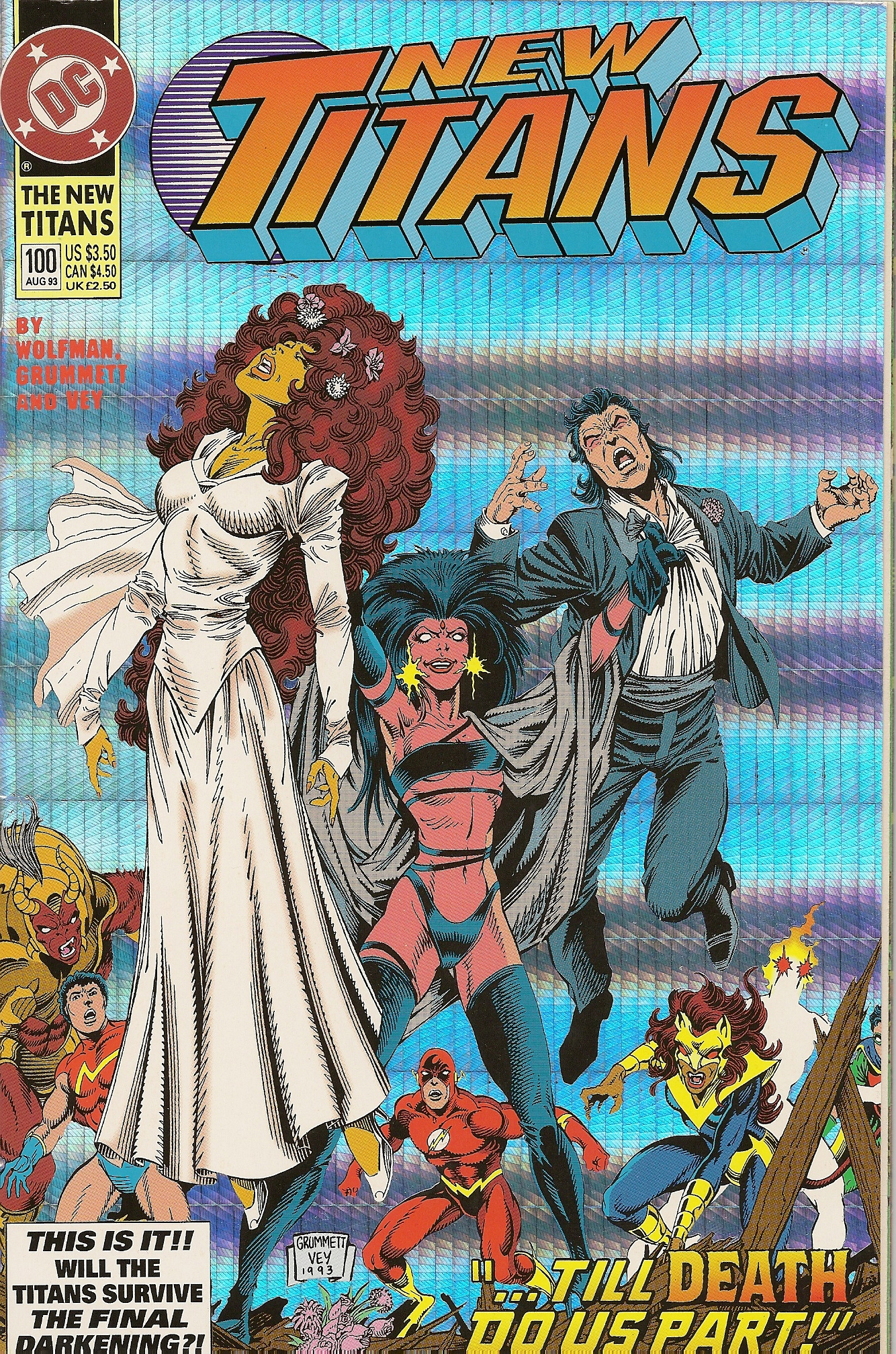
Now, considering that this was the 1993, an anniversary cover could no longer simply carry a special banner (like the “Anniversary” one that DC used for the better part of a decade on the cover of any milestone isssue–in fact, the last comic I remember seeing the “Anniversary” banner on was Detective Comics #627, which was the “600th” appearance of Batman in the title).  In order to commemorate said anniversary, you needed a gimmick.  For instance, Superman #75 (the Death of Superman issue) had a deluxe edition that came in a black polybag with some stuff (you know, I never opened the polybag and wound up selling it on eBay still in the polybag); Batman #500 had an overlaid cutout of Batman swinging through Gotham over Azbats swinging through Gotham in an entirely different costume.  And the title that during its formative years the Titans had been compared to–The Uncanny X-Men–had a foil cover with the X-Men’s logo in a hologram for its 300th issue that March, a mere three months before New Titans #100 debuted in July.

Considering that since its debut in 1984 with the epic return of Trigon storyline, the New Teen Titans series that would eventually would be renamed The New Titans with #50 had gone through many ups and downs and had nearly been canceled at least once, the fact that issue #100 was hitting the stands was something pretty remarkable.  Also, the fact that Nightwing and Starfire were going to be married in issue #100 was something pretty remarkable because if you go all the way back to issue #1, they were shown in bed together for the very first time and that caused quite a stir in the lettercolumns.

But if you look at the foil-embossed cover, which is all nice and rainbow-reflective when you hold it up to the light, Dick and Kory weren’t exactly on their way to wedded bliss.  The Grummett/Vey cover (their very last on the title) shows an unmasked Dark Raven looking excessively sunburned and wearing an outfit that is something out of a bad S&M fantasy holding both the bride and groom while the Titans plus guest stars Robin and The Flash look on.  It’s a revelation of a villain whose big “reveal” we would have expected to have to wait for during the issue but I guess considering that the average Titans fan had figured out that the cloaked figure who’d made out with Liz Alderman and brought us the Deathwing (seriously … Deathwing?) for the past few issues was Raven, so at least we weren’t left feeling insulted, and we were teased from the shelves by what promised to be a decent fight. (more…)

It’s getting dark in here (My Life as a Teen Titan, Part Fifteen)

The name is so '90s, the costume looks like he's the superhero of the Charlotte Hornets. Ladies and Gentlmen, ARSENAL!

If you were creating a comic book in the 1990s or if you were revamping a flagging title, you probably wound up doing one of four things (if not all four):  added a lot of guns and maybe some leather jackets to the cast’s wardrobe; gave the entire female cast, even the mousy girl, boob jobs; made half of the characters darker, edgier, or maybe even evil; killed someone; and hired an artist who drew like Jim Lee, Rob Liefeld, or Todd MacFarlane.  By the time that New Titans hit its “zero issue” (in other words issue #0) in 1994, they had either attempted or accomplished all five.  It started, of course, with issue #71, which is where we started this journey, but the process ramped up with New Titans #100, which was the conclusion to a story arc called “The Darkening.”

Yeah, they actually called it “The Darkening.”  Moreover, there was a companion story that ran in Team Titans called “The Darkening Night,” which wrapped up in that title but the implications of which were shown in New Titans #100.  It’s kind of hard to figure out the order in which to read the individual comics of these stories, as they are two separate continuous stories, but in looking at them again I broke it down by reading New Titans #97, 98, and 99, then following with Team Titans #7-10 before reading New Titans #100 (and Annual #9, which will get a little bit of a mention at some point).  I know, this is one of those “get back to the nerdery” moments here, but the only books that I knew at this time that were doing a continuing story across several titles and let you know what order in which to read those titles were the Superman books, so sometimes you have to figure these things out for yourself.

New Titans #97 begins the very last story arc for the art team of Tom Grummett and Al Vey, who had more or less been working on the book during the end of George Perez’s second tenure, which was about issue #56 or so.  I was going to miss this art team, although not too much–not because I didn’t like them, but because Grummett was already on Adventures of Superman and would be working on the regular Robin title, so at least I got to see the same pencils somewhere else.  I’ll … uh … get to his replacement in a later entry, so for now let’s just get to “The Darkening.” (more…)

Sequelitis (My Life as a Teen Titan, Part Fourteen)

The cover to New Teen Titans (Baxter) 15 sums up this entire era perfectly.

So the Titans were popular when I was a teenager, but not that popular.  Sure, Jon Peterson’s editorial run put the book back in the spotlight with enough cache to warrant two spin-off titles with an “event” crossover between them, but they weren’t so popular that comics shops were charging ridiculous amounts of money for their back issues.  The Wolfman-Perez run on the book, which started in 1980 and ran until 1984 (or 1985-1986 if you factor in, by extension, Crisis on Infinitie Earths) is now one of those “classic” runs, something that comics fans put up as one of the best of that particular period (I don’t know if I’d say the best of all time because then you wind up in Lee/Kirby territory and I think that’s still considered blasphemy.  Anyway …) but Marv Wolfman and George Perez are not Todd MacFarlane, Jim Lee, or Rob Liefeld whose backstock on the X-Men and Spider-Man were selling for prices in the double-digits.  I should know … I’m the jackass who once paid $25 for a copy of Uncanny X-Men #248.  So like I said, I got most of the original New Teen Titans series for about $2-$3 an issue, with the occasional issue, usually a very early one or a Deathstroke appearance, costing more.

The back issues of the Baxter series, which began in 1984, were a little more expensive and a little harder to come by, at least at Amazing Comics.  Part of that was because the original price of each of those issues was more.  Back in 1984, instead of paying 75 cents or $1.00 for an issue of New Teen Titans/Tales of the Teen Titans, you paid $1.25 for the Baxter series (by the time I started collecting, the price was $1.75).  If you were buying off a newsstand, you could stil get the same stories for 75 cents or $1.00 because DC was reprinting the Baxter series in Tales of the Teen Titans, which continued the numbering of the original series.  This meant that anyone buying Titans off the newsstand got those stories about a year after they had originally been printed.

Why a year, if DC was publishing the books simultaneously?  Well, that’s because for the first year or so of the Baxter series, the original, newsstand series (which had been retitled Tales of the Teen Titans, if you didn’t guess that by now) was still running original stories.  I think it might have confused readers a little because the stories in the Baxter book featured events that hadn’t happened yet in the other book.  When Tales started reprints with #60 (well, technically #59, but that issue reprinted DC Comics Presents #26 and a DC Digest tale), it became apparent that if you were going to read the New Teen Titans from beginning to end, you’d start with DCCP #26 and work your way to Tales of the Teen Titans #58.  Then you’d pick up the second series starting with issue #1 and the Raven/Trigon storyline.

Now that we’ve gotten that exhausting bit of explanation out of the way, I have to say that I think I agree with those fans who think that one of the contributions to the decline in the Titans through the late 1980s was the fact that the book was part of this direct market push.  This was at a time when the idea of a comics shop was really starting to gain steam and both DC and Marvel (but honestly, I think DC more than Marvel because I don’t recall that many “direct market only” titles from Marvel) were creating products specifically to be sold in comics shops.  For DC this meant books like The New Teen Titans, The Legion of Super-Heroes, The Outsiders, Vigilante, and The Omega Men being printed on Baxter paper and sold at a higher price as if they were meant to be in a bookstore instead of a spinner rack at the 7-Eleven (I think we kinda see this today with the trade paperbacks market … more books are coming out in hardcover and then softcover because DC and Marvel are clearly following a traditional publishing model that caters to Barnes & Noble rather than the LCSes of the world).  Sure, of the three super-hero titles (Titans, Legion, Outsiders) there were newsstand-available reprint books, but I think that this move still took the Titans off the market and damaged sales potential.

But that’s not what really hurt the book so much as the actual stories did.  Wolfman and Perez were a great team, but they tend to have the same faults as a Lennon/McCartney pairing.  Both are great writers on their own but their weaknesses definitely get the better of them at times.  I haven’t read too much of George Perez’s Wonder Woman, which is the title he took over after Crisis (I intend to, eventually), but I can say that Wolfman’s work suffered a bit … and he admits it, having said that during the post-Crisis period he went through a serious case of writer’s block, which caused the quality of the book to suffer and storylines to drag on way longer than they had to.  I mean, Chris Claremont was writing the X-books at the time and his run is notorious for long-assed storylines, but the x-books in the 1980s had really hit their stride and Marvel was doing the right events and hiring the right artistic talent to put that book on top and keep it on top.  I mean, I enjoyed Eduardo Barretto’s run as an artist on New Teen Titans, but the guy wasn’t Jim Lee.

Why, then, did it always seem that the books published between New Teen Titans #6 and New Titans #50 were such a pain in the ass to find?  I have no idea.  If I could speculate, perhaps the first year or so the book was selling so well that there weren’t that many back issues, and once the book started to fall off, the number of books ordered probably declined.  Bob just didn’t have that many of the second series, so it meant going elsewhere, like to Sun Vet and any other shop I could find.  Thankfully, the trip was always worth it because here and there I wound up with a couple of books at the low price of $3-5 each and eventually collected the entirety of an enormous storyline that starts with a spaceship crashing in Tales of the Teen Titans #52 and ends with Raven getting naked in New Teen Titans #39.

Uh … what?  Trust me, I’ll get to it.  It’ll take a long time, but I’ll get there. (more…)

It Begins With a Kiss (My Life as a Teen Titan, Part Thirteen)

Starfire meets Robin and kisses him right away ...

Going into the winter of 1992 and spring of 1993, DC was definitely riding a pretty high wave considering the sales it had gotten from the Death of Superman and upcoming Reign of the Supermen storylines as well as events like Knightfall, which was billed as the “breaking of the Batman.”  The Titans franchise itself was still enjoying a decent amount of success, especially considering that 1992 had seen a very huge event (well, huge as far as the Titans were concerned), “Total Chaos.”  The books had lost a bit of momentum after the whole “Sell-Out” storyline but a quality pinch-hit and a looming 100th issue still had it poised for something pretty great.

What had gotten them to this point was a good editor in Jon Peterson, who had taken a look at a failing title and said, “Let’s shake up the status quo.”  So, we got Titans Hunt.  Peterson left with the end of “Total Chaos” and Rob Simpson came on to the book.  His first few issues were the “Sell-Out” storyline as well as the three-issue Red Star arc but the lead in to issue 100 and that event in itself was obviously going to be considered his biggest moment (oddly, nobody, not even Titans Tower or the Titans Companion people, have been able to pin down Rob Simpson for an interview about this period.  Marv Wolfman has a bit of disdain for everything that followed Total Chaos, so it would be interesting to see another perspective).  Once again, with the storyline that would start with New Titans #97–“The Darkening” (yeah, it’s a very 1990s sounding story title)–he’d go for the shakeup of the status quo again.

... so that she can learn the English language. I tried that on a foreign girl once. It didn't work.

When I started to reread these issues, I had no problem remembering how we got here, but there were things that Woflman was working into his stories that anyone who picked up the book for the very first time wouldn’t know the first thing about.  Like, what’s a Mento Helmet?  Who are the Doom Patrol?  Why does Nightwing want to marry Starfire?  And what does that have to do with Raven?  I mean, I would have been lost, too, because what leads up to #100 really has its roots way back at the beginning of the famed Marv Wolfman/George Perez run that started in 1980 with DC Comcs Presents #26 and New Teen Titans #1.  And since I was immersed in the Titans back in these days and was buying as many back issues as I could, I thought I’d take a couple of entries to really get into the very long and involved backstory.

Then I realized how freaking long and involved this backstory is.  I’ve heard a few podcasters say (and forgive me for forgetting who it was … probably Scott Gardner, Michael Bailey, or Thomas Deja b/c I listen to their shows on a fairly regular basis and sometimes they get mixed up in my head) that Marv Wolfman’s Titans was a soap opera that just happened to have super heroes.  Considering how long some storylines and relationships in the Titansverse played out over the years, that’s a very accurate statement.  It probably also explains why I’ve always been able to sit through All My Children and One Life to Live whenever I’m at my in-laws’.  Anyway, I started combing through my back issues to see what I needed to pull for the best Dick and Kory and Raven moments and I found myself with a huge stack of comics.  So, I’ve split it up.  This time around, I’ll take a look at the aforementioned Wolfman/Perez run and how the characters first developed; next time, I’ll take a look at Wolfman post-Perez in the Baxter era, which gets quite sluggish at times.  Then we’ll go back to the present for “The Darkening” and its corresponding story in Team Titans, “The Darkening Night.”

(more…)

Deathstroke, the Punisher? (My Life as a Teen Titan, Part Twelve)

I think that one of the drawbacks of Marv Wolfman’s sixteen year run on the various Titans books is that he didn’t do much as far as take time off.  Sure, that is definitely an advantage because he was able to really craft his core group of characters and have them grow in a way that seemed organic, but at the same time there were clearly periods where he was, for lack of a better word, running out of gas.  In the next couple of months, I’ll definitely be getting to one of those times as I start moving toward New Titans #100 and I get to go through at least a couple of years’ worth of Titans stories that aren’t considered the best of the bunch.

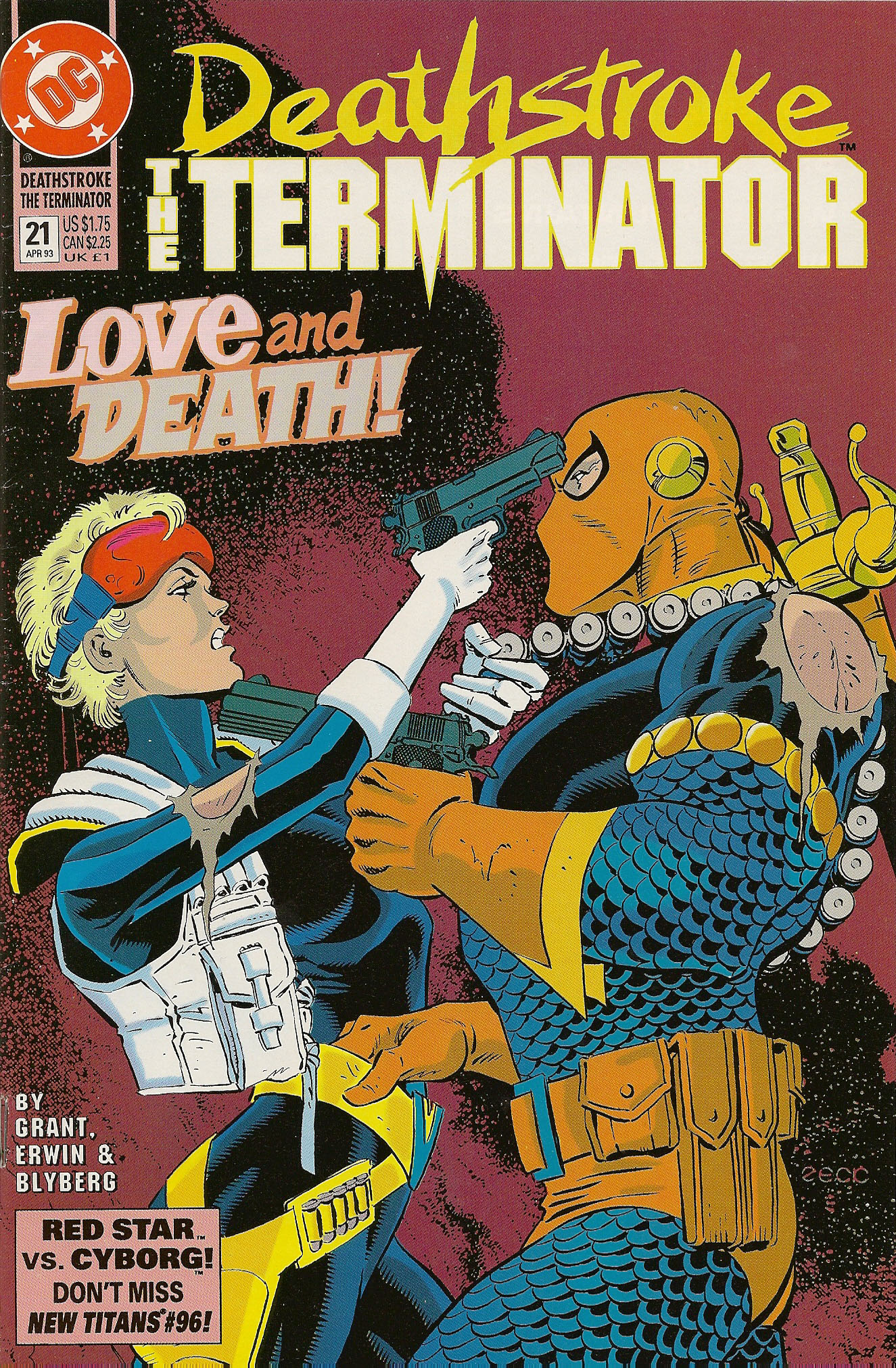
When Wolfman did step away for a moment and leave the books in someone else’s hands–like Louise Simonson, who did the Red Star Storyline I looked at last time around–the books weren’t necessarily better, but they were a refreshing “pinch hit”.  At the same time Simonson was handling Red Star and Cyborg over in New Titans, Steven Grant–he of the Punisher mini-series from the 1980s–was brought on to do several issues of Deathstroke.  I think that Wolfman was out on his honeymoon or something when these issues were due, or at least he felt he needed that break from Total Chaos.  At any rate, the Titans books moved along pretty well during this time, although I think Grant had an easier job than Simonson because he wasn’t dealing with all of the soap opera-type of stuff that had been moving its way through the Titans books.

Deathstroke was at the end of a long storyline that culminated in Cheshire’s destruction of Quarac and Slade’s telling off the U.S. government.  The Cheshire conspiracy had essentially been started back in the very first issue of the series so you are basically talking about nearly two years of story that wrapped up right before Grant came in.  Instead of starting something that was long and involved (which we will get with the “World Tour” storyline that starts with issue #26), Grant does one-offs and two-parters that remind us that the book is meant to first and foremost be an action comic.  I’d say that in ways it is definitely trying to reflect The Punisher but whereas The Punisher is a vigilante with a mission, Deathstroke is a mercenary/hitman and takes jobs.  It serves to further solidify his supporting cast (characters like the weapons supplier Squirrel and a contact named Frannie) and makes for some solid reading.

(more…)

Glasnost!!! (My Life as a Teen Titan, Part Eleven)

You hate to admit that sometimes a pinch-hitter is exactly what a team needs.  I have watched too many hours of baseball in my life to see the Mets pinch hit with me wanting to pull my hair out at the supposed “intelligence” of that managerial decision.  You know, because I have this awesome track record of knowing so much about and being so awesome at baseball.  Anyway, in my experience, pinch hits usually wind up with someone like Rusty Staub or Julio Franco grounding into a 6-4-3, but every so often Kirk Gibson guts one out of Dodger Stadium.

The covers to New Titans #94-96 created a single image. It's not perfect but it's pretty cool.

I’m not saying that Louise Simonson filling in for Marv Wolfman in New Titans #94-96 was the comics equivalent of Kirk Gibson’s now-legendary homer (nor was it Rusty Staub), but I will say that her three-issue story with pencils by Phil Jiminez was exactly what the title needed.  I will fully admit that the Sell-Out story and creations like Metallik showed that Wolfman was hurting a little and probably feeling a little burned out.  So the editors gave him a break and had Simonson finally get us back to figuring out what might be going on with Cyborg.

If you recall, nearly two years earlier, in New Titans #75, Jericho had detonated Cyborg’s rocket and two issues later the team was in Russia, where Red Star and a team of Russian scientists had rebuilt him.  Unfortunately, Vic Stone is more or less a robot because his mind was completely wiped out, something we have been reminded of either through Gar leading him around by remote control, entire pages of him staring off into nowhere, and the first two issues of the Showcase ’93 series.

(more…)