Before I get to the meat of this, I should provide some preamble. The post that will go up later in the week is titled “Being Michael Grates,” wherein I take a look at Ben Stiller’s character from Reality Bites from the perspective of someone who is in his mid-thirties and see, much like Mr. Vernon in The Breakfast Club and Lloyd Dobler in Say Anything … how much that perspective has changed. As I was writing that piece, I thought of a piece I wrote in my high school newspaper where I referenced the movie in some screed about then-current stereotypes about teenagers and twenty-somethings of the day, who were labeled collectively as “Generation X” (taken from the Douglas Coupland novel of the same name). I thought of quoting an excerpt from it in the post and then I decided, why don’t I just reprint it?
So, this is from the November 1994 (Volume 4, Issue 1) issue of Voices Inside, the then-student newspaper for Sayville High School. I was seventeen years old, and it was the first in a regular “column” I had (read: gave to myself since I was made editor-in-chief) called “@#$&!”, which is an early precursor to this blog. Perhaps one day I’ll write about that and “From the Nosebleeds,” the column I had in college. But until then, enjoy this and come back later in the week for another all-new post as well as next week’s episode of the podcast, which also touches on Reality Bites. Until then, here is the original column in its entirety (with a few punctuation errors fixed). (more…)
Despite what I’m saying in this post, this scene still is awesome.
Just like last week’s post, this is another that was an old post that I’ve updated and revised for this blog.
I think that if I ever actually met him, I would hate Lloyd Dobler. This is a lot coming from me. Say Anything … is one of my favorite movies of all time, so much so that I have the framed movie poster on the wall of my office at home. But with my tendency to over-examine everything I read, watch, or listen to (just like a good English teacher should) and with the film more than twenty years old, I’ve been thinking a lot about Lloyd and Diane Court and I have come to the conclusion that if I ever had to interact with Lloyd, I probably wouldn’t like him.
It’s not like I think he’s a bad guy or anything; on the contrary, there is something genuine about Lloyd and how he pursues and is devoted to Diane throughout the film that makes him great. John Cusack’s portrayal and Cameron Crowe’s writing and directing don’t hurt, either, because he clearly is the hero in the teen romance story and when he is finally with Diane at the end it feels right. But I still can’t help feel some sort of resentment because Lloyd is pretty much every guy I’m not, or ever was; furthermore, he is one of the types of guys who often proves to be the bane of my existence as an educator.
When I was in school, I was not in the clique that included guys like Lloyd. If I was in a clique at all, that is. I kind of simply existed, floating through the lower echelons of the social scale among the dorks. Guys like Lloyd were guys who showed up to school when they felt like it, took general-level classes and probably screwed around but more or less floated by on their way to graduation. They weren’t stupid by any means, but when I was in high school I probably would have assumed he was unintelligent in that way that every honors student with no life looks down anyone in a lower-level class as a way to compensate for having little or no social status. I didn’t have Corey or her 65 songs about Joe to occupy me on a Friday night; I had whatever was on television, video games, and maybe a few rounds of pool with my friends. Lloyd was cool, the dude everyone relied upon, and who didn’t give a crap. I was high-strung, rarely took risks, and should have left the house more.
Of course, he was also my competition.
Let’s consider Diane Court for a moment. Whereas I’d probably hate Lloyd if I met him, if I ever met Diane I wouldn’t hate her, I would have fallen in love with her and this, in turn, would have made me hate Lloyd more. I know this for a fact because I went to a high school with so many Diane Courts. Bright, beautiful, but kind of unaware. Not a snot, but so focused elsewhere that even she doesn’t know how good she would have it if she played into the school’s social status games. In fact, it’s wonderfully appropriate that Heather Chandler herself says that she wouldn’t have pushed herself so hard if she didn’t feel like she was competing with Diane. And if Heather Chandler is the queen, then that makes Diane an Athena of sorts, someone who is not even known until she leaves the halls of Lakewood High School and actually attends a graduation party with Lloyd, after which, they share this exchange:
Diane: Nobody knew me before tonight
Lloyd: They knew of you. Now they know you.
Of course, it makes perfect sense that Diane winds up falling for Lloyd. Even on the surface it works. Girls like Diane fall for guys like Lloyd all the time. Some would say it’s a “sowing your wild oats” type of thing or an “opposites attract” thing. But there’s so much more to it than that. When a drunken partygoer asks Lloyd how she agreed to go out with him, as in “Who are you,” Lloyd replies, “I’m Lloyd Dobler.” Because he is. He’s normal. She’s not.
Two months, Bender. Don’t mess with the bull, young man, you’ll get the horns.
A quick editorial note: This is an update of an old post from an old blog. But I was watching The Breakfast Club the other day and thought about it so I dusted it off and posted it here.
Saturday, March 24, 1984. Shermer High School, Shermer, Illinois. 60062.
Dear Mr. Vernon, we accept the fact that we had to sacrifice a whole Saturday in detention for whatever it was that we did wrong. What we did WAS wrong. But we think you’re crazy to make us write this essay telling you who we think we are. What do you care? You see us as you want to see us…in the simplest terms and the most convenient definitions. You see us as a brain, an athlete, a basket case, a princess and a criminal. Correct? That’s the way we saw each other at seven o’clock this morning. We were brainwashed.
So begins what is arguably the best teen-oriented movie of all time, John Hughes’s The Breakfast Club. I have, in past lives, written what seems like volumes on this movie and just about anyone under the age of 40 who watches movies is familiar with its story, so I won’t bore you to death with the details of the plot. Instead, I’m going to focus on the one teacher character in the school, Mr. Richard Vernon (Paul Gleason).
Vernon, of course, is the overseer of the five students central to the plot, a veteran vice principal who’s been putting kids in detention probably for longer than he can remember and makes sure that they’re behaving and on task, at least for the first part of the movie before the kids sneak out of the library to get a bag of pot from Bender’s (Judd Nelson) locker. Bender’s the main source of grief for Vernon; he’s a detention regular and the group’s resident “rebel.” Vernon fills the authority figure role well when he comes down hard on Bender for talking back, assigning him two months’ worth of detentions and expels him from the library when he catches him in the gym.
Then, he crosses a line. After throwing Bender in a storage closet, Vernon threatens him …
Vernon: That’s the last time, Bender. That the last time you ever make me look bad in front of those kids, you hear me? I make $31,000 a year and I have a home and I’m not about to throw it all away on some punk like you. But someday when you’re outta here and you’ve forgotten all about this place and they’ve forgotten all about you, and you’re wrapped up in your own pathetic life, I’m gonna be there. That’s right. And I’m gonna kick the living shit out of you. I’m gonna knock your dick in the dirt.
Bender: You threatening me?
Vernon: What are you gonna do about it? You think anyone’s gonna believe you? You think anyone is gonna take your word over mine? I’m a man of respect around here. They love me around here. I’m a swell guy. You’re a lying sack of shit and everybody knows it. Oh, you’re a tough guy. Hey c’mon. Get on your feet pal. Let’s find out how tough you are. I wanna know right now how tough you are.
[offers Bender his chin]
Just take the first shot. I’m begging you, take a shot. Just one hit. Come on, that’s all I need, just one swing…
[Bender pauses, staring]
That’s what I thought. You’re a gutless turd.
On some level, you can take this as the scene where we all see Vernon as a symbol for all of the overbearing horrible authority figures that keep teenagers from doing anything they want; after all, the most memorable line from The Breakfast Club is “When you get old, your heart dies.” But if you follow Vernon after the incident, you get a sense that he’s not proud of what he just did and his subsequent conversation with Carl, the janitor, reveals that he’s more than just a caricature of an ineffective authority figure (which is what Mr. Rooney from Ferris Bueller’s Day Off is). Carl and Vernon have a pretty standard conversation about “kids these days” and how they don’t respect anything. Carl calls bullshit on that sentiment, saying that Vernon has changed just as much as he thinks the kids have. (more…)
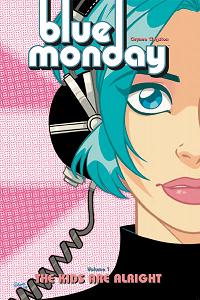
So what am I doing taking a look at an anime-influenced comics series about the misadventures of a teenage girl and her friends? Well, why don’t you listen to the latest episode of Pop Culture Affidavit, where I talk about Chynna Clugston’s Blue Monday, a series from Oni Press with what has to be the most kickass 1980s new wave soundtrack.
It sounds ungrateful to say this, but there were many times throughout my youth where I was bored off my ass while on a family vacation. oh sure, we took trips to amusements parks and went to places like Washington, D.C. where there was plenty to do at museums, but I remember that for every ride at Disney World or every arcade
game at Weirs Beach, there was an antique shop or glass factory. Plus, there were car rides–long, mind-numbing car rides.
In fact, based on the amount of stuff geared towards keeping kids occupied in the car, I think it’s safe to say that a long, mind-numbing car ride was a rite of passage for much of my generation, possibly sitting in the seat that faced backward in someone’s station wagon. My parents didn’t have a station wagon, so my sister and I were sometimes forced to squeeze into the back seat of my mom’s 1987 Honda Prelude, which as an incredibly cramped fit when you were driving eight hours from Long Island to Williamsburg or to new Hampshire. But we definitely kept ourselves occupied with tapes in our Walkmen, comic books, novels, and travel board games.
These would keep our attention for at least a little while until we got bored enough to stare out the window and count the mile markers or keep an eye out for a Sunoco station because dad was low on gas.
There was one activity that I remember sticking with beyond an hour on I-95 in Connecticut, and that was a folder with stickers titled Road Sign Games. My sister and I first spotted this in a store in Lake Sunapee, New Hampshire during one of our many family outings. Being that it was one of those knick-knack gift shops that seemed to be everywhere in that area of New Hampshire, when we went in, we weren’t allowed to do anything and were instantly bored. Not that we would want to–after all, vases, dishes, scented candles, homemade soaps, and necklaces with runes on them weren’t exactly the type of things that set our world on fire, especially when I would spend most of my vacation each year reading Star Trek novels.
The road sign stickers that you would peel and place inside the Road Sign Games folder.
This particular place, though, had toys and games and Road Sign Games was not too expensive, so my parents went ahead and bought one for me and one for my sister. The game was simple, too–contained in a polybag was a folder containing pictures of commonly found road signs along with a sheet of stickers, which you would stick to the matching sign in the folder whenever you saw that particular sign. At a glance, it looks like the type of thing you’d have a little bit of fun with but eventually put away among the sticker books, word searches, and crossword puzzle books that were all bought at one time or another as boredom cures.
But when I was up in New Hampshire that year, completing the book became one of the most important things I had to get done when I was on vacation. My parents would often make us schlep halfway across the state or even into Vermont throughout the vacation and when I realized that I was seeing a number of road signs during these day trips, I knew that I had found my salvation. No longer was I going to spend my time int he back seat fighting with my sister or wondering why there weren’t any good songs on the radio, I had signs to see!
Some of the signs were pretty easy to spot. I didn’t have to go very far to see a stop sign, one way, do not enter, or a speed limit sign; and interstate shield and exit signs would about whenever we traveled long distances. But I had never seen a no passing zone or a pavement ends sign. And so began the quest. on the way to shopping, I noticed that whenever there was a solid yellow line on the side of the road, there would be a yellow triangular no passing zone sign; whenever we hit construction traffic, I saw orange signs; and I noticed how all of the signs around the parks were brown. In fact, I became so determined to finish the road sign game that I walked from our cabin over to Wadleigh State park, where I managed to fill more than a few of that section’;s stickers. I think i got as far as all but ten stickers before the road sign game was filed away and then either lost or thrown in the trash. (more…)
When you’re a total geek and you’ve got a ton of money to blow, what do you do? Well, you spend it on getting a popular girl to go out with you! At least that’s the premise of “Can’t Buy Me Love,” a 1980s romantic teen comedy if there ever was one.
So take an hour or so and go back to 1987 and all of its bad hair as I talk about this Patrick Dempsey classic as well as dive into my own personal review archives, all in the name of love. And getting people to listen.
So in searching for an idea for this week’s entry (and admittedly running out of time for an idea for this week’s entry), I was bumming around YouTube and stumbled upon this:
I know that commercials have gotten more sophisticated since I was a kid; after all, Mars has made a fortune off of the licensing of the animated M&M’s that it currently features in its commercials. But seeing this again for the first time in nearly 30 years, I have to say that is still one of the most perfect commercials because in thirty seconds it encapsulates playing baseball as a kid.
Okay, maybe not for me because I absolutely sucked when I was younger, but I do remember that this commercial came out right around the time I started my first year of “real” baseball (read: not tee ball), and there were times that while riding the bench (which I did a lot), I would talk to my teammates and we’d say that we were going to “take the ball dowwwntooowwwn.” Plus, I think that every kid in the history of being kids has at some point sorted his or her M&M’s.
Yeah, I know that they all taste the same because they are milk chocolate that surrounded by a thin candy shell (hence it “melts in your mouth but not in your hand”), but the brown ones were so plain, and while the yellow and orange ones were slightly more interesting, the green ones stood out, so they were immediately a favorite. And during a game, if we had M&M’s, we’d actually save the green ones before getting in the on-deck circle because I think that on some level we thought that the green M&M would lead to a home run.
Of course, that was never true and since then, M&M’s come in many more colors than the ones in the commercial and more flavors than just plain and peanut (the peanut butter ones are a personal favorite); however, I still like to think that there was something special about the green ones, even if there wasn’t truth in advertising.
In the history of television, there are shows that become so remembered that they are iconic, part of our culture’s constant obsession with its own nostalgia. And then there are the novelties, those shows that are legitimately popular but after their time are really only remembered by people like me who have the strange ability to remember the most random crap from childhood yet who also have to keep their keys in the same bowl every night lest they forget where they are. I can think of no show that helps epitomize the flash-in-the-pan novelty hit than the early 1990s syndicated dating game show, Studs.
Female contestants on Studs, which represent a good cross-section of early 1990s women’s fashion, especially among Generation X.
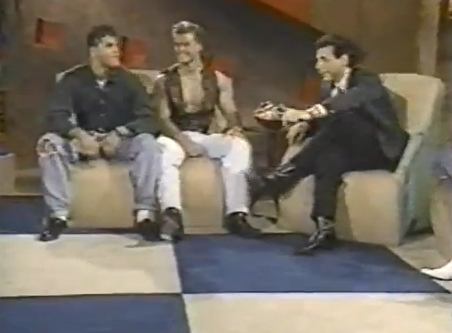
Created by Fox television studios and airing from 1991-1993, Studs was a show very similar to The Dating Game or Love Connection, but instead of the kitschiness of the former and the smoothness of the latter (and don’t deny it, Chuck Woolery was Lando smooth with his “Back in 2 and 2”), it had a “Fox Attitude”–meaning it was a lot more in-your-face and raunchy. Well, as in-your-face and raunchy as a syndicated dating show could be. Hosted by Mark DeCarlo, a guy who looked like everyone’s wingman and who had a perpetual look of “Can you believe they pay me for this” on his face, the show had two members of one gender go out with two members of another gender (in the case of the episode I watched for this show, it was two guys going out with three girls). After a cold opening, Mark would introduce the trio to the audience–including a running gag where he would say “Audience” and the crowd would yell, “WHAT?!”–before bringing out the two suitors.
Now, while there were episodes–especially in the later seasons–that featured people who were clearly a little older, most of the contestants on Studs were in their twenties, which is why the show had that “Fox Attitude” because it was obviously trying to appeal to twenty-somethings and a twenty-something audience would probably want to see people they found attractive, even if this was the “Eighties Hangover” part of the 1990s, as evidenced by the fact that you could have Kelly Kapowski on one part of the couch and Valerie Malone sitting right next to her.
In fact, the show was very 1990s, as I noticed when I checked out the opening titles as well as the set. The color palette and designs looked like they were ripped off from a bad 1990 R&B video where everything was just blocky and chunky. And honestly, nowhere but 1991 would a guy get away with wearing a vest and nothing else as a “shirt.”
Male contestants from Studs. Note the guy on the right with his vest of awesomeness. He’s French, although that’s no excuse. Plus … are they pegging their jeans?
Anyway, so Mark would do the introductions–what do you ladies like in a man–while the audience (who was obviously imported from a taping of Married … With Children) would hoot and holler. He’d bring the other contestants out and do the same, which is pretty standard for this type of show. Then, the show would get into what it was known for, which was the multiple choice quiz. The guys would hear statements about what happened on the date and if they figured out what girl said what, the guy would win a stuffed heart. The guy who got the most hearts would win. Pretty standard, right? Well, that is, until they actually got to the questions.
You see, since this was a show with “Fox Attitude,” Studs didn’t simply ask the guys and girls where they went to dinner, but they insinuated that every single one of them engaged in several acts of carnal knowledge that are illegal in most Bible belt states. Mark always started with questions about first impressions (mostly appearance based) and we’d get stuff like “He looked like a puffed-up Ken doll” or “All he had to do was say my name and I melted” (yunno, because the guy had an accent), but eventually we got to the actual date and instead of being all censor-friendly, the statements were full of innuendo or flat out “sexy.”
“He showed me what it means to be a woman.”
WOOOOOOOO!
“It was all I could do to keep from screaming out loud.”
WOOOOOOOOOOOOOOOO!
An example of the infamous multiple choice section of an episode of Studs. Your tongue takes over and then you party all night long, right?
“My mouth opened wide and my tongue took over.”
WOOOOOOOOOOOOOOOOOOOOOOOOOOOOOOOOOO!
Now, I don’t think that I would have found any of this talk sexy or remotely risque when I was in my twenties. But when I was watching this on a weekday afternoon as a fourteen-year-old? Oh hell yes. My friends and I used to wonder how many of the contestants actually did it, and thought that the show was completely awesome because everything was a sex reference.
Studs lasted two years, but I don’t even know if I watched it beyond six months or a year before I got bored with it, although that was long enough to get the brilliant “Amish Studs” parody courtesy of The Ben Stiller Show. But I don’t think it was ever meant to be more than a novelty anyway, and the same can be said for Singled Out, Blind Date, and whatever shows have come out in the last couple of decades. They last long enough to cure boredom but eventually, like most of television, is quickly forgotten.
You can watch an episode, courtesy of YouTube, below:
It’s a new year and that means it’s time to just see what’s going on. Join me as I ramble on for an hour and a half about movies, books, television, and plans for this year. Here we go … “Once More Into the Geek!”
While I know that it didn’t get the attention of the deaths of Dear Abby, Stan Musial, or Earl Weaver last week, I have to admit that I felt a little sad when I saw the obituary for Conrad Bain in the New York Times. A Canadian-born actor with quite the lengthy resume, Bain was a mainstay of television in my childhood ecause of his role as Mr. Drummond on Diff’rentStrokes.
A sitcom that began airing in 1978, Diff’rent Strokes lasted until 1986 and aired mostly on NBC (with the 1985-1986 season airing on ABC) and was the story of two black kids from The Bronx who were adopted by a Park Avenue millionaire. It’s an odd concept for a show and one I swear only would have worked in the 1970s, but I didn’t think anything of that when I was six years old and allowed to stay up on Saturday nights to watch it (and sometimes Silver Spoons, which came on at 8:30). This was a big deal for a kid whose bedtime was 8:00 on the weekdays and I remember loving the show so much that I tape recorded (like literally sat a tape recorder next to the television and hit “record”) the 1984 hour-long “Mr. Drummond gets married” episode.
I’m not sure if I watched it on Saturday nights beyond that, because my memory is hazy and I always associate Saturday night television viewing with The Facts of Life (briefly, anyway), and The Golden Girls (which dominated NBC Saturday nights for years), but that doesn’t matter because the show was a rerun mainstay all the way up until I was in my first year or so of high school. WNYW, New York’s Fox affiliate (channel 5) ran Diff’rent Strokes at 5:00 p.m. and The Facts of Life at 5:30 p.m. through much of the latter part of my elementary school career, concluding it sometime when I was in junior high (what it was replaced with I don’t remember, although eventually Fox 5 ran The Simpsons, Seinfeld, and Friends). Since I didn’t have cable at the time, that meant I would come home, turn on the television, and at 5:00, after cartoons were done, I would see a familiar shot of the east side and hear Alan Thicke’s lyrics: “Now the world don’t move to the beat of just one drum …” Then, it would be Arnold, Willis, Kimberly (unless it was one of the seasons where Dana Plato had been fired for being knocked up and using drugs), Sam (whose mushroom haircut I hated), and Mr. Drummond.
Bain played Mr. Drummond like a typical sitcom father, imparting some of the show’s lessons like Robert Reed did on The Brady Bunch (a show that I remember seeing for the first time at an incredibly early age and much like Diff’rent Strokes always seemed to be on) and making some lame attempt at a joke every once in a while. He wasn’t the type of sitcom father whom you felt was “your father” or a ‘dad”; he was just … well, there, the mainstay of a show whose cast was full of problems (though I honestly didn’t know that until years later). In fact, I don’t remember Mr. Drummond being much of a factor in most of the episodes, especially the two most memorable ones–the Nancy Reagan anti-drug epsiode, and the two-parter about sexual molestation where Gordon Jump plays the bike shop owner (though Mr. Drummond does call the authorities and is the “moral voice” throughout). He did, however, have a couple of episodes that stood out.
Aside from his romancing Maggie (first played by Dixie Carter and then Mary Ann Mobley, who replaced Carter after NBC canceled the show and Carter went to Designing Women), there was the time Mr. Drummond came home with his neck all cramped from stress and the family discovered that Willis had severe stress and had to learn to balance the activities in his life. There was the “Undercover Boss” episode where Mr. Drummond works at one of his company’s factories to see what it’s like to work there and challenges the entire family to “live blue collar,” which for Arnold means wearing a Van Halen T-shirt because that’s what poor people do or something.
And of course, there was the two-parter where Sam was kidnapped and at some point, Drummond had some fisticuffs with a possible kidnapper, a scene that I remember prompted my friend Harris and I to come up with the idea for a fake movie: “Conrad Bain is X-CUTIONER 3000.” Yeah, I don’t know why Mr. Drummond as Charles Bronson in Death Wish was so hilarious but when you’re 13, you find some of the most random crap funny, I guess. Besides, when I told him about Bain’s death the other day, he replied, “Bonar Lives!” in reference to Conrad Bain’s twin brother Bonar, something we also found funny at 13 (and I’m amazed that I never wrote BONAR LIVES! across the front of my notebook as if it were “Save Ferris”).
Anyway, there’s only five cast members left alive from Diff’rent Strokes: Todd Bridges (Willis, who had his share of substance abuse issues but has been clean for about 20 years), Danny Cooksey (Sam, who has a decent-sized voice-over resume and was in Terminator 2 as John Connor’s mulleted friend), Mary Ann Mobley (the second Maggie), Mary Jo Catlett (Pearl, the third maid, who now provides the voice of Mrs. Puff on SpongeBob SquarePants), and Charlotte Rae (Mrs. Garrett, who will outlive them all). And I’d like to say that the show taught me so much, but like Mr. Drummond, I think I watched it because it was simply always there.