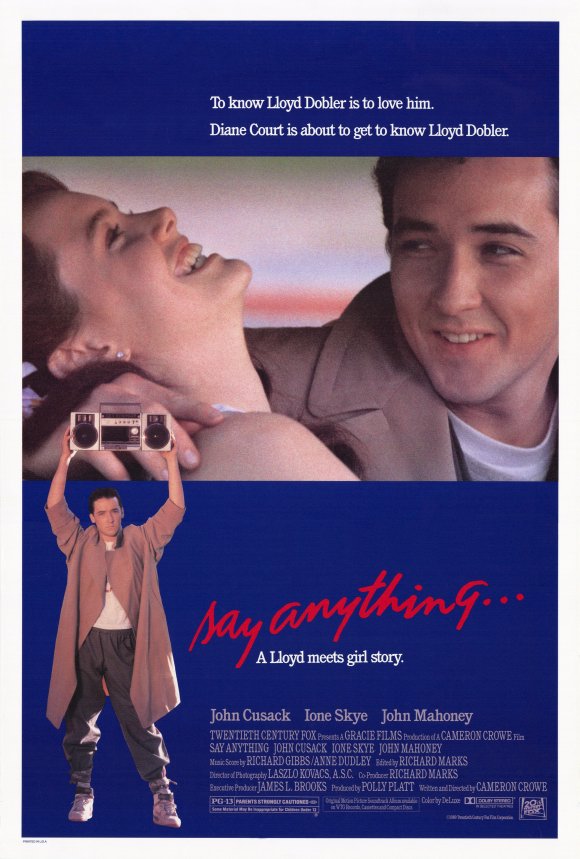
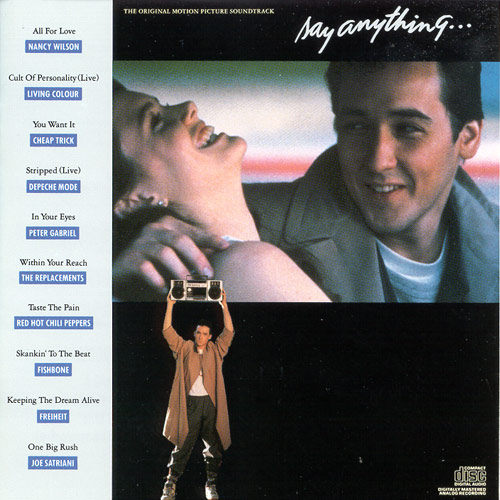
In 1989, Cameron Crowe wrote and directed one of the seminal movies of the teen film genre. Starring John Cusack, Ione Skye, and John Mahoney, it’s Say Anything …, one of my favorite movies of all time.
Join me as I take a look back at the movie, talk about my favorite scenes and also take a look at the soundtrack.
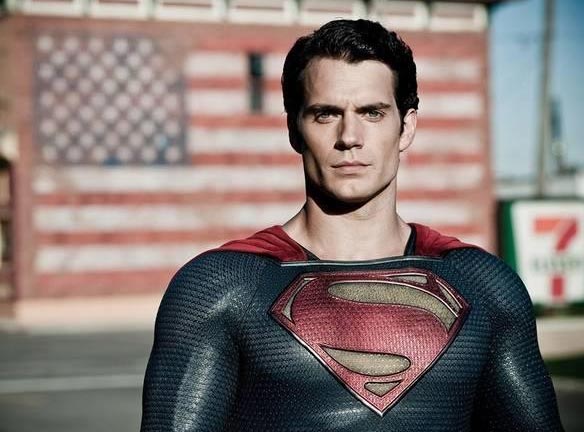
I saw Man of Steel on the day it opened and absolutely loved it. I found myself quietly cheering in a few scenes and actually got choked up in a couple of others. It wasn’t a perfect Superman movie–it could have been maybe 10-15 minutes shorter, a few more jokes would have been nice, and someone needs to confiscate Zack Snyder’s copy of the Singles soundtrack–but when I walked out of the theater I had a big smile on my face and was all, “YES!”
Then, I went on the Internet.
My liking Man of Steel in the midst of a serious backlash over a variety of things (and I’ll keep it spoiler-free for those of you who haven’t seen it) made me feel like I was stupid or had done something wrong. Reading through last week’s Entertainment Weekly made me feel even dumber–they had a fun cover story on Superman’s 75th birthday but then did what’s a typical fake-out for them where the critic destroyed the movie in his review. This week’s issue didn’t help matters much, with Supes appearing in the outer rim of their back page “bullseye” feature with the caption, “Man of Steal–as in, you stole two and a half hours of our life, and we want it back.”
Now, I don’t know why I am taking this as personally as I am taking it. After all, this is only a movie, right? I guess some of it is rooted in the psychological trauma of high school, where I often found myself ridiculed for my musical tastes (among other things–I took a lot of shit from my “friends” in high school, who were actually quite cruel). But I graduated from high school almost twenty years ago and am pretty much over all that crap, although I sometimes wonder if you can be completely over it, especially when you develop reactions to certain behaviors in such a way that they almost become reflexive.
Anyway, this post isn’t meant to be about the shit I went through in high school, it’s meant to be about movies, and it’s not meant to be a defense of Man of Steel, either, because there are plenty of people out there doing that. What led me to writing this post was that in the midst of all of the hand-wringing and Internet-bashing (some of which I am pretty sure is of the “It’s fun to hate on something” variety) about the movie, I began to think about why I like what I like and how I came to have the movie collection that I have. I’m sure there’s enough for an entire book, let alone one blog post, but in thinking about the experience of seeing Man of Steel and then feeling weirdly hurt when the media I read has the complete opposite reaction to the movie that I do, I thought of other times I’ve watched movies and they’ve either changed my tastes or changed the way I view the moviegoing experience. I narrowed it down to six, and since lists are fun, here they are in chronological order. (more…)
Hey everyone, take advantage of this special offer where you will get a ton of CDs for JUST ONE PENNY!
Does that sound familiar? If it does, then you’re familiar with Columbia House, the record, tape, CD, and video club that flourished in the 1970s, 1980s, and 1990s and provided mail-order entertainment for America, one person at a time (or at least that’s what the commercial says).
So, this time around, I not only take a look at Columbia House but at my personal experience with Columbia House, as I got my very first CD player when I was sixteen years old (twenty years ago!) and also signed up, eventually starting my music collection with thirteen CDs.
The following is a list of albums and songs mentioned in the podcast in case you’re interested in actually checking out the music (and if you are interested in purchasing some, use the Amazon link at Two True Freaks) …
Alice in Chains, Dirt (“Would?”)
Guns N’ Roses, Appetite for Destruction (“Think About You”)
Guns N’ Roses, Use Your Illusion I and II (“Breakdown,” “You Ain’t the First,” “Estranged,” “Pretty Tied Up”)
Elton John, Greatest Hits 1976-1986 (“I’m Still Standing,” “I Guess That’s Why They Call It The Blues”)
Last Action Hero Original Motion Picture Soundtrack (AC/DC, “Big Gun;” Def Leppard, “Two Steps Behind;” Aerosmith, “Dream On;” Cypress Hill, “Cock the Hammer”)
Denis Leary, No Cure for Cancer (“Asshole”)
Megadeth, Countdown to Extniction (“Symphony of Destruction”)
Nine Inch Nails, Broken (“Wish,” “Physical [You’re So],” as well as the remixes of “Wish” and “Happiness in Slavery” on Fixed)
Say Anything … Original Motion Picture Soundtrack (Peter Gabriel, “In Your Eyes”)
Singles Original Motion Picture Soundtrack (Paul Westerberg, “Waiting for Somebody”)
Stone Temple Pilots, Core (“Plush,” “Wicked Garden”)
Wayne’s World Original Motion Picture Soundtrack (“Wayne’s World Theme [Extended Version];” Queen, “Bohemian Rhapsody;” Jimi Hendrix, “Foxy Lady;” Gary Wright, “Dream Weaver;” Tia Carerre, “Ballroom Blitz;” Red Hot Chili Peppers, “Skiamikanico”)
So funny enough, I actually missed the last episode of Degrassi Junior High when PBS aired it. There was a point where I was watching DJH on a fairly regular basis and then PBS started airing episodes of Degrassi High, a series that I’m definitely going to cover in full detail on the blog because whereas I only remember certain episodes of DJH, I remember every episode of Degrassi High and that’s the show that I grew attached to, at least for the couple of years that I was able to find it on television. But really, one day I was watching an episode like “Pass Tense” or “Black and White” and the next I saw the Degrassi kids starting high school at a new show and heard hints of something really bad happening to the junior high school.
It wasn’t until years later–a few years ago, in fact–that I managed to get my hands on a copy of this, the very last episode of Degrassi Junior High. I had placed a bid for VHS copies on eBay and had won an auction but then the auction was done away with because the person involved was selling copies of the show that he/she had taped and that was technically illegal. When that happened, the person contacted me and offered to send me a tape anyway. I offered to pay for shipping and the cost of a VHS tape–all in all it was about $10–and wound up with all of Degrassi High and several episodes of DJH, including “Bye Bye Junior High.” This wound up being one of the first episodes I sat down and watched, thinking, “I never actually got to see this.”
The episode famously (at least if you’re a Degrassifan) ends with the boiler room of the junior high school catching on fire on the night of the big graduation dance and everyone in the dance being evacuated and forced to watch the place burn to the ground. But before that there’s a lot of resolution to various character plotlines and we get the feeling that this is indeed some sort of finale and that the main stories from the entire season are being wrapped up. So, it’s not a “jumping on” point but then again when is a season/series finale a “jumping on” point?
If you’d been watching the entire season, you know that there have been three major storylines at this point: Wheels’s parents dying at the beginning of the season and his struggle to come to terms with their deaths and getting on with his life, Joey’s learning disorder and having to repeat the eighth grade, and Spike’s struggles in school as a result of raising Emma. All three of these are addressed over the course of the last couple of days of school wherein the gang finishes their final exams and then gets their report cards. Most of them pick their report cards up at the main office but these three have teachers personally hand them their grades. It’s a weird thing, but for story’s sake it works. Oh, and lurking in the background is the foreshadowing of the fire with the constant presence of a malfunctioning fire alarm and maintenance workers who are there to fix the furnace of what is a very old building–okay, it’s not so much lurking in the background for foreshadowing’s shake as it is blatant telegraphing of what’s going to happen at the end of the episode but it works in a sense.
Anyway, the three characters each have their worries and their moments. Wheels struggles to finish his last final exam and in the end barely makes it out of ninth grade. Mr. Garcia–who talks in “teacher vocabulary”–tells him that yes, he passed, but barely and under normal circumstances he would be made to repeat some courses, maybe even the entire grade. Wheels seems to ignore most of this hearing: “Blah blah blah PASSED blah blah blah” and leaves excitedly, which is true to his character, especially considering what will happen as he moves through high school and at the end of the series in the School’s Out movie. (more…)
The flat remains of a two-liter bottle of Diet Pepsi. Yes, that’s my kitchen in the background.
A couple of months ago, I was at a work function where food was being served. We had a few tables of fried chicken and some sides as well as a table of two-liter soda bottles. As I poured myself a cup of Diet Pepsi, I couldn’t help but think of how ubiquitous the two-liter is—it’s a party and holiday industry standard and has been ever since I was a kid.
I suppose that is not something to get really nostalgic about, especially since it’s a plastic bottle. It’s not the iconic 6.5-ounce contour shaped glass Coke bottle that is the “nostalgic” Coke bottle and it doesn’t have the personality of the 20-ounce bottle, which is easily accessible and personal, plus it’s shaped like an old classic glass Coke bottle so it calls back to images where people from the 1950s or so pop a top of a glass Coke bottle. The two-liter has never had that. When you buy one of those, you twist off the metal or a plastic cap, and don’t think twice about it.
Which is indicative of the area and time period that constitutes my youth. Having been born in 1977, I have this attraction to the shopping mall, the multiplex, and everything else in the suburbs. It is an era that is by and large disposable and I think on some level, even though nostalgia has turned its eye a little more toward my formative years, that nostalgia is selective at best—it’s the music, the movies, the fashion. Nobody is going to look at suburban life in the 1970s and 1980s with the same rose-colored glasses our culture uses for the 1950s. Because the decades of my childhood are the rose-colored 1950s’ unfortunate afterbirth: Levitt homes and small towns gave way to shopping malls, gated communities, and McMansions, especially where I grew up. You cannot go anywhere on Long Island without seeing shopping malls or multiplexes.
Do you know it’s been twenty years since Zack Morris graduated high school? Take a look back at the crew from Bayside High as I talk about Saved By The Bell–its history, its characters, my favorite episodes, and its legacy. Plus, a look at “Graduation,” the final episode to feature the original cast.
I spent a lot of my teenage summers inside. Oh sure, there were family vacations, Saturday afternoons playing hockey, and Tuesday evenings playing softball, but there were also entire weeks where I barely left the house, so much so that I knew that the same Craftmatic Adjustable Bed commercial came on every day at 1:00 p.m. on WPIX.
I think it was then that my father would force me out of the house by cranking the dehumidifiers in both the basement and den, therefore making it impossible to watch television. That, or he’d find some sort of back-breaking manual labor for me to do.
Anyway, among the many types of commercials I watched were commercials for compilation albums. Put out by companies such as Time-Life Music, these were collections of famous songs that fit a particular theme. In Time-Life’s case, there were collections for different decades such as the 1960s or 1980s (I personally own all of Sounds of the Eighties), but there were also compilations such as AM Gold andLove Songs.
The commercials were always pretty much the same. There was some sort of intro, and then several song titles would scroll up the screen while either a clip or photo of the artist or stock footage of people from a Mt. Airy Lodge commercial was shown. The song playing would change every once in a while and then you’d get some message about how you could order the albums, which usually came on record, cassette or CD (and later on cassette or CD).
But a select few took this commercial concept to another level. There, of course was Hey Soul Classics and its “No my brother, you’re gonna have to go buy your own!” and the classic exchange at the beginning of the Freedom Rock commercial:
“Hey, man, is that freedom rock?”
“Yeah, man!”
“Well, turn it up, man!”
And as awesome as those are, nothing trumps what has to be the most insanely bizarre yet spectacularly awesome compilation commercial of all time. Dear readers (both of you), I give you Feel Good Rock.
The commercial starts out kind of silly, using old 1950s sci-fi footage in a way that is a pretty common commercial trope, but then takes a turn that just about nobody is expecting when instead of the simple footage of bands performing their hits or the classic stock footage of people being romantic and/or having a good time, we get two minutes–yes, two minutes–of people ridiculously lip-synching the hits contained on the album. In some cases, there are people who have clearly been waiting their whole lives for this moment (the woman in the waitress uniform clearly is enjoying her moment in the spotlight), and in other cases, the people barely know the words (one of the guys singing “Crocodile Rock” doesn’t fully commit).
Now, until I scraped this off of the floor of YouTube, I hadn’t seen it in a good twenty years and while I remember it being an odd commercial, I can honestly tell you that I had forgotten how flat-out insane it was. And much like the Coke Is It! commercial and Juicy Fruit commercials from the 1980s, I felt the need to take a look at some of the people in the commercial who are just feeling so good.
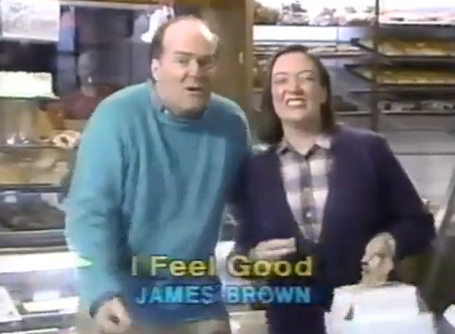
“I Feel Good” is the first song mentioned in the commercial and that’s definitely appropriate because the album is called Feel Good Rock. Here we have two people who are either at a bakery or are getting ready to tape tomorrow’s episode of Supermarket Sweep and they are just really into it. Either that, or the woman is having a stroke. Either way, I’m pretty sure that this commercial became famous in the house to the point where every time it was on, Dad would call the kids into the den, yelling, “Hey, the commercial’s on again!”
To which their teenage daughter, who has hanging with her friends in the other room, would storm into the den and scream, “GOD, STOP! YOU ARE SO EMBARRASSING!” and storm out. (more…)
The Dukes of Hazzard Big Wheel, courtesy of Dukes Online.com
There are some toys that you remember getting or having, and then there are others that are definitive. They aren’t just Christmas or birthday presents, they are in introduction to a lifestyle. For those of us born in the Seventies or Eighties, that toy was Big Wheels.
A modified tricycle that allowed the rider to sit low and tended to move faster, therefore adding more to the everyday life of the average kid, the Big Wheel ride-on toy was created by Louis Marx and Company in 1969 and became very popular among both kids and parents, at least according to Wikipedia’s entry, which notes that its plastic construction and low center of gravity made it less expensive and safer than the classic tricycle. Big Wheels was actually the trademark of Louis Marx & Co, but wound up becoming the generic name for the toy, and through the 1970s, they sold in huge numbers.
Having been born in 1977, I am a part of the second wave of the Big Wheels generation. Those older than I was probably didn’t have much to choose from when it came to their big wheel experience, as evidenced by the Big Wheels that had been procured by and donated to my nursery school. They’d let us out onto the playground each day and we would go right for a shed in the back that held several Big Wheels. Some were in better condition than others–the blue and yellow ones were relatively new, which meant they were also the most desirable, and the purple ones were slightly used and therefore second tier. Those blue ones became so coveted, in fact, that at one point, our teachers had to designate beforehand who got to use them.
By the time I was old enough to have my own Big Wheels, at the age of five, the makers of Big Wheels (mainly Empire Pastics, who made Big Wheel competitor Power Cycle; as well as Coleco, a company more known for a video game console than a kids’ ride-on toy) had figured out that there was money to be made from licensing. Now, everyone who grew up in the Eighties will remember that the ultimate in licensed Big Wheels was the Knight Rider Big Wheels that was made to look like KITT, but the one that I owned had to run a close second to KITT, which was the General Lee.
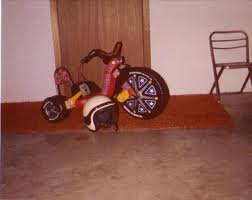
I had been a fan of three prime time television shows when I was five years old. One was The Greatest American Hero, one was ChiPs, and the third was the Dukes of Hazzard. Granted, I got to watch all of half a season before the Coy and Vance era began, but I don’t think I noticed that considering I was paying more attention to the stunts and car chases and I still really liked the show. I liked it so much, in fact, that when I received the General Lee Big Wheels that Christmas, it was the most awesome thing ever. How could you not like an orange and black Big Wheels with ribbons on the handlebars, stars on the wheels, and a compartment where you could store things? (more…)
In 1985, Joel Schumacher directed a seminal film that perfectly captures the angst of youth having been unleashed onto the world after graduating from college. Okay, that’s giving this movie too much credit, but St. Elmo’s Fire is still one of the best illustrations of Post-Collegiate Stress Disorder, or PCSD. So let’s go back to the Eighties with one of the ultimate Brat Pack movies!
About a week or two ago, I came across a few articles filled with emotional hand-wringing on the part of the generation often referred to as Millenials. I read about how there is a generational conflict between this younger generation, which seems to be dismayed that the world doesn’t think they are entitled to anything; and older generations, who wish these kids would get over themselves. It’s accompanied by talk about the uphill battle this generation faces as it enters a very touchy employment situation–the job market, after all, is terrible–and will have an enormous amount of student loan debt. There is also the sentiment of “You created this mess and we inherited it.”
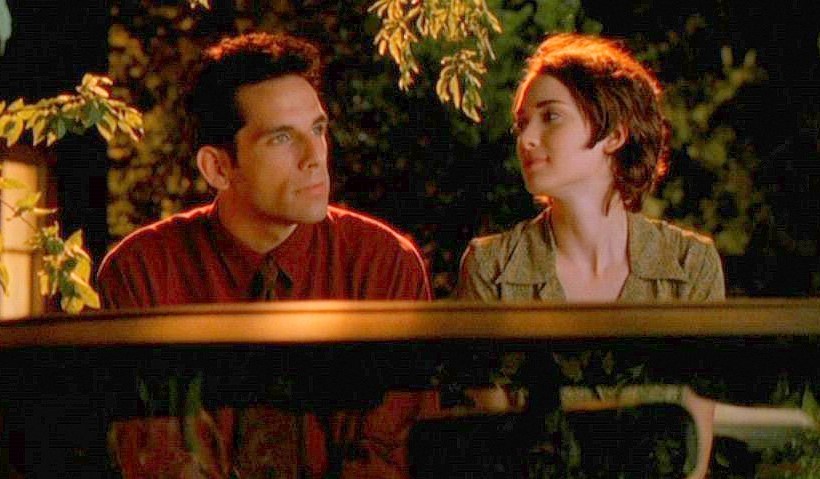
I found myself thinking about how Millennials need to get over themselves and how they’re all entitled brats, but then I couldn’t help but be reminded of two decades ago when Generation X seemed to be facing the same problems. I am sure that your average Millennial will tell me otherwise, but it seems that there is something universal here: the up-and-coming generation takes crap from the older generation. And I also couldn’t help but watch Reality Bites, the 1994 Winona Ryder-Ethan Hawke film that attempted to capture the struggle that particular group of twentysomethings was going through at the time. Watching it again–and I watch it every once in a while–I knew that I would have a slightly different perspective and perhaps even view at least one of the characters a different way. Not surprisingly, the character I seemed to sympathize with more than I did when I first saw the movie as a teenager was Michael Grates. (more…)


![DSCN4205[1]](https://popcultureaffidavit.com/wp-content/uploads/2013/06/dscn42051.jpg)