1980s

In Country: Marvel Comics’ “The ‘Nam” — Episode 9

Nam 9

A major event in the lives of the 23rd and Ed Marks’s experience in “The ‘Nam” occurs in this episode, as I take a look at issue #9, “Pride Goeth …,” which is brought to us by Doug Murray, Michael Golden, and John Beatty. As always, in addition to the summary and review of the issue I’ll be talking about the story’s historical context as well as taking a look at the letters, ‘Nam Notes, and ads.

You can download the episode via iTunes or listen directly at the Two True Freaks website

In Country iTunes feed

In Country Episode 9 direct link

Amazin’ Baseball

Mazer CoverUsually when I write posts for this blog, I’ve recently read, watched, or listened to whatever I am writing about; however, I haven’t done my homework this time, choosing instead to set aside the movie I was going to write about and take a few hundred words to talk about Bill Mazer, who passed away earlier today.

Mazer, if you are unfamiliar with him, was a longtime New York sports journalist and commentator, one of the early guard of sports radio hosts, and was a mainstay on WNEW (Channel 5, now WNYW, the New York City Fox affiliate) during the 1980s, kind of the same way that George Michael was a Washington, D.C. mainstay with his “Sports Machine” highlights.  The New York Times has an excellent obituary of Mazer that I highly recommend reading, as I was struck by the extent and longevity of his career.

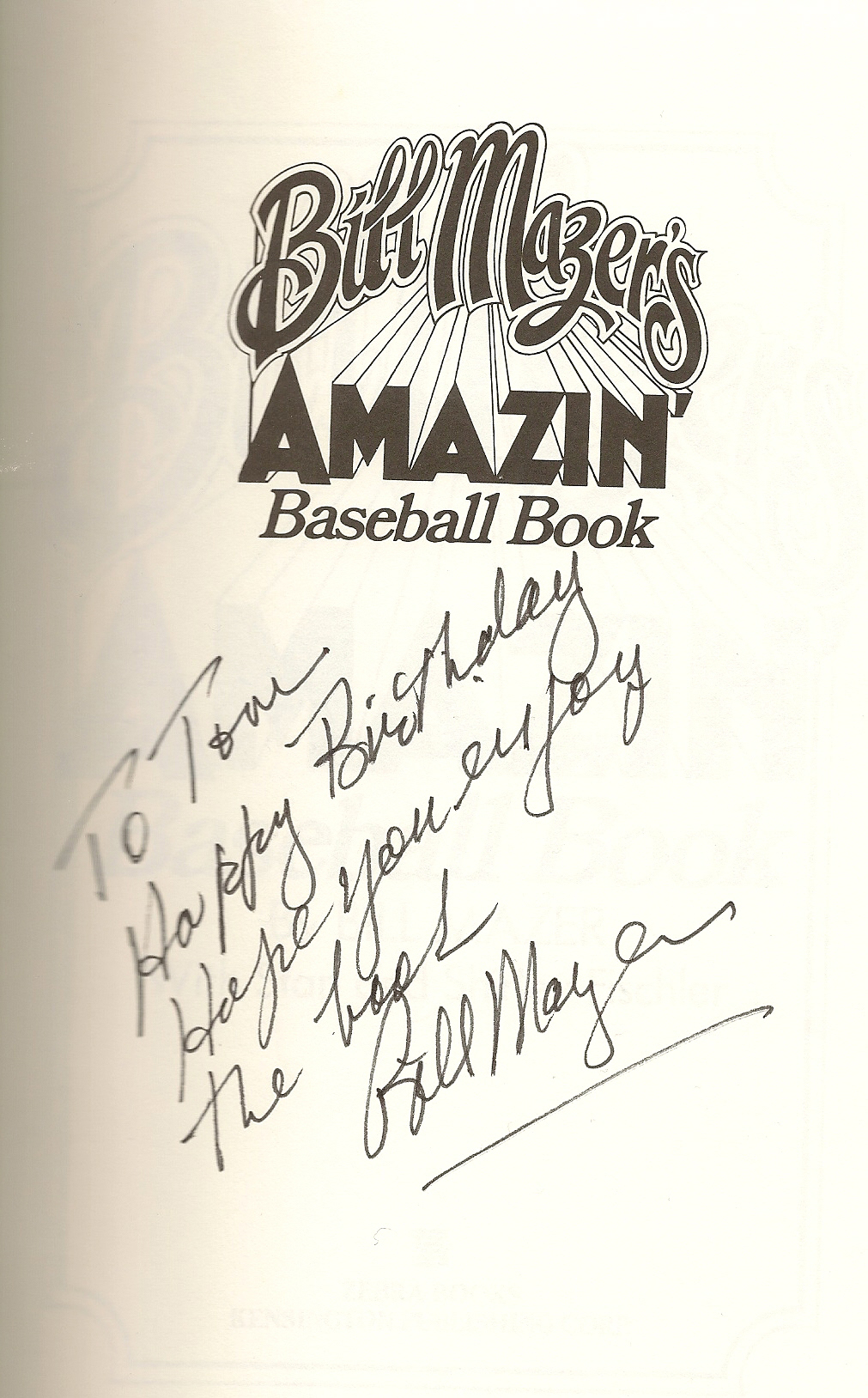
To be honest, I wasn’t that familiar with Mazer or his career, as I was too young to watch him on television and have only had a passing interest in sports radio (and only then it’s to listen to the occasional game).  But for the last twenty-three years I have had a signed copy of Bill Mazer’s Amazin’ Baseball Book on my bookshelf, and when I saw the obituary in the Times, I immediately pulled it off the bookshelf and will be reading it again for the first time since my Uncle Michael and Aunt Clare gave it to me for my thirteenth birthday.

The title page of my copy of Bill Mazer's Amazin' Baseball Book, signed by the author for my thirteenth birthday.

The title page of my copy of Bill Mazer’s Amazin’ Baseball Book, signed by the author for my thirteenth birthday.

As noted in my post about the 1988 Mets, when I was in the latter part of elementary school and through most of junior high school, I was a rabid baseball fan.  I’m still a huge Mets fan, but this was a time in my life when I was the encyclopedic sort of fan, the type of kid who read or watched everything about baseball that he could get his hands on and who enjoyed the most minute, trivial details about the history of the game (ironically, however, I found Ken Burns’s Baseball boring but I may give that a re-watch at some point).  Bill Mazer’s Amazin’ Baseball Book was the perfect gift, as it is both a memoir of his life and career in relation to the game along with page upon page of facts and stories about the history of the game itself.  The facts are presented in Q&A format with all sorts of tidbits, such as:

WHICH FORMER LOS ANGELES DODGER PITCHER APPEARED IN SUCH TELEVISION SHOWS AS THE LAWMAN AND THE BRADY BUNCH?

Don Drysdale.

It was questions like these (and their answers) that had me flipping back and forth through the book and poring over every page with my friend Tom in the back of his mom’s Ford Taurus on the way to Shea Stadium, and I think what’s always drawn me to shows and books about sports history, especially baseball history, even if my interest in the subject has waned from time to time, replaced with film, comic books, or whatever other part of popular culture I was obsessing over.  Mazer himself, in the introduction to his book, talks about being a fact-o-phile, a proto-Schwab, the type of guy who could rarely, if ever, be stumped.   In fact, the Times obituary sums it up perfectly:

Mr. Mazer’s boyhood idol, Van Lingle Mungo, became the title of a song by the singer, pianist and songwriter Dave Frishberg, consisting entirely of old-time ballplayers’ names. Mungo, who died in 1985, won 120 games and lost 115 with the Dodgers and the Giants, and he led the National League in strikeouts with 238 in 1936. It’s a fair guess that the Amazin’ would have known those statistics without having to look them up.

I’m a fan of experts like that, guys who have extensive knowledge and are experts on topics.  I have always liked having an answer to almost every question and even though it’s becoming a bit passe for people in my field to want to be considered “experts” on anything, I still enjoy just knowing stuff.  I’m sure my fellow sports fans and comics podcasters know exactly how I feel.

But as interesting as all of the facts, figures, and stories contained in Bill Mazer’s Amazin’ Baseball Book are, his passing also reminds me of how many of those in his generation are passing away.  Mazer grew up in Brooklyn during the golden age of the Dodgers’ tenure at Ebbets Field, an era that I’ve only read about in books or heard about in stories that older relatives, like uncles and grandfathers would tell years ago at family functions.  For my money, if I could go back to any era of baseball, it would be the late 1960s so I could see the 1969 Mets, but I remember sitting at many an extended family barbecue listening to Grandpa Panarese talk to my Uncle Brian about the Giants, the Yankees, and whatever other sports stories they had.

While I think it’s out of print, you can find used copies of Bill Mazer’s Amazin’ Baseball Book on Amazon and I recommend picking it up.  It’s truly a trip back in time, one that I’m looking forward to taking again.

In Country: Marvel Comics “The ‘Nam” Episode 8

Nam 8Let’s head into the tunnels with “In the Underground” from The ‘Nam #8, an issue that also reprints one of Doug Murray and Michael Golden’s “5th of the First” stories from Savage Tales. It’s two stories about tunnel rats for the price of one! As always, in addition to the summary and review of the issue I’ll be talking about the story’s historical context as well as taking a look at the letters, ‘Nam Notes, and ads.

You can download the episode via iTunes or listen directly at the Two True Freaks website

In Country iTunes feed

In Country Episode 8 direct link

The Day the Mets Died

Dwight Gooden holds his head in his hands in the 1988 NLCS.  This just about sums it up.

Dwight Gooden holds his head in his hands in the 1988 NLCS. This just about sums it up.

The night before I wrote this, the St. Louis Cardinals defeated the Los Angeles Dodgers in the 2013 National League Championship Series.  I’m not sure if the Cardinals will win the World Series and as a Mets fan with a longtime grudge against the Redbirds, I can tell you that I don’t want them to.  Had the Dodgers made the series it would have been the first time in twenty-five years since they’d been to the fall classic, a series which they won in five games and whose most famous highlight is Kirk Gibson’s dramatic home run off of Dennis Eckersley in the ninth inning of game one.  But as big of a baseball fan as I was when I was eleven years old, I did not watch a single inning of the 1988 World Series because the Dodgers had completely broken my heart.

They weren’t supposed to beat Oakland; furthermore, they weren’t supposed to be there.  All season, the National League East champion New York Mets had cruised to the title much like they had in 1986, winning 100 games, fifteen games more than the Pirates.  The Dodgers won their division handily as well, but they hadn’t even been able to touch the Mets all season, losing ten out of eleven games and losing badly as well.  With the 1987 season (and TERRY FUCKING PENDLETON) behind them, the Mets looked like they were back to the “true form” of 1986 and I was so excited to see them play Oakland in the World Series.  With a solid offense, surging rookie phenom Gregg Jeffries, and a solid backup catcher in Mackey Sasser (don’t laugh–I remember having at least a few conversations about how good he was during that summer), the playoffs (I didn’t refer to the postseason as the Championship Series and World Series, it was “the playoffs and the Series”) were just a formality.  The Mets were going to destroy the Dodgers.  Maybe not in four games because they had to face Orel Hershiser, but definitely in five or six–after all, they’d beaten the mighty Astros and gotten around Mike Scott back in 1986, right?

Now, one of the tougher things about my childhood following baseball was that I had an early bedtime.  Even through junior high school, I had to be in bed by 9:00 on most nights, so staying up to watch every game was out of the question.  I only watched all of games three and four because they were played over Columbus Day weekend, so the rest of the series was seen in bits and pieces and highlights on Eyewitness News the following morning before getting on the bus to school.  On one hand, this was annoying–going into the games I could watch, I had really no perception of how badly the team was underperforming.  Oh sure, I saw the highlights on the news, but without access to the internet, cable, or even a daily newspaper in 1988, I wound up remaining pretty naive that the Mets were as good as they were throughout the regular season and were going to cruise to what was going to be the most awesome of awesome World Series.  They’d lost two games against Boston in the 1986 Series and won that … so they’d take this, right?

Game three kept my hopes up despite the fact that it was pretty messy, but game four?  At eleven years old, I had no idea what it was like to wake up with a hangover and wonder if the previous night was really as bad as it seemed, but  that’s exactly what it was like.  After he settled down, Dwight Gooden started out pitching a pretty solid game, striking out nine, and the Mets went into the top of the ninth with a solid 4-2 lead and it looked like it would only be a matter of another win before taking on the “bash brothers.”

Then, this happened:

Until I watched it while working on this post, Mike Scioscia’s home run was a surreal blur, something that I remember seeing but not seeing as I was half-asleep when it happened and went to bed soon after, not having the stamina to stay up until the wee hours of the morning to see Kirk Gibson knot the series at two.  The Dodgers would win game five and shift the series back to Los Angeles, where the Mets would tie things up in game six.

My friend Tom has quite possibly the most vivid memory of game seven of anyone I know.  He was watching the game at a local restaurant with our friend Evan and I remember him telling me a few years later that after the game was over, they went back to his place and could do nothing else but sit in stunned silence.  I missed the game but went to bed optimistic that my Mets would pull it out and go to another Series.  When I saw footage of Tommy Lasorda celebrating with a champagne bath on the morning news, I began sobbing.  They couldn’t have lost.  They couldn’t have lost.  They just … couldn’t.

The front page of Newsday summed everything up perfectly.  It was a Mets logo on a black background with @#$%! written underneath.  Mr. Lewin, our elementary school gym teacher, put it up in the hallway along with other recent sports headlines that we’d look at whenever we walked by the gym, and I remember him giving me that front page because I liked the headline so much, thought it would be therapeutic in some way, or I was that much of a masochist.  I was eleven and I’m pretty sure that I wasn’t capable of many deep thoughts about getting over pain, so it probably was because I liked the cover.

At any rate, twenty-five years after the fact, I can point to this series as a loss of innocence when it came to sports.  I’d seen the Mets lose before, but I had spent the summer so ensconced in baseball–looking at stats, collecting cards and stickers, watching as many games as I could–that to have it end this way was crushing and a small part of me died with the dream of another championship.  They were, after all, supposed to win, and soon I would realize that being a Mets fan is less about taking home championships and more about waiting for the other shoe to drop.

In Country: Marvel Comics’ “The ‘Nam” Episode 7

Nam 7This time around we take a break from the month-by-month in real time look at the Vietnam War for a history lesson. Wayne Vansant, who would eventually become the book’s regular penciller, joins Doug Murray and Michael Golden for a look at the origins of the Vietnam War in “Good Old Days.” As always, in addition to the summary and review of the issue I’ll be talking about the story’s historical context as well as taking a look at the letters, ‘Nam Notes, and ads.

You can download the episode via iTunes or listen directly at the Two True Freaks website

In Country iTunes feed

In Country Episode 7 direct link

Here is the CBS News story that I mention in the lettercolumn portion of the show …

And here is the trailer for Thrashin’!

In Country: Marvel Comics’ “The ‘Nam” Episode 6

Nam 6Only happy when it rains? You’re the exception to the rule, especially in “The ‘Nam” as Ed Marks and the boys deal with the constant downpours of monsoon season in a story that can only be called “Monsoon.” It’s issue #6 of “The ‘Nam.” As always, in addition to the summary and review of the issue I’ll be talking about the story’s historical context as well as taking a look at the letters, ‘Nam Notes, and ads.

You can download the episode via iTunes or listen directly at the Two True Freaks website

In Country iTunes feed

In Country Episode 6 direct link

COMMENTARIES FOR THINGS THAT DON’T NEED COMMENTARIES! Weekend at Bernie’s Edition (Pop Culture Affidavit Episode 16)

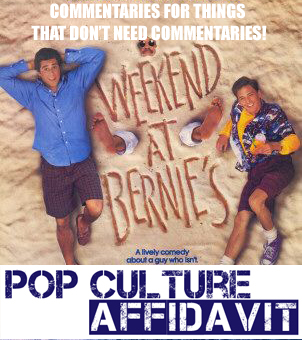
Episode 16 CoverIntroducing a brand new occasional feature for the Pop Culture Affidavit Podcast:  COMMENTARIES FOR THIGNS THAT DON’T NEED COMMENTARIES! For this first commentary, I take a look at the 1989 Andrew McCarthy/Jonathan Silverman classic, Weekend at Bernie’s.

So grab some popcorn, prop your dead boss up on the couch, sit back, relax, and enjoy!

You can listen here:

iTunes:  Pop Culture Affidavit

Direct Download 

Pop Culture Affidavit podcast page

In Country: Marvel Comics’ “The ‘Nam” Episode 4

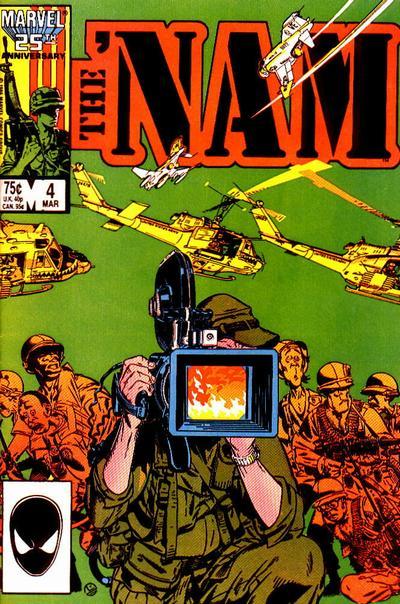
Nam 4Episode 4 of “In Country” is breaking news for the folks at home, or at least that’s what the guys in the 23rd think when they have a camera crew tag along with them on what should be a routine day. However, things don’t go as they think it will. “Six O’Clock News” is written by Doug Murray, penciled by Michael Golden, inked by Pepe Moreno and features events from May of 1966. As always, in addition to the summary and review of the issue I’ll be talking about the story’s historical context as well as taking a look at the letters, ‘Nam Notes, and ads.

You can download the episode via iTunes or listen directly at the Two True Freaks website

In Country iTunes feed

In Country Episode 4 direct link

Also, below is the Life Magazine photo “Reaching Out,” which I mention during the episode.

You can read about the history of this photo here:  LIFE Behind the Picture: Larry Burrows’ Reaching Out

“Reaching Out” by Larry Burrows, published in 1966 by Life Magazine.

Pop Culture Affidavit, Episode 15 — One Savage Evening

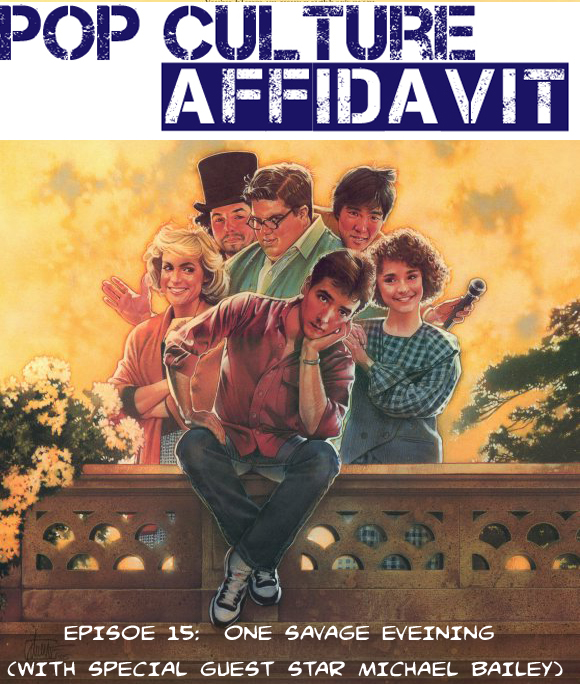
Episode 15 CoverThis time out we have an extra-sized and extra-AWESOME episode of the podcast.  Joining me is my friend and fellow podcaster Michael Bailey (of Views From the Longbox and From Crisis to Crisis) and we spend THREE FULL HOURS discussing the films of Savage Steve Holland!

Who is Savage Steve Holland, you ask?

You may not necessarily recognize the name but any child of the Eighties will recognize the phrase “I want my two dollars!”  That’s right, Savage Steve directed Better Off Dead …, the 1985 John Cusack classic about breakups, French foreign exchange students, psychotic paperboys, and weird neighbors who sit at home crocheting and snorting nasal spray.

But that’s not all we talk about.  We also reminisce about Savage Steve’s other two films:  the 1986 beach romp One Crazy Summer, which also stars John Cusack as well as Demi Moore and Bobcat Goldthwait; and we talk about his least-known but most-underrated film, How I Got Into College.

Here’s where to listen:

iTunes:  Pop Culture Affidavit

Direct Download

Pop Culture Affidavit podcast page

Also, here’s a few great extras.  First, the theatrical poster for Better Off Dead … (more…)

In Country: Marvel Comics’ “The ‘Nam” Episode 3

The_'Nam_Vol_1_3It’s episode 3 of “In Country” and time for a little R&R for Ed Marks and his friends as they take a long weekend in Saigon but wind up getting more than they bargained for in The ‘Nam #3: “Three Day Pass.” The issue was written by Doug Murray, pencilled by Michael Golden, inked by Armando Gil and features events from April 1966. As always, in addition to the summary and review of the issue I’ll be talking about the story’s historical context as well as taking a look at the letters, ‘Nam Notes, and ads.

You can listen to it on iTunes or right here:  In Country, Episode 3