1980s

Board for Christmas

Did you know that I once owned a copy of Trump: The Game?

For all I know, it might still be at my parents’ house, although they’re very good at cleaning out their basement every few years, so it probably left via donation years ago. Good riddance anyway, especially considering current circumstances; besides, I played that game maybe once. In fact, I don’t even remember what it was about other than I assume real estate. And knowing how unoriginal he is, it was probably some second-rate Monopoly rip-off. Then again, there are several second-rate Monopoly rip-offs out there.

Pictionary Party Edition from 1989. Image taken from eBay.

I was in Target the other day and wandered by the games aisle, and I noticed how many board games seem to be available as well as how many of them seem to be the same game rebranded or with licensed characters. Many of them clearly are something you’d open up and look at but probably not even touch after you read the very detailed instructions for game play. Then again, I’m pretty sure that Target doesn’t care how many times you play a game you plunked down $39.95 for; the games could be gathering dust in a closet for decades and that store got their money.

I do have more than a few games sitting in my house collecting dust–stuff like the MTV game that’s a party game I couldn’t make heads or tailes of to “teach” everyone the one time we had people over and got into the board games after a few beers. I think we gave up after a few sentences of instructions and then played Superfight or dug out an old Trivial Pursuit game or something. No harm, no foul, I guess, although thinking about that does make me think of all the years I got board games for Christmas and all the years those board games went untouched after Christmas morning. Oh, some definitely got played–I would drag anyone I could into a game of the Young People’s Edition of Trivial Pursuit–but others like Trump: The Game sat on the shelf, forever passed over for another round of Sorry!

When I picture the closet in the basement that had all of our toys, what was always staring back at me from the shelf of board games were classics that got played to death–Scrabble, Trivial Pursuit, Monopoly, checkers, Don’t Break the Ice, Mouse Trap, Connect Four, Candy Land, Chutes and Ladders–along with a number of others that were popular at the time and became classics or wound up populating Goodwill stores for decades. But we always asked for them and I had enough of them to be able to make a pretty long categorized list, so let’s go.

(more…)

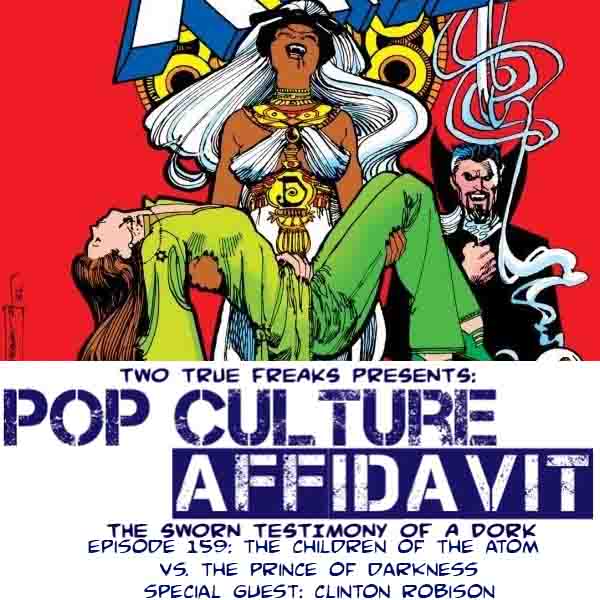
Pop Culture Affidavit Episode 159: The Children of the Atom vs. The Prince of Darkness

Just in time for Halloween, it’s mutants vs. vampire courtesy of Chris Claremont and Bill Sienkiewicz! I’m joined by Coffee and Comics’ Clinton Robison to talk about Uncanny X-Men #159 and X-Men Annual #6 where Storm becomes a vampire and the team faces off against Dracula!

Music for this episode is “Pop Rock” by Scott Holmes music and has been used under Creative Commons via the Free Music Archive.

Apple Podcasts:  Pop Culture Affidavit

Spotify: Pop Culture Affidavit — Two True Freaks

Direct Download 

Pop Culture Affidavit podcast page

Faces (addendum to Pop Culture Affidavit Episode 157)

In my latest podcast episode, I looked at three issues of Batman that came out between A Death in the Family and the Year 3/A Lonely Place of Dying storylines, which are about the death of Jason Todd and then the introduction of Tim Drake. Of course, Tim doesn’t officially become Robin until about a year and a half after Batman #442, in which he puts on Jason’s old costume and we have the iconic George Perez cover of him swinging into action. But once that happened, everyone more or less knew that Tim was going to be the next Robin.

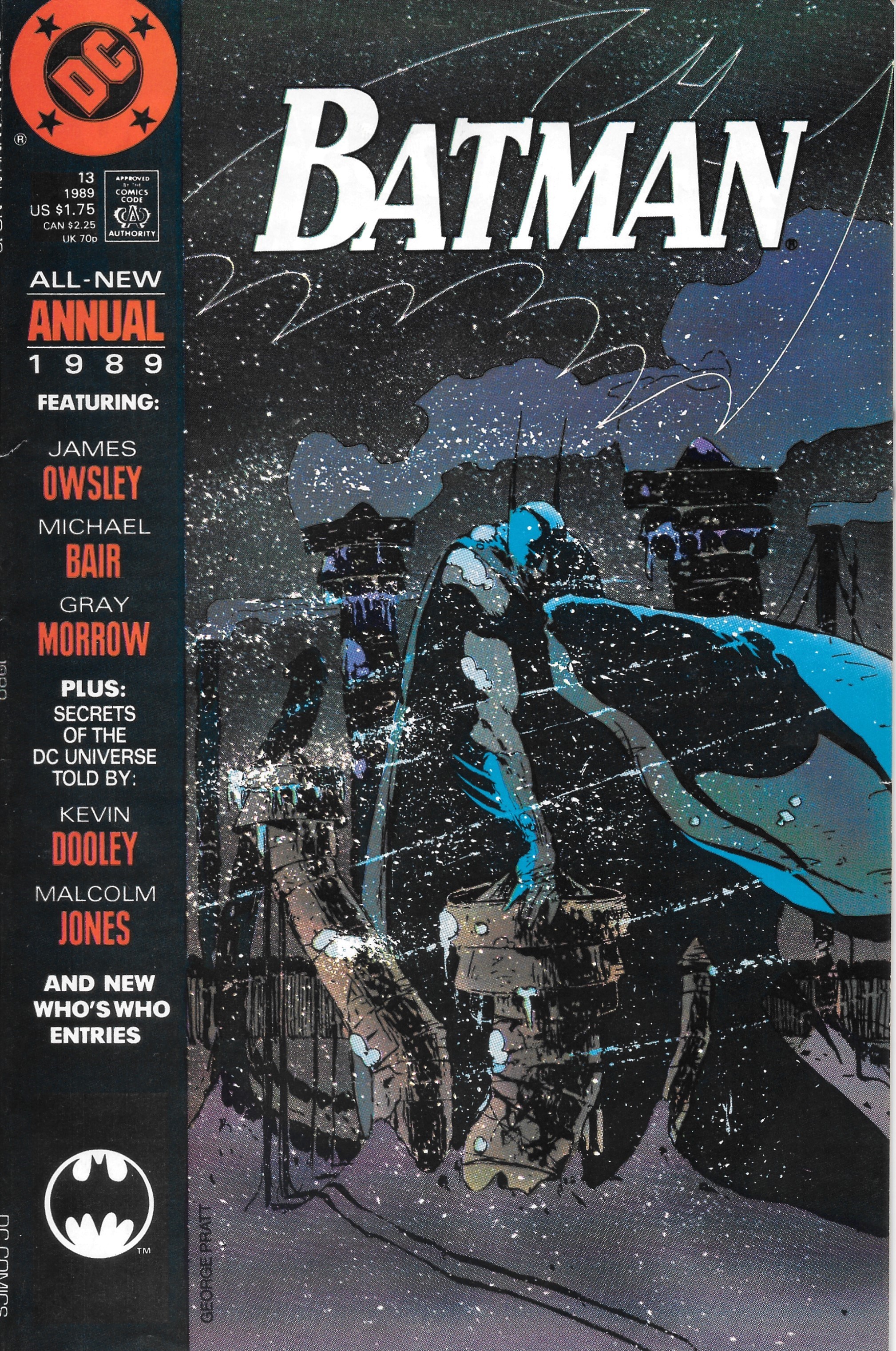
What I had wanted to see was how the Batman was handled in those three issues, which were #430-432 of his main series (and if you listened to the episode you know that I mentioned The Many Deaths of Batman but it seemed more like a fill-in arc and less of an “in-the-moment in-continuity” storyline) but had to skip Batman Annual #13, which came out during that period but is not available on DC Infinite nor was collected in the trade paperbacks I own from that era (it is available in Batman: The Caped Crusader Vol. 2, which also reprints Year 3 but omits Lonely Place, probably because that has been folded into the trade for A Death in the Family). Well, I was at my LCS the other day and decided to see if they had it and lo and behold a copy in very good condition was available for $1.99, so I grabbed it and decided to offer up a review of it here as an addendum to that podcast episode.

I could go into a whole history of comic book annuals, which began back in the 1960s (I believe) and very often reprinted old stories. They were always bigger than the regular issues–about two or two-and-a-half times bigger–and cost about as much. Batman had seven annuals published in the early 1960s (which were about twice a year and therefore semi-annuals) and then those editions as we know them began in earnest with Batman Annual #8 in 1981. DC would begin crossovers and themes with the annuals in 1991 with Armageddon 2001 (a story near and dear to my heart that I may get around to one day), but during the 1980s, the books were simply oversized stories that sometimes had backup stories and extra features. All had similar trade dress and for 1989, that trade dress was a bar running down the left side of the cover with a rundown of the creative team and what was in the book.

For this annual, the copy on the left side advertised a story by James Oswley (now known as Christopher Priest), with art by Michael Bair and Gray Morrow; a backup story featuring “secrets of the DC Universe” told by Kevin Dooley and Malcolm Jones III; and a set of updated Who’s Who entries (which Rob and Shag covered years ago on the Who’s Who podcast). The cover is by George Pratt and fhows Batman sitting on a snow-covered rooftop, a picture that is slightly obscured by snow blowing around hiim, but we can certainly see the blue and gray uniform of our hero. Personally, I think it looks pretty cool and while it is more of a pinup and has nothing to do with the story inside (as opposed to the Detective Comics annual that year, which had a Klansman on the cover because the Klan were the villains of that book), I’ve always been drawn to it. I don’t know why I always thought this issue was somehow special because of that cover, but it felt that way.

(more…)

Pop Culture Affidavit Episode 157: Batman: From Death to Dying

In A Death in the Family, Jason Todd died. In A Lonely Place of Dying, we got our first look at Tim Drake. But what happened between? This episode, I take a look at some of the issues in the very brief set of issues following Robin’s death but before Batman: Year 3 and A Lonely Place of Dying. It’s the end of the Jim Starlin run in Batman #430 and two great fill-in issues written by Christopher Priest in #432 and #433.

Apple Podcasts:  Pop Culture Affidavit

Direct Download 

Pop Culture Affidavit podcast page

A Last Point in Elementary School

I wish I could have some profound way of starting this essay or even something or someone to tie it together, but the truth is that last week, I fell down one of hte more random Internet rabbit holes. Although I don’t know if this was a rabbit hole beacuse I was actually finding the answer to something and had some serendipity come along with it. Either way I think I am probably the only person in the world who does a fist pump the moment he discovers his sixth grade reading textbook on the Internet Archive.

The timing of my search for it does make sense, though. It was my last week of summer break and I didn’t have much to do on the day when it was pouring out, so I decided to look into some of the topics on the very large list of topics for possible blog posts and then remembered that years ago, I’d purchased a copy of The Mine of Lost Days by Marc Brandel. It’s a children’s/young adult novel published in 1975 that’s about a kid visiting relatives in Ireland and finding a group of children in a mine who are actually from more than 100 years ago. I remembered liking the book when I was a kid and had bought it because I had been looking for an answer to my very specific question: “What was that novel that was in Point?”

Point was a book published in 1982 as part of the Addison-Wesley Reading Program and at Lincoln Avenue Elementary was considered the highest level of reading book that you could hit. I was a high-achieving reader through all of elementary school, so I was pretty sure that as I was working my way through Green Salad Seasons in the fifth grade, I would wind up being one of those cool kids in sixth grade carrying around the elite reading book–and nothing says elite like a textbook with a unicorn on the cover. I probably had to cover it with a brown paper bag anyway.

Point‘s elite status lost a little bit of its luster when my sixth grade teacher, Ms. Frei, told us that everyone in the class was reading from it. Modern pedagogy says that this is probalby not a good idea (although to be fair, modern pedagogy gives you conflicting information on everything from instructional approach to whether or not you should put a poster on the wall), although now that I have been teaching for about 20 years, I see the case of having everyone read the same thing at the same time. Besides, she had us do a lot beyond simply trudge our way through a reading book story by story–there were book reports, research projects, and the occasional short story from a 1970 reading book called To Turn a Stone, which sounds like the most 1970 title for a reading book ever. I remember one story from that collection called “The Cave” where this kid who is in a gang befriends a homeless guy who lives in a cave and then his gang runs the guy off so they can use the cave for their new hideout. He winds up fighting the gang leader and getting kicked out, then makes a vow to join the other gang and get revenge. Between this and The Outsiders in the eighth grade, no wonder my generation was largely feral.

(more…)

Localized Earworms

So if you’ve been watching enough of the Paris Olympics, you’ve seen enough footage of Parisian life and culture and you’ve inevitably heard the “Can-Can.” I think it was used in the opening ceremonies, in fact. And we’re all familiar with it, right? We can even picture the dancers from a place like the Moulin Rouge doing their high kicks to the song. Well, unless you’re like me and every time you hear the tune, you hear: “Now, Shop Rite does the can can selling lots of brands of everything in … cans cans.”

Yes, I realize that I have a problem. But really, when you think of it, we all have commercials that get stuck in our heands, and I even talked about some of my most memorable ones back on episode 97 of the podcast. And on that episode, with the exception of Crazy Eddie and a Roy Rogers commercial, most of the commercials I talked about in that episode were for national brands. When it comes to this Shop Rite commercial, people in maybe five states in the Northeast/Mid-Atlantic part of the country are going to recognize that jingle, just like we also recognize character actor James Karen as “The PathMark guy”:

Again, who gets that except for people in the NY-NJ-CT Tri-State area?

(more…)

The Force, Funspot, and my Forties

When my wife asked me what I wanted to do for my birthday, I replied like any soon-to-be 47-year-old would: I wanted to go to the arcade. In Charlottesville, that’s Decades Arcade, which is full of old (and some new) video games and pinball machines, some dating back to the early days of the video game era (and in the case of the pinball machines, the 1950s and 1960s). Upon arriving, I went right for what I think is one of the greatest games every put into an arcade: Star Wars, which was first released in 1983 and has you piloting Luke Skywalker’s X-Wing through three stages in order to destory the Death Star. It’s clearly blown out of the water by a billion other games that have come out since, but for my quarters, it’s the most fun you can have in an arcade.

Prior to that day a week ago, I had only played the Star Wars Arcade Game a few times in my life. I was six years old in 1983 and wouldn’t have the chance to frequent arcades until my late elementary school and junior high years, which was toward the end of that decade. By the late 1980s and early 1990s, the game had become a rare find in arcades that only had so much space and because the nostalgia for old games was a couple of decades away, often jettisoned older machines for whatever was new and popular. So I spent those years playing After Burner, X-Men, Teenage Mutant Ninja Turtles, Double Dragon, and Mortal Kombat. They had 16-bit graphics (which were the best in the early Nineties) and were way cooler than an old vector graphics game, although I’m pretty sure that if you put that machine in front of any 13-year-old in 1990, they’d get sucked in, especially if they spent any time standing around the Star Wars machine watching other kids play while they waited their turn like I used to do at Sayville Bowl. Come to think of it, I spent a lot of time in arcades watching other people play games or wandering around for a good hour or two because I blew all my money on sucking at Double Dragon. To this day, I’m more familiar with the demo screens of a number of games than the games themselves.

(more…)

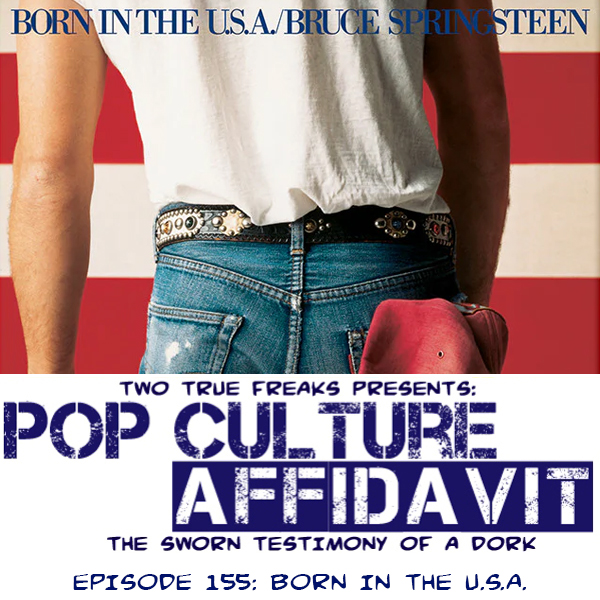
Pop Culture Affidavit Episode 155: Born in the U.S.A.

It’s the 40th anniversary of one of the biggest albums of the Eighties, Bruce Springsteen’s Born in the U.S.A. Join me as I go through the album song by song, look at a few of my favorite B-sides, and talk about why it’s one of my favorite albums of all time.

Apple Podcasts:  Pop Culture Affidavit

Direct Download 

Pop Culture Affidavit podcast page

Here’s some extras …

(more…)

Pop Culture Affidavit Episode 154: Off-Brand Robotech

In 1984, DC Comics published a Robotech miniseries as a tie-in with the Revell model company. But Rick Hunter, Lisa Hayes, Lynn Minmei, the SDF-1 or anything else we know and love from Robotech was nowhere to be seen. Titled Robotech Defenders, it was a three-part miniseries that became a two-part miniseries and that lack of success meant it faded into obscurity pretty quickly.

So what was Robotech Defenders?

Join me as I take a look at the Revell models, the DC Comics miniseries and what, if any, ties it has to the classic Harmony Gold-produced cartoon.

Apple Podcasts:  Pop Culture Affidavit

Direct Download 

Pop Culture Affidavit podcast page

Here’s some extras …

(more…)

Pop Culture Affidavit Episode 153: Just Part of the Song

Maybe it’s a lyric. Or a guitar solo. Or the bridge. Whatever it may be, there’s always small parts to songs that you remember. Taking inspiration from a 2004 Retrocrush post, I’m giving you a list of some of my favorite song parts. From classic tunes of the 1960s and ’70s to R&B breakdowns of the ’90s, there a lot to listen to. Maybe you’ll think of some of your own!

Apple Podcasts:  Pop Culture Affidavit

Direct Download 

Pop Culture Affidavit podcast page

Some extras down below …

(more…)