One of the things you have to remember about Friends when it premiered is that the six members of the cast were made up of five “Hey, It’s That Guy!” actors and Courteney Cox, and wasn’t wholly unique in its presentation–Fox had been doing Living Single at the time and NBC had hits with thirty-something sitcoms like Seinfeld and Mad About You, so aging the main characters down but giving them the “adult sitcom” plots that had worked for the other shows made sense. I can’t remember if the show was a hit at first because I picked it up about halfway through its first season; I’d been watching My So-Called Life on ABC and returned to NBC after that show’s cancellation. Once I did, however, I recognized every one of the cast members from other shows: Jennifer Aniston had been on the short-lived Fox sketch show The Edge, David Schwimmer had been on The Wonder Years; Matt LeBlanc had played Kelly’s boyfriend Vinny on Married … With Children (and its spinoffs), and Lisa Kudrow had been and still was playing the ditzy waitress on Mad About You.
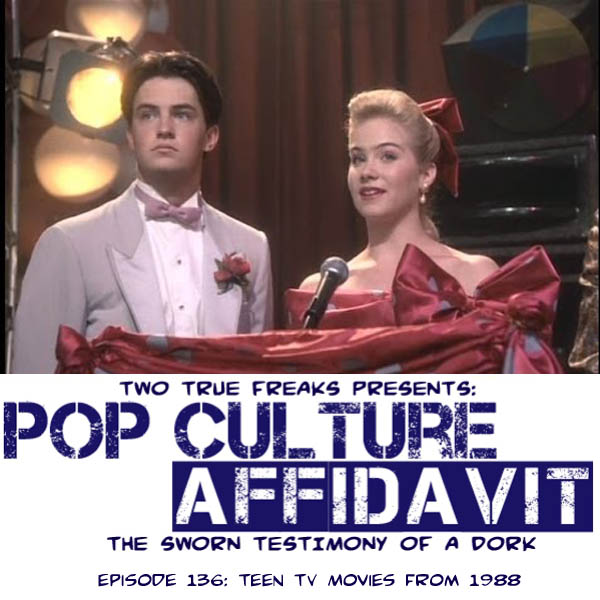
And then there was Matthew Perry, whom had shown up in a number of places over the past several years, especially on television. I’d seen him as a tragic, pressured rich kid on Beverly Hills, 90210; as Christina Applegate’s put-upon boyfriend in Dance ‘Til Dawn (which I reviewed in episode 136 of the podcast); as Ami Dolenz’ skeezy prom date in She’s Out of Control (a movie I should look at in the future); and Carol Seaver’s dead boyfriend on Growing Pains. But most importantly, I knew him as the guy from Boys Will Be Boys.
A retool of a sitcom called Second Chance, Boys Will Be Boys debuted on the Fox network on January 16, 1988 and starred Perry (then credited as “Matthew L. Perry”) as Chazz Russell, a typical suburban teen in California whose best friend is an Italian greaser named “Booch”. Chaz is the nice play-by-the-rules guy with a solid head on his shoulders while Booch is a borderline criminal. And if this sounds familiar to you, that’s becuase the creators were going with the Richie Cunningham/Fonzie dynamic. Rounding out the cast were Randee Heller (the mom from the Karate Kid movies) as Chazz’ mom, and Demian Slade (the paperboy from Better Off Dead) as Eugene, who I think was the slightly younger neighbor (it’s not defined in the episode I watched).
The intro is pretty much everything you’d expect from a generic sitcom on the Fox network in 1988: T&A shots, a synth and sax theme song, some “hijinks” taken from episodes, and … well, I don’t know how to describe the title card and camera effects for this montage, but it’s got 1988 written all over it:
A number of the show’s 11 episodes (it was cancelled after the end of its first season) are available on YouTube (because really, who is going to come for the copyright on this thing), so I watched the premiere, which is typically formulaic. As he’s cleaning up in the garage after mowing the lawn, Chazz is approached by his hot new neighbor, Debbie (who’s wearing as little clothing as any extra on a Fox show would wear back then), who wants to borrow his weed whacker. They wind up making a date for him to “show her the sights” around California. But then a problem arises: Chazz can’t get the car because mom needs it. So Booch steps in to help, and with Chazz’ $500 secures … a Corvette. That we know from the jump is stolen, and even Chazz thinks so. But then Debbie walks into his garage and drools over the car, so he decides to take it out for just one night.
Of course, the two of them get thrown in jail and are placed in a holding cell with a bunch of tough biker gang-looking guys (I swear that there was just a pool of these actors for sitcoms back in the 1980s) and one pleasant-enough looking guy in a suit. And if you’ve watched enough dumb sitcoms like I have, you know that the guy in the suit is the most dangerous, which he proves to be when he tells the boys that he’s been accused of killing seven people but it wasn’t him and was “Mr. Bunny” who did it. Mr. Bunny, by the way, is a hand puppet, so we’ve got the Fox sitcom version of the Batman villain The Ventriloquist and Scarface (even though I think this predates them). Anyway, mom bails them out and later on she and Chazz have a heart to heart talk and the episode ends.
When I was 10, my friend Tom told me about this show a few episodes into its run, and since it was on at 8:00 on Saturday night, I would be allowed to stay up and watch it (I had a pretty strict 8:00 bedtime back then). Of course, it was on against The Facts of Life, a show that I watched on the regular because of its daily reruns on the same channel. So I’m pretty sure that I didn’t pick up Boys Will Be Boys until later that spring when its timeslot changed to 8:30 after Fox’s 8:00 airing of Family Double Dare (oh, and that’s a whole other tangent and blog entry, let me tell you), and that meant I only watched about four or five episodes of the show after it went off the air that May. For some reason, I remember the two of us having arguments over whether Boys Will Be Boys was a better show than The Facts of Life, which are the kind of stupid arguments you have when you’re 10 years old. I’m sure our attention shifted to action movies or the Mets or something pretty quickly. I know I forgot about it and would only think of it when Perry showed up in something else I watched; in fact, I’m sure he was my very first “Hey, It’s That Guy!” actor.
Watching the show again, 35 years later, I obviously don’t see a “brilliant but canceled” or “hidden gem” of a television show. But I do see where we’d eventually get to Chandler Bing. From the very first scene, Perry gives his character the same neuroitc insecurity that his Friends character had, even if Chandler’s sarcasm isn’t there. Perry’s physical humor and his reactions to the situations and dialogue in the episode foreshadow his comedic acting skill; in other words, he stood out enough on a crappy show to be someone to remember.
Hearing of his passing this weekend was sad for a number of reasons. Having been a fan of Friends through pretty much its entire run, I was well aware of Perry’s struggles; moreover, it’s always sad whenever an actor from my generation passes on when they’re too young to do so. Perry had the familiarity that a lot of television actors (especially those from sitcoms) do, and while I can’t say that I considered him a “friend,” it definitely feels like a classmate or someone from the neighborhood is gone.




 Pop Culture Affidavit