1990s

Elseworlds (My Life as a Teen Titan, Part Twenty-Eight)

As I’ve said before, when you’re trying to cover a series, annuals can be problematic.  They don’t often fit into the continuity, or you find yourself struggling to fit them in, and even when they do they’re often not that good.  During the sixteen years that Marv Wolfman wrote the New Teen Titans and New Titans series, there were fourteen annuals, and when I think of it there were three that were good and three that were worth reading.  The three that were great were the exceptions to the rule–three annuals that wrapped up major storylines (the original Tamaran storyline, the origin of the Vigilante, and The Judas Contract in the 1980 series’ three annuals).  The three that were worth reading either wrapped up long-standing questions (New Titans Annual #6, where the team returns to Tamaran and Karras dies), introduced new characters (New Titans Annual #7, which introduced the Team Titans), or carried the story along (1995’s New Titans Annual #11).  But for the most part, the annuals from the New Teen Titans/ New Titans “baxter” series badly introduced new heroes or villians or spent time trying to reconcile post-Crisis continuity issues.

For what it’s worth, during the 1990s, DC did try to make their annuals relevant and for a couple of years it seemed to work.  I don’t have the exact sales figures or anything in front of me, but I found both Armageddon 2001 and Eclipso: The Darkness Within fun, and Bloodlines … well, I read Bloodlines, does that count?

Okay, pithy comments aside, I’m sure that lack of quality and/or interest in Bloodlines proved a little problematic because when 1994 rolled around and it was time for annuals, DC decided that it wasn’t going to force its readers to buy every single annual out there to get a full-on storyline, but still wanted to tie together all of its annuals in some way and went for a thematic tie-in with Elseworlds.

Elseworlds was a concept that up until this point had mainly been applied to prestige format one-shots that mostly featured Batman or Superman, beginning with the excellent Gotham By Gaslight, which placed Batman in 19th Century Gotham City trying to solve the mystery of Jack the Ripper (it didn’t have the “Elseworlds” emblem on it, but is considered one of the very first).
The concept, as described by DC, is, “In Elseworlds, heroes are taken from their usual settings and put into strange times and places–some that have existed and others that can’t, couldn’t or shouldn’t exist.”

The Elseworlds specials seemed to be pretty successful each time and fans seemed to love the idea so much that the 1994 annuals were all “Elseworlds” stories starring the characters from those individual comics.  This made it easy for continuity geeks like me to figure out where the annuals go, even if some of the annuals were pretty good and others seemed to come from the hackneyed “Die Hard on a ______” type of storytelling model.

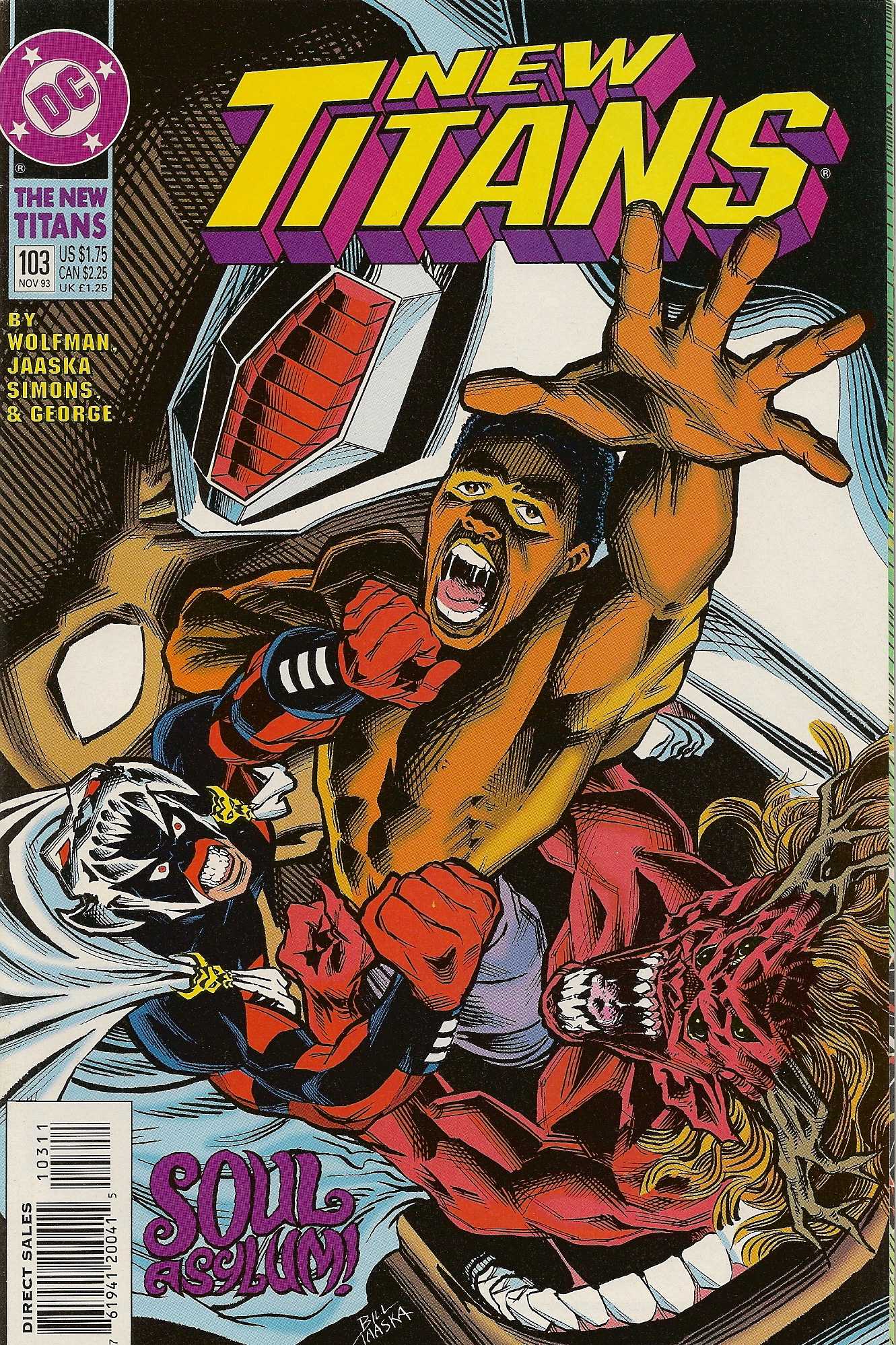
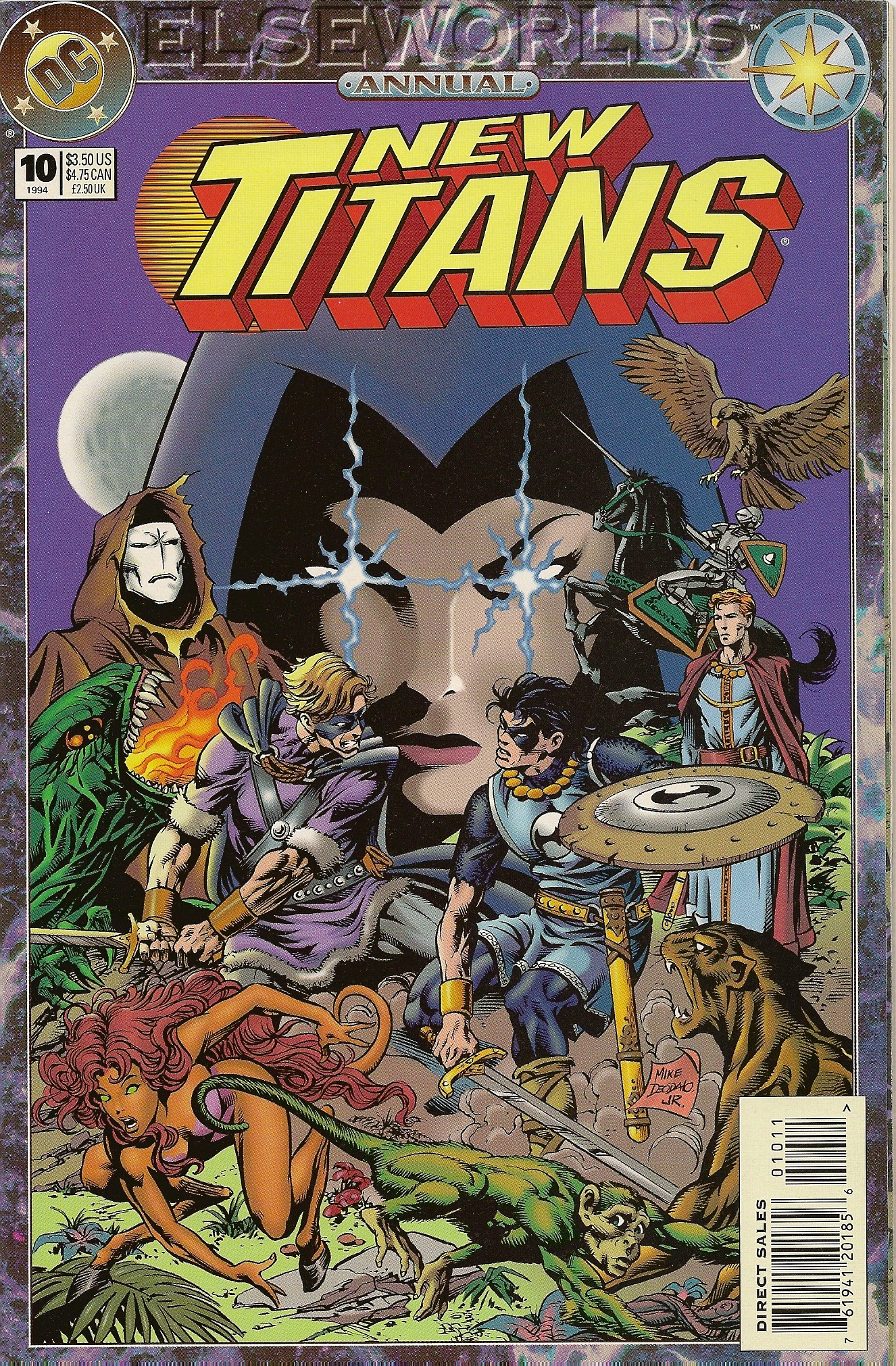
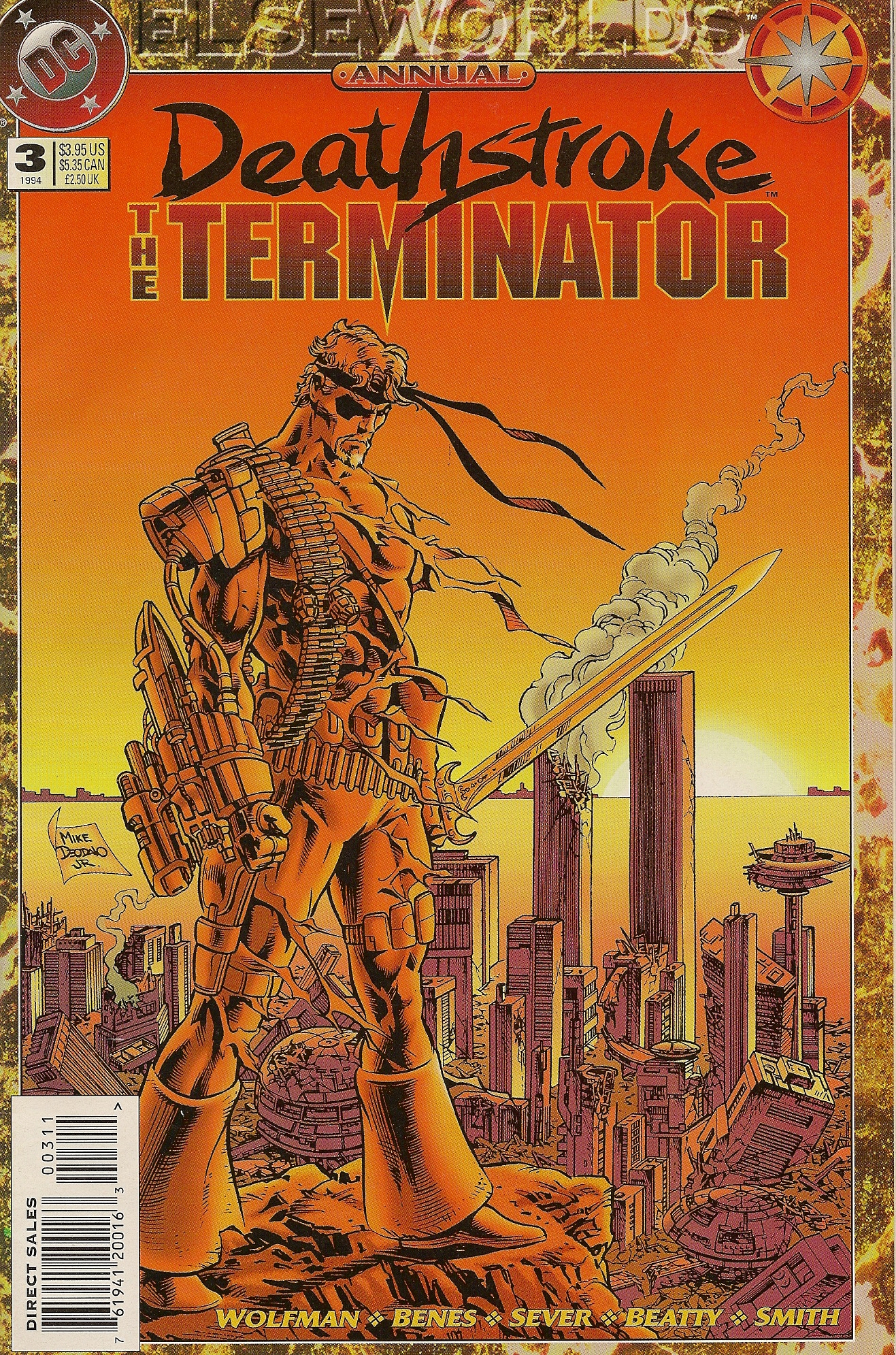
The Titansverse had three annuals going for it, as Deathstroke: The Terminator Annual #3, New Titans Annual #10, and Team Titans Annual #2 were Elseworlds tales, and apparently I found these so significant that I didn’t realize that I didn’t even known the Deathstroke annual until a couple of years ago when I was sorting my collection into fresh long boxes and I noticed it wasn’t there.  My local comics shop had it for a whopping $2.00, so it’s not like it was a crisis.

That Deathstroke annual, which was written by Marv Wolfman with art by Ed Benes (yes, that Ed Benes, and it’s extremely early Benes, so there’s no butts in anyone’s face), is the story of how Deathstroke fights in a future gone made against a race called The Genetix.  Since he has been made immortal because of all of the experiments conducted on him, he seems to be the only man who can take down The Genetix, especially after learning their secret.  Reading the story made me wonder if Wolfman had been watching Mad Max movies or reading old issues of Hex, because the post-apocalyptic world is right out of the 1980s.  But to his credit, he chooses not to rework an origin story (which is what so many of the Batman Elseworlds tended to do) and that makes it the strongest of the three and a decent stand-alone story.

New Titans Annual #10, on the other hand, which was scripted by Louise Simonson from a plot by Wolfman, tries a little too hard.  The creative team tries to place the Titans in a sword-and-sorcery epic and relies on a plot by Raven to bring back Trigon so he can take over the world, which is what had already been going on in the regular title (and what, quite frankly, fans were a little tired of) and quite frankly it feels like … well “It’s Die Hard but with magic!”  and is rather forgettable.
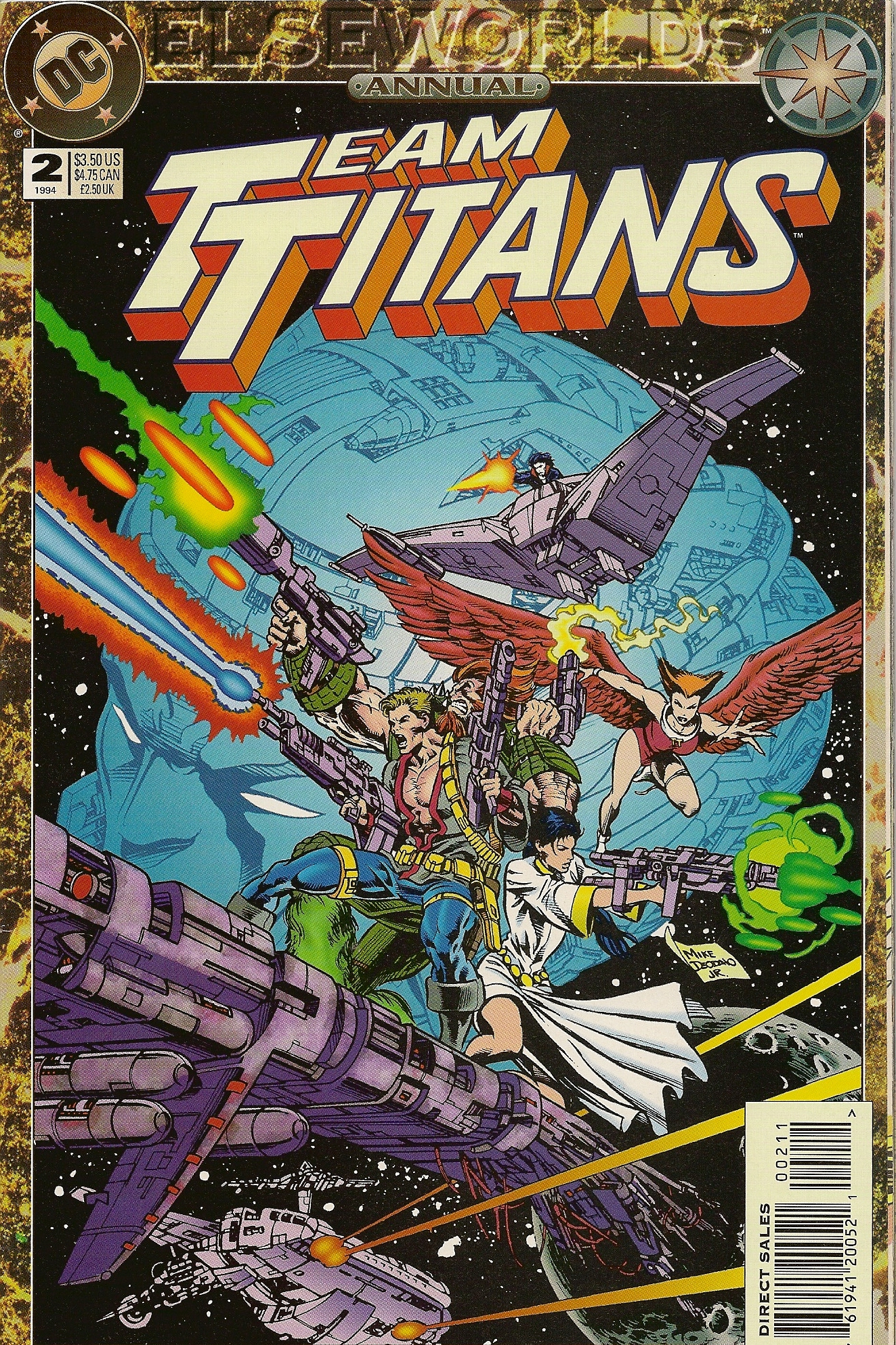
Team Titans Annual #2, on the other hand, is not too bad.  This came out a week before Team Titans #20, so Monarch hadn’t been revealed as the Team Titans’ leader and we weren’t aware of how he had this master plan that involved the upcoming Zero Hour crossover, but it wound up revealing one of the plot points for the last issues of the series.  The adventure takes place in outer space with Lord Chaos essentially using Earth as some sort of Warworld and the Teamers being a band of rebels committed to destroying his tyranny.  Most of the characters stay who they are, except for Redwing, who is able to transform into a beast called “Warhawk.”  The difference between this and her transformation during Team Titans #20-24 was that in the annual she changes back to her more humanoid form and in the series the change is permanent, but I do remember seeing the regular issues and thinking it was pretty cool that I was able to see that Carrie would become “warhawk” in the regular comic.

Otherwise, the comic feels like a rehash of the Team Titans’ origin but a good enough rehash to stand on its own as a halfway decent story.  Jeff Jensen and Phil Jiminez wrote a story that seemed to be a throwback to Marvel’s Star Wars series from the late 1970s and early 1980s, with its rebels and swashbuckling sort of space adventure and much like the series they were writing, they did their best to show that they were having some sort of fun.  Had there not been three art teams, it may have been a little more solid, but reading “The Titans do Star Wars” is worth tracking  it down.

So I’m sorry if this seems a little rushed, but that’s annuals for ya — something you’ve got to read because you’re reading everything, but nothing that you really remember when you’re done and file it away among the regular story.

Next Up:  Raven haunts Starfire as New Titans heads toward a huge change.

Self-Righteous

The watershed moments in your life rarely come with a script.  Oh sure, you have your major milestones and accomplishments but the moments of true epiphany are the most random, often happening when you least expect it.  One such moment in my life came before a club meeting during my senior year of high school.  I was helping pass out agendas and had left my backpack on my seat.  A friend of mine, Jim, was a fellow officer in the club happened to see my Walkman and out of curiosity, pulled it out of my bag and gave it a listen.  I returned to the table in time to see a look of complete confusion make its way across his face.

“Give me that,” I said, snatching the Walkman out of his hand.  Jim didn’t respond, and I put my headphones on to hear what had prompted such a strange look.  Playing near full blast was “You’ve Lost That Lovin’ Feelin’.”

Luckily, the meeting soon began and Jim didn’t care enough to mention it again or to anyone else, and needless to say that had me relieved because while I brushed the incident off, I felt the same sort of weird guilt you’d feel as if you’d been caught masturbating.  This was music I had been listening to when nobody was around, an act of musical self-pleasure that I kept hidden from the guys I talked heavy metal with at the lunch table where for all they knew, I was genuinely impressed that Jeff tracked down a Megadeth bootleg or that Brian finally acquired the studio version of “Breadfan” when he bought the Japanese import single for “One.” Had he mentioned it to the group of people we hung out with, I would have been mercilessly ridiculed, like the time they found my copy of Born in the U.S.A. and wrote “Nice ass!” on the cover.

I probably shouldn’t have cared, to be honest.  What’s wrong with having your own tastes?  Who cares what other people think, right?  But I was an individual with serious self-esteem problems and a need for approval that meant not only did I really want to seem like I was cool, but I was quite possibly the easiest target for ridicule.  I will spare you the vulgar nicknames, the perfume sprayings, and other jokes in my honor and say that though Bill Medley and Bobby Hatfield’s glory years were a good thirty years behind them at that point, my listening to the Righteous Brothers tape I’d borrowed from my mother, especially “You’ve Lost That Lovin’ Feelin'” had a perfectly reasonable explanation:  Top Gun. (more…)

On Earth, Everyone Can Hear You Scream

“The Book of Alien,” published in 1979, had me scared out of my mind when I was a kid.

I think of all the movies I’m looking forward to this summer, Prometheus is at the top of the list. I know that being a huge comic book reader I would probably be more excited about The Avengers or The Dark Knight Rises, but when I heard that Ridley Scott was making a movie that had ties somehow to Alien, something in my nerd past reawakened and I remembered (suddenly? I mean it’s not like I ever really forgot) that when I was about 11 years old, the world he created in Alien was the center of my universe.

Okay, to be fair, the reason for that was more due to James Cameron’s sequel, Aliens, because up until the time I was in the fifth or sixth grade, I had only ever seen anything to do with Alien in the movie book–The Book of Alien–that someone on my bus had been passing around when I was in the second grade. Furthermore, what I had seen was a picture of the movie’s infamous “chestburster scene” (although at the time we called it “when that thing came out of the guy’s stomach”) and it scared the crap out of me.

I refused to watch Alien until I finally sat down and watched it during the summer before sixth grade–this was either the day before or the day of the incident where my father, who was wallpapering the living room–stepped on a razor blade and wound up with a few stitches in his foot. I don’t think I thought very much of the movie when I first saw it because it wasn’t as cool as Aliens, which I had already been watching on constant replay for the better part of a year.

Can you really blame me, after all? I was eleven or twelve and it was the middle of the “action Eighties” where I was into any movie that had large guns that shot lots of people, it quickly became my favorite movie. My friends and I would “play” Aliens (I was often Hudson to my friend Tom’s Hicks, although I think one time I actually played Ripley which I’m sure that some psychologist would have jumped on … but I have a feeling I just wanted to be one of the leads) when we wanted something slightly different than the “army” games we were used to playing after being kicked out of the house for watching Aliens way too many times.

But with anything from my childhood, my interest faded after a little while and I paid less attention to Ripley, Hicks, Hudson, Newt, and the other characters and more attention to things like baseball and the WWF. I would gravitate back toward Alien when I was in junior high after watching the original theatrical trailer while waiting on line to ride The Great Movie Ride at what was then called Disney’s MGM Studios in Disney World.  I knew I had seen the movie before, but trailers were hard to come by in 1990–you either had to have it as part of a commercial break on something you taped off of television or on another video tape that came out at that time, and considering that Alien was released in 1979 and then released on VHS for the first time by CBS FOX video in the early 1980s, that wasn’t likely to happen in my house.  The trailer blew me away and left so much of an impression that I remember trying to duplicate it as part of a computer animation project in my advanced computer graphics class in the ninth grade (I think it was a bunch of stills with quick cuts that wound up with no sound and a title in a really bad font … then again, it was 1991).

(more…)

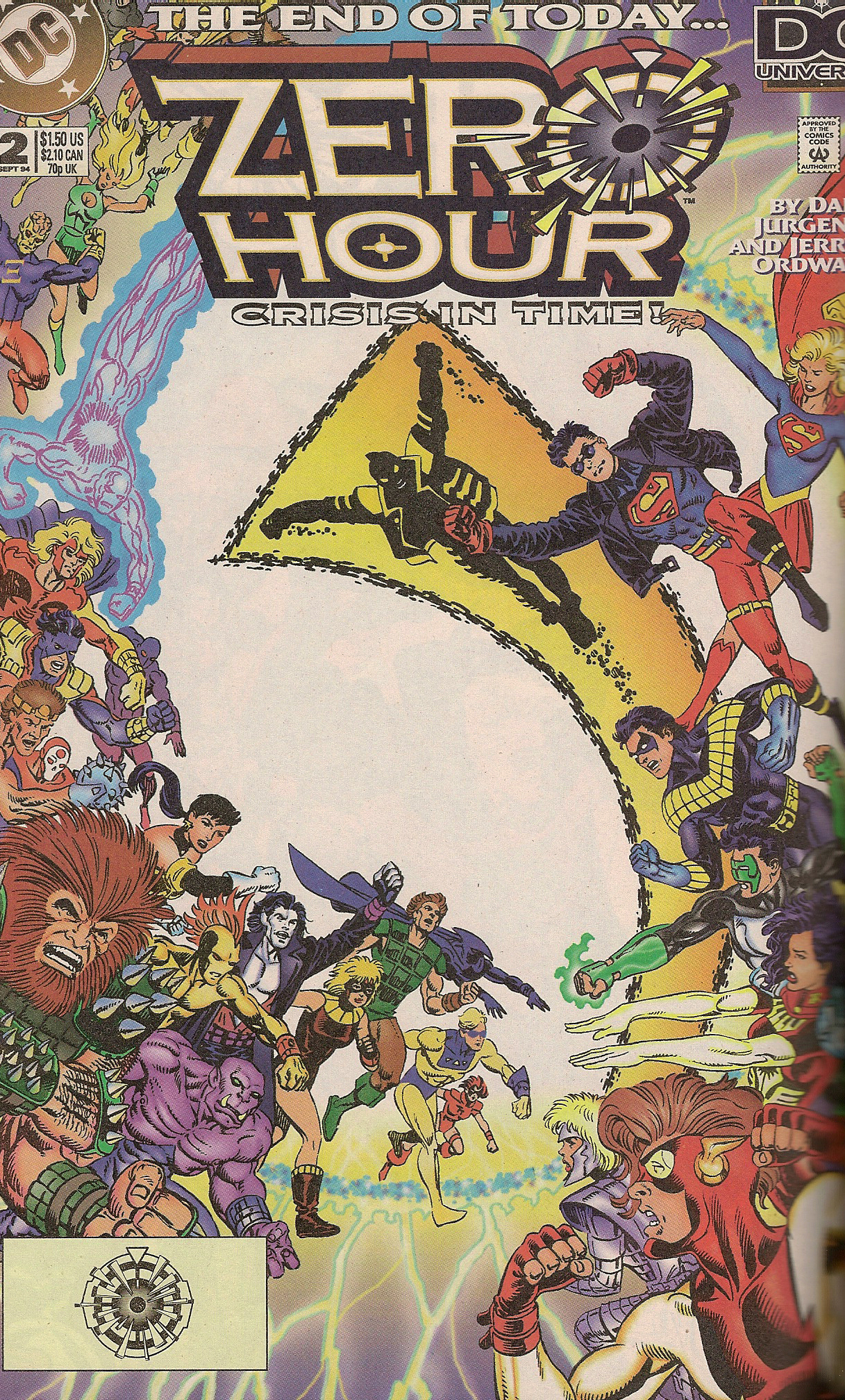
Zero Hour: Crisis in Time (My Life as a Teen Titan, Part Twenty-Seven)

About two years ago, when I started posting comics-related entries to this blog, I made a point to write about the first series that ever had a true impact on me, which was Crisis on Infinite Earths.  Marv Wolfman and George Perez’s 1985 epic was a story that I came late to, having read it for the first time in its entirety in 1991 after owning only issue 12 and then going back and collecting the rest.  Before the summer of ’91–when Armageddon 2001 and War of the Gods were both published–there had been three company-wide crossovers that don’t hold the same weight as Crisis did and some of which haven’t aged very well.  Legends, Millennium, and Invasion! were published in the late 1980s before DC decided to take a break from the company-wide crossover for a couple of years.  With maybe one or two exceptions, the issues for each of these stories were pretty easy to find and were cheap to procure in the early 1990s (seriously, except for Batman books, nobody was buying DC back issues at the time) so I quickly became an obsessive crossover fan.

The annuals crossovers that began with Armageddon 2001 (awesome then awesomely disappointing), Eclipso: The Darkness Within (uneven in parts but still a solid crossover), and Bloodlines (let’s not go there) were nice to have, but since the one company-wide-within-the-actual-books crossover that DC had in the early 1990s was the poorly executed War of the Gods, there wasn’t much to satisfy my craving for something epic.  Oh sure, there was the Superman books’ Panic in the Sky! and by the time 1994 rolled around I was knee-deep in both The Death and Return of Superman and Knightfall, but I still wanted more.  I mean, if Marvel could have Infinity Wars and Crusades, couldn’t DC have something?

Then, in the fall of 1993 on the DC Universe promo page, there appeared a simple graphic of a ticking clock with the words “The Countdown Has Begun.  Zero Hour.  Be Prepared.”

I remember going almost practically apeshit over this.  I didn’t know what it was, I didn’t know what it was going to be … but I wanted it.  During the course of the next year or so, weird stuff would happen in the various books of the DC Universe that suggested that this Zero Hour event was going to be something very important, not just some random C-list villain making an effort to be someone important.  The biggest one that I noticed was that Valor–otherwise known as Lar Gand of the 30th Century–dies in his 20th Century-set book, a thousand years before he is part of the Legion of Super-Heroes.  Plus, there was this attempt to make some sense of Hawkman (I didn’t understand it either), and in Team Titans, the identity of The Leader was revealed to be none other than … Monarch.

This all led in to two issues of the anthology series Showcase ’94 where Waverider (he of Armageddon 2001 and Linear Men fame) and Rip Hunter observe Hank Hall as Monarch in some random hideout where he’s hooked up to a bunch of machines and … well, we’re supposed to accept the idea that Hall has been able to get his hands on a lot of different technology and also had the knowledge to use it.  They attempt to develop his character a little bit, or at least try to “erase” the mistake of the end of Armageddon 2001 by having him explain something about how when Dove died, her essence as a personification of order went into him (Hawk, the personification of chaos) and he became more powerful and aware than he ever had.  Then, Hall changes himself into Extant, a time-traveling villain who is supposed to serve a legitimate threat to the heroes of the DCU (instead of Monarch, who never really could seem to get his crap together).

It’s a halfway decent lead-in to Zero Hour, because we at least have a villain established and by the time Zero Hour #4 opens (the issues were numbered counting down to 0), it’s thought that Extant has somehow figured out how to screw with time itself to the point where pockets of entropy are opening up and swallowing time and space from both ends.  The heroes of the DCU are called upon to fight it and even though Wally West (aka The Flash) seemingly dies (he winds up in the speed force, a concept that Mark Waid would introduce at this point in his spectacular run on The Flash) and the Justice Society is forced into retirement (in quite possibly the worst way possible), they seem to stop the entropy from eating up the universe.  At least for a moment, when it’s revealed that the true villain of the story is Hal Jordan, aka Parallax, who has decided to try to recreate the universe so that everything that sucked never happened.    The heroes fight him, use a kid named Damage to start a new version of the Big Bang, and then the universe restarts as it should.

Make any sense? (more…)

Time’s Up (My Life as a Teen Titan, Part Twenty-Six)

When you have a comic book title that has a big mystery such as the identity of a major character and you finally reveal the answer to that mystery, you are then faced with an almost unbearable burden–following it up.  In some cases, it goes well and that reveal becomes another notch in the belt of a classic creative team.  Most of the time, however, it marks the beginning of the end.  Though it is not entirely the creative team’s fault, Team Titans definitely falls into the latter, as it only lasted four more issues after the revelation that Monarch was the mysterious team leader.

Now, from what I understand, Jeff Jensen and Phil Jiminez had taken on a flagging title and wound up being forced into a corner by DC editorial by way of Zero Hour: Crisis in Time, a “This Changes Everything” type of crossover that had a lead-up of a few months in some of DC’s titles, especially those that starred the Legion of Super-Heroes or had crazy continuity problems, such as Hawkman.  Team Titans joined that group of titles because since the book was on the chopping block, the teamers were going to be playing a part in Zero Hour and the story that runs from issue 21-23 winds up being a crossover lead-in with the series’ final issue being an actual Zero Hour crossover.

The story that was told, which set up the Teamers as unknowingly working for Monarch and that included character changes like increased aggression from characters like Kilowatt, a darker and more mysterious attitude from Prester Jon, and an actual physical transformation of Carrie Levine, a.k.a. Redwing as she morphed from a girl with wings into an actual man-bird beast renamed Warhawk.  But before we even were to get to that point, we had to sever the most important connection that the Team Titans had to its parent title, and that is Donna Troy. (more…)

The Summer of 4 ft. 2

Lisa practices acting like a teenager in "The Summer of 4 ft. 2."

When my yearbook staff puts the finishing touches on its last deadline, we have a few traditions.  First, we take the ladder–a poster-sized “map” of the yearbook–and pass it around the room, each staff member tearing it until it’s completely shredded.  Second, we have a pizza party.  Third, we watch the Simpsons episode “The Summer of 4 ft. 2.”

If you’re unfamiliar with the episode, I don’t blame you.  It originally aired on May 19, 1996 and along with the star-studded episode “Homerpalooza,” capped off season 7 of the series, which means that it was an episode from back when the show was not only good but amazing.  Flipping through my copy of The Simpsons: A Complete Guide to Our Favorite Family, I see that season 7 is incredibly strong: “Bart Sells His Soul,” “Radioactive Man,” “King-Size Homer,” “Team Homer,” and “Bart on the Road” are just five episodes in a year packed with gems, and I have to say that I have to consider myself lucky because this particular year (1995-1996) was when I first started watching The Simpsons on a regular basis.

You see, I actually wasn’t allowed to watch the show when it first premiered in 1990.  Not right off the bat, anyway.  I remember watching the first regular episode (not “Simpsons Roasting on an Open Fire” but “Bart the Genius”), but when the show took off and the merchandise started hitting the shelves, my mother didn’t think that the image of Bart Simpson holding a slingshot and proclaiming he was an “underachiever and proud of it” was a good image for her kids.  Therefore, me–the 13-year-old–and my sister–the 10-year-old–were forbidden from watching The Simpsons.

Now, let’s think about this for a minute.  I had spent the better part of my childhood watching festivals of violence–from Tom & Jerry cartoons to Commando.  I was also a straight-A student who never got into any trouble at school.  How a cartoon character that was about as harmful as Dennis the Menace was going to make me rebel in some way was completely beyond me.  So I was stuck watching The Cosby Show instead, at least until the beginning of season two when I was able to watch “Bart Gets an F” because it was about that underachiever trying to achieve; and then wound up catching most of that and the next season.  Then my viewing fell off as I became more involved in school and found myself spending most of my nights holed up in my room doing homework or listening to Rangers games on the radio. (more…)

Running Out of Time (My Life as a Teen Titan, Part Twenty-Five)

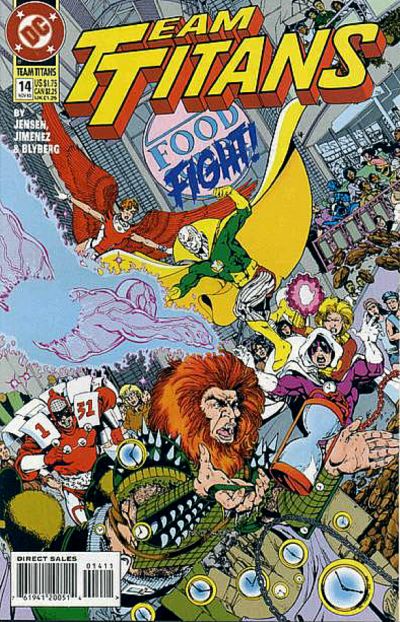
The cover to Team Titans #14 by Phil Jiminez

While I have no experience actually writing comic books, I think that taking over a failing title might have to be one of the hardest things that a creative team has to do, maybe even harder than following a very successful run because at least in the latter case, the book you’re coming into is selling well. In 1993, I was sixteen and didn’t know that Team Titans wasn’t selling well because out of the three Titans books that were being published at the time, it was the one I followed the most closely. As I said last time around, I was barely paying attention to Deathstroke; and New Titans, while definitely still an important comic book in my monthly reading pile, had artwork that was either so inconsistent or lackluster that I often found myself tuning out.

Team Titans, on the other hand, had two things going for it. First, there was an ongoing mystery as to the identity of the “leader,” the guy who sent the team back into the past to kill Donna Troy all the way back in New Titans Annual #7. Harris and I, who had been writing the New Titans editors since the first time we asked them to kill Donna Troy a couple of year earlier, were also writing to the letter column of this book, with our usual M.O., but also trying to figure out who this mysterious red-haired person was. It kept us on the lookout for clues all the way until issue #20 when it was revealed on the last page.

The other thing going for the book was the art. Phil Jiminez and then Terry Dodson are very well-known artists by now, but back then nobody had really heard of them. I had started to really enjoy Jiminez’s work when I first saw it in the Eclipso-related Titans annuals and the three-issue Red Star/Cyborg storyline written by Louise Simonson. It was reminiscient of George Perez, the famous New Teen Titans co-creator and artist who’d left the book for the second time a couple of years earlier; furthermore, it was so much the opposite of what New Titans was providing with Bill Jaaska that it was, by comparison, amazing.

Jiminez was also one of the writers on the title, co-writing with Jeff Jensen who is now a senior writer for Entertainment Weekly and recently wrote Green River Killer: A True Detective Story, a graphic novel about the search for the Green River Killer. Re-reading the last 13 issues of this title, it’s clear that they were cutting their teeth and while there are some missteps, I find this particular portion of Team Titans to be underrated, especially considering the problems they had as a creative team.

For starters, Marv Wolfman never really was happy writing the characters, or at least that’s how he has characterized his time on the Team Titans. in The Titans Companion, he says in an interview:

I always thought it was a stupid idea.  I didn’t like it; didn’t like working on the book.

Furthermore, the editors of the book, as Jiminez said in the Companion

…wanted was DC Comics’ X-Force.  They, DC management at the time, saw Team Titans as this answer to Rob Liefeld’s X-Force and what we wanted to do was something much more character-driven [and] self-aware, something more like Grant Morrison’s Doom Patrol.  So from literally the first issue, it was a struggle editorially to the point that the book just fell apart on us completely and a long-term story that we had planned got condensed into four issues.  Then Zero Hour came along and undermined everything anyway.

So you can see where they were kind of behind the eight ball when it came to writing the title, and in looking at their first storyline, you can see where it was obviously meant to be something bigger. (more…)

The man of action just keeps going (My Life as a Teen Titan, Part Twenty-Four)

One of the tougher things about covering the 1990s-era Titans books for this blog (if you can believe that is difficult at all) is not having to reread disappointing storylines like “Terminus” (especially considering if I extend my reading all the way through to the late 1990s The Titans title, I am going to be looking at some extremely poor stories), it’s that I find it tough to determine in what order to read these books.

With the Team Titans and New Titans titles, it was always easy to figure out where things were going, especially because they would cross over into one another here and there, at least through Team Titans‘ first year and as the DC Universe as a whole inched closer to Zero Hour, a crossover I found intriguing from the very first advertisement on the DC Universe coming attractions page.

But Deathstroke? It was a good action-adventure book but always kind of the odd man out in the Titansverse. Slade Wilson and his supporting cast kind of kept to their own until it was absolutely necessary for them to appear in the main Titans books, and since this was a book I was getting through the mail via DC’s subscription program, I really didn’t pay much attention to it. In fact, I’m pretty sure when I first got the issues between the “World Tour” and the post-Zero Hour “The Hunted” storyline, I skimmed the books, bagged and boarded them and really never gave them much thought.

Rereading issues #35-40, you can kind of see why. They’re not terrible stories, but whereas the small group of stories between the end of the Cheshire storyline and the World Tour were decent adventure tales, these are serviceable at best. Over the course of these issues, there are several art teams and while there is a three-parter about Wintergreen fighting for the right to restore his family’s honor because his father was a Nazi sympathizer, it seems that Wolfman was asked to kind of plug along before giant editorial changes took place.

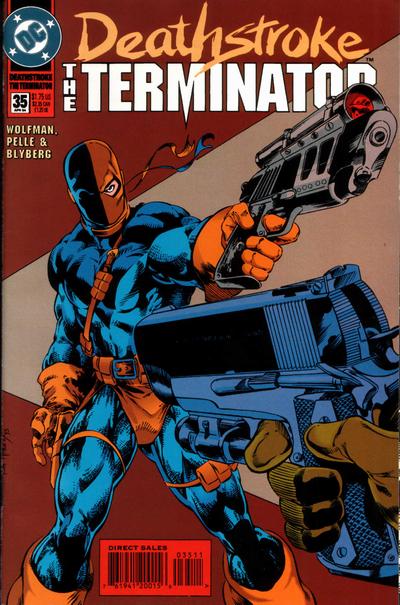
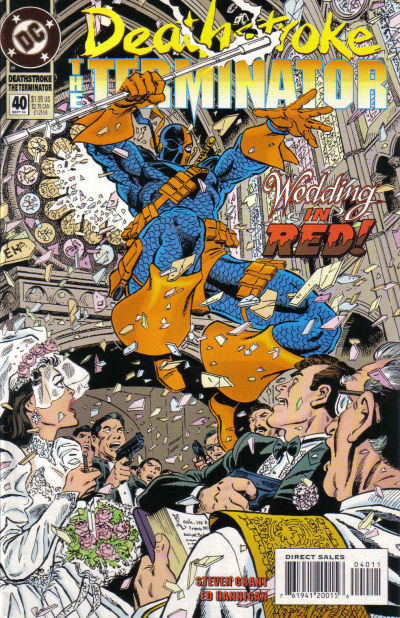
It is kind of odd, by the way, that Deathstroke did not have a Zero Hour crossover issue (and really neither did New Titans, although the issue that takes place around the same time as Zero Hour does at least put an ending to part of the Titans story). It would have been interesting to see a different version of Deathstroke pop up or maybe even one, if not both of his dead sons come back. Instead, there is the Wintergreen story, a team-up with Green Arrow, and Slade breaking up a mafia wedding. Wolfman does try to continue to build Slade’s character in some issues–in fact, issue #35 is basically a huge fight between slade and Wintergreen that winds up replaying the “No, go ahead! Kill yourself!” scene from Lethal Weapon. But even so, the “My family is dead because of me!” bit is starting to get tired.

I’m not trying to sound too negative here because it’s not like I didn’t enjoy Deathstroke’s title and it’s not like I didn’t like reading these stories, but I didn’t expect to have the same feelings I did nearly twenty years ago, which was these were the books I had to “get through” and that I was reading because they were associated with the Titans. In fact, it may have been a mistake to continually tie the title back to the Titans because Wolfman’s writing was pretty tight, and if this had been its own title that had its own continuity–something I think he was trying to do here but would be stopped with the next summer crossover–it would have worked a lot better.

Next Up: Back to the Team Titans and a look at that book’s change in creative team.

Terminus! (My Life as a Teen Titan, Part Twenty-Three)

The last panel that the late Eduard Barretto ever drew for the New Teen Titans was of Victor Stone kissing the woman who was now the love of his life, Sarah Charles, as they entered a new phase of their relationship at the end of New Teen Titans #49.  So I guess it’s wholly appropriate that by the time we finally got around to resolving the Cyborg storyline, it’s Sarah Charles who has been watching over him and trying to help restore his mind, even going so far as to head to Russia for him back in New Titans #94-96, which was one of the stronger post-Total Chaos stories that rightfully featured two of the Titans’ strongest members.

Unfortunately, the storyline that sends this particular strong member off is one of the weakest in the latter part of Marv Wolfman’s run, and one of the lowlights during the post-New Titans #100/pre-Zero Hour period (I’d call it the Bill Jaaska era, but most of the issues featured here actually aren’t drawn by Jaaska).  Entitled “Terminus: The Final Fate of Cyborg,” the story builds on what was established at the beginning of “The Darkening” with the apparent return of Rita Farr and villains that were not really villains but weird beings of light, and then goes bi-weekly for issues #104-107 in order to wrap everything up in a timely manner.

But the story really begins in New Titans #102, where Sarah Charles is trying to restore Vic and brings in the Team Titans’ ethereal computer guy, Prester Jon (my second-least-favorite Team Titan, something I’ll get more into next time) to try to interface with him, kind of in the same way that the Justice League used to use The Atom to go waaaayyyy down to somewhere small.  Meanwhile, Pantha digs deeper into whether or not Dayton Industries had something to do with her origin,  Dick and Kory are having their issues and Gar fights a monster called Sinn while he also fights against what seems to be indulging the fact that he can only seem to transform into monsters.  At the end of the issue, Sinn is revealed to be an agent of Raven, who is also manipulating Councilman Quirk, the replacement for Liz Alderman–which begs me to ask, if she was going to ruin the Titans’ public image all along, why remove Liz Alderman from the picture?

But we will leave Gar and Raven, as well as Dick and Kory for another month and turn our attention solely to Cyborg, as Prester Jon spends most of issue #103 inside Cyborg trying to find Vic Stone.  He runs into a fair bit of trouble, even getting attacked at one point while the fake Doom Patrol members from “The Darkening” show up and reveal themselves to be denizens of a planet called Technis and that they need Cyborg in order to survive.  The next issue box promises two issues per month and a “hot newcomer” named George Napolitano on pencils, which at the time was promising.  If you read the letters column from this time (when there was one), you’ll see that there were quite a number of readers who really loved Bill Jaaska’s pencils and DC was clearly making an effort to show all of us doubters out there that he was a good penciller.  The problem was that I couldn’t stand him and when I saw that someone else was taking on the art for a couple of months, I was actually excited and I think that Harris and I actually wrote a letter to the editor complimenting the art.

Re-reading it nearly two decades later, one of the biggest problems with Terminus is that the art completely takes away from what could have probably been a halfway decent story.  In fact, just as with many bad runs of art on any comic book, it becomes hard to “see” the story unless you take the time to read closely.  And the story itself is … well, it’ll seem familiar after a while. (more…)

Jewel-cased Memories

And this is only A-H of my CD collection.

One of the most practical gifts I received for Christmas was a CD book the size of a photo album.  It’s made out of faux leather and holds about 375 CDs, which is about half of my music collection.  I’m going to need another one at some point, but I was able to clean out half of the dresser that houses my CDs and I did something that I have never been able to do in nearly twenty years of owning compact discs: I threw away my jewel cases.

That sounds completely ridiculous because I am sure that there are plenty of people who were throwing jewel cases out the moment they bought their CDs a decade ago and didn’t feel the need to write about it.  Then again, I have that hoarder’s mentality where I hold on to some things because I feel like I am going to miss out on something, which is why I never threw out my jewel cases the first time I had one of these large CD books fourteen years ago, or during my twenties when I hauled box after box of CDs up and down flights of stairs during move after move.

So why pull the trigger now?  Well, as I was making my Christmas list, I realized that I had absolutely no CDs on it.  I certainly had been listening to a lot of music, but I couldn’t remember the last time I had purchased a new CD (which, after some thinking, I realized was The Gaslight Anthem’s American Slang), and the dresser where I keep the CDs was taking up so much space in my office that I wanted to get rid of it.  I began with the start of the alphabet, or ABBA Gold, and in a few hours found myself staring at a pile of empty jewel cases on the floor.

It didn’t seem right that they—along with the CD booklets—were so disposable.  If this were a record collection, I would have been carefully preserving the album sleeves and covers as much as the albums themselves.  But so many of the jewel cases were cracked and missing pieces that preservation wasn’t exactly going to be an issue.  And I don’t think that years from now, a guy on Antiques Roadshow will be telling me that my copy of Ride the Lightning would be worth more if the jewel case didn’t have a crack in it. (more…)