“Dear Mr. Vernon …” On March 24, 1984, five students sat through detention in the Shermer High School library. Now, I take a look at my favorite movie of all time, The Breakfast Club. I break down the movie’s plot and give my review, sharing what makes it so special.
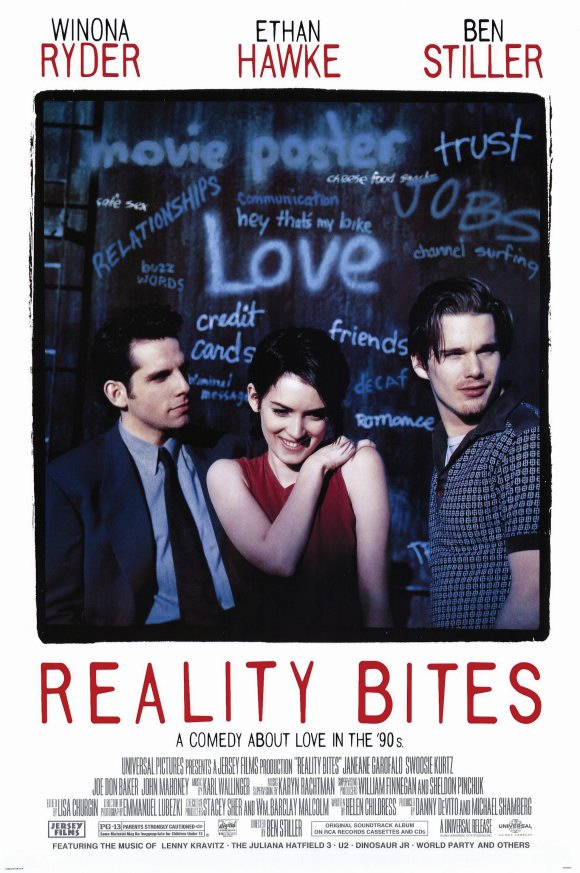
1994: The Most Important Year of the Nineties continues with one of the most Nineties of Nineties movies, Reality Bites. I take a look at the Winona Ryder/Ben Stiller/Ethan Hawke classic and also talk about its place in popular culture as well as talk about why it failed at the box office as did so many other attempts ot market to “Generation X.”
This post, actually my first column from my high school newspaper in the fall of 1994, is my seventeen-year-old self trying to make sense of my generation, especially after I watched Reality Bites on video.
In this post, I take a look at Reality Bites nearly two decades later and discover how much I identify with Ben Stiller’s character, Michael Grates, the yuppie In Your Face TV executive who competes with Troy Dyer’s (Ethan Hawke) for Lelaina’s (Winona Ryder) affection.
It’s not that I’m trying to figure out what made Jim Carrey funny in the mid-1990s, it’s just that in thinking about what was funny in the mid-1990s, I sometimes amazed that he was so huge.
Maybe I should rephrase that, or at least explain what the heck I’m talking about because that introduction is poor and it looks like I’m starting in the middle of things. Next week’s post will be an episode of the podcast about Reality Bites, the Winona Ryder film about life after graduation. It’s one of those films that has become … well, I don’t want to say seminal because that would be giving it too much credit, but it definitely is one of those films that stuck with much of my generation. More on why next week, but I bring it up because around the same time that Reality Bites hit theaters, so did Ace Ventura: Pet Detective. This film is up there with movies like Billy Madison or Dude, Where’s My Car? or Paul Blart: Mall Cop. You look at them and say, “This is going to be ridiculous.” In essence, you are right, but the ridiculousness of the movie is what nets them tens or even hundreds of millions of dollars at the box office.
Such were Jim Carrey movies in the mid-1990s, especially in 1994. The man, who up until that point had been best known for being the white guy on In Living Color (and well, one day I’ll get to Doing Time on Maple Drive) starred in the aforementioned Ace Ventura flick as well as The Mask and Dumb and Dumber, each one of which was an enormous hit and rocketed him to superstardom. I remember that I enjoyed two out of the three of them (I actually have never seen The Mask) because they are, at their core, pretty funny. But as life went on and I got older, I remember that Carrey’s movies, at least to me, didn’t hold up the way that Caddyshack or Airplane! do. So what is it? Has my sense of humor faded or my heart shriveled up and died? I’m not sure.
Let’s do a quick test and look at this scene from Ace Ventura: Pet Detective …
And this one from Dumb and Dumber …
Now, at a glance this stuff is funny. Carrey’s got one of those faces that looks ridiculous to begin with, so he’s not afraid to just act silly and really let loose. And in both scenes, the director just lets him do his schtick. But at the same time, even two watchings of either scene gets annoying after a little while–and this is coming from someone who can watch Chris Farley do the “I killed my sale” scene in Tommy Boy multiple times and thinks that never gets old.
I think perhaps it’s that these scenes are the type of stuff that your annoying younger brother or cousin would find hilarious and repeat over and over and over and over. The tutu bit in the lobby with instant replay goes on way too long and is the type of thing that your hyperactive cousin would repeat out of nowhere in the middle of a conversation.
But hey, maybe that’s what we needed in the mid-1990s. There’s a sense that maybe, after a few years of a crappy economy and serious “message” movies winning Oscars, audiences wanted something totally ridiculous and didn’t want to have to think when they went to the theater. After all, the highest grossing film of the year was Forrest Gump, a feel-good nostalgia-fest and within the next few years we’d have Toy Story, Batman Forever, Independence Day, and Armageddon make huge amounts of money–not exactly thinking man’s movies.
But like I said, I just can’t find them funny anymore (and hey, maybe it’s just because I’m cranky), even though I know that Carrey can be …
(and yes, I know what you’re thinking … I don’t know how Courtney Love stayed in that dress either).
Happy New Year and welcome to the first in a series of posts for this year, “1994: The Most Important Year of the Nineties.” All this year, I’m going to sit down and take a look at what was going on twenty years ago. That means movies, comics, music and all sorts of other stuff all this year! To kick off, it’s an “intro” episode where I talk a little bit about last year and also relate why I think 1994 is such an important year in the decade of the 1990s.
The latest episode is a little late but I promise you it’s well worth it. This time around I take a look at one of my absolute favorite rock and roll stories, Eddie and the Cruisers. I delve into P.F. Kluge’s original novel; talk about the 1983 feature film starring Michael Paré as Eddie Wilson, along with Tom Berenger and Ellen Barkin; and I even cover the sequel, Eddie and the Cruisers II: Eddie Lives! So come along for a rock and roll ghost story for the ages!
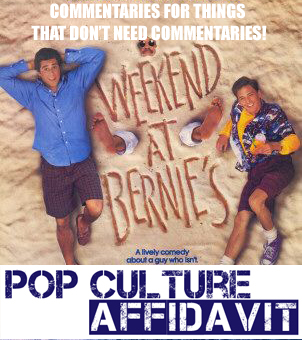
Introducing a brand new occasional feature for the Pop Culture Affidavit Podcast: COMMENTARIES FOR THIGNS THAT DON’T NEED COMMENTARIES! For this first commentary, I take a look at the 1989 Andrew McCarthy/Jonathan Silverman classic, Weekend at Bernie’s.
So grab some popcorn, prop your dead boss up on the couch, sit back, relax, and enjoy!
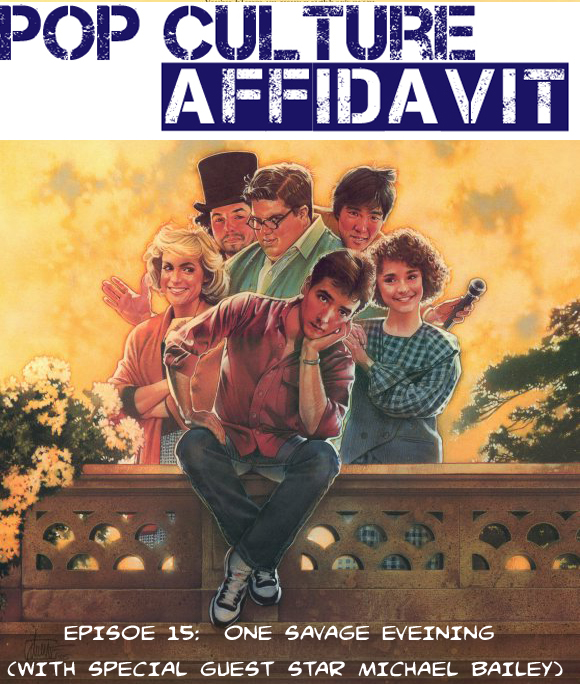
This time out we have an extra-sized and extra-AWESOME episode of the podcast. Joining me is my friend and fellow podcaster Michael Bailey (of Views From the Longbox and From Crisis to Crisis) and we spend THREE FULL HOURS discussing the films of Savage Steve Holland!
Who is Savage Steve Holland, you ask?
You may not necessarily recognize the name but any child of the Eighties will recognize the phrase “I want my two dollars!” That’s right, Savage Steve directed Better Off Dead …, the 1985 John Cusack classic about breakups, French foreign exchange students, psychotic paperboys, and weird neighbors who sit at home crocheting and snorting nasal spray.
But that’s not all we talk about. We also reminisce about Savage Steve’s other two films: the 1986 beach romp One Crazy Summer, which also stars John Cusack as well as Demi Moore and Bobcat Goldthwait; and we talk about his least-known but most-underrated film, How I Got Into College.
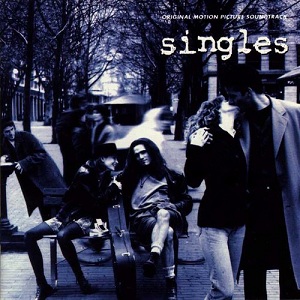
This time around in the podcast I take a look at the 1992 Cameron Crowe-directed film Singles, a romantic comedy whose soundtrack became one of the definitive albums from the 1990s. Starring Campbell Scott, Kyra Sedgwick, Bridget Fonda, and Matt Dillon and set in 1991 Seattle, Singles follows several characters in their twenties as they go through the complexities of trying to date and find love.
But of course, many people remember it for its music: Pearl Jam, Alice in Chains, Soundgarden, Mudhoney, Smashing Pumpkins, and other bands important to the era make appearances on the soundtrack and even in the film, which is a great snapshot of a particular moment in our cultural history.
I spend the episode discussing the movie as well as my opinion of it and then spend a little bit of time on the soundtrack as well as a bit on its lasting legacy.
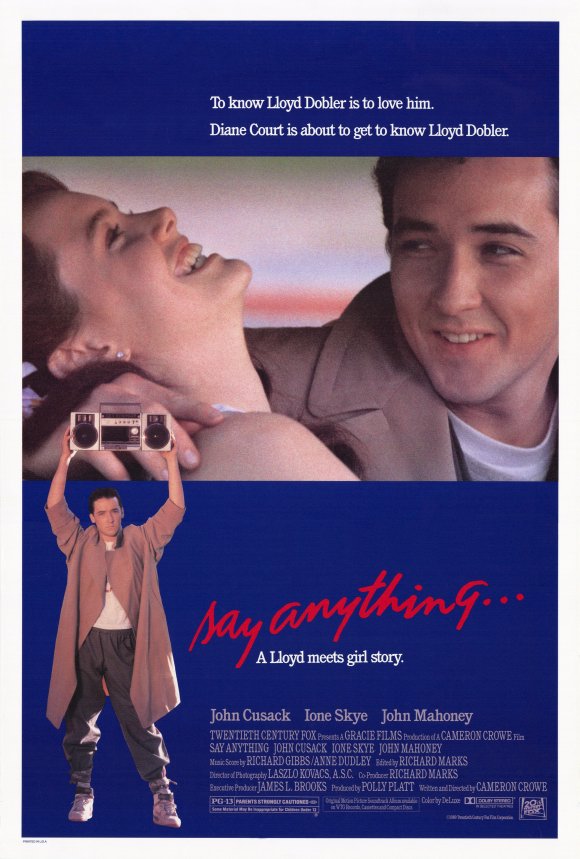
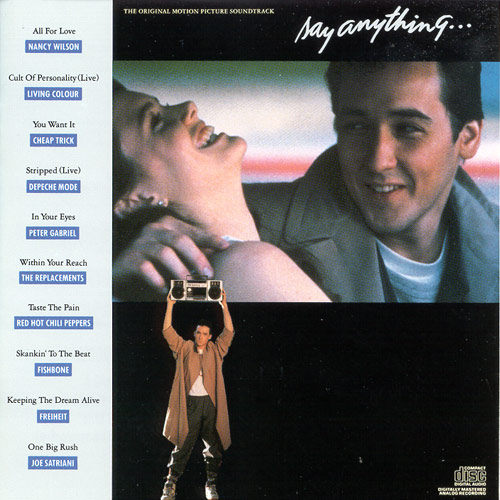
In 1989, Cameron Crowe wrote and directed one of the seminal movies of the teen film genre. Starring John Cusack, Ione Skye, and John Mahoney, it’s Say Anything …, one of my favorite movies of all time.
Join me as I take a look back at the movie, talk about my favorite scenes and also take a look at the soundtrack.
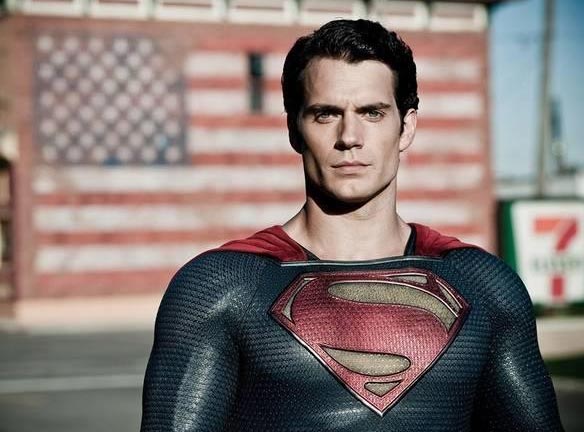
I saw Man of Steel on the day it opened and absolutely loved it. I found myself quietly cheering in a few scenes and actually got choked up in a couple of others. It wasn’t a perfect Superman movie–it could have been maybe 10-15 minutes shorter, a few more jokes would have been nice, and someone needs to confiscate Zack Snyder’s copy of the Singles soundtrack–but when I walked out of the theater I had a big smile on my face and was all, “YES!”
Then, I went on the Internet.
My liking Man of Steel in the midst of a serious backlash over a variety of things (and I’ll keep it spoiler-free for those of you who haven’t seen it) made me feel like I was stupid or had done something wrong. Reading through last week’s Entertainment Weekly made me feel even dumber–they had a fun cover story on Superman’s 75th birthday but then did what’s a typical fake-out for them where the critic destroyed the movie in his review. This week’s issue didn’t help matters much, with Supes appearing in the outer rim of their back page “bullseye” feature with the caption, “Man of Steal–as in, you stole two and a half hours of our life, and we want it back.”
Now, I don’t know why I am taking this as personally as I am taking it. After all, this is only a movie, right? I guess some of it is rooted in the psychological trauma of high school, where I often found myself ridiculed for my musical tastes (among other things–I took a lot of shit from my “friends” in high school, who were actually quite cruel). But I graduated from high school almost twenty years ago and am pretty much over all that crap, although I sometimes wonder if you can be completely over it, especially when you develop reactions to certain behaviors in such a way that they almost become reflexive.
Anyway, this post isn’t meant to be about the shit I went through in high school, it’s meant to be about movies, and it’s not meant to be a defense of Man of Steel, either, because there are plenty of people out there doing that. What led me to writing this post was that in the midst of all of the hand-wringing and Internet-bashing (some of which I am pretty sure is of the “It’s fun to hate on something” variety) about the movie, I began to think about why I like what I like and how I came to have the movie collection that I have. I’m sure there’s enough for an entire book, let alone one blog post, but in thinking about the experience of seeing Man of Steel and then feeling weirdly hurt when the media I read has the complete opposite reaction to the movie that I do, I thought of other times I’ve watched movies and they’ve either changed my tastes or changed the way I view the moviegoing experience. I narrowed it down to six, and since lists are fun, here they are in chronological order. (more…)
 “Dear Mr. Vernon …” On March 24, 1984, five students sat through detention in the Shermer High School library. Now, I take a look at my favorite movie of all time, The Breakfast Club. I break down the movie’s plot and give my review, sharing what makes it so special.





 Pop Culture Affidavit