nostalgia

Memories Can be Wafer-Thin

Necco Wafers

Image from Old Time Candy.

As I have gotten older, I have found that there are some things in my past that are actually better left there.  The quality of certain movies or television shows are the best examples of this, but it can apply to things like food.

From the time I was ten until I was sixteen, I spent a week every summer on Kezar Lake in the extremely small town of North Sutton, New Hampshire.  While it’s not too far away from the larger area of Lake Sunapee, North Sutton is basically comprised of the lake, a bed and breakfast, several homes, and a general store named the Vernondale Store.  When we weren’t swimming, riding our bikes around the lake, or being dragged to a glass factory by our parents, my sister and I as well as our friends would journey up to Vernondale with a couple of dollars to buy baseball cards, Mad Magazine, and candy.

Vernondale stocked a wide variety of candy, but one of our favorites was Necco Wafers.  Wrapped up like a roll of quarters, Necco Wafers are manufactured by the New England Candy Company, or Necco, and have been made sine 1847.  So it’s no wonder they were in such abundance in New Hampshire (another food item, Hires root beer, will definitely get its own post at some point as well).  I’d seen them outside of New Hampshire, but rarely south of the Mason-Dixon line.  There are eight flavors in a roll of Necco Wafers:  lemon (yellow), lime (green), orange (orange), clove (purple), cinnamon (white), wintergreen (pink), licorice (black), and chocolate (brown).

So I was recently at a convenience store and as I made my way from the soda cases to the front counter, I spotted Necco Wafers in the candy rack.  Usually, I would ignore such things, but I felt nostalgic and picked up a pack, then proceeded to write down my reaction to eating each of the eight flavors for the first time in twenty years.

Pink: Well, now I know why I’m able to tolerate the taste of Pepto Bismol.

White: Is this cinnamon?  I’m tasting a little heat here, and it kind of reminds me of when I was a kid and used to suck on cinnamon Certs until I torched the hell out of my tongue.

Black (which  looks more like dark blue): This is obviously licorice and I guess Necco was trying to get me ready for Jager shots later on in life.  It certainly has an aftertaste, so I was prepared for that effect of Jager.

Yellow: This was like alternately sucking on a wafer coated in lemon Pledge and like those old Archway lemon cookies that my dad used to buy in Waldbaum’s every weekend.

Green:  I’ve never eaten a fresh scent Clorox wipe, but I’m pretty sure this is what it tates like.

Brown:  This is obviously chocolate–in fact, they sell entire rolls of chocolate Necco Wafers–but at first it tastes like very little and the actual taste of chocolate sneaks up on you.

Orange: They did a good job here of replicating the flavor of a creamsicle.  In fact, this is probably the way creamsicles are eaten on The Jetsons.

Purple:  Did I just swallow potpourri?

They are, I guess, an acquired taste, and are truly made for a kid’s palate.  Still, my disgust at the flavor gauntlet I ran doesn’t take away from what are some fond memories of vacations gone by.
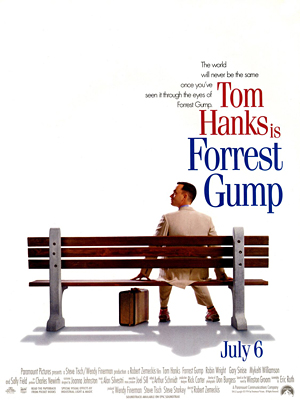
5 Things to Love and 5 Things to Hate About Forrest Gump

Forrest Gump PosterI could not spend a whole year talking about 1994 and calling it “the most important year of the Nineties” if I didn’t take the time to talk about the film from 1994 that would go on to win best picture: Forrest Gump.  Directed by Robert Zemeckis, it is the story of a simple-minded man (the un-PC term would be “mentally retarded”) who winds up living an extraordinary life.  Told through mostly flashbacks, the story concerns Forrest Gump (Tom Hanks), who is sitting on a bus stop bench in 1982 on his way to see Jenny, who as we learn over the course of the movie, is the love of his life.  He tells his life story to anyone who happens to be sitting next to him (as well as the audience):  born in Alabama, Forrest has a low I.Q. and had to wear braces on his legs as a kid until one day he learned how to run.  This served him well more than once, as he played for the University of Alabama football team, served in Vietnam, played diplomatic ping pong, opened a shrimping company, and started a running craze.  Along the way, we also see the life of his girl, Jenny (Robin Wright), who had a life that directly contrasts Hanks’s characcter: she was abused as a child, became a hippie, and spent much of her formative years in a drug- and alcohol-induced haze until finally coming home to Alabama and living with Forrest before leaving (which prompts Forrest to start running and the creation of his running craze).  When Forrest and Jenny meet up after he’s done telling his story, she tells him that she is dying and that she has a son named Forrest, who is the result of the one night that the two of them slept together.  By the end of the film Jenny has passed away and Forrest is now raising his son in his childhood home in Alabama.

That’s a gross simplification of the movie’s plot (after all, I didn’t mention Bubba or Lt. Dan), but most of the people reading this post are probably at least familiar enough with the film to follow along (and if you’re not, the film is available for streaming via Netflix).    Or you can check out the trailer:

So, with the plot out of the way, I thought I’d get to what I wanted to say about this movie, which has not been one of my favorites; in fact, I’ve long contended that with both The Shawshank Redemption and Pulp Fiction nominated for best picture that year, I can’t understand how this won best picture.  Okay, I can see why it was a popular choice for best picture, what with its sentimentality and emotional impact; I can’t understand how the Academy thought that this was more worthy of that particular honor than those two films, the latter of which had a major influence on filmmaking for at least the better part of the rest of the decade (and possibly beyond).

You know, never mind that I saw this three times in the theater, bought the soundtrack, and own a copy on VHS (although for the life of me I have no idea where that copy is).  In fact, I liked the movie when it came out.  It was beautifully shot, was pretty funny, and the music was great.  But it did not age well, especially after I saw Pulp Fiction and read Winston Groom’s novel upon which the film is based.  The novel turned me against the film in a big way, as Groom’s Forrest is a lot less likable than the buffoon with a heart of gold that Hanks plays on screen (and for which he won Best Actor).  Prior to writing this post, I hadn’t watched the film since 1996 and decided to give it a fair shake.  I didn’t hate it as much as I thought I would, although I still think it wasn’t worth the Best Picture honor (and I still maintain that it’s right up there with the oft-derided Ordinary People’s victory as Oscar larceny).  So what I did was do what any lazy good blogger does, and that’s made a list.  So here are the top five things I liked and the top five things I hated about Forrest Gump. (more…)

Pop Culture Affidavit, Episode 31 — The 1994 Grab Bag!

man reaching into grab bagWhat do Beverly Hills, 90210, the 1994 Baseball Strike, and Zima all have in common?  They’re all covered in the latest episode of Pop Culture Affidavit!  As part of my series of posts and episodes called 1994: The Most Important Year of the Nineties, I take a look at ten completely random things from 1994.  It’s movies, television, music, and current events all in one convenient episode!

You can listen here:

iTunes:  Pop Culture Affidavit

Direct Download 

Pop Culture Affidavit podcast page

(more…)

Leave Yourself Behind

Tom Paris 1994A quick note:  This piece originally appeared on an old blog of mine in July 2004.  I’ve edited and updated it.

My only regret is that I did not stay longer. I would have loved to experience more, go deeper into some countries and learn more about other cultures. However, being a Student Ambassador has opened my mind even further, as I am forced to think on a global scale about my life, and the lives around me.

That is the final paragraph of the journal I kept during the summer of 1994, after I had spent 23 days touring France, Germany, Switzerland, and Spain as a People to People Student Ambassador. Written on a flight back from Paris after my fellow “ambassadors” and I had exhausted the plane’s supply of coffee and soda and had annoyed all of the other passengers, it’s a statement typical of a 17-year-old. At the time, I thought that the program changed my life. Of course, at 17, it had. Being on the verge of my senior year of high school, I was making earnest statements like that on a regular basis. Still, I cannot discount that those three weeks were a turning point in my adolescence, the result of a program whose educational experience was more well-rounded than intended.

Can You Really Get There From Here?

The mission of People to People International and its Student Ambassador program is: “to bridge cultural and political borders through education and exchange, creating global citizens and making the world a better place for future generations.” I received their brochure in the fall of my junior year, right around the time my guidance counselor was drilling into my head that I was in the most important year of my academic career, perhaps even my life. As a result, I went looking for the type of opportunities that would look good on what eventually became a rejected application to Dartmouth — Anchor Club historian, student journalist, and mock trial lawyer. “Student Ambassador to Europe” was something that college admissions officers were impressed with. Europe was where great art was born; where history took place; and where entire generations of disaffected young Americans fled to find themselves.

I convinced my parents that not only would I make it into the program, I would somehow come up with $1200 of the trip’s cost. Not that I knew how I was going to pull that off — this wasn’t exactly like the time I hoarded my $25/week from JillMatt Cards & Gifts so that I could save enough money to visit my friend Chris in Fort Lauderdale. But after some creative publicity, including a story in The Suffolk County News and a talk with the Kiwanis Club (where I made a never-fulfilled promise to come back and speak to them), I had my tuition. On June 24, I set off for Kennedy airport, where I met up with the rest of the Long Island delegation. We had our flight to Washington, D.C. canceled and were forced to cab it to LaGuardia where, in a move reminiscent of a bad Amazing Race moment, two of our group members were dropped off at the Delta terminal and not the Delta Shuttle terminal.

Don’t Smurf an International Incident

Ultimately, my People to People delegation arrived in Washington intact. The entire group of 28 hailed from Long Island, Connecticut, Virginia, Tennessee, and California, and was lorded over by three advisors — the LaMers of Connecticut and Mary Nolan, who had run the Long Island pre-trip meetings. They were all nearing senior citizenship (if they weren’t there already), and I have to admit that I admire anyone that age who is willing to travel for three weeks with a group of unruly teenagers. They had some help during those first few days while we stayed at George Washington University, where People to People’s representatives laid down all of the rules.  Essentially, they wanted to avoid three things: the “ugly American” syndrome, an international incident, and a babysit-the-rich-kids summer camp. I mean, that’s why the Student Ambassador program director stood on the stage in a university lecture hall and told us that we weren’t allowed to drink, smoke, do drugs, have sex, or even form cliques.

I honestly thought that last one was insane. Not that I wanted cliques to form, but it seemed that with 28 teenagers in close quarters, cliquing up was inevitable. In fact, small groups of friends formed on the very first day and would get even more defined as the trip went on. But when up against Papa & Mrs. Smurf (named so for Mr. LaMers’ beard) and Punky (Mary Nolan wore a spiked femullet), we were a single group of 28 students who annoyed everyone on the National Mall, the Metro and in the Crystal Underground. I guess all the things that annoyed me about D.C. when I was living and working there, then, were come-uppance for my acting like an asshat at 17. But anyway, I wrote about our initial camaraderie: “We started as … two groups of people from different states. We left as a group of Americans wearing stupid shirts and name tags.” (more…)

Pop Culture Affidavit Episode 30: “Summer 1999”

Episode 30 coverFifteen years ago this summer, moviegoers were treated to one of the best and most consistent moviegoing experiences in history.  Walk with me through ten movies from the summer of 1999, from The Phantom Menace and its ultimate disappointment to The Blair Witch Project and its being the scariest surprise of the season!

You can listen here:

iTunes:  Pop Culture Affidavit

Direct Download 

Pop Culture Affidavit podcast page

Below are the ten movies I talk about and their trailers, which you’ll hear in the episode … (more…)

June 17, 1994: The Most Important Day of the Nineties

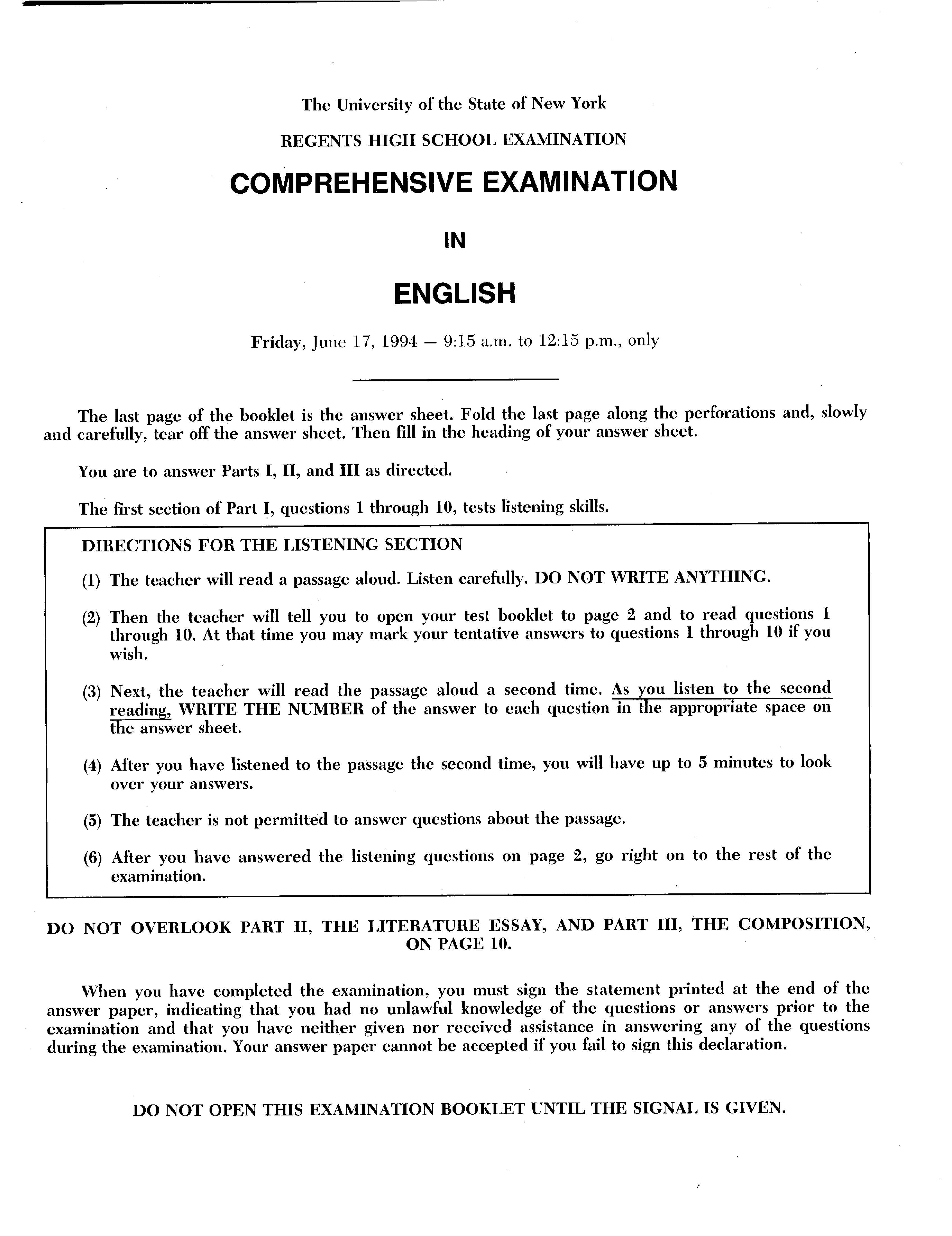
The cover to the 1994 Regents exam in English.

The cover to the 1994 Regents exam in English.

Had the events of the evening of June 17, 1994 not proceeded the way they did, i am sure that I would have remembered the day anyway.  It wouldn’t have had the national significance that it does; still, it’s not every year that the Rangers get a ticker tape parade because they won the Stanley Cup.  In fact, that day wound up marking the end of two significant periods of my life hours before O.J. and A.C. managed to take the Los Angeles Police Department and every television station in the country up the 405 for 50 miles and a few hours.

At 8:30 that morning in the Sayville High School gymnasium, I sat down to take my English Regents.  This was both the culmination of three years of novels, plays, literary essays, and compositions at the hands of my English teachers as well as the very last Regents I would have to take.  That may not seem like much, especially to people who did not grow up and attend public school in New York State, but those who did know exactly what I mean when I say that I considered the end of my Regents-taking career to be a cause for celebration, if however minor.

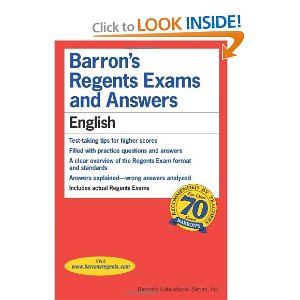
Regents were what kept us in school until late in June (well, that an starting after Labor Day and having a week off in February) and were a ritual for high school students since the New York State Department of Education started them way back in the 1930s (a quick look at the archives, shows tests on homemaking in the 1950s and 1960s).  Coming sealed in plastic and bearing titles like “The University of the State of New York Regents High School Examination Comprehensive Examination in English,” the tests were more than a rite of passage–they were one of the most important rituals of our academic careers.  Starting after Easter, our book bags were further weighed down with Red Barron’s books full of old tests, which we’d take and then pore over to see what we were doing right and what needed improvement.

A Barron's Regents review book, courtesy of Amazon.com

A Barron’s Regents review book, courtesy of Amazon.com

And English wasn’t particularly hard, although I’m sure my students would blanch at the sight of it.  Whereas current students in Virginia take SOL exams in reading and writing that are passage-based and have one simple five-paragraph prompt-based persuasive essay, my generation had to endure spelling,  definitions, two essays (a literary analysis piece and a composition), and a listening section.  That’s right–a portion of our test required us to sit and listen while our teachers read a passage and we had to answer multiple-choice questions based on what we heard.  I’m sure that such a concept would send today’s average anti-testing advocate/expert into a blood-vomiting rage.  Personally, I never thought twice about it, but then again I was one of those students they’d accuse of having Stockholm Syndrome or something because I dutifully took my Regents exams and did well in school.

Anyway, I remember chugging through the multiple choice, choosing one of the two literary essay prompts (which have both made their way onto my 10th grade advanced English final in recent years) and writing a composition that I think I titled “Notes From a Rest Stop on the Information Highway.”  It was my attempt at wit, I guess, and it seemed to work because I did well enough to continue on my path to graduating with honors a year later.

A page from the spelling section of the 1994 Regents English exam.

A page from the spelling section of the 1994 Regents English exam.

I wasn’t thinking of any of that while taking the test, of course, because the Rangers parade was going to be on television and the Regents exam was the only reason I hadn’t asked my parents if I could take the train to the city that morning (same could be said for my friends as well because we all had to take the Regents).  So like everyone else, I watched it on television.  To this day, the Rangers hoisting the Cup as they drove through the Canyon of Heroes followed by the presentations at City Hall seem surreal.  I wasn’t wearing my jersey–I had finally thrown that in the laundry after superstitiously refusing to wash it throughout the playoffs–but I was glued to my television set the way I was eight years earlier when my dad taped the 1986 Mets parade for me.

The Rangers hoist the cup on Broadway.

The Rangers hoist the cup on Broadway.

Of course, the television would be more important later that night.  But I didn’t know that; did anyone?

Stone Temple Pilots were supposed to appear on Letterman.  I don’t think that’s why I stayed home, but at some point in the afternoon, I made a mental note to stay up late and turn on The Late Show after I was done with whatever Friday night plans I had made–which, knowing my life in 1994 was probably renting videos and watching them in the basement–so I could see one of my favorite bands.  But of course, that didn’t happen.  Well, the STP performance actually did because Letterman taped his show in the afternoon, but it never aired.

At some point–I don’t remember when–I turned on the television and saw live footage of a white Ford Bronco speeding down a Los Angeles freeway followed by police.  The news reporters said that driving the Bronco was Al Cowlings and his passenger was O.J. Simpson. (more…)

Pop Culture Affidavit, Episode 29 — Now I Can Die in Peace

Episode 29 CoverTwenty years ago, the New York Rangers won their first Stanley Cup since 1940.  Join me as I reminisce about that amazing run and talk about my life as a Rangers fan as well as share the memories of some of my friends.

You can listen here:

iTunes:  Pop Culture Affidavit

Direct Download 

Pop Culture Affidavit podcast page

And in case you’d like to relive the entire season, here is “OH BABY!” the Rangers highlight video from 1994:

http://www.youtube.com/watch?v=anIxQbYGoAk


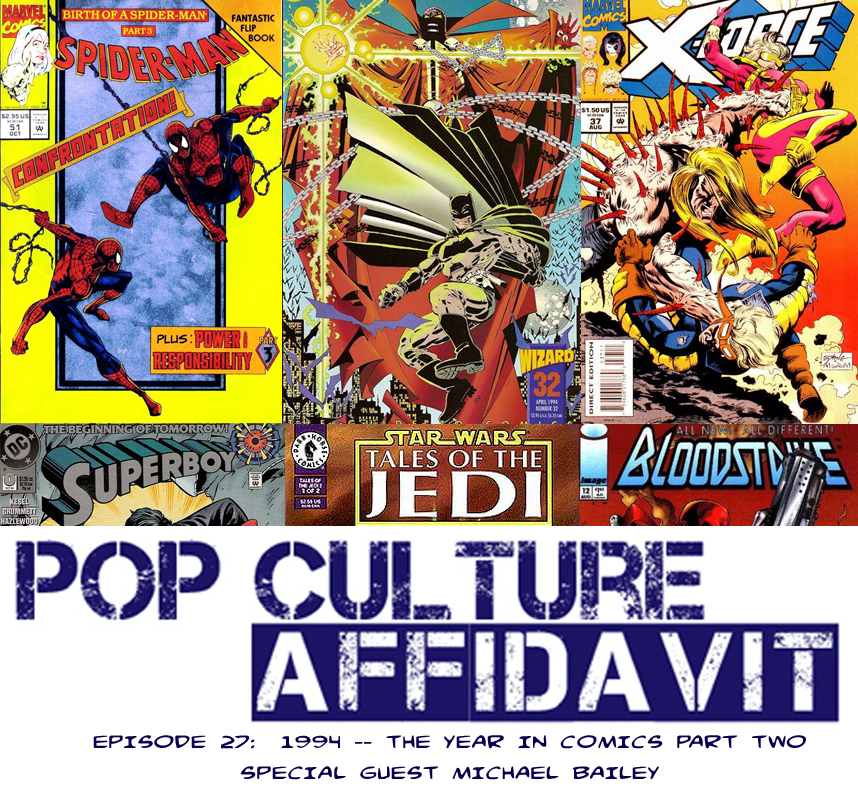
Pop Culture Affidavit, Episode 27: 1994 — The Year in Comics, Part Two

Episode 27 CoverIt’s It’s the big conclusion of my conversation with Michael Bailey about 1994 in comics.  Whereas we spent last episode talking about the comics industry, we spend most of this episode talking about what we thought were the most important comics of the year.the big conclusion of my conversation with Michael Bailey about 1994 in comics.  Whereas we spent last episode talking about the comics industry, we spend most of this episode talking about what we thought were the most important comics of the year.

You can listen here:

iTunes:  Pop Culture Affidavit

Direct Download 

Pop Culture Affidavit podcast page

And for your viewing pleasure, here is the Zero Hour/Zero Month promo video that Mike mentions in the episode:

A Banquet, a Song, a Date, a Mug

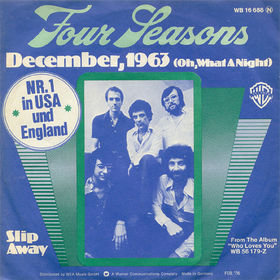
December_1963_oh_what_a_nightA few months ago, I was doing the dishes after breakfast, and after putting my coffee mug in the drying rack, I heard it crash to the floor.  I sighed and grabbed the broom and dustpan, and while sweeping it up, got annoyed.  I was annoyed at myself for not being careful, but also annoyed that a mug I had owned for twenty years was now gone.

The black coffee mug with a gold rim and “Sayville High School ’95” was the favor from my junior banquet, which took place on April 18, 1994. I honestly don’t know why it was called a banquet and not a prom–I suspect it had something to do with the seniors not wanting the juniors to call our dance a “prom” because my high school was all about that petty sort of crap–but it was the first formal school dance I ever attended.  In fact, if you want to get technical, it was my first date.

It is shocking to absolutely no one that I was an incredibly late bloomer.  Oh sure, I knew as early as elementary school that I liked girls, but at sixteen, I had not evolved socially beyond the awkwardness I had around girls when I was twelve.  I could control my behavior and wasn’t as obnoxious or immature in the presence of a pretty girl, but I still had ridiculous crushes on girls who were way out of my league, and even as late as college it took signals brighter than the average Times Square billboard for me to pick up on the fact that someone found me even marginally attractive.  In fact, at that point, my pursuit of the opposite sex amounted to asking out my crush in the ninth grade (and getting rejected) and getting friendzoned by someone prior to Christmas break, so the idea that I’d actually get a date for a dance was pretty ridiculous.

The junior banquet, though, was the social event of the year–at least for me, anyway–and because of that I felt that finding a date was necessary.  Okay, there was no stated obligation to find a date, but I definitely felt some sort of pressure to make sure I had a companion for the evening.  Maybe it was because my friends were getting dates or maybe because the dance was formal.  Personally, I blame our class’s choice of a theme song:  “Oh What a Night.” (more…)

Interstate Love Song

Interstate Love SongThere have only been a few times where I looked at the title of a song and said, “This is going to be a good one.”  Usually, song titles are pretty innocuous and if you were to give me a list of titles from a band’s latest album, I’d shrug.  The song’s called “Stay?”  Well, that could mean anything.  But like I said, every once in a while, I see “Raining in Baltimore” or “Elderly Woman Behind the Counter in a Small Town” and pay a little more attention to what it might be about.

Such was the case with “Interstate Love Song.”

When Purple was released in early June 1994, I had been waiting in anticipation for a couple of weeks.  “Big Empty” had been playing on the radio and in commercials for The Crow, and “Vasoline” had made its debut a week before.  Couple that with the fact that Core was still in regular rotation in my CD player and I didn’t need anything else to be sold.  I’m not sure if I bought the album the week it came out or if I picked it up a few weeks later.  All I know is that one afternoon, I came home from the mall (probably Sam Goody) with copies of Purple and 10,000 Maniacs’ MTV Unplugged.

One of my friends, who was the self-appointed authority when it came to all things music, wasn’t too hot on the album because it wasn’t as heavy as Core; however, I actually preferred Purple, and my co-purchase of the 10,000 Maniacs album should have been a sign that I had different tastes (the number of times that girls I knew borrowed said 10,000 Maniacs CD should have also been a sign that I was on the right track).  Purple wasn’t exactly a revelation in the way Dookie would become later that year, but in hindsight, it was a sign that the alternative music scene was lightening up a little.  “Big Empty” was the “this is the same as Core” track; “Vasoline” was a little different but still had guitars and speed the way I thought guitars and speed should be in a song.  But “Interstate Love Song?”  I looked at the title and wanted to listen to it because it sounded like a great title, even if a love song–which was more suited to people like Jon Secada–did not fit the criteria for a “good” song among my friends and I.  I mean, we listened to metal, not love songs.

Okay, my friends listened to metal and I was only listening to it so I could fit in.

Even so, that title drew me in.  I wanted to know more.  So after binging on “Big Empty” and “Vasoline,” I skipped ahead to track #4 and almost immediately, Purple’s status above Core as the better of the two albums, was established.  The tune hooked me in, which is perfect because I couldn’t understand what the hell Scott Weiland was actually singing about anyway.

By the way, it’s heroin.  He’s singing about heroin.

Okay, that’s not entirely true, although his heroin addiction–which was common among musicians of the early 1990s alternative scene–is something he’s cited in interviews as an inspiration.  The song’s also about honesty, and touches upon how relationships are inherently complicated.  Having not been in a relationship yet when I was sixteen, I didn’t know anything about this.  But I understood, on some level, the song’s sense of longing and of hoping for something (albeit pessimistically).

“Interestate Love Song” would eventually receive the highest of honors when it came to my musical tastes–I put it on a mix tape for a girl.  Granted, I had completely misinterpreted the song and had it mean something about long-distance relationships (I guess I took the title a bit too literally), but in that misinterpretation, the song wound up fulfilling the purpose of a mix tape anyway–it was repurposed by a listener.  And that’s usually why it’s one of those songs that reminds me of being a teenager, with the contradiction between its tune and its meaning recalling the conflict between youth and burgeoning adulthood and the struggle between longing and ultimate fulfillment.