Sayville

We Wrote the Book on Savings

consumers catalog

The cover of the fall 1991-1992 Consumers catalog. The company stayed in business until the mid-1990s, although my local store was gone by then.

I think that I am at the point in my life where I don’t get upset if I go to the store and something is out of stock.  Oh sure, it’s a minor inconvenience and the solution usually leads to me getting in the car and driving to another, similar store down the road.  But when you are a kid, this is a hard lesson to learn.  You don’t have a car and you don’t know much about the stores in your area beyond what you have seen whenever your parents have taken you, so showing up to TSS only to find out that the action figure you wanted was completely sold out can be absolutely devastating, even if it provides you with much-needed lessons about how you’re not always able to get what you want instantly.  Now, I’m sure that if you ask a number of people in my generation how they learned this lesson, they’ll tell you a variation on the same story–they wanted a toy, they asked mom or dad to take them to the store to get it, it wasn’t there.  Or they may say one word:  “Consumers.”

Consumers was a catalog-based store that was founded in Canada as Consumers Distributing in 1957 and expanded over the course of a couple of decades, adding stores and then buying out other, similar retail outlets, something that helped them to pop up with more frequency during the 1980s.  The idea behind the store was similar to its main competitor, Service Merchandise:  the company published a catalog and then anyone who wanted to buy something from the catalog would head to the local retail outlet–usually at a mall–and pick it up.

That is, if they actually had anything.

The G.I. Joe page of a 1980s Consumers catalog. Photo courtesy of YoJoe.com

The arrival of the Consumers catalog twice a year was an event.  My friends and I would grab it out of the mail and skip right to the toys and games section.  Open before us was a display of everything we ever wanted, from G.I. Joe figures and vehicles to every Nintendo game that we’d ever seen advertised anywhere.  Plus, the prices were much better than what you would get at Toys R Us–not that Toys R Us was overpriced or anything, but any time you can say, “Hey Mom!  The Legend of Zelda is only $45 and not $60!  Can we get it?” you have a better shot at getting what you wanted.

That is, if your parents were completely gullible, which mine were not, but that didn’t stop me from trying.  Unfortunately for those who actually got this ploy to work, going to Consumers was usually a bust because they would head to the store, find the item on display, give the cashier a ticket and most of the time discover that said item was currently out of stock.  According to the Wikipedia page on the store, this led to the company creating what was then an innovative inventory checking system, where they were able to look up the item you wanted on the inventory of every store in the area, which is something that we take for granted in today’s retail world.

But the prevailing perception was that most of the merchandise at Consumers was non-existent and as much as the company tried to change that, I don’t think it really helped.  It also didn’t help that the Consumers store in the Sayville area was in the Sun Vet Mall, a mall that was closer than any of the malls in the area but was clearly third-tier, especially when compared to the South Shore Mall and Smith Haven Mall, which had big-name department stores.  Sure, Sun Vet had The Gap, which was convenient when I was in junior high and high school, but its anchors were a Rickel Home Center and a PathMark, so it didn’t exactly scream “Galleria” if you know what I mean.

The Consumers store was located in the corner of the mall near the Gap and McCrory, both of which have since left, and whereas the other malls always were bustling, Sun Vet always seemed half dead and while the mall’s pizzeria was excellent and Sun Vet Coin and Stamp always was good for a few back issues, you only went there if you absolutely had to or if you were like me and my friend Jeremy, who would ride there on our bikes when we were teenagers simply because we had very little else to do.  Whereas Service Merchandise would be a huge store that was part of a brand new shopping center down the road, Consumers was shoved into that corner and while the first few catalogs would get people there, the store was pretty dead within a year or two, especially as we’d taken to dragging our parents back to Toys R Us or anywhere else where we knew that would have what we wanted in stock.

So in a way, it was a learning experience about being more strategic in begging for toys and other stuff as well as being more patient, and perhaps that is why so many of us are more intelligent these days about where we shop.
My mutant power activated the day I was left “Far Behind”

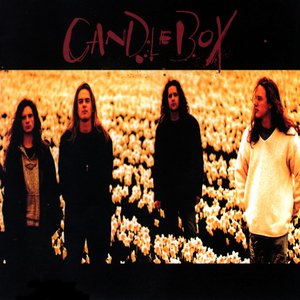
CandleboxThere’s a running joke that Michael Bailey (of Views From the Longbox fame) and I have going about us having “the same childhood”–being close in age and having grown up being able to watch a lot of the same TV channels, he and I have a lot of shared experiences when it comes to entertainment from the 1980s and 1990s.  What makes this coincidence possibly more weird than funny, however, is that we both have the same mutant power.  Both Mike and I have the ability to remember exactly where we were and what we were doing when we first saw a particular movie, heard a certain song, read a certain comic book, or encountered a number of other pieces of popular culture.  I can take it one step further and tell you exactly where I was and what I was doing when my mutant power manifested itself.  It was the day after Thanksgiving in 1994 and I was in my friend Vanessa’s kitchen.  My girlfriend was breaking up with me over the phone and in the background of our conversation was Candlebox’s “Far Behind.”

Written as a tribute to Andrew Wood, the late singer of the seminal Seattle band Mother Love Bone, “Far Behind” is arguably the most well-known song off of Candlebox’s 1993 self-titled album.  It was released on January 25, 1994 and peaked at #18 on the Billboard Hot 100, although it’s important to note that it was on the charts for most of the year and by the end of November 1994 was still in the top 40, having dropped to #35.  But chart position for rock in 1994 wasn’t terribly important to those of us who were living on a steady diet of any band that we thought was quality in the wake of the coming of Nirvana and Pearl Jam during my freshman and sophomore years of high school, and since Candlebox sounded similar to Pearl Jam, Soundgarden, and Alice in Chains, I heard songs like “You” (their first single) and “Far Behind” and picked up the album.

I honestly had no idea that this was a tribute song.  In fact, I had no idea who Andrew Wood was back in 1994 and my only experience with Mother Love Bone was the song “Chole Dancer/Crown of Thorns,” which was on the Singles soundtrack.  I figured it was a typical-for-the-era breakup song/torch song, and to be honest, the events surrounding the day after Thanksgiving 1994 definitely contributed to that, especially since I took that moment very hard and it would take the better part of a year for she and I to get around to being friends without “We had once gone out and you broke up with me and I’m still pissed” being the elephant in the room.  And that had more than anything to do with my immaturity–even though we only went out for a couple of weeks, she was the first girl I’d ever really dated and therefore this was my first real breakup.  So “Far Behind” became its theme song and every time I heard itI’d picture myself hanging out with Vanessa, who was home on break from college, calling up the girlfriend, and hearing her awkwardly ramble her way through a breakup that ended with “Well, I think we should just be friends.”  It got to the point where it was like I was following some sort of masochistic ritual, and when I signed her yearbook that June I drove home the point by quoting the opening lines: “Well maybe I didn’t mean to treat you bad, but I did it anyway.”  Because, you know, I was a senior in high school but when it came to girls I sometimes felt like I was still in junior high.

Despite all that, she and I are still friends and in a weird sort of way, this is a belated thank-you note to her because most importantly, that breakup was where memories of certain events or people in my life really began to be associated with something in popular culture and I began to think along the lines of “I remember when I first saw/heard this.”  I hadn’t listened to “Far Behind” in nearly twenty years before watching the video on YouTube–a video I had, by the way, never seen before because I didn’t have cable in high school, and one that is so very Nineties (seriously, the empty pool, the color scheme, the guy walking around aimlessly, the outfits … this isn’t a music video, it’s an artifact in a Nineties museum)–and that’s not because of my memories but more because of my changing tastes in music (unlike Live’s Throwing Copper which I refused to listen to for years because of a girl and now refuse to listen to because Live simply sucks).  Hearing it now, I can still see the wood paneling in Vanessa’s house and remember our conversations about David Letterman before picking up her phone and having that conversation and having my stomach drop, a moment that at the time was painful but eventually became almost bittersweet because of its normalcy and innocence.

Memories That Overshadow Movies

Just because we're both hideous doesn't mean we'll be compatible.

Just because we’re both hideous doesn’t mean we’ll be compatible.

About five years ago, I was showing Mary Shelley’s Frankenstein to a room full of high school seniors. We got to the scene where the monster (Robert DeNiro), who is now at the point where he has Victor Frankenstein (Kenneth Branagh) by the throat and is forcing the good doctor to make him a bride from the tattered remains of Helena Bonham Carter. The Bride of Frankenstein, so to speak, emerges from the 19th-Century life-giving apparatus and Victor and the monster begin calling to her, telling her to come to each of them as if she’s a puppy trying to choose between two owners.

I went on to ask my students about how Hollywood is forever getting Frankenstein completely wrong as I thought about how I missed how bad this movie was back when I saw it in the theater in 1994. After all, by putting the name of the author above the title–a trend that eventually died out after William Shakespeare’s Romeo & Juliet because … Shakespeare Wrote Romeo & Juliet? Thanks for telling me, Baz–Kenneth Branagh’s film purported to be the definitive adaptation of Mary Shelley’s classic horror novel. And to a point, it actually works out pretty well–bride-dog moments aside, the basic structure of the plot is there–but in many areas it falls flat and that’s why I was wondering why I liked it when I was seventeen. Then I realized that like a few of my entertainment choices in the mid-1990s, this story begins with the phrase: “You see, there was this girl …”

While I know it shouldn’t, being on a date drastically changes your perspective on the film you’re watching. The night I went to see Mary Shelley’s Frankenstein, I was on my first official date with a girl I had been friends with for a couple of years, but we’d been hanging out a lot and that prompted me to do the math: our hanging out together + she knowing that I liked her = she might actually want to go out with me. This wouldn’t mean very much to your average seventeen-year-old boy, but I wasn’t exactly your average seventeen-year-old boy. I had spent the majority of my adolesence being painfully awkward around girls, acting immature and not knowing what to say. The more attracted I was to a girl, the worse that awkwardness was, and that is probably the reason I didn’t go on a single date until that night in November to see Mary Shelley’s Frankenstein. So I spent most of the movie not concentrating on the film but trying to figure out how to properly behave so that the date went well and by the end of the night I could … well, I guess the experession “get to first base” would apply. In the blur of Branagh, Bonham Carter, DeNiro and Aidan Quinn (I remember his part because she squeed when she saw him), I worked on trying to find the right moment to put my arm around her, followed by trying to figure out a tactful way of taking my arm away when it started to go numb. It was ten times tougher than the calculus class I had every first period.

Not to brag, but I was successful. Okay, it’s not much of a brag because we walked from the movie theater to the corner near both of our houses and I spent what might have only been two minutes but felt like ten awkwardly and nervously chuckling and making small talk until I finally made a move and kissed her good night. It wasn’t my first kiss–that had come the previous summer when I was away in Europe–but it was my first “date” kiss, the first kiss that had the potential to lead to something more than a goodbye and a half-assed attempt at writing letters to one another for the first month after I got home. Never in my life had so much depended on one very chaste kiss at the end of the night; never in my life had a moment been so charmingly small town that they don’t even write those types of moments anymore.

I haven’t watched Mary Shelley’s Frankenstein in its entirety since that moment in my classroom five years ago; I’ve been more or less permanently teaching sophomores since then and high-concept, high-budget horror from the 1990s isn’t as interesting to me as low-budget schlock from the 1980s. And I guess I’ll keep it that way because for once I don’t mind having a memory overshadow a movie.

Leave Yourself Behind

Tom Paris 1994A quick note:  This piece originally appeared on an old blog of mine in July 2004.  I’ve edited and updated it.

My only regret is that I did not stay longer. I would have loved to experience more, go deeper into some countries and learn more about other cultures. However, being a Student Ambassador has opened my mind even further, as I am forced to think on a global scale about my life, and the lives around me.

That is the final paragraph of the journal I kept during the summer of 1994, after I had spent 23 days touring France, Germany, Switzerland, and Spain as a People to People Student Ambassador. Written on a flight back from Paris after my fellow “ambassadors” and I had exhausted the plane’s supply of coffee and soda and had annoyed all of the other passengers, it’s a statement typical of a 17-year-old. At the time, I thought that the program changed my life. Of course, at 17, it had. Being on the verge of my senior year of high school, I was making earnest statements like that on a regular basis. Still, I cannot discount that those three weeks were a turning point in my adolescence, the result of a program whose educational experience was more well-rounded than intended.

Can You Really Get There From Here?

The mission of People to People International and its Student Ambassador program is: “to bridge cultural and political borders through education and exchange, creating global citizens and making the world a better place for future generations.” I received their brochure in the fall of my junior year, right around the time my guidance counselor was drilling into my head that I was in the most important year of my academic career, perhaps even my life. As a result, I went looking for the type of opportunities that would look good on what eventually became a rejected application to Dartmouth — Anchor Club historian, student journalist, and mock trial lawyer. “Student Ambassador to Europe” was something that college admissions officers were impressed with. Europe was where great art was born; where history took place; and where entire generations of disaffected young Americans fled to find themselves.

I convinced my parents that not only would I make it into the program, I would somehow come up with $1200 of the trip’s cost. Not that I knew how I was going to pull that off — this wasn’t exactly like the time I hoarded my $25/week from JillMatt Cards & Gifts so that I could save enough money to visit my friend Chris in Fort Lauderdale. But after some creative publicity, including a story in The Suffolk County News and a talk with the Kiwanis Club (where I made a never-fulfilled promise to come back and speak to them), I had my tuition. On June 24, I set off for Kennedy airport, where I met up with the rest of the Long Island delegation. We had our flight to Washington, D.C. canceled and were forced to cab it to LaGuardia where, in a move reminiscent of a bad Amazing Race moment, two of our group members were dropped off at the Delta terminal and not the Delta Shuttle terminal.

Don’t Smurf an International Incident

Ultimately, my People to People delegation arrived in Washington intact. The entire group of 28 hailed from Long Island, Connecticut, Virginia, Tennessee, and California, and was lorded over by three advisors — the LaMers of Connecticut and Mary Nolan, who had run the Long Island pre-trip meetings. They were all nearing senior citizenship (if they weren’t there already), and I have to admit that I admire anyone that age who is willing to travel for three weeks with a group of unruly teenagers. They had some help during those first few days while we stayed at George Washington University, where People to People’s representatives laid down all of the rules.  Essentially, they wanted to avoid three things: the “ugly American” syndrome, an international incident, and a babysit-the-rich-kids summer camp. I mean, that’s why the Student Ambassador program director stood on the stage in a university lecture hall and told us that we weren’t allowed to drink, smoke, do drugs, have sex, or even form cliques.

I honestly thought that last one was insane. Not that I wanted cliques to form, but it seemed that with 28 teenagers in close quarters, cliquing up was inevitable. In fact, small groups of friends formed on the very first day and would get even more defined as the trip went on. But when up against Papa & Mrs. Smurf (named so for Mr. LaMers’ beard) and Punky (Mary Nolan wore a spiked femullet), we were a single group of 28 students who annoyed everyone on the National Mall, the Metro and in the Crystal Underground. I guess all the things that annoyed me about D.C. when I was living and working there, then, were come-uppance for my acting like an asshat at 17. But anyway, I wrote about our initial camaraderie: “We started as … two groups of people from different states. We left as a group of Americans wearing stupid shirts and name tags.” (more…)

June 17, 1994: The Most Important Day of the Nineties

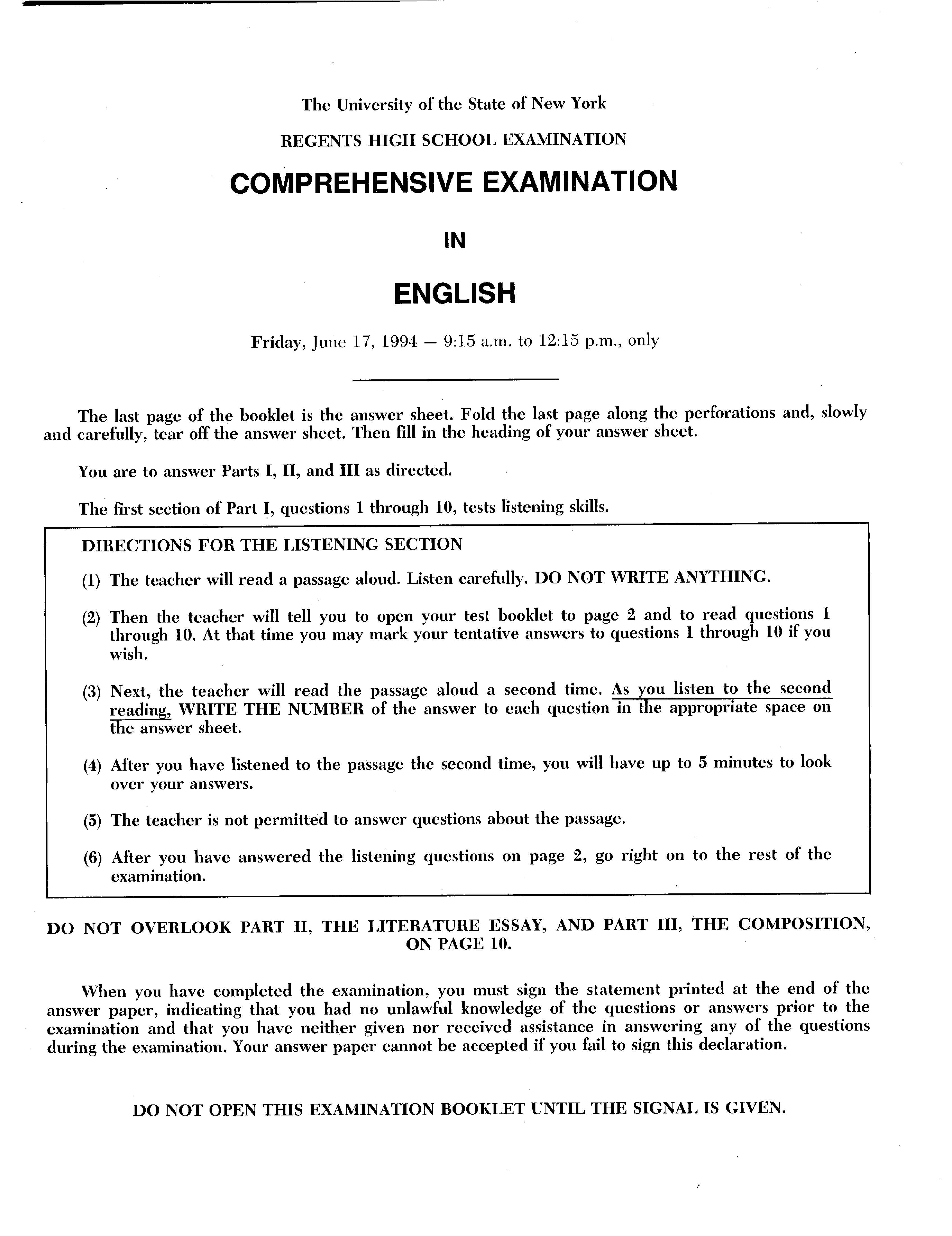
The cover to the 1994 Regents exam in English.

The cover to the 1994 Regents exam in English.

Had the events of the evening of June 17, 1994 not proceeded the way they did, i am sure that I would have remembered the day anyway.  It wouldn’t have had the national significance that it does; still, it’s not every year that the Rangers get a ticker tape parade because they won the Stanley Cup.  In fact, that day wound up marking the end of two significant periods of my life hours before O.J. and A.C. managed to take the Los Angeles Police Department and every television station in the country up the 405 for 50 miles and a few hours.

At 8:30 that morning in the Sayville High School gymnasium, I sat down to take my English Regents.  This was both the culmination of three years of novels, plays, literary essays, and compositions at the hands of my English teachers as well as the very last Regents I would have to take.  That may not seem like much, especially to people who did not grow up and attend public school in New York State, but those who did know exactly what I mean when I say that I considered the end of my Regents-taking career to be a cause for celebration, if however minor.

Regents were what kept us in school until late in June (well, that an starting after Labor Day and having a week off in February) and were a ritual for high school students since the New York State Department of Education started them way back in the 1930s (a quick look at the archives, shows tests on homemaking in the 1950s and 1960s).  Coming sealed in plastic and bearing titles like “The University of the State of New York Regents High School Examination Comprehensive Examination in English,” the tests were more than a rite of passage–they were one of the most important rituals of our academic careers.  Starting after Easter, our book bags were further weighed down with Red Barron’s books full of old tests, which we’d take and then pore over to see what we were doing right and what needed improvement.

A Barron's Regents review book, courtesy of Amazon.com

A Barron’s Regents review book, courtesy of Amazon.com

And English wasn’t particularly hard, although I’m sure my students would blanch at the sight of it.  Whereas current students in Virginia take SOL exams in reading and writing that are passage-based and have one simple five-paragraph prompt-based persuasive essay, my generation had to endure spelling,  definitions, two essays (a literary analysis piece and a composition), and a listening section.  That’s right–a portion of our test required us to sit and listen while our teachers read a passage and we had to answer multiple-choice questions based on what we heard.  I’m sure that such a concept would send today’s average anti-testing advocate/expert into a blood-vomiting rage.  Personally, I never thought twice about it, but then again I was one of those students they’d accuse of having Stockholm Syndrome or something because I dutifully took my Regents exams and did well in school.

Anyway, I remember chugging through the multiple choice, choosing one of the two literary essay prompts (which have both made their way onto my 10th grade advanced English final in recent years) and writing a composition that I think I titled “Notes From a Rest Stop on the Information Highway.”  It was my attempt at wit, I guess, and it seemed to work because I did well enough to continue on my path to graduating with honors a year later.

A page from the spelling section of the 1994 Regents English exam.

A page from the spelling section of the 1994 Regents English exam.

I wasn’t thinking of any of that while taking the test, of course, because the Rangers parade was going to be on television and the Regents exam was the only reason I hadn’t asked my parents if I could take the train to the city that morning (same could be said for my friends as well because we all had to take the Regents).  So like everyone else, I watched it on television.  To this day, the Rangers hoisting the Cup as they drove through the Canyon of Heroes followed by the presentations at City Hall seem surreal.  I wasn’t wearing my jersey–I had finally thrown that in the laundry after superstitiously refusing to wash it throughout the playoffs–but I was glued to my television set the way I was eight years earlier when my dad taped the 1986 Mets parade for me.

The Rangers hoist the cup on Broadway.

The Rangers hoist the cup on Broadway.

Of course, the television would be more important later that night.  But I didn’t know that; did anyone?

Stone Temple Pilots were supposed to appear on Letterman.  I don’t think that’s why I stayed home, but at some point in the afternoon, I made a mental note to stay up late and turn on The Late Show after I was done with whatever Friday night plans I had made–which, knowing my life in 1994 was probably renting videos and watching them in the basement–so I could see one of my favorite bands.  But of course, that didn’t happen.  Well, the STP performance actually did because Letterman taped his show in the afternoon, but it never aired.

At some point–I don’t remember when–I turned on the television and saw live footage of a white Ford Bronco speeding down a Los Angeles freeway followed by police.  The news reporters said that driving the Bronco was Al Cowlings and his passenger was O.J. Simpson. (more…)

Pop Culture Affidavit, Episode 29 — Now I Can Die in Peace

Episode 29 CoverTwenty years ago, the New York Rangers won their first Stanley Cup since 1940.  Join me as I reminisce about that amazing run and talk about my life as a Rangers fan as well as share the memories of some of my friends.

You can listen here:

iTunes:  Pop Culture Affidavit

Direct Download 

Pop Culture Affidavit podcast page

And in case you’d like to relive the entire season, here is “OH BABY!” the Rangers highlight video from 1994:

http://www.youtube.com/watch?v=anIxQbYGoAk


A Banquet, a Song, a Date, a Mug

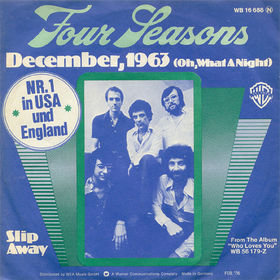
December_1963_oh_what_a_nightA few months ago, I was doing the dishes after breakfast, and after putting my coffee mug in the drying rack, I heard it crash to the floor.  I sighed and grabbed the broom and dustpan, and while sweeping it up, got annoyed.  I was annoyed at myself for not being careful, but also annoyed that a mug I had owned for twenty years was now gone.

The black coffee mug with a gold rim and “Sayville High School ’95” was the favor from my junior banquet, which took place on April 18, 1994. I honestly don’t know why it was called a banquet and not a prom–I suspect it had something to do with the seniors not wanting the juniors to call our dance a “prom” because my high school was all about that petty sort of crap–but it was the first formal school dance I ever attended.  In fact, if you want to get technical, it was my first date.

It is shocking to absolutely no one that I was an incredibly late bloomer.  Oh sure, I knew as early as elementary school that I liked girls, but at sixteen, I had not evolved socially beyond the awkwardness I had around girls when I was twelve.  I could control my behavior and wasn’t as obnoxious or immature in the presence of a pretty girl, but I still had ridiculous crushes on girls who were way out of my league, and even as late as college it took signals brighter than the average Times Square billboard for me to pick up on the fact that someone found me even marginally attractive.  In fact, at that point, my pursuit of the opposite sex amounted to asking out my crush in the ninth grade (and getting rejected) and getting friendzoned by someone prior to Christmas break, so the idea that I’d actually get a date for a dance was pretty ridiculous.

The junior banquet, though, was the social event of the year–at least for me, anyway–and because of that I felt that finding a date was necessary.  Okay, there was no stated obligation to find a date, but I definitely felt some sort of pressure to make sure I had a companion for the evening.  Maybe it was because my friends were getting dates or maybe because the dance was formal.  Personally, I blame our class’s choice of a theme song:  “Oh What a Night.” (more…)

Bowling, Burgers, and Birthdays

Sayville Bowl Interior

The interior of Sayville Bowl.  Image courtesy of MapQuest.  Year unknown.

I went to a kid’s birthday party a few weeks ago.  Normally, these are held at one of those huge playland places that have ball pits, inflatables, kiddie habitrails, and that have names like Bounce and Play or Adventure Central.  This party, however, was at the local bowling alley, and as I watched my son bowl (well, more like drop the ball in the lane and rush back to the chair so he could see the computer animation), I couldn’t help but think of the number of bowling birthday parties I attended as a kid.

My birthday parties–and most of my friends’ birthday parties–were pretty standard back in the 1980s.  We’d go to the birthday kid’s house, play a few games, eat pizza or hamburgers and hot dogs, drink way too much soda, and finish off with Carvel cake.  Then everyone would go home with goody bags that matched the decorations–cups, plates, paper tablecloths, etc–for Star Wars, He-Man, or whatever the party’s theme was.  Sometimes, the party would be a sleepover and we would put the parents through hell because hours of fun and hours of soda and candy equals no actual sleeping at the sleepover.  The parties were straightforward and always fun.

But bowling parties were a reality and we considered them some of the most memorable at the time, even if they don’t measure up to the standards of today’s epic theme parties and play apparatus.  Bowling at a birthday party in the early 1980s was some of the most fun you could have as a kid for a few hours, and Sayville Bowl was the typical AMF bowling center whose decor would remain so unchanged for years that when I was in high school and college it seemed like 1979-1983 were being preserved for posterity.  I don’t remember being a particularly good bowler–it was a lot of gutterballs and not enough Superman III–but I remember having an enormous amount of fun anyway.

Sigh … it’s never Superman III. (more…)

Two Liters With a Pie

DSCN4205[1]

The flat remains of a two-liter bottle of Diet Pepsi. Yes, that’s my kitchen in the background.

A couple of months ago, I was at a work function where food was being served.  We had a few tables of fried chicken and some sides as well as a table of two-liter soda bottles.   As I poured myself a cup of Diet Pepsi, I couldn’t help but think of how ubiquitous the two-liter is—it’s a party and holiday industry standard and has been ever since I was a kid.

I suppose that is  not something to get really nostalgic about, especially since it’s a plastic bottle.  It’s not the iconic 6.5-ounce contour shaped glass Coke bottle that is the “nostalgic” Coke bottle and it doesn’t have the personality of the 20-ounce bottle, which is easily accessible and personal, plus it’s shaped like an old classic glass Coke bottle so it calls back to images where people from the 1950s or so pop a top of a glass Coke bottle.  The two-liter has never had that.  When you buy one of those, you twist off the metal or a plastic cap, and don’t think twice about it.

Which is indicative of the area and time period that constitutes my youth.  Having been born in 1977,  I have this attraction to the shopping mall, the multiplex, and everything else in the suburbs.  It is an era that is by and large disposable and I think on some level, even though nostalgia has turned its eye a little more toward my formative years, that nostalgia is selective at best—it’s the music, the movies, the fashion.  Nobody is going to look at suburban life in the 1970s and 1980s with the same rose-colored glasses our culture uses for the 1950s.  Because the decades of my childhood are the rose-colored 1950s’ unfortunate afterbirth:  Levitt homes and small towns gave way to shopping malls, gated communities, and McMansions, especially where I grew up.  You cannot go anywhere on Long Island without seeing shopping malls or multiplexes.

But then, there’s the pizza parlor. (more…)

Being Michael Grates

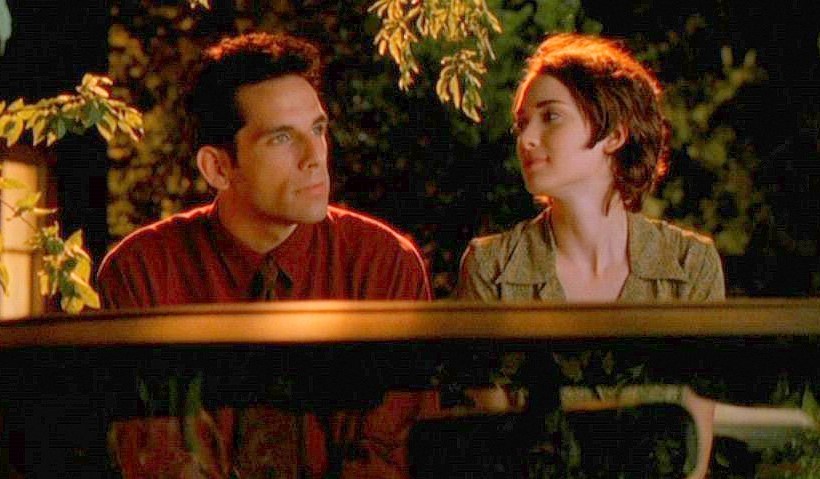
stillerrealitybitesAbout a week or two ago, I came across a few articles filled with emotional hand-wringing on the part of the generation often referred to as Millenials.  I read about how there is a generational conflict between this younger generation, which seems to be dismayed that the world doesn’t think they are entitled to anything; and older generations, who wish these kids would get over themselves.  It’s accompanied by talk about the uphill battle this generation faces as it enters a very touchy employment situation–the job market, after all, is terrible–and will have an enormous amount of student loan debt.  There is also the sentiment of “You created this mess and we inherited it.”

I found myself thinking about how Millennials need to get over themselves and how they’re all entitled brats, but then I couldn’t help but be reminded of two decades ago when Generation X seemed to be facing the same problems.  I am sure that your average Millennial will tell me otherwise, but it seems that there is something universal here:  the up-and-coming generation takes crap from the older generation. And I also couldn’t help but watch Reality Bites, the 1994 Winona Ryder-Ethan Hawke film that attempted to capture the struggle that particular group of twentysomethings was going through at the time.  Watching it again–and I watch it every once in a while–I knew that I would have a slightly different perspective and perhaps even view at least one of the characters a different way.  Not surprisingly, the character I seemed to sympathize with more than I did when I first saw the movie as a teenager was Michael Grates. (more…)