Author: Tom Panarese

The tale of a continuing voyage on the sea of no cares

Love stories are hard to tell.

Oh sure, I can point to an endless number of works of literature, film, and song that suggest otherwise, but for the most part they’re either complete garbage or don’t tell the whole story.  Or perhaps they attempt to tell the whole story but they’re just way too broad, so they skip over a lot of the details.

Then again, isn’t pre-packaged love with a nice soundtrack what we have all been conditioned to look for, anyway?  It’s certainly less complicated than being in a relationship or being married, and our modern world certainly allows ourselves to encapsulate first glance to last kiss in a narrative.  I certainly am guilty of polluting my girlfriends’ lives with mix tapes that were sometimes so awful that I am shocked that I wasn’t broken up with after the first listen.  But for as much as my musical taste has been questionable throughout my life, I know that at least a few time I found a gem among what Sir Paul once called “silly love songs.”  In fact, it’s happened several times, including when I first heard Great Big Sea perform “Sea of No Cares.”

Great Big Sea is a band I stumbled upon in the summer of 1999 when Amanda and I were house-sitting for a friend.   While we spent a good amount of time exploring the greater Arlington/Alexandria area and seeing every movie that was in theaters at the time, I spent much of my days hanging out while she went to the internship she’d started after graduation.  Most of that time, I was working on a novel and the various 1980s mixes in my car were wearing thin, so I went diving into her friend’s CD collection and found Rant and Roar.  I’d heard of the band because I’d seen a video or two on MuchMusic, but wasn’t that familiar with them.

They didn’t need to do much to make me a fan, to be honest.  The band was from Newfoundland, which is where my grandmother hailed from, and they had a boisterous sound that was what I was looking for after spending most of the last four years trapped in my roommates’ Grateful Dead/Phish/Jimmy Buffett death spiral.  A year or so later, they played the Birchmere is Alexandria to support Turn.  It was a great gig and I knew I wanted to see them again, so when my sister heard that they were playing the Maritime Festival in West Sayville on July 13, 2001, I was on the phone the minute tickets went on sale.  I mean, when you come from a town that’s as obscure as mine, you definitely jump at the chance to see one of your favorite bands play there.

So we went, and in the hot July afternoon right next to the Great South Bay, the band started with “Donkey Riding,” which had become somewhat of a staple as far as opening numbers were concerned.  The next couple of songs were from a few albums back and then, the band decided to play “Sea of No Cares,” which was going to be the title track to the new album.  Amanda was standing next to me and humored me by letting me hold her even though by that point we were both sweaty and gross, and Alan Doyle began: “When you’re in love, there’s no time and no space/There’s a permanent smile on your face/Your friends all complain that you’re goin’ insane/But the truth is they’re just afraid/Hey, hey, hey somewhere/You threw your fear in the sea of no cares …”

Almost immediately, I found myself struck by the lyrics, as if they were some sort of revelation.  Or, at least, I flashed back to an earlier point in our relationship where those first few lyrics rang true.

(more…)

The Yearbook Myth

One commercial that stuck with me from the time I first saw it as a kid until I became a teenager was an ad for McDonald’s entitled “Great Year!”  It features the antics of Central Junior High School’s yearbook staff as they attempt to cover all of the great and crazy things that happened during the course of the school year and then meet at McDonald’s to celebrate their success.

Watch the minute-long ad and you’ll see a portrait of a junior high school that in 1983 or whenever it was originally shot had to be the coolest place on Earth.  Everyone gets along, someone walks through the hallway dressed as a strawberry, and even the high pressure moments are filled with a goofiness that only comes when you are selling hamburgers.  I don’t have to do much to convince anyone that my junior high experience was not really like this.  Had “Great Year!” been a real reflection of what I remember, there would have been footage of a gym teacher cutting gum out of someone’s hair, two guys blowing snot rockets all over the school store while the people who worked there gagged and yelled at them to stop, and one kid looking scared out of his mind while another threatened to beat the ever-loving snot out of him if he did even the slightest thing wrong.  Or maybe that’s just my take.

(more…)

Scared Straighter

The shouts echo through the near-empty room, and while the volume of voice and harshness of his tone would make any normal person wince, the boy he is screaming at doesn’t budge.  In fact, he seems to be staring past the raving man and putting his best defiant face forward.  He might seem like he isn’t listening to the man talk about how he got to prison and what all of his experiences in prison have done to him as a person, but someone thinks he is.   More than likely this person is his teacher or a mentor or the head of some program that’s meant to take kids off the streets and make them realize that if they continue their behavior, they will have a very hard life.

The inspiration for such an experience is Scared Straight!, a 1978 documentary that showed a group of juvenile delinquents spending three hours with a group of convicts. Most of the delinquents had been in and out of trouble with the law and the idea was to have them face reality and change their lives.  For the most part–although there definitely are critics of the program who say it wasn’t–the teenagers were “scared straight” and the documentary inspired several other television specials, including follow-up shows, and local scared straight programs that were conducted through sheriff’s departments and public schools.

I wasn’t the the type of student to ever wind up in a scared straight program.  I was an honors student and my life was very straight and narrow; I hadn’t stolen so much as a pack of gum in my lifetime and never even had an overdue library book.  However, in the spring of my junior year of high school, I found myself standing in the middle of a prison cafeteria watching my friend get reamed by a guy named Tracy and his fellow inmate, Cedric. Of course, we weren’t tough-as-nails juvenile delinquents and I think that the two of us would have both urinated all over ourselves if we went on the trip not knowing that we were going to get yelled at by felons because we were not in the scared straight program but part of an 11th grade social studies elective called You and the Law.

(more…)

I come to bury Wizard, not to praise it.

Wizard #21, featuring one of the Youngblood teams.

“Can I see that?”  he asked me in study hall.  We were supposed to be working, but he’d been staring at the ceiling for the last twenty minutes and I’d been alternately writing some really bad short story and flipping through the magazine he wanted to look through.

“Uh … okay, but give it back,” I replied, as if what I had in my hands was serious contraband that would get us sent down to the principal’s office in a heartbeat.  Was it an issue of Playboy?  In study hall?  No.  It was Wizard: The Guide to Comics #21.

I’m the gabillionth person to write about this today but when I read that Wizard magazine folded, I couldn’t help but think, just like so many others seem to be doing, about the time I used to collect it and what effect it had on my comic book collecting life.  I’m not one of those people who seems to be saying “good riddance” to the once popular magazine, partly because I don’t particularly enjoy seeing people lose their jobs (unless they’re the cast of Jersey Shore or something) and partly because as much as I think Wizard shoulders at least some of the blame for the comic crash of the early 1990s I stopped buying the magazine before I graduated from high school and long before I stopped collecting comics so I really can’t hold a grudge against it.  Besides, I think I can add my voice to the many who say that the magazine really was a true guide to comics for me back then.

When I first got into comics in the early 1990s I was being guided along by the characters I knew from either seeing movies or watching cartoons.  Batman was the first character I gravitated toward and then I instinctively picked up a few issues of Superman because I’d been a huge fan of the Christopher Reeve movies and it just seemed like you’d automatically buy at least a few Superman comics in your lifetime.  I had heard of the X-Men and knew that Spider-Man was worth reading (I’d bought the “Kraven’s Last Hunt” storyline a few years earlier), but couldn’t have told you fact one about anything that was happening in any of their books.  I’d latch on to the Titans a few months after I bought my first issue of Detective Comics and would really spend most of my time collecting back issues of stuff from the 1980s, especially Crisis on Infinite Earths and its related crossovers.

I am pretty sure that I would have done very little more than that had I not spent part of the summer of 1991 down in Florida visiting my friend Chris and reading through all of his X-Men comics, especially one of his five different versions of X-Men #1 as well as most of the others in Jim Lee’s Uncanny run, quite a few Todd McFarlane Spider-Man books and the first issue of a new book called Spawn, a copy of which he’d bought me for my birthday.  That trip, which included spending a lot of money at two different comic book stores, was one of the most important trips I’d ever taken in terms of comic collecting for several reasons, one of which was that I got the chance to leaf through a few copies of Wizard.

(more…)

Interlude (My Life as a Teen Titan, Part Six)

The Titans contemplate death (and Gar Logan's mullet) at the funeral for Jericho while Slade Wilson, aka Deathstroke, looks on from afar.

Traditionally, the issues after a big storyline in a comic book are pretty tame.  Unless the reader knows that something big is right around the corner, a writer will spend that next issue cooling things down, whether it be Superman and Batman stopping a one-of villain or X-Factor going into therapy.

Marv Wolfman, over the course of his run on New Teen Titans and New Titans, became somewhat of an expert at the post-event story, starting all the way back in 1981 with “Private Lives,” the acclaimed story in New Teen Titans #8.  The team had just formed, encountered Deathstroke, and fought back both Trigon and the Fearsome Five, so Wolfman and George Perez took an issue to show the heroes getting their lives in order before ramping up a multi-issue storyline that involved Deathstroke, the Titans of Myth, and a hunt for the killers of the Doom Patrol.  Similarly, the parade/camping issue of #6 of the Baxter series came between a Trigon and Titans of Myth story.

There seems to be a pattern there.

Anyway, Wolfman seemed to be very aware that big events or moments, especially tragic ones, don’t end neatly, and many take a long time to resolve.  The most famous new Teen Titans storyline of all, “The Judas Contract” (which I will delve into one day) officially endedn in New Teen Titans Annual #3, but there was action versus one of that story’s villains–The HIVE–for three more issues, and the resolution between the titans and Deathstroke wouldn’t come up until nearly a year later with a scene in a coffee shop.

So it is with “Titans Hunt/The Jericho Gambit.”  At the end of New Titans #84, the Titans have escaped what’s left of Azareth and are sitting around wondering: a) what the hell just happened, b) what’s going to happen next, and c) does anyone have some clothes we can borrow?  When “Dirge” begins in issue #85, what happens next is Jericho’s funeral, which Slade Wilson does not officially attend (he chooses the tried and true tactic of being in the cemetery but staying far away from everyone) and that leads to resentment from our heroes, who are already acting self-righteous because he killed his own son.  Then again, you can kind of excuse it because they’re obviously working through some serious grief.

(more…)

XOXO

One of my favorite things about looking at old commercials, especially those from when I was a kid, is how someone thought that their idea was what kids back then thought looked cool.  Granted, in 1988 this wasn’t very hard.  I mean, this was the decade where you could put a bunch of random cartoon characters on screen for thirty seconds and tell us there was a toy involved and parents would be beating one another down in parking lots for the toys.

But those were toys.  How did you sell something that wasn’t a toy, or say a movie that looked like it would have cool toys?  How did you sell, for instance, food?

A few weeks ago, I took a glance at an old McDonald’s commercial, which was this sappy brother-sister number where the brother is obviously stalking his sister but it’s supposed to be all cute because he offers her a french fry or something.  Phone company commercials from that era are noted for this type of syrupy fun, and soft drink commercials?  Well, I’ve already talked about the epic nature of Dr. Pepper’s early 1990s ad campaign and at some point I’m going to get around to Coke.

But a lot of those commercials weren’t specifically geared towards kids, mainly because kids weren’t the only people going to drink Coke or go to McDonald’s.  However, we were the people most likely to eat Chef Boyardee.

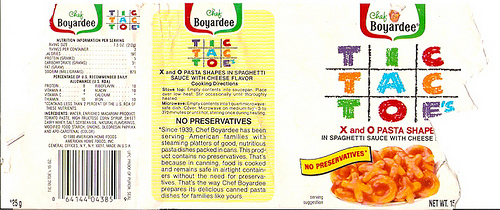
Canned pasta has been around for what seems like eons (I think that’s its shelf-life, too) and there have been quite a number of products geared towards kids, such as Franco-American’s Spaghetti-O’s and Chef Boyardee’s Tic Tac Toe’s (yeah, I know it’s a misused apostrophe … it was their mistake, not mine).  The former is somewhat of an American institution because even those of us who have never eaten a single Spaghetti-O know the jingle “Uh oh, Spaghetti-O’s!”  Tic Tac Toe’s, however, don’t enjoy the same iconic status.  In fact, they’re not even made anymore.

But back in the late 1980s, the pasta company tried to break Spaghetti-Os monopoly on kids’ pasta consciousness and unveiled one of those commercials that I have never been able to get out of my head since:

(more…)

Revolution!

Stephanie Kaye next to one of the many "Out of the way Stephanie Kaye" posters that were up in the halls of DJH. Yes, they made posters. Photo from Degrassi Online.

Lately, when I’ve rewatched old Degrassi Junior High episodes, I’ve been marveling not only how realistic it is but how typical the plots seem to be.  Not cliche, mind you, but a lot of the episodes seem to be what I would expect from the junior high/high school drama genre:  drugs, sex, alcohol stories that are just “hard” enough so that you can picture a person of that age dealing with the issues.

Furthermore, when it comes to character development there are expected outcomes to the way certain characters act or consequences for their actions, even if the consequences come a few episodes down the road.  In the first season of DJH, Stephanie Kaye was one of the spotlight characters, or at least one of the characters that I remember being so prominent.  Her big struggle through that season, which detailed the first half of her eighth grade year, was how to deal with being popular while becoming more mature.  The last episode I discussed, “Best Laid Plans” addressed that, especially how she wore provocative clothing while at school yet dressed “down” at home.  We also saw how she treated her younger step-brother, Arthur, like crap.

(more…)

If I could just hold you again

When it comes to nostalgia, there are those things that are true memories and those which are false memories.  No decade has more of this going for it than the 1980s.  Eighties nostalgia is a juggernaut that began when I was in high school back in the early 1990s and really hasn’t stopped since, especially since I’ve had students who say they’re nostalgic for the 1980s, something I find hilarious considering they weren’t really old enough to remember it (And no, they don’t, because that would be like me saying I remember the 1970s when I was born in 1977 and my only memory of anything world events before 1981 is seeing Jimmy Carter on a television screen.  That might be a 1970s memory but it doesn’t exactly put me inside Studio 54).

If you are truly a Child of the Eighties, you are fully aware of these two sides of nostalgia because for every movie, television show, compilation album, or Glee medley that says, “Remember Eighties?  Here it is!  No, don’t think about anything that really happened.  This is Eighties.  Enjoy these memories.”  You’re not supposed to remember that Wang Chung had three good songs, only that they recorded “Everybody Have Fun Tonight” and made a seizure-inducing video to go along with it.  You’re not supposed to remember Fresh Horses, the piece-of-crap other Molly Ringwald/Andrew McCarthy flick, just Pretty In Pink.  And you’re not supposed to remember the Cloris Leachman years of The Facts of Life.

Okay, sorry about that last one.

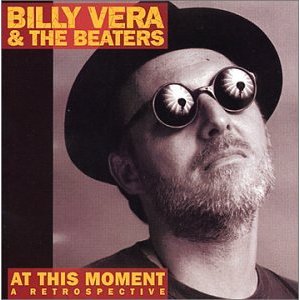
Anyway, I’m one of those people who will listen to a flashback station on Sirius and be happy that Alan Hunter has decided to play “Stone in Love” instead of “Don’t Stop Believin'” for the hour’s dose of Journey.  Maybe it’s because I’m a nostalgia dork, or maybe it’s because I’ve been exposed to so much Eighties nostalgia for the past two decades that I need more than something that scratches the surface.  I think that everyone reaches that point in his life, where he wants more than just another playing of “Hungry Like the Wolf,” and usually there is one work that serves as a trigger for the true memories that lie beneath the VH-1-produced surface.  For me, it was “At This Moment” by Billy Vera and the Beaters.

(more…)

Can I Have Christmas Chocolate?

My English classes this week were reading Dylan Thomas’s short story “A Child’s Christmas in Wales,” which is a cute story about –well, the title’s kind of self-explanatory.  But what I love about the story, besides Thomas’s use of the English language, especially in his imagery and his wit, is that it’s one of the few Christmas stories that I have read (or seen on TV) that doesn’t attempt to teach me any sort of lesson.  Instead of Scrooge, etc. learning the “meaning of Christmas,” Dylan Thomas simply talks about the Christmases of his youth as a matter of fact.  I’m not sure if my students enjoyed the story (most of them spent two days either bitching about the fact that they had to be in school when every other school district in the area had the entire week off, or attempting to sleep), but we had a great discussion about holiday traditions and why we enjoy them so much.

Over the course of this discussion, I brought up some of the things my family has done since I was a little kid.  This included such time-honored traditions as my mother forcing my sister and I to sit at the top of our stairs and take a picture, getting a toothbrush in our stockings, and the long arduous process of opening the gifts under the tree.  Furthermore, I talked about how when you get to be my age and you have a family on your own, you find yourself either starting new traditions or carrying on old traditions either by yourself or with your siblings or children.  One such tradition has been holding on to the idea that while Christmas is a day, there is a whole Christmas season.

The idea of Advent has been around for at least a few hundred years and is marked in several ways by different religious denominations.  I grew up attending the Lutheran church and the tradition there was that during the four Sunday services prior to Christmas, there would be an advent wreath, which is a wreath with five candles (four purple candles in a circle and a white one in the center), sitting near the altar.  At the beginning of the service, the acolyte (which I think is what Catholics would call an “altar boy”) would light one of the purples candles (each a different shade of purple and I believe with a meaning, which I once knew, but my rejection of most things religious in my teens and twenties and suppression of Sunday School trauma led to this information being purged from my memories), with the  white one for Christmas Eve/Day to signify the birth of Christ. 

However, this wasn’t the only way I knew how to celebrate the Christmas season.  There’s been the obvious running of the Christmas shopping gauntlet and a barrage of Christmas-themed television specials and movies (as well as short stories in my English classes), but the most important one, since I’ve been a kid, has been the PeA advent calendar. 

(more…)

The Routine

A "fall in the suburbs" shot of a brother and sister that's worth some caption about Americana, but I can't think of one.

In the middle of my sister’s wedding last month, I walked over to her and said jokingly, “Now we are so happy, we do the dance of joy!”  She finished the sentence along with me, as it’s one of the many weird in-joked the two of us have, most of which have something to dow ith the countless hours of crappy 1980s-era sitcoms that we grew up watching in syndication because my father was too cheap to spring for cable. 

It is entirely fitting, by the way, that I turn to sitcoms when I think about what growing up with my sister was like.  I know brothers and sisters who are weirdly close, or have one of those relationships where the brother may as well be another father.  I also know brothers who are perfect confidants and had greeting-card upbringings.  While Nancy and I had annoyingly ordinary childhoods, we weren’t exactly the Cleavers of the Bradys.  On some level I guess you could say we were the Cunninghams, even though my parents didn’t have an older child who mysteriously disappeared (I’ve always thought that Chuck Cunningham was an early anti-war activist and a member of the communist party so Mr. C. drove him to the Canadian border under the cover of night because while he loved his son, he was proud of his country and didn’t want to face the humiliation of HUAC) and none of my friends were cool guys who lived above my parents’ garage.  Besides, we didn’t really grow up watching Happy Days unless WPIX was rerunning it in the afternoons.

No, we were more accustomed to vegging out in front of stuff like Growing Pains, The Wonder Years, Full House, or Charles in Charge.  Full House, especially, stuck with us over the yars because it gave my sister her longest-running nickname (unless you count the Wonder Years reference “butthead”).

(more…)