random stuff

Pop Culture Affidavit Episode 55: Where Dreams Come True (Summer 2015 Part Two)

Episode 55 Website CoverThe summer 2015 recap continues with a Walt Disney World episode! Join me, Amanda, and Brett as we head to Orlando in July and cover past and present vacations, what we loved doing, what we loved to eat, and a little bit of Agent P’s World Showcase Adventure!

Here’s where to listen:

iTunes: Two True Freaks Presents Pop Culture Affidavit

Direct Download

Two True Freaks Presents: Pop Culture Affidavit podcast page

And now for some bonus material!

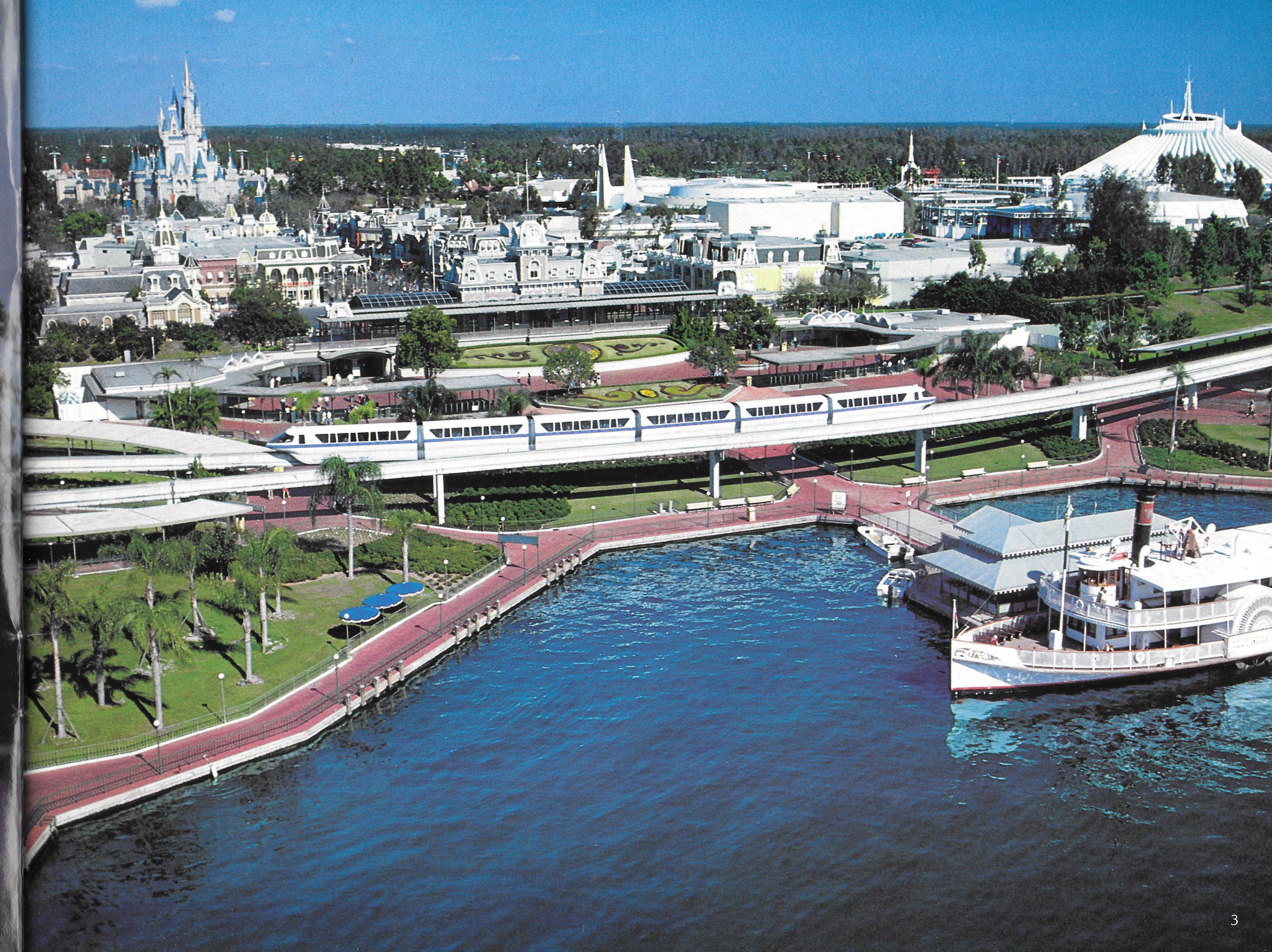
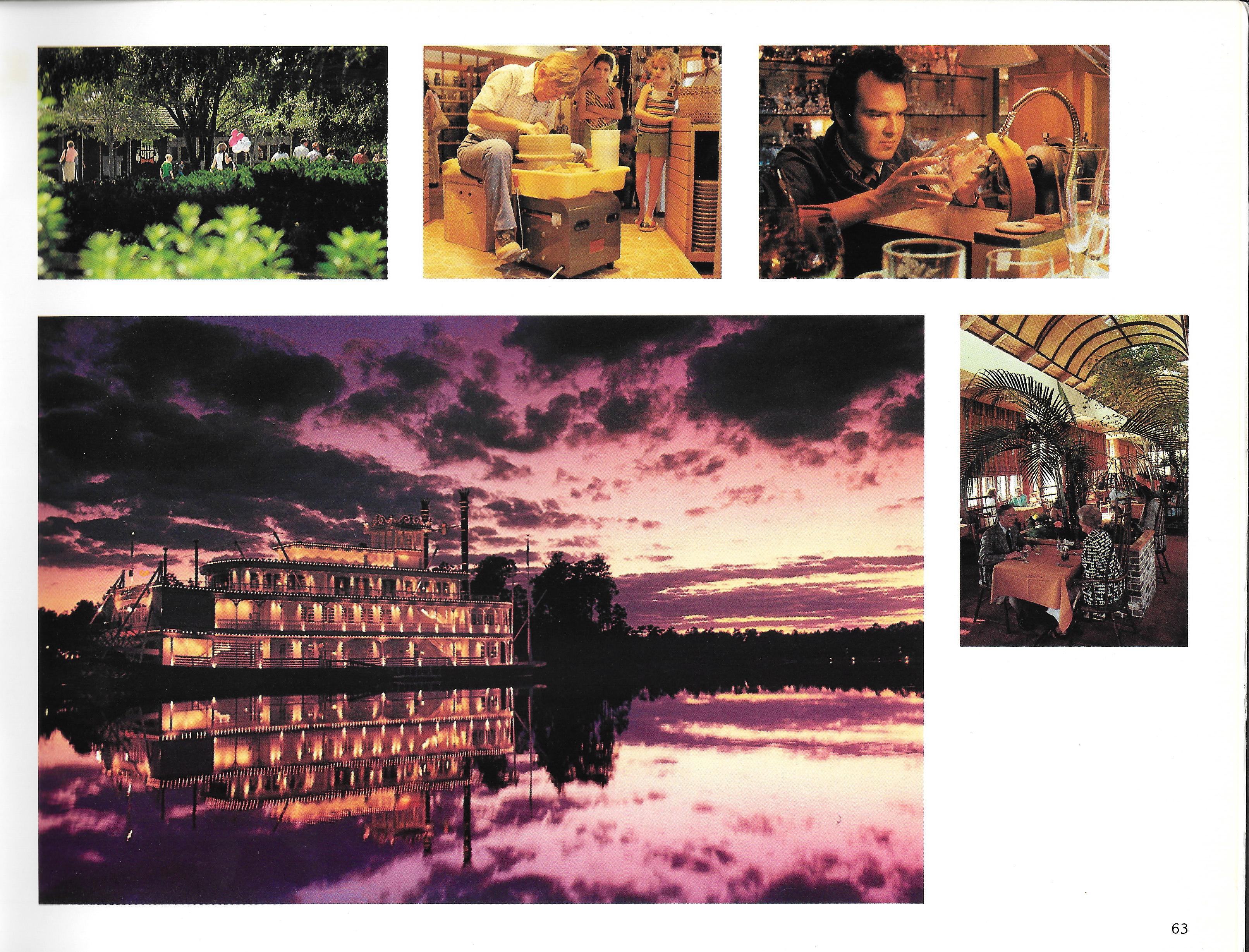
During the show, I talk about my past experiences at Walt Disney World and also read the section on the now-defunct EPCOT Center ride Horizons found in Walt Disney World: A Pictorial Souvenir, which was published in 1984 and I received either right before or during my first trip to Walt Disney World in 1985.  Below are some scans of the book for you all to enjoy.

First, the cover:

Disney Guidebook Pictures0001

The beginning of the section of The Magic Kingdom, featuring a gorgeous evening shot:

Disney Guidebook Pictures0021

Disney Guidebook Pictures0022

Main Street, U.S.A.  I particularly like this page because of the perspective in the picture on the lower left.  You don’t get that view very often.  Plus, I have to admit that the lack of a crowd in the picture on the lower right is amusing:

Disney Guidebook Pictures0023

Two of the pages on Fantasyland.  I chose the first because of that gorgeous shot of Cinderella’s Castle with the purple sky behind it.  The second, I chose, because it has a picture of the skyway that ran over Fantasyland but closed in 1999 (fun fact: Disneyland had a similar skyway, which took you through the Matterhorn, which sounds awesome):

Disney Guidebook Pictures0024

Disney Guidebook Pictures0002

A quick look at Tomorrowland, which is definitely one of the lands of the magic kingdom that changed the most since I was a kid.  I rode the Astro Orbiter for the very first time this year, although I have to admit that part of me wishes I’d ridden it back in the day when it had its classic look:

Disney Guidebook Pictures0003

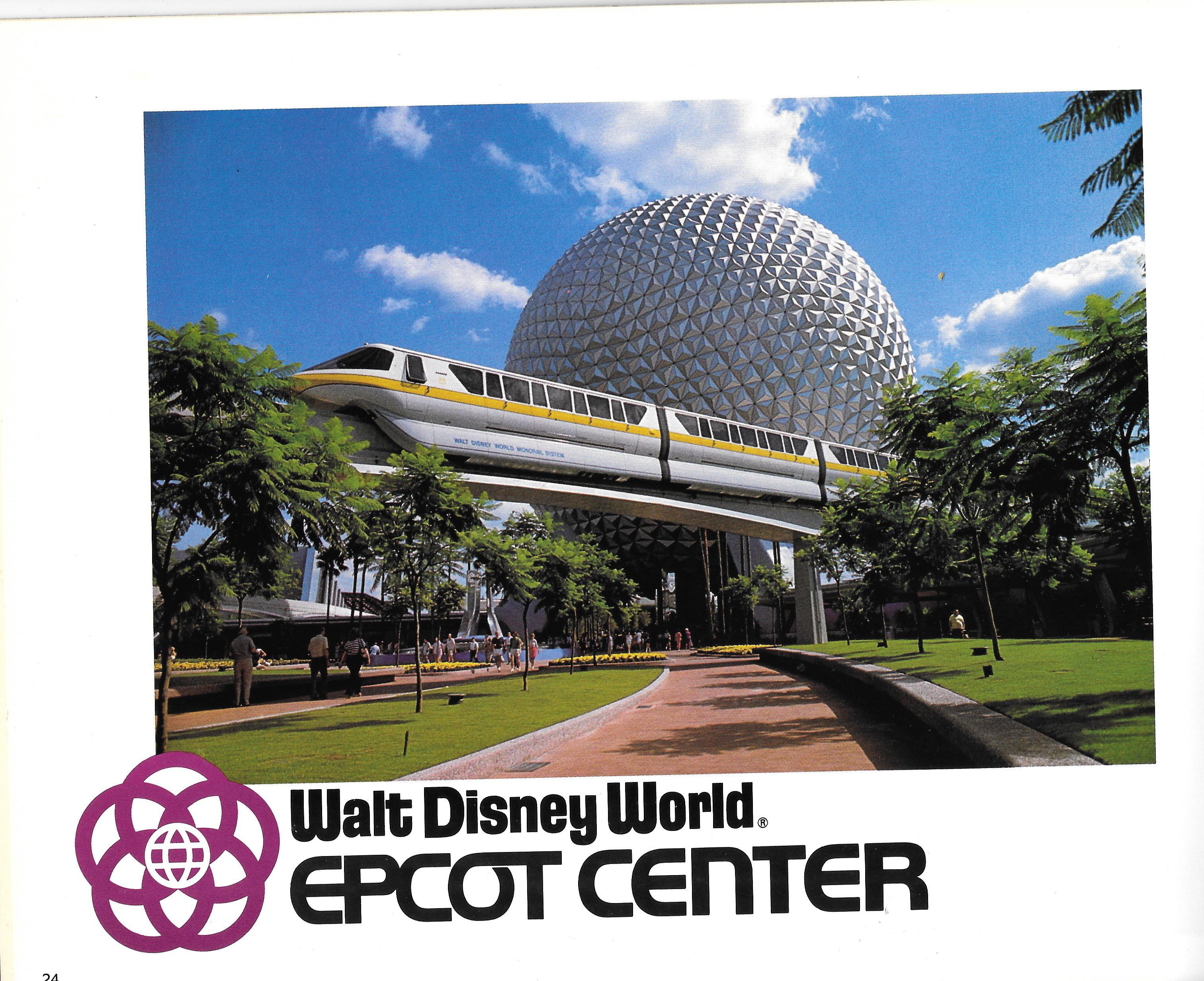
The opening of the EPCOT Center section of the book, complete with the old EPCOT Center logo.  I own two vintage-style T-shirts with the logo:
Disney Guidebook Pictures0004

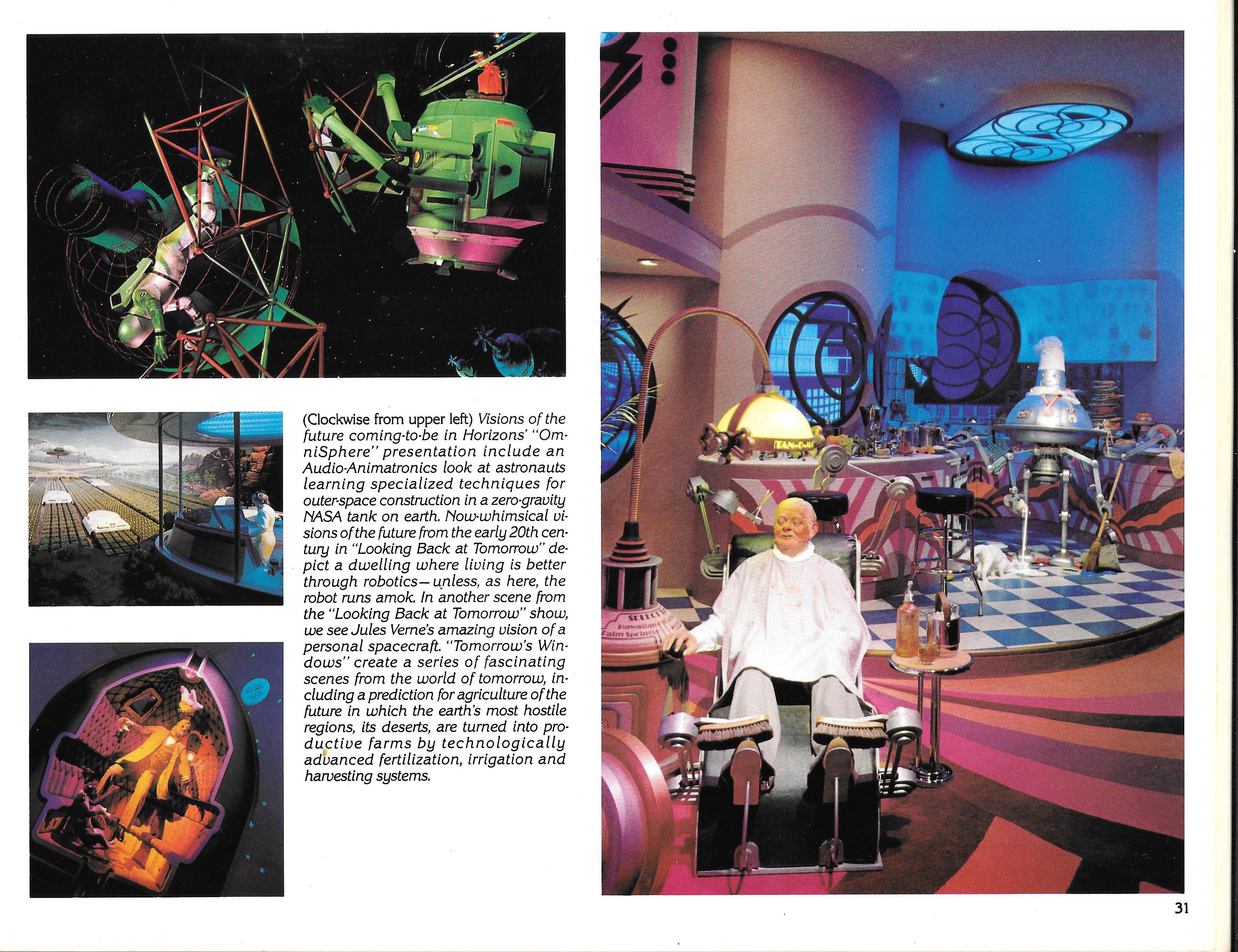
The two-page spread about the EPCOT Center attraction known as Horizons.  This is the section of the book I read on the air.  A little more history about Horizons:  it opened in 1983 and was part of the “phase II” of EPCOT construction/attractions.  It closed in 1994 but was reopened in December 1995 and then closed permanently in 1999.  The attraction was completely disassembled and demolished and is now the home of Mission: Space.  You can see some of the pieces of the Horizons ride on display in the lobby of Walt Disney: One Man’s Dream theater in Hollywood Studios.

Disney Guidebook Pictures0005

Disney Guidebook Pictures0006

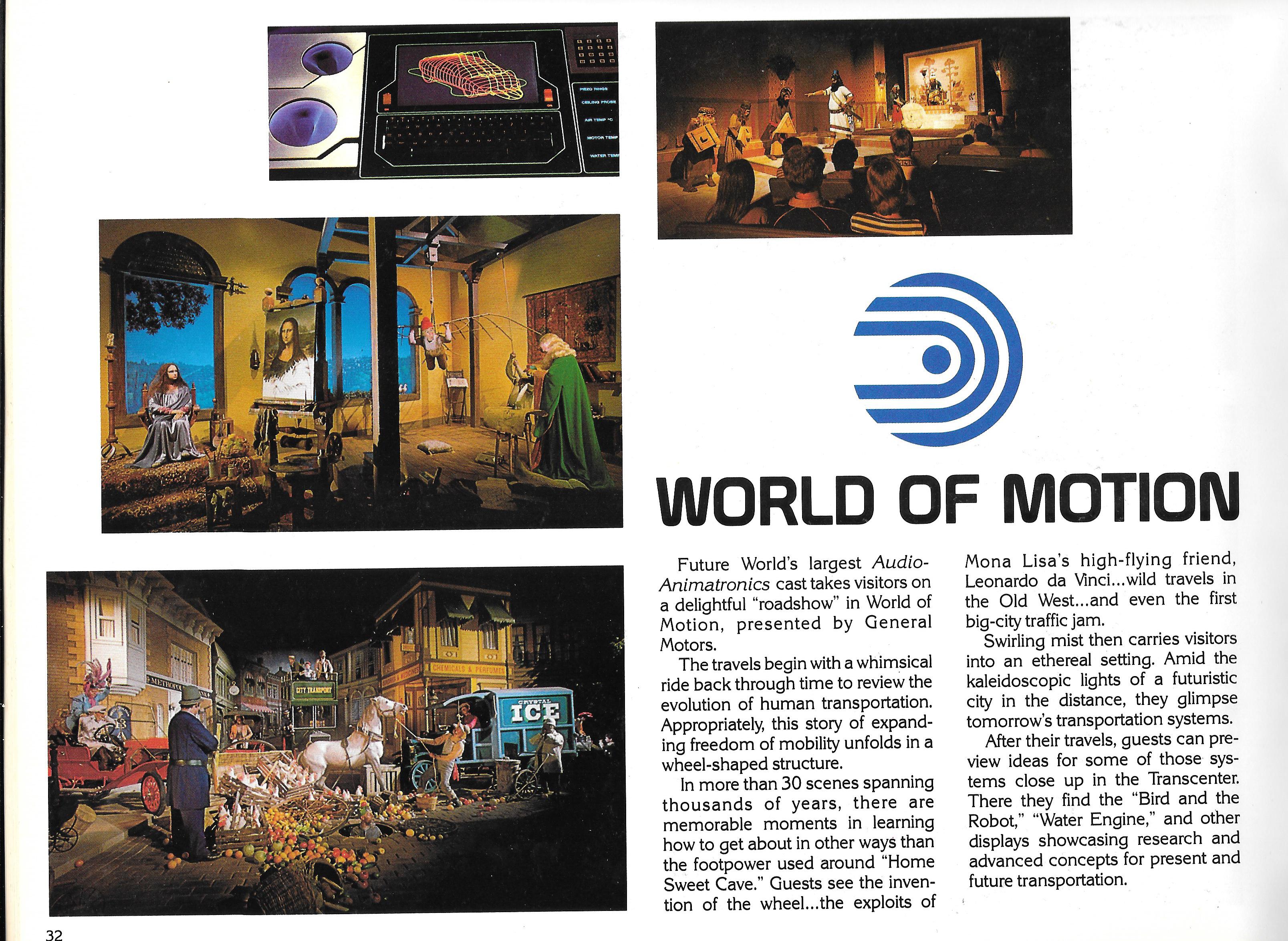
Another defunct ride in EPCOT is the GM-sponsored World of Motion.  This was one of the original EPCOT Center Future World rides before it closed in 1996.  The building still remains, as it was refurbished for what is now the Chevrolet-sponsored Test Track:
Disney Guidebook Pictures0007

Disney Guidebook Pictures0008

CommuniCore is the original name for what is now known as Innoventions in EPCOT’s Future World.  The buildings haven’t changed in structure–they are still two half-circles right behind Spaceship Earth–and there are still restaurants and gift shops.  The original exhibits were more thematically linked to the various pavilions in Future World, but the Innoventions ones seem to be more of their own thing.  If I may editorialize for a moment, I hope something more interesting is done with Innoventions because while some of the exhibits and interactive games are pretty cool, it seems like there is a lot of wasted space in those buildings:

Disney Guidebook Pictures0009

Disney Guidebook Pictures0010

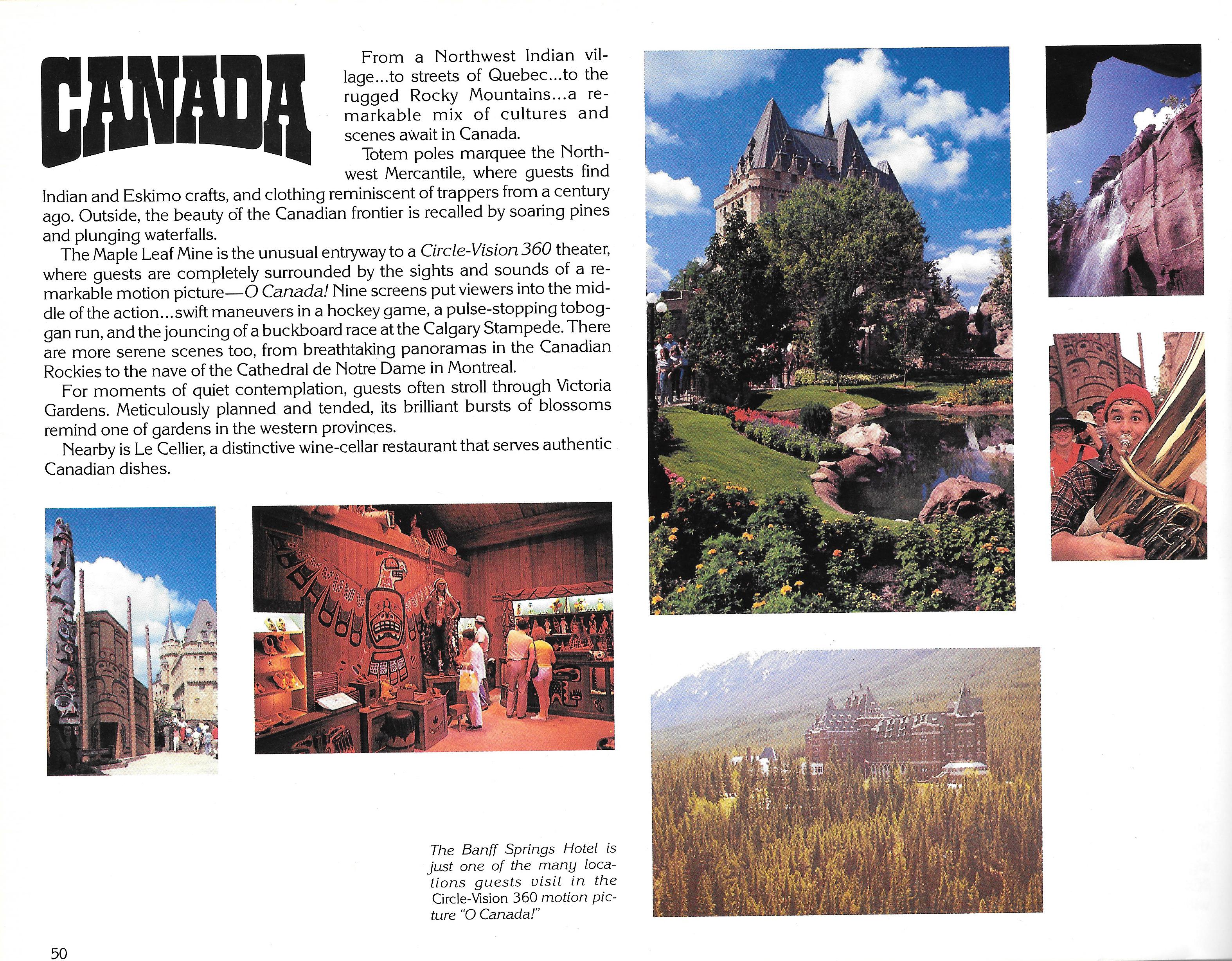
The page on Canada in the World Showcase.  Because Canada is awesome, has one of my favorite gift shops in EPCOT, and there’s a guy playing a tuba:
Disney Guidebook Pictures0011

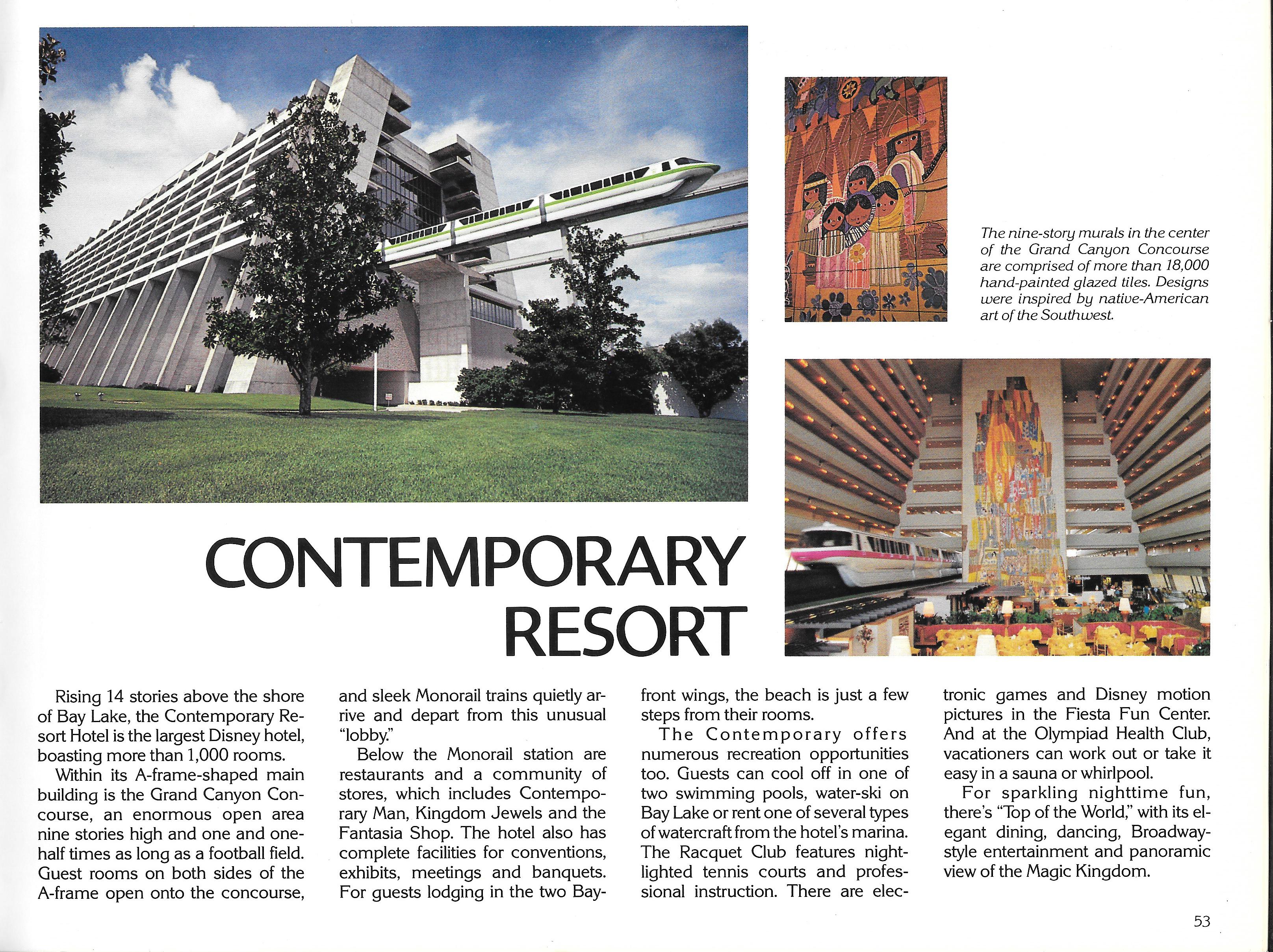
One of the souvenir guidebook’s pages on the Contemporary Resort hotel.  This one was always a personal favorite of mine, as I think it is with a lot of kids, because it’s the one that the monoral drives through.
Disney Guidebook Pictures0012

Here are some pages on Discovery Island, the now-closed zoological park that was part of the Walt Disney World resort until 1999.  And if you’re interested in more, here’s a link to a blog post by Shane Perez, who explored the closed facility in 2009:  The Photography of Shane Perez — Discovery Island:

Disney Guidebook Pictures0013

Disney Guidebook Pictures0014

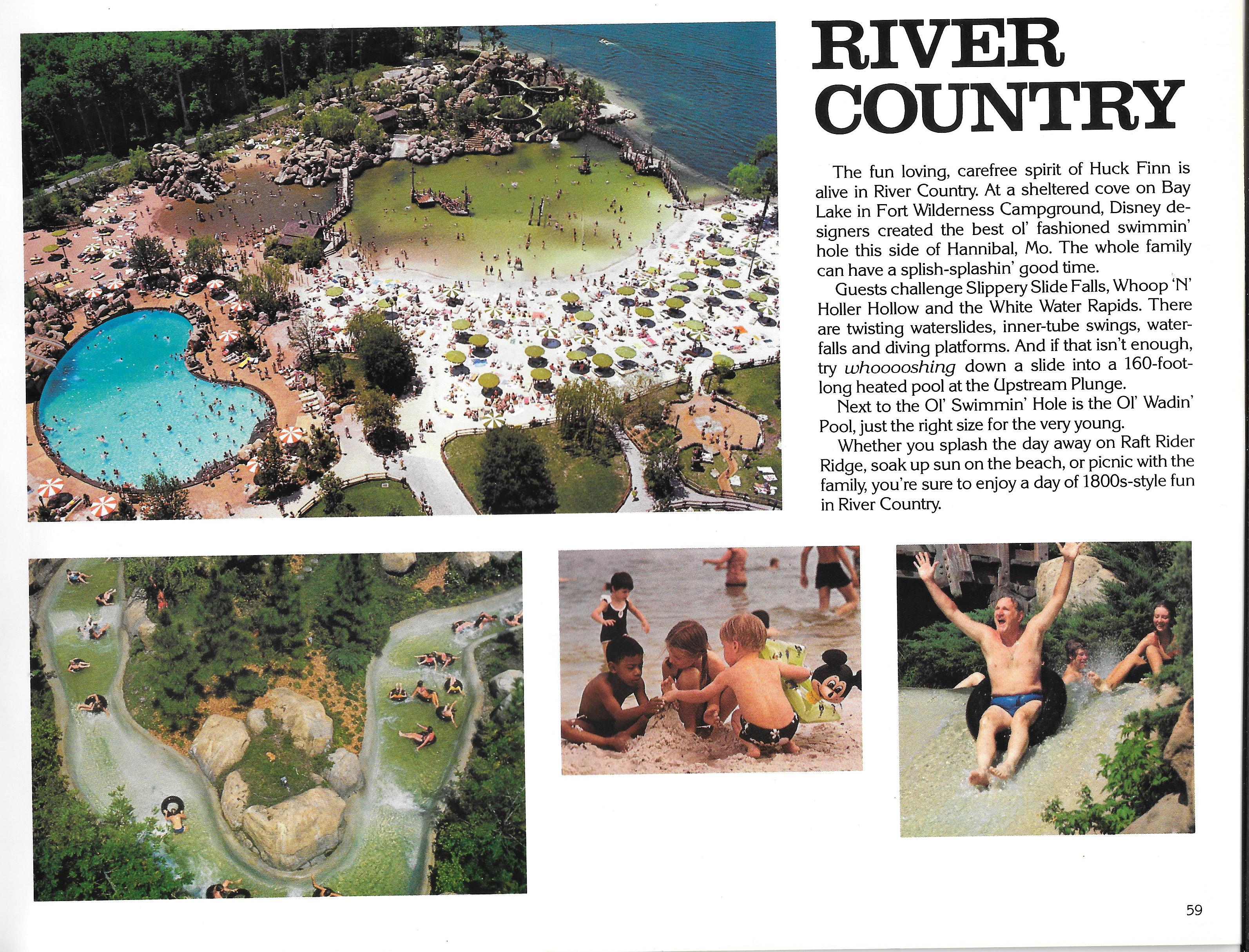
River Country was Walt Disney World’s first water park and operated seasonally until November 2001.  It was scheduled to reopen in 2002 but that never came to be and the park now sits abandoned:
Disney Guidebook Pictures0015

One of the other resorts that you could stay at in 1984 was the Golf Resort Hotel.  The property has since been sold off and from what I can tell is no longer part of the Walt Disney World resort; however, if you’d like a trip down memory lane, the blog Passport to Dreams has an excellent post about it from 2012:  Passport to Dreams–Return to the Golf Resort:

Disney Guidebook Pictures0016

Two other areas that have been around since the park’s earliest days in the 1970s are Lake Buena Vista and Walt Disney World Village.  I am not sure if Lake Buena Vista still functions as a resort the way it did back in the 1970s and 1980s, but you can still shop at the Walt Disney World Village.  Except they don’t call it the Walt Disney World Village anymore–it was renamed Disney Village Marketplace in 1989, Downtown Disney in 1997, and Disney Springs on September 29, 2015:

Disney Guidebook Pictures0017

Disney Guidebook Pictures0018

Disney Guidebook Pictures0019

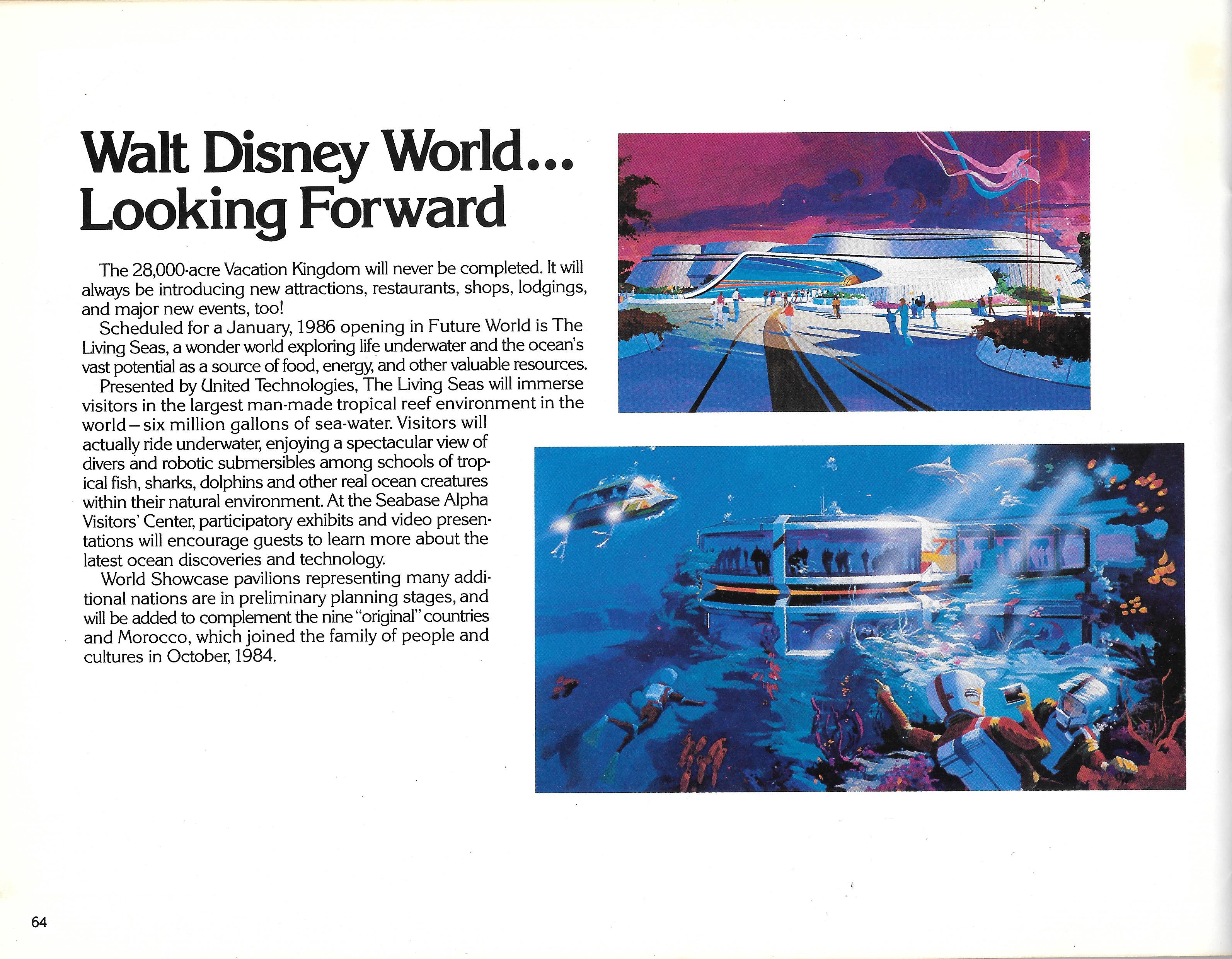
Finally, a look ahead at what was coming to Walt Disney World in 1986, the new EPCOT Center Future World attraction known as The Living Seas:
Disney Guidebook Pictures0020

Modern Diner

1:43 a.m.
(Conversation on a Diner Napkin)

Rain falls to the sidewalk
beside a lonely crowded roadside diner,
where I’m wondering what it was about her
that could have stopped the world for so long.

The exact handwriting, shape of numbers–
lines a paper napkin
with her phone number
in faded gray pencil and that smudge
always a backdrop for conversation.

And smiling.

I remember smiling
and she did the same
even though the music stopped
and the words were erased
by the rain ticking off my umbrella
into the night.

I wrote that poem for a creative writing class. in the fall of 1997.  It’s not a particularly great poem, nor is it based on anything that actually happened or anyone I know.  I am pretty sure that the inspiration was more along the lines of an imaginary idea, a fictional story where two people enter a diner and one leaves heartbroken, the only thing left to show for it is something scribbled on a napkin–notes, a phone number, maybe something much deeper.  It didn’t matter.

But the geographical inspiration was very real.  Sitting on Main Street not too far from the intersection with Greene Avenue, the Sayville Modern Diner was just about everything you would expect from a restaurant with the word “diner” in its name–a greasy spoon filled with vinyl-covered booths, the sounds of silverware clanking on thick earthenware dishes, and the smells of a grill that had seen countless omelets and cheeseburgers.  It was not haute cuisine by any means and even though the menu was pretty extensive, any time I was in there, I ordered one of two things:  some sort of omelet with a toasted bagel, orange juice, and coffee; or a cheeseburger deluxe.  Well, that’s not 100% accurate because there were those times when I was feeling extra fancy and got a hot open turkey sandwich, but really it was those two items, which are diner standards.

The Sayville Modern Diner circa 1996.  Taken from a 1997 calendar.  Photo by Pat Link.

The Sayville Modern Diner circa 1996. Taken from a 1997 calendar. Photo by Pat Link.

While breakfast after midnight is something you can get in quite a number of places outside Long Island (I have a number of memories involving late-night runs to Denny’s outside of Baltimore), I have to say that there are few if any places without the word “diner” in their name that really know what a cheeseburger deluxe is.  And yes, there are better hamburgers out there, burgers with higher quality ingredients and all sorts of creative sauces.  I love those places, don’t get me wrong, but there is something about the simple perfection of a single patty on a bun served with fries, onion rings, and a pickle (with the option of topping it with lettuce, tomato, and onions).  You don’t need anything else.

Of course, the food at a place like the Modern Diner is not the reason you go to a place like the Modern Diner.  I’ve noticed that diner culture has been fetishized over the last few years because of the culinary hate crime that is Guy Fieri, but turn away from his shtick and walk into a diner and you find something incredibly genuine that cannot be mass-produced.  Oh, it’s been tried–I’m sure there are still a few Silver Diner restaurants left at local shopping malls, but that place felt more like bad theme park kitsch as opposed to an actual diner.

That’s because a real diner feels worn in.  It’s the type of place where you can go in, get a booth, and aside from getting food and refills, you can be ignored.  You can allow yourself to disappear into that booth as long as possible.  The Modern Diner, when I was a kid, had this brown and gold decor that clearly came from the 1970s and at some point in the Eighties, they remodeled with the same dull magenta color you’d find in your average doctor’s office waiting room.  I’m trying to remember if they remodeled one more time and for some reason keep picturing a seafoam green motif, but I’m not sure.  Decor aside, if I was with my friends, those booths were the entire world for an hour or two.

Sometimes, the conversations were memorable; most of the time they were complete mundane.  Looking back, I feel that time spent there was our part of a ritual that had existed since time immemorial.  You’d make plans to go out and no matter what you did that night, you’d wind up at the diner.  Billy Joel put Brenda and Eddie there.  Garry Marshall had The Fonz set up shop in the bathroom.  George Lucas had Steve Bolander drown his sorrows in a vinyl-cushioned booth.  Barry Levinson wrote an entire movie called Diner that remains one of the all-time great friendship films.  Even when I (badly) wrote teenage characters, I’d have them hang out at the greasy spoon, giving them a moment of pause in a hectic plot or providing a place where moments of truth were had.  They are moments of importance, or in the case of the poem above, moments that are fleeting.  It’s something that is easy to recognize yet tough to capture in exactly the right way.

The Monday before this post went live, the Sayville Modern Diner served its last meal.  The owner, a former classmate of mine, apparently decided to sell, leaving the diner to be turned into a sushi/Asian fusion restaurant.  While I hadn’t been there in nearly a decade, I can definitely say I will miss it, even though there are other diners in town and other diners on Long Island, meaning that the idea of the diner will continue even though this one has closed its doors.

We Wrote the Book on Savings

consumers catalog

The cover of the fall 1991-1992 Consumers catalog. The company stayed in business until the mid-1990s, although my local store was gone by then.

I think that I am at the point in my life where I don’t get upset if I go to the store and something is out of stock.  Oh sure, it’s a minor inconvenience and the solution usually leads to me getting in the car and driving to another, similar store down the road.  But when you are a kid, this is a hard lesson to learn.  You don’t have a car and you don’t know much about the stores in your area beyond what you have seen whenever your parents have taken you, so showing up to TSS only to find out that the action figure you wanted was completely sold out can be absolutely devastating, even if it provides you with much-needed lessons about how you’re not always able to get what you want instantly.  Now, I’m sure that if you ask a number of people in my generation how they learned this lesson, they’ll tell you a variation on the same story–they wanted a toy, they asked mom or dad to take them to the store to get it, it wasn’t there.  Or they may say one word:  “Consumers.”

Consumers was a catalog-based store that was founded in Canada as Consumers Distributing in 1957 and expanded over the course of a couple of decades, adding stores and then buying out other, similar retail outlets, something that helped them to pop up with more frequency during the 1980s.  The idea behind the store was similar to its main competitor, Service Merchandise:  the company published a catalog and then anyone who wanted to buy something from the catalog would head to the local retail outlet–usually at a mall–and pick it up.

That is, if they actually had anything.

The G.I. Joe page of a 1980s Consumers catalog. Photo courtesy of YoJoe.com

The arrival of the Consumers catalog twice a year was an event.  My friends and I would grab it out of the mail and skip right to the toys and games section.  Open before us was a display of everything we ever wanted, from G.I. Joe figures and vehicles to every Nintendo game that we’d ever seen advertised anywhere.  Plus, the prices were much better than what you would get at Toys R Us–not that Toys R Us was overpriced or anything, but any time you can say, “Hey Mom!  The Legend of Zelda is only $45 and not $60!  Can we get it?” you have a better shot at getting what you wanted.

That is, if your parents were completely gullible, which mine were not, but that didn’t stop me from trying.  Unfortunately for those who actually got this ploy to work, going to Consumers was usually a bust because they would head to the store, find the item on display, give the cashier a ticket and most of the time discover that said item was currently out of stock.  According to the Wikipedia page on the store, this led to the company creating what was then an innovative inventory checking system, where they were able to look up the item you wanted on the inventory of every store in the area, which is something that we take for granted in today’s retail world.

But the prevailing perception was that most of the merchandise at Consumers was non-existent and as much as the company tried to change that, I don’t think it really helped.  It also didn’t help that the Consumers store in the Sayville area was in the Sun Vet Mall, a mall that was closer than any of the malls in the area but was clearly third-tier, especially when compared to the South Shore Mall and Smith Haven Mall, which had big-name department stores.  Sure, Sun Vet had The Gap, which was convenient when I was in junior high and high school, but its anchors were a Rickel Home Center and a PathMark, so it didn’t exactly scream “Galleria” if you know what I mean.

The Consumers store was located in the corner of the mall near the Gap and McCrory, both of which have since left, and whereas the other malls always were bustling, Sun Vet always seemed half dead and while the mall’s pizzeria was excellent and Sun Vet Coin and Stamp always was good for a few back issues, you only went there if you absolutely had to or if you were like me and my friend Jeremy, who would ride there on our bikes when we were teenagers simply because we had very little else to do.  Whereas Service Merchandise would be a huge store that was part of a brand new shopping center down the road, Consumers was shoved into that corner and while the first few catalogs would get people there, the store was pretty dead within a year or two, especially as we’d taken to dragging our parents back to Toys R Us or anywhere else where we knew that would have what we wanted in stock.

So in a way, it was a learning experience about being more strategic in begging for toys and other stuff as well as being more patient, and perhaps that is why so many of us are more intelligent these days about where we shop.

Pop Culture Affidavit Episode 43: Yet Another Rambling January Podcast Episode

Episode 43 webpage coverSo it’s Jaaaaaaaaaaaaaaaaaaaanuaaaaaaaaaaaaary. Blah. BUT, thankfully I’m here to bore you all to death … I mean, get you pumped up for another year of pop culture randomness! Join me for 40 minutes of rambling where I talk about Christmas, highlights from last year, and what I’m looking forward to this year.

You can listen here:

iTunes:  Pop Culture Affidavit

Direct Download 

Pop Culture Affidavit podcast page


Ponies and Journeys: When What Was in the Driveway Became Important Again

The Ford Explorer after its update for the 1995 model year.  Image courtesy of Wikipedia.

The Ford Explorer after its update for the 1995 model year. Image courtesy of Wikipedia.

I will fully admit that I’m not a car guy. I know very little aboutt the interior workins of an automobile, and don’t really care about what I am driving as long as it has four wheels and runs properly. In fact, I didn’t even get my license until after I graduated high school, and even then it was because I wanted to get my road test out of the way before heading to college. Still, like any of the guys I know who are into cars, I can appreciate a well-designed vehicle and did notice through the mid- to late-1990s how the automobiles I was seeing on the road were starting to change. By the time we hit the turn of the century, the SUV came to dominate, something os noticable that even The Washington Post Magazine was doing its cover story on how people in compact cars were afraid for their lives on the Beltway due to the high volume of Ford Expeditions (and how many of those Expeditions were being driven by the incompetent and the aggressive).

But the Expedition wasn’t king of the road yet in 1994, as most of the suburbanite families I knew were hauling kids around and running errands either in a minivan or in a Ford Taurus wagon, which was the last great station wagon. It was the best-selling car in the country at the time and held that status until 1997 when it was replaced by the Toyota Camry. I’m sure that there were many reasons for this, but a significant factor had to be Ford’s lackluster redesign of the Taurus in 1996, which effectively killed the sedan. That didn’t mean, however, that Ford didn’t make its mark in the mid-1990s because it did so with an SUV and a car: the Explorer and the Mustang.

Both of these cars already existed prior to 1994, obviously, but it’s important to note that this year saw important changes for both. The Explorer was a relative newcomer to suburban driveways, hvaving been introduced in 1990. SUVs weren’t as ubiquitous then as they are now–some people had Jeep Grand Cherokees, some had GMC Suburbans (which was more like a truck), and there was this infamous Ford Bronco that made its way down a Los Angeles freeway that June–so to own an Explorer back in its first few years meant that you had enough money to not need a Taurus and were a bit more sophisiticated than the average minivan owner. And if you had the Eddie Bauer edition Explorer? Well.

The 1994 Ford Explorer Eddie Bauer edition.  Image from Motortopia.

The 1994 Ford Explorer Eddie Bauer edition. Image from Motortopia.

Really, very few things int he early 1990s say “Family plucked from the pages of a catalogue” than the Eddie Bauer edition of the Ford Explorer. Usuall hunter green, the SUV had an all-leather interior with the Eddie Bauer goose logo stitched into the seat backs and tan pinstriping with “Eddie Bauer” stenciled on side. There was one owned by a family a few blocks over from me, a car appropriate for its street–Handsome Avenue, which was a wide street lined with trees whose leaves cascaded beautifully to the ground each fall. I pictured that family wearing matching barn jackets while driving their Eddie Bauer edition Ford Explorer to some cabin on a lake where they would then spend their evenings drinking cocoa while sitting by a fire in their coordinating sweaters. Ford probably saw this and saw potential in it too, because even though the Eddie Bauer edition was out in 1993 or so, they redesigned the Explorer for the 1995 model year to be less boxy and more in line with the curvature of then-modern cars. Unlike the Taurus, this was a win and by the end of the decade, the Explorer, Expedition, and Excursion were just about everywhere.

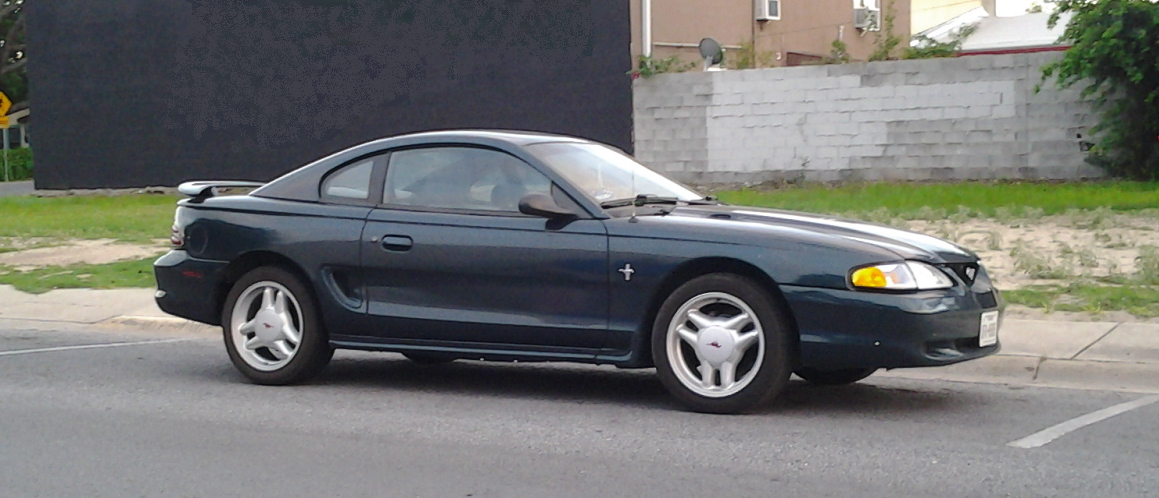
Another win was the redesign of the Mustang, a car that helped define “muscle” during its heyday. but like quite a number of cars in the 1980s and early 1990s, it had fallen upon hard times aesthetically and was a shadow of its former shefl. The 1994 Mustang was Ford’s shot at changing that, a redesign that was going to return its famous sports car to its former glory, as evidence by this ad campaign:

The redesigned 1994 Ford Mustang.  Image courtesy of Wikipedia.

The redesigned 1994 Ford Mustang. Image courtesy of Wikipedia.

The redesign worked and the new Mustang definitely made enough of a splash to get it noticed by even non-car guys like me. But honestly, if it went from 0-60 in 5.3 seconds, it went from 0-guido in 2.5. I don’t know if it was Ford’s intention, but whenever I think of this car, I picture it being colored bright teal, reeking of Parliaments and blasting Gina G. with the driver spackling on another layer of base while driving 75 in a 35 on the way to a club whose name includes the word “Dublin” to meet a Mustang-driving boyfriend who infused the once-great car with all of the tricked out features, gold chains, tank tops, backwards Yankees caps, and Drakkar Noir they could get their hands on.

And I know I spent my time here focusing on Ford when there are scores of other cars out there, but these two cars are two that would help define the suburban landscape for the latter part of the decade. Furthermore, they would help re-create the sense of the cars you own as a middle class status symbol, an affordable luxury that was beyond the utilitarian K-cars of the prior decade and showed how well you were at keeping up with everyone else.

O Say Does That Star-Spangled Banner Yet Wave; This Concludes Our Broadcast Day

JeffersonThis weekend marks the bicentennial of Francis Scott Key’s writing “The Star-Spangled Banner.”  To mark the occasion, Baltimore had a large celebration in its harbor, especially near Fort McHenry, which is where Key was being held prisoner during the Battle of Baltimore.  The history of our national anthem goes beyond that one battle of the War of 1812 and  The Washington Post has a really great article that discusses that history (“5 Myths About the National Anthem”).  I actually knew a majority of the truths the writer discusses because of a filmstrip I saw in music class when I was in the fifth or sixth grade.  Don’t ask me how I actually retained that information and not, say, trigonometry, because it’s one of the great mysteries of life.

But I didn’t want to write this short post about the history of “The Star-Spangled Banner” or discuss its significance in our everyday lives as Americans.  No, this blog is about popular culture and when I, and quite a number of people older than myself, think of the national anthem’s place in popular culture, they might think of this:

If you’re under a certain age, you may not know what the significance of the clip I just posted because you might also not be familiar with the concept of a station signing off.  In the days before hundreds of channels and all-night infomercials, local television stations and network affiliates signed off for the night, concluding their broadcast day with a pre-packaged video montage and then going to some sort of test pattern with a constant high-pitched tone:

One of the most common sign-offs was the playing of “The Star-Spangled Banner” (something so common it opens Billy Joel’s song “Sleeping With the Television On”). There were quite a number of different versions of the national anthem sign-off, but this one always stuck out to me as one of the more memorable, probably because it was one of the few I actually saw–although if I’m being truthful, it may have been used as an early morning sign-on as well.

The montage I posted was created by the New York-based firm Saxton Graphics Associates, Ltd., probably in the early 1970s (since it closes with the moon landing) but I couldn’t find much else in the way of history of the montage beyond this paragraph on the Wikipedia page for “Performances of ‘The Star-Spangled Banner'”:

Over the early years of U.S. television broadcasts it became common practice by many stations to close their broadcast day, usually late at night or early in the mornings, by airing the Star Spangled Banner accompanied by some visual image of the flag or some patriotic theme. One audio-visual arrangement in particular, entitled “National Anthem,” [5] was produced by a New York-based graphics firm, Saxton Graphic Associates, Ltd. The uncommonly complex and interesting orchestral arrangement of the Star Spangled Banner commences with a trumpet fanfare then the anthem is accompanied by images that illustrate several of the highlights of the history of the United States of America, culminating with an image from 1969 of an Apollo 11 astronaut standing on the Moon by the US flag. Several television stations aired this including WNEW-TV in New York (through 1978), and Washington DC WDVM-TV channel 9. There is no reference to whom arranged the music, nor to what orchestra performed it though numerous sites on the Internet host messages inquiring about this and where the original music might be found today.


I don’t have a long, drawn-out nostalgic story for this one.  It does remind me of the times when I had to stay at my grandmother’s house and we’d get to stay up late for, say, New Year’s Eve or something, and it kind of reminds me of flipping around the channels in the very early hours of the morning when I had my first job of putting Sunday papers together at a local stationery store.  But when I watch it now, it actually is a little moving.  I’ve always loved how the montage takes us through all of American history and reminds us just how much has happened in the last 200-300 years; furthermore, the bombastic arrangement of the song is enough to get even the most cold-hearted cynic (read: me) feeling at least slightly patriotic.  And it’s a memento of an earlier time in our country’s media history, a piece of ephemera that makes some wistful for an earlier time and others curious.

Memories Can be Wafer-Thin

Necco Wafers

Image from Old Time Candy.

As I have gotten older, I have found that there are some things in my past that are actually better left there.  The quality of certain movies or television shows are the best examples of this, but it can apply to things like food.

From the time I was ten until I was sixteen, I spent a week every summer on Kezar Lake in the extremely small town of North Sutton, New Hampshire.  While it’s not too far away from the larger area of Lake Sunapee, North Sutton is basically comprised of the lake, a bed and breakfast, several homes, and a general store named the Vernondale Store.  When we weren’t swimming, riding our bikes around the lake, or being dragged to a glass factory by our parents, my sister and I as well as our friends would journey up to Vernondale with a couple of dollars to buy baseball cards, Mad Magazine, and candy.

Vernondale stocked a wide variety of candy, but one of our favorites was Necco Wafers.  Wrapped up like a roll of quarters, Necco Wafers are manufactured by the New England Candy Company, or Necco, and have been made sine 1847.  So it’s no wonder they were in such abundance in New Hampshire (another food item, Hires root beer, will definitely get its own post at some point as well).  I’d seen them outside of New Hampshire, but rarely south of the Mason-Dixon line.  There are eight flavors in a roll of Necco Wafers:  lemon (yellow), lime (green), orange (orange), clove (purple), cinnamon (white), wintergreen (pink), licorice (black), and chocolate (brown).

So I was recently at a convenience store and as I made my way from the soda cases to the front counter, I spotted Necco Wafers in the candy rack.  Usually, I would ignore such things, but I felt nostalgic and picked up a pack, then proceeded to write down my reaction to eating each of the eight flavors for the first time in twenty years.

Pink: Well, now I know why I’m able to tolerate the taste of Pepto Bismol.

White: Is this cinnamon?  I’m tasting a little heat here, and it kind of reminds me of when I was a kid and used to suck on cinnamon Certs until I torched the hell out of my tongue.

Black (which  looks more like dark blue): This is obviously licorice and I guess Necco was trying to get me ready for Jager shots later on in life.  It certainly has an aftertaste, so I was prepared for that effect of Jager.

Yellow: This was like alternately sucking on a wafer coated in lemon Pledge and like those old Archway lemon cookies that my dad used to buy in Waldbaum’s every weekend.

Green:  I’ve never eaten a fresh scent Clorox wipe, but I’m pretty sure this is what it tates like.

Brown:  This is obviously chocolate–in fact, they sell entire rolls of chocolate Necco Wafers–but at first it tastes like very little and the actual taste of chocolate sneaks up on you.

Orange: They did a good job here of replicating the flavor of a creamsicle.  In fact, this is probably the way creamsicles are eaten on The Jetsons.

Purple:  Did I just swallow potpourri?

They are, I guess, an acquired taste, and are truly made for a kid’s palate.  Still, my disgust at the flavor gauntlet I ran doesn’t take away from what are some fond memories of vacations gone by.

Pop Culture Affidavit, Episode 31 — The 1994 Grab Bag!

man reaching into grab bagWhat do Beverly Hills, 90210, the 1994 Baseball Strike, and Zima all have in common?  They’re all covered in the latest episode of Pop Culture Affidavit!  As part of my series of posts and episodes called 1994: The Most Important Year of the Nineties, I take a look at ten completely random things from 1994.  It’s movies, television, music, and current events all in one convenient episode!

You can listen here:

iTunes:  Pop Culture Affidavit

Direct Download 

Pop Culture Affidavit podcast page

(more…)

Leave Yourself Behind

Tom Paris 1994A quick note:  This piece originally appeared on an old blog of mine in July 2004.  I’ve edited and updated it.

My only regret is that I did not stay longer. I would have loved to experience more, go deeper into some countries and learn more about other cultures. However, being a Student Ambassador has opened my mind even further, as I am forced to think on a global scale about my life, and the lives around me.

That is the final paragraph of the journal I kept during the summer of 1994, after I had spent 23 days touring France, Germany, Switzerland, and Spain as a People to People Student Ambassador. Written on a flight back from Paris after my fellow “ambassadors” and I had exhausted the plane’s supply of coffee and soda and had annoyed all of the other passengers, it’s a statement typical of a 17-year-old. At the time, I thought that the program changed my life. Of course, at 17, it had. Being on the verge of my senior year of high school, I was making earnest statements like that on a regular basis. Still, I cannot discount that those three weeks were a turning point in my adolescence, the result of a program whose educational experience was more well-rounded than intended.

Can You Really Get There From Here?

The mission of People to People International and its Student Ambassador program is: “to bridge cultural and political borders through education and exchange, creating global citizens and making the world a better place for future generations.” I received their brochure in the fall of my junior year, right around the time my guidance counselor was drilling into my head that I was in the most important year of my academic career, perhaps even my life. As a result, I went looking for the type of opportunities that would look good on what eventually became a rejected application to Dartmouth — Anchor Club historian, student journalist, and mock trial lawyer. “Student Ambassador to Europe” was something that college admissions officers were impressed with. Europe was where great art was born; where history took place; and where entire generations of disaffected young Americans fled to find themselves.

I convinced my parents that not only would I make it into the program, I would somehow come up with $1200 of the trip’s cost. Not that I knew how I was going to pull that off — this wasn’t exactly like the time I hoarded my $25/week from JillMatt Cards & Gifts so that I could save enough money to visit my friend Chris in Fort Lauderdale. But after some creative publicity, including a story in The Suffolk County News and a talk with the Kiwanis Club (where I made a never-fulfilled promise to come back and speak to them), I had my tuition. On June 24, I set off for Kennedy airport, where I met up with the rest of the Long Island delegation. We had our flight to Washington, D.C. canceled and were forced to cab it to LaGuardia where, in a move reminiscent of a bad Amazing Race moment, two of our group members were dropped off at the Delta terminal and not the Delta Shuttle terminal.

Don’t Smurf an International Incident

Ultimately, my People to People delegation arrived in Washington intact. The entire group of 28 hailed from Long Island, Connecticut, Virginia, Tennessee, and California, and was lorded over by three advisors — the LaMers of Connecticut and Mary Nolan, who had run the Long Island pre-trip meetings. They were all nearing senior citizenship (if they weren’t there already), and I have to admit that I admire anyone that age who is willing to travel for three weeks with a group of unruly teenagers. They had some help during those first few days while we stayed at George Washington University, where People to People’s representatives laid down all of the rules.  Essentially, they wanted to avoid three things: the “ugly American” syndrome, an international incident, and a babysit-the-rich-kids summer camp. I mean, that’s why the Student Ambassador program director stood on the stage in a university lecture hall and told us that we weren’t allowed to drink, smoke, do drugs, have sex, or even form cliques.

I honestly thought that last one was insane. Not that I wanted cliques to form, but it seemed that with 28 teenagers in close quarters, cliquing up was inevitable. In fact, small groups of friends formed on the very first day and would get even more defined as the trip went on. But when up against Papa & Mrs. Smurf (named so for Mr. LaMers’ beard) and Punky (Mary Nolan wore a spiked femullet), we were a single group of 28 students who annoyed everyone on the National Mall, the Metro and in the Crystal Underground. I guess all the things that annoyed me about D.C. when I was living and working there, then, were come-uppance for my acting like an asshat at 17. But anyway, I wrote about our initial camaraderie: “We started as … two groups of people from different states. We left as a group of Americans wearing stupid shirts and name tags.” (more…)