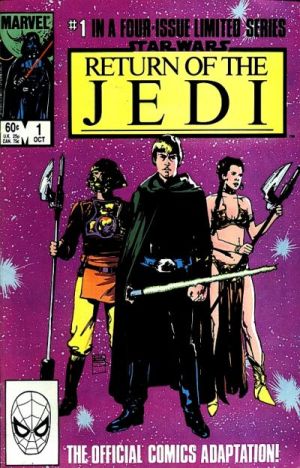
 In my previous post, I wrote about the first comic I technically owned, although I only remember finding it years after I actually had “bought” it as a kid and it wound up feeling way more important later on, especially when I became an avid Batman collector and a fan of DC continuity, especially the continuity that centered around or was associated with Crisis on Infinite Earths. Here, looking at the second set of comics, is something that was purchased because it was associated with the most important thing in my life when I was six years old and that was Star Wars.
To this day, Return of the Jedi remains the Star Wars film I saw the most in theaters and is the only film from the original trilogy that I saw upon its original release. My father took me and my friend Chris to see the film at the Patchogue Indoor/Outdoor drive-in theater (the one that eventually became the UA Patchogue 13, which I wrote about in 2010: “Let’s Go to the Movies”) in 1983, would take me again to see it at the Sayville triplex when it was rereleased in 1985, and Amanda and I would go and see the special edition during spring break in 1997. I will always have a soft spot in my heart for the film because of it being the one I saw in the theater (as opposed to Star Wars, which was on television and video and I had watched numerous times before seeing Jedi; or The Empire Strikes Back, which I saw via bootleg copy before it finally came out on video in 1984), and also because of how its merchandising shaped that part of my childhood.
 You could not escape Return of the Jedi in 1983 and 1984. You may have not gone and seen the film (although I don’t know that many people my age who hadn’t seen it), but that didn’t matter because no matter what store you walked into, it seemed that there was something with a return of the Jedi logo on it. Lucasfilm licensed Jedi to the hilt and when I was a the height of my kid fandom, I had a ton of merchandise that went beyond the toys: sheets; cookies; Dixie cups; a calendar; and my most prized non-toy possessions, which were the records, tapes and books that told the story of the film. For myself and a number of other kids my age, owning these pieces of merchandise allowed me to relive the movie for at least a few years before I saw it again or owned my own copy on VHS (a copy I still actually have).

A two-page spread of Star Wars merchandise, most of it from Jedi, as featured in “George Lucas: The Creative Impulse” by Charles Champlin
The comics, however, I have to admit, were not really a part of that. My comic book buying as a little kid was incredibly sporadic–if I saw something I liked and my dad had enough pocket change, I would buy it, but there were rarely return trips to the store to get the next issue or anything like that. But I did own the entire Marvel Comics film adaptation and that is because of something that is an integral part of the 1980s childhood nostalgia, which is the comic book multipack.
 If you’re unfamiliar with comic book multipacks, these were polybagged packs of three or four comic books that were stocked on the shelves of K-Mart, Toys R Us, and similar stores (for those local to Long Island, you’ll recognize the name TSS). Sometimes they were entire collections of limited series, such as this, but other times they were three comics featuring the same character or characters. I remember a number of times where I would pick one of the multipacks off the shelf and try to see what the middle book was because you only could see the full covers of two of them. Most of the comics multipacks were from Marvel, although DC produced them as well, and at some point in late 1983 or early 1984, the company bagged the entire four-issue series and put it on the shelves for the low, low price of $2.29, which was an 11-cent discount.
I really don’t need to get that much into the plot of the series because if you’re reading this, you’re probably familiar with the events of Return of the Jedi, and unlike, say, Marvel’s adaptation of Star Wars back in 1977, there aren’t major discrepancies between the comic and the movie such as deleted scenes left in or lines of dialogue significantly changed. In fact, the thing that does make the Return of the Jedi adaptation unique is that it’s a separate miniseries from the then-ongoing Star Wars title that Marvel was publishing and it is only four issues long instead of the six that were given to tell the stories of Star Wars and Empire. The creative team was the same as Empire‘s six-issue story arc, with Archie Goodwin handling the writing and Al Williamson and Carlos Garzon doing the art (the team on Star Wars back in 1977 had been Roy Thomas and Howard Chaykin).
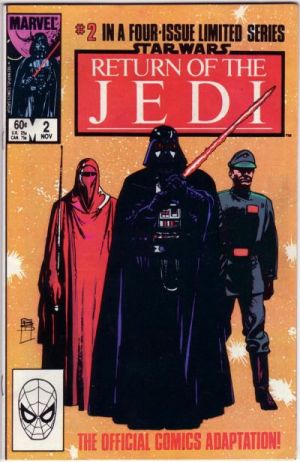 In trying to remember how I got these comics, I seem to recall getting them from Toys R Us in Bay Shore, and it was one of those rare times when my parents took Nancy and I to the store and allowed us to pick something out because we didn’t get toys or anything like that at random very often–they were usually saved for Christmas or our birthdays. Why we were at Toys R Us to begin with is beyond me, but I’m going to assume that either one of us was there to spend Christmas or birthday money or we were there to buy a gift for someone else, perhaps someone whose birthday party we were attending. The comics and coloring books were all located on a newsstand rack that was at the end of the board games aisle at the back of the store (and honestly, the old-school Toys R Us layout is probably worth its own blog post, especially if I can find pictures), and what probably happened is that I saw the comics multipack, asked my parents to buy it for me, and since it was roughly the same price as an action figure (my usual go-to “can you buy me this” item because it was cheap and they knew it wouldn’t go to waste), they said yes.
I’d like to say that I read the covers off of the series, but quite honestly, I only remember one time where I read it in the car on the way to my grandmother’s house and what probably happened after that was that I shoved the comics in the desk where I kept all of my coloring books. The storybook, which had bonafide photographs from the film was more important to me anyway. And what that means was that I had vague memories of it beyond the covers–which, to be honest, are different characters striking simple poses in a way that can best be described as “serviceable” and nowhere near as dynamic as the adaptations of the other two films–so when I read the adaptation as part of the “A Long Time Ago …” Volume 4 omnibus that Dark Horse Comics released, I didn’t have any serious emotional attachment.
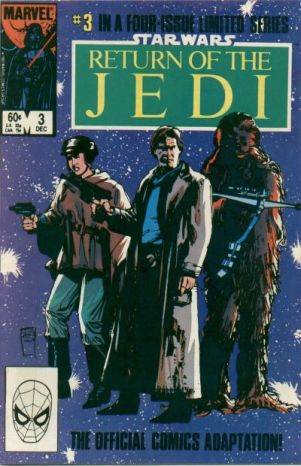 Still, I have to say that it is quite a disappointment. Having to condense the entire movie into four issues means that Goodwin and Williamson are almost doing a retread of the photographic storybook, as it’s heavy on narration boxes and the panels look more like stills than dynamic depictions of action. Granted, I know the story and knew the story when I first read it, so I didn’t and don’t need that feeling of “What’s going to happen next,” but this during an era of the Marvel Star Wars comics where David Micheline and Jo Duffy were writing some excellent stories and the work by artists such as Walt Simonson, Ron Frenz, and Tom Palmer was top-notch. That’s not saying that Goodwin and Williamson were bad at their jobs, but reading Jedi as part of that omnibus package had me wondering what the series would have been like if those creators had taken on the task of adapting the film.
Instead, what we have is probably the very definition of a “disposable” comic book. I mean, there are quite a number of comics out there that are ephemeral, but for something that had such a big impact on popular culture and the comics industry (especially Marvel) as Star Wars, the adaptation of Jedi reads as if it were to be consumed in the moment and then tossed aside to be put on a pile of coloring books, storybooks, and other things that would eventually make their way into a trash can at some point during a huge spring cleaning a few years later.
Coming next month: Star Wars #81
 Well, it’s been a month since Christmas and you’ve all finally listened to all of the holiday-themed episodes that everyone else on the TTF network put out … so why not one more? That’s right, folks–we’ve kept the lights up and drinking egg nog way past its expiration date to bring you a look at FOUR Christmas-themed DC Comics. First up is a treasury-sized Rudolph the Red-Nosed Reindeer read by yours truly and Brett, complete with running commentary. I follow that up with Stella who discussed a Golden Age Batman story live at our local Starbucks. Then, it’s time to check in with the boy of steel and the Legion of Super-Heroes in a classic story that I reviewed with Michael Bailey. And finally, I fly solo for Team Titans #6. It’s festive! It’s jolly! It’s a month overdue!
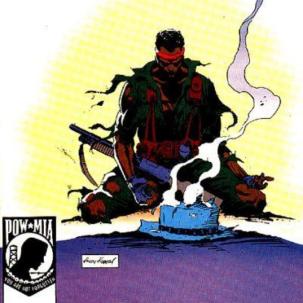 “The Death of Joe Hallen” hits its penultimate chapter with “Burned” from The ‘Nam #57. Joe and his Marine unit finish their covert mission for a CIA agent and try to find their way back to more friendly territory, but things don’t exactly turn out as planned. It’s brought to us by Chuck Dixon, Wayne Vansant, and Tony DeZuniga. Plus, I’ll take a look at the historical context for October 1970.
 It’s the first episode of 2016 and I’m back from Vegas, baby, so I’ve decided to take a look at one of the biggest independent film success stories of the mid-1990s, Swingers. Directed by Doug Liman and starring Jon Favreau (who also wrote the screenplay) and Vince Vaughn, the film is a comedy about guys, Hollywood, and attempts at romance in their twenties.
 I suppose it’s kind of funny to say that comic #1 in your collection (read: the first comic you purchased and still have) is only #1 on a technicality. I own a copy of The Brave and the Bold #182 and have owned this comic since 1981; however, I honestly do not remember buying it.


 “Whipping Post” is the title of The ‘Nam #56 and part three of “The Death of Joe Hallen.” Here we see Joe and his new unit take on a very secret, possibly sketchy mission into enemy territory that involves a connection to the Chinese and the CIA. It’s brought to you by Chuck Dixon, Wayne Vansant, and Tony DeZuniga.
 Be a good citizen! Don’t do drugs! Understand the dangers of unprotected sex and fight the stigma of AIDS. These are all part of various DC Comics public service announcements over the company’s 80-year history. In this episode, I tackle citizenship by looking at a classic one-page Superboy PSA; fight the war on drugs by looking at not one, but all three New Teen Titans Drug Awareness giveaways; and I contribute to AIDS awareness by looking at one-page PSAs featuring the DCU’s best and brightest as well as the mini-comic Death Talks About Life.
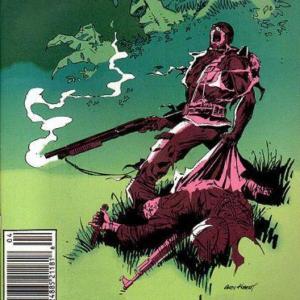 Chuck Dixon, Wayne Vansant, and Tony DeZuniga bring us part two of “The Death of Joe Hallen” in The ‘Nam #55 as Joe Returns to Vietnam for some LRRP and falls in with a new group. Plus, I take a look at “Christmas in Saigon,” an episode of the classic 1980s Fox television drama 21 Jump Street.
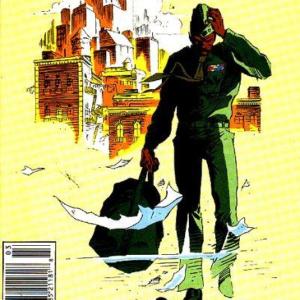 Chuck Dixon’s regular tenure as the writer for The ‘Nam begins with part one of “The Death of Joe Hallen,” a special five-party storyline featuring art by Wayne Vansant and Tony DeZuniga. In this issue, we get a closer look at Joe (whom we’ve seen briefly before) and what is waiting for him when he returns from Vietnam to Baltimore. Additionally, I take a look at another story of a vet returning home from Vietnam by looking at Bruce Springsteen’s classic song, “Born in the U.S.A.”
 Pop Culture Affidavit