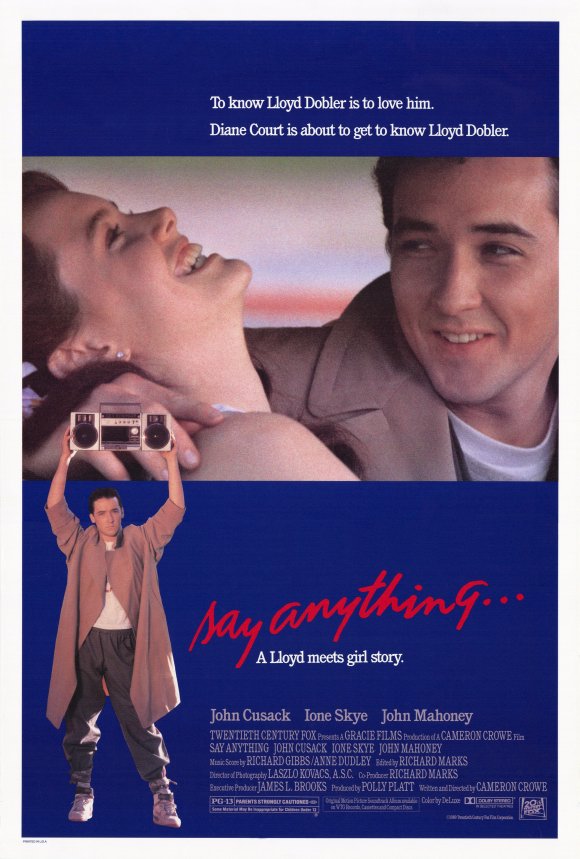
In 1989, Cameron Crowe wrote and directed one of the seminal movies of the teen film genre. Starring John Cusack, Ione Skye, and John Mahoney, it’s Say Anything …, one of my favorite movies of all time.
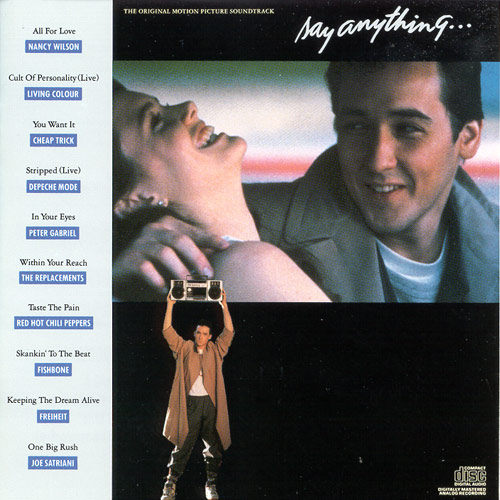
Join me as I take a look back at the movie, talk about my favorite scenes and also take a look at the soundtrack.
So funny enough, I actually missed the last episode of Degrassi Junior High when PBS aired it. There was a point where I was watching DJH on a fairly regular basis and then PBS started airing episodes of Degrassi High, a series that I’m definitely going to cover in full detail on the blog because whereas I only remember certain episodes of DJH, I remember every episode of Degrassi High and that’s the show that I grew attached to, at least for the couple of years that I was able to find it on television. But really, one day I was watching an episode like “Pass Tense” or “Black and White” and the next I saw the Degrassi kids starting high school at a new show and heard hints of something really bad happening to the junior high school.
It wasn’t until years later–a few years ago, in fact–that I managed to get my hands on a copy of this, the very last episode of Degrassi Junior High. I had placed a bid for VHS copies on eBay and had won an auction but then the auction was done away with because the person involved was selling copies of the show that he/she had taped and that was technically illegal. When that happened, the person contacted me and offered to send me a tape anyway. I offered to pay for shipping and the cost of a VHS tape–all in all it was about $10–and wound up with all of Degrassi High and several episodes of DJH, including “Bye Bye Junior High.” This wound up being one of the first episodes I sat down and watched, thinking, “I never actually got to see this.”
The episode famously (at least if you’re a Degrassifan) ends with the boiler room of the junior high school catching on fire on the night of the big graduation dance and everyone in the dance being evacuated and forced to watch the place burn to the ground. But before that there’s a lot of resolution to various character plotlines and we get the feeling that this is indeed some sort of finale and that the main stories from the entire season are being wrapped up. So, it’s not a “jumping on” point but then again when is a season/series finale a “jumping on” point?
If you’d been watching the entire season, you know that there have been three major storylines at this point: Wheels’s parents dying at the beginning of the season and his struggle to come to terms with their deaths and getting on with his life, Joey’s learning disorder and having to repeat the eighth grade, and Spike’s struggles in school as a result of raising Emma. All three of these are addressed over the course of the last couple of days of school wherein the gang finishes their final exams and then gets their report cards. Most of them pick their report cards up at the main office but these three have teachers personally hand them their grades. It’s a weird thing, but for story’s sake it works. Oh, and lurking in the background is the foreshadowing of the fire with the constant presence of a malfunctioning fire alarm and maintenance workers who are there to fix the furnace of what is a very old building–okay, it’s not so much lurking in the background for foreshadowing’s shake as it is blatant telegraphing of what’s going to happen at the end of the episode but it works in a sense.
Anyway, the three characters each have their worries and their moments. Wheels struggles to finish his last final exam and in the end barely makes it out of ninth grade. Mr. Garcia–who talks in “teacher vocabulary”–tells him that yes, he passed, but barely and under normal circumstances he would be made to repeat some courses, maybe even the entire grade. Wheels seems to ignore most of this hearing: “Blah blah blah PASSED blah blah blah” and leaves excitedly, which is true to his character, especially considering what will happen as he moves through high school and at the end of the series in the School’s Out movie. (more…)
The flat remains of a two-liter bottle of Diet Pepsi. Yes, that’s my kitchen in the background.
A couple of months ago, I was at a work function where food was being served. We had a few tables of fried chicken and some sides as well as a table of two-liter soda bottles. As I poured myself a cup of Diet Pepsi, I couldn’t help but think of how ubiquitous the two-liter is—it’s a party and holiday industry standard and has been ever since I was a kid.
I suppose that is not something to get really nostalgic about, especially since it’s a plastic bottle. It’s not the iconic 6.5-ounce contour shaped glass Coke bottle that is the “nostalgic” Coke bottle and it doesn’t have the personality of the 20-ounce bottle, which is easily accessible and personal, plus it’s shaped like an old classic glass Coke bottle so it calls back to images where people from the 1950s or so pop a top of a glass Coke bottle. The two-liter has never had that. When you buy one of those, you twist off the metal or a plastic cap, and don’t think twice about it.
Which is indicative of the area and time period that constitutes my youth. Having been born in 1977, I have this attraction to the shopping mall, the multiplex, and everything else in the suburbs. It is an era that is by and large disposable and I think on some level, even though nostalgia has turned its eye a little more toward my formative years, that nostalgia is selective at best—it’s the music, the movies, the fashion. Nobody is going to look at suburban life in the 1970s and 1980s with the same rose-colored glasses our culture uses for the 1950s. Because the decades of my childhood are the rose-colored 1950s’ unfortunate afterbirth: Levitt homes and small towns gave way to shopping malls, gated communities, and McMansions, especially where I grew up. You cannot go anywhere on Long Island without seeing shopping malls or multiplexes.
Do you know it’s been twenty years since Zack Morris graduated high school? Take a look back at the crew from Bayside High as I talk about Saved By The Bell–its history, its characters, my favorite episodes, and its legacy. Plus, a look at “Graduation,” the final episode to feature the original cast.
I spent a lot of my teenage summers inside. Oh sure, there were family vacations, Saturday afternoons playing hockey, and Tuesday evenings playing softball, but there were also entire weeks where I barely left the house, so much so that I knew that the same Craftmatic Adjustable Bed commercial came on every day at 1:00 p.m. on WPIX.
I think it was then that my father would force me out of the house by cranking the dehumidifiers in both the basement and den, therefore making it impossible to watch television. That, or he’d find some sort of back-breaking manual labor for me to do.
Anyway, among the many types of commercials I watched were commercials for compilation albums. Put out by companies such as Time-Life Music, these were collections of famous songs that fit a particular theme. In Time-Life’s case, there were collections for different decades such as the 1960s or 1980s (I personally own all of Sounds of the Eighties), but there were also compilations such as AM Gold andLove Songs.
The commercials were always pretty much the same. There was some sort of intro, and then several song titles would scroll up the screen while either a clip or photo of the artist or stock footage of people from a Mt. Airy Lodge commercial was shown. The song playing would change every once in a while and then you’d get some message about how you could order the albums, which usually came on record, cassette or CD (and later on cassette or CD).
But a select few took this commercial concept to another level. There, of course was Hey Soul Classics and its “No my brother, you’re gonna have to go buy your own!” and the classic exchange at the beginning of the Freedom Rock commercial:
“Hey, man, is that freedom rock?”
“Yeah, man!”
“Well, turn it up, man!”
And as awesome as those are, nothing trumps what has to be the most insanely bizarre yet spectacularly awesome compilation commercial of all time. Dear readers (both of you), I give you Feel Good Rock.
The commercial starts out kind of silly, using old 1950s sci-fi footage in a way that is a pretty common commercial trope, but then takes a turn that just about nobody is expecting when instead of the simple footage of bands performing their hits or the classic stock footage of people being romantic and/or having a good time, we get two minutes–yes, two minutes–of people ridiculously lip-synching the hits contained on the album. In some cases, there are people who have clearly been waiting their whole lives for this moment (the woman in the waitress uniform clearly is enjoying her moment in the spotlight), and in other cases, the people barely know the words (one of the guys singing “Crocodile Rock” doesn’t fully commit).
Now, until I scraped this off of the floor of YouTube, I hadn’t seen it in a good twenty years and while I remember it being an odd commercial, I can honestly tell you that I had forgotten how flat-out insane it was. And much like the Coke Is It! commercial and Juicy Fruit commercials from the 1980s, I felt the need to take a look at some of the people in the commercial who are just feeling so good.
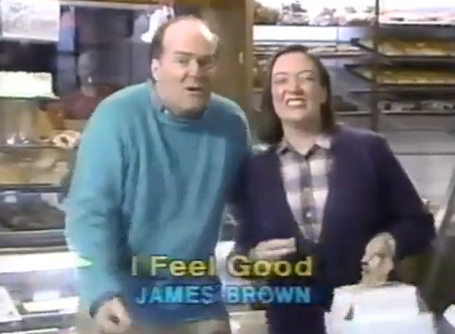
“I Feel Good” is the first song mentioned in the commercial and that’s definitely appropriate because the album is called Feel Good Rock. Here we have two people who are either at a bakery or are getting ready to tape tomorrow’s episode of Supermarket Sweep and they are just really into it. Either that, or the woman is having a stroke. Either way, I’m pretty sure that this commercial became famous in the house to the point where every time it was on, Dad would call the kids into the den, yelling, “Hey, the commercial’s on again!”
To which their teenage daughter, who has hanging with her friends in the other room, would storm into the den and scream, “GOD, STOP! YOU ARE SO EMBARRASSING!” and storm out. (more…)
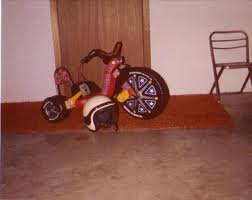
The Dukes of Hazzard Big Wheel, courtesy of Dukes Online.com
There are some toys that you remember getting or having, and then there are others that are definitive. They aren’t just Christmas or birthday presents, they are in introduction to a lifestyle. For those of us born in the Seventies or Eighties, that toy was Big Wheels.
A modified tricycle that allowed the rider to sit low and tended to move faster, therefore adding more to the everyday life of the average kid, the Big Wheel ride-on toy was created by Louis Marx and Company in 1969 and became very popular among both kids and parents, at least according to Wikipedia’s entry, which notes that its plastic construction and low center of gravity made it less expensive and safer than the classic tricycle. Big Wheels was actually the trademark of Louis Marx & Co, but wound up becoming the generic name for the toy, and through the 1970s, they sold in huge numbers.
Having been born in 1977, I am a part of the second wave of the Big Wheels generation. Those older than I was probably didn’t have much to choose from when it came to their big wheel experience, as evidenced by the Big Wheels that had been procured by and donated to my nursery school. They’d let us out onto the playground each day and we would go right for a shed in the back that held several Big Wheels. Some were in better condition than others–the blue and yellow ones were relatively new, which meant they were also the most desirable, and the purple ones were slightly used and therefore second tier. Those blue ones became so coveted, in fact, that at one point, our teachers had to designate beforehand who got to use them.
By the time I was old enough to have my own Big Wheels, at the age of five, the makers of Big Wheels (mainly Empire Pastics, who made Big Wheel competitor Power Cycle; as well as Coleco, a company more known for a video game console than a kids’ ride-on toy) had figured out that there was money to be made from licensing. Now, everyone who grew up in the Eighties will remember that the ultimate in licensed Big Wheels was the Knight Rider Big Wheels that was made to look like KITT, but the one that I owned had to run a close second to KITT, which was the General Lee.
I had been a fan of three prime time television shows when I was five years old. One was The Greatest American Hero, one was ChiPs, and the third was the Dukes of Hazzard. Granted, I got to watch all of half a season before the Coy and Vance era began, but I don’t think I noticed that considering I was paying more attention to the stunts and car chases and I still really liked the show. I liked it so much, in fact, that when I received the General Lee Big Wheels that Christmas, it was the most awesome thing ever. How could you not like an orange and black Big Wheels with ribbons on the handlebars, stars on the wheels, and a compartment where you could store things? (more…)
In 1985, Joel Schumacher directed a seminal film that perfectly captures the angst of youth having been unleashed onto the world after graduating from college. Okay, that’s giving this movie too much credit, but St. Elmo’s Fire is still one of the best illustrations of Post-Collegiate Stress Disorder, or PCSD. So let’s go back to the Eighties with one of the ultimate Brat Pack movies!
Despite what I’m saying in this post, this scene still is awesome.
Just like last week’s post, this is another that was an old post that I’ve updated and revised for this blog.
I think that if I ever actually met him, I would hate Lloyd Dobler. This is a lot coming from me. Say Anything … is one of my favorite movies of all time, so much so that I have the framed movie poster on the wall of my office at home. But with my tendency to over-examine everything I read, watch, or listen to (just like a good English teacher should) and with the film more than twenty years old, I’ve been thinking a lot about Lloyd and Diane Court and I have come to the conclusion that if I ever had to interact with Lloyd, I probably wouldn’t like him.
It’s not like I think he’s a bad guy or anything; on the contrary, there is something genuine about Lloyd and how he pursues and is devoted to Diane throughout the film that makes him great. John Cusack’s portrayal and Cameron Crowe’s writing and directing don’t hurt, either, because he clearly is the hero in the teen romance story and when he is finally with Diane at the end it feels right. But I still can’t help feel some sort of resentment because Lloyd is pretty much every guy I’m not, or ever was; furthermore, he is one of the types of guys who often proves to be the bane of my existence as an educator.
When I was in school, I was not in the clique that included guys like Lloyd. If I was in a clique at all, that is. I kind of simply existed, floating through the lower echelons of the social scale among the dorks. Guys like Lloyd were guys who showed up to school when they felt like it, took general-level classes and probably screwed around but more or less floated by on their way to graduation. They weren’t stupid by any means, but when I was in high school I probably would have assumed he was unintelligent in that way that every honors student with no life looks down anyone in a lower-level class as a way to compensate for having little or no social status. I didn’t have Corey or her 65 songs about Joe to occupy me on a Friday night; I had whatever was on television, video games, and maybe a few rounds of pool with my friends. Lloyd was cool, the dude everyone relied upon, and who didn’t give a crap. I was high-strung, rarely took risks, and should have left the house more.
Of course, he was also my competition.
Let’s consider Diane Court for a moment. Whereas I’d probably hate Lloyd if I met him, if I ever met Diane I wouldn’t hate her, I would have fallen in love with her and this, in turn, would have made me hate Lloyd more. I know this for a fact because I went to a high school with so many Diane Courts. Bright, beautiful, but kind of unaware. Not a snot, but so focused elsewhere that even she doesn’t know how good she would have it if she played into the school’s social status games. In fact, it’s wonderfully appropriate that Heather Chandler herself says that she wouldn’t have pushed herself so hard if she didn’t feel like she was competing with Diane. And if Heather Chandler is the queen, then that makes Diane an Athena of sorts, someone who is not even known until she leaves the halls of Lakewood High School and actually attends a graduation party with Lloyd, after which, they share this exchange:
Diane: Nobody knew me before tonight
Lloyd: They knew of you. Now they know you.
Of course, it makes perfect sense that Diane winds up falling for Lloyd. Even on the surface it works. Girls like Diane fall for guys like Lloyd all the time. Some would say it’s a “sowing your wild oats” type of thing or an “opposites attract” thing. But there’s so much more to it than that. When a drunken partygoer asks Lloyd how she agreed to go out with him, as in “Who are you,” Lloyd replies, “I’m Lloyd Dobler.” Because he is. He’s normal. She’s not.
Two months, Bender. Don’t mess with the bull, young man, you’ll get the horns.
A quick editorial note: This is an update of an old post from an old blog. But I was watching The Breakfast Club the other day and thought about it so I dusted it off and posted it here.
Saturday, March 24, 1984. Shermer High School, Shermer, Illinois. 60062.
Dear Mr. Vernon, we accept the fact that we had to sacrifice a whole Saturday in detention for whatever it was that we did wrong. What we did WAS wrong. But we think you’re crazy to make us write this essay telling you who we think we are. What do you care? You see us as you want to see us…in the simplest terms and the most convenient definitions. You see us as a brain, an athlete, a basket case, a princess and a criminal. Correct? That’s the way we saw each other at seven o’clock this morning. We were brainwashed.
So begins what is arguably the best teen-oriented movie of all time, John Hughes’s The Breakfast Club. I have, in past lives, written what seems like volumes on this movie and just about anyone under the age of 40 who watches movies is familiar with its story, so I won’t bore you to death with the details of the plot. Instead, I’m going to focus on the one teacher character in the school, Mr. Richard Vernon (Paul Gleason).
Vernon, of course, is the overseer of the five students central to the plot, a veteran vice principal who’s been putting kids in detention probably for longer than he can remember and makes sure that they’re behaving and on task, at least for the first part of the movie before the kids sneak out of the library to get a bag of pot from Bender’s (Judd Nelson) locker. Bender’s the main source of grief for Vernon; he’s a detention regular and the group’s resident “rebel.” Vernon fills the authority figure role well when he comes down hard on Bender for talking back, assigning him two months’ worth of detentions and expels him from the library when he catches him in the gym.
Then, he crosses a line. After throwing Bender in a storage closet, Vernon threatens him …
Vernon: That’s the last time, Bender. That the last time you ever make me look bad in front of those kids, you hear me? I make $31,000 a year and I have a home and I’m not about to throw it all away on some punk like you. But someday when you’re outta here and you’ve forgotten all about this place and they’ve forgotten all about you, and you’re wrapped up in your own pathetic life, I’m gonna be there. That’s right. And I’m gonna kick the living shit out of you. I’m gonna knock your dick in the dirt.
Bender: You threatening me?
Vernon: What are you gonna do about it? You think anyone’s gonna believe you? You think anyone is gonna take your word over mine? I’m a man of respect around here. They love me around here. I’m a swell guy. You’re a lying sack of shit and everybody knows it. Oh, you’re a tough guy. Hey c’mon. Get on your feet pal. Let’s find out how tough you are. I wanna know right now how tough you are.
[offers Bender his chin]
Just take the first shot. I’m begging you, take a shot. Just one hit. Come on, that’s all I need, just one swing…
[Bender pauses, staring]
That’s what I thought. You’re a gutless turd.
On some level, you can take this as the scene where we all see Vernon as a symbol for all of the overbearing horrible authority figures that keep teenagers from doing anything they want; after all, the most memorable line from The Breakfast Club is “When you get old, your heart dies.” But if you follow Vernon after the incident, you get a sense that he’s not proud of what he just did and his subsequent conversation with Carl, the janitor, reveals that he’s more than just a caricature of an ineffective authority figure (which is what Mr. Rooney from Ferris Bueller’s Day Off is). Carl and Vernon have a pretty standard conversation about “kids these days” and how they don’t respect anything. Carl calls bullshit on that sentiment, saying that Vernon has changed just as much as he thinks the kids have. (more…)
It sounds ungrateful to say this, but there were many times throughout my youth where I was bored off my ass while on a family vacation. oh sure, we took trips to amusements parks and went to places like Washington, D.C. where there was plenty to do at museums, but I remember that for every ride at Disney World or every arcade
game at Weirs Beach, there was an antique shop or glass factory. Plus, there were car rides–long, mind-numbing car rides.
In fact, based on the amount of stuff geared towards keeping kids occupied in the car, I think it’s safe to say that a long, mind-numbing car ride was a rite of passage for much of my generation, possibly sitting in the seat that faced backward in someone’s station wagon. My parents didn’t have a station wagon, so my sister and I were sometimes forced to squeeze into the back seat of my mom’s 1987 Honda Prelude, which as an incredibly cramped fit when you were driving eight hours from Long Island to Williamsburg or to new Hampshire. But we definitely kept ourselves occupied with tapes in our Walkmen, comic books, novels, and travel board games.
These would keep our attention for at least a little while until we got bored enough to stare out the window and count the mile markers or keep an eye out for a Sunoco station because dad was low on gas.
There was one activity that I remember sticking with beyond an hour on I-95 in Connecticut, and that was a folder with stickers titled Road Sign Games. My sister and I first spotted this in a store in Lake Sunapee, New Hampshire during one of our many family outings. Being that it was one of those knick-knack gift shops that seemed to be everywhere in that area of New Hampshire, when we went in, we weren’t allowed to do anything and were instantly bored. Not that we would want to–after all, vases, dishes, scented candles, homemade soaps, and necklaces with runes on them weren’t exactly the type of things that set our world on fire, especially when I would spend most of my vacation each year reading Star Trek novels.
The road sign stickers that you would peel and place inside the Road Sign Games folder.
This particular place, though, had toys and games and Road Sign Games was not too expensive, so my parents went ahead and bought one for me and one for my sister. The game was simple, too–contained in a polybag was a folder containing pictures of commonly found road signs along with a sheet of stickers, which you would stick to the matching sign in the folder whenever you saw that particular sign. At a glance, it looks like the type of thing you’d have a little bit of fun with but eventually put away among the sticker books, word searches, and crossword puzzle books that were all bought at one time or another as boredom cures.
But when I was up in New Hampshire that year, completing the book became one of the most important things I had to get done when I was on vacation. My parents would often make us schlep halfway across the state or even into Vermont throughout the vacation and when I realized that I was seeing a number of road signs during these day trips, I knew that I had found my salvation. No longer was I going to spend my time int he back seat fighting with my sister or wondering why there weren’t any good songs on the radio, I had signs to see!
Some of the signs were pretty easy to spot. I didn’t have to go very far to see a stop sign, one way, do not enter, or a speed limit sign; and interstate shield and exit signs would about whenever we traveled long distances. But I had never seen a no passing zone or a pavement ends sign. And so began the quest. on the way to shopping, I noticed that whenever there was a solid yellow line on the side of the road, there would be a yellow triangular no passing zone sign; whenever we hit construction traffic, I saw orange signs; and I noticed how all of the signs around the parks were brown. In fact, I became so determined to finish the road sign game that I walked from our cabin over to Wadleigh State park, where I managed to fill more than a few of that section’;s stickers. I think i got as far as all but ten stickers before the road sign game was filed away and then either lost or thrown in the trash. (more…)

![DSCN4205[1]](https://popcultureaffidavit.com/wp-content/uploads/2013/06/dscn42051.jpg)