When you’re a total geek and you’ve got a ton of money to blow, what do you do? Well, you spend it on getting a popular girl to go out with you! At least that’s the premise of “Can’t Buy Me Love,” a 1980s romantic teen comedy if there ever was one.
So take an hour or so and go back to 1987 and all of its bad hair as I talk about this Patrick Dempsey classic as well as dive into my own personal review archives, all in the name of love. And getting people to listen.
So in searching for an idea for this week’s entry (and admittedly running out of time for an idea for this week’s entry), I was bumming around YouTube and stumbled upon this:
I know that commercials have gotten more sophisticated since I was a kid; after all, Mars has made a fortune off of the licensing of the animated M&M’s that it currently features in its commercials. But seeing this again for the first time in nearly 30 years, I have to say that is still one of the most perfect commercials because in thirty seconds it encapsulates playing baseball as a kid.
Okay, maybe not for me because I absolutely sucked when I was younger, but I do remember that this commercial came out right around the time I started my first year of “real” baseball (read: not tee ball), and there were times that while riding the bench (which I did a lot), I would talk to my teammates and we’d say that we were going to “take the ball dowwwntooowwwn.” Plus, I think that every kid in the history of being kids has at some point sorted his or her M&M’s.
Yeah, I know that they all taste the same because they are milk chocolate that surrounded by a thin candy shell (hence it “melts in your mouth but not in your hand”), but the brown ones were so plain, and while the yellow and orange ones were slightly more interesting, the green ones stood out, so they were immediately a favorite. And during a game, if we had M&M’s, we’d actually save the green ones before getting in the on-deck circle because I think that on some level we thought that the green M&M would lead to a home run.
Of course, that was never true and since then, M&M’s come in many more colors than the ones in the commercial and more flavors than just plain and peanut (the peanut butter ones are a personal favorite); however, I still like to think that there was something special about the green ones, even if there wasn’t truth in advertising.
While I know that it didn’t get the attention of the deaths of Dear Abby, Stan Musial, or Earl Weaver last week, I have to admit that I felt a little sad when I saw the obituary for Conrad Bain in the New York Times. A Canadian-born actor with quite the lengthy resume, Bain was a mainstay of television in my childhood ecause of his role as Mr. Drummond on Diff’rentStrokes.
A sitcom that began airing in 1978, Diff’rent Strokes lasted until 1986 and aired mostly on NBC (with the 1985-1986 season airing on ABC) and was the story of two black kids from The Bronx who were adopted by a Park Avenue millionaire. It’s an odd concept for a show and one I swear only would have worked in the 1970s, but I didn’t think anything of that when I was six years old and allowed to stay up on Saturday nights to watch it (and sometimes Silver Spoons, which came on at 8:30). This was a big deal for a kid whose bedtime was 8:00 on the weekdays and I remember loving the show so much that I tape recorded (like literally sat a tape recorder next to the television and hit “record”) the 1984 hour-long “Mr. Drummond gets married” episode.
I’m not sure if I watched it on Saturday nights beyond that, because my memory is hazy and I always associate Saturday night television viewing with The Facts of Life (briefly, anyway), and The Golden Girls (which dominated NBC Saturday nights for years), but that doesn’t matter because the show was a rerun mainstay all the way up until I was in my first year or so of high school. WNYW, New York’s Fox affiliate (channel 5) ran Diff’rent Strokes at 5:00 p.m. and The Facts of Life at 5:30 p.m. through much of the latter part of my elementary school career, concluding it sometime when I was in junior high (what it was replaced with I don’t remember, although eventually Fox 5 ran The Simpsons, Seinfeld, and Friends). Since I didn’t have cable at the time, that meant I would come home, turn on the television, and at 5:00, after cartoons were done, I would see a familiar shot of the east side and hear Alan Thicke’s lyrics: “Now the world don’t move to the beat of just one drum …” Then, it would be Arnold, Willis, Kimberly (unless it was one of the seasons where Dana Plato had been fired for being knocked up and using drugs), Sam (whose mushroom haircut I hated), and Mr. Drummond.
Bain played Mr. Drummond like a typical sitcom father, imparting some of the show’s lessons like Robert Reed did on The Brady Bunch (a show that I remember seeing for the first time at an incredibly early age and much like Diff’rent Strokes always seemed to be on) and making some lame attempt at a joke every once in a while. He wasn’t the type of sitcom father whom you felt was “your father” or a ‘dad”; he was just … well, there, the mainstay of a show whose cast was full of problems (though I honestly didn’t know that until years later). In fact, I don’t remember Mr. Drummond being much of a factor in most of the episodes, especially the two most memorable ones–the Nancy Reagan anti-drug epsiode, and the two-parter about sexual molestation where Gordon Jump plays the bike shop owner (though Mr. Drummond does call the authorities and is the “moral voice” throughout). He did, however, have a couple of episodes that stood out.
Aside from his romancing Maggie (first played by Dixie Carter and then Mary Ann Mobley, who replaced Carter after NBC canceled the show and Carter went to Designing Women), there was the time Mr. Drummond came home with his neck all cramped from stress and the family discovered that Willis had severe stress and had to learn to balance the activities in his life. There was the “Undercover Boss” episode where Mr. Drummond works at one of his company’s factories to see what it’s like to work there and challenges the entire family to “live blue collar,” which for Arnold means wearing a Van Halen T-shirt because that’s what poor people do or something.
And of course, there was the two-parter where Sam was kidnapped and at some point, Drummond had some fisticuffs with a possible kidnapper, a scene that I remember prompted my friend Harris and I to come up with the idea for a fake movie: “Conrad Bain is X-CUTIONER 3000.” Yeah, I don’t know why Mr. Drummond as Charles Bronson in Death Wish was so hilarious but when you’re 13, you find some of the most random crap funny, I guess. Besides, when I told him about Bain’s death the other day, he replied, “Bonar Lives!” in reference to Conrad Bain’s twin brother Bonar, something we also found funny at 13 (and I’m amazed that I never wrote BONAR LIVES! across the front of my notebook as if it were “Save Ferris”).
Anyway, there’s only five cast members left alive from Diff’rent Strokes: Todd Bridges (Willis, who had his share of substance abuse issues but has been clean for about 20 years), Danny Cooksey (Sam, who has a decent-sized voice-over resume and was in Terminator 2 as John Connor’s mulleted friend), Mary Ann Mobley (the second Maggie), Mary Jo Catlett (Pearl, the third maid, who now provides the voice of Mrs. Puff on SpongeBob SquarePants), and Charlotte Rae (Mrs. Garrett, who will outlive them all). And I’d like to say that the show taught me so much, but like Mr. Drummond, I think I watched it because it was simply always there.
Wait, didn’t we just have an episode of this MONTHLY podcast LAST WEEK? Well, we survived the apocalypse so it’s time to celebrate Christmas! And what am I doing to celebrate Christmas? Well, I’m taking a look at one of my favorite toy lines ever, G.I. Joe!
While I am also a fan of the cartoon as well as the Marvel comic book series and do mention them a couple of times, I decided to stick to the toy line. Over the course of this episode, I talk about the my five favorite action figures, my five favorite vehicles, and five action figures and vehicles I always wished I owned but didn’t.
Hey everyone, it’s time for THE APOCALYPSE!!! And while you’re sitting around wondering if a civilization that’s been dead for the better part of half of a millennium was right about the world ending, I thought I’d supply you with some music.
You can listen to the entire episode, which is basically one big playlist, here:
So in every kid’s life there is a moment where Christmas is ruined. Okay, that’s probably being dramatic, but I definitely can say that when you find out Santa Claus isn’t real, the holiday loses a bit of its magic. Coming in slightly behind that is the Christmas when you find the presents.
Now, when you’re a little kid, the idea of Christmas is something that flat-out blows your mind on an annual basis. You write a letter to Santa, maybe even sit on the lap of a parolee playing Santa at the local second-rate shopping mall, and on the morning of December 25, there is a bacchanal of toys. You never questioned where the presents came from, nor wondered about the hours of thought and labor your parents put into procuring said gifts (let alone the money involved)—Christmas just arrived and everything was awesome. Then, around the time you were eight or nine you start hearing from some kid in your class about how he knows everything he’s getting.
I was always perplexed by this kid. I had loved the surprise that came with Christmas morning, so I never understood why he was able to get his presents early. Moreover, he seemed to be bragging about it. Was there something wrong with this kid? Did his parents not love him enough, which is why they stole the magic of Christmas from him at an early age? What he an over-privileged little twerp whose parents gave him the presents so they didn’t have to deal with him? Or, was he onto something?
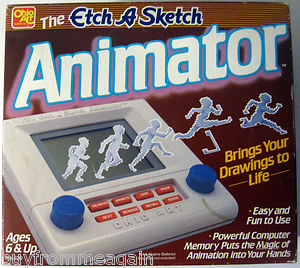
This last thought didn’t occur to me until I was about ten years old and my sister and I saw a commercial for the Etch-A-Sketch Animator, which was a toy that I swear only the 1980s was capable of producing. The original recipe Etch-A-Sketch had been out for decades, and we, just like every other kid in existence, owned one. It wasn’t a favorite toy of ours or anything, just one of those things you’d play with from time to time because you came across it while you were looking for something else or because it was the only thing available when you were bored out of your mind. But the commercials for the Animator made it seem like this was not only the next level of Etch-A-Sketch, but the next level of awesome. We were both sure that it wouldn’t suffer the same fate as its ancestor.
A device with a basic black and while pixilated display, the Animator had memory for several frames upon which you would draw image after image, which you would then have the Animator play back so it looked like you had drawn a cartoon. The commercial showed a girl animating a horse running and a boy animating a guy swinging a baseball bat. Since my sister rode horses and I played little league, that’s all we needed to know. Almost immediately, we put The Animator on our Christmas lists, which probably put our parents in a precarious situation because they were not the type who would buy each of us our own toy. No, they believe in sharing.
We hated sharing as kids. We didn’t like sharing with one another. We didn’t like sharing with friends. We didn’t like sharing with kids of family friends. We didn’t like sharing with kids who we didn’t even know but whom just happened to be at the same place we were. We weren’t total selfish jerks or anything, but when you’re a kid, morals can sometimes take a backseat to wanting all of a candy bar or wanting a particular toy all to yourself. And needless to say, when we both saw The Animator on our respective Christmas lists, Nancy and I both knew that we would be fighting over the one Animator that would be opened on Christmas Day.
And then came the day we found it.
I can’t remember if we were actively looking for our Christmas presents, or if we came across them by accident, but one day we were in the basement and in the back of my dad’s workshop we found a large lawn and leaf bag that bulged irregularly. We approached it with caution, pulled back the edge and saw two things—the puzzle toy known as Rubik’s Magic Rings, and The Etch-A-Sketch Animator.
From there, it was on. Each of us assumed that we’d be the one the Animator was meant for, so we proceeded to threaten one another with it. If my sister wouldn’t share the last donut with me, I’d say, “You eat that whole donut and I won’t let you play with my Animator.” If I wouldn’t let you watch a show or movie she wanted to watch, she would say, “If you don’t let me watch this, I won’t let you play with my Animator.”
Now, you’d think that my parents would have liked the newfound cooperation that came with this—after all, we were sort of not being selfish toward one another—but hearing that the sharing and unselfishness came through blackmail, they obviously figured out something was up. Plus, it didn’t help that Nancy couldn’t, and still really can’t keep a secret to save her life and wound up blabbing about our finding the Christmas present to my parents. I can’t remember if my parents punished the two of us or if it went beyond a conversation wherein they told us they were disappointed in us.
That disappointment definitely registered, although the vocal threats continued because despite knowing there was an Animator in the house, we still didn’t know who it was for; moreover, to my parents’ credit, they didn’t retaliate by giving us the presents early or simply placing them under the tree unwrapped. It went under the tree as planned and on Christmas morning, my sister unwrapped the Animator.
Being ten years old, I probably was not able to mask my disappointment. I knew that I would get to play with the toy—like I said, sharing was house policy—but I was disappointed because she had won. I did not get the prize and I would be forced to be at the mercy of someone else for black and white pixilated animation fun.
Okay, that’s totally melodramatic because Nancy was never that diabolical.
We had our fair share of fun with The Animator. Sometimes we created the animations that were in the instruction book and sometimes we had fun making words appear and disappear, but most of the time my friends and I would animate a hand giving the middle finger. That, in our minds, was using the toy to its fullest potential. Predictably, after a year or two, it wound up being lost to the back of the toy closet as we got interested in other things and eventually was either donated or sold at a yard sale when we were teenagers.
As for Christmas, I’d like to say that this was the moment that changed everything, but it really wasn’t. Oh sure, I’d spend the next few Novembers and Decembers sneaking around to find presents, but for the most part, we had the same sort of Christmas morning. But gradually, the element of surprise dwindled as my parents began a tradition of taking us to the mall on Black Friday (this was before Black Friday became a spectacle of animal-level greed and trampling deaths) to buy clothes that would go under the tree on Christmas Day, something which seemed to always cause my mother to sigh, “Oh well, no surprises this Christmas.” But I honesty never felt that whatever Christmas was about was ever ruined.
Final still from “Black & White” courtesy of degrassi.ca
Degrassi Junior High (and later Degrassi High) was known for a few long-running storylines, and I’d venture to say that the fact that these long-running storylines were organic in a sense was the show’s hallmark. In other words, characters whose stories we had been following for what seemed like forever would come and go and the next time we saw them, there would have been some progress in their lives.
Spike is the best example. Her pregnancy, which is quite possibly the thing that people remember the most about Degrassi Junior High, progressed throughout the second season of the show, even though not every episode was about her being pregnant. Other stories included the death of Wheels’s parents and constant fighting with his grandparents, the relationship between Joey Jeremiah and Caitlyn Ryan, and the interracial couple, Michelle and BLT.
This couple is the center of “Black and White,” a later episode in the last season of junior high. It is an episode that, quite frankly, I don’t remember really paying much attention to when I was watching Degrassi as a kid. I’m pretty sure I remember seeing it, but for the most part the reason I decided to cover it in this scattered discussion of the series is because there are episodes about Michelle and BLT from Degrassi High that I remember pretty vividly, so I figured that if you’re following along with this particular feature (ah, who am I kidding, nobody is), it’s probably best to cover their “origin story.”
So the issue here, as I mentioned, is racism, and right off the bat we see BLT confronting it when he bumps into a student who calls him the n-word, which incites a fight. Michelle happens to witness this, and we find out that she likes him–not because he’s fighting with someone, just because she likes him. The feeling is mutual, as Joey, Wheels, and Snake note when they tease him about Michelle being the reason that he joined the yearbook staff. About halfway through the episode, he asks her to the graduation dance.
Unfortunately, there is a complication–Michelle’s parents, who claim that she’s too young to date anyone, even though they have the reaction of “You didn’t tell us the boy you liked was black” when they meet him. When she finally has a heart-to-heart with her mother, her mom gives her the undeniably horseshit excuse of, “We’re not racist but other people are and we don’t want you to get hurt,” before piling on futher with “People like to be with their own kind.” Michelle sees through this and tells BLT she’ll go to the dance with him anyway, which is where the story ends.
In the subplot, Spike is having problems with daycare because her current daycare provider is moving to Vancouver. So, she decides that to pay to put Emma in a daycare center, she’s going to try and get a part-time job. Unfortunately, when she goes to interview for a job at a diner, the manager spends the entire time making fun of her hair and dismisses her as a punk kid.
And there’s some C plot with Bartholomew Bond and Scooter taking yearbook photos. Or whatever. (more…)
I have been playing the piano since I was about seven years old, and since I was in junior high, I have also owned an electronic keyboard. Keyboards were big-ticket items when I was a kid because they not only cost a decent amount of money, but also were pretty amazing. The better keyboards could synthesize a ton of instruments and had several present rhythms and one-touch chords.
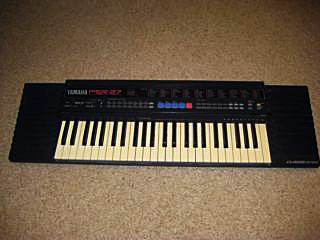
My first keyboard was a small Casio PT-180, which I remember bringing into school to work on a project, but the first keyboard that I remember really being important to me was myu second one, a Yamaha PSR-27. In terms of keyboardness, it wasn’t much (compared to some of the more high end models), but it had way more instruments than that Casio, plus came with its own stand so instead of taking it out of the box, setting it up, and plugging it in whenever I wanted to use it, I simply set it up and plugged it in in the basement.
The coolest thing on the keyboard was a yellow button that said “demo.” This was pretty much exactly what you’d think it was–a demonstration of what the keyboard was capable of, done through a 90-second song that used several instruments, rhythms, and effects, including the orchestra hit, which was popular to almost an annoying degree in the late 1980s and early 1990s.
My sister and I played that keyboard endlessly, fooling around with the different instruments, playing our weekly piano pieces on the “distortion guitar” or “church organ” settings, and even adding the one-touch chords and disco beat to songs like the Star Wars theme. But the most fun we had was with the demonstration because it was a crazy tune that used just about everything the keyboard offered and even if we figured out how to play it, we would never be that good because we were not very quick at changing instruments.
But more importantly, this was around the time when the two fo us were really into playing with her stuffed animals. Yes, I know that it seems weird that a twelve year old would play with stuffed animals, but Nancy was still nine and there were many days when the two fo us were stuck in the house together. By this time, stuffed animal play had evolved to the action-adventure stage. Each animal that was among our “main players” had a distinct character and we were even working on a semblance of continuity when it came to our stories.
That is, of course, when we weren’t playing Battle of the Stuffed Animal Bands. This was a regular contest that featured four of the most hard-rocking groups of animals: two frogs named Felix and Fred, otherwise known as “Fe and Fred;” the guitar-laden novelty animal Rockasaurus; the beaver-rabbit-raccoon combo known as the Woodland Creatures; and two dogs that we called the Nas. (more…)
In the second episode of the Pop Culture Affidavit podcast, I take a look at Stephen King’s It, both the 1986 novel as well as the 1990 TV movie starring Tim Curry as the evil Pennywise The Clown. It’s a Halloween treat that will remind you why demonic clowns dwelling in sewers will make you swear off the circus forever.
One of my favorite aspects of Mad Men is the constant looks into the ad pitch meetings. Maybe it’s because I used to work in sales support and marketing, but whenever Don or one of the other guys at the company is trying to get new business, I find it fascinating how they not only come up with their ideas but how they present it to the prospective clients. Sometimes, it’s brilliant, and sometimes they crash and burn, like in this clip that shows the company pitching Pepsi on their new diet cola, Patio:
I think my favorite part of this clip is Roger Sterling summing up why the commercial doesn’t work: “It’s not Ann-Margret.”
But I love soda commercials. I don’t think I’ve seen that many from the era of Mad Men–the earliest ones I can remember is probably the “I’d like to buy the world a Coke” one from 1971 followed by David Naughton’s “I’m a Pepper!” ads and the Mean Joe Green one from 1978 or so–but I do remember that next to commercials for the phone company, McDonald’s, and Juicy Fruit, nothing in the non-toy category defined my childhood more than soft drink commercials.
And for good reason: they were everywhere in the 1980s, to the point where the last line of the last verse of “We Didn’t Start the Fire” is “Rock and roller cola wars, I can’t take it anymore!” And by 1989, yeah, you’re right, Billy. Because over the course of the decade, Coke and Pepsi seemed to be doing whatever they could to up the ante, especially when it became apparent that Pepsi was gaining in market share right around 1985 and Coke decided that its old formula wasn’t enough and launched the debacle known as New Coke. Plus, you really couldn’t outdo Pepsi’s commercials in the 1980s. I mean, they almost killed the King of Pop. That set the bar impossibly high.
But as much as I have fond memories of watching the “Michael Jackson’s hair catches on fire” commercial on my old taped-off-TV copy of The Wizard of Oz from 1983, I have to say that one of my favorite 1980s soft drink commercials has to be this Coke ad from 1982:
Now you can picture this pitch meeting, can’t you? “So, has anyone seen Fame?” (more…)
 When you’re a total geek and you’ve got a ton of money to blow, what do you do? Well, you spend it on getting a popular girl to go out with you! At least that’s the premise of “Can’t Buy Me Love,” a 1980s romantic teen comedy if there ever was one.