A screen shot of the end of “Taking Off,” the two-parter surrounding Wheels’ grief over his parents’ deaths. Image courtesy of Degrassi Online.
I know that I wasn’t the only person surprised by the news that Neil Hope, who played Wheels on Degrassi Junior High and Degrassi High not only died, but died back in 2007 and this was just discovered now. In fact, I probably would have never heard about it at all had I not “liked” his onetime co-star, Stacie Mistysyn, on Facebook and read a post of hers.
In light of this, I watched the Degrassi Junior High third-season two-parter, “Taking Off,” which while not the next episode I wanted to watch for the purpose of this blog (that would be “Food for Thought,” which I think I’m going to get to anyway even if it is out of order), is one of the more important points of that season because it continues two crucial stories–Wheels’ parents’ deaths, and Shane and Spike. It also puts the spotlight clearly on Hope and his acting, as Wheels continues to struggle with his grief and does so not just by acting out but running away altogether.
We begin by finding out that Wheels has been skipping school and hanging out all day at the arcade; furthermore, he’s sold his bass guitar to get money to play video games like Konami’s Main Event, much to the chagrin of the rest of the Zit Remedy (especially Joey, who’s still in his Zack Morris “scheme to get us some airtime” phase … yunno, when he’s not flirting with Caitlin). His grandmother is concerned and he is not just stand-offish to her, but downright hostile and wishes that he could be anywhere but home and school. Then, the possibility presents itself when his birth father, Mike, sends him a postcard from a town called Port Hope, which is where his band has a standing gig for the next couple of weeks.
Meanwhile, most of the DJH crew is going to the Gourmet Scum concert that Saturday night (love the band’s name, btw), including Luke and Shane, who buy acid and then drop it before going inside. What’ll happen is that Shane will disappear and the police will spend the better part of the two-parter looking for him, even asking Luke if the boy was under the influence (and paranoid Luke will lie his ass off). He is eventually found underneath a bridge, having fallen off, and at the end of the second part is comatose, leaving Emma completely without a father (something that is explored in both Degrassi High and Degrassi: The Next Generation).
But that’s really a subplot and it’s Wheels who takes center stage as he hitchhikes through Ontario and at one point winds up getting picked up by a guy who seems okay at first–in fact, he kind of looks like Sam Waterson–and that guy tries to molest him. But he makes it to Port Hope to see Mike, and his hopes for a happy reunion are dashed when Mike more or less wants very little to do with him (in fact, he’s got a pregnant fiancee) and his grandmother ultimately tracks him down. (more…)
I’m not a sportswriter; hell, I’m not even a sports blogger. So sitting down to write anything about an athlete’s death on my part is probably more self-indulgent than anything, especially since I’m sure that come morning there will be at least a few columns on the same topic. That being said, when my wife told me this afternoon that Gary Carter had passed after a battle with brain cancer, I felt the urge to say something.
As the catcher for the Mets when I began following them in 1985, Carter was one of their sluggers as well as an RBI leader and he became one of my favorite players. I probably, at one point, imitated his batting stance (which was one of those stances that didn’t suggest that he really had any power); I had a poster of him on the wall of my basement; and of course I had quite a number of his baseball cards. I don’t know if he was a hero in the sense that I ever wanted to “be” like him–after all, nobody would have wanted as terrible a little leaguer as me to get behind the plate–but he was definitely someone I looked up to.
Gary Carter wins game 5 with an extra-inning hit. From the Daily News Scrapbook of the 1986 Mets Season
It seems like I made a good choice in that regard, too, because from what I’ve read over the years about Carter and his career, he had a love of the game of baseball and played that way but if you watch some of his highlights you can tell that he was a true competitor. I’ll never forget the opening to those Mets games of the 1980s where you could see a highlight of him tagging out Ken Griffey, Sr. on Rusty Staub Day, or his reaction to finally breaking through in game 5 of the 1986 NLCS and getting what was probably the second-most clutch hit of his career (the first being the hit that started the Game Six rally). It was, to put it simply, genuine joy. I mean, he took his fair share of curtain calls for home runs but I don’t remember the guy as a showboat, on or off the field. I never had the fortune of meeting him, but a few friends of mine had personalized autographed pictures and I rarely, if ever, heard a bad word about what it was like to actually meet him.
I know that I’m writing this through the lens of childhood nostalgia, and I know that all he was was a baseball player and didn’t fight and die for our country and all of the other things that true heroes do. But when I was seven years old, I was thinking about those things when I chose my role models. He was a guy who was on my favorite team and got hits and hit home runs and I thought of him in the same way that people of the generations before me thought of Joe DiMaggio or Mickey Mantle, and even though other players are more famous for wearing number 8, and there have were better catchers before and since, I have to set those aside and tip my hat.
When I finally return to the New Titans, I’ll be taking a look at a storyline called “Terminus: the Final Fate of Cyborg.” At the time, it was a long-awaited story because Cyborg had been blown up in a rocket to Russia at the end of New Titans #75 and then rebuilt in New Titans #77. We’re heading into issue #104 at this point, so that means that Vic Stone has been a vegetable for something like 2-1/2 years, which is a long time for a character whose story is so integral to the Titans as a team.
I have to admit, though, when I was a teenager first collecting the New Teen Titans and New Titans, I really wasn’t the biggest Cyborg fan. Robin/Nightwing was obviously my favorite character and I also wanted all of the issues that involved Terra and Deathstroke, which are all issues I’ll get to in a few months. I mean, I bought the issues that focused on Cyborg but that’s because I wanted as many issues as I could.
Or that I could find, anyway.
Up until I was about 15, I had rarely been to a comic book store outside of Amazing Comics or Sun Vet Coin and Stamp. Sure, there was the occasional trip to that comic book store in Huntington, but it was true that for the most part, I had bought just about every Titans back issue that Bob had in the bins and with the exception of ordering back issues through Mile High Comics (which usually charged a pretty penny for them) didn’t have any other ways to get comics. In the summer of 1992, however, I flew down to Fort Lauderdale to spend a week with my friend Chris, who was as much of an X-Men fan at the time as I was a Titans fan.
Armed with a stack of Uncanny X-Men back issues for him–mostly stuff from the mid-170s, which were all part of the “From the Ashes” trade–and a hefty amount of cash I had saved from the job I had working at a stationery story on weekend mornings, I hit Florida and went comics shopping at his LCS, which I don’t remember the name of except that he referred to it as “Phil’s.” Phil had an enormous backstock, especially of Titans and I was able to complete most of my collection of the 1980 series (I think I had to track down #2, and #34, and if I wanted to, the reprints issues). Among those were most of Cyborg’s story before the Trigon storyline in the first issues of the Baxter series.
That story begins all the way in the New Teen Titans’ very first appearance in DC Comics Presents #26 (a book I got for all of a buck at a comics show back in the early 1990s). The premise of that story is that Raven is planting dreams in Robin’s head that involve him fighting alongside the New Teen Titans, a team that includes herself, Starfire, and Cyborg, none of whom he knows at that point. While Starfire is simply a “golden girl” flying around and shooting bolts from her fingers and Raven is at the center of the mystery, We see that something has made Cyborg angry because when they defeat an interdimensional monster at STAR Labs, he starts yelling at one of the scientists, who happens to be his father.
That’s all we get for the most part, but it establishes his character as two things: a very powerful Cyborg and an angry kid. I’d venture to say that at a glance, the early Vic Stone stories are that of an angry black kid and he would have been a complete stereotype if Wolfman and Perez hadn’t slowly given hints to his origin throughout the first year or so of the book before revealing it completely in the first issue of the Titans mini-series, Tales of the New Teen Titans (not to be confused with Tales of the Teen Titans). In New Teen Titans #7, we see Vic’s father, Silas Stone, again as he has designed Titans Tower and had it built and then reveals he is dying. The two get a chance to reconcile before he does pass, which is supposed to show that he hasn’t lost all his humanity because we had just been treated to a brief summary of how Vic was mutilated in a lab accident and his father built the Cyborg body to save him. (more…)
My movie viewing history as a child and adolescent seems to have two phases. Starting from when I was very young, I have always loved science fiction and action movies. That shouldn’t be a surprise, considering I was born the year Star Wars came out and spent the better part of my youth watching cartoons that were used to sell action and sci-fi based toys. My father, his friend (my “uncle”) Chuck, my Uncle Lou, and quite a number of other family members happily fostered my love for those things through buying me toys and making me copies of those movies, or not balking at the fact that in the fourth and fifth grade I was watching R-rated movies.
But as I went through high school, I began to become more interested in another genre, which was the teen movie. I’d known about the types of movies for a while and had owned a copy of Ferris Bueller’s Day Off since it first came out on video, but before I graduated, I had probably seen every movie starring John Cusack or directed by John Hughes. The person or people who deserve the credit for this are not the same who got me into a galaxy far, far away, because none of them absolutely loved Say Anything … the way I did (though nobody seemed to think it was weird that a 15-year-old boy wanted to rent Porky’s). I lay the blame for my love of the teen movie genre at someone I didn’t even know: the programming director of WPIX.
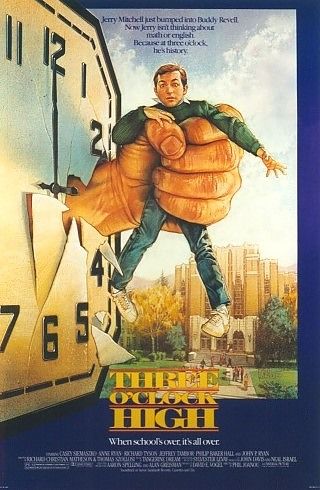
Now, here is where I probably should talk about how I first watched Three O’Clock High on a random Saturday afternoon on WPIX and that prompted me to rent the uncensored version of the movie and from there I was completely hooked on this little gem of a film, but that would be a lie. That’s because I actually saw Three O’Clock High in the theater, which should have been a sign that I would become fully ensconced in teen angst flicks within a few years, but in all honesty I went to see it with my friend Tom on Columbus Day weekend of 1987 because we had nothing better to do that day and the commercial had been running on television for the better part of a couple of weeks, so we asked my dad for some money and rode our bikes up to Sayville Theater to take in a very cheap matinee.
My dad was on the phone when I asked him for the money, although I wasn’t deliberately timing it that way because the cost of a matinee for two people at Sayville Theater in those days came in under ten bucks, so it wasn’t like I wasn’t going to get the money. He reached for his wallet and began describing what he thought was the movie we were going to see: a guy has to protect a daughter and she’s in danger, which was the plot of the Scott Glenn version of Man on Fire. I corrected him and he stopped telling my neighbor what the movie was about and looked at us incredulously.
“You’re going to see the one about the fight?” he asked.
“Uh … yeah,” I said.
My father looked at both of us and let out a groan, as if we had just committed the most disappointing act a couple of ten-year-old boys ever could have done. I mean, I might as well have told him that we were going to the salon to learn how to braid the hair of my sister’s My Little Pony collection.
And yes, Three O’Clock High is about a fight. Casey Siemaszko plays Jerry Mitchell, an overachieving geek who raises the ire of Buddy Revell (played by Richard Tyson, who is probably best known for being the villain in Kindergarten Cop) because … well, Jerry touches him and Buddy hates being touched. (more…)
My car is quite possibly the most annoying place to be during the month of December. That’s because I listen to Christmas music almost non-stop. I have an entire CD wallet full of CDs that I bust out between Thanksgiving and Christmas, and a preset on Sirius for holiday music. Now, this may seem like a far way to go to listen to the sounds of the season, especially when there is a regular radio station that plays non-stop Christmas music, but the station near me plays a pretty bad selection. Everything on Z-95.1 is too inspirational or the same bad Sinatra (or Sinatra impersonator’s) rendition of an otherwise okay song.
Especially missing is the humor. Oh sure, they’ll play “Grandma Got Run Over By a Reindeer” and some stay-at-home mom with the fashion sense of an elementary school art teacher will call in a request for “I Want a Hippopotamus for Christmas,” but those songs aren’t very good and even if I did like them, it’s not worth listening to Dan Fogelberg to get to them.
When I was younger, the local deejays would run the occasional Christmas song and not a 24-7 holiday barrage that we have now, and while they played their fair share of traditional Christmas tunes, some of the rock stations (I was particularly attached to WBAB, the classic rock station that was one of the very few my radio actually picked up) would find the time to play something out of the ordinary. WBAB is the reason I’m so familiar with The Kinks’ “Father Christmas” and The Waitresses’ “Christmas Wrapping,” but it’s also the reason I am familiar with Bob Rivers’ Twisted Christmas tunes and other warped material.
So, if you are being forced to suffer through little brats singing about hippos, the Trans-Siberian Orchestra playing the caroling of bells as if it has explosions, or versions of “Do You Hear What I Hear” that are so epic you expect to hear Gandalf shout “You shall not pass!”, may I present five songs that will provide some relief. (more…)
Being that I grew up without cable television and didn’t always get the chance to get to a video store, there were times in my formative years where I lived for a good movie on broadcast television. The local stations always seemed to comply with my wishes, too, because WPIX seemed to have one of the deepest film libraries imaginable, and even our local Fox affiliate would bust out something random when the network wasn’t running their primetime programming. And of course you had the ABC Sunday Night Movie, which is where I got most of my exposure to the Roger Moore-era Bond films as well as various versions of the first two Superman movies. The 1980s and early 1990s were a glorious period of movies on television, and are definitely directly responsible for my ongoing obsession of teen films, especially those of the two Johns: Hughes and Cusack.
Now, I think one day I will probably do an entire post on the edited-for-television version of The Breakfast Club because it has its own place in the “Children of the Eighties” museum, and how WPIX seemed to have all of the rights to all of John Cusack’s mid-1980s teen comedies, even Hot Pursuit, which is one of those “Someone greenlighted this?” films that only the most hardcore of teen movie buffs will sit through. I’ll even go into Better Off Dead, which was the start of my Cusack fandom (up until then, I’d recognized him as the older brother in Stand By Me and The Journey of Natty Gann, the latter of which made me bawl my eyes out when I first saw it), because I would rather focus on one of the films that is in my All-Time Desert Island Top Five Cusack films, and that is The Sure Thing (the others, in chronological order, are Better Off Dead, Say Anything …, Grosse Pointe Blank, and High Fidelity).
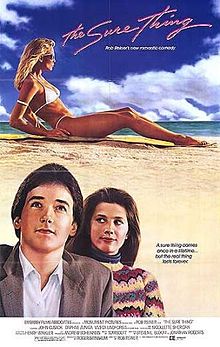
Directed by Rob Reiner in 1985, The Sure Thing was his follow-up to the seminal This is Spinal Tap and has the most Eightiesness about his films from that decade, even though it does not look dated at all (except for maybe Nicolette Sheridan’s hair and the fact that her breasts are real, but we’ll get to that). I first saw the film in 1991 when it had its network broadcast premiere on Fox one summer evening. I was about to enter high school at the time and therefore the strict 8:00 bedtime my parents had maintained up until that point was starting to be eased, especially since it was the summer and I didn’t have school and rarely went out at night because I was either without rebellious friends or spending the summer recovering from some kind of facial surgery.
Anyway, I had heard of the film’s title because I had the easy-level sheet music to Rod Stewart’s “infatuation” in a movie themes book for the piano. Never played it, though because I didn’t like Rod Stewart very much and the only thing I remembered about that song was the black-and-white video where he’s being really pervy. The way the song is used in the film, by the way, is where I am sure that David Hasselhoff got his inspiration for about a hundred Baywatch montages, because it’s simply Nicolette Sheridan in a white bikini on a beach putting a blanket down, putting lotion on, and laying out while a very 1980s-looking title font rolls credits. And even though I don’t like the song, I give props to Reiner because it’s a damn near perfect introduction.
I stuck with the movie not because of Sheridan (although being that I was fourteen years old, I was definitely, shall we say, intrigued), but because I noticed Cusack’s name in the credits and I had just spent most of the summer watching my taped copies of Better Off Dead and One Crazy Summer to the point where I had every line memorized and they were already wearing out. Rob Reiner was a director I was slightly familiar with too, having watched Stand By Me and The Princess Bride quite a bit. And the plot was simple enough to keep me going through Fox’s various commercial breaks that advertised the only thing it had going for it in the summer, which was the beach club episodes of Beverly Hills, 90210 (I can never remember the name of the beach club, btw. I want to say Malibu Sands, but that was Saved By The Bell … ah, Stacy Carosi …): guy travels 3,000 miles to get laid.
Okay, that’s not the entire plot of the movie because the 3,000 miles to get laid part starts after the movie’s first act is over and that first act sets up the two major characters: Walter “Gib” Gibson (Cusack) and Allison Bradbury (Daphne Zuniga, who I definitely knew from Spaceballs). They’re attending college together at some ivy league-type school in the northeast (Gib tells his friend that he’s “never seen so much corduroy in one place”) and much like any good romantic comedy where opposites attract, they don’t really like each other after they first meet and by the time they wind up stuck together on the road trip to UCLA, where his friend Lance (a pre-Goose but nicely fratbro Anthony Edwards) has arranged a night with The Sure Thing; and her boyfriend Jason (Boyd Gaines) attends, they absolutely despise one another.
At this point, the film actually becomes a road movie and very much in the classic sense, which is what I think gives The Sure Thing its timelessness. It’s one of those movies that I’m sure hasn’t been attempted in the remake/reboot sense, and I have a feeling that if a remake was attempted it would fall completely flat because it would be more like Road Trip, which has its moments but also has diminishing returns on subsequent viewings. I’ve been watching The Sure Thing for twenty years—first on a pirated VHS copy and then on DVD—and to this day I laugh my ass off the entire way through. I think it has to do with how realistic the situations and characters actually are. A movie like Road Trip might be zany and crazy, but what happens to Allison and Gib while they’re on the road in The Sure Thing could very well still happen. Reiner and the screenwriters seemed to take a lot of care to make sure that the film felt organic and that comedic bits, such as Allison’s flashing a truck full of guys after Gib calls her repressed, aren’t forced.
The credit also goes to the entire cast, too. Cusack’s obviously the star (and it’s hard to believe that he was only 17 and actually had to be emancipated from his parents in order to shoot on location), and he nails every line and rant (his “if I fail English my life is ruined” bit is a classic). But it’s not a John Cusack showcase; Zuniga’s job is to elevate the comedy above that of stuff like Porky’s, and she plays Allison like a Mallory Keaton with a brain. Then, you have her on-screen boyfriend, Jason, who is the epitome of the “square” and should be a one note character, but Boyd Gaines delivers his lines so well that he almost steals certain scenes, especially when it becomes obvious that Allison is kind of over him. The line, “How about a good hot mug of China Black?” which should be a random line, is quite possibly one of the funniest lines in Eighties teen movies.
But I digress. I could very well sit down and talk for at least a couple of hours (or in our case, 1500 more words) about all of the little things that make this such a favorite of mine. I’m just honestly pleased that a film genre that is very so often disposable has produced a gem like this.
So back in October, when I was wrapping up my look at the 1986 Mets with all of the memorabilia that I had collected over the years, I left one particular item out of my list. At first, I thought that I had forgotten to include it, but then I realized that it actually commanded its own entry, in a way. That’s because I can’t write about the 1986 World Champions commemorative ornament without writing about Christmas itself.
I received the ornament as a Christmas gift in 1986 and while I am not 100% sure who gave it to me, I’m going to say it was my Uncle Lou because around the same time he also gave my sister and I copies of the 1986 World Series program. And since we always went to my grandmother’s house on Christmas Eve, we more than likely hung it on the tree that night before we went to bed. Soon after, however, I became insistent that every single year it go on the center of the Christmas tree, to the point where I would make sure it was the first ornament on the tree.
But I’m getting ahead of myself.
This weekend, my wife and I will be putting up our Christmas decorations and our pre-lit artificial tree is in a bag in the basement all ready for us to take it out and put it together. This is a radical departure from what my sister and I had to go through when we were kids and it was time to put up the tree. You see, my family was never one to rush a holiday, so we actually waited until after Thanksgiving to think about decorating for Christmas (as opposed to people who start putting inflatables up in September), but once Black Friday hit, we were shopping and were also commencing what was a 42-step process of putting Christmas together:
Go to St. Ann’s church on Middle Road in Sayville. Find a tree.
Set that tree aside and wander around the lot in search of a better tree.
Re-locate that first three and purchase it.
Put tree in a bucket of water and lean against fence in backyard.
Wait two weeks, during which children ask, “When are we going to put the tree up? When are we going to put the tree up? When are we going to put the tree up?”
Decide on a day to decorate. Wait until late afternoon to get started.
Open attic stairs, do impression of Chevy Chase taking stairs to the face in National Lampoon’s Christmas Vacation.
Go up to attic, realize how dark it is.
Go to basement and get droplight.
Hang droplight in attic and plug into bathroom outlight using extension cord that is longer than most “Turkey Trots” run on Thanksgiving weekend.
Locate giant cardboard box that once held case of Luvs diapers but now holds every Christmas ornament that family has owned since the Carter Administration.
Drag box across attic floor, almost fall to death when attic stairs are misjudged.
Carry box down stairs, to den.
Take Tylenol for back pain.
Bring the tree in bucket from the back fence to the deck.
Attempt to pry bucket off with hands.
Give up on hands, start kicking the bucket.
Give up kicking the bucket, use a hammer.
Realize that water poured into bucket has frozen and chisel is required
Chisel ice.
Find tree stand bought during Eisenhower Administration in decorations box.
Spend twenty minutes sawing tree trunk and fitting tree to stand.
Bring tree into the house.
Spend twenty more minutes making sure that tree is straight.
Listen to kids bitch impatiently.
Spend twenty more minutes making sure that fullest part of tree is in front.
Continue to listen to kids bitch.
Put on Christmas music to shut kids up or drown them out.
Listen to kids bitch that Celine Dion’s Christmas album is an affront to the season.
Begin stringing lights.
Discover one strand of lights is not working properly.
Insist that tree is neither straight nor full, which leads to further tree adjustment.
Wash sap off hands from tree adjustment.
Continue stringing lights.
Allow first ornament to be put on tree.
Watch sun rise.
Okay, maybe I’m exaggerating on that last one but when you’re nine or ten years old and your life during the latter part of the year centers around celebrating Christmas, you have to admit that the process of putting a tree together seems to take an eternity, and every year I would spend that eternity fondling the blue ball that had the classic Mets logo on the front at 1986 World Champions, waiting to place it front and center, usually next to an orange light so that anyone that came by could bask in the awesomeness of the 1986 Mets.
When I sat down to write about the afterglow of the 1986 World Series, I started to consider what it was like to be a fan of a championship-winning team and how that carried over into the 1987 season when I was sure that the Mets would “do it again” as the promos kept saying. But the 1987 Mets were a bit of a letdown (Thanks a LOT, Terry FUCKING Pendelton!) and the afterglow of the 1986 World Series is something that I don’t remember as well as my repeated viewings of 1986 Mets: A Year to Remember had made it seem.
Then, I began to sift through the massive amount of 1986 Mets crap that I own or have owned at one point during the past 25 years, and thought I would simply “catalogue” it. Partially because I’m lazy and don’t feel like writing anything with an actual point, and partially because even I am amazed at how much stuff there is.
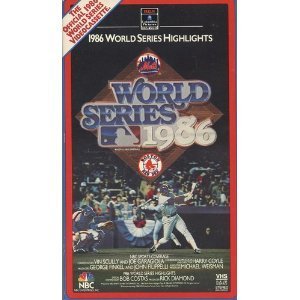
1986 Mets: A Year to Remember. This is the official team highlight video, which my friends and I rented repeatedly from Video Empire, so much so that it was impossible for anyone to find it because one of us always seemed to have it out. I do happen to have my own copy because sometime in the late 1990s I rented it one more time and hooked two VCRs together in order to dub the video.
The video itself starts with a highlight of Game Six and then goes month to month through the regular season, with a few montages thrown in, the most famous of which definitely has to be the Len Dykstra and Wally Backman “Wild Boys” video set to the Duran Duran song of the same name, as well as a great clip of Howard Johnson and Roger McDowell telling the audience how to pull the “hot foot” prank on a player. The playoffs and series are covered as well, with most of the play calling coming from Bob Murphy, the radio voice of the Mets, which I have to say is awesome because as much as I like hearing Vin Scully, Bob Murphy’s voice calling the Mets is one of the best things you’ll ever hear. (more…)
[A quick note: I originally published this on my old website, Inane Crap, five years ago. Since I have been writing about the 1986 Mets, I thought it would be appropriate to repost. There will be another post tomorrow.]
I think that one of the biggest problems you face when you grow up normal is that you grow up being a good kid. Technically there is nothing wrong with parents instilling their children with a sense of morality, a work ethic, and awareness of the world around them. The problem is that normal kids do not make good criminals.
I mean, I am a terrible liar. I can embellish and exaggerate, but when it comes to fabrication, I flat-out suck. Luckily, I discovered this in the fourth grade when I tried to con my way out of getting in trouble for not doing my homework.
When I was nine years old, I began the fourth grade at Lincoln Avenue Elementary School in the fall of 1986. My teacher was a very nice woman named Mrs. Balcewicz, whom everyone called “Mrs. B.” Fourth grade was a huge year from anyone at Lincoln because it meant that you moved into the “big kid” hallway and got actual grades on your report cards instead of weird letters like “S,” “N,” and “U.” And not only was being in the 4-5-6 hallway exciting, I was poised to do very well because my third grade year had been stellar.
Unfortunately, this year of school was where I began my very slow descent into the social awkwardness that defined my adolescence. Like other years, I spent most of my days playing G.I. Joe and Top Gun and beating up on girls (not in the “future domestic violence case” way, though; more like in the “pulling pigtails” way). But most importantly, my brain was trying to tell me that it was time to start maturing, and that was by getting in trouble.
For the most part, this was not through any violent behavior, because I was a good kid. Nor was it through refusing to be clean, because I’d had a messy desk since I was in the first grade. The way I rebelled when I was nine years old was by not doing my homework. Mrs. B didn’t assign a lot of homework, but during one week in October 1986, thought a little homework was too much and refused to do it. What’s worse is that when she came to collect my homework and I didn’t have it, I used the excuse of going to see my ailing grandfather in the hospital. It was underhanded and mean, and my come-uppance was quick because on the Friday of that week, she handed out progress reports that had to be signed by our parents. Mine said that I was missing a couple of assignments, and had this comment: “Tommy has been telling me about going to see his grandfather in the hospital.”
Now when you’re in the fourth grade and you have never really done anything wrong in your life, you don’t’ have the smarts to know that the jig is up and you should come clean to your teacher about not doing your homework. I was a likable student, who would eventually be named “Teacher’s Pet” in my high school yearbook, so I probably would have gotten off with a warning. Instead, I hastily signed my mom’s name on the progress report and hid it in my desk at school until the day she collected it. Mrs. B was not stupid, and a few days later on October 28, 1986, she called my parents. (more…)
New Titans #100 is probably one of the better examples of a “sucker punch” big issue that came out in the midst of the much-maligned “Dark Age” of comics. Oh sure, there were big events in other comics that people actually cared more about; Superman had just come back from the dead, Batman #500 came out and Azbats gave Bane a serious beatdown, and we were getting pretty close to the time when Magneto ripped Wolverine apart (which is also close to the time I stopped buying the X-books). But aside from the moment that would basically become the genesis of Onslaught (look it up, kids), many of the “events” were pretty well-known at the time. And I guess you could say that Evil Raven interrupting the wedding of Dick Grayson and Kory Anders was telegraphed as well, but I think that most Titans fans didn’t expect the mood of the book to change so drastically with its new art team.
To say the least, Bill Jaaska’s contributions to the title weren’t very welcomed by fans (though the editors did have a tendency to run positive letters stating otherwise), and looking at it now it looks clunky in some parts and hasn’t really aged well, but I can see where they were going for a newer, darker mood for the book. And in order to take the book down this path, Marv Wolfman had a four-pronged approached, at least for the next year’s worth of issues. He had the Nightwing/Starfire relationship reach its ultimate conclusion, Changeling started to lose his mind due to the manipulations of the Mento helmet, Arsenal would gain control of the team, and after nearly four years of wondering what was going to happen to Vic Stone, we finally would get the conclusion to the Cyborg story.
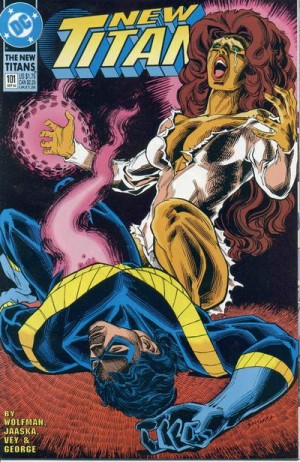
But since the biggest event of the previous issue was Raven kissing Starfire, it’s best to bring us back to our exploration of the Titans books of this era by looking at how Nightwing and Starfire recovered from the kiss. Issue #101 was appropriately titled “Aftermath” and begins in S.T.A.R. Labs, where Kory is flipping out because she thinks that Raven is attacking her. It’s a little bit different from many of the other Raven attacks we’ve seen because Kory seems to be fighting Raven’s influence and Phantasm–who at this point only seems to show up when the plot finds it necessary–uses his powers to help her fight. It seems that they chase away the demon and Kory is back to the land of the living.
Meanwhile, Arsenal is wresting control away from a distraught Nightwing and it looks like he is about to strike a deal where the Titans may be a government-sponsored organization, something that pisses Nightwing off to no end and he and Roy come to blows. Dick leaves the Titans to be at Kory’s bedside and Roy takes the team over, and in order to follow the story of the fan favorite Titans couple, we have to head to Flash #80-83, a four-part storyline where they help Wally West face off against a group called the Combine and an ex-girlfriend of his, Frances Kane. (more…)





 Pop Culture Affidavit