1980s

When Billy Joel Was Homework

We Didn't Start the FireIt’s been derided as one of the worst Billy Joel songs ever written, maybe even one of the worst ever, and when Christopher Bonanos of Vulture put it second to last in a comprehensive list of all of his songs*, he called it, “The biggest problem for the Billy Joel apologist, because it is so highly popular and inescapably bad.” But for me, a “We Didn’t Start The Fire” is important—while Billy Joel was inadvertently summarizing the entire Cold War in three minutes, I was taking my first steps into the world of collecting music.

Released on September 27, 1989, the song, which was the first single off of Storm Front, topped the Billboard Hot 100 for the weeks of December 9 and 16 of that year and came on the heels of his monstrous 1980s grand slam of An Innocent Man, Greatest Hits Volume I & II**, The Bridge, and the Russia tour. That prior success and the chart-topping first single helped Storm Front go quadruple platinum, outselling his prior studio album, something that’s impressive for what is half of a good album, although the singles, especially “The Downeaster Alexa”, “I Go to Extremes”, and “And So It Goes” have gotten many a replay over the years.

Of course, “We Didn’t Start the Fire” overshadows all of those. Its verses are laundry lists of events and people from his then forty years, which Bonanos trashes by saying, “So much is wrong here: boomer-generation narcissism, the tri-state area-news myopia (‘hypodermics on the shore?’ ‘Bernie Goetz’?), the iffy rhymes (‘James Dean’ with ‘winning team’ and many others), the double mention of the Dodgers.” But the appeal was the challenge of memorizing every single  reference, which while not as tough as, say, “It’s the End of the World As We Know It (And I Feel Fine)” by R.E.M., was still a task, especially since Joel was not known for his ability to enunciate and it was years before I realized that “Dien Bien Phu falls” was not prnounced “Din din foo falls.”

To do so, I would need a copy of the song and while I was content to wait until I heard it on the radio and had a tape ready to record, but fate intervened in the form of Saturday Night Live and my junior high school.

In late September, NBC aired a huge prime-time special to celebrate SNL’s 15th Anniversary (which I covered in episode 45 of the podcast). It was, as these shows tend to be, a huge retrospective of the characters, comedians, guests, and sketches from the show’s history, and just about everyone in my grade wound up watching it, or at least that is what I could tell from the number of times we repeated lines in class for weeks after. This ultimately led to the last time I ever really dressed up for Halloween—my friend Rich and I wore gray sweatpants and sweatshirts and weight belts and went as Hans and Franz.

The costumes were a hit and we won “Funniest costume”*** and a $25 gift certificate to Record World, a record store in the Sun Vet Mall that even in 1989, when mall record and tape stores were still important destinations for teenagers, seemed like a relic of the decade before. The décor was deep brown shelving with gold carpeting that might have at one time held years’ worth of nicotine tar. The cassettes were locked behind glass cases, and the disaffected employees working the register stood in a perch, nearly inapproachable. Think Empire Records, but with paneling. Rich and I walked in and almost immediately saw the cassingle for “We Didn’t Start the Fire”, snatched it up, and then grabbed other tapes we were interested in. I can’t remember what else we got, but the minute I got home, that cassingle of “We Didn’t Start the Fire” went into constant rotation on the boom box with its partially broken antenna that sat on my bedroom dresser.

Later that winter, Rich and I, along with my sister, would set my parents’ camcorder up on the washing machine and record a music video of us lip syncing the song, using the mallets of a croquet set as guitars and microphones, which is something we’d been doing for a while****.  And while my peers and I had no context for the majority of the song, we belted out the lyrics and many of us had to research them.

Now, I was never asked to do a research project on one of the song’s many allusions, but more than a few of my friends were, and it’s even Bonanos writes that he didn’t place the song last in the list because it made him learn something.  I’m pretty sure that Joel didn’t intend to hand junior high teachers a lesson plan, but he did and even to this day, you can find online lessons available. Most of them haven’t changed much in 30 years—I don’t care if you add multimedia, you’re still looking up a song lyric and doing research. So whereas Boomers could wax nostalgic, their kids could be forced to learn about all of the important things in their generation’s lifetime. And for a generation as notoriously narcissistic as the Baby Boomers, “We Didn’t Start The Fire” was perfect fuel for the nostalgia that had been started by American Graffiti, ramped up with The Big Chill, and was chugging along with The Wonder Years.

Over the years, Joel has been asked about adding extra verses to the song but has declined, which I can respect, because he doesn’t need to.  Future generations can take it upon themselves to follow it up, like Matchbox 20 did with “How Far We’ve Come”, a Gen-X spiritual sequel that has a similar sound (superimpose the final verse of “We Didn’t Start the Fire” over the song’s bridge, it fits perfectly) and a video that is flashes of events from the late 20th and early 21st Centuries. And I guess it’s appropriate that a band whose Greatest Hits album is called Exile on Mainstream is paying tribute to an artist who practically defined mainstream during their youth.

“We Didn’t Start the Fire” was the first cassingle I ever bought.  I didn’t realize it at the time, but it was a watershed moment. Up until that point tapes were something I flipped through as TSS while my mom was shopping***** and I only had the few that I put on birthday and Christmas lists–Thriller; Born in the U.S.A. (which I wore out and had to replace); and the soundtracks to Footloose, Over the Top, The Karate Kid Part II, and Top Gun.  Songs were something I heard on the radio and taped onto a blank cassette. As I made my way through junior high and then into high school, I’d start a music collection. And while my taste could be–and has often been–called into question, to this day I will still loudly proclaim, “Rock and roller cola wars, I can’t take it anymore!”

* Last on the list was “The Mexican Connection”, a piano instrumental off of Streetlife Serenade that isn’t bad per se but is certainly a very deep cut.

** At some point in the mid-1980s, just about every household on Long Island was issued a cassette copy of Greatest Hits I & II and I can imagine those cassette copies of the album circulate in the area’s garage sales like currency.

*** I remember someone yelling at me that it wasn’t fair because the prize was supposed to some guy named Emil who dressed in a toga and I honestly don’t remember why he didn’t get it but it just sticks out at one of many “You didn’t deserve this, loser” moments from my formative years.

**** A video that no longer exists because I threw the tape away years ago.

*****When I wasn’t staring at Samantha Fox posters.

Fallen Walls Open Curtains Episode 1

Fallen Walls Open Curtains Episode 1 WebsiteIt’s the first chapter in a brand new podcast miniseries that looks at the fall of the Iron Curtain and the popular culture of the Cold War.  To start us off, I look at the watershed event from 30 years ago that marked the beginning of the end of four decades of conflict and tension between the super powers: the opening of the Berlin Wall on November 9, 1989.  I look at the history of the wall, talk about Berlin’s importance in the Cold War, and go in depth about what brought about the wall’s eventual demise.  Plus, I talk about songs inspired by the wall as well as my featured piece of pop culture, John Le Carre’s The Spy Who Came in From the Cold.
You can listen here:

Apple Podcasts:  Pop Culture Affidavit

Direct Download 

Pop Culture Affidavit podcast page

After the cut, here are some extras from this episode …

(more…)

Brand Me! (My Favorite Non-Toy and Giveaway Merchandise)

So my son and I were at at our LCS this weekend and we took some time to sift through their selection of Funko Pop! figures.  We do this pretty regularly, and while we’re not hardcore collectors or anything, we do like seeing what the company is able to license and sometimes even buy them because we’re suckers for a brand. Then again, we all are and have been since my parents were little and could buy merchandise that tied into Howdy Doody and the George Reeves Superman television series. My generation, of course, took it a step further and spent the 1980s immersing ourselves in the franchises that made up our childhood, gobbling up not just toys but everything from trading cards and video games to the most random piece of merchandise that had a logo or character slapped on its side.

Not surprisingly, seeing these items posted by people on Twitter, in scans of old Sears catalogues, or up for sale on eBay gets me nostalgic and so I decided to sit down and talk about six non-toy merchandising tie-ins that I remember with serious fondness.

signallight

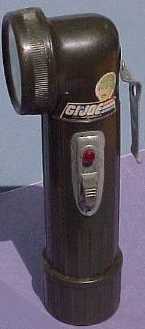
The G.I. Joe Flashlight (image: yojoe.com)

1. The G.I. Joe Flashlight: I think this is the closest thing to a toy that is on this list, and I am including it because it was the first G.I. Joe item that I ever owned and was the second-coolest thing that I got for Christmas when I was five (the coolest thing being my General Lee Big Wheels). When the Joe line was revived in 1982 under the “Real American Hero” subtitle, Hasbro came out with a superior line of figures and vehicles. But as anyone who flipped through the Sears catalogue int he 1980s will tell you, there was also a slew of other stuff. A quick look at YoJoe.com shows that in 1982 alone there were 48 different products ranging from the typical sheets, pillows, cups, and beach towels to Colorforms, View Master reels, and Lite Brite sets.

But the coolest stuff was the merchandise that had you playing army as hardcore as possible. There were dog tags, pins that showed off your rank, a whistle, walkie talkies, a canteen, and even a mess kit. The official G.I. Joe flashlight was a real working flashlight that took the same batteries as the red Eveready in my parents’ closet, but unlike the Eveready, it was colored army green and was positioned “military style” so that you had to hold it vertically. It also had a belt clip so you could take it with you on secret missions, unlatching it when you needed to crawl around and look into tight spaces like the ventilation shafts of Cobra HQ or under your parents’ couch because you think that’s where Han Solo’s blaster got kicked.

2. Masters of the Universe Puffy Stickers. Quite possibly the greatest things that ever came out of a box of cereal were the puffy stickers featuring five Masters of the Universe characters in Rice Krispies. A quick look at this old commercial shows that they were: Battle Armor He-Man, Skeletor, Teela, Evil Lyn, and Orko.

These prizes were given away in the summer of 1984 and this is one of those instances in my life where my parents’ strict adherence to non-sugary cereals paid off. Basically, the only cereals allowed in my house were Cheerios, Rice Krispies, Chex, Kix, and Raisin Bran (yes, I know the raisins are coated in sugar, but it wasn’t Frosted Flakes, and my sister’s love for Pro Grain Cereal is a topic for another day). That meant that for the entire time the promo was active, I was eating boxes of the stuff just so that I could collect all five stickers. Of course, collecting them wasn’t easy because the box didn’t tell you what sticker was inside, so any time you opened up a fresh box, you ran the risk of getting yet another Orko sticker instead of the Skeletor sticker you so desperately needed.

My big get, by the way, was Evil Lyn because I negotiated that with my cousin Brian when we were staying at my grandma’s house and came across her sticker in the Rice Krispies box. I can’t remember what sort of bartering went on between us as seven year olds 35 years ago, but I remember feeling pretty psyched because I really liked Evil Lyn. Who wouldn’t? She’s second only to the Baroness when it comes to awesome 1980s cartoon villainesses.

Anyway, I am sure that if we wanted to back then, we could spend our allowance money on a sheet of Masters of the Universe puffy stickers at the local stationary store, but that would have kind of been like cheating. What made the stickers so special was the snap, crackle, and pop of the hunt.

Return of the Jedi Party Favor

Party favor bags from a galaxy far, far away.

3. Return of the Jedi Party Supplies. I can’t remember which birthday was my Return of the Jedi birthday. I turned six when the movie came out, and since the Star Wars franchise as a merchandising juggernaut by then, it’s very possible that I had an Jedi-themed party one month after it premiered in theaters. But it could have been the next year, considering how long Jedi stuck around in my life before it got replaced by Transformers.

Anyway, I have to say that a kid’s birthday party in 1984 was pretty much your friends coming over to your house for Carvel cake one afternoon and not your parents renting out an entire trampoline park for three hours on a Saturday, so a Jedi-themed birthday meant that mom and dad bought a bunch of cups, napkins, and plates that had the movie logo on it and that’s what you ate cake off of and drank punch out of after you ran around in the backyard for two hours. And hey, they might have even been feeling fancy and sprung for the paper tablecloth.

I think my parents did, anyway. Those supplies were easy to find and weren’t very expensive–they were always right by the entrance to Toys R Us and there were usually piles of them for sale at a decent price. Plus, they managed to get a Carvel cake with Darth Vader’s picture on it (back in the days before entertainment companies started cracking down on copyright) and they even wrapped the party favors–which I think were Star Wars coloring books–in Star Wars wrapping paper. I am sure there is a picture somewhere of said birthday party in an old family photo album and my mom has pictures of the cake or at least the cups and napkins in crowd shots, but just looking at an eBay listing has me feeling cool for being a Star wars party kid when I was young.

4. Masters of the Universe Plastic Cups. Another giveaway that really had us captivated was this Burger King promo from 1983.

These were plastic cups with original Masters of the Universe comic strips printed on the side. I don’t know if these comics were four separate stories or if they were four parts of one big story, but what I do know is that BK released one each week for four weeks in the fall of 1983 and my sister and I spent four weeks begging my parents to take us for burgers.

This wasn’t exactly a small feat in 1983. My parents had nothing against fast food, but going out to eat, even at Burger King, was definitely a “sometimes” type of thing, so to do it for four straight weeks to get a souvenir cup? That was pushing it. I mean, I was six years old and couldn’t care less about that because I stopped everything–even my umpteenth watching of Star Wars–when He-Man came on. I wanted those cups and would eat as many Whalers or Whoppers as I needed to.

Or just hamburgers. I was big on just the BK hamburgers. And the Italian chicken sandwich. Come to think of it, those cups may have been what started what became a pretty regular trip to the Burger King in Blue Point, especially after our weekly piano lessons. And I honestly don’t remember if I got all four cups–I think that I might have only wound up with two of them and they lasted a year or two before the comics peeled off and faded because of repeated trips through the dishwasher.

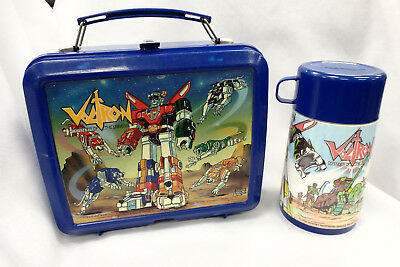
Voltron Lunch Box

The 1984 Voltron lunchbox.  Kind of makes me wish that I had it now.  I’d be the king of the break room.

5. Voltron Lunch Box. I blogged about Voltron years ago, but I still can’t get over how Voltron just sort of was there one day without prior notice. The cartoon dropped right around the beginning of second grade and beyond my insane quest to collect all of “Lionbot”, I rarely, if ever, saw much merchandise until probably the end of that school year and into the beginning of third grade when Panosh Place’s toy line came out and there was a lot more merchandise in the stores, including this.

Manufactured by Aladdin, who made a number of lunchboxes of mine back in the day, this was one of the plastic lunchboxes that were becoming more common as the Eighties wore on, replacing the metal ones that ended, I believe, with a Rambo lunchbox circa 1986-1987. The illustration on the front was straight from the cartoon and the thermos inside was a wraparound image of Voltron and the lion force. I never used the thermos, though, since I bought milk every day or packed a boxed Yoo-Hoo.

I treasured this thing. It was, quite possibly, the coolest lunchbox that I ever owned and I walked around the halls of Lincoln Avenue Elementary feeling so boss because I carried a much-coveted Voltron lunchbox. So you can imagine how terrible I felt when I left it somewhere and never saw it again. I think my parents were pretty annoyed because my absent-mindedness caused yet another thing they had to pay for to go missing, a motif throughout my childhood that also included jackets, a camera, and a mountain bike (which was stolen but I wound up taking the blame anyway).

Thankfully, the lunchbox was recovered. Sort of. I found one in the school’s lost and found but I knew it wasn’t mine because it had a thermos in it. Still, I had seen only one other kid with a Voltron lunchbox and thought that maybe he picked up mine by accident one day and what I was holding was his. Not having yet developed my social anxiety, I approached him at lunch one day and politely suggested that we had accidentally switched lunchboxes. He responded by yelling something at me–I can’t remember what it was but even at the age of eight, I knew that this kid lacked in basic social skills. My parents told me to keep the lunchbox, which I guess is technically dishonest, but it had been unclaimed, so Keith, Lance, Pidge, Hunk, and Princess Allura continued to protect my sandwiches.

400201_orig

When the four puzzles were locked together to form the mural, they would look like this (although these are just the boxes put together).  Image: 3Djoes.com

6. The G.I. Joe Mural Puzzle Closing this out where we began, there is the most action-packed exercise in patience you will ever see or experience. According to YoJoe.com, this came out in 1985, but it was still available in stores as late as 1987 when i was at the height of my Joe fandom. And I wouldn’t have wanted it if my mom hadn’t dragged me to go clothes shopping with my sister at Swezey’s, a local department store that I still associate with off-brand clothing and mind-destroying ennui.

Anyway, Swezey’s had a random rack of accessories and pseudo-toys near the girls’ clothes (purses, pencil cases, some stuffed animals, games) and among all of it, I spotted a puzzle featuring G.I. Joe. It was a 221-piece puzzle that, as I saw on the box, could be linked to three other scenes to form a giant mural.

Now, badgering my parents to schlep to Burger King when I was six was one thing, so asking my mom to make special trips to buy puzzles was probably something else. Surprisingly, getting all four of these came easy because puzzles were always an approved form of entertainment–they were challenging, they kept you occupied for a long time, and they were done without the television being on. I can’t remember how long it took me to get all four puzzles, and I’m pretty sure that I paid for one of them with my birthday money one year, but I eventually did get them and assemble them and when the day came that I was ready to make the mural, I got ready to connect them, and … nothing.

To this day, I have no idea what I did wrong that prevented the giant awesome battle mural from coming together, as i stared at the directions on the box for several minutes, made multiple attempts to connect the puzzles, and ultimately said, “Forget it.” I am sure the puzzles were eventually donated to charity, so if I wanted to try one more time as an adult, I’d have to track them down at a thrift shop or on eBay.

Toys, comics, movies, and television shows will always be in the front of my mind whenever someone mentions Star Wars, Masters of the Universe, G.I. Joe, Voltron, or anything else I was into as a kid. But what’s special about these things is that although they eventually faded away or were set aside for something new, when they were there, they shared a part of my life and became attached not just to entertainment nostalgia but memories of significant events as well as the everyday.

Pop Culture Affidavit Episode 100: Deeds Not Words

Episode 100 Website CoverAfter nine years of blogging and 99 podcast episodes, it’s time to take another look at the movie that started it all:  MEGAFORCE!  In this episode, I take a look at the 1982 Hal Needham film, which stars Barry Bostwick as Ace Hunter, the commander of a super-elite international military unit.  I give a summary of the movie, talk about my Megaforce origin story and re-evaluate my opinion of it.

You can listen here:

Apple Podcasts:  Pop Culture Affidavit

Direct Download 

Pop Culture Affidavit podcast page

Some extras for you …

(more…)

Pop Culture Affidavit Episode 98: Tales of the Dark Knight

Episode 98 Website Cover

In celebration of the 80th anniversary of Batman and the 30th anniversary of the release of Tim Burton’s first Batman film, I am taking a look at my own Bat-fandom, focusing specifically on Mark Cotta Vaz’s 1989 book Tales of the Dark Knight: Batman’s First Fifty Years, 1939-1989. I cover what’s in the book as well as talk about my Batman origin story and why this book was so important to my fandom.

You can listen here:

iTunes:  Pop Culture Affidavit

Direct Download 

Pop Culture Affidavit podcast page


Pop Culture Affidavit Episode 97: And Now A Word From Our Sponsor

Episode 97 Website CoverThey’re the 30-second segments you fast-forwarded through, ignored, or used for a bathroom break, but when you think about it, you know them better than you realize.  They are commercials.  In this episode, I talk about advertising and commercials that I remember, both fondly and not so fondly.  I begin by going over what makes a good and a bad commercial and then make my way through a bunch of commercials that I can’t get out of my head.  From cereal to fast food to toys to local car dealerships, it’s so much advertising that it’s … INSANE!

You can listen here:

iTunes:  Pop Culture Affidavit

Direct Download 

Pop Culture Affidavit podcast page

As a bonus, here are links to past blog posts about commercials.

“Your Winds Song Stays on My Mind”:  Wind Song perfume.

“When Clothes Shopping Became Cool”:  Kids “R” Us.

“Because Rock Should Make You Feel Good”:  The as-seen-on-TV compilation album Feel Good Rock.

“Why the green M&M’s have always been my favorite”: An M&M’s commercial featuring little leaguers.

“Coke Is It!”:  A 1980s Coke commercial.

“The Taste That’s Gonna Move You!”:  Juicy Fruit gum.

“Fuzzy Memories of Summer Camp”:  About local summer camp commercials from the NY tri-state area.

“Just ‘Round the Corner!”:  Long Island-area furniture store commercials.

“All You Have to Bring Is Your Love of Everything”:  Sandals, Mount Airy Lodge, and the Commack Motor Inn

“The Yearbook Myth”:  A post about yearbooks and yearbook DVD music from the mid-2000s that also features a 1980s McDonald’s commercial called “Great Year!”

“XOXO”:  Tic-Tac-Toes canned pasta from Chef Boyardee.

“Heaven in a Can”:  Franco-American gravy.

“Just What the Dr. Ordered”:  Dr. Pepper commercials from the early Nineties.

And here is a playlist of the commercials used in this episode …


Requiem for a Pint

235px-americoneupdatedlogoRecently I discovered that I can no longer eat a pint of Ben & Jerry’s without serious digestive repercussions. I have never been lactose intolerant or had any other dietary restriction or need, but on a Friday night a few weeks ago after downing an entire pint of Americone Dream, I found myself planted on the toilet, praying for the sweet release of death.

As someone who has been trying to lose weight for some time, this discovery should be a welcome one–a craving for a pint of ice cream can now be quickly subdued by the reminder that I will spent a significant amount of time testing the limits of my house’s plumbing–but it kind of annoys and saddens me because I’ve been eating Ben & Jerry’s ice cream for more than 30 years. Whatever middle age is starting to do to my body in these days of sleep apnea, anxiety, and gout, has now claimed one of my favorite desserts.

Ice cream in general has had a constant presence in my life since I was little. My parents usually had a half-gallon of some sort of ice cream–Breyer’s, Edy’s, or the abomination known as Sealtest Ice Milk–in the freezer; birthday cakes were always from Carvel; and I spent many nights of my formative years eating sundaes at our local Friendly’s. But truly the only thing resembling a scoop shop in the greater Sayville area was the Baskin-Robbins on Sunrise Highway and Oakdale-Bohemia Road, a store too far away to reach by bike. The names Ben & Jerry were completely unknown to me until a family vacation in 1987.

Arctic Dreams Sign

The sign for Pizza Chef and Arctic Dreams in New London, New Hampshire c. 2011.  By then, the store had stopped serving Ben & Jerry’s and was serving Annabelle’s Ice Cream.  Image courtesy of Yelp.

Arctic Dreams was an independently owned ice cream shop in New London, New Hampshire, which is one of those small towns in new England that you pass by or drive through on your way to somewhere else. My parents rent a cabin on Kezar lake, which is just south of New London in North Sutton, a town that literally has one intersection, and at least a few times ever year we would head up to New London for a meal at Pizza Chef followed by ice cream at Arctic Dreams. It happened so often that it became a tradition, even though Pizza Chef was one of the few restaurants in New London where you could take a family of picky kids who could be real pains in the ass when it came to what was on the menu. Then again, very few kids aren’t pains in the ass about at least something.

arctic dreams inside

The Arctic Dreams menu/”flavor board”.  Image courtesy of Yelp.

Anyway, I can’t remember if the food at Pizza Chef was any good–the fact that a Google street view shot had it still open as of 2014 with the same 1980s-looking logo on the sign suggests they’ve been doing something right–but walking into Arctic Dreams that first time was a revelation. The place was cold (you could expect that from an ice cream shop) and instead of the constant hum and pull of soft serve machines I’d been used to from Carvel, there was a billboard-sized list of ice cream flavors and the smell of freshly made waffle cones. My ten-year-old mind was completely blown the moment I first stepped into the place and I just stood there for at least a full minute reading every flavor on that board until I eventually settled on what would become my all-time favorite scoop shop variety: vanilla chocolate chunk. No, not mint chocolate chunk, but vanilla ice cream with huge chunks of chocolate.

Even though I wanted a waffle cone stuffed full of ice cream, I was probably crabbed at to “just get a cup”–I was a notoriously sloppy eater and we could finish cups faster in order to beat the imaginary traffic back to the lake–the trips to Arctic Dreams were some of the best things about those vacations. Sure, there were trips to tourist destinations, days spent rowing and swimming in the late, and tours of the campus of Dartmouth College that were truly memorable, but even when I was at my most surly level of teenager, the ice cream was worth it.

pint-evol-blog-1

The Ben & Jerry’s pint in the mid-1980s.  Image courtesy of Ben & Jerry’s.

But I didn’t get to be planted on my toilet at midnight doing an impromptu ab workout while slowly realizing I did this to myself by visiting an ice cream place in New Hampshire in the mid-1980s. It was the pint, that package of goodness now ubiquitous to the supermarket that 30 years ago was a novelty. Ben & Jerry’s introduced their pints in 1980 and the packaging was so lo-fi, I would have believed it if you told me that they printed the labels by hand in the back of Arctic Dreams. A cartoon drawing of a guy making ice cream was on the front and you could tell what flavor you were buying by reaidng the lid, which also had a picture of Ben and Jerry. There was something special about the Ben & Jerry’s pint, just like their competitor, Haagen-Dazs, made their pints seem like indulgence beyond the basic bitch half gallons of Breyer’s chocolate and vanilla you were fishing out of an icebox at Waldbaum’s.

When I hit my twenties, that novelty wore off, and the pint was more or less a standard-issue single serving. Oh sure, the nutritional label on the pint says that a serving is half a cup and that meant that four people coud share that pint of Half-Baked who probably sat at home eating gallons of the stuff while playing three video games simultaneously and barking commands at his parents. So I made up for this childhood injustice by buying whatever the hell I wanted whenever the hell I wanted no matter how slow my metabolism got.

And you’d think that because Ben & Jerry’s was bought by Unilever in 2000 and therefore became even more widely available, getting the right pint would be one of the easiest things in the world. I mean, it was if you weren’t picky, and there were times when I would choose the Helvetica that is Chocolate Chip Cookie Dough (Ben & Jerry’s very first flavor, by the way, is vanilla, the Times New Roman of ice cream; the jury is still out on which flavor is comic sans). But then there were those times when I didn’t want just any ice cream and if I were to indulge a sweet tooth and take the calorie hit, I was going to do it at mach two with my hair on fire by wolfing down a pint of Brownie Batter.

The problem often was that not every place carried the same flavors and some of the more limited batches could only be found in a few select stores. At the height of my Ben & Jerry’s love, I had committed to memory exactly where I needed to go for what. For instance, the Harris Teeter in Pentagon City had vanilla caramel fudge but if I wanted a pint of Festivus (The Flavor for the Rest of Us), I had to drive to the Shoppers Food Warehouse at Potomac Yard. And I wanted some sort of limited edition batch that I actually read about in the news, I had to Indiana Jones it by constructing The Staff of Ra so I could figure out which Giant within a five-mile radius carried Marsha Marsha Marshmallow or something.

Of course, such quests had fleeting rewards and over the years, I got more interested in expanding my waistline via cookies and cake, which I’ll now have to stick to lest I turn my digestive tract into the very bowels of hell. Then again, you never know … I may want to dance with The Devil again.

Everybody Wants Something

EWS21

Caitlin dumps Joey for Claude (pronounced “Clowde”).  Don’t worry, they’ll get back together … eventually. Image courtesy of Degrassi fandom Wiki.

First of all, hold up. Has it really been three and a half years since I did a review of a Degrassi High episode? Well, so much for keeping a commitment. Or maybe I’m keeping it because I am here and I am finally picking this up again.


At any rate, when I first realized this a few months ago, I did a rewatch of Degrassi High and decided to pick my ten favorite episodes that I watched when PBS first ran the show back in the late 1980s and early 1990s, and I intend for this to lead up to a podcast episode covering the show’s TV-movie finale, School’s Out! And before I get to the episode I’m going to cover in this entry, I should say that most of the Degrassi High episodes I am covering will be from the first of the show’s two seasons–at some point, WNET moved its Degrassi airings to Sunday morning and since my mom was dragging my ass to church, I caught bits and pieces of episodes from the show’s final season.

Here, I’m starting a strong one, and with one that is one of the most memorable for me based on the number of times I saw it on television back in the day and how honestly I connected with those characters. “Everybody Wants Something” is the fifth episode of season 1 and has three landmark moments: the Zits’ first (and only) music video, Erica and Liz in an epic fight, and Caitlin dumping Joey for Claude.

As detailed in the last episode I wrote about, “A New Start,” Degrassi High started with Erica finding out she was pregnant and then choosing to terminate the pregnancy, despite her and her sister’s religious beliefs. And unlike a teen-centered show like Saved By the Bell, this serious matter was not left completely unresolved (yes, SBTB had its ongoing plots, but they were usually the romances between characters and the only time anything serious got mentioned again, it was during a clip show). The after effects of Erica’s abortion were C-plot sutff for a couple of episodes, as someone was writing nasty things about her on bathroom mirrors and leaving things on her locker.

Toward the end of this episode, Erica finds a picture of a fetus with “Abortion Kills Children” on it and after getting upset, turns around to see Liz (best friend of Spike, who is famous as having been pregnant on Degrassi Junior High) was the person who planted it. We knew from an earlier conversation between Liz and Spike that Liz is decidedly antiabortion because her father tried to beat her mother into getting one while she was pregnant. Liz doesn’t tel Erica this, but instead calls her a murderer and Erica goes right at her.

It’s a fight that is pretty quick and ends with the two of them on the floor pulling at one another’s hair, and while it was obviously staged, I saw enough girl fights in the halls of my junior high and high school to know that it looks like these two were actually fighting. The way Erica goes after her, a crowd gathers, and they dig in and won’t let go of one another, even on the ground, suggests that someone had been paying attention to an actual high school.

And while it is not the end of Erica’s abortion arc or even the main event of the episode, it fits nicely with everything else, which is what this show always did well. There were something on the order of 10-20 characters on Degrassi High, so having this happen while something totally unrelated was going on and having those not directly affect one another is exactly what happens in a high school.

The main story is actually a two-in-one that centers around Joey Jeremiah, who I guess we could say is one of the core characters of the series (especially considering how things play out toward the series’ end). Joey’s taking yet another shot at fame with his band, The Zits (formerly The Zit Remedy) and has badgered Lucy into finally letting her shoot his video, even if he blows most of the guys’ money on getting two girls to wear bikinis (and then has that fall through). All the while, his girlfriend, Caitlin, has started hooking up with Claude (pronounced “Clowde”) and right before the video shoot, she dumps Joey.

Pat Mastroianni won awards for playing Joey Jeremiah and you can see why in episodes like this where he has to switch between having been dumped and being a goofball on camera, putting on an act for his friends. The final still of him looking consternated, while not dramatic, encapsulates the performance and was actually the kickoff to a PBS pledge break that I sat through when I saw the episode one time on a random weekend afternoon. The emcee said that if we wanted to see more of Joey, we should give money, and also showed some behind the scenes stuff about the show. I don’t know if this is an honor or not, but perhaps somewhere Mr. Mastroianni is proud that he was used to advertise public television.

My connection to this episode has little to do with Joey and Caitlin’s relationship or Erica’s abortion; instead, it’s the video the band shoots that resonates with me. When this episode aired, YouTube didn’t exist and while people did have video cameras, the ability to edit a video and give it a soundtrack required equipment or time in a studio that was cost prohibitive. oh, I’m sure you could do that with two VCRs, but even then, things were crude. My friends and I used to make stupid, silly videos–skits, lip-syncing, and other things that will never see the light of day–and in our minds, what we were putting together was more epic than the low-rent camcorder footage shot in my basement.  In other words, my friends and I could have been The Zits.  I definitely think that we could have milked that one song, too.

Next Up: “Just Friends”

Jesus Jones Wept

[This post addresses current-day politics and expresses some of my political views.  If you care not to read that, please skip this.]

I saw the decade end

when it seemed the world could change

in the blink of an eye.

mv5bmdg3nzg2otatogu2zs00zwe0lthhodytnja3mjbinwvkm2nkxkeyxkfqcgdeqxvymjuyndk2odc-_v1_sy1000_sx1000_al_Those are the first lines of the second verse of “Right Here, Right Now”, a song by Jesus Jones that hit number two on the Billboard Hot 100 (and topped the alternative chart) in late July 1991.  Written about a year earlier, it is an optimistic song that celebrates what lead singer Mike Edwards describes as “watching the world wake up from history.”  Even though the song is approaching its thirtieth anniversary, it still gets some airplay, especially on alternative radio stations that cater to the aging teenagers of the Nineties.

The song’s melody has aged well, especially compared to the pop that accompanied it at the time–an era in which pre-“grunge” alternative was seeing some mainstream success (EMF’s “Unbelievable” was also in the top ten) and D.J. Jazzy Jeff and the Fresh Prince released “Summertime,” but that was dominated by Paula Abdul’s “Rush Rush,” Bryan Adams’ “(Everything I Do) I Do It For You”, and the constant chart presence of Color Me Badd and Amy Grant–but its lyrics are very much of its time.  The line about the world waking up from history is a reference to the end of the Cold War, which had begun in 1989 with the fall of the Berlin Wall and would continue until the Soviet Union finally disbanded in December 1991.  And while I’m sure that anyone who actually takes music seriously would look at it and scoff at the sentiment, I thought then and still think that it encapsulates the feeling of the time (with apologies, of course, to “Winds of Change” by The Scorpions).

Granted, when I was seeing the world change in the blink of an eye, I was in junior high school and to me, it did seem that everything was happening at once.  When you’re a ‘tween (I guess that’s the official term now–it really didn’t exist in the early 1990s), you don’t have a deep understanding of how the news that you catch glimpses of between your favorite shows is the result of years of policy decisions and other tactics taken by leaders, some of whom long ago left the world stage.  Sure, maybe I’d get the Weekly Reader condensed version in class every once in a while, but for the most part, my context for the Cold War was mostly the action movies I was renting from the video store. The Soviet Union (or “Russia”, which is what we tended to say) was a big bad that our action heroes and action figures fought against.  When we were on the playground, we weren’t having long discussions on the ramifications of Glasnost; we were pretending that the swings were F-14 Tomcats or we were hunting Gaddafi through the deserts of Libya.  At the same time, though, we were being taught that not everyone over there was like what we saw on TV.

I am from the last Cold War generation and occupy a unique part of it because while my early childhood came during the first part of the Reagan era–that of the “Evil Empire” speech, The Day After, and the “Star Wars” plans to blow nuclear missiles out of the sky–my formative years truly began as it was all ending.  I saw the threat of nuclear war but started to come of age when the teens in the U.S.S.R. were not zombified commie youth, but blue jeans-wearing, Coca-Cola drinking, heavy metal-loving kids.  So, this song, with its catchy hook and bright lyrics, matched my perspective that everything was going to be great because we had gotten through a tough time in our history, but the Wall came down, all those countries were free, and we didn’t have to worry about a Third World War.

Flash forward to when I recently heard “Right Here, Right Now” on my local alternative station and thought about how much of a contrast the world politics of 1991 are to the situation in which we currently find ourselves.  I know that not everyone thinks we have been living a waking nightmare since 2016, but I find it hard to think otherwise as I have tried to navigate the news, social media, work, and everyday life without having a complete breakdown.  And I realize that compared to many other people out there, I am saying this from a place of extreme privilege, but I still feel that people who cheered with me when the Berlin Wall fell slammed me with a folding chair because heel turning on their tag team partner was more lucrative.

Yes, I realize that I just made a pretty clunky professional wrestling comparison and also realize that I’m the Marty Jannetty of said metaphor, but watching people go after one another online because “owning” them and declaring themselves some sort of “winner” is more important than actual conversation or a relationship makes said comparison apt.  When I finally studied how the Cold War ended, I saw way more nuance and complexity than I was seeing in junior high and became more appreciative of it.  At 41, I struggle with being someone who wants to see the same nuance and complexity in our world, knowing that’s a losing battle.  I’ve watched people throw away their core values (though they don’t see it or won’t admit it) and let the doublethink take over and this makes me just want to toss my hands up and walk away because we’re completely fucked and quite frankly, I’m exhausted.

For decades, we’ve let pop music be the soundtrack to the times, but right here, right now, it’s tough to figure out what that soundtrack should be.  At our most positive, maybe we could find comfort in the bittersweetness of “Let It Be”; at our most negative, we’re a teenager slamming the door to our room and blasting The Downward Spiral.  Jesus Jones’ sentiment is quaint and maybe even trite, especially considering the cynical, toxic world in which we live.  Maybe, though, listening to it now can provide us with some hope that there can be another time when we can say “I was alive and I waited for this.”

A New Year’s Eve on the Brink

When you trade in nostalgia, the idea of a milestone anniversary for something you cherished in your formative years is constantly on your mind.  Since starting this blog, I have watched the 20th, 25th, 30th, and even 40th anniversaries of pieces of popular culture that were personal milestones come and go.  Some, I have celebrated; others, I have acknowledged but decided not to cover because the idea of constantly chasing such anniversaries sounds exhausting.

That being said, today marks 30 years since New Year’s Eve 1988.  Nothing significant happened exactly on this day, but when I was thinking about what to write for my annual New Year’s Eve post, the thought of the 1988-1989 school year kept popping into my head and the more and more I thought about it, I discovered that in hindsight, this was a year that was more important than I once thought, both personally and culturally.

Why?  Well, for a number of reasons (and not just mathematically), 1988 was the beginning of the end of what we commonly celebrate as the 1980s and as we moved into 1989, we would see our culture shift into that odd post-1980s hangover that was the pre-Nevermind early 1990s.  It was, as the title of this post suggests, a time when we were on the brink.  The Cold War was ending, we were heading toward a new decade, I was hitting puberty, and there were other societal shifts that we as a culture were both seeing and wouldn’t realize were there until they were over (or in my case, 30 years later).

So, to take us out of 2018, here is my list of … Eight Significant Things about 1988-1989. (more…)