So we all remember the Energizer Bunny ads from the mid-to-late-1980s, right? The first one were simply the bunny drumming and rolling and not stopping. Then, the commericals got creative; they’d start with ads for fake products and thent he bunny would interrupt (“Still going … nothing outlasts Energizer”). For its time, it was a pretty innovative idea for a commercial. I’m not going to say that it ushered in an era of humor or parody in commercials or anything; maybe it did. But there were definitely a few copycats.
The one I remember the most was, for, of all things, TV Guide.
It’s kind of weird to me that TV Guide had commercials. After all, it was one of those things that was always just … there. You know, that digest-sized magazine you threw around and sometimes read just beyond the listings (or in my case, always read the articles). But in the early Nineties, they launched their own ad campaign using fake commercials. I don’t know how many there were, but I do remember one, a music video named SKUM and the song “Screaming at the Top of Our Lungs.”
So in case you are wondering, the band in the commercial doesn’t exist. A comment from 11 years ago made by YouTube User @rhino6849 says:
This was written played and sung by Chuck Duran. We were in a band together called Loud and Clear which was quite a departure from this.Sorry to disappoint some of the metal heads but this was written with his tongue planted firmly in his cheek. I was on the floor laughing the first time he played it. Funny stuff!
p.s. That’s an actor, not Chuck.
Another user, @painebobby, adds, “Chuck sang and played guitar But did not write it.”
And even Chuck Duran himself, whom I found on the website “Demos That Rock”, has posted about it in some places. He is also a working voice-over artist who has a podcast about that work. One of his guests was E.G. Daily, which is pretty cool.
For me, the commercial still holds up, especially because of the over-the-top nature of the video. I’m not sure if GWAR was getting any rotation on MTV (this is about a year or two before Beavis and Butt-Head premiered), but that’s what it reminds me of. With a … tap … of Spinal Tap (I’ll show myself out).
The cover to the NES Game Atlas, one of the specials that Nintendo published.
A while back, I wrote about the games series that Nintendo created as part of their initial years of the NES and the first wave of available games. Of course, I ownd a few of them and played a number of others, but I have to onfess that so many of them passed me by because I didn’t get my NES until 1988. That was the “Action Set”–with the still-gray Zapper and Super Mario Bros./Duck Hunt cartridge–and it was a huge birthday present, completely changing how I spent my free time.
Along with that set was a chance to join what was then called “The Nintendo Fun Club,” which had a thin magazine that came out every so often and featured stories about upcoming games and tips for taking on certain levels or bosses. My one and only issue of tha tmagazine was its very last and it featured Ice Hockey on the cover (a game I played endlessly and wrote about a while back). But I wasn’t cheated out fo whtever money my parents psnt on a Fun Club memership because in the fall of 1988, Nintendo put out the first issue of Nintendo Power.
I don’t need to explain Nintendo Power to most people my age because it’s the single most important magazine published for my generation. In fact, I am sure that I am not the only person who can close his eyes and see that first cover with Mario jumping, telling us taht inside the issue was an exclusive look at Super Mario Bros. 2. That first issue, with its coverage of the Mario sequel, also profiled three baseball games we could choose from (including Bases Loaded) and previewed upcoming games, including one announced or in development (something that magazines like Wizard would do for comics and movies about comics for years afterward).
My well-worn and taped back together copy of the map for the second quest of The Legend of Zelda, which you could find in the very first issue of Nintendo Power.
Most importantly, the first issue of Nintendo Power featured a pull-out centerfold that on one side was a baseball video game-themed poster and on the other was a map. And it wasn’t just any map; no sir, it was the map for the second quest of The Legend of Zelda.
I cannot express how important this was. Zelda was the premier game for the NES and beating that gold cartridge was a badge of honor. Okay, maybe I considered it a badge of honor because I suck at video games and to this day have never actually completed The Legend of Zelda by myself–both times I had quests that had gotten deep into the game, one of my friends proceeded to “help” me and did a speed run of the remaining boards. At least I got the second quest–as did my sister, who took advantage of naming a game “Zelda” so she would automatically get the second quest. That map, therefore, proved invaluable and was used so many times. I still have it and it’s held together with Scotch tape and a prayer.
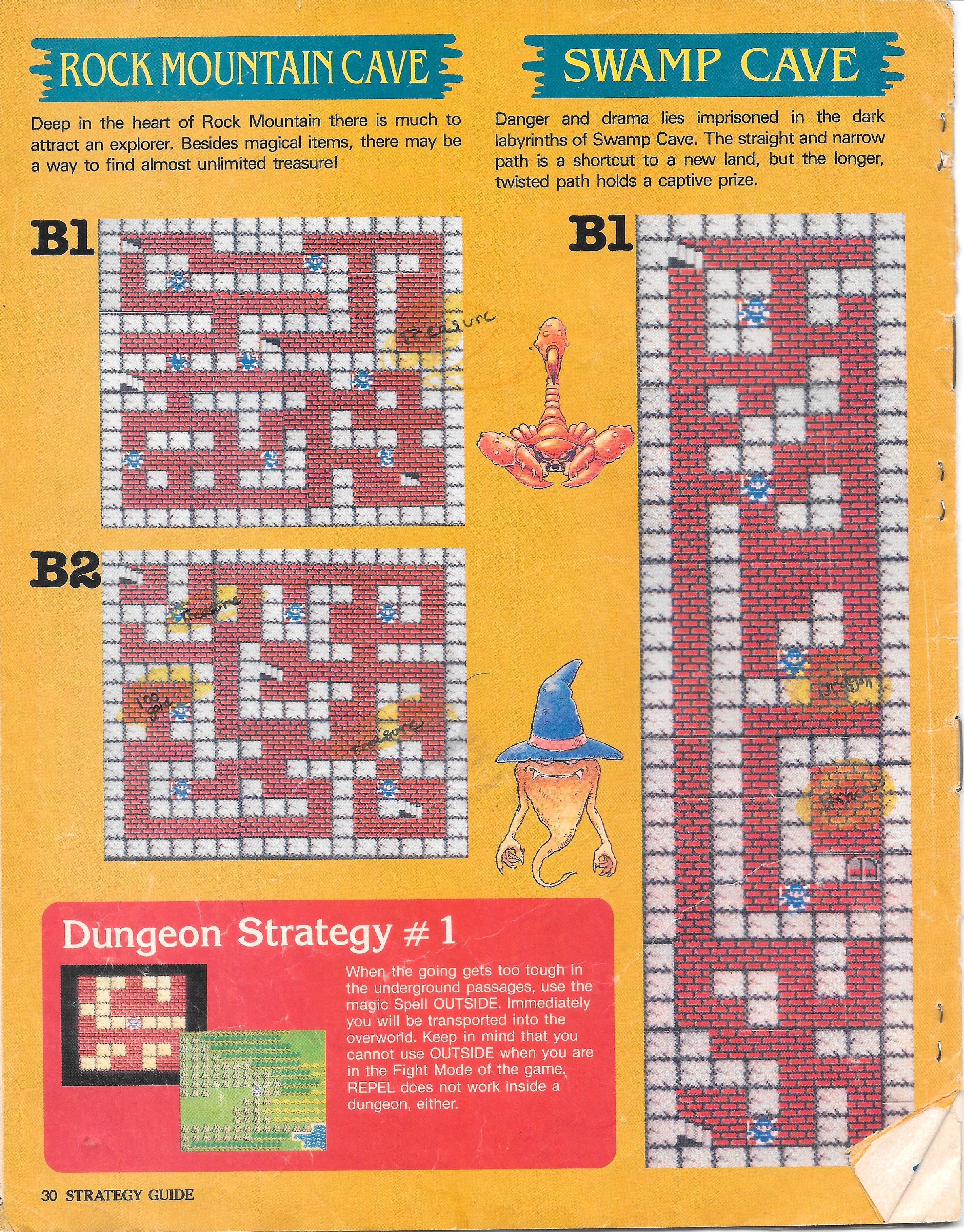
Nintendo Power published this guide to Dragon Warrior. You can see where I wrote down where to find treasure in the caves.
The same can be said for a couple of other things Nintendo Power published, such as their mini magazine insert about Dragon Warrior, the role-playing game that I know some of my friends found boring as hell, but I was obsessed with (along with its first sequel, and would have kept going in that series if I ever found III and IV but they were hard to come by). I marked that up with notes about where to find certain things or what direction to go in at certain points; I also saved one of the advice columns where someone wrote in to ask about the network of caves that would get you to the island where the final boss–The Dragon Lord–lived. And to their credit, Nintendo knew exactly what they had because eventually, they got into publishing player’s guides like The NES Game Atlas.
A book composed entirely of screenshots of each level from various games, the Game Atlas was a special book that you bought separately or came with a subscription renewal–which I’m pretty sure is how I got mine. It was printed to stand out as well, with a stiffer cover and size akin to what we’d eventually see in comic book trade paperbacks. The graphics on the page, while real, were microscopic and it took some real effort to actually see the images. I’m pretty sure I didn’t care, though, because this was a treasure trove, especailly for games like Zelda and Metroid.
Not that helped me win anything or get any further in a game, mind you.
I guess, though, that was the other appeal, because I was able to see later stages of Teenage Mutant Ninja Turtles that I never, ever saw due to dying in that damned underwater stage every time I played the game. Seriously, it was rage-inducing.
Anyway, the Game Atlas was the frist of a series of Players Guides of which Nintendo would publish three more before choosing a different format. The other three were Game Boy, Mario Mania, and Super NES. That last one is on our house and I’m pretty sure it’s because my wife owns a Super Nintendo. It is similar to the Game Atlas in that it does contain some maps, but it’s more like a set of fairly in-depth profiles of just about every SNES game available at the time. Nintendo was competing with Sega Genesis at the time.
Most of my Nintendo Power issues were thrown away years ago. I still have the one with Teenage Mutant Ninja Turtles on the cover as well as issue #41, which was Super Castlevania IV. I’m pretty sure the latter issue was toward the end of my subscription because they were covering NES games less and less. And that made sense considering that they would phase out the system by 1994. I never did own a Super Nintendo or a Game Boy, so I decided to drop my subscription and read Sports Illustrated.
But I get such a rush of nostalgia whenever I flip through one of these books or magazines. They are such an encapsulation of my early teen years.
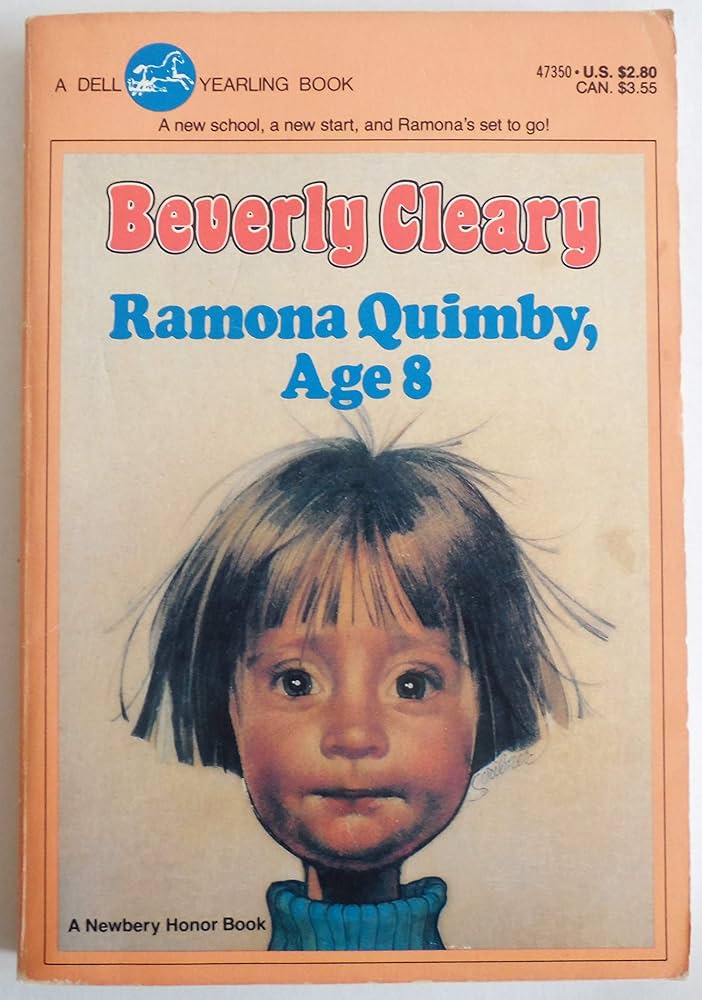
Ramona Quimby, Age 8. The paperback edition from the 1980s. That Dell Books border was a mainstay for kids’ paperbacks. Image from Amazon.
I have had so many discussions with Stella about the literature we read in our formative yearrs. While I realize that pointing out the difference in ages (she’s nine years younger than I am) is a running joke, it applies here because what was “Young Adult” literature was different for eachof us. I am sure that there was some overlap of titles we’d find on the Scholastic Book Club flyer, but I also can say that YA lit was at the beginning of its boom years when she was in middle and high school and barely existed when I was a tween (in fact, the word “tween” didn’t exist when I was a tween).
I realize that’s a bit of an exaggeration. There certainly were books aimed at a middle or junior high school audience, but the great ones were few and far between and I found my refuge in Star Trek, Star Wars, and Robotech novels as well as more adult works by Stephen King. But I didn’t get there right away because while I am sure that my fandom for a franchise like Star Wars would definitely motivate me to read at least one novel, something before all of that made me want to read.
Looking back, I always had books in my home. My parents had a good stack of novels and when I was little, I owned a ton of Golden Books and Curious George books. I can’t remember when I graduated from those to works that were more complicated, but I want to say that it probably started sometime in the first grade. I have done an entry about the McGraw-Hill readers and also have a memory of grabbing these Reader’s Digest collections in the back of Mrs. Hickman’s room and reading through them one by one. I cannot tell you what any of them were about, of course, but I did understand them, and by the time I was in the second grade, I (and a number of my friends) had children’s novels and textbooks to read or read to us.
But that, of course, is probably the case for so many of us, and there has to be some specific books that I can set apart from the rest as truly formative. And of course, I have a list.
My generation’s weekends always began with The Smurfs.
Or maybe it was The Snorks? The Shirt Tales? The Super Friends?
No matter what the show was, we all share a common memory of sitting in our parents’ TV room every Saturday morning watching cartoons. I’m not sure when this particular tradition started–children’s programming had been part of Saturday morning television since Captain Kangaroo and The Howdy Doody Show in the 1950s–and I knew that it died out in the Nineties and 2000s as cable networks started becoming the place to go for endless hours of cartoons. But Generation X can lay a significant claim to sitting ont he floor in your PJs–possibly while eating some sugary cereal–and watching nearly four hours of cartoons. I mean, they’re such a part of our childhood that we remember even the more random ones that didn’t have a toy line, like Camp Candy or Kidd Video.
But when I think about my Saturday mornings, the often began a little earlier that 8:00. Sometimes by a couple of hours.
Maybe it’s just me because I have never been able to sleep in on Saturdays (well, with the exception of when I was in high school and college), so for much of my childhood, I would be up way before the ffirst cartoon started and because nobody else was awake, I had to fend for myself. Sometimes, that meant making myself breakfast or cleaning my room (for some strange reason I remember emptying out my dresser, folding all my clothes, and then putting everything back). Sometimes, I played with my toys. Very often, though, there was television.
Look at Wikipedia’s listings for daytime television int eh 1980s, and pre-cartoon Saturday mornings are listed as “local programming.” I didn’t have the luxury of cable as a kid, so I made do with seven channels: the three networks, WNEW (which would become WYNW, the Fox affiliate), WWOR 9, WPIX 11, and PBS (WNET 13). WPIX was usually the best bet for early morning cartoons because they’d run shows that had falled out of their afternoon lineups, so you’d catch Voltron or later seasons of Transformers a couple of years after they’d faded away. On the networks, though, the programming was completely random.
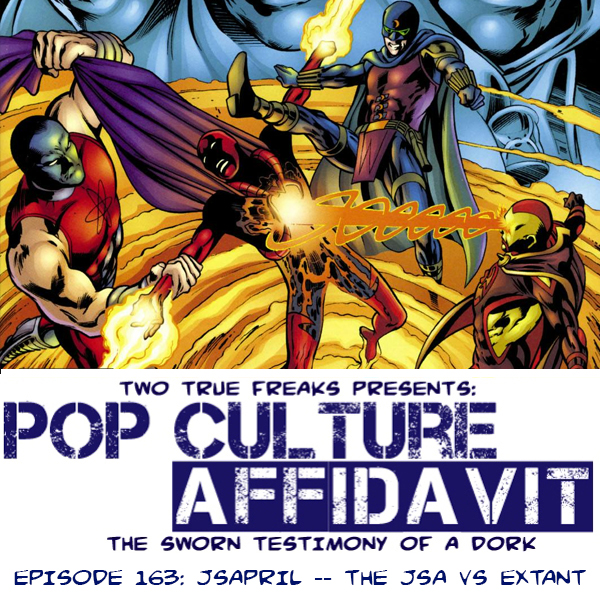
It’s JSApril! All this month, comics podcasts and blogs are celebrating the original super-hero team, the Justice Society of America. For this episode, I’ll be talking about one of the JSA’s darkest hours, their battle with Extant in Zero Hour, followed by their re-match/redemption in “The Hunt for Extant”. I’ll also talk about Extant’s origins and the Impulse One-Shot “Bart Saves the Universe.”
For more JSApril content, look for #JSApril on social media or check out JSApril: Celebrating 85 Years of the JSA at the Fire and Water Podcast Network.
Note: I have a new Apple Podcasts feed and am on Spotify! Just search for Pop Culture Affidavit!
And for more JSApril, look for #JSApril on social media and check out this list of all of the contributors to JSApril, and thanks to The Fire and Water Podcast Network for putting all of this together!
When Brett was little–and I mean preschool-aged–they used to think that seasonal graphics on the weather report were the most hilarious things ever. The winter forecast had a snowman. Thanksgiving had a turkey. And Christmas, of couse, had a tree.
It doesn’t take much to keep a four-year-old entertained, but it made me think of when I was younger and I used to look for the same thing when I was watching the local news. I wasn’t a news junkie or anything when I was in elementary school, but for some reason I came to know who all of the personalities were, especially the sports and weather guys.
The other thing I always loved seeing were the holiday bumpers. If I happened to be watching television on Thanksgiving Day, there would be a “Happy Thanksgiving from all of us at channel 5” message at some point during a commercial break. The same could be said for Christmas and New Year’s. It got to the point where I was such a dork that I looked forward to seeing them every year.
I haven’t been watching television on the holidays in recent years, although I do see them from time to time. So, in the spirit of the season, I thought I’d look at a few that I found on YouTube. They’re all from the New York area, which is where I grew up.
The first is from WNBC 4 in 1977. Obviously, I never saw this when it aired because it’s from the year I was born. But in itself, it’s an interesting relic of television past–the quick bumper for a show that will be on later in the week. There are still some iterations of this around, but they usually have to do with local news shows and not locally programmed specials. I guess it’s also a fun fact to point out that up until I think about the mid-1990s, the Rockefeller Center Tree lighting was a half-hour show that wasn’t cheaply produced per se, but didn’t have the “network special” aspect it does these days. Plus, the feel of this–a still and a muffled narration due to 1977 television quality–has the feel of staying up past your bedtime.
Next up is WPIX 11 from 1984. I’m nto sure when this was first recorded because I found it on YouTube in several places, all with different years listed. I’m not surprised that it appeared several times over the years; WPIX was one of those stations that recycled stuff like this -and would re-air stuff from the Eighties way into the Nineties. What makes this interesting to me are three things: its length (it’s nearly four minutes long), the overtly religious content, and the fact that the guy speaking at us is the general manager of the station. Who these days–or at any time, really–knows who the heck the general manager of a television station is? I mean, for a second, I thought this was the PathMark guy.
Anyway, I wonder if this would even fly today. Because aside from the message, who is going to devote this much time–this much ad space–to something like this?
This one, from WNYW Fox 5 in 1998, is an example of a type of promo I’d see frequently–the idea that the people on the local news were a kind of family (and maybe by extension your family?). Like I said at the top of the post, I developed a knack early on for recognizing the people who were on television, and over the years I remember noticing when someone on one station moved to the other or even moved up to the network, like Al Roker or Sam Champion.
I live in a much smaller market these days and for a long time, the familiarity of the people on the news is still a valued commodity. I don’t know for how long, though, especially since local news stations keep getting bought out and staff is being reduced (my local weekend news has completely disappeared, for example). While I’m not going to flip a table if the weather guy changes again (because they change all the time), promos like this are nice in an age where the news seems less and less friendly.
And finally, there is the WNBC Sing-Along.
WNBC — 4 New York — is the New York City area’s undisputed champion of station promos. There’s more to write about at a later time, but right now is the time to look at one that’s been a tradition for a very long time. Granted, I have not watched television in New York in a few years, so I can’t tell you if that’s true, but I know that well into the 2010s, the entire WNBC staff would gather outside of 30 Rockefeller Center (which is where the station broadcasts from) and sing Christmas carols. The promo would air in 30-second and one-minute forms and would be just another commercial in a commercial break. And me being the dork that I am, would always look to see who I could name whenever it came on. This one’s from 1994 when I would have been a senior in high school.
Seeing this and all the reast always meant that Christmas break was coming and for a little more than a week, I’d be able to turn school off and enjoy a lot less structure in my day. Thinking about them now helps me recapture that feeling as I leave work behind and try to have a happy holiday season.
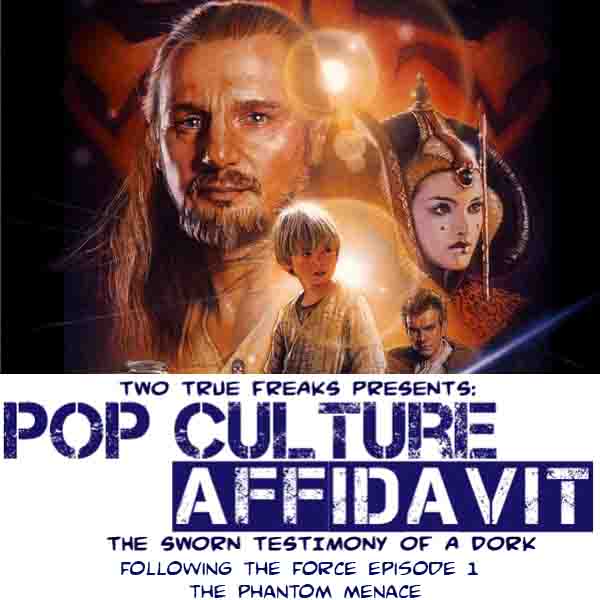
Beginning a new feature! I’m setting down a path that may or may not dominate my destiny: working my way through Star Wars. With this episode, I begin a reading and watching project that will cover the entire nine-movie Star Wars cycle plus television shows and spin-off films. First up are three novels that lead into Episode I and the film itself, The Phantom Menace.
Works included in this episode are Master and Apprentice by Claudia Gray; Cloak of Deception by James Luceno; Darth Maul: Shadow Hunter by Michael Reaves; and The Phantom Menace as a film, novel (by Terry Brooks), and comic book, including the 25th anniversary one-shot published by Marvel.
So if you’ve been watching enough of the Paris Olympics, you’ve seen enough footage of Parisian life and culture and you’ve inevitably heard the “Can-Can.” I think it was used in the opening ceremonies, in fact. And we’re all familiar with it, right? We can even picture the dancers from a place like the Moulin Rouge doing their high kicks to the song. Well, unless you’re like me and every time you hear the tune, you hear: “Now, Shop Rite does the can can selling lots of brands of everything in … cans cans.”
Yes, I realize that I have a problem. But really, when you think of it, we all have commercials that get stuck in our heands, and I even talked about some of my most memorable ones back on episode 97 of the podcast. And on that episode, with the exception of Crazy Eddie and a Roy Rogers commercial, most of the commercials I talked about in that episode were for national brands. When it comes to this Shop Rite commercial, people in maybe five states in the Northeast/Mid-Atlantic part of the country are going to recognize that jingle, just like we also recognize character actor James Karen as “The PathMark guy”:
Again, who gets that except for people in the NY-NJ-CT Tri-State area?
In Reality Bites, Winona Ryder and Ben Stiller are on their first date and she tells him that hte Big Gulp is “the most profound, important invention of my lifetime.” They hook up after that and the plot follows its trajectory of a twentysomething coming-of-age romantic comedy, but the line stands out as one of the many witty pop culture observations that are simultaneously the film’s greatest strength and biggest weakness. Okay, maybe I’m just using the word weakness just so show contrast, but I will say that there are moments in the movie where the catchphrases and allusions work and other timeswhere they wind up feeling ham-handed and forced. The Big Gulp line could have been the latter if in the hands of someone other than Winona Ryder, but she’s being silly and flirting in that moment, which makes Ben Stiller melt (and I admit, me too). Besides, we all know that there is no way, with all of the technological innovation we have achieved since the end of the Second World War, that the Big Gulp of all things could possibly be that important.
Or could it?
7-Eleven has kind of always innovated when it comes to the convenience store, and especially when it comes to drinks. For instance, they invented the coffee to go cup in 1964 (although the iconic Greek Diner coffee cup debuted around the same time, so I guess you can make a case for either being first). What became the Big Gulp debuted in 1976, as according to Smithsonian magazine, 7-Eleven came out with a 32-ounce drink that was circular on the bottom and had a square top “like a milk carton” (the magazine’s authors and editors could not find an image of it and sadly neither could I). The cup was created at the requrest of Coca-Cola, who was looking for a way to shift more product, since back in the 1970s, they were still selling their drink in glass bottles that went for 50 cents and included a “deposit,” meaning you’d get money back upon returning the bottle. 7-Eleven sold the 32 ounce up at the price of 39 cents and advertised no deposit, and it was an immediate hit. When the cup’s manufacturer could not continue to produce it for a little while because they were moving their manufacturing to Canada and had to take a hiatus in operation, Dennis Potts–who was in charge o fthe product at 7-Eleven–commissioned a new design and the Big Gulp as we know it came to be.
Sometime in the Nineties, before the Lifetime Network took complete ownership of suspenseful TV movies, the networks–especially NBC–ran a slew of them and several were aimed at teens. They’d had success during the late 1980s with a bunch of kids/teen TV movies, such as Crash Course and Dance Til Dawn, but I would imagine that the shift to drama happened because of the popularity of teen television drama in the first half of the decade. The biggest things on television for adolescents were MTV’s The Real World and Fox’s Beverly Hills 90210, both of which provided enough drama (and in the case of the latter, soapy drama) that the network probably thought they could pull an audience.
I’ve seen bits and pieces of a number of these movies over the years, many of which star Tori Spelling, but also featured actresses like Tiffani-Amber Theissen, Kellie Martin and Candace Cameron and had titles like The Face on the Milk Carton or Mother, May I Sleep With Danger? In the fall of 1996, they put another one out, Lying Eyes, although this one stars Cassidy Rae, who at that point was probably best known for a recurring role on Melrose Place as well as its spin-off Models, Inc. She plays a high school senior named Amy who gets involved in an affair with a much older guy and then someone starts stalking her and …
… I honestly have no idea why, but I have not only seen this movie three times (once for the sake of this blog post and twice prior), but it’s stuck with me ever since it first aired nearly thirty years ago. I’ll try to get to that after I run through the plot.




 Pop Culture Affidavit