It’s the end of 2019, so I think that every publication has been doing some sort of “End of the Decade” or “Best of the Decade” article during the last few weeks. Even some of my friends have been making lists of their favorite pieces of popular culture from the past decade. Meanwhile, I and a number of people who have settled into oncoming middle age have been legitimately surprised that we are on the precipice of another ten-year period. I mean, I am able to do the math, but it still feels like 1999 was ten years ago.
Anyway, rather than lament that I pretty much missed an entire decade because I was adulting or becoming more lame or something of that nature, I thought I would try and remember what it was like to ring in 1990, which was the first time I remember a new decade coming into being (I had been all of two years old when 1979 became 1980, so I don’t remember any of that). At the time, I was twelve and in junior high school, so I probably didn’t do much in terms of actual celebrating during New Year’s Eve. More than likely, I spent the evening at my grandmother’s while my parents went to their friends’ party, and at some point or another I listened to all 106 songs of 106.1 WBLI’s end-of-the-year countdown. I may have even made a list–I was really into cataloguing stuff like that back then. So the memories, at best, are spotty.
I remember feeling that 1990 was going to be a big year. It’s probably because the dawn of the Nineties coincided with my transition to junior high school and teenagedom, and when you have one foot in childhood and another foot in the quasi-adult world, everything can feel like some sort of benchmark or milestone. I was also watching way too much TV back then and there that feeling of the next decade being some how markedly different was a pretty common message.
I wish I would have been able to find articles, shows, features, or even commercials that reflected this, but the prepositional phrase that seemed to permeate so much of what I read, saw, and heard, was “…of the ’90s.” Even in 1989, it was code for less frivolity and more substance in your life. Granted, that would become a pretty harsh reality for a number of people within seven months of the new year when the recession that would last until 1992 took hold, but we were more or less being told that we had to take things more seriously.

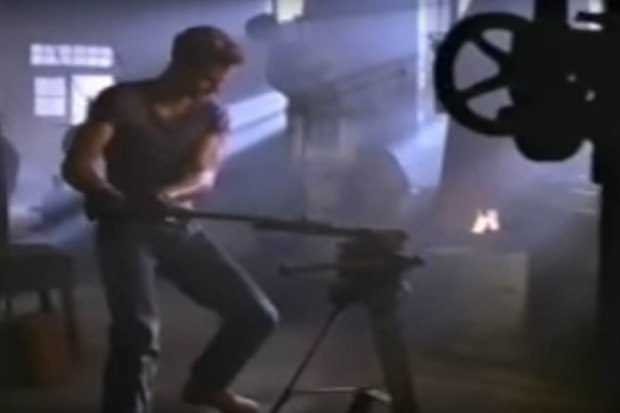
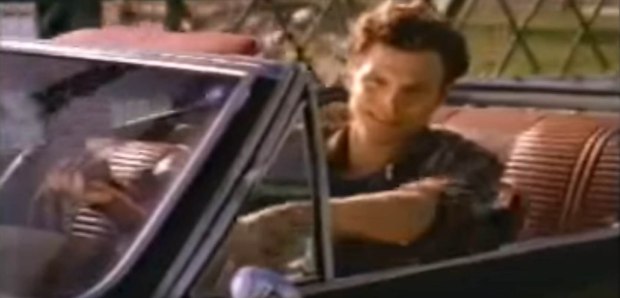
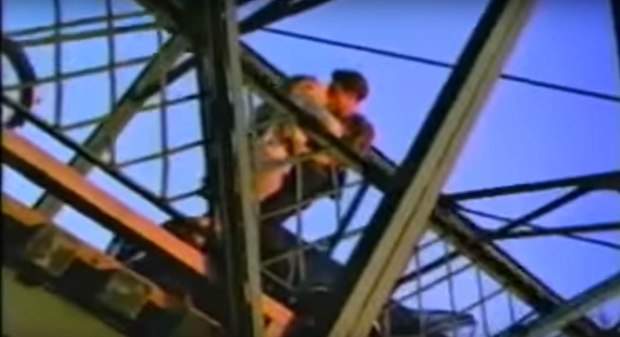
An image from the “Foreclose on a Yuppie Contest” promo where the cool guy in the leather jacket and jeans gets the douchebag yuppie’s money.
MTV, which had latched onto and helped define youth culture throughout the Eighties, even got in on this, sponsoring a contest called “Foreclose on a Yuppie”, which had a decidedly non-yuppie-looking guy getting into the apartment of a typical ’80s douchebag and taking all of his stuff, then making the douchebag yuppie his butler. The prize was $50,000 and a BMW.* But nothing is that simple, especially considering that throughout late 1989, MTV was still airing NKOTB and hair metal in heavy rotation and they gave more exposure to lighter, poppier rap/hip-hop acts like Ton Loc and Young MC than harder-edged stuff. In fact, as the Eighties closed, we still hadn’t seen MC Hammer and Vanilla Ice release their biggest singles.
But MTV would make sure it was showcasing the ‘now” as much as possible as 1989 ended by airing The Dawn of the Decade House Party at the Palladium in New York City. Airing live on December 31, 1989 (naturally), it used a setting familiar to viewers, as the Palladium was where the station’s daily dance show, Club MTV, was filmed; and the channel’s veejays and hosts at the time were the emcees. These included Club MTV host and all-around late-1980s MTV icon Downtown JUlie Brown, Remote Control host Ken Ober, veejay Kevin Seal, veejay and Headbanger’s Ball host Adam Curry, Yo! MTV Raps host Fab 5 Freddy, and MTV’s Half Hour Comedy Hour host Mario Joyner.
 I only know of this show’s existence thanks to YouTube, where someone uploaded the entire special, including commercials, and my train of thought was, “Oh wow, I can see how people rang in the Nineties and it’ll be this great time capsule of the era and it’ll be so different than what I’m used to seeing on New Year’s Eve!”
Well, part of that is true because what you get in this house party is basically a two-hour special that is New Year’s Rockin’ Eve with just the performances and no Times Square ball drop. Now, I’m sure that there are people who absolutely love NYRE and crack up at the antics of Jenny McCarthy’s street-level interviews and dance in their living rooms to yet another performance from Pitbull or the Black-Eyed Peas, but in recent years, I’ve found that this is something you endure until midnight rather than look forward to. MTV’s Dawn of the Decade House Party wasn’t much of an upgrade, either.
On paper, it looks way more appealing than ABC’s programming. Excepting Clark, who was live in New York, NYRE ’90’s pre-taped Hollywood segments were hosted by Kirk Cameron and Lori Loughlin and featured performances by Michael Damian, Martika, Expose, and Dion**. MTV had the B-52’s, Young MC, Richard Marx, Neneh Cherry, Living Colour, and Lenny Kravitz, so they definitely had the edge when it came to cool. Granted, I’m not the best arbiter of cool, but I would take Living Colour belting out “Cult of Personality” rather than Michael Damian’s cover of “Rock On.” The show also ran through the top five videos of the year, which the show prior had led into with the other 95 videos of the year, so while we didn’t get to see Madonna perform, we got to see some of her video for “Like a Prayer”.***
So, considering the show was basically a “cooler” version of NYRE, would it have been worthwhile alternative programming? Assuming it was aired live, if you were actually in the audience, I think that it would have been something to brag about, if your friends cared about those things. Being twelve at the time and not having access to the channel (or such parties), MTV had the allure of looking in on the cooler older kids. I never emulated them by getting into the blazer with turtlenecks and Cavariccis or the huge cardigan with a turtleneck and Cavariccis or the sweater vest with a turtleneck and Cavariccis, though.
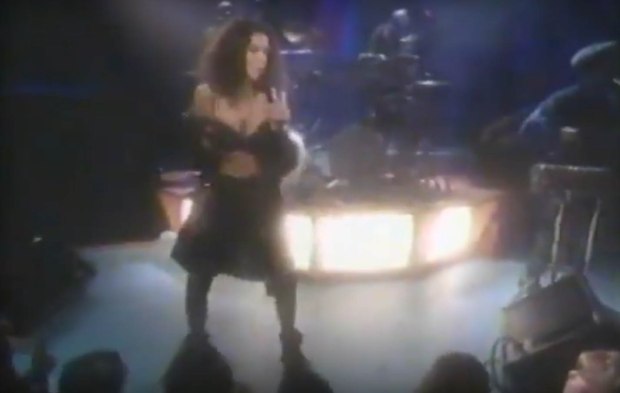
Neneh Cherry performs “Buffalo Stance.” Her outfit consisted of a Han Solo on Hoth parka over a bra. I don’t know how comfortable that would have been considering the club was probably pretty hot.
Anyway, the hosts do a capable job for the show’s two hours and probably did some partying themselves****, and the acts feel very “in the moment” of that time. The B-52’s are in the prime spot, on the stage for the countdown to midnight and then ringing in 1990 with a New Year’s version of The Beatles’ “Happy Birthday” followed by “Love Shack,” a song I keep telling myself that I don’t like but then sing along to whenever I hear it. Young MC does “Bust a Move”, of course, and all I the highlight of Neneh Cherry’s performance is that she was singing to a tape (as has been and is still done on TV) and kept singing after the tape ended. Even though the rock acts–Marx and Living Colour–give some really solid performances–it all seems so normal for a channel that prided itself on smacking down those norms*****.
This wound up being the general problem that MTV would have for the next couple of years as it tried to find its footing in the early 1990s. Throughout the show, there are advertisements for something called “MTV Part 2: A New Beginning”, which isn’t a show or a channel as much as M2/MTV 2, but a slate of programming that would include Unplugged and Liquid Television. And I only know this based on the short clips in the ads along with thirty years of hindsight. I’m not sure if I would have found any of it enticing back then, because anything called “… Part 2” sounded like it was not going to be worth the price of admission.
New year, new decade, new block of programming. Part 2: A New Beginning doesn’t sound very promising.
The decade would take a little while to become “The Nineties”, and we’d have an Eighties hangover for a couple of years. Even so, there is such a difference between the early and later parts of the decade that it is hard to define in simple ways. The people who put together MTV’s show at the Palladium weren’t thinking about any of this and were probably just looking to throw a cool party that hopefully skimmed some of the ratings off of Dick Clark’s stalwart of a show. But they inadvertently provided us with a snapshot of the decade-to-decade transition we were about to go through. Lenny Kravitz closes the show. This was a few years before “Are You Gonna Go My Way”, so his closing slot was the dead one–most people watching the show had probably already gone to bed. He finishes his set with “Let Love Rule”, a song that has its roots in the Sixties but with its stripped down aesthetic is less slick than Whitesnake or Motley Crue. Of all the songs I heard and all the moments I saw, this last one felt the most Nineties.
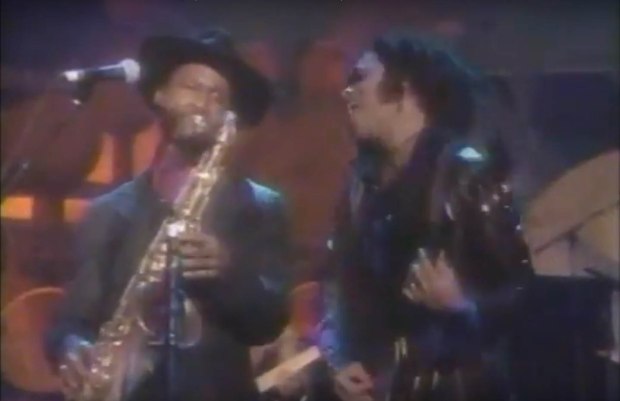
This embodies “transitional.” The saxophone is very 1980s while Kravitz would go on to be one of the biggest mainstream rock acts of the 1990s.
* In a look back at crazy MTV contests of the 1980s, Rolling Stone said that according to the Chicago Tribune, the winner of the contest, 23-year-old John Rogers, crashed the BMW and his resulting partial paralysis led to him spending most of the cash winnings on medical expenses.
**Yes, as in 1950s frontman of The Belmonts. According to Wikipedia, he had a comeback album in 1989 that was well-received.
*** The clips were cut to make room for the live show, so we got a little bit of each. The other four, starting from the bottom, were “Won’t Back Down” by Tom Petty, “Straight Up” by Paula Abdul, “Cult of Personality” by Living Colour, and “She Drives Me Crazy” by Fine Young Cannibals.
****The look on Adam Curry’s face is that of a designated driver, or at least someone who had to stay sober enough to be the last veejay standing around 1:00 a.m. when he announced Lenny Kravitz.
*****Marx finished his set with “Edge of a Broken Heart”, which was a hit by all-woman heavy metal group Vixen. I then did some googling and learned that he wrote the song for them in the late 1980s.
 It’s the most self-indulgent, ultra-sized episode of Pop Culture Affidavit EVER!!!
 It’s the second of two “milestone year” episodes as Amanda sits down with me once again for a talk about 1999!
 They’re the 30-second segments you fast-forwarded through, ignored, or used for a bathroom break, but when you think about it, you know them better than you realize. They are commercials. In this episode, I talk about advertising and commercials that I remember, both fondly and not so fondly. I begin by going over what makes a good and a bad commercial and then make my way through a bunch of commercials that I can’t get out of my head. From cereal to fast food to toys to local car dealerships, it’s so much advertising that it’s … INSANE!
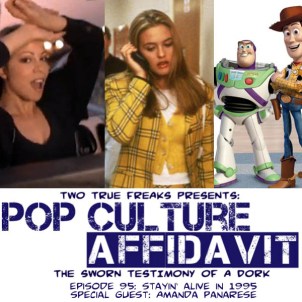 It’s the first of two “milestone year” episodes where Amanda and I sit down and take a pretty thorough look at what was going on in a particular year of the 1990s. First up, 1995. Join us as we talk about where we were in our lives in ’95 and then run through the television shows, movies, and music of that year.
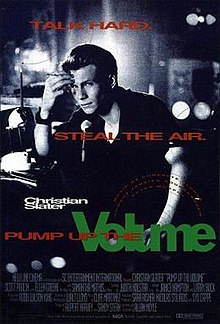

 Those are the first lines of the second verse of “Right Here, Right Now”, a song by Jesus Jones that hit number two on the Billboard Hot 100 (and topped the alternative chart) in late July 1991. Written about a year earlier, it is an optimistic song that celebrates what lead singer Mike Edwards describes as “watching the world wake up from history.” Even though the song is approaching its thirtieth anniversary, it still gets some airplay, especially on alternative radio stations that cater to the aging teenagers of the Nineties.
 In what is now an annual Pop Culture Affidavit tradition, it’s time for us to celebrate Festivus, the holiday that is for the rest of us! This year, I’m joined for the airing of grievances and the feats of strength by The Irredeemable Shag. We complain about fandom and other things that irritate us and then follow that up by looking at War Dancer #4, which was published in 1994 by Defiant Comics.