movies

Bottom of the Inning: Taking Baseball Personally (Baseball, Part Two)

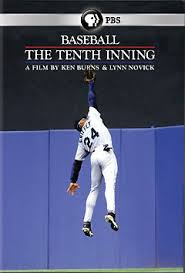
Baseball 10thIn my last post, I mentioned that watching all of Baseball made me feel like I was in an introductory, or “101” class on the game.  As well-researched and well-crafted as Ken Burns’s documentary was, there were times where I felt like I was getting the history textbook version of the baseball story:  hit the high points, go selectively in-depth, and completely skip over quite a bit.

While that’s a valid criticism, leaving it at that would be giving the work short shrift, especially since it’s a full day’s worth of a documentary.  Furthermore, I spent much of that first part of my look at Baseball on summary and critique and didn’t give much of my personal “story” as it is, or at least my personal reactions while I was watching it.  Which is kind of the whole purpose of this blog, right?

So that’s what I’m going to do.  Inning by inning.

First Inning (“Our Game” 1850s-1900):  This isn’t Baseball, this is seventh grade social studies with Mr. Kerkhof.  We’re talking about the Antebellum period and …  man, the 1800s are boring.  But this?  This isn’t so much because it’s an origin story, the kind I’m fixated on whenever we begin looking at an important event.  What were the first shots fired in the Revolutionary War and how did it progress from there?  Who actually founded the Roman Empire?  When did the  Middle Ages officially begin?  Who played that first game of baseball and what was it like in what seems like the Dark Ages to me–before Ruth, Gehrig, Mays, Mantle, and every other name I know?

Second Inning (“Something Like a War” 1900-1910):  I’m ten years old and my parents have given me a “Baseball’s All-Time Greats” baseball card set, the one I spotted in the Sears catalogue.  There’s Ty Cobb, and there’s Honus Wagner, who has the most expensive baseball card in existence, something I learned on a feature I saw on 20/20 the previous year.  I begin looking at the all-time stats for the old players and am amazed and even though many of their records have been broken, they still are in the top five for many of their most notable categories.  The card set is worth original retail price (and even today it’s not worth much), but what it lacks in monetary value it more than makes up for in facts.

Third Inning (“The Faith of Fifty Million People” 1910-1920):  To me, it’s not the Black Sox scandal; it’s Eight Men Out and Field of Dreams.  It’s “Say it ain’t so, Joe,” and the last scene of that softball episode of Married … With Children that parodies the last scene of Eight Men Out.  It’s also the idea that even something as pure as a game I play on Saturday mornings in Little League can be corrupted by outside influences (yunno, beyond the opposing team’s coach being friends with the umpire).

Fourth Inning (“A National Heirloom” 1920-1930):  I’m in the fifth grade and we’re asked to take a biography out of the library for our latest book report/conference with the teacher.  I grab one about Babe Ruth.  He competes with Gehrig.  He is supposedly “stranger than fiction,” which is what one of the chapter titles says.  Despite my being an excellent reader, I have trouble getting through the entire book.  I don’t know if it’s because the book’s badly written or because I don’t find the subject matter as interesting as I thought I would.  In fact, I can’t remember if I ever finished that book.  I do know that when I had my conference with Mr. Schafer about it, I did fine.

Fifth Inning (“Shadow Ball” 1930-1940):  I have no personal context for this.  In fact, if there is any episode that I found myself glued to, it’s this one.  Growing up, my knowledge of the struggle of African-Americans was limited to slavery, Plessy v. Ferguson, Brown v. Board of Education, and Martin Luther King Jr.  I was not exactly a scholar.  I knew the Negro Leagues existed but I don’t think that what little I read about them in books clued me in to what extent.  If anything, I’m grateful for what I gained from this episode.

Sixth Inning (“The National Pastime” 1940-1950):  It’s 2012 and I’m in a used bookstore on the Downtown Mall.  I’m looking for a copy of As You Like It but am also perusing the small graphic novel section.  On my way to the counter, I pass sports and Roger Kahn’s The Boys of Summer.  It sits on my shelf until the start of the 2013 season rolls around.  While Kahn’s biographical retelling of his time becoming a sportswriter is interesting, it’s his visits with former Dodger greats and the retelling of Jackie Robinson’s history that pulls me in.  For years, I knew three things about Robinson:  he played for the Dodgers, he broke the color barrier, and he stole home once in the World Series.  This tells me so much more.

Seventh Inning (“The Capital of Baseball” 1950-1960): I’m twelve years old and my family is throwing one of those big barbecues where everyone–from my mom’s side and dad’s side–is there.  My Uncle Brian, a die-hard Yankees fan, spends a good hour talking to Grandpa Panarese about baseball in the 1950’s.  They talk about the Yankees, the Giants, and the Dodgers.  I don’t interject; I just listen.  It’s one of the best memories I have of these two men and one of the most informative conversations upon which I ever eavesdrop.

Eighth Inning (“A Whole New Ballgame” 1960-1970):  To me, this is where baseball begins; specifically, in 1962, when the New York Mets go 40-120 and set an all-time single-season loss record that still stands.  I cut my baseball history teeth on An Amazin’ Era in 1986 and to me, “baseball history” has always involved Seaver, Koosman, Swoboda, Clendenon, Agee, Grote, Garrett, and McGraw.  Yes, there are more important figures in baseball history and more important events.  But it’s the lovable losers’ transformation into the Miracle Mets that I always remember.

Ninth Inning (“Home” 1970-1993):  It’s fascinating to see Bob Costas tell the story of being in the Red Sox locker room during the Buckner play and watching the champagne get wheeled out as quickly as possible.  It’s also fascinating to see testimony from Red Sox fans who were wounded by the play.  After all, I rooted for “the enemy” in 1986.  My nine-year-old dreams came true when Jesse Orosco threw the last pitch to Marty Barrett (I have a poster on the wall of my classroom), so it never occurred to me that someone might be upset by that night’s events.  Beyond that, there are so many recognizable faces here and I wish he was taking more time on them; I wish he was reminiscing with me the way he was reminiscing with my parents through the seventh inning.

When it ends with a talk about how baseball endures I realize that this isn’t a documentary; it’s a eulogy.  The season was cancelled due to a strike the month before the first episode aired and it doesn’t seem like we’ll get the game back.  Furthermore, it’s hard to pick a side because everyone seems greedy; everyone seems like a villain.  And here, at the funeral, we’re all trying to remember why we came.

Tenth Inning (1994-2010):  I was there.  I remember that.  I watched that.

I will never tire of watching Barry Bonds fail to throw out Sid Bream.  I always loved how much fun Ken Griffey Jr. seemed to be having–and always wished I had that swing.  I was cheering for McGwire the whole time and have to admit I was disappointed when the PED charges came to light.  I never cheered for Bonds unless he struck out looking.  I want to buy Steve Bartman a beer and talk baseball with the guy–not that game, just baseball.  No, the 2004 ALCS is not overrated and yes, I’ll watch the Yankees choke like that any time, day or night.  My heart was in my throat when Endy Chavez made that catch, only to have the Cardinals rip it out and crush it a few innings later.  You’re really using that Springsteen song, Ken?  Don’t you realize it’s about looking back and realizing how middle-aged you are?

“But then time slips away and leaves you with nothing mister but boring stories of glory days.”

You know what?  That’s exactly what this is, isn’t it?  Good job, sir.

Pop Culture Affidavit Episode 25 — Thirty Years of Neo Maxi Zoom Dweebies

Episode 25 Cover“Dear Mr. Vernon …”  On March 24, 1984, five students sat through detention in the Shermer High School library.  Now, I take a look at my favorite movie of all time, The Breakfast Club.  I break down the movie’s plot and give my review, sharing what makes it so special.

You can listen here:

iTunes:  Pop Culture Affidavit

Direct Download 

Pop Culture Affidavit podcast page

In the episode, I mention a piece I wrote and posted last year about my changing feelings about Mr. Vernon.  Here it is:  Sympathy for Richard Vernon

Pop Culture Affidavit Episode 24 — A Comedy About Love in the ’90s

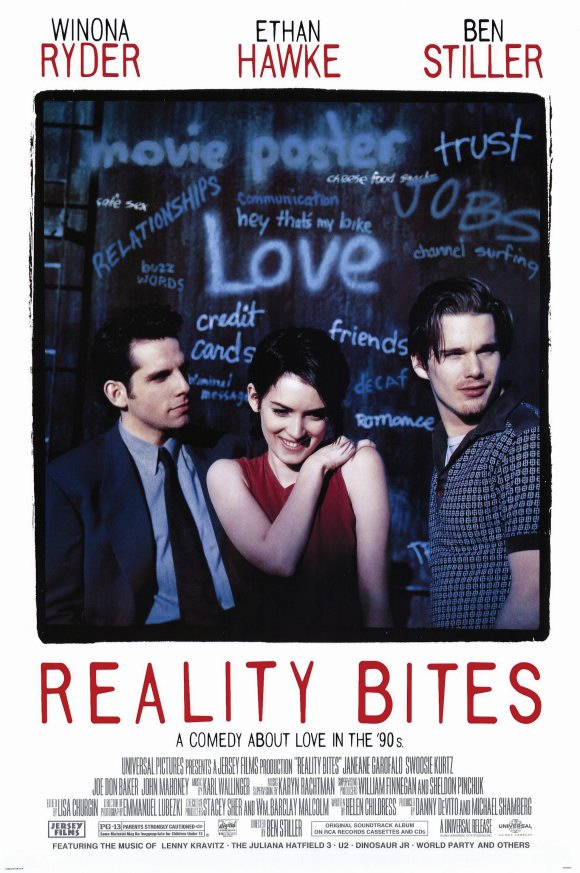
Episode 24 Cover1994: The Most Important Year of the Nineties continues with one of the most Nineties of Nineties movies, Reality Bites.  I take a look at the Winona Ryder/Ben Stiller/Ethan Hawke classic and also talk about its place in popular culture as well as talk about why it failed at the box office as did so many other attempts ot market to “Generation X.”

You can listen here:

iTunes:  Pop Culture Affidavit

Direct Download 

Pop Culture Affidavit podcast page

Here are some links to some recent pieces about the movie …

20 Years Later: An Oral History of Reality Bites

Hit Fix interviews the principal players from the movie’s cast and production and they talk about what it was like to make it in 1993-1994.

I Watched Reality Bites and it’s Bascially a Manual for Shitheads

A very funny Jezebel piece that waxes nostalgic about the film … with some perspective.

Reality Bites PosterHere’s also a link to two previous posts about the movie …

Generation X Is …

This post, actually my first column from my high school newspaper in the fall of 1994, is my seventeen-year-old self trying to make sense of my generation, especially after I watched Reality Bites on video.

Being Michael Grates

In this post, I take a look at Reality Bites nearly two decades later and discover how much I identify with Ben Stiller’s character, Michael Grates, the yuppie In Your Face TV executive who competes with Troy Dyer’s (Ethan Hawke) for Lelaina’s (Winona Ryder) affection.

Alllllllllllllrighty Then!

It’s not that I’m trying to figure out what made Jim Carrey funny in the mid-1990s, it’s just that in thinking about what was funny in the mid-1990s, I sometimes amazed that he was so huge.

Maybe I should rephrase that, or at least explain what the heck I’m talking about because that introduction is poor and it looks like I’m starting in the middle of things.  Next week’s post will be an episode of the podcast about Reality Bites, the Winona Ryder film about life after graduation.  It’s one of those films that has become … well, I don’t want to say seminal because that would be giving it too much credit, but it definitely is one of those films that stuck with much of my generation.  More on why next week, but I bring it up because around the same time that Reality Bites hit theaters, so did Ace Ventura: Pet Detective.  This film is up there with movies like Billy Madison or Dude, Where’s My Car? or Paul Blart: Mall Cop.  You look at them and say, “This is going to be ridiculous.”  In essence, you are right, but the ridiculousness of the movie is what nets them tens or even hundreds of millions of dollars at the box office.

Such were Jim Carrey movies in the mid-1990s, especially in 1994.  The man, who up until that point had been best known for being the white guy on In Living Color (and well, one day I’ll get to Doing Time on Maple Drive) starred in the aforementioned Ace Ventura flick as well as The Mask and Dumb and Dumber, each one of which was an enormous hit and rocketed him to superstardom.  I remember that I enjoyed two out of the three of them (I actually have never seen The Mask) because they are, at their core, pretty funny.  But as life went on and I got older, I remember that Carrey’s movies, at least to me, didn’t hold up the way that Caddyshack or Airplane! do.  So what is it?  Has my sense of humor faded or my heart shriveled up and died?  I’m not sure.

Let’s do a quick test and look at this scene from Ace Ventura: Pet Detective …

And this one from Dumb and Dumber … 

Now, at a glance this stuff is funny.  Carrey’s got one of those faces that looks ridiculous to begin with, so he’s not afraid to just act silly and really let loose.  And in both scenes, the director just lets him do his schtick.  But at the same time, even two watchings of either scene gets annoying after a little while–and this is coming from someone who can watch Chris Farley do the “I killed my sale” scene in Tommy Boy multiple times and thinks that never gets old.

I think perhaps it’s that these scenes are the type of stuff that your annoying younger brother or cousin would find hilarious and repeat over and over and over and over.  The tutu bit in the lobby with instant replay goes on way too long and is the type of thing that your hyperactive cousin would repeat out of nowhere in the middle of a conversation.

But hey, maybe that’s what we needed in the mid-1990s.  There’s a sense that maybe, after a few years of a crappy economy and serious “message” movies winning Oscars, audiences wanted something totally ridiculous and didn’t want to have to think when they went to the theater.  After all, the highest grossing film of the year was Forrest Gump, a feel-good nostalgia-fest and within the next few years we’d have Toy StoryBatman Forever, Independence Day, and Armageddon make huge amounts of money–not exactly thinking man’s movies.

But like I said, I just can’t find them funny anymore (and hey, maybe it’s just because I’m cranky), even though I know that Carrey can be …

(and yes, I know what you’re thinking … I don’t know how Courtney Love stayed in that dress either).

Pop Culture Affidavit Episode 22 — 1994: The Most Important Year of the Nineties

Episode 22 CoverHappy New Year and welcome to the first in a series of posts for this year, “1994: The Most Important Year of the Nineties.” All this year, I’m going to sit down and take a look at what was going on twenty years ago. That means movies, comics, music and all sorts of other stuff all this year! To kick off, it’s an “intro” episode where I talk a little bit about last year and also relate why I think 1994 is such an important year in the decade of the 1990s.

You can listen here:

iTunes:  Pop Culture Affidavit

Direct Download 

Pop Culture Affidavit podcast page

Pop Culture Affidavit Episode 20 — Eddie Lives!

Episode 20 CoverThe latest episode is a little late but I promise you it’s well worth it.  This time around I take a look at one of my absolute favorite rock and roll stories, Eddie and the Cruisers.  I delve into P.F. Kluge’s original novel; talk about the 1983 feature film starring Michael Paré as Eddie Wilson, along with Tom Berenger and Ellen Barkin; and I even cover the sequel, Eddie and the Cruisers II: Eddie Lives!  So come along for a rock and roll ghost story for the ages!

You can listen here:

iTunes:  Pop Culture Affidavit

Direct Download 

Pop Culture Affidavit podcast page

Here is the trailer for Eddie and the Cruisers:

Here is the trailer for Eddie and the Cruisers II: Eddie Lives!: 

And just because it’s so cool, here’s the full Eddie and the Cruisers poster:

Eddie and the Cruisers Poster

COMMENTARIES FOR THINGS THAT DON’T NEED COMMENTARIES! Weekend at Bernie’s Edition (Pop Culture Affidavit Episode 16)

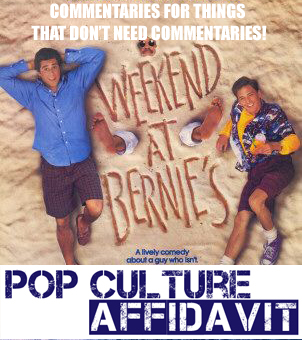
Episode 16 CoverIntroducing a brand new occasional feature for the Pop Culture Affidavit Podcast:  COMMENTARIES FOR THIGNS THAT DON’T NEED COMMENTARIES! For this first commentary, I take a look at the 1989 Andrew McCarthy/Jonathan Silverman classic, Weekend at Bernie’s.

So grab some popcorn, prop your dead boss up on the couch, sit back, relax, and enjoy!

You can listen here:

iTunes:  Pop Culture Affidavit

Direct Download 

Pop Culture Affidavit podcast page

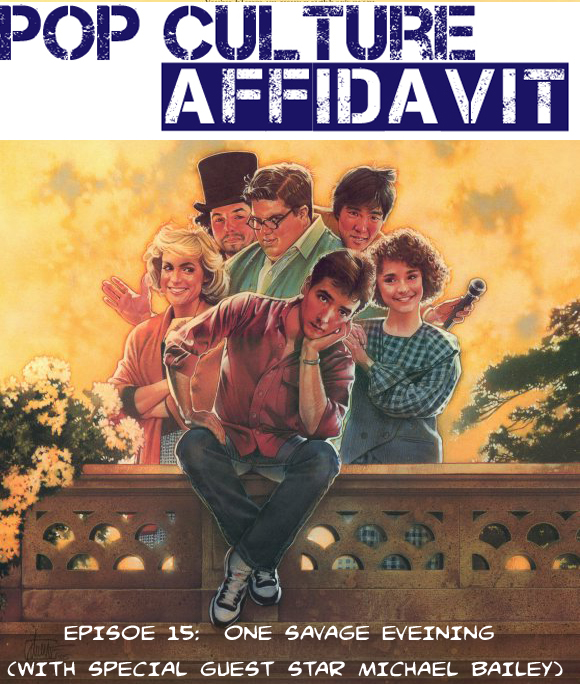
Pop Culture Affidavit, Episode 15 — One Savage Evening

Episode 15 CoverThis time out we have an extra-sized and extra-AWESOME episode of the podcast.  Joining me is my friend and fellow podcaster Michael Bailey (of Views From the Longbox and From Crisis to Crisis) and we spend THREE FULL HOURS discussing the films of Savage Steve Holland!

Who is Savage Steve Holland, you ask?

You may not necessarily recognize the name but any child of the Eighties will recognize the phrase “I want my two dollars!”  That’s right, Savage Steve directed Better Off Dead …, the 1985 John Cusack classic about breakups, French foreign exchange students, psychotic paperboys, and weird neighbors who sit at home crocheting and snorting nasal spray.

But that’s not all we talk about.  We also reminisce about Savage Steve’s other two films:  the 1986 beach romp One Crazy Summer, which also stars John Cusack as well as Demi Moore and Bobcat Goldthwait; and we talk about his least-known but most-underrated film, How I Got Into College.

Here’s where to listen:

iTunes:  Pop Culture Affidavit

Direct Download

Pop Culture Affidavit podcast page

Also, here’s a few great extras.  First, the theatrical poster for Better Off Dead … (more…)

Pop Culture Affidavit, Episode 14 — Life is a game. Easy to start. Hard to finish.

Singles PosterThis time around in the podcast I take a look at the 1992 Cameron Crowe-directed film Singles, a romantic comedy whose soundtrack became one of the definitive albums from the 1990s.  Starring Campbell Scott, Kyra Sedgwick, Bridget Fonda, and Matt Dillon and set in 1991 Seattle, Singles follows several characters in their twenties as they go through the complexities of trying to date and find love.

But of course, many people remember it for its music:  Pearl Jam, Alice in Chains, Soundgarden, Mudhoney, Smashing Pumpkins, and other bands important to the era make appearances on the soundtrack and even in the film, which is a great snapshot of a particular moment in our cultural history.

I spend the episode discussing the movie as well as my opinion of it and then spend a little bit of time on the soundtrack as well as a bit on its lasting legacy.

You can listen to the podcast via iTunes, or here:  Pop Culture Affidavit Episode 14

Also, if you’re interested, here is some extra reading–articles and blog posts that I used for research this episode …

Singles Soundtrack CoverSingles Turns 20: Who Would be on the Soundtrack in 2012?”  (Spin)

Singles: 25 Things You Didn’t Know About the Cameron Crowe Flick” (Moviefone)

“Where’s the Cast of Singles Now?” (NY Daily News)

Singles Soundtrack Turns 20″ (Stereogum)

Singles Production Notes (“The Uncool”: The Official Website for Everything Cameron Crowe)

“Mindhole Blowers: Cameron Crowe’s Singles Inspired NBC’s Friends and 14 Other Facts That Might Explode Your Head” (Pajiba.com)

“Five Ways Singles Ruined My Life” (Hello Giggles)


And as mentioned in the podcast, I have some pictures of my VHS copy, which was bought from the late, lamented Sayville’s Video Empire …

DSC_0073

DSC_0075

DSC_0072

Pop Culture Affidavit, Episode 12 — A Lloyd Meets Girl Story

In 1989, Cameron Crowe wrote and directed one of the seminal movies of the teen film genre. Starring John Cusack, Ione Skye, and John Mahoney, it’s Say Anything …, one of my favorite movies of all time.

Join me as I take a look back at the movie, talk about my favorite scenes and also take a look at the soundtrack.

You can listen here:

iTunes:  Pop Culture Affidavit

Direct Download 

Pop Culture Affidavit podcast page

say anything poster say anything soundtrack