television

Pop Culture Affidavit Episode 127: Merry PBSmas

It’s a holiday-themed follow-up to last episode, as Amanda joins me to talk about what we watch on PBS during the holidays.  From European Christmas Markets to Rick Steves to GBBO, we talk about all of the programming that brings us comfort and joy in December.

You can listen here:

Apple Podcasts:  Pop Culture Affidavit

Direct Download 

Pop Culture Affidavit podcast page

And here’s some clips of what we discussed on the show …

(more…)

9/11 and Popular Culture Part Six

It’s the extra-sized sixth and final episode of a six-part miniseries that examines the books, movies, music, comics, and other popular culture that directly addresses or is about the attacks of September 11, 2001. This time, I look at an assortment of items, including “The Falling Man” (and an Esquire article written about the photo), an ominous PostSecret postcard, rumors and urban legends debunked by Snopes, Gordon Sinclair’s “The Americans” radio broadcast, the French documentary 9/11, comedy courtesy of SNL and The Onion, and the New York Mets’ return to Shea Stadium. Then, I close things out with listener feedback and final thoughts on the 20th anniversary.

A quick content warning: Though these events are now 20 years in the past, they are still traumatizing to many, and I also discuss some of my personal feelings and views, so listener discretion is advised.

And while I did answer feedback this episode, I still would love to hear from you, so feel free to leave leave comments on the Pop Culture Affidavit Facebook pagefollow me on Twitter, or email me at popcultureaffidavit@gmail.com. I’ll read your feedback on a future Pop Culture Affidavit episode.

Here’s where to listen:

Apple Podcasts:  Pop Culture Affidavit

Direct Download 

Pop Culture Affidavit podcast page

Some extras for you …

(more…)

9/11 and Popular Culture Part Four

It’s the fourth episode of a six-part miniseries that examines the books, movies, music, comics, and other popular culture that directly addresses or is about the attacks of September 11, 2001. In this episode, I look at film and television, including the big budget films United 93 and World Trade Center, the worldwide short film compilation September 11, as well as the West Wing episode “Isaac and Ishmael”.

A quick content warning: Though these events are now 20 years in the past, they are still traumatizing to many, and I also discuss some of my personal feelings and views, so listener discretion is advised.

Finally, I will be including a feedback section in the sixth episode of the series, and would love to hear what you think, so leave comments on the Pop Culture Affidavit Facebook pagefollow me on Twitter, or email me at popcultureaffidavit@gmail.com.

The deadline for feedback will be Tuesday, September 7, 2021 if you want it read on the sixth episode.

Here’s where to listen:

Apple Podcasts:  Pop Culture Affidavit

Direct Download 

Pop Culture Affidavit podcast page

Some extras for you …

(more…)

9/11 and Popular Culture Part One

It’s the first episode of a six-part miniseries that examines the books, movies, music, comics, and other popular culture that directly addresses or is about the attacks of September 11, 2001. To begin, I take an historical look at the events of the day as well as some nonfiction about it, including the 9/11 commission report, news from professional and student journalists, as well as the works of bloggers and internet diarists.

A quick content warning: Though these events are now 20 years in the past, they are still traumatizing to many, and I also discuss some of my personal feelings and views, so listener discretion is advised.

Finally, I will be including a feedback section in the sixth episode of the series, and would love to hear what you think, so leave comments on the Pop Culture Affidavit Facebook page, follow me on Twitter, or email me at popcultureaffidavit@gmail.com.

Here’s where to listen:

Apple Podcasts:  Pop Culture Affidavit

Direct Download 

Pop Culture Affidavit podcast page

And here are some extras for you …

(more…)

“Kid 90” and the discoveries from Personal Archaeology

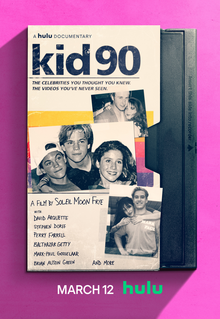
Toward the end of her documentary Kid 90, Soleil Moon Frye talks about how she watches video tapes that she made of her and her friends in the early and mid-1990s and considers how she never saw the warning signs regarding those friends who died by suicide or because of drug abuse. She also mentions that she is living a lot of those memories for the second time and (of course) with the perspective of a now middle-aged adult. It’s a moment that is predictable because of the way we naturally consider such things after a tragedy, but is sad nonetheless and tempers a very nostalgic documentary with a sadness, making it more than superficial fluff.

If you haven’t heard of Kid 90, it was born out of the fact that Frye spent much of her childhood and adolescence recording both audio and video of herself and her friends in their everyday live, intending it as a private keepsake*. A few years ago, she dug up the material and began going through it with the intention of making a documentary about being a child star and a teenager in Hollywood during the 1980s and early 1990s. She originally didn’t intend to put herself into the film (except for the aforementioned archival footage) but as she told Variety, she was editing one particular segment and realized that in order to give it full context, she needed to be interviewed. And that’s how we get the moment I just described.

I came to this film via Hulu’s recommendations and upon seeing the description, put it on my watch list. Plus, I’m a mark for any sort of late 1980s/early 19990s nostalgia, and am like every other person my age in that I immediately associate Fry with her iconic role as Punky Brewster. I also remember her showing up on a couple of random sitcom episodes–The Wonder Years and Friends, especially. What I didn’t know was that her circle of friends consisted of actors and actresses I was watching regularly during my early teen years and whom were also about my age (Frye is a year older than I am). So when people like Brian Austin Green, Mark Paul Gosselaar, and Jenny Lewis started showing up in both the footage and interviews, and also oddly connected to it beyond just recognizing those faces.

Over the past couple of years, I have spent time going trough my own personal teenage archive. Most of the stuff I have been looking at has been my teenage journal, along with various ephemera I’d thrown in a box or storage bin and held onto over the years. None of it is nearly as star-powered as Frye’s video and audio footage of hanging out with Danny Boy from House of Pain, but I could at least relate to it on the level of digging into what you had in the past. But as I watched Kid 90, I also had the passing thought:

This is what it must like like for the cool kids to reminisce.

Oh yeah, that is flat-out one of the most idiotic thoughts a middle-aged man could have about people from high school, but I couldn’t help it. As the movie rolled, my mind flashed to Facebook group threads filled with pictures of them at house parties, seventeen with 1990s haircuts, flannels over Gap jeans, with Budweiser cans everywhere. And really, that’s what Frye’s home movies look like–suburban keggers but with famous people. There’s a point she makes in the film that her mom tried her best to her and her brother (Meeno Replace, the star of the NBC show Voyagers!) as normal a life away from their jobs in Hollywood as possible and this is the proof. The rooms they’re in, the general silliness that they’re up to (especially when they’re 13 or 14) all looks s if it could be taking place in any number of my classmates’ houses, and a world that I never entered. I spent many Saturday nights playing video games with friends or renting whatever movie I could get my hands on and then watching Saturday Night Live.

And while I’d like to be nonchalant and say “Ah, who gives as shit about school popularity when you’re 44?”, I have to also admit that this lack of coolness dogged me for quite a long time. I wound up with more tan a few toxic “friendships” and a laundry list of embarrassing and awkward moments, which my anxiety loves to weaponize on occasion, just to remind me who I am … or at least who I was. The world of the cool kids in my immediate vicinity was as much a mystery to me as the world of these ultra-cool Hollywood kids in the film. Frye goes from hanging with the ‘tween and teen jet set of the early ’90s to heading across the country to attend college in New York and befriending cast members from Larry Clark’s Kids, showing that she always had a “crew” wherever she decided to live.

But in the midst of all of that, there’s a real darkness. At one point, we hear an audio recording of her talking to a friend and trying to figure out what happened the previous night because she woke up at home not knowing how she got there. At another point, she is discussing how a guy at a party clearly raped her when he kept going even though she told him she didn’t want to. You can’t dismiss those stories by saying that it’s some symptom of Hollywood excess or that it’s another sign of how former child stars often become cautionary tales. No, ask around and you are bound to meet a woman who has had one of both of those happen, maybe even more. And, to bring in Hollywood, add the way the film industry treated her because of her body (she had breast reduction surgery at 16, which was a People Magazine cover story) and you have a look at how monumentally screwed up our culture is.

Which brings me back to what I mentioned in the beginning of this piece–Frye’s perspective as a woman and parent in her forties. One of the reasons she began the project that would become Kid 90 is to see if how she remembered her teenage years was accurate, and I found myself relating to the honesty with which she approached everything as well as the bravery required to do it. You can always flip through an old yearbook and laugh at the silly or even heartfelt things people wrote to you, but there is a point where you have to decide if you want to cross the threshold into the uncomfortable and really meet the kid you were. As a parent, you want to see what you can learn from your younger self so that your kid doesn’t suffer the same fate. Sure, there are adolescent rites of passage that involve mistakes and regrettable moments and I know I can’t protect my kid from everything bad they might encounter, but I also know that part of my job as a father is to use the gift of hindsight to discern between true rites of passage and truly awful things that we are too scared to admit were wrong or even toxic.

Reopening old wounds, taking the blindfold off in the cave, digging into the past–whatever you want to call it–can suck, even when you know it’s going to be therapeutic and said therapy can last longer than intended. But it’s a testament to the fact that making it through any of it is a small miracle.

* A similar documentary from Val Kilmer is set to debut on Amazon Prime in August.

Fallen Walls Open Curtains Episode 7

It’s the seventh chapter in a podcast miniseries that looks at the fall of the Iron Curtain and the popular culture of the Cold War. To start us off, I look at what happened in Eastern Europe from March 1991 to May 1991 with a special focus on Yugoslavia and the civil wars in Bosnia and Kosovo that lasted well into the Nineties. Then, Michael Bailey joins me to take a look at The Day After as well as other nuclear holocaust films of the 1980s.

You can listen here:

Apple Podcasts:  Pop Culture Affidavit

Direct Download 

Pop Culture Affidavit podcast page

And here are a few extras for you …

(more…)

73 Seconds

The Challenger at liftoff. Image from americainspace.com.

When my son was little, he liked to watch videos of the space shuttle taking off. They were exciting and short, perfect for the attention span of a three-year-old. But whenever we watched them, I would get anxious about a minute and a half after the launch when the camera angle switched to the underside of the shuttle as it flew diagonally away from the viewer. The anxiety would melt when the solid rocket boosters separated, because I knew that the launch had been completely normal.

It doesn’t take any real analysis to understand why that happened. Everyone in my generation has not only seen the Challenger explode, we each have our own very specific answer to the “Where were you?” question. Mine? I was in Miss Hubbard’s third grade classroom at Lincoln Avenue Elementary School. We didn’t get to watch it live, and found out when Mrs. Nolan, our principal, came over the PA to tell us that the space shuttle carrying the teacher in space had blown up after takeoff. I’d never heard an adult sound so upset before and I can’t imagine how she managed to even stay that composed. Nobody said a word for at least a while and I can’t remember what our teacher said, just going home, turning on the television, and watching Peter Jennings narrate the shuttle taking off and exploding 73 seconds into its flight, leaving a huge ball of smoke in the clear Florida sky. The lack of sound after Mission Control’s “Go at throttle-up” made it more real than anything I’d seen in a movie, and while it scared me, I couldn’t stop watching.

Christa McAuliffe. Official NASA press photo.

The news played the footage more times than I can remember and 35 years later, I am struck by how we were all totally unprepared. Everyone who saw the Challenger explode live on television had been watching because something good was supposed to happen. Christa McAuliffe, a teacher, was being launched into space, nearly every child in the country — every member of a generation — was tuned into that event in some way. Unlike the way my parents’ generation watched Jack Ruby shoot Lee Harvey Oswald, which had a pallor of tragedy prior to its happening, this broke a generation’s trust in the world. The time after was surreal and confusing. President Reagan offered words of solace that we half understood and adults chastised us for not staying quiet enough while he did. And nobody wanted to be an astronaut anymore.

One of the best sources of solace came a little more than a month later when the Punky Brewster episode “Accidents Will Happen” aired on NBC. Filmed as a direct response to the Challenger disaster, it was a rare moment of responsibility on the part of a show, as the writers understood their influence on a young audience. We all understood how Punky felt when she comes home in tears after watching the Challenger explode on live television, and how she is completely inconsolable. It takes a heartwarming talk from an adult—in this case, it’s Buzz Aldrin—to help her realize this is something she’s allowed to be upset about but it shouldn’t stop her from pursuing dreams of going up into space or loving space travel. While not a cure for our sadness, it was a much-needed balm; Punky was our friend and if the adults in her world took the time to show they cared, then they cared and were thinking about us.

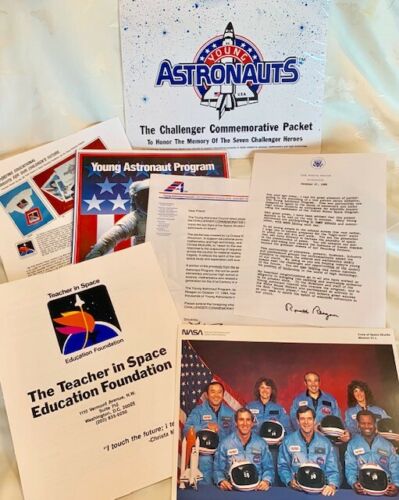
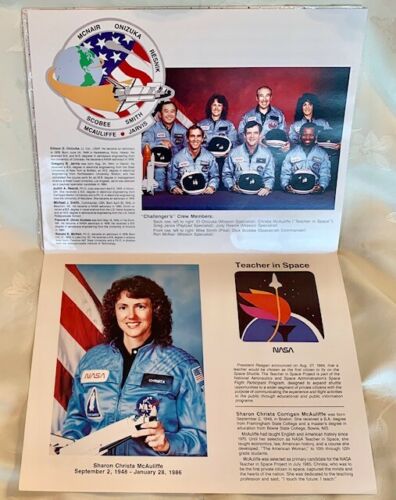
Later that year, we received Young Astronauts commemorative packets. These had 8×10 pictures of the crew, Christa McAuliffe, and the shuttle lifting off; two stickers with the Teacher in Space Program and the official mission logos; a letter from President Reagan; and a poster with a picture of the shuttle and the poem “A Salute to Our Heroes”. That poster hung on my bedroom wall for a few years and I even bought a Revell space shuttle model kit because I really wanted a space shuttle toy but couldn’t find one. It sat in its box for a few years before I made a poor attempt at putting it together. We had a moment of silence on the one-year anniversary, but then the Challenger faded from consciousness and conversations—that is, when we weren’t making tasteless jokes like “What does NASA stand for? Need Another Seven Astronauts”. We turned our attention to movies where humans were fighting aliens in space, and the shuttle program went into in limbo.

In the aftermath, NASA took a serious image hit, especially after hearings revealed that the explosion could have not only been prevented, but some engineers’ pleas about an impending disaster were ignored or dismissed. While at eight, I knew about the cause of the explosion—a failure of both O-ring seals on the right solid rocket booster—it wouldn’t be until college that I would attend a lecture given by Roger Boisjoly, one of the Morton Thiokol engineers who gave the warning. He went into detail about the engineering behind the rocket boosters, what was an ultimately fatal design flaw, and those efforts to warn management and NASA about the probability that the shuttle would explode. Having just watched the Clinton impeachment play out, I was fully aware at the capabilities of our government to cover things up, but I still wound up feeling almost exactly how I felt like the day of the disaster when I stood in the den watching television. The gravity of the situation was still abundantly clear.

The Space Shuttle Discovery at the Smithsonian’s Udvar-Hazy Center in Chantilly, VA.

The shuttle program would be retired in 2011 and in 2013, my son and I went to see Discovery—the shuttle that in 1988 made the first successful launch after Challenger—at the Smithsonian’s Udvar-Hazy Center. Upon reaching its exhibit hall, I was floored by its enormity. Knowing that we could build something that huge and send it into orbit reminded me of what we are capable of, and as I walked around it, holding my son’s hand, I felt the same awe that he did, and was humbled knowing what our achievements cost.

Pop Culture Affidavit Episode 116: Holidays With a Laugh Track

Spend this holiday season with some of your favorite families in TV Land!  This time around, I take a look at seven sitcom episodes from the 1980s to 2010s that center around or take place around the holidays:  Cheers, Married … With Children, Saved by the Bell, Seinfeld, The Simpsons, Friends, and Schitt’s Creek.  I take a look at one holiday-themed episode from each that I find memorable and give each a quick review.  It’s all a bit of cheer to close out 2020!

You can listen here:

Apple Podcasts:  Pop Culture Affidavit

Direct Download 

Pop Culture Affidavit podcast page

And as it is the week of Christmas, I wanted to take an opportunity to thank everyone who reads this blog and listens to this podcast for your support, especially during this very tough year. Merry Christmas and Happy Holidays to you and yours!

Pop Culture Affidavit Episode 114: Unsolved Mysteries of the Unknown

It’s Halloween and that means it’s time for me to actually get seasonal … for once.  I’m here and talking about some oddities of entertainment from the late 1980s and early 1990s.  First up is Time-Life Books’ best-selling series Mysteries of the Unknown, whose commercials were some of the creepies of the time.  Then, I move into the area of true crime (among other subjects) by looking at a classic Robert Stack-era episode of Unsolved Mysteries.  Plus: listener feedback!

You can listen here:

Apple Podcasts:  Pop Culture Affidavit

Direct Download 

Pop Culture Affidavit podcast page

After the break, here’s some extras for you, including four of the classic Mysteries of the Unknown commercial …

(more…)

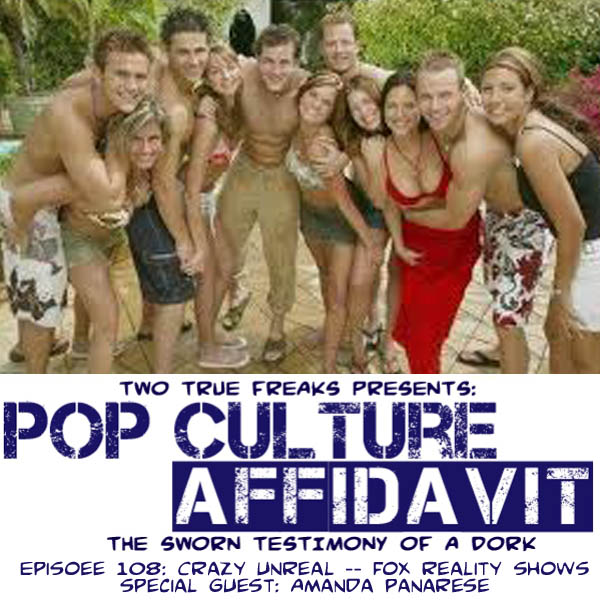
Pop Culture Affidavit Episode 108: Crazy Unreal — Fox Reality Shows

Episode 108 Website CoverWhat happens when you take two people who have repeatedly watched what happens when you take a group of hot singles and put them in a mid-level resort in Cabo San Lucas? You get a conversation about reality shows on the Fox Network! Amanda joins me to talk about everything from the early days of Totally Hidden Video, COPS, and America’s Most Wanted, to the high point of trashy Fox reality of Temptation Island and Paradise Hotel. Along the way, there’s American Idols and Gordon Ramsey calling someone an idiot sandwich.

You can listen here:

Apple Podcasts:  Pop Culture Affidavit

Direct Download 

Pop Culture Affidavit podcast page

And as a bonus, here’s a YouTube playlist of random Fox reality stuff: