Spend this holiday season with some of your favorite families in TV Land! This time around, I take a look at seven sitcom episodes from the 1980s to 2010s that center around or take place around the holidays: Cheers, Married … With Children, Saved by the Bell, Seinfeld, The Simpsons, Friends, and Schitt’s Creek. I take a look at one holiday-themed episode from each that I find memorable and give each a quick review. It’s all a bit of cheer to close out 2020!
And as it is the week of Christmas, I wanted to take an opportunity to thank everyone who reads this blog and listens to this podcast for your support, especially during this very tough year. Merry Christmas and Happy Holidays to you and yours!
In 1990, David Fincher directed one of the most iconic videos of all time, “Freedom ’90” by George Michael. The video featured five supermodels lip synching the song and was a literally explosive deconstruction of the image he had created in his 1987 solo debut, “Faith.” So, on the video’s thirtieth anniversary, Amanda and I sit down to talk about George Michael and his music, do a video commentary, and then segue into a discussion about fashion in the early Nineties.
It’s the fifth chapter in a podcast miniseries that looks at the fall of the Iron Curtain and the popular culture of the Cold War. To start us off, I look at what happened in Eastern Europe from September to November 1990 with a special focus on the roles that corporate America and pop music played in the end of the Cold War. Then, the discussion turns to sports; specifically, the Olympics with a spotlight on the controversial 1972 men’s basketball final, The Miracle on Ice, and the 1984 Los Angeles Summer Olympics.
It’s Halloween and that means it’s time for me to actually get seasonal … for once. I’m here and talking about some oddities of entertainment from the late 1980s and early 1990s. First up is Time-Life Books’ best-selling series Mysteries of the Unknown, whose commercials were some of the creepies of the time. Then, I move into the area of true crime (among other subjects) by looking at a classic Robert Stack-era episode of Unsolved Mysteries. Plus: listener feedback!
When the COVID quarantine began to drag on through the summer, I made what was a real bummer of a choice–to not attend this year’s Baltimore Comic-Con. I’d already canceled two trips for the year and was holding out hope that I could at least go somewhere other than Costco, but it wasn’t looking great. But my thinking proved fortuitous when the organizers of the convention announced they were going online and were offering up a full slate of programming along with virtual experiences that were much like what you’d expect on a convention floor.
Aside from catching some panels from shows like San Diego, New York, or DragonCon on YouTube or various podcasts, I’d never experienced a comic convention–or any convention for that matter–online, but as the lineup was posted in the time leading up to this weekend, I had to check it out and I couldn’t resist also blogging about it. It’s such a great comics-centered show, but would they be able to re-create the experience of being there through streaming feeds?
Spoilers: They did.
Now, much like the live convention, it was nearly impossible for anyone to attend every single minute of every single event; much like my experience with the live convention, I wound having to pick and choose what I wanted to attend. I guess the difference this time was that I didn’t run around trying to talk to different creators and get books signed, although signature packages were offered, and there was plenty to shop for at the Artist’s Alley Page. More on that later, as I’m going to start by looking at the specific programming that I watched.
Panels
I’ve done a few panels here and there over my years at going to the con, although they tend to be the first thing I skip in favor of getting those last signatures, roaming the floor, or going to lunch. This time, I viewed panels almost exclusively, hitting three of the creator panels, one full and one partial Kids Love Comics panel, and the retailers showcase preview on Thursday night. Two of them were on Friday night, which was a huge treat for me, especially since I never have the chance to go to Friday because I’m always headed up to my in-laws’ after work. Plus, the convenience of AirPods allowed me to put my iPod down and just listen to the panel while I did the dishes.
Okay, this review is getting boring. Let’s get to the panels.
Justice League: BWAH-HA-HA!!! with J.M. DeMatteis, Keith Giffen, and Kevin Maguire
I admit that this was my whole reason for watching on Friday night. I came into comics when this era of the Justice League was starting its third act and while I have yet to read all of it (trust me, it’s on my list), what I have read over the years has been absolutely fantastic. Plus, I’ve had the chance to meet all three of these creators over the years and have them sign my copy of the Justice League: A New Beginning trade. Keith Giffen wasn’t on the panel when I was watching it (I had to hop off to eat dinner during the second half), but what DeMatteis and Maguire had to say could have filled two panels.
And you could tell they were old hat at this, having done a number of these panels before and therefore came off as old friends reminiscing (which it essentially was). Even though I’d read and listened to quite a bit about this era of the Justice League over the years, I learned a few things, namely that they were given the characters as a result of the Legends crossover and that DeMatteis was not one of the original writers, having been given the book to help Giffen when he was in the middle of the Justice League job he’d been hired for–killing off JL Detroit.
They also talked about how the creative freedom offered to them in the 1980s allowed them to create characterizations and relationships between characters in a way that developed organically as opposed to some of the forced dynamics that comics can sometimes have, and it made me wonder if that’s something that we’ll ever get nowadays considering how many superheroes are considered more like intellectual property owned by a parent company as opposed to characters in a story. But hey, maybe me as an old-man comics reader is too narrow minded to think that this sort of lightning in a bottle is unlikely to be caught again. Then again, these guys didn’t think it would be as legendary as it has become, especially Maguire, who commented, “It’s odd what sticks” during a conversation about his artwork, especially the oft-homaged and repeated cover to Justice League #1.
Brian Michael Bendis and Gerry Conway
Whereas three old friends were getting together with a moderator (and I should mention that John Siuntres from Word Balloon did an excellent job hosting the BWAH-HA-HA!!! panel), this was a conversation between two comics legends across generations. Bendis was essentially putting a spotlight on Gerry Conway, who wrote Justice League of America #200, an issue that Bendis admits to chasing for pretty much his entire career, especially in recent Legion of Super-Heroes issues (a series that is amazing, by the way, and you should add it to your pull list yesterday). But they not only spent a lot of time talking about the various characters that Conway has worked on over the years, they talked about the creative process as well as what happens to the characters after they leave the page.
The latter is where I came in and Conway was addressing the appropriation of The Punisher by the police and those carrying out acts of aggression in way that is contrary to the actual mission of the character. Bendis shed some light on the more positive side of that particular phenomenon by talking about the success that Miles Morales has had. But for all of his frustration about the use of the Punisher, Conway seemed grateful to have a stake in the character, and feels that he has a voice in the matter.
The conversation about the creative process is something I’d see echoed in other panels later on, and I found it fascinating to hear how one can get pigeonholed as a television writer (Conway has written a lot of mystery story-based television) and appreciated how they talked about doing the work to read, research, and get a character right.
Inside the Comics Studio: 1985 with Howard Chaykin, Walt Simonson, Denys Cowan, and Bill Sienkiewicz
Now if the Bendis/Conway panel was two generations of comics men talking shop and the Justice League panel was three friends reminiscing, this panel was the equivalent of a corner table at a bar as the night wears on. And it was so much fun. The four of them, who were work mates at both Marvel and DC and in their own studio, spent an hour talking about where they were in 1985 and Dean Haspiel, did a pretty good job of keeping the conversation from going completely off the rails and even keeping it interesting despite some streaming lag and freezing on Sienkiewicz’ part. Like I said, this was like listening in on a conversation and I confess that I stopped taking notes early on just so that I could listen and laugh along.
Creator Spotlight: Terry Moore
My main draw (no pun intended) was Terry Moore, whose table I regularly visit when he’s at the Baltimore Comic-Con (I’m very close to getting all of my Strangers in Paradise trades signed) and I know that he’s got a new graphic novel coming out named Ever, which is a dark fantasy book (that I’ve already preordered, so I’m pumped). Plus, as he announced at the panel, he will be publishing Serial in 2021 starring Zoe, the fan-favorite 10-year-old serial killer from Rachel Rising.
Amy Dallen hosted and was outstanding, bringing the enthusaism of a fan of Moore’s work as well as the knowledge and professionalism of a good host, interjecting where she can but spending most of the time sitting back and listening to him talk about his career. And one thing I really appreciated was how he talked about where he gets some of the motivation for his writing and some of his themes; furthermore, he made this great point about how after the 9/11 attacks, he set out to make sure that all of his stories had some semblance of hope. That’s not something we often get in our stories these days, as our culture seems to equate intelligence with cynicism. There’s something incredibly genuine about him and it really came across in the interview.
Kids Love Comics: Jeff Kinney
My son–who is now 13 and has been reading the Diary of a Wimpy Kid books since he was in elementary school–and I came into this one at the end because I had been doing some lesson planning all morning and he’s turned into the type of teenager who rolls out of bed close to noon on a Saturday. Despite that, it was pretty cool to hear him talk about how amazed he is at the impact that his books have had, and I have to hand it to the convention organizers because this is the type of person I could imagine having a Todd McFarlane-sized line of kids at his table.
Kids Love Comics: Kazu Kibuishi
So if you remember the first time I had my son with me at the convention, we met Kibuishi because Brett is a huge fan of the Amulet graphic novels and I bought a couple of GNs that Kibuishi then signed. We also went to a panel where he talked about what was coming up for the books as well as his creative process. Now that it’s several years later, Brett is really interested in drawing and was excited to see him talk again.
What was also cool about the panel was that it was hosted by Jamar Nicholas, whom we met a couple of years ago when he was selling Leon: Protector of the Playground at a table in the Kids Love Comics area and we interviewed him for the show. And he’s just signed with Scholastic, which is huge, and that’s great, because you love to see that type of success for someone writing great books for kids (and who is especially nice to boot).
As for the interview, it was also very well run with each question projected onto the screen, and I could clearly see that both creators as well as the KLC coordinators knew their primary audience was because the conversation was geared toward the kids in attendance. At the same time, neither of them talked down to the audience, which I appreciated. Kibuishi talked about how he got interested in drawing, how he had support from his parents and gave some really good advice, saying that he likes to stay independent as an artist and not connect himself too much to the business side of things, even though that’s necessary. Oh, and they both joked about how they can’t–and so many others can’t seem to–draw horses.
Brett told me that he really liked the advice of not being super money hungry and that Kibuishi has things he likes to do in order to disconnect from work, take a break, and reflect–mainly mountain biking (my son likes to read and hike). Plus, he felt pretty inspired hearing that he didn’t have to have the most expensive equipment when he’s just starting out.
Retailers and Artist’s Alley
Spending a huge wad of cash at the convention is a big part of it for me, and while I was able to sate my desire for back issues by going to my LCS on Friday, I did miss the rush of flipping through bins and looking for a hidden gem. But the Artist’s Alley setup on the site that featured links to most of the exhibitors’ websites was great and I bookmarked four or five artists from whom I’ll be buying something once I get paid this week.
Also really useful was the Retailers Showcase, which was hosted by The Great Legend and Anthony Snyder and featured a number of the more high-profile retailers that exhibit at the convention. It was shown Thursday night and even though it was some retailers talking about what they sell, it was so comics-centered and so pure to the tone and purpose of the convention that it set everything up nicely. I mean, I can’t afford anything that the Heritage Auctions guy was showing us, but my jaw still dropped at the sight of a high-grade Golden Age comic. But I am looking forward to buying a comics portfolio from Fine Comics Collectibles–who would have thought of that for those of us who bring a ton of books to have signed at a convention?
Next year’s show is scheduled for the same time in October and it’s my hope that it will be live and in person because even before I saw the guest list, I was ready. Still, the convention organizers did a great job with the virtual con and I hope that this possibly means that they’ll expand the experience to include some online offerings or maybe some recorded or livestreamed panels next year. Yunno, for those of us who will be just so happy to be back on the floor flipping through those bins.
This time around, I’m back to looking at my history with music by going deep into the early 1990s and my early teens, recollecting those nights I spent in my room listening to the radio and rushing to hit record so that I wouldn’t have to wait for the station to play that Brian May song. I talk about the stations I grew up listening to, the tapes I made, my unfortunate music choices, and how I learned about what was popular (and what wasn’t) before I finally got my own CD player.
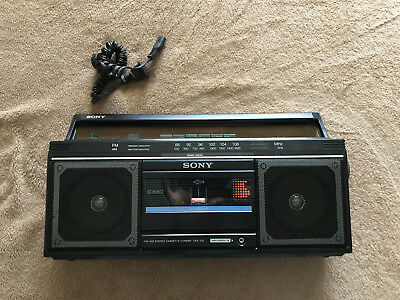
So the picture above isn’t of my exact radio, but it is the radio I owned and used to tape all of those songs. It’s the Sony CFS-230 cassette-corder boombox. I got this for either my birthday or Christmas sometime in the late 1980s and it was eventually replaced with a cassette/CD player that I received for my fifteenth birthday.
And here is the Spotify playlist that includes the songs I featured in the episode. Enjoy!
It’s the fourth chapter in a podcast miniseries that looks at the fall of the Iron Curtain and the popular culture of the Cold War. To start us off, I look at what happened in Eastern Europe from June to August 1990 with a special focus on the Singing Revolution in Estonia, Latvia, and Lithuania. Then, Luke Jaconetti joins me once again to talk about the science fiction classics The Day the Earth Stood Still and Godzilla.
The song that opens and closes the show, Sheb Wooley’s “Flying Purple People Eater”:
The theme to The Day the Earth Stood Still:
The theme to Godzilla:
ABC News’ story on the Baltic Way or Baltic Chain from August 1989:
A video for an Estonian patriotic song whose title translates to “No Land is Alone.” While this is more recent than the 1980s, this was one of the “Five Patriotic Songs” that I mentioned in my look at the Singing Revolution:
Space. The final frontier. This episode is a conversation between me and special guest star Gene Hendricks. Our mission? To talk about the original crew Star Trek films and explore our own origins as fans of the classic science fiction franchise. But it’s not just movie talk. We have also read all six of the film novelizations and discuss how much they add to the experience. It’s a classic fan conversation with two guys who are boldly going where many have gone before!
And a quick note on the audio quality of the episode. At one point, early on in recording, my USB microphone died and I had to switch to my in-computer mic. I have done my best to remedy the poor quality through rerecording a few pieces of what I had, and using various noise cancellation and volume balancing tricks. So my apologies for the bad quality of sound on my end. I just didn’t want to let such a great conversation go unheard.
Get on your bike and grab your sack of morning editions! This time around, we’re back to looking at comics as Stella and I take a look at the Eisner-winning series “Paper Girls” by Brian K. Vaughn and Cliff Chiang. We give a summary of the book–with and without spoilers–and then talk about why we both think it’s required reading (even if that’s usually on our other podcast).
Cookies & Creme Twix are back. Well, they’ve been back for a few months now, but I recently had a chance to try them, which is something I was never able to do when they were available in the early 1990s. This shouldn’t be cause for celebration–after all, the last thing I need is more candy–but being able to just buy some when I see it at 7-Eleven is one of those aspects of adulthood that never gets old.
It’s not like I was completely deprived of dessert or candy when I was a kid–we had it from time to time but my parents didn’t keep it around the house–but while I sometimes did go down to the local drugstore to buy atomic fire balls, I usually chose to spend what little allowance I got on comic books and baseball cards. So I guess that’s why when I kept seeing commercials for Cookies and Creme Twix I was intrigued but didn’t make much of an effort to pursue them, which is ironic considering that it’s one of my favorite ice cream flavors. Or perhaps I actually did look for them on the candy racks but never found them and eventually gave up and forgot about them even if I never did forget about the commercials.
The candy made its debut in 1990 along with Chocolate Fudge Twix (at the time, peanut butter and caramel were the available flavors) and along with them came an ad campaign with the slogan “one of life’s great kicks.”
Now, there were a few commercials that were part of this overall ad campaign and while they different here and there, they share the same tone and have the same message: Twix knows what you, New Teen of the Nineties, are about. And I’m going to look at three of them because they so very well encapsulate that very early part of the Nineties where culture seemed to be half about looking for something new while also suffering from a major Eighties hangover.
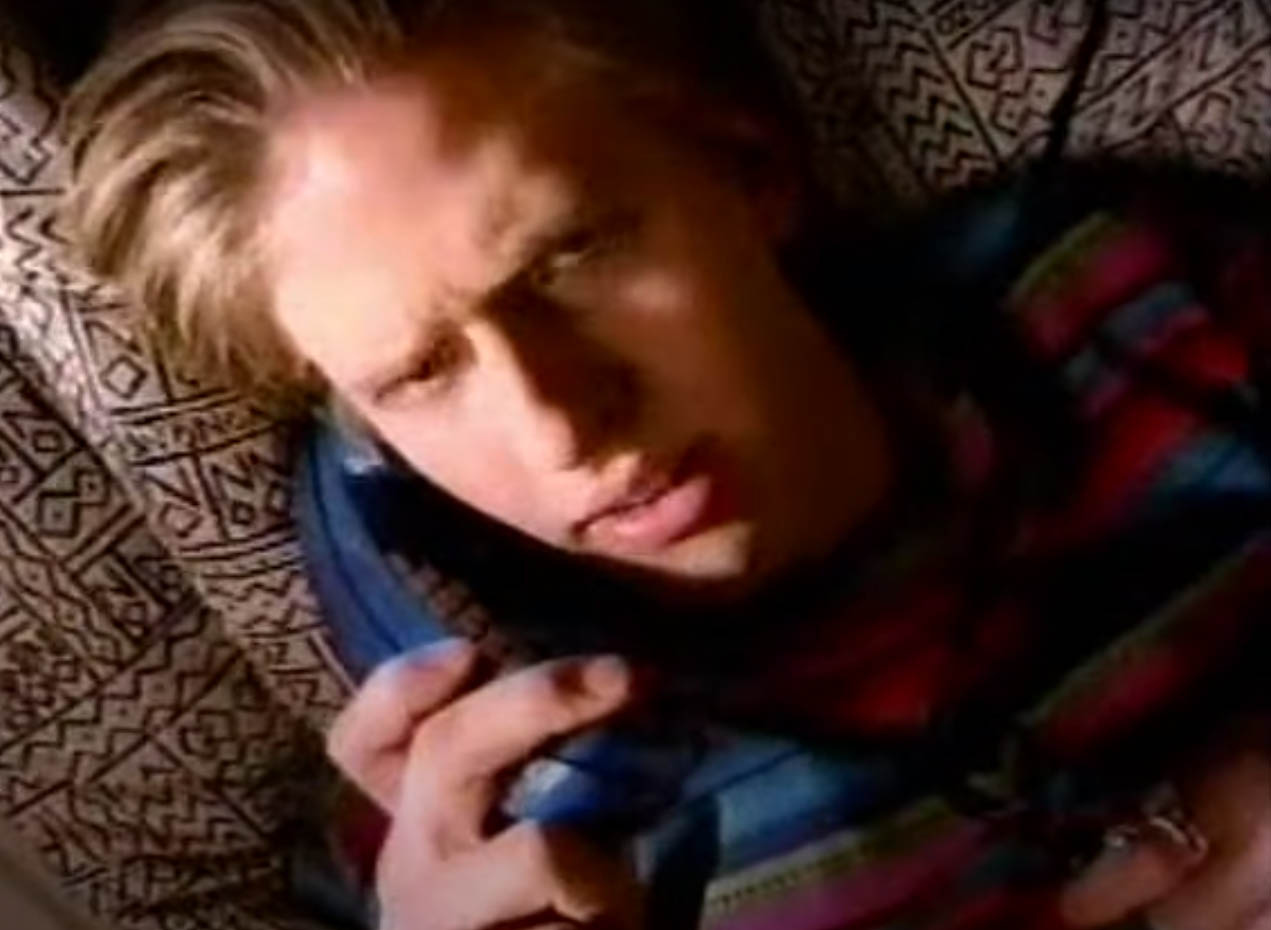
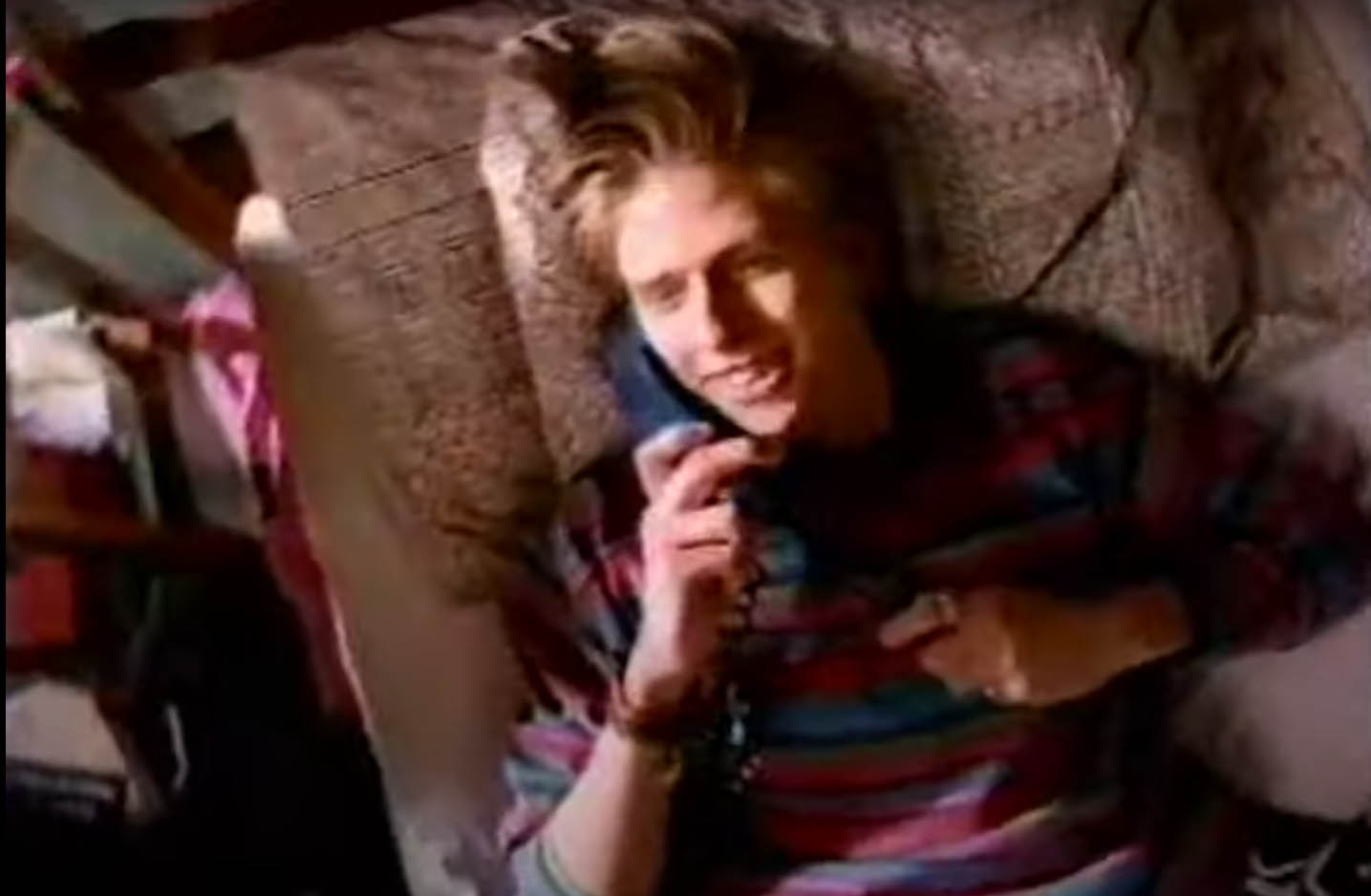
So this is a very short commercial, but it gets its point across in its 16 seconds: Twix understands that it sucks to get friendzoned and it’s the cure for those relationship woes. Here, we see Rick, who is on the phone with his girlfriend. And Rick’s obviously a fun-lovin’ guy. He’s got that “I woke up like this” sufer/skater hair, the type that took considerably less effort than the Aqua Net-laden hair of your average Long Island mall rat but looked a lot cleaner than that of the Nirvana and Pearl Jam disciples that would populate his high school a couple of years later.
I’d say the shirt is probably a Quicksilver shirt because they were all over the place around this time, although the ones I owned weren’t striped but had random patterns. And speaking of random patterns, can we talk about the sheets here? These were pretty much the type of sheets that teenage boys were issued back in the Nineties–neutral, earth tone colors with some sort of innocuous geometric pattern that was chosen off a shelf at Linens n’ Things because it was the only non-pastel or flowered comforter and sheet set available.
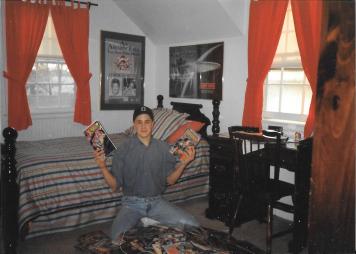
I’m serious about this. Here’s a picture of me when I was sixteen, showing off my comics collection (I don’t know why I took it, either, but it is one of only a few pictures of me as a teenager that survived). Behind me is a striped bed spread that I’m pretty sure I got when I was in junior high but really looks like I might have been sleeping in it when I was eight or nine. So the issue was not really finding bed linens that conformed to gender norms; it was more like it was hard to find bed linens that were mature because everything that was “mature” at Linens n’ Things was some floral Laura Ashley print.
I mean, at least Rick had earth tones in 1991. I wouldn’t get earth tones until college, which you can see here in this shot of my dorm room circa September or October 1995. And I’m being completely honest when I say that this was the only comforter and sheet set that I could find at the store. I also can’t let this picture get posted without pointing out how it is, in itself, the epitome of the college experience in 1995. From the Sega Genesis on my roommate’s dresser to the ROLM phone under my Reservoir Dogs poster, there is so much I could talk about that it’s pretty much its own post*. But right now, I have to get back to Rick.
So, Rick’s friendzoned and breaks the fourth wall with a WTF that I swear I not only had but that I will admit to practicing.
Yes, I said it. Then again, I watched Ferris Bueller’s Day Off, Parker Lewis Can’t Lose, and Saved By the Bell all the time in the early 1990s and every guy was giving us an aside. How could I not raise an eyebrow or give a strange look to a camera that wasn’t there? No, I’m not insane.
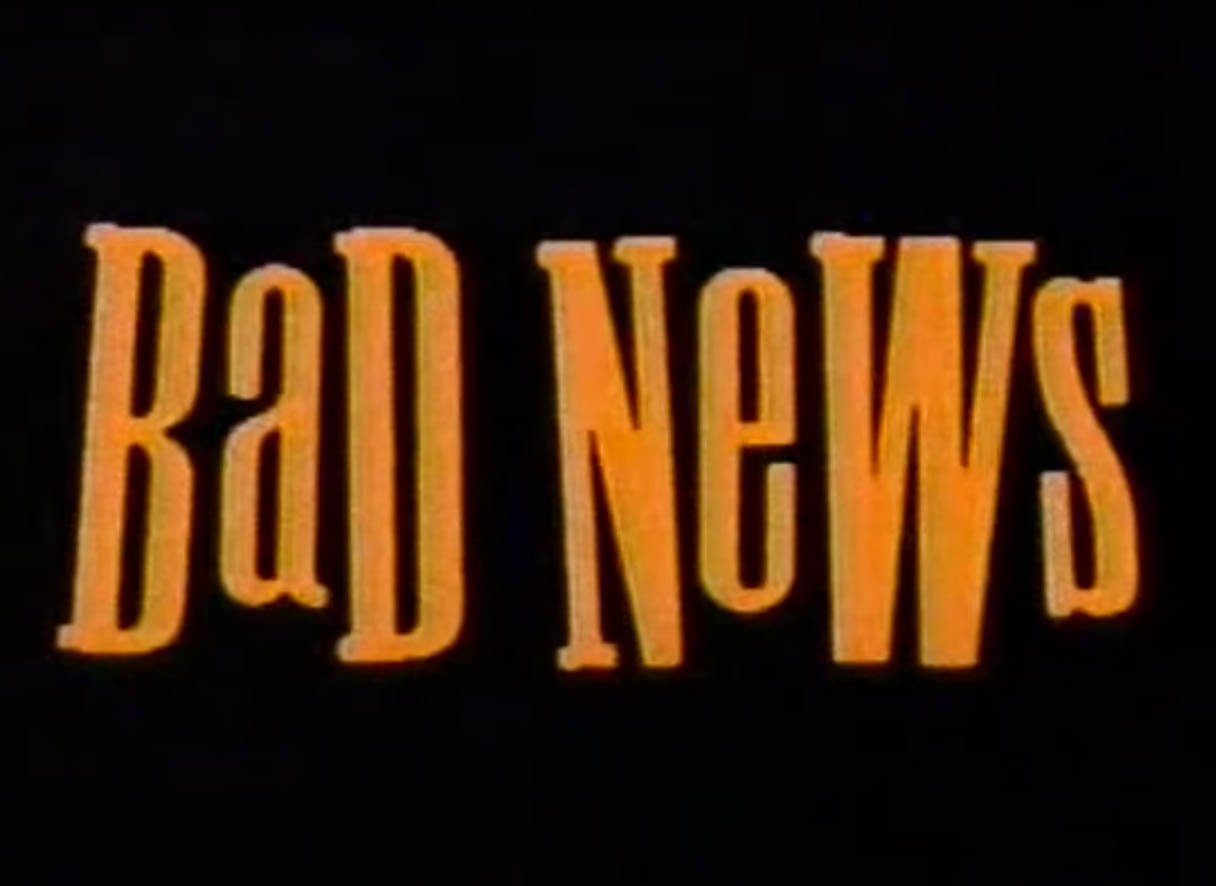
ANYWAY, two Bill and Ted type guys voice over the words “Bad News”, clearly showing the public that marketers either saw the Bill and Ted movies or had spun the “wheel of teenage cliches” and landed on … well, let’s just say this is very Poochie.
And let’s discuss this font and color scheme for a moment. We’ve clearly moved beyond the bright blues and pinks with scripted writing that we tend to associate with the Eighties (or at least that’s what shown to us in Eighties retro stuff) and have settled for a darker color palate, which is on trend for the Nineties. After all, you can look at just about any music video from around this time and will see that while they still maintained some sort of gloss, the tones were darker and deeper. So we’ve got a black background with kind of an orange-yellow “Bad News” that is written in a serif font with alternating uppercase and lowercase letters in a shaky setting. It’s very “cool”, right? Or at least what someone in marketing thinks the kids think is cool.
Which, by the way, is the inherent problem with most advertising directed at teenagers and twentysomethings in the early 1990s. Those of us who went to high school during 1990-1996 or so** were the very tail end of Generation X (a term that really only came to prominence at that time as it is) and whereas ads aimed at twentysomethings failed so spectacularly, people wrote all the think pieces, those aimed at high schoolers were a shit show, albeit a different kind of shit show where people slapped Nineties onto Eighties coolness complete with kids plucked from the same “cool kid” template that spawned Zack Morris.
Take this one, for example:
Now, this screams Eighties hangover, right down to the use of Yello’s “Oh Yeah”***. I didn’t screencap any images from this one because the resolution was pretty poor, but there are three dominant images: a girl partying at a huge house, a guy in sunglasses floating on an inner tube in a pool, and a guy with slinky-eyed glasses at a graduation ceremony. They all contrast with voice overs that are straight from the “Things Parents Say” block on the $100,000 Pyramid. And now, don’t get me wrong, I like some good teenage rebellion, but this really smacked of Poochie. Did whomever wrote this ad just rent a bunch of ’80s flicks from the video store to get the images they needed to tell teenagers “Hey, Twix knows life has to be fun.”
I guess I also need to bring up the Twix narrator’s voice, which is a guy with a generic “island” accent. It’s cringe-y in the same way Disney has the Castaway Key guy say “Cookies and Cookies Too”. However, I remember Bob Marley/Jamaica/the Bahamas being this thing in the early Nineties, especially after Cool Runnings came out and white people started thinking that saying “Jamaica, mon” wasn’t offensive at all. Between that; saying “Thank you, come again” in an Apu accent; and the Asian, Black, and Latinx “accents” us white people used back then (and in many cases still do), we’ve got a lot to think about and answer for.
Anyway, getting back to the accent, I believe the thought process here was that this was cool at the time. Plus, it was just foreshadowing that we were all going to one day own one of the millions of copies of the Legend Bob Marley greatest hits CD that were issued to college freshmen in the Nineties. All of this–and other Twix commercials–were there to show us how fun and cool we could be with chocolate-coated cookie crunch goodness.
To be fair, these worked. If you were a kid in 1990 or 1991, these were your beer commercials. Not that we didn’t see beer commercials, but I wasn’t walking into Grand Union in search of a sixer of Bud Dry when I was 13. But I could totally see Twix being good for what ails me, especially since after Rick’s bad news, we got a good five or six seconds of Twix porn.
I bought the candy and ate it, by the way, mainly because I didn’t get the chance to do so thirty years ago. And it was … well, disappointing. I was expecting a creamier cream with just enough sweetness, which is what you get when you bite into a Hershey’s cookies and creme bar (and I freaking love those). Instead, this was way too sugary and did not at all complement the cookie, which in itself was too dry. I think the mistake was layering the two ingredients instead of mixing them together. That’s cookies and creme; this is creme with cookie topping.
Not that I wouldn’t eat it again, though, because despite my disappointment, it still tasted like nostalgic promise. Somewhere in the back of my mind, there is the hope that the candy in the blue package in 2020 is going to not only be the candy in the gold and brown package in 1990 (and btw, I want chocolate fudge Twix because that’s my favorite color scheme of the four packages and while it probably would also taste too sweet, I can imagine it would be good), but will take me into the cool kid candy commercial life I dreamed about when I was younger.
*Oh, it’ll get its own post.
**It’s probably 1998, but that would mean my sister winds up being a Gen X-er, but we clearly sit on opposite sides of the Nirvana-Britney Spears generational divide, so … no.
***I owned this on cassette at one point, purchasing their album Stella at a Best Buy in Baltimore in 1998. Years later, this Best Buy would be featured on the first season of the podcast Serial. For the record, I don’t know if there was a payphone.



 Space. The final frontier. This episode is a conversation between me and special guest star Gene Hendricks. Our mission? To talk about the original crew Star Trek films and explore our own origins as fans of the classic science fiction franchise. But it’s not just movie talk. We have also read all six of the film novelizations and discuss how much they add to the experience. It’s a classic fan conversation with two guys who are boldly going where many have gone before!
 Get on your bike and grab your sack of morning editions! This time around, we’re back to looking at comics as Stella and I take a look at the Eisner-winning series “Paper Girls” by Brian K. Vaughn and Cliff Chiang. We give a summary of the book–with and without spoilers–and then talk about why we both think it’s required reading (even if that’s usually on our other podcast).
 Cookies & Creme Twix are back. Well, they’ve been back for a few months now, but I recently had a chance to try them, which is something I was never able to do when they were available in the early 1990s. This shouldn’t be cause for celebration–after all, the last thing I need is more candy–but being able to just buy some when I see it at 7-Eleven is one of those aspects of adulthood that never gets old.
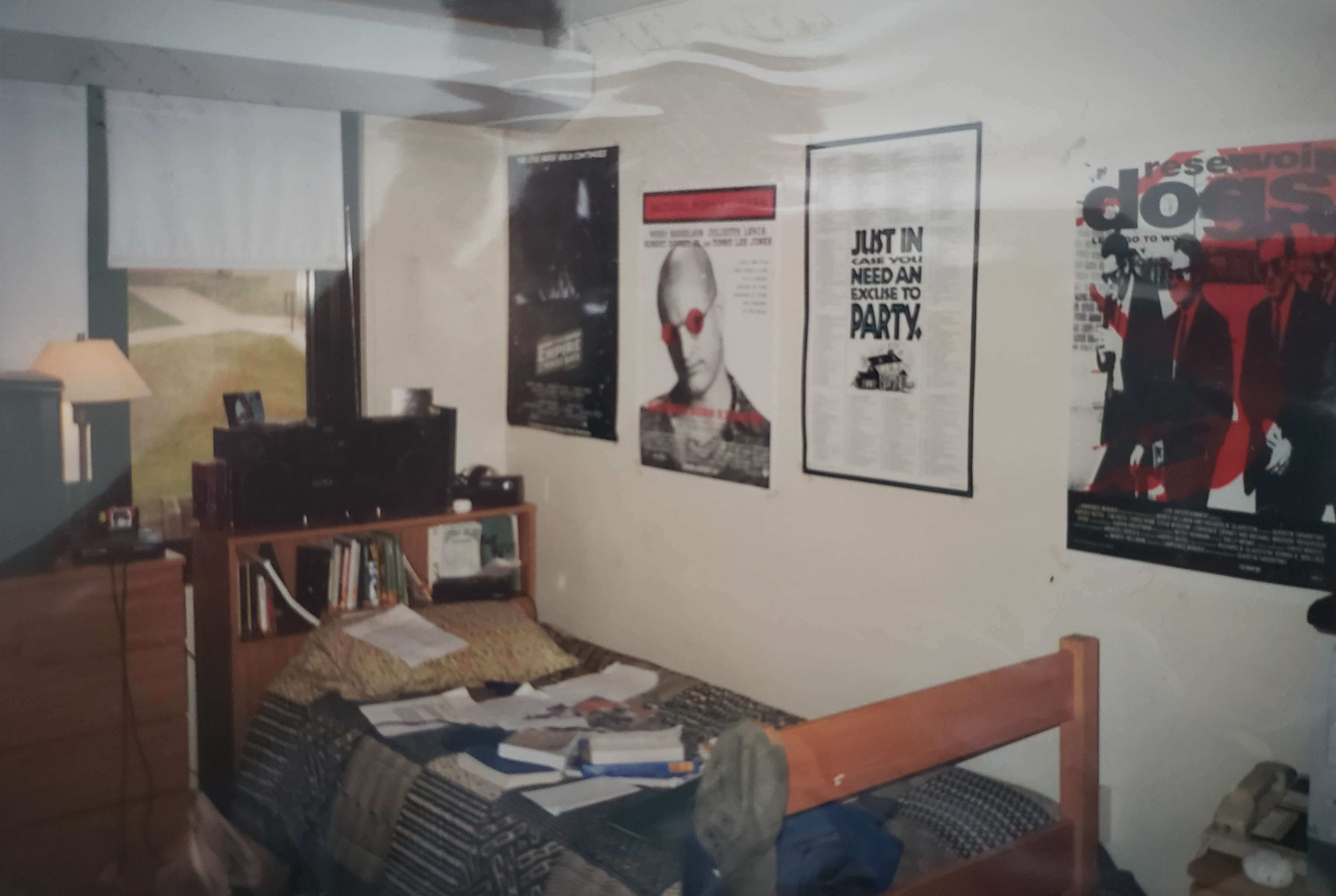 I mean, at least Rick had earth tones in 1991. I wouldn’t get earth tones until college, which you can see here in this shot of my dorm room circa September or October 1995. And I’m being completely honest when I say that this was the only comforter and sheet set that I could find at the store. I also can’t let this picture get posted without pointing out how it is, in itself, the epitome of the college experience in 1995. From the Sega Genesis on my roommate’s dresser to the ROLM phone under my Reservoir Dogs poster, there is so much I could talk about that it’s pretty much its own post*. But right now, I have to get back to Rick.