Author: Tom Panarese

Time’s Up (My Life as a Teen Titan, Part Twenty-Six)

When you have a comic book title that has a big mystery such as the identity of a major character and you finally reveal the answer to that mystery, you are then faced with an almost unbearable burden–following it up.  In some cases, it goes well and that reveal becomes another notch in the belt of a classic creative team.  Most of the time, however, it marks the beginning of the end.  Though it is not entirely the creative team’s fault, Team Titans definitely falls into the latter, as it only lasted four more issues after the revelation that Monarch was the mysterious team leader.

Now, from what I understand, Jeff Jensen and Phil Jiminez had taken on a flagging title and wound up being forced into a corner by DC editorial by way of Zero Hour: Crisis in Time, a “This Changes Everything” type of crossover that had a lead-up of a few months in some of DC’s titles, especially those that starred the Legion of Super-Heroes or had crazy continuity problems, such as Hawkman.  Team Titans joined that group of titles because since the book was on the chopping block, the teamers were going to be playing a part in Zero Hour and the story that runs from issue 21-23 winds up being a crossover lead-in with the series’ final issue being an actual Zero Hour crossover.

The story that was told, which set up the Teamers as unknowingly working for Monarch and that included character changes like increased aggression from characters like Kilowatt, a darker and more mysterious attitude from Prester Jon, and an actual physical transformation of Carrie Levine, a.k.a. Redwing as she morphed from a girl with wings into an actual man-bird beast renamed Warhawk.  But before we even were to get to that point, we had to sever the most important connection that the Team Titans had to its parent title, and that is Donna Troy. (more…)

The Summer of 4 ft. 2

Lisa practices acting like a teenager in "The Summer of 4 ft. 2."

When my yearbook staff puts the finishing touches on its last deadline, we have a few traditions.  First, we take the ladder–a poster-sized “map” of the yearbook–and pass it around the room, each staff member tearing it until it’s completely shredded.  Second, we have a pizza party.  Third, we watch the Simpsons episode “The Summer of 4 ft. 2.”

If you’re unfamiliar with the episode, I don’t blame you.  It originally aired on May 19, 1996 and along with the star-studded episode “Homerpalooza,” capped off season 7 of the series, which means that it was an episode from back when the show was not only good but amazing.  Flipping through my copy of The Simpsons: A Complete Guide to Our Favorite Family, I see that season 7 is incredibly strong: “Bart Sells His Soul,” “Radioactive Man,” “King-Size Homer,” “Team Homer,” and “Bart on the Road” are just five episodes in a year packed with gems, and I have to say that I have to consider myself lucky because this particular year (1995-1996) was when I first started watching The Simpsons on a regular basis.

You see, I actually wasn’t allowed to watch the show when it first premiered in 1990.  Not right off the bat, anyway.  I remember watching the first regular episode (not “Simpsons Roasting on an Open Fire” but “Bart the Genius”), but when the show took off and the merchandise started hitting the shelves, my mother didn’t think that the image of Bart Simpson holding a slingshot and proclaiming he was an “underachiever and proud of it” was a good image for her kids.  Therefore, me–the 13-year-old–and my sister–the 10-year-old–were forbidden from watching The Simpsons.

Now, let’s think about this for a minute.  I had spent the better part of my childhood watching festivals of violence–from Tom & Jerry cartoons to Commando.  I was also a straight-A student who never got into any trouble at school.  How a cartoon character that was about as harmful as Dennis the Menace was going to make me rebel in some way was completely beyond me.  So I was stuck watching The Cosby Show instead, at least until the beginning of season two when I was able to watch “Bart Gets an F” because it was about that underachiever trying to achieve; and then wound up catching most of that and the next season.  Then my viewing fell off as I became more involved in school and found myself spending most of my nights holed up in my room doing homework or listening to Rangers games on the radio. (more…)

Running Out of Time (My Life as a Teen Titan, Part Twenty-Five)

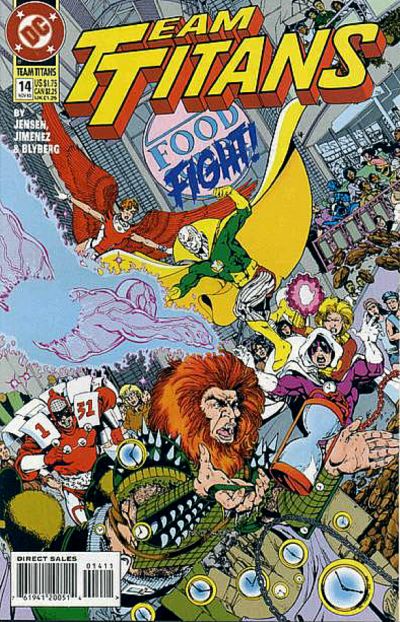
The cover to Team Titans #14 by Phil Jiminez

While I have no experience actually writing comic books, I think that taking over a failing title might have to be one of the hardest things that a creative team has to do, maybe even harder than following a very successful run because at least in the latter case, the book you’re coming into is selling well. In 1993, I was sixteen and didn’t know that Team Titans wasn’t selling well because out of the three Titans books that were being published at the time, it was the one I followed the most closely. As I said last time around, I was barely paying attention to Deathstroke; and New Titans, while definitely still an important comic book in my monthly reading pile, had artwork that was either so inconsistent or lackluster that I often found myself tuning out.

Team Titans, on the other hand, had two things going for it. First, there was an ongoing mystery as to the identity of the “leader,” the guy who sent the team back into the past to kill Donna Troy all the way back in New Titans Annual #7. Harris and I, who had been writing the New Titans editors since the first time we asked them to kill Donna Troy a couple of year earlier, were also writing to the letter column of this book, with our usual M.O., but also trying to figure out who this mysterious red-haired person was. It kept us on the lookout for clues all the way until issue #20 when it was revealed on the last page.

The other thing going for the book was the art. Phil Jiminez and then Terry Dodson are very well-known artists by now, but back then nobody had really heard of them. I had started to really enjoy Jiminez’s work when I first saw it in the Eclipso-related Titans annuals and the three-issue Red Star/Cyborg storyline written by Louise Simonson. It was reminiscient of George Perez, the famous New Teen Titans co-creator and artist who’d left the book for the second time a couple of years earlier; furthermore, it was so much the opposite of what New Titans was providing with Bill Jaaska that it was, by comparison, amazing.

Jiminez was also one of the writers on the title, co-writing with Jeff Jensen who is now a senior writer for Entertainment Weekly and recently wrote Green River Killer: A True Detective Story, a graphic novel about the search for the Green River Killer. Re-reading the last 13 issues of this title, it’s clear that they were cutting their teeth and while there are some missteps, I find this particular portion of Team Titans to be underrated, especially considering the problems they had as a creative team.

For starters, Marv Wolfman never really was happy writing the characters, or at least that’s how he has characterized his time on the Team Titans. in The Titans Companion, he says in an interview:

I always thought it was a stupid idea.  I didn’t like it; didn’t like working on the book.

Furthermore, the editors of the book, as Jiminez said in the Companion

…wanted was DC Comics’ X-Force.  They, DC management at the time, saw Team Titans as this answer to Rob Liefeld’s X-Force and what we wanted to do was something much more character-driven [and] self-aware, something more like Grant Morrison’s Doom Patrol.  So from literally the first issue, it was a struggle editorially to the point that the book just fell apart on us completely and a long-term story that we had planned got condensed into four issues.  Then Zero Hour came along and undermined everything anyway.

So you can see where they were kind of behind the eight ball when it came to writing the title, and in looking at their first storyline, you can see where it was obviously meant to be something bigger. (more…)

The man of action just keeps going (My Life as a Teen Titan, Part Twenty-Four)

One of the tougher things about covering the 1990s-era Titans books for this blog (if you can believe that is difficult at all) is not having to reread disappointing storylines like “Terminus” (especially considering if I extend my reading all the way through to the late 1990s The Titans title, I am going to be looking at some extremely poor stories), it’s that I find it tough to determine in what order to read these books.

With the Team Titans and New Titans titles, it was always easy to figure out where things were going, especially because they would cross over into one another here and there, at least through Team Titans‘ first year and as the DC Universe as a whole inched closer to Zero Hour, a crossover I found intriguing from the very first advertisement on the DC Universe coming attractions page.

But Deathstroke? It was a good action-adventure book but always kind of the odd man out in the Titansverse. Slade Wilson and his supporting cast kind of kept to their own until it was absolutely necessary for them to appear in the main Titans books, and since this was a book I was getting through the mail via DC’s subscription program, I really didn’t pay much attention to it. In fact, I’m pretty sure when I first got the issues between the “World Tour” and the post-Zero Hour “The Hunted” storyline, I skimmed the books, bagged and boarded them and really never gave them much thought.

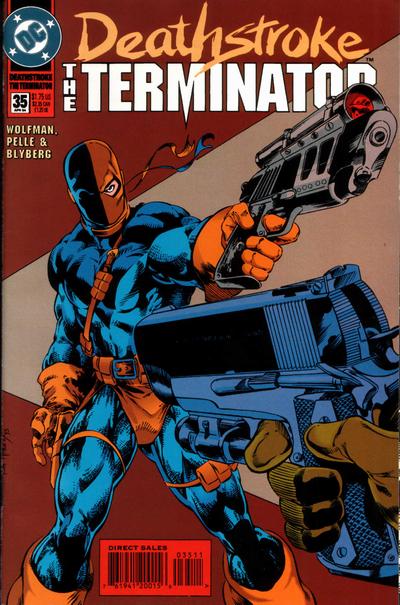
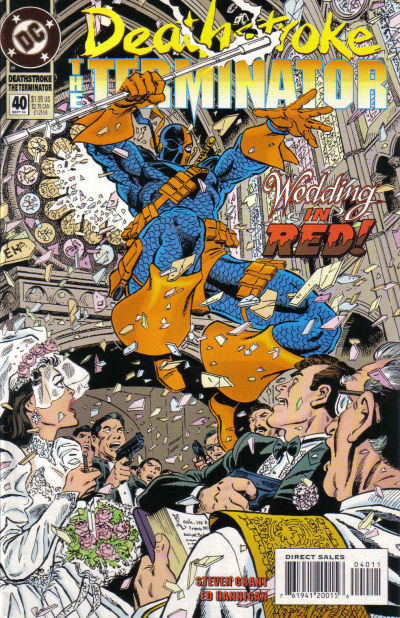
Rereading issues #35-40, you can kind of see why. They’re not terrible stories, but whereas the small group of stories between the end of the Cheshire storyline and the World Tour were decent adventure tales, these are serviceable at best. Over the course of these issues, there are several art teams and while there is a three-parter about Wintergreen fighting for the right to restore his family’s honor because his father was a Nazi sympathizer, it seems that Wolfman was asked to kind of plug along before giant editorial changes took place.

It is kind of odd, by the way, that Deathstroke did not have a Zero Hour crossover issue (and really neither did New Titans, although the issue that takes place around the same time as Zero Hour does at least put an ending to part of the Titans story). It would have been interesting to see a different version of Deathstroke pop up or maybe even one, if not both of his dead sons come back. Instead, there is the Wintergreen story, a team-up with Green Arrow, and Slade breaking up a mafia wedding. Wolfman does try to continue to build Slade’s character in some issues–in fact, issue #35 is basically a huge fight between slade and Wintergreen that winds up replaying the “No, go ahead! Kill yourself!” scene from Lethal Weapon. But even so, the “My family is dead because of me!” bit is starting to get tired.

I’m not trying to sound too negative here because it’s not like I didn’t enjoy Deathstroke’s title and it’s not like I didn’t like reading these stories, but I didn’t expect to have the same feelings I did nearly twenty years ago, which was these were the books I had to “get through” and that I was reading because they were associated with the Titans. In fact, it may have been a mistake to continually tie the title back to the Titans because Wolfman’s writing was pretty tight, and if this had been its own title that had its own continuity–something I think he was trying to do here but would be stopped with the next summer crossover–it would have worked a lot better.

Next Up: Back to the Team Titans and a look at that book’s change in creative team.

All You Have to Bring is Your Love of Everything

It’s been a mild winter, so skiing is the last thing on my mind (granted, I’ve only been skiing twice in my life, so it’s not on my mind very often), and based on what I have been seeing on the local news, it’s been the last thing on everyone’s mind because ski resorts are struggling.  In the same vein, I find myself wondering if any other vacation spots are struggling.  The economy isn’t exactly doing the best, and airfares are insane, so travel to anywhere for a period of time longer than a weekend seems to be costing a year’s tuition at Harvard.

Still, I keep seeing commercials for those ever-popular destinations for people who don’t find hitting the slopes and then curling up in a snowflake sweater appealing–the Caribbean.  Specifically, resorts like Sandals and Beaches.  My son loves the latest commercial for Beaches because Cookie Monster is in it (although I’m not sure that he realizes that Cookie Monster might not be at Virginia Beach when we go in July).  But the Sandals commercials always amuse me because they make a vacation to that resort seem like the most epic romantic time ever imagined.

That’s the best example of a couple frolicking outside on an apparatus that’s not in a Cialis commercial.  And actually, it’s kind of appropriate that the ad agency used “(I’ve Had) The Time of My Life” by Bill Medley and Jennifer Warrens (but not the version sung by Bill Medley and Jennifer Warrens) in the commercial because the movie it comes from is Dirty Dancing, which takes place at a resort in the Catskills and mentions several times the decline of such resorts as popular family destinations.  Indeed Sandals and Beaches have sort of become the new Catskills or Poconos and the commercials are the perfect evidence of that because that Sandals commercial is very much like a commercial from my youth:

Ah, beautiful Mount Airy Lodge, which was, by the time this commercial was airing in the late 1980s and early 1990s, a deteriorating shell of its former self.  What was once a popular getaway for couples in the 1960s and 1970s was by this time (at least according to Wikipedia) hemorrhaging money and wound up going into foreclosure in 1999 before being bought by Harrah’s and turned into a casino.  But this commercial aired before the great decline and if you were watching one of the syndicated channels in the New York metropolitan area (WPIX or WWOR) during the day, you wound up seeing the Mount Airy Lodge commercial at least a few times, enough that you knew the “All you have to bring is your love of everything” slogan by heart. (more…)

Terminus! (My Life as a Teen Titan, Part Twenty-Three)

The last panel that the late Eduard Barretto ever drew for the New Teen Titans was of Victor Stone kissing the woman who was now the love of his life, Sarah Charles, as they entered a new phase of their relationship at the end of New Teen Titans #49.  So I guess it’s wholly appropriate that by the time we finally got around to resolving the Cyborg storyline, it’s Sarah Charles who has been watching over him and trying to help restore his mind, even going so far as to head to Russia for him back in New Titans #94-96, which was one of the stronger post-Total Chaos stories that rightfully featured two of the Titans’ strongest members.

Unfortunately, the storyline that sends this particular strong member off is one of the weakest in the latter part of Marv Wolfman’s run, and one of the lowlights during the post-New Titans #100/pre-Zero Hour period (I’d call it the Bill Jaaska era, but most of the issues featured here actually aren’t drawn by Jaaska).  Entitled “Terminus: The Final Fate of Cyborg,” the story builds on what was established at the beginning of “The Darkening” with the apparent return of Rita Farr and villains that were not really villains but weird beings of light, and then goes bi-weekly for issues #104-107 in order to wrap everything up in a timely manner.

But the story really begins in New Titans #102, where Sarah Charles is trying to restore Vic and brings in the Team Titans’ ethereal computer guy, Prester Jon (my second-least-favorite Team Titan, something I’ll get more into next time) to try to interface with him, kind of in the same way that the Justice League used to use The Atom to go waaaayyyy down to somewhere small.  Meanwhile, Pantha digs deeper into whether or not Dayton Industries had something to do with her origin,  Dick and Kory are having their issues and Gar fights a monster called Sinn while he also fights against what seems to be indulging the fact that he can only seem to transform into monsters.  At the end of the issue, Sinn is revealed to be an agent of Raven, who is also manipulating Councilman Quirk, the replacement for Liz Alderman–which begs me to ask, if she was going to ruin the Titans’ public image all along, why remove Liz Alderman from the picture?

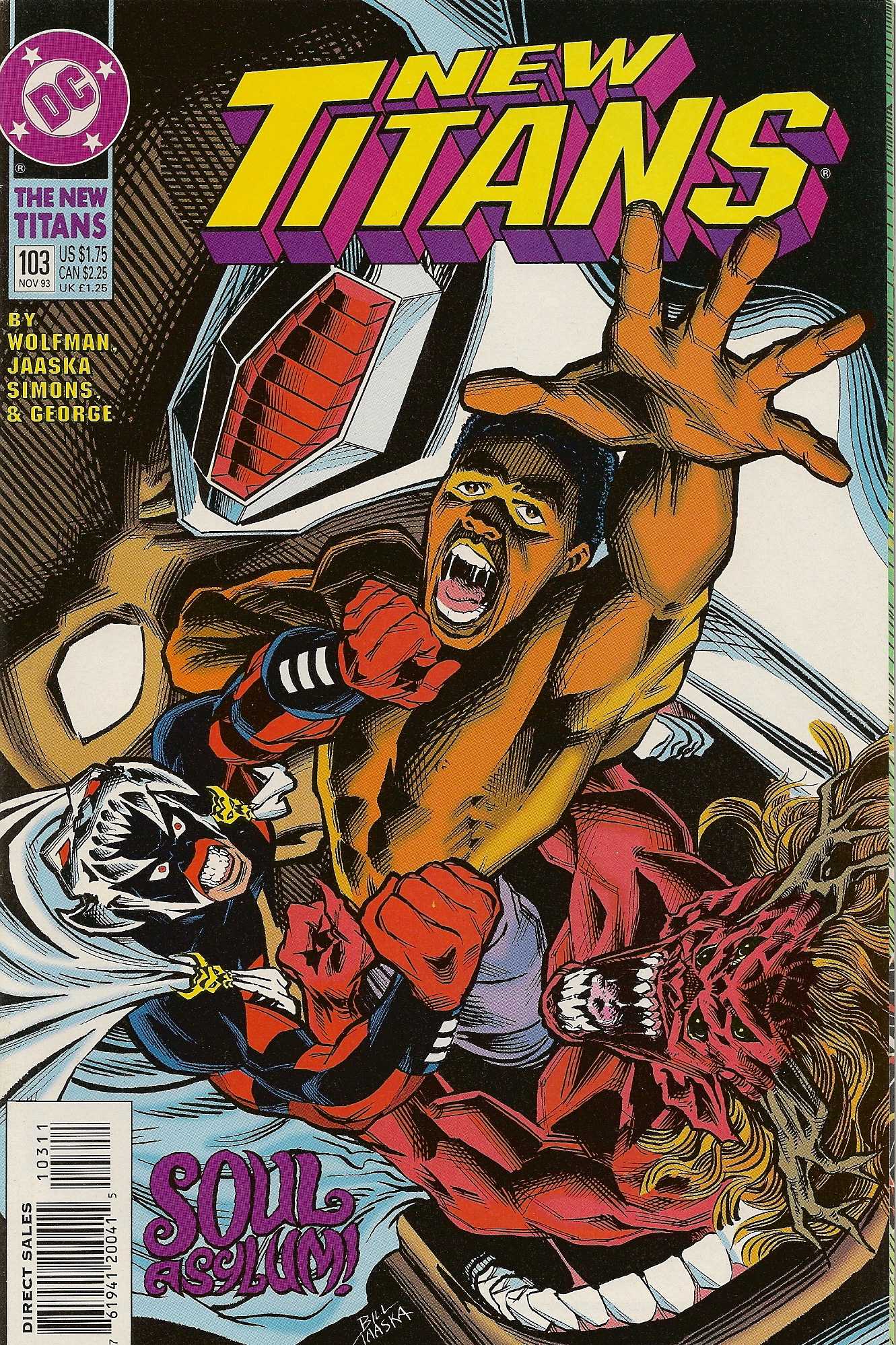
But we will leave Gar and Raven, as well as Dick and Kory for another month and turn our attention solely to Cyborg, as Prester Jon spends most of issue #103 inside Cyborg trying to find Vic Stone.  He runs into a fair bit of trouble, even getting attacked at one point while the fake Doom Patrol members from “The Darkening” show up and reveal themselves to be denizens of a planet called Technis and that they need Cyborg in order to survive.  The next issue box promises two issues per month and a “hot newcomer” named George Napolitano on pencils, which at the time was promising.  If you read the letters column from this time (when there was one), you’ll see that there were quite a number of readers who really loved Bill Jaaska’s pencils and DC was clearly making an effort to show all of us doubters out there that he was a good penciller.  The problem was that I couldn’t stand him and when I saw that someone else was taking on the art for a couple of months, I was actually excited and I think that Harris and I actually wrote a letter to the editor complimenting the art.

Re-reading it nearly two decades later, one of the biggest problems with Terminus is that the art completely takes away from what could have probably been a halfway decent story.  In fact, just as with many bad runs of art on any comic book, it becomes hard to “see” the story unless you take the time to read closely.  And the story itself is … well, it’ll seem familiar after a while. (more…)

Taking Off

A screen shot of the end of “Taking Off,” the two-parter surrounding Wheels’ grief over his parents’ deaths. Image courtesy of Degrassi Online.

I know that I wasn’t the only person surprised by the news that Neil Hope, who played Wheels on Degrassi Junior High and Degrassi High not only died, but died back in 2007 and this was just discovered now.  In fact, I probably would have never heard about it at all had I not “liked” his onetime co-star, Stacie Mistysyn, on Facebook and read a post of hers.

In light of this, I watched the Degrassi Junior High third-season two-parter, “Taking Off,” which while not the next episode I wanted to watch for the purpose of this blog (that would be “Food for Thought,” which I think I’m going to get to anyway even if it is out of order), is one of the more important points of that season because it continues two crucial stories–Wheels’ parents’ deaths, and Shane and Spike.  It also puts the spotlight clearly on Hope and his acting, as Wheels continues to struggle with his grief and does so not just by acting out but running away altogether.

We begin by finding out that Wheels has been skipping school and hanging out all day at the arcade; furthermore, he’s sold his bass guitar to get money to play video games like Konami’s Main Event, much to the chagrin of the rest of the Zit Remedy (especially Joey, who’s still in his Zack Morris “scheme to get us some airtime” phase … yunno, when he’s not flirting with Caitlin).  His grandmother is concerned and he is not just stand-offish to her, but downright hostile and wishes that he could be anywhere but home and school.  Then, the possibility presents itself when his birth father, Mike, sends him a postcard from a town called Port Hope, which is where his band has a standing gig for the next couple of weeks.

Meanwhile, most of the DJH crew is going to the Gourmet Scum concert that Saturday night (love the band’s name, btw), including Luke and Shane, who buy acid and then drop it before going inside.  What’ll happen is that Shane will disappear and the police will spend the better part of the two-parter looking for him, even asking Luke if the boy was under the influence (and paranoid Luke will lie his ass off).  He is eventually found underneath a bridge, having fallen off, and at the end of the second part is comatose, leaving Emma completely without a father (something that is explored in both Degrassi High and Degrassi: The Next Generation).

But that’s really a subplot and it’s Wheels who takes center stage as he hitchhikes through Ontario and at one point winds up getting picked up by a guy who seems okay at first–in fact, he kind of looks like Sam Waterson–and that guy tries to molest him.  But he makes it to Port Hope to see Mike, and his hopes for a happy reunion are dashed when Mike more or less wants very little to do with him (in fact, he’s got a pregnant fiancee) and his grandmother ultimately tracks him down. (more…)

Thanks, Kid.

I’m not a sportswriter; hell, I’m not even a sports blogger.  So sitting down to write anything about an athlete’s death on my part is probably more self-indulgent than anything, especially since I’m sure that come morning there will be at least a few columns on the same topic.  That being said, when my wife told me this afternoon that Gary Carter had passed after a battle with brain cancer, I felt the urge to say something.

As the catcher for the Mets when I began following them in 1985, Carter was one of their sluggers as well as an RBI leader and he became one of my favorite players. I probably, at one point, imitated his batting stance (which was one of those stances that didn’t suggest that he really had any power); I had a poster of him on the wall of my basement; and of course I had quite a number of his baseball cards.  I don’t know if he was a hero in the sense that I ever wanted to “be” like him–after all, nobody would have wanted as terrible a little leaguer as me to get behind the plate–but he was definitely someone I looked up to.

Gary Carter wins game 5 with an extra-inning hit. From the Daily News Scrapbook of the 1986 Mets Season

It seems like I made a good choice in that regard, too, because from what I’ve read over the years about Carter and his career, he had a love of the game of baseball and played that way but if you watch some of his highlights you can tell that he was a true competitor.  I’ll never forget the opening to those Mets games of the 1980s where you could see a highlight of him tagging out Ken Griffey, Sr. on Rusty Staub Day, or his reaction to finally breaking through in game 5 of the 1986 NLCS and getting what was probably the second-most clutch hit of his career (the first being the hit that started the Game Six rally).  It was, to put it simply, genuine joy. I mean, he took his fair share of curtain calls for home runs but I don’t remember the guy as a showboat, on or off the field.  I never had the fortune of meeting him, but a few friends of mine had personalized autographed pictures and I rarely, if ever, heard a bad word about what it was like to actually meet him.

I know that I’m writing this through the lens of childhood nostalgia, and I know that all he was was a baseball player and didn’t fight and die for our country and all of the other things that true heroes do.  But when I was seven years old, I was thinking about those things when I chose my role models.  He was a guy who was on my favorite team and got hits and hit home runs and I thought of him in the same way that people of the generations before me thought of Joe DiMaggio or Mickey Mantle, and even though other players are more famous for wearing number 8, and there have were better catchers before and since, I have to set those aside and tip my hat.


Superman and the Image problem

Recently, screenwriter Max Landis (Chronicle) posted a video to YouTube where he took down the 1992-1993 Death and Return of Superman storyline (it was his commentary accompanied by several famous friends playing roles).  It’s snarky, mean-spirited, and wildly inaccurate, and the best rebuttals have been from Michael Bailey and Jeffery Taylor, the guys behind a great podcast called From Crisis to Crisis: A Superman Podcast (their mission is to cover every Superman comic published between 1986 and 2006 and right now, they are covering this very storyline).

Nothing more needs to be said about Landis’ video, but it did remind me of another time Superman’s death was used as a springboard for commentary on the state of the comics industry.  What’s funny is that like Landis’ commentary it comes off more as a poor reflection of the commentator rather than the story.  You see, in the world of comics, there are great stories, great artists, and then there are those who just think they’re great.  Sometimes, they intersect in a way that at the moment seems important but looking back borders on the ridiculous.

Spawn #10 was written by Dave Sim as part of a four month-long string of issues that were written by notable guest writers (Alan Moore, Neil Gaiman, Sim, and Frank Miller) and penciled by series creator Todd McFarlane.  Moore, Gaiman, and Miller’s issues served to introduce new characters nad help build the Spawn mythos; Sim’s spot in issue #10 seems to serve the Image Comics mythos.  It’s a piece of meta-fiction about the nature of creativity that is a reinforcement of the attitude that McFarlane and his Image co-founders had when they left Marvel twenty years ago.

In the story, after the conclusion of the previous issue where Spawn touched the mystical staff of that issue’s villain, Angela (a move that “removed” him from the continuity long enough to tell issue #10’s story), he meets up with Sim’s Aardvark, Cerebus, who teaches the hero a lesson about creator-owned characters and the happiness that comes with being able to have the rights to what you make.  It even ends with “Spawn is trademark and copyright Todd McFarlane/Cerebus is trademark and copyright Dave Sim FOREVER” written in the same way it would be airbrushed onto a license plate Gina made for Tommy’s IROC.

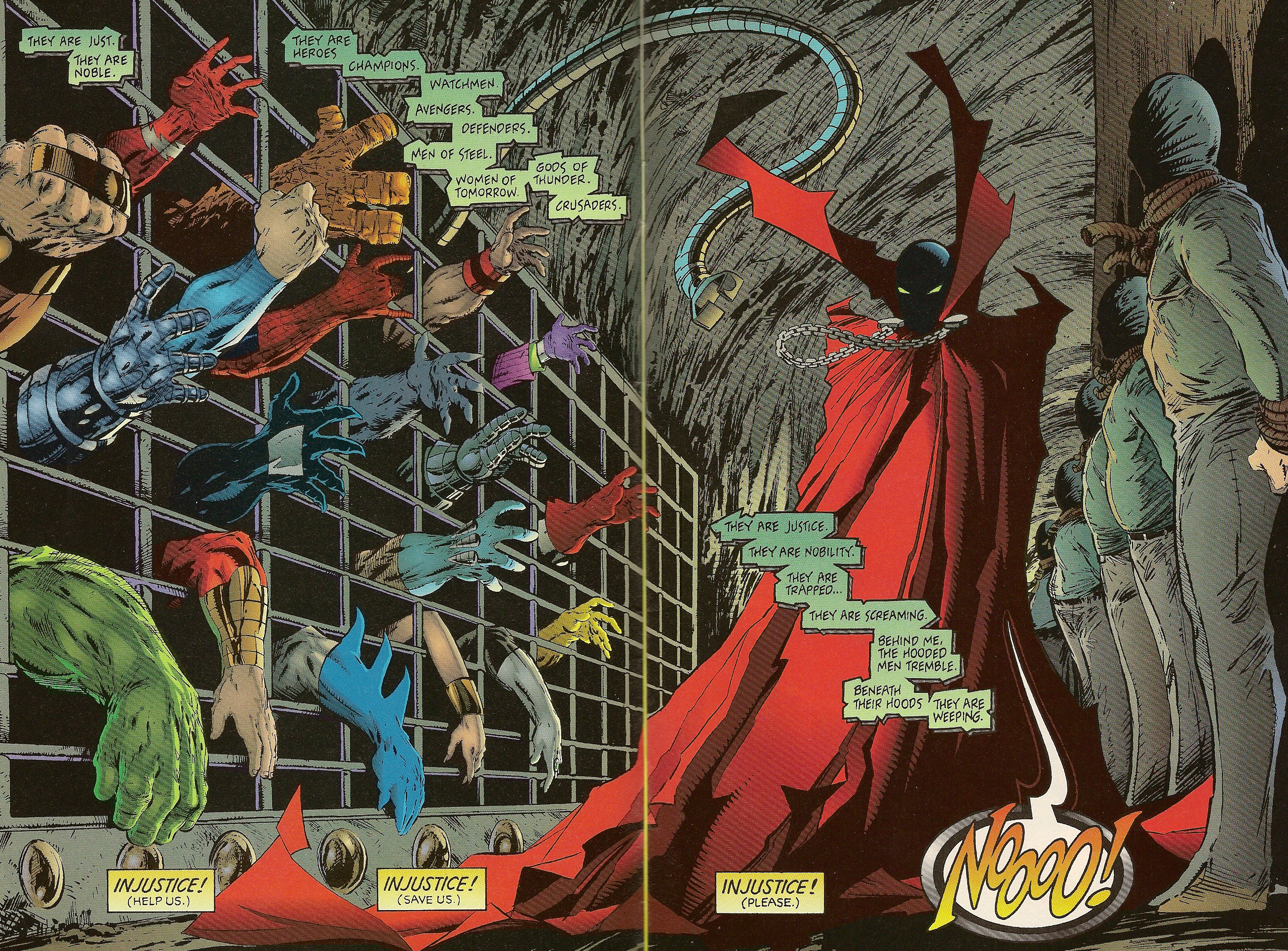
Pithy comments aside, the most important few pages in the story are in the beginning.  Spawn walks down a dungeon hall where men stand with hoods over their heads and their hands tied behind their backs while several costumed hands reach out for his help.  Many of the hands are identifiable (in fact, shortly after this issue came out, Wizard–never one to miss a chance to promote an Image comic–had a contest where they challenged you to name all of the characters displayed on that panel), and the hooded men with their hands behind their backs are obviously the creative teams of those various heroes’ books.  It is Sim and McFarlane’s comic book version of Plato’s Allegory of the Cave, although I think that the Greeks were a little more subtle.

The biggest point made in the whole sequence, however, comes not from the multitude of hero hands reaching out from inside their prison, but from a single hero who tells Spawn that he is the “original hero.”  In a two-page sequence, he offers Spawn his power because he claims that Spawn has the ability to free all of the prisoners.  Our protagonist takes it, and fires, but it is to no avail, as the villain (a version of Spawn’s archenemy The Violator wearing a dress made of money) claims he is too powerful and there will be no justice for those creators because even that “original hero” has succumbed to his will.  This is confirmed when the hero utters one word:  Doomsday. (more…)

Jewel-cased Memories

And this is only A-H of my CD collection.

One of the most practical gifts I received for Christmas was a CD book the size of a photo album.  It’s made out of faux leather and holds about 375 CDs, which is about half of my music collection.  I’m going to need another one at some point, but I was able to clean out half of the dresser that houses my CDs and I did something that I have never been able to do in nearly twenty years of owning compact discs: I threw away my jewel cases.

That sounds completely ridiculous because I am sure that there are plenty of people who were throwing jewel cases out the moment they bought their CDs a decade ago and didn’t feel the need to write about it.  Then again, I have that hoarder’s mentality where I hold on to some things because I feel like I am going to miss out on something, which is why I never threw out my jewel cases the first time I had one of these large CD books fourteen years ago, or during my twenties when I hauled box after box of CDs up and down flights of stairs during move after move.

So why pull the trigger now?  Well, as I was making my Christmas list, I realized that I had absolutely no CDs on it.  I certainly had been listening to a lot of music, but I couldn’t remember the last time I had purchased a new CD (which, after some thinking, I realized was The Gaslight Anthem’s American Slang), and the dresser where I keep the CDs was taking up so much space in my office that I wanted to get rid of it.  I began with the start of the alphabet, or ABBA Gold, and in a few hours found myself staring at a pile of empty jewel cases on the floor.

It didn’t seem right that they—along with the CD booklets—were so disposable.  If this were a record collection, I would have been carefully preserving the album sleeves and covers as much as the albums themselves.  But so many of the jewel cases were cracked and missing pieces that preservation wasn’t exactly going to be an issue.  And I don’t think that years from now, a guy on Antiques Roadshow will be telling me that my copy of Ride the Lightning would be worth more if the jewel case didn’t have a crack in it. (more…)