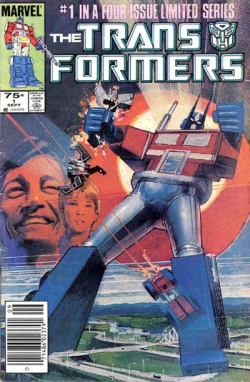
 According to Mike’s Amazing World of Marvel Comics, Transformers #1 hit the stands on May 29, 1984. This would have been around the time that I was finishing up the first grade, and while I can’t exactly recall everything I got for my seventh birthday, I’m pretty sure that in the very least by the time I hit the beginning of second grade, I owned at least one Transformer–and it was probably Huffer. I was still pretty much unaware of anything related to comic books or comic stores, aside from what I saw in my local stationary stores, so the idea of a Transformers comic book would have completely passed me by. In fact, I’m pretty sure that it passed by a number of people my age at that point, even if the toys and television show didn’t.
What I do know about acquiring it is that I got this at the same place I got a few comic books in those days of single-digit ages, a birthday party. At some point in the early 1980s, a parent or two figured out that if you had a dozen kids, mostly boys, at a birthday party and you had to give something away for a goody bag and didn’t want to ply them with candy, spending about $10 on a few Marvel three-packs was a great idea. And indeed it was. I walked away from a few birthday parties at the time with a comic book that I read cover to cover several times over, eventually rolling the spines or nearly completely taking the covers off until they eventually disappeared down whatever memory hole your childhood belongings eventually go. And while the strategy of putting a comic from a three-pack was nearly perfect (a not-so-perfect example will be the penultimate entry in this series of posts), I wasn’t thinking much about the quality of the comics I was getting in 1984. I was excited to get something better than a ball on a paddle.
Transformers #1 is, as the cover by Bill Sienkewitz tells us, #1 in a four-issue limited series. I used to love seeing the “… in a four-issue limited series” label on the top of a Marvel comic book in the same way that I loved the colored bar with “4 part mini series” or “12 part maxi series” running along the top of DC’s comics at the same time. To me, it seemed like there was something special about the comic that I was going to read–plus, it meant that convincing my parents that further comics needed to be purchased was a good idea because a limited series meant it had an end and therefore less of a commitment.
Then again, it’s not like I ever owned any other part of the original limited series that featured the Transformers. A friend at one point had a copy of issue #4 and let me read it, and I know that issue #3 was one of the more expensive back issues to get a few years later because the black-suited Spider-Man made an appearance (and I believe this has also caused some issue when it comes to the reprints of the series), but I wouldn’t pick up the adventures of my favorite metamorphing toys until the first issue of the ongoing series, which was #5. And while they will be a big part of the “Origin Story” podcast miniseries, the Transformers comics never had the impact on me the way that G.I. Joe eventually would.
The plot to the issue (which has no story title and was written by Bill Mantlo and Ralph Macchio with art by Frank Springer and Kim DeMulder) is everything you’d expect from a first issue of the era, especially one that is the first chapter of a miniseries–it’s mostly exposition and setup. We start out on Cybertron, learn the history behind the war between the Autobots and Decepticons, a war that lasted 1,000 years and whose devastation and power sent the planet hurtling off course and its path took it directly toward an asteroid field. Seeing the danger, Optimus Prime and his Autobots board a spaceship called The Ark and flee the planet. The Decepticons, who have been spying on their opponents, follow suit, attack The Ark, and Prime steers The Ark toward Earth. They land and are buried for millennia and eventually the ship’s computer wakes up to find themselves in 20th Century America. Not distinguishing between opponents, it equips them with the ability to transform into vehicles of that world.
The Decepticons flee the ark and we get a few pages of character identification and Prime summing up how they got their and restating what their mission is. Meanwhile, in Oregon, Buster and Spike Whitwicky work in their repair shop and Buster eventually comes across Bumblebee and some other Autobots who are doing some recon and exploring the world. Suddenly, the Decepticons attack and Buster manages to hop into Bumblebee and escape to the garage, where they first hear the car speak, “Help me, please! I’m dying!”
I suppose I never bought the next issue because by the time I got it, it was already a back issue and Transformers were on the rise, so the price would have been too much. I suppose I could have asked my parents to purchase the very three-pack that my copy of the book was taken from, but i was interested in getting them to buy me action figures. It would would take a couple of years for that to change.
Coming Next Month: Superman: The Secret Years
 We reach the conclusion to “The Death of Joe Hallen” with “Down So Long …” in The ‘Nam #58, a story written by Chuck Dixon with art by Wayne Vansant and Tony DeZuniga as well as a cover with metallic silver ink by Andy Kubert (it’s about as Nineties as The ‘Nam will get, kids … at least as far as the covers go). Also in this episode, I wrap up the historical context for the year 1969 with a look at December.
 It’s time for YET ANOTHER PLAYLIST EPISODE! Inspired by Andrew Leyland’s movie scores episode of “The Palace of Glittering Delights,” I’ve compiled a playlist of songs from movie soundtracks that are both classic and obscure but are in many ways spectacular. I’ve got Simon & Garfunkel, The Bee Gees, Queen, Irene Cara, and (of course) Kenny Loggins. So many movie memories! So many songs left off the list!
 Be a good citizen! Don’t do drugs! Understand the dangers of unprotected sex and fight the stigma of AIDS. These are all part of various DC Comics public service announcements over the company’s 80-year history. In this episode, I tackle citizenship by looking at a classic one-page Superboy PSA; fight the war on drugs by looking at not one, but all three New Teen Titans Drug Awareness giveaways; and I contribute to AIDS awareness by looking at one-page PSAs featuring the DCU’s best and brightest as well as the mini-comic Death Talks About Life.
 My look at 80 Years of DC Comics continues with a review of the fantasy genre of comics, one that spans much of the company’s publishing history. I start off in the 1950s with a classic Kanigher-Kubert Viking Prince tale from Brave and the Bold #3 and then fast-foward to the 1980s for the 16-page Amethyst: Princess of Gemworld preview story “Duel in Dark Magic,” which appeared in Legion of Superheroes #296. Finally, I tackle one of Neil Gaiman’s classic Sandman comics, where he gets some help from Charles Vess on art and William Shakespeare himself in “A Midsummer Night’s Dream” from Sandman #19. Plus … listener emails!
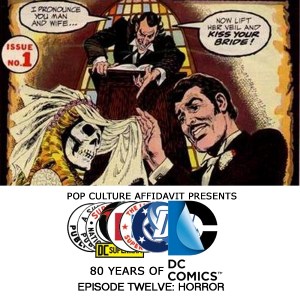 Just in time for Halloween, it’s a look at DC’s horror offerings! I take a look at some classic 1970s horror with stories from Ghosts and Forbidden Tales of Dark Mansion (a story by none other than Jack “King” Kirby himself) and after a very quick look at an issue of John Constantine: Hellblazer, finish up with the first story in American Vampire #1.
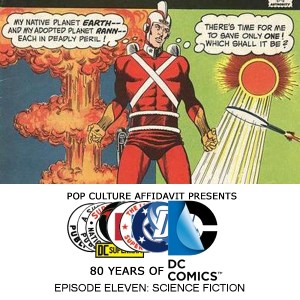 If there’s one genre that DC is known for as much as its superheroes, it’s science fiction. A staple of the company since it’s very early days, it has spawned thousands of stories, and in this episode I take a look at 80 years of DC Comics’ science fiction. What’s covered, you ask? Don Drake on the Planet Soro, Tommy Tomorrow in “Columbus of Space,” Adam Strange in “War on Earth and Rann,” a story called “Killing Time” from Mystery in Space, Hex #11, and the Warren Ellis/Colleen Doran graphic novel Orbiter. Plus, interludes from Real Fact Comics that show us all what a wonderful future the Golden Age had in store for us!
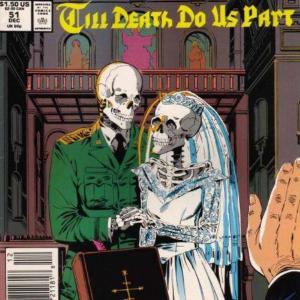 Our three-part chopper pilot and donut dolly romance story comes to an end as does Doug Murray’s run as the writer of The ‘Nam with issue #51, “Stone Age,” which has art by Herb Trimpel.
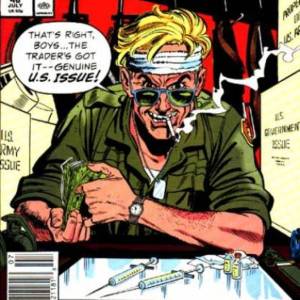 Chuck Dixon returns to fill in and give us a look at a group of Marines in late April 1970 with issue #46 of The ‘Nam. It’s a story that actually seeds something for later on down the line, although we’ll have a couple of other storylines before we get there. So check out “On the Clock” by Chuck Dixon, Wayne Vansant, and Tony DeZuniga. Plus, I’ll have historical context, which includes a musical selection by Crosby, Stills, Nash, & Young; as well as listener feedback, which includes some Iron Maiden!
 Pop Culture Affidavit