If the New Titans was, after issue #100, anywhere near the quality that Marv Wolfman, Tom Grummett, and Al Vey had been delivering when I started picking up the title with issue #71, I probably would have been felt that New Titans #113 was a monumental comic book. But Bill Jaaska was still on the artwork and the series had been limping along for the better part of a year, so I probably skimmed through the issue upon buying it and then set it aside so that I could dive into the latest chapter of KnightsEnd, Mark Waid’s run on Flash, or anything that was going to clue me into what Zero Hour was going to be about (especially since my beloved Team Titans were apparently agents of Monarch). As a result, it never registered with me that New Titans
#113 and #114 was the last time for a long time where Marv Wolfman would write Dick Grayson (he’d return to the character for guest spots on various Titans-related titles and have a run on Nightwing after Infinite Crisis, but after these two issues, Master Grayson was put in the capable hands of Chuck Dixon).
When you consider that Dick Grayson and Tim Drake were basically the reason that I started collecting comics for real in 1990, that’s actually kind of sad.
I bought comics for about a year–most of 1987, in fact–and since most of those comics were toy-based (G.I. Joe/Transformers), the wane in my reading and collecting coincided with the wane in my interest in toys. By the fall of 1987, my interests turned to more hardcore action/sci-fi movies like Aliens and Predator and my friends and I were tuning into the WWF twice a week when we weren’t playing Nintendo or playing baseball. With the exception of a random trip or two to the comic store, I didn’t really pick anything up until the summer of 1990 when friends of mine had started reading Batman comics on the regular. So after thumbing through a few issues, I picked up Detective Comics #617, the “middle chapter” of a three-part “Return of the Joker” story (that is a surreal story that isn’t vital to the other parts, which were in Batman #450 and #451 and is more or less a side dish).
But what made me stay was the next issue, Detective Comics #618. In that issue, Tim Drake’s parents are kidnapped and he starts what would be the penultimate story arc toward his finally putting on a new Robin costume in Batman #457. Concurrently, in New Titans #71, the Titans are kidnapped and Dick Grayson is among those looking for him and … well, if you’ve read the past 29 blog posts in this series, you know what I mean.
It took about four years (almost to the month–the Titans Hunt started the same month Batman #456 was published) for the team to finally be completely dismantled and the one character who was instrumental in getting and keeping the team together through his leadership to finally walk away for good. Now, if I’m being completely accurate here, Nightwing hadn’t really been leadning the team since issue #100 because of what had happened at his “wedding” to Kory. But during the year’s worth of Titans issues (and a few issues of Flash and some Bat-related books as well), there was always the underlying sense that when this was all over and Kory was saved and Raven was defeated, then Nightwing would return to leading the classic Titans lineup. Yes, they would have changed slightly–Cyborg’s new body and Donna Troy’s job as a Darkstar being great examples of this–but the classic New Teen Titans would be back.
This was not to be. New Titans #113 happens more or less simultaneously with the previous couple of issues, but instead of the satellite where the Titans are kissing Kory back to “normal,” Dick is in the jungles of South America on some sort of voyage of self-discovery where he canoes down rivers and hangs out with native tribes that have the kind of half-nude women you’d see in old issues of National Geographic. It’s the kind of plot device that has you sort of shaking your head and going “really, Marv?” but also makes total sense. After all, Dick is the “son” of a very wealthy person and needs to do something to cast that aside instead of trying to prove that he is/isn’t/is better than/is over his relationship with his “father,” which is what he’s been doing since he put on the Nightwing costume … at least in the post-Crisis.
And I guess we should talk about that, right?
The storyline that is arguably the most famous in New Teen Titans history is 1984’s “The Judas Contract.” It’s a four-part story that is the culmination of not one but two years’ worth of comics that began with the introduction of the character Terra in New Teen Titans #26. Actually, let me walk that back slightly–it’s technically the culmination of something that had been going on since the end of New Teen Titans #2 in 1980. In that issue, Grant Wilson gets superhuman abilities from the H.I.V.E., who stole them from Deathstroke, and then takes on the name of The Ravager and a mission to kill the Teen Titans. However, his powers overload his physiology and he winds up dying, leaving Deathstroke to take on that contract.
Slade Wilson appears one more time after that, in issue #10, where he tries to nuke the Titans and kills Changeling (who is brought back to life on Paradise Island in the following issues) and more or less lays low until issue #34, where Terra, having become a newly inducted member of the team, is key to his defeat. We then learn that said defeat was a setup to get the Titans to trust her some more–after all, she’s working with Deathstroke to uncover their secrets. The result is “The Judas Contract,” where Deathstroke and Terra play their endgame, capturing all of the Titans and giving them to the H.I.V.E.
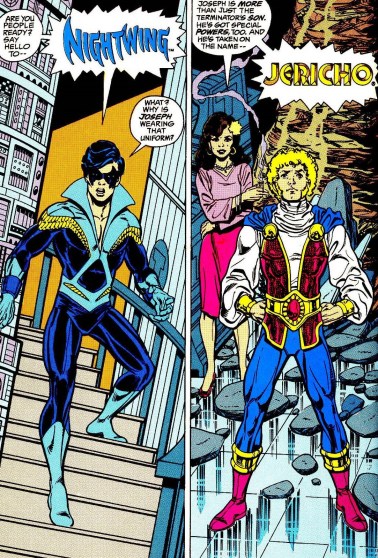
Dick Grayson makes his official debut as Nightwing in Tales of the Teen Titans #44.
“The Judas Contract” is amazing for its being a four-part finale where the payoff for years of buildup was satisfying (although full disclosure–I didn’t read these issues as they come out, so I’m only speaking from my experience of doing several read-throughs) but also because it was a game-changer for DC. In Tales of the Teen Titans #44 (the title switched names in order to make way for the direct market-only “Baxter series” that would hit the shelves about a month after “The Judas Contract” finished), Dick Grayson puts on a new costume and says, “Are you people ready? Say hello to NIGHTWING!” At the same time, over in Batman, a kid named Jason Todd was putting on the Robin costume for the first time.
When you think about it, this was huge. Dick Grayson had been Robin since his debut in Detective Comics #38 in 1940 and up until the late 1960s, he had been Batman’s trusty sidekick, a “Boy Wonder” in every sense of the word. When the Dark Knight was reinvented for the Silver and Bronze Ages, Mr. Grayson was aged and sent off to college–no longer a boy, he was the teen wonder and would be so through much of the 1970s.
When DC Comics Presents #26 and The New Teen Titans #1 rolled around in 1980, not only was Dick Grayson a teen wonder, he was showing signs of having outgrown his pixie boots and short pants. He dropped out of college and had moved back into Wayne Manor and that had begun to cause tension between him and Batman. This tension grew throughout the New Teen Titans series, especially in late 1983 when Jason Todd was introduced to the Batman titles and was being groomed to be the second Robin. When the Titans teamed up with Batman and the Outsiders in New Teen Titans #37 and Batman and the Outsiders #5, the tension was so high that the Dynamic Duo openly argued with one another. Two issues later, Dick announced that he was giving up being Robin and after a two-part Brother Blood story and Deathstroke failing to capture him in part two of “The Judas Contract,” Dick became Nightwing and teamed up with Slade’s other son, Joseph, aka Jericho, to stop Deathstroke, Terra, and The H.I.V.E.

The poster version of the covers to The New Teen Titans #37 and Batman and the Outsiders #5, which was done by George Perez and Jim Aparo, two of the all-time DC greats.
Which they do. Jericho jumps into Deathstroke’s body and frees the Titans from whatever the H.I.V.E. was holding them in (it’s one of those Rube Goldberg devices that drains powers and kills heroes that villains were into back in the Bronze Age) and a huge melee breaks out between the Titans, the H.I.V.E., Deathstroke, and Terra, with Terra finally snapping and trying to kill everyone but doing herself in. It’s a tragic ending and a pyhrric victory that only gets more painful in Tales of the Teen Titans #55 when Changeling drags Slade Wilson out of court to get him into a confrontation so he can murder him but then has a cup of coffee and a nice long talk. No, that’s really what happens and it’s actually a well-scripted issue because it gives those two characters depth in a way that few writers ever could (on a side note, Peter David will outdo Wolfman in the early 1990s with X-Factor #87, a stand-alone “therapy” issue that is still one of the all-time greats).
From here, Nighwing goes on to lead the Titans and while his relationship with Kory has some bumps, he gets closure with Batman and really is his own man. Until the Crisis and then Max Alan Collins come along.
If there’s one Titan whose entire story was monumentally screwed up by the events of Crisis on Infinite Earths, it’s Donna Troy. Second to her is Dick Grayson. If you look at any of the other founding members of the team–Raven, Starfire, Cyborg, Kid Flash, Changeling–the Crisis comes and goes and they’re more or less fine. However, Donna’s history gets messy as a result (and I covered that in past entries in this series) and so does Dick’s because of the way the Batman books changed Jason Todd.
The pre-Crisis Jason Todd was more or less a Dick Grayson clone. Yes, there were differences is his story and Dick’s, but the kid was a circus kid whose parents were killed and who eventually became Robin. It fit what DC was going for at the time, which was to get the image of a classic Dynamic Duo back into the forefront. After the Crisis, Max Alan Collins took over the writing on Batman while Mike W. Barr did a woefully underrated run on Detective Comics (a run that–and I realize it’s sacreligious to say this–feels more Batman than Frank Miller’s Batman). While Jason appeared alongside Bruce in ‘Tec, Collins spent a few issues reinventing and retconning the character, which also completely redid the relationship between Bruce and Dick. Batman #408 is titled, “Did Robin Die Tonight?” and in that story, Dick (as Robin in his only post-Crisis Robin appearance at this point) is shot by The Joker. Batman, saying that Dick made a stupid mistake and let himself get shot, fires his partner. An issue later, he catches Jason Todd trying to steal the tires off of the Batmobile. Missing his partner and thinking that this kid has serious spunk, Batman takes him under his wing as a new Robin.
This version of Jason Todd was met with derision from a number of fans, especially after Batman #423, when he kinda sorta kills a drug dealer by not helping him when he falls off an apartment balcony. This Jason was a smart ass, a punk, and not the type of kid you thought deserved to be Robin, no matter how much Batman thought he needed saving one way or the other. So the fans voted to kill him in the infamous “A Death in the Family” storyline, something that would reverberate and have consequences all the way up until and through the day I picked up that copy of Detective Comics #618.
Which is to say, it was all prologue, and all things I hunted down either in trade or in back issues so that I could read what I felt was the “full story of Nightwing.” And if you want, you can create your own “Marv Wolfman’s Nightwing” (with some other writers thrown in at times) by reading the following books (and a quick note here–I limited this to stuff published between 1940 and 1994-95, so some storylines that came later, such as Chuck Dixon’s Robin Year One, Batgirl Year One, and Nightwing Year One are not here, although they do add some great stuff to the Nightwing mythos) …
Detective Comics #38: Not 100% necessary because in the post-Crisis DCU, Wolfman will tell this story in Batman: Year 3, but this is the introduction and origin of Robin and even if you’re reading the character in a modern context, I think it’s important to go back and look at where he started. Furthermore, I think it’s important to see how dark his origin was–the death of his parents and subsequent tracking down of his parents’ killers are gritty and real to the point where they hold up better than any other version of this that I’ve seen.
The Brave and the Bold #54, Teen Titans (1964 series) #14, Batman #312, Teen Titans (1964 series) #53: While I’m sure there are other essential stories from the original “Teen Titans” run as well as Robin stuff in the Silver and Bronze Ages, these four comics are a quick look at the evolution of Dick Grayson from “Boy” to “Teen Wonder.” B&TB #54 is the very first Teen Titans adventure (although it happens sans Wonder Girl) and if you can pick out any crucial Teen Titans issue regarding Robin, it’s issue #14 with its famous Nick Cardy “Quit, Robin, Quit!” cover. Self-doubt would become a running theme for Dick and we even see some of it in Batman #312, where he leaves Wayne Manor for Hudson University (and Bruce subsequently moves out of the Manor and into the Wayne Foundation building, which is where he would be for much of the 1970s). Teen Titans #53 is the last issue of that series and serves as a retcon of the original meeting of the team as well as a reference point for where Wolfman will pick things up a few months later. If you want to dive deeper into this, I’d also recommend picking up the Steve Engelhart-written/Marshall Rogers-pencilled issues of Detective Comics that were collected into the “Strange Apparitions” trade paperback a number of years ago.
DC Comics Presents #26, New Teen Titans (1980 series) #1, 2, 10: While #10 has little to do with the Batman and Robin angst going on, it helps to read it so that you can see a solid Deathstroke appearance before you get into the meat of the goings on with “The Judas Contract” and you can understand why there’s such animosity between Slade and Gar Logan. The DCCP issue is the first appearance of this new team and issues #1 and 2 do show some of the tension that’s been building up between Bruce and Dick–when Dick heads out to meet Donna at the beginning of issue #1, he thinks about how Bruce has been upset with him as of late because he dropped out of college. Issue #2, which is Deathstroke’s first appearance, plants the seeds for what we’ll see later.
New Teen Titans (1980 series) #26-27; Justice League Quarterly #17; New Teen Titans (1980 series) #28-34, Annual 2; : The Titans return home from an epic adventure on Tamaran, Dick and Kory begin their relationship, and we are introduced to Terra. The last few issues of this run reveal that Terra has been working with Deathstroke and also introduce Adrian Chase as The Vigilante. It’s this case that has Robin begin to seriously rethink his role as Batman’s partner, and while he does not go down the route of killing perps like The Vigilante does, he sees that perhaps he needs to be more hard-edged. Terra, it should be noted, does not immediately go on the attack. It will take another year for her and Deathstroke to make their move. The Justice League Quarterly issue is not vital–it just happens to have a follow-up to the “Runaways” storyline from #26-27 that I have always absolutely loved.
New Teen Titans (1980 series) #37; Batman and the Outsiders #5; New Teen Titans (1980 series) 38; Batman #408; New Teen Titans (1980 series) #39; Batman #409, 410, 411; Tales of the Teen Titans #40-44, Annual 3, 53-55; Annual 3: “The Judas Contract” and its aftermath, with the origin of the post-Crisis Jason Todd weaved in. It’s not the smoothest thing, but if you read the Titans-Outsiders team-up followed by “Who is Donna Troy?” and then “Did Robin Die Tonight?” you can head into the “Robin Quits” issue of New Teen Titans (with the iconic “Dick and Wally Walk Away” cover) before reading the introduction of the new Jason as going on parallel to the events of the Brother Blood storyline and “The Judas Contract.” Again, the three issues of Tales of the Teen Titans that come out after the annual are not Nightwing stories but they give Changeling and Deathstroke closure (to the point where with the exception of a cameo or two, Slade doesn’t appear in a Titans book until 1988/1989).
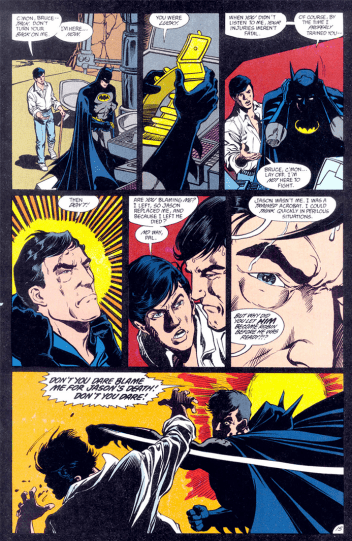
New Teen Titans (1984 series) #19, 20, 21; Teen Titans Spotlight #14; Batman #416: The three issues of the baxter series are more vital to the long-running Tamaran and Brother Blood storylines (and I mean loooooong ruuuunnnning) than anything, but there’s more of Wolfman giving Dick serious doubts. Teen Titans Spotlight #14 is a great Batman/Nightwing team-up and goes well with the first post-Crisis meeting between Dick and Jason in Batman #416, which is still one of my favorite Jim Starlin Batman issues.
Batman #426-429; New Titans #52, 55: The Batman issues are “A Death in the Family,” where The Joker kills Jason Todd. The Titans issues are part of the “Who is Wonder Girl?” storyline and you need to read just a few panels of #52 (Danny Chase searches for Jason Todd on the CBI databases and can’t find him, leading him to think he’s dead) and a few pages of #55 (Danny smart-mouths his reaction to Jason’s death, Dick goes off on him and then heads to the Batcave to confront Bruce. After Bruce decks him, Dick realizes that Danny is a pain in the … I mean, too young for this … and fires him from the Titans).
Secret Origins Annual #3; Batman #436-439; New Titans #57-59: The Secret Origins annual tells the history of the Teen Titans all the way up until this point through the perspective of Dick Grayson being haunted in his nightmares by an old enemy. The main thing to read here is Batman: Year 3, which is in those four Batman issues. Marv Wolfman and Pat Broderick deliver a post-Crisis version of Dick Grayson’s origin as well as have him work out some of his present-day issues with Bruce. It’s actually unique to the “Year” storylines as it doesn’t happen entirely in flashback the way Year One and Year Two do. The Titans issues are a side dish–a few pages in each update us on the team’s concern for their leader as well as help set up the next storyline.
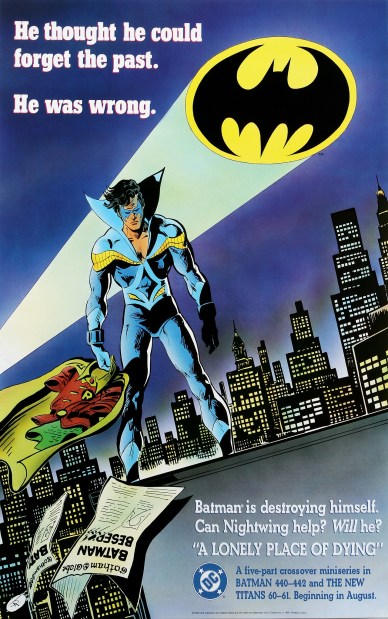
A DC house ad for “A Lonely Place of Dying.” Art by Jim Aparo.
Batman #440-442, New Titans #60, 61, 65: “A Lonely Place of Dying.” Batman is starting to run amok. Two-Face has grand plans. And Tim Drake tracks down Dick Grayson, revealing that he knows who he is and he knows that Batman not only needs help, he needs Robin. It is a sequel to “A Death in the Family” that has Tim putting on the Robin costume for the first time, at least momentarily, and starts him on his road to being the next Boy Wonder, which wouldn’t officially happen for another 15 issues. The story in New Titans #65 is one where Tim visits Dick in New York and learns some things about what it means to be Batman’s partner as well as a detective. It serves as an outstanding epilogue to “A Lonely Place of Dying” and makes me appreciate the time that Wolfman, Alan Grant, and Denny O’Neil would put into developing Tim Drake’s character before he actually became Robin.
A couple of notes here: “Year 3” was wiped out of continuity post-Zero Hour when Robin’s origin was retold in Robin Annual #4 and then later on in Robin: Year One. However, “A Lonely Place of Dying” stayed in continuity for years afterward, even being packaged in a new “A Death in the Family” trade. It’s also at this point where you can follow Tim Drake’s road to becoming Robin in Detective Comics #618-621, Batman #455-457, and the first three Robin miniseries before he gets his own book. Nightwing’s story continues in New Titans #71, which was the first post in this blog series. After reaching New Titans #113, you would read #114 and then head to Robin #0 followed by the “Prodigal” storyline, which is about Dick temporarily serving as Batman. At the end of that story, he heads off into his own miniseries and eventually into the Chuck Dixon-penned title of the late 1990s.
But I won’t be going too far into those. Instead, I’ll be sticking with the Titans themselves and talking about their disillusion and reformation.
Next Up: The Titans fall apart while Zero Hour rages on.